


Likes
Comments
Share


Likes
47
Share


@Master_weeda
Follow
Bonjour à tous les padawans et maîtres jedis
Un monstre! Il y a des bourgeons partout et ils sont énormes
Magnifique de toute beauté elle sent bon avec des trichomes qui commencent à être très laiteux ce qui annonce une belle récolte
Je me languis de la goûter
Peace

Likes
5
Share


@kingmcdaid
Follow
Welcome everybody to week 2 of white widow X big bud from female seeds. So far so good it's looking healthy and growth is beginning to pick up speed. I did try to germinate two of these but only one popped. I'm not sure if the seed was inviable from the start or if it was something else. But lucky for the community we still have a representative for this promising strain. I gave her her first round of worm tea and have steadily been pushing the light intensity. I also rough up the main stem regularly to increasing it's strength. She has began to increase growth rate and I looking forward to it's continued progress. Thanks for checking in on my grow if you like female seeds genetics or the specific strain ww x bb or if your interested in organic/ living soil growing. Hit the follow button and let's watch her grow together!

Likes
76
Share


@Nugs_are_us
Follow
Hey all welcome to week 7 of flower!!
The lady’s are slowly gaining some thickness of there buds and just going along quiet nicely. A tad smaller buds than I had hope for but that’s just life ain’t it.
We have had a quick look through the scope and think they will run for about her 2 weeks so they may fatten up a little more.
Until next week happy growing 🤙🏻

Likes
6
Share


@Muravushka
Follow
During my previous grow, I harvested and made some bubble hash. Afterward, I dropped the used, wet buds onto this coco, and it seems some seeds sprouted from the leftover material. I’m not even sure if they’re photoperiod or autoflower, but hey—let's roll with it!
Both my pH meter and PPM meter are broken. I have no idea why they keep breaking so often. They’re ADWA meters, and while you can replace the reading elements, the replacements cost half the price of a new meter. It’s frustrating, and I really don’t want to keep buying them every time I start a new grow
Likes
17
Share


@jamjam887766
Follow
First ever harvest! Plant #2 has been covered in trichomes for the last two weeks and with a jeweler's magnifying glass and my camera phone zooming 7x it's clear that many of trichomes have turned amber. I chopped her down last night and have been hanging the branches upside down in a cardboard box with a fan and dehumidifier. I've read I should keep the temperature in the 70s F and the humidity around 50%. I'm doing my best but the garage isn't well insulated so I'm at the mercy of the weather. I'll keep an eye on them and when the branches snap easily I'll get them in jars for curing.
Plant #1 still has some time to go. The branches are filling out but to the naked eye there are no trichomes. When I look with the magnifying glass I can see them but I'm concerned that #2 had been coated in them for about two weeks now. Should I just wait? I think I'll just wait
Likes
31
Share


@The_Bearded_Grower
Follow
Day 39 11/06/20 ok so she is doing very good and the color is amazing. i cant wait till she gets bigger and boy she is thirsty i have to 5 from 1 gal to 5 L. i have lots of info in the vids for your viewing. happy growing and keep your stick on the ice

Likes
30
Share


@eurorack
Follow
A good week's growth, they are drinking more and I've started to feed, and I think they enjoyed the nutes as they clearly stretched over this last 24 hours.

Likes
9
Share


@SmallGrowz
Follow
70 gramms trimmed buds.
I think we would have achieved 1 gram per watt if the third plant hadn't been hermaphroditic/ a male.


Likes
1
Share


@MJ_LIVINGSOIL
Follow
this week i topdressing with Fish bone meal 4-16-0 100g per plant and 4-9-4 100g 3-7-4 50g per plant
Avg. 250gram of craft organic fertilizer for plant
4-16-0 = 100g = 400-1600-0
4-9-4 = 100g = 400-900-400
3-7-4 = 50g = 150-350-200
950-2850-600 /100 = 9.5-28.5-6.0 g every 250g from fish bone and craft
So plant avg. got npk 9.5-28.5-6.0 per 1 plant from Topdressing
In next week we plan to take little N and more than K
Good phenotype it look like Berries Candy and syrup sugar

Likes
6
Share


@DogDoctorOfficial
Follow
💙 Project Blue Tent – Week 7
Blue Waffle F1 – Pheno B (Folder 13B)
Hello everyone, and welcome back to another chapter of Project Blue Tent! 💙🌱
If you're joining us for the first time, welcome aboard.
Project Blue Tent follows four individual Blue Waffle F1 plants from Zamnesia, each documented separately from seed all the way through harvest.
All four sisters share the same environment, lighting, nutrition, irrigation and training techniques.
The idea is simple:
Keep the environment as consistent as possible and let the genetics tell the story.
And despite all those similarities, each plant still manages to develop her own little personality.
Today we're checking in with Blue Waffle F1 – Plant B.
And if you've been following her journey...
You might remember that this is the girl who had a rather unexpected visitor last week. 🐛
Don't worry.
She's absolutely fine.
In fact, judging by the way she's growing...
She seems to have completely forgotten it ever happened.
────────────────────────
🌿 Week Seven – The Canopy Is Ready
This week feels like the end of one chapter and the beginning of another.
For several weeks we've been building the canopy.
Topping.
Training.
Guiding branches.
Installing the SCROG.
Tucking shoots underneath the net.
Slowly filling every available space.
And now...
We've done it.
The canopy is essentially where I want it.
Plant B is sitting at approximately 60 cm, just like her sisters, with the SCROG keeping the plants at a remarkably even height.
Looking from above, it's becoming increasingly difficult to distinguish one phenotype from another.
That's actually one of the most fascinating things about this project.
Four individual plants.
Four individual diaries.
And yet, under identical conditions, they're producing an incredibly uniform overall canopy.
Plant B has once again filled her section beautifully.
She's healthy, vigorous and absolutely covered in potential flowering sites.
So now it's time for the final preparation before we flip.
────────────────────────
🕸️ The SCROG Mission – Completed
The SCROG has been one of the most important pieces of the puzzle during this vegetative cycle.
Instead of allowing the plants to develop a few dominant vertical tops, we've spent weeks encouraging the branches to grow horizontally across the screen.
Every time a shoot tried to escape upward, we'd gently guide it underneath the net and into the next available square.
Slowly...
The empty spaces disappeared.
And eventually, the screen became one continuous canopy.
That's exactly what we wanted.
The purpose isn't simply to keep the plants at 60 cm.
It's to distribute the growing tips across the available light and create a more uniform structure for flowering.
And Plant B has handled the entire process beautifully.
Now that the screen is full, however, our priorities are changing.
We're no longer trying to add more foliage.
We're preparing the foliage we already have.
────────────────────────
✂️ Defoliation – The Final Vegetative Cleanup
This week's main event is defoliation.
And this is an important distinction:
Defoliation isn't about removing leaves because they look ugly.
It's not about trying to make the plant look "clean."
And it's certainly not about stripping every leaf from the plant.
Leaves are the plant's solar panels.
They're valuable.
So the objective is selective removal, not destruction.
After several weeks of vigorous vegetative growth and SCROG training, the interior of the canopy has become extremely dense.
There are leaves overlapping one another.
Branches crossing through crowded areas.
And sections of the plant where airflow and light penetration can be improved simply by removing some unnecessary foliage.
That's what we're addressing now.
We're opening the plant.
Creating breathing room.
Improving visibility.
And preparing the structure for the much denser environment that flowering will bring.
────────────────────────
🌬️ Why Do This Before Flower?
This timing is very deliberate.
Defoliation is a form of stress.
Even when performed correctly, removing a substantial amount of foliage temporarily forces the plant to adjust to a new balance between its leaves, roots and active growing points.
So I want that recovery to happen before flowering begins.
We're still running an 18/6 vegetative schedule.
The plants are actively growing.
They have time to recover.
And we're not simultaneously asking them to transition into a completely different developmental phase.
Once flowering begins, I want the plant's attention moving toward flower development rather than recovering from major structural work.
So we're following a very simple sequence:
Build the canopy.
Fill the screen.
Defoliate.
Recover.
Flip.
One step at a time.
────────────────────────
🧠 What Defoliation Actually Achieves
There's a common misconception that removing leaves automatically means more light equals more growth.
It's not quite that simple.
The reason we're doing this is to improve the overall efficiency of the canopy.
We're trying to create a better relationship between:
🌱 Growing sites
💡 Light penetration
🌬️ Air movement
🍃 Leaf density
? Plant structure
The upper canopy is already receiving plenty of light.
What concerns me more is what happens underneath it.
A dense interior can become a maze of overlapping leaves and branches.
By selectively removing some of that congestion now, we're creating a more open structure before the flowers begin developing.
And that's particularly valuable inside a compact tent where four vigorous plants are sharing the same space.
────────────────────────
🌿 Plant B – The Girl Who Bounced Back
And then there's Plant B.
The survivor of the infamous caterpillar incident. 😂🐛
Last week she had a tiny visitor arrive from the outside vegetable garden and apparently decided that one of her leaves would make an excellent snack.
Fortunately, the entire event was almost comically uneventful.
The caterpillar was found.
It was removed.
The affected area was cleaned up.
The entire tent was inspected.
And Plant B simply continued growing.
No meaningful setback.
No visible stress.
No drama.
If anything...
She seems to have responded by growing even harder.
Her foliage is now rich, healthy green from top to bottom.
The new growth is vigorous.
The branches remain strong and flexible.
And the canopy has continued expanding exactly as planned.
So I think it's safe to say:
Plant B won that battle.
The caterpillar got one meal.
Plant B got another week of growth.
I'd call that a draw. 😂
────────────────────────
💧 Drip Irrigation – Doing Its Job
The Mars Hydro drip irrigation and automatic drainage system continues to impress me.
Each plant is currently receiving approximately 1.2 litres of nutrient solution per 24 hours, delivered consistently through the individual drippers.
The runoff is then collected and removed through the automatic drainage system.
That consistency has become particularly valuable now that the plants are getting larger and the root systems are becoming increasingly demanding.
Instead of manually trying to reproduce the same watering pattern every day, the system gives the plants a predictable routine.
And the plants are clearly responding well to it.
Healthy foliage.
Strong growth.
Stable development.
It's one of those pieces of equipment that quietly does its job in the background...
Which is exactly what I want from an irrigation system.
────────────────────────
🥥 Feeding Program
The nutrient recipe remains completely unchanged this week.
There is simply no reason to interfere with something that's working.
Current feeding:
• Plagron Hydro A — 1.9 ml/L
• Plagron Hydro B — 1.9 ml/L
• Plagron Hydro Roots — 1 ml/L
Current EC:
1.92 mS/cm
pH:
5.8
For now, I'm keeping the nutrition exactly where it is.
The plants are showing excellent colour, vigorous growth and healthy structure.
We may increase the nutritional strength next week depending on how they respond after this defoliation and as we move into flowering.
But I prefer to make that decision based on the plants rather than simply increasing numbers because the calendar says we should.
They'll tell me when they're hungry.
────────────────────────
🌡️ Blue Tent Environment
The environmental conditions remain wonderfully stable.
This week's average conditions were:
• 🌡️ Day Temperature: 28°C
• 🌙 Night Temperature: 25°C
• 💧 Relative Humidity: 65%
• 🥥 Substrate Temperature: 24°C
• 💦 Nutrient Solution: 18°C
• ⚗️ pH: 5.8
• ⚡ EC: 1.92 mS/cm
• 💨 CO₂: approximately 450 ppm
• 💡 Light Schedule: 18/6
• 💧 Irrigation: approximately 1.2 L/plant/24h
• ? Pot Size: 8 L
• 📏 Plant Height: approximately 60 cm
The consistency between the four plants is one of the things I appreciate most about this project.
We're trying to remove as many environmental variables as possible so that when differences appear, we can look much more closely at the plants themselves.
And right now...
The similarities are remarkable.
────────────────────────
🌱 Four Sisters, One Canopy
This is perhaps the strangest part of the project at the moment.
When I look across the Blue Tent from above, the four plants almost look like one giant organism.
The canopy is extremely uniform.
The colour is consistent.
The height is consistent.
The growth rate is remarkably similar.
And the SCROG has done an excellent job of bringing everything together.
Of course, if you look closely, you can still see the individual personalities.
That's why these separate diaries exist.
But from a distance?
It's becoming increasingly difficult to tell who is who.
And honestly...
That's a beautiful result.
It means the environment is doing exactly what we wanted it to do.
────────────────────────
🌿 Plant B's Personality
Plant B continues to be one of the more naturally cooperative plants in the tent.
She's responsive to training.
She's vigorous without becoming unruly.
And she has developed an incredibly usable structure beneath the screen.
Her branches have thickened nicely, her internodal spacing remains compact, and the new growth continues appearing with that healthy, vibrant colour I've been looking for.
And perhaps most importantly...
She doesn't seem to hold grudges.
We topped her.
We bent her.
We tucked her.
A caterpillar ate her.
And now we're defoliating her.
And she's still standing there saying:
"Is that all you've got?" 😂🌱
That's Plant B.
────────────────────────
👀 Looking Ahead – Flower Is Coming
After today's cleanup, the most important thing we can do is...
Nothing.
Let her recover.
Let the new growth settle.
Keep the environment stable.
Keep the roots happy.
And observe.
This is where patience becomes just as important as technique.
We've spent weeks building this plant.
Now we need to give her the time to respond.
If everything continues looking this good, the next major milestone will be the transition into flowering.
The screen is full.
The excess foliage has been cleaned up.
The structure is ready.
And the plants are healthy.
We're almost there.
Vegetative growth is coming to an end.
The next chapter is going to be very different.
🌸 Flowering is next.
────────────────────────
💙 Thank You
A huge thank you to Zamnesia for making Project Blue Tent possible and for providing these fantastic Blue Waffle F1 genetics.
A heartfelt thank you to Plagron for the Premium Growbags and Hydro nutrient line, which continue providing the plants with everything they need to maintain this beautiful growth.
A special thank you to Mars Hydro for the drip irrigation and automatic drainage system. It has been performing wonderfully throughout this project and has made maintaining consistency inside the tent considerably easier.
Thank you as well to Future of Grow for the UVC LED bar, which remains another tool within my preventative IPM routine.
And of course, thank you to GrowDiaries for giving growers around the world a place to document, learn, exchange ideas and share these journeys.
And finally...
Thank you.
For following.
For commenting.
For asking questions.
For sharing your own experiences.
And for simply being here.
Plant B has already survived topping, SCROG training and a tiny caterpillar invasion.
Now she's clean, healthy and ready for the next chapter.
The canopy is full.
The room is ready.
The plants are ready.
And soon...
we flip the Blue Tent. 🌸💙
Until next week...
Growers Love, happy growing, and take care everyone! 🌱💙
Likes
3
Share


@BruWeed
Follow
Se secó bastante rápido. En 5 dias. Y metí todo en un frasco grande para que empiecen a curarse. Todo perfecto.

Likes
41
Share


@MadeInGermany
Follow
Welcome to the Sweet Seeds Cup 🏆
Hi everyone 👋
This week she continued to develop really well 😍.
From this week on she will receive 3 ml of Canna Bio Flores.
She starts to put the whole production into the buds :-)
Next week she gets 4 ml per L :-)
Otherwise there is not much to report this week :-).
I wish you all a nice start into the new week, stay healthy 🙏🏻 and let it grow 🌱👍
The variety San Fernando Lemon Kush is available here at Sweet Seeds 🌱
https://sweetseeds.es/de/#
☝️🏼☝️🏼☝️🏼☝️🏼☝️🏼☝️🏼☝️🏼☝️🏼☝️🏼☝️🏼👍
Sweet Seeds Cup 🏆
Type:
San Fernando Lemon Kush
☝️🏼
Genetics:
OG Kush x Kosher Kush
👍
Vega lamp: 2 x Todogrow Led
Quantum Board 100 W
💡
Bloom Lamp : 2 x Todogrow Led
Cxb 3590 COB 3500 K 205W
💡💡☝️🏼
Earth: Canna Bio
☝️🏼
Fertilizer: Canna Bio
☝️🏼🌱
Water: Osmosis water mixed with normal water (24 hours stale that the chlorine evaporates) to 0.2 EC. Add Cal / Mag to 0.4 Ec Ph with Organic Ph - to 6.0 - 6.3
💦💧


Likes
15
Share


Likes
72
Share


@BodyByVio
Follow
This will be the last week i will Feed. I m keeping TDS at 400PPM and PH at 5.8. This week I took out the Silica Blast, Great White and also stoped the CO2.
Also I lowered the water temp to 66 degrees.
Lights on temp is between 75 and 80 degrees, lights off between 65 and 72.
I’m trying to keep humidity as low as possible around 45%
week 10 will be flush week.

Likes
3
Share


@OldskoolHed
Follow
Starting to get pom poms nice and early and throwing out tons of frost..had to raise light and dim to 75% was hitting 1300ppfd without co2. No good. Adjusted to aprox. 900-950 ppfd. Stretch is over woo-hooooo🙌
Likes
7
Share
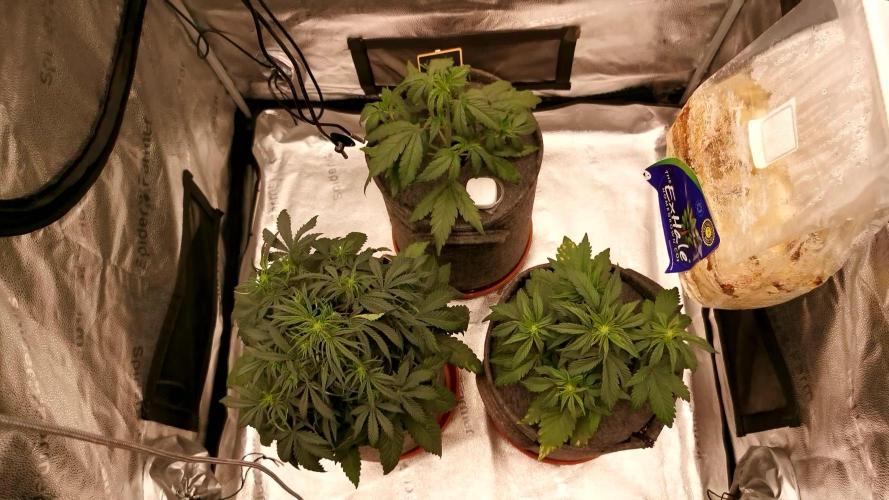

@CannaArchive
Follow
Growth Stage: Early Flower / Pre-Flower
Environment:
Temperature: ~25–26 °C
Humidity: ~60–62 % RH
Light intensity: increased to ~500 PPFD. ☀️
Watering / Feeding:
The plant was watered with RO water + CalMag only. 💧
No additional nutrients were given during this week.
Observations:
Midway through Week 4, the first white pistils became visible, marking the start of flowering. 🌸
Amnesia Skittlez looks compact and healthy, with a tight structure compared to the Apricot Autos.
At this point, stretch is still limited, but expectations are high for the coming days. 🙂
No visible deficiencies or stress symptoms were observed.
Training / Work Done:
No training or defoliation was done.
The plant was left untouched to transition smoothly into flowering. 🌱
Notes:
Week 4 was a calm and stable transition phase.
With flowering officially starting and conditions dialed in, the focus now shifts to watching the upcoming stretch and early bud development. 👀🌿
Likes
3
Share


@CaptonianMoneymaker
Follow
Had rain For 2 days high humidity buds also added another wave of pistills on 1 cheese strain