Likes
Comments
Share


@Fergie
Follow
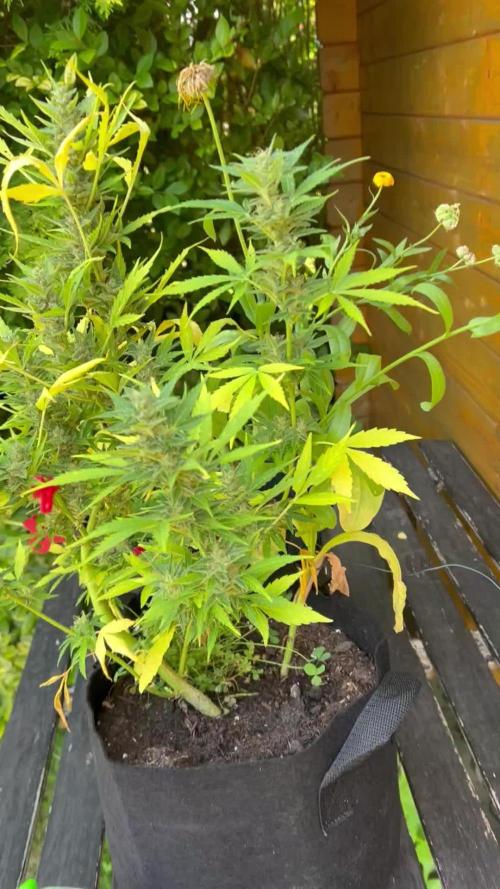
hey guys so another week has passed all beasting along got a few high temp days coming and still a week or so for air con unit . But girls seem be loving the heats even when getting up to 30degree . Done a little deflowation clean up the under , ordered some epsom salts and mollasses a few days ago to assist in flower , still only r/o water and calmax then ph seem to be way forward and my soil mix is defo doing wonders . Til next week family 😉😀

Likes
8
Share


@JohnnyBarrel
Follow
Cream Caramel took more time to finish the cycle than other strains in the room. But flowers are well developed, sticky and thick.
A bigger pot is necessary for having a better yield but the weed look strong and good.


Likes
13
Share


@Youngbuds1
Follow
So as you can see I now have four flowering which I guess were the autos and I have one gelato that is still vegging and is doing damn good. There are two that have lighter color leaves, I’m trying to focus on on these and see if I can get better production. As for the tall GG in the back, leaves are waxy and have resin production starting. A lot better, overall I’m learning more and more every week!
Hope everyone is enjoying my grow and stick around, ask questions. Happy New Year!


Processing
Likes
58
Share


@Joah420
Follow
Another week down, lots of growth this week. Got rid of a few leaves blocking light getting to major bud spots and the plants seem to have reacted okay with it all, made sure didn't go overboard. Plants producing a strong citrus/fruity smell when opening and closing tent, the smell after touching them is just incredible sticky, fruity fingers for hours 😂 if anyone is thinking of growing these ladies invest in a carbon filter (So glad I did before flowering), im running 7 in total and the house is filled with the aroma after the tent being open a few minutes, (I don't mind, neighbours might).
Give a nice big water on Monday, let the plants do their thing throughout the week until drying up and provided a feed with less nutes than normal, which they seem to drink up instantly!
Each plant has grew different, size / shape, however all providing equally as nice bud sites and size, absolutely amazing to compare each one beside each other.
Managing to keep humidiy low 50s, good air flow constantly and temps sitting 20 in dark 24-26 with lights on.
Noticed slight yellowing on tips of some leaves very tiny and slight bend, is this due to nutes? Only came around within the last few days.
Shall upload some close ups with the jewlers piece tomorrow 🙏😁 thanks for looking and all the help so far from everyone who has commented!
Attached video as didn't get much time to picture - got some more pics in today + close ups

Likes
21
Share


@Fullmeltalchemist
Follow
5.23 F60
5.27 F65 - Everything has been going well this week. The plants went through a feed cycle that should carry them through flower no problemo. Started with the AACT Tea, then a bokashi drench with Fish Shit from Fishheadfarms and plain water from here on out. They are drinking quite a bit. 1.5-2 gallons a plant every 3ish days. The terps in my tents smell out of this world. The ScrOG and 3x3 are like a candy store. Passion Berry has mango/guava citrus terps while Deadstar v2 has strawberry watermelon terps. The 4x5 is much more varied, but in general the sweet pink dominates with it's grape candy terps and the dread bread cuts through with it stanky gassy lemon while the prayer pupil smells like moth balls and a bit of GMO. Very lucky to get to experience this much variety.
5.29 F67


Likes
25
Share

@MistaOC
Follow
31.01. F29
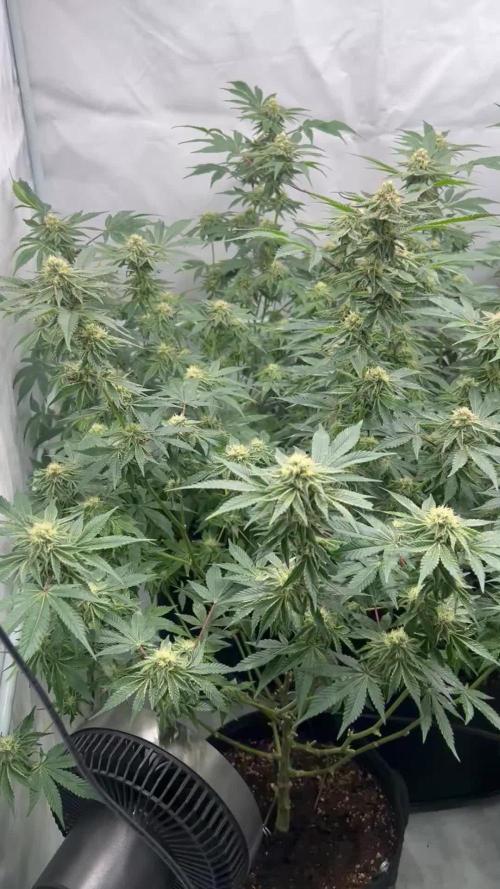
Overall, everything is still running according to plan, although powdery mildew is starting to become more noticeable again. Control measures remain consistent and ongoing. Compared to the previous Super Buff Cherry run, the situation is much better under control, mainly because countermeasures are being applied earlier and more actively this time. The goal is to get the mildew issue fully resolved in the coming weeks.
Aside from that, the Blueberry Skunks are performing exceptionally well. The automatic irrigation system clearly contributes to stable, low-stress growth, and the Biotabs nutrient system continues to impress. The difference compared to earlier runs is very noticeable, especially considering how little manual input is required.
All in all, this is a solid run, and despite the mildew challenge, it already creates a lot of anticipation for the harvest.
05.02. F34
Unfortunately, powdery mildew has become noticeably more present again and has clearly spread compared to last week. So far, the infestation is fortunately limited to the fan leaves, although it is visibly more pronounced there than it was a week ago.
The plants were treated again with a water–Purolyt solution to actively counter the issue. The current focus is clearly on containing the mildew and closely monitoring how the situation develops.
Relative humidity is currently around 53 %. The goal is to bring it below 50 % (ideally around 48 %), as powdery mildew struggles significantly more below this threshold. Even a difference of just a few percentage points can make a noticeable impact.
Aside from this, the grow continues to perform very well overall. Biotabs is once again outstanding, delivering excellent results with very simple handling. The Gardena drip Blumat system is working flawlessly, and all key parameters remain well balanced.
Thrips were only present at a very minimal level. After a single nematode application, no further signs have been observed so far.
The focus remains on keeping the powdery mildew under control.


Likes
23
Share


@Happy_Rakosnicek
Follow
Beautifully colored 😍 It still has signs of nutrient deficiency, but it's nothing serious anymore 😉 And she had brown spots on her leaves, for all I know, it's too much calcium and magnesium, so I'm not going to add him next week.
Likes
14
Share


@ExterminatorX
Follow
I have them going at 18-6, 2 mixed autos are identical im 85%sure, 2 C4Matics are recovered, They are short and skimpy at this week because of germination issues, also oxygen issues. This is going into 2024, Good luck on all your GROW
Ex-Out
Likes
19
Share


@Mr_Juice
Follow
3x frozen black cherry auto-anesia seeds
1x skywalker og runtz xl auto-sweet seeds
smaller attempt:
containers in the back contain-
10g seaweed guanokalong
8g veg pearls guanokalong
15g guano powder guanokalong
10g mykorizae
biochar
containers in front-nutrients plagron

Likes
10
Share

@Caertner
Follow
Alter...
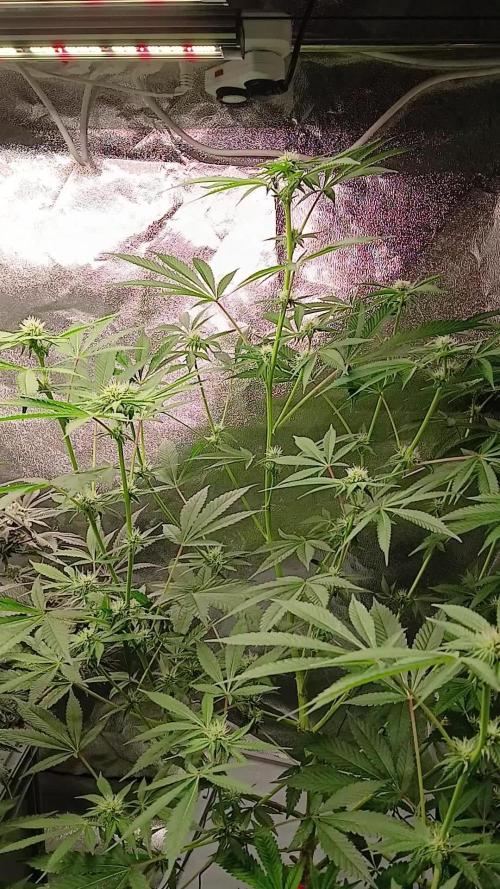
Die Streckung ist abnormal. Bestimmt 15cm in den letzten 10 Tagen. Das ist jetzt Ende BW3... langsam sollte Schluss sein, aber Stiele und Blüten wachsen und wachsen.
Habe jetzt beim Wasserwechsel mal auf
Black Forest Seeds
Oma's Blühwunder
Umgestellt... mal sehen.
Bisherige Ergebnisse mit Opa's Wuchseunder waren vielversprechend.
Update: Bevor sie in die Lampe wächst, wird geknickt... war bei der letzten auch schon gut.
Likes
47
Share


@Ultraviolet
Follow
What's in the soil? What's not in the soil would be an easier question to answer. 16-18 DLI @ the minute. +++ as she grows.
Probably not recommended, but to get to where it needs to be, I need to start now.
Vegetative @1400ppm 0.8–1.2 kPa 80–86°F (26.7–30°C) 65–75%, LST Day 10, Fim'd Day 11
CEC (Cation Exchange Capacity):
This is a measure of a soil's ability to hold and exchange positively charged nutrients, like calcium, magnesium, and potassium. Soils with high CEC (more clay and organic matter) have more negative charges that attract and hold these essential nutrients, preventing them from leaching away.
Biochar is highly efficient at increasing cation exchange capacity (CEC) compared to many other amendments. Biochar's high CEC potential stems from its negatively charged functional groups, and studies show it can increase CEC by over 90%. Amendments like compost also increase CEC but are often more prone to rapid biodegradation, which can make biochar's effect more long-lasting. biochar acts as a long-lasting Cation Exchange Capacity (CEC) enhancer because its porous, carbon-rich structure provides sites for nutrients to bind to, effectively improving nutrient retention in soil without relying on the short-term benefits of fresh organic matter like compost or manure. Biochar's stability means these benefits last much longer than those from traditional organic amendments, making it a sustainable way to improve soil fertility, water retention, and structure over time. Needs to be charged first, similar to Coco, or it will immobilize cations, but at a much higher ratio.
a high cation exchange capacity (CEC) results in a high buffer protection, meaning the soil can better resist changes in pH and nutrient availability. This is because a high CEC soil has more negatively charged sites to hold onto essential positively charged nutrients, like calcium and magnesium, and to buffer against acid ions, such as hydrogen.
EC (Electrical Conductivity):
This measures the amount of soluble salts in the soil. High EC levels indicate a high concentration of dissolved salts and can be a sign of potential salinity issues that can harm plants.
The stored cations associated with a medium's cation exchange capacity (CEC) do not directly contribute to a real-time electrical conductivity (EC) reading. A real-time EC measurement reflects only the concentration of free, dissolved salt ions in the water solution within the medium.
98% of a plants nutrients comes directly from the water solution.
2% come directly from soil particles.
CEC is a mediums storage capacity for cations. These stored cations do not contribute to a mediums EC directly.
Electrical Conductivity (EC) does not measure salt ions adsorbed (stored) onto a Cation Exchange Capacity (CEC) site, as EC measures the conductivity of ions in solution within a soil or water sample, not those held on soil particles.
A medium releases stored cations to water by ion exchange, where a new, more desirable ion from the water solution temporarily displaces the stored cation from the medium's surface, a process also seen in plants absorbing nutrients via mass flow. For example, in water softeners, sodium ions are released from resin beads to bond with the medium's surface, displacing calcium and magnesium ions which then enter the water. This same principle applies when plants take up nutrients from the soil solution: the cations are released from the soil particles into the water in response to a concentration equilibrium, and then moved to the root surface via mass flow.
An example of ion exchange within the context of Cation Exchange Capacity (CEC) is a soil particle with a negative charge attracting and holding positively charged nutrient ions, like potassium (K+) or calcium (Ca2+), and then exchanging them for other positive ions present in the soil solution. For instance, a negatively charged clay particle in soil can hold a K+ ion and later release it to a plant's roots when a different cation, such as calcium (Ca2+), is abundant and replaces the potassium. This process of holding and swapping positively charged ions is fundamental to soil fertility, as it provides plants with essential nutrients.
Negative charges on soil particles: Soil particles, particularly clay and organic matter, have negatively charged surfaces due to their chemical structure.
Attraction of cations: These negative charges attract and hold positively charged ions, or cations, such as:
Potassium (K+)
Calcium (Ca2+)
Magnesium (Mg2+)
Sodium (Na+)
Ammonium (NH4+)
Plant roots excrete hydrogen ions (H+) through the action of proton pumps embedded in the root cell membranes, which use ATP (energy) to actively transport H+ ions from inside the root cell into the surrounding soil. This process lowers the pH of the soil, which helps to make certain mineral nutrients, such as iron, more available for uptake by the plant.
Mechanism of H+ Excretion
Proton Pumps: Root cells contain specialized proteins called proton pumps (H+-ATPases) in their cell membranes.
Active Transport: These proton pumps use energy from ATP to actively move H+ ions from the cytoplasm of the root cell into the soil, against their concentration gradient.
Role in pH Regulation: This active excretion of H+ is a major way plants regulate their internal cytoplasmic pH.
Nutrient Availability: The resulting decrease in soil pH makes certain essential mineral nutrients, like iron, more soluble and available for the root cells to absorb.
Ion Exchange: The H+ ions also displace positively charged mineral cations from the soil particles, making them available for uptake.
Iron Uptake: In response to iron deficiency stress, plants enhance H+ excretion and reductant release to lower the pH and convert Fe3+ to the more available form Fe2+. The altered pH can influence the activity and composition of beneficial microbes in the soil. The H+ gradient created by the proton pumps can also be used for other vital cell functions, such as ATP synthesis and the transport of other solutes. The hydrogen ions (H+) excreted during photosynthesis come from the splitting of water molecules. This splitting, called photolysis, occurs in Photosystem II to replace the electrons used in the light-dependent reactions. The released hydrogen ions are then pumped into the thylakoid lumen, creating a proton gradient that drives ATP synthesis.
Plants release hydrogen ions (H+) from their roots into the soil, a process that occurs in conjunction with nutrient uptake and photosynthesis. These H+ ions compete with mineral cations for the negatively charged sites on soil particles, a phenomenon known as cation exchange. By displacing beneficial mineral cations, the excreted H+ ions make these nutrients available for the plant to absorb, which can also lower the soil pH and indirectly affect its Cation Exchange Capacity (CEC) by altering the pool of exchangeable cations in the soil solution.
Plants use proton (H+) exudation, driven by the H+-ATPase enzyme, to release H+ ions into the soil, creating a more acidic rhizosphere, which enhances nutrient availability and influences nutrient cycling processes. This acidification mobilizes insoluble nutrients like iron (Fe) by breaking them down, while also facilitating the activity of beneficial microbes involved in the nutrient cycle. Therefore, H+ exudation is a critical plant strategy for nutrient acquisition and management, allowing plants to improve their access to essential elements from the soil.
A lack of water splitting during photosynthesis can affect iron uptake because the resulting energy imbalance disrupts the plant's ability to produce ATP and NADPH, which are crucial for overall photosynthetic energy conversion and can trigger a deficiency in iron homeostasis pathways. While photosynthesis uses hydrogen ions produced from water splitting for the Calvin cycle, not to create a hydrogen gas deficiency, the overall process is sensitive to nutrient availability, and iron is essential for chloroplast function.
In photosynthesis, water is split to provide electrons to replace those lost in Photosystem II, which is triggered by light absorption. These electrons then travel along a transport chain to generate ATP (energy currency) and NADPH (reducing power). Carbon Fixation: The generated ATP and NADPH are then used to convert carbon dioxide into carbohydrates in the Calvin cycle. Impaired water splitting (via water in or out) breaks the chain reaction of photosynthesis. This leads to an imbalance in ATP and NADPH levels, which disrupts the Calvin cycle and overall energy production in the plant. Plants require a sufficient supply of essential mineral elements like iron for photosynthesis. Iron is vital for chlorophyll formation and plays a crucial role in electron transport within the chloroplasts. The complex relationship between nutrient status and photosynthesis is evident when iron deficiency can be reverted by depleting other micronutrients like manganese. This highlights how nutrient homeostasis influences photosynthetic function. A lack of adequate energy and reducing power from photosynthesis, which is directly linked to water splitting, can trigger complex adaptive responses in the plant's iron uptake and distribution systems.
Plants possess receptors called transceptors that can directly detect specific nutrient concentrations in the soil or within the plant's tissues. These receptors trigger signaling pathways, sometimes involving calcium influx or changes in protein complex activity, that then influence nutrient uptake by the roots. Plants use this information to make long-term adjustments, such as Increasing root biomass to explore more soil for nutrients. Modifying metabolic pathways to make better use of available resources. Adjusting the rate of nutrient transport into the roots. That's why I keep a high EC. Abundance resonates Abundance.
Likes
10
Share


@Uneasy
Follow
04.11--> Pistil appeared 6 days after changing the light pattern to 12-12. They're growing faster than I expected, won't fit in the cabin 😬
07.11--> One of the plants turned out to be male. I saw buds with pollen sacs and moved them away from the cabin. This was not nice. I will not be able to get close to the harvest amount I planned. 😔


Likes
7
Share


@FrostyFarmers
Follow
Since this week is the first with 3 plants in inside the tent and Amnesia 2 has an urgend light stress problem, she switches places with Amnesia 1. We also thought of some new intuitiv names for the plants.
The new order and names are now:
Long Girl (Amnesia 2) - right side
Middleman (Amnesia 1) - middle
The Dwarf (Amnesia 3) - left side
Even though Long Man doesnt look as happy leafe-wise, the problem got a little better with not as many neawly infected ones.
Unluckily she doesnt have as many leaves anymore and the buds at the top look a little naked. Never the less bud growth looks the best out of all plants we think, which is suprising.
Middlemans leafs turnt a little yellow-ish, so she got some more nutrigen-rich fertilizer. This helped already, with new growth having a darker green. Great news. She looks good and healthy overall. Buds looks nice aswell.
Dwarf plant is kinda just existing. It seems like she is just happy in life and doesnt have as high standards. Growth is not as fast, but she also doesnt really do any work, which is fine.
Buds on all 3 plants are very sticky and have a great aroma already.
Processing
Likes
3
Share


@Grownewgenetics
Follow
These amazing genetics are after 12 hours on the ground, comming out these strain's cream caramel auto is the second faster after the dark devil auto.