


Likes
Comments
Share


@Mr_nugs_lover_David
Follow
This are 2 of the 29 ladies of my SOG in 7l pots, let's see how this couple of ghost cookies by original sensible perform, very stocked on their genetics!

Likes
12
Share


@The_Good_Twin
Follow
7/16/22
Today marks the 1st day of week 14, and the start of the 2nd week of the ripening stage.
Stella received a gallon of water mixed with the following nutrients:
FloraMicro - 5 ml
FloraBloom - 15 ml
Floralicious Plus - 1 ml
Dry KoolBloom - 0.5 tsp.
I seem to be having an issue with pH the last 2 feeding days. I think my gallon jugs have reached the end of their lifetimes, and THAT is what is causing my issue. It has happened to me once before, and getting new jugs cleared up the issue. I’m assuming that will be the solution to the problem.
However, we all know what “assume” stands for don’t we? If you don’t, leave a comment and I’ll explain.
The initial pH was 5.4. That is the lowest that I have ever had simply after adding nutrients. I added a total of 10 ml’s of pH UP, which in my opinion is way too much! But, I did it in 3 separate increments. Not that that makes it better.
The final pH after all that was 6.3. The runoff pH was 5.6.
She is still looking good, but you can tell she’s getting ready to start getting to her end stage. I wait with baited breath!
The tent was 81.7F, with a humidity of 56%.
We’re almost there! Happy growing everyone.
7/18/22
Today I’m going to keep this note brief… I promise.
Stella is continuing to fatten up getting ready for harvest in a few weeks. She is still doing well.
Today she received a gallon of water mixed with the ripen stage nutrients again. I changed all of my jugs, but after mixing everything up the initial pH was 5.5. I added 8 ml’s of pH UP which adjusted the pH going in to 6.2. Her runoff pH was 5.6.
The tent was 83.3F, with humidity at 58%.
See! A short note is possible!! Happy growing everyone.
7/21/22
Stella and all of her children were fed today. As usual, a day later than planned, but they got fed, and are all still doing wonderful.
We’re keeping with the ripen nutrients mixed into a full gallon of water.
FloraMicro - 5 ml
FloraBloom - 15 ml
Floralicious Plus - 1 ml
Liquid KoolBloom - 2 ml
Initial pH was 5.2. I added 12 ml’s of pH UP which adjusted it to 6.2. She had plenty of runoff with a pH of 5.8
The tent was 83.9F, and humidity was 52%.
Her buds are FAT!! Happy growing everyone!

Likes
5
Share


@CannabisAprendiz
Follow
Para ser mi primer cultivo . encuentro que tuvo un excelente resultado . las cepa escogida me dejo muy conforme con los resultados y la produccion obtenidad
en un espacio de 1x1x2 con 300 watts de luz encuentro que estuvo muy bien . Muy contento con el efecto relajante y medicinal del la cepa , era lo que estaba buscando y lo encontre. /
To be my first crop. I find that it had an excellent result. the chosen strain left me very satisfied with the results and production
in a space of 1x1x2 with 300 watts of light I found that it was very good. Very happy with the relaxing and medicinal effect of the strain, it was what I was looking for and I found it.




Likes
31
Share


@bioaccessory
Follow
Hi!
At the end of the second week after switching the light schedule, the plant bloomed. I hope the bush will have time to get the right size.
Removed stretch marks, put a metal ring.
I wish all kind people a Merry Christmas and a Happy New Year!🎄🎅
Glory to Ukraine! 🇺🇦


Likes
16
Share


@GreeneScene
Follow
What to say about this week? For starters LST was started this week. Initially I used garden ties but soon after replaced them with 6” garden staples .
2 of the 6 girls began throwing pistals resulting from the LST starting around day 15 YIKES 😬.
The Zkittlez & the Runtz both from (Expert Seeds ) began giving the 5x5 its first smells .
The LST so far has been a pleasure no ooosy daisies so far & the girls are showing what they are made of . The secondary shoots have great potential to form a nice round bush that I can train out into an even-as-possible canopy .
Today is day 21 & day 20 for this bunch . They are only using Gaia Green dry amendments for feedings but I decided to take some advice given to another grower & supplement my girls with some compost tea . NO I DONT THINK THEY NEED ANYTHING ADDITIONALLY IM REALLY HAPPY SO FAR WITH MY NUTES bbbbuuuuuttttttt in the short chance that my ladies may take a liking to an occasional tea & reward my pampering with large , long , frosty, stacked cola’s . . Thennnn I’m supplementing , I consider this all “4-play” for my ladies Ik a giver 🤷♀️😭
My only concerns are racing against this clock to get as much size & solid structure before flowering sets in I’ve really got my heart set on a certain outcome & I’m one for a good challenge.
Finally , atleast as much as I can remember, I increased the dimmer knob on the light from 65% to about 78%. I won’t increase the watts any higher until bloom sets in fully & at that point I’ll be turning it to 100% raising it a maybe 6 inches & watching patiently for my girls to start praying 🙏 to it .
Week 3 in the books !

Likes
4
Share

@Sensemillia
Follow
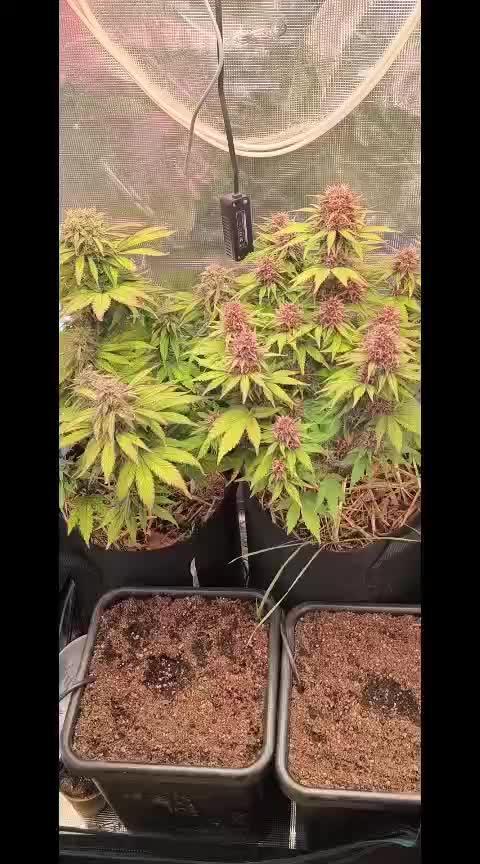
Day 58 from seed.
They looking good.
Thinking about 2 weeks more.
Mostly cloudy trichomes with a few starting te yellow.
Pistils are turning brown.
They are drinking less or taking longer to drink the amount given.
Its crazy to me how i gave these girls 4L each and never had any runoff.
Reducing the nutes to 50%.
Really noticing fast grow cycles to harvest when using the deepred 660nm light.
The smells are very fresh and sweet. Its like the smell of a just peeled orange.
Buds are super heavy and dense, alot of mass. They are like golfballs.
Planning to harvest on day 73.
Already planted 2 blueberry autos for my next grow in autopots.
Likes
7
Share


@thephalanx420
Follow
The stretch has definitely begun. No issues whatsoever. I turned the lights up to 250W and bumped the PPM to 950. Thinking about adding another LED to tent - these things are going to be out of control!
The GSC in the 64L res is almost exactly on the same schedule as the 1L, which is 5 days older. the 1L is obviously in the lead in terms of size, but the 64L isn't far behind. I honestly think they'll both end up being almost identical...
Likes
51
Share


@Fatnastyz
Follow
2nd week of flower and shes going hard!
sun 1.5 inches
mon 12.5
tues 13.5
wed 15.0
Thurs 16.0
Friday 18.0. Woo look at her go!
Sat 19.5
did minor, very minor LST. just enough to help guide the tops out for light.
only removed leaves really blocking bud sites. like 4-6 total.
Smooth and easy for now! Very exciting!
Likes
6
Share


@Saltoa
Follow
Do you care about the flowers blooming.Do you have an intense smell in your nose
Processing
Likes
25
Share


@Kikiwindsurf
Follow
AQUI EMPIEZA EL CULTIVO DE 3 GORILLA GLUE DE FAST BUDS EN MACETAS ESPECIALES PARA AUTOMATICAS DE 25 LITROS CON SUSTRATO BIOBIZZ ALL MIX // HERE BEGINS THE BRIGHT OF 3 GORILLA GLUE FROM FAST BUDS 420 , USING 25 L POTS 100% SPANISHMADE SPECIAL DESING FOR AUTOMATIC STRAINS. BIO BIX ALL MIX.
dia 5 // day 5 : Se abre la primera GG // First GG opens.
dia 6 // day 6 : todas las semillas germinadas correctamente // all seeds germinated properly.
HEARING TO THE COMMUNITY , I SET UP A PROVISIONAL NIGHT ROOM TO BRING EXTRA LIGHT TO OUR BABYS. 8 HOURS DIRECT SUNLIGHT + IDK HOW MANNY HOURS OF CFL LIGHT... STAY TUNED !
ESCUCHANDO A LA COMUNIDAD , HE MONTADO UNA SALA PROVISIONAL PARA DAR MAS LUZ A NUESTRAS NENAS DURANTE LA NOCHE. 8 HORAS LUZ SOLAR + NIPUTAIDEA DE CFL... MANTENTE ATENTO PARA SABER MAS DETALLES EN LOS PROXIMOS DIAS
Likes
11
Share


Likes
4
Share


@Mo_Powers
Follow
not much has happened this week. there is still some sun per day. however, the temperatures drop to 4-8 degrees at night. these are not exactly the best conditions. maybe this late outdoor experiment was not a good idea after all. however, they have not died yet.
Likes
41
Share


@Bread_n_Buds
Follow
We enter the magical moment and do it with a surprise, we will be for a lot of time in collaboration with Marshydro and thanks to this we have a brand new light setup and truly top tent.
The two Dark Phoenix are coming to the end. The first plant the most regular with a topping to 16 pounds has raised and inflated well and regularly all 16 and practically they are more or less at the same level at the time they are going to do the final sprint they scare. Beautiful peaks see them mature will be a joy.
The second plant had a problem with the leaves I think a deficiency or excess of something, I am doing a pH 6 flush to make the nuts absorb and give an enahcer bang before the end. There are both and looks like the top.
Immediately after the Flush the last wintered with Enahncer is scheduled and then only Flush.
LIGHT >> MARSHYDRO SP3000 AT 100% OF POWER, we already like it so much because it covers the intact length of the tent.
Tent >> Marshydro 120x60x180
CHECK IG >> https://www.instagram.com/marshydro_aliexpress2/
Buy >> marshydroled.aliexpress.com
GD >> https://growdiaries.com/grow-lights/mars-hydro


Likes
14
Share


@TOMI08
Follow
87.nap
Már nem húzom vissza őket
A special kush elkezdett virágozni és a bubba slush is őket masképp etetem
Szerintem szépek


Likes
12
Share


@Foggedaboudit
Follow
Buds so heavy the branches are flopping all over. I guess that’s one of them good problems. Hopefully the zip ties and walls keep them standing til harvest.


Likes
49
Share


@Roberts
Follow
Green Cure CBD is acclimated, and starting to grow. She is looking really healthy, and ready to go. I will likely try to lst her some with what space I have. Everything is looking good at the moment. Thank you Medic Grow, and Zamnesia seeds. 🤜🏻🤛🏻🌱🌱🌱
Thank you grow diaries community for the 👇likes👇, follows, comments, and subscriptions on my YouTube channel👇.
❄️🌱🍻 Happy Growing 🌱🌱🌱
https://youtube.com/channel/UCAhN7yRzWLpcaRHhMIQ7X4g
