Likes
7
Share


@GreenMoon
Follow
minor bugs bites biting i have sticky traps i use Fox farm happy frog soil any advice for faster budding because i still don’t see any

Likes
Comments
Share


@babaweed
Follow
The plant grows very vigorously and relentlessly. He developed a large central top, which has an intoxicating scent of fruit. If you touch it, it's full of resin. Another week or two then it will be cut and hung, I gave the last dose of fertilizer knows now only water

Likes
4
Share


@Theia
Follow
ve repotted into her final 15l auto pot.
The procedure I used is as follows.
Items needed..
Clay pebbles
Hydro coco 60/40 clay pebbles/Coco.
Silicium Flash
Startrex
Mycrotrex
Bactrex
And of course Bio tablets X2.
15l of hydro coco was mixed with 25g of Silicium Flash and 25g of Startrex. Mixed up well to form the main substrate.
I filled the autopots to a depth of 5cm with clay pebbles and then layered up the amended substrate making a nice hole for my 300ml nursery pots.
Into this hole I sprinkled in 5g of Mycrotrex and then dropped the seedling in.
This then gets 2 biotabs pushed 5-8cm into the substrate and 1l of water mixed with 5ml of Bactrex
I need to top feed the autopots for a couple of weeks so the root system can establish before I transfer to my flower room and the gravity feeding trays..🤘🏼👍🏼
I'm keeping temps at a constant 25c and lights are on 24hrs a day. Rh is sitting around 65%.it too low hence the domes but then it goes too high. I'm going to run a couple of days with the 65% but vpd over 1 is a bit high for so early.. we shall see.
The sweet seeds all seem very strong and I'm really liking how fast these are growing in this substrate. I just need to work out the watering correctly..
🤞🏼🤞🏼🤞🏼
.

Likes
19
Share


@adam_pawloski87
Follow
This week went real great, 2 ogreberrys and Bruce banner got trimmed up an jarred ! We chopped the 3 other Ogreberrys on Sunday the 14th , they will hang out to dry for 14 days ! Stay tuned for next update! More trimming an weight an overall photos! Cheers to y’all 😶🌫️💨💨💨💨


Likes
26
Share


@Rock_n_Roll_Randy
Follow
SORRY TO EVERYONE WHO TRIES TALKING TO ME....I STILL CANT TALK TO ANYONE BECAUSE I TRIED CHANGING MY EMAIL ON HERE AND IT MESSED EVERYTHING UP. I CANT LIKE ANYTHING OR COMMENT ON ANYTHING. THE WORST IS I CANT JOIN CONTESTS😪😢😭
FINALLY STARTING ANOTHER GROW. MY BACK HAS BEEN FUCKED FOR MONTHS. CANT WAIT!!!! IM DOING 24 AUTOFLOWERS FOR THIS GROW AND IN 5 WEEKS IM STARTING ABOUT 20 FEMINISED PHOTOPERIODS IN MY 5X5 WITH A TSW2000 SO THEY CAN BE READY TO MOVE INTO THE 8X8 TENT AFTER THE AUTOFLOWERS ARE FINISHED. HOPE MY TIMING IS GOOD🤞🤞🤞🤞 LOL


Likes
1
Share


@GrowFunMD
Follow
The Grapey Walker Kush shot up in week three like crazy. I mean, already looking like bushes. The Super Orange Haze is normal size.

Likes
19
Share


@sneakymexican712
Follow
Ok this was my first grow and I made mistakes.
-forgot to buffer coco
- nutrient burn
-started the manlining to early
- probably worried to much about every stage these plants.
-ended up with fungus gnats
And probably appt more I can’t rmeber in the moment.
But i learned so much from all of my mistakes and spent so much time researching and seeing in real time how these plants react and grow.
I did do some experimentation
just a normal top with one blue dream.
I topped twice one another blue dream and did a 3 times topped on all the blue dreams and I see why you should at least top three times the eight main colas and spread out the plant I see some of the buds on the one I only topped once not matured at all because there was minimal light other buds were growing so fat it suffocated it basically. I could have probably defoliated and manliness better but ayy. Beginners wil make
Mistakes and I’m happy with what came out of these girls. Not excited for trim hail but I am at the same time 😅😅

Likes
55
Share


@MadeInGermany
Follow
Info:
Unfortunately, I had to find out that my account is used for fake pages in social media.
I am only active here on growdiaries.
I am not on facebook instagram twitter etc All accounts except this one are fake.
Flowering day 15
since the time
change to 12/12 h.
Hey guys :-)
This week the lady starts developing her buds.
She has also gained a few cm again :-)
Today I have downstairs the shoots removed so that the upper ones get more energy :-).
This week it was poured twice with 1.2 l each time (for nutrients, see table above).
The plant has been checked for health and everything has been cleaned.
Fresh osmosis water was filled into canisters for the next few weeks.
I wish you a lot of fun with the update.
Stay healthy 🙏🏻
You can buy this Nutrients at :
https://greenbuzzliquids.com/en/shop/
With the discount code: Made_in_Germany you get a discount of 15% on all products from an order value of 100 euros.
You can buy This Strain at :
www.Zamnesia.com
☝️🏼☝️🏼☝️🏼☝️🏼☝️🏼☝️🏼
Strain
Gelato clone from mother (Zamnesia )
☝️
Genetics: Wedding Cake x Gelato x Gelato 33
Vega lamp:
2 x Todogrow Led
Quantum Board 100 W
💡
Bloom Lamp :
2 x Todogrow Led
Cxb 3590 COB 3500 K 205W
💡💡☝️🏼
Soil :
Canna Coco Professional +
☝️🏼
Nutrients :
Green Buzz Liquids :
Organic Grow Liquid
Organic Bloom Liquid
Organic more PK
More Roots
Fast Buds
Humic Acid Plus
Growzyme Big Fruits
Clean Fruits
Cal / Mag
Organic Ph - Pulver
☝️🏼🌱
Water: Osmosis water mixed with normal water (24 hours stale that the chlorine evaporates) to 0.2 EC. Add Cal / Mag to 0.4 Ec Ph with Organic Ph - to 5.8

Likes
9
Share


@DeepRootsGrowTrees
Follow
TRIPLE G by ROYAL QUEEN SEEDS
Week #20 Overall
Week #3 Flower
This week she's doing good buds are starting to get some trichomes on them she's dealing with the heat for the most part and I haven't had any other issues with her as far as pest go either!! Stay Growing!!
ROYAL QUEEN SEEDS
TRIPLE G

Likes
9
Share


@TheBulldozerSicily
Follow
Inizio nuovo ciclo
Giovedì 26 settembre 2024
Aggiungo 75 lt acqua osmosi inversa ec 146 ph 9
Aggiungo tutti I nutrienti ottenendo ec 908 ph 6.5
Venerdì 4 ottobre
Inizio controllo ec 1196 ph 7
Aggiungi 20 lt acqua osmosi portando l'ec a 950

Likes
62
Share


@MeaCulpa
Follow
Third week in bloom. Everything is going well. My only concern is that I have defoliated too much and my humidity is too high.
Difficult to get it down when it's just raining outside. I'll see what happens...
19.12.2023 I've made some space and flanged my old 60x60x120cm tent on the right site and switched on another PC fan. I hope I haven't made a serious mistake. All fans repositioned. And everything is taped off so that no light comes in.
That was too crowded. Next time 4 or 5 will be enough for me.
Likes
5
Share


@AestheticGenetix
Follow
Everything is growing great.
Im hesitant to keep weaving through the scrog because I don't want to mess up the mains but I'm just trusting the process and doing the best I can.
I have been heavy defoliating and lollipopping like crazy each day trying to make sense of this mess



Likes
19
Share


@sellem
Follow
This week marked the start of flowering - they were showing sex and soon you could make out the little preflower budsites on both of them! This week also marked the start of their explosive grow-stretch phase. Looking back, i should have trained way more aggressive. but not TOO aggressive! on Day 21, i adjusted a prexisting stake too hard and plant Bs main trunk snapped in the middle. (I only fully noticed this in the next week, i just heard a snap but didnt visually see anything, the crack really formed over the next couple of days) A shock for me as an inexperienced grower - but again, as with everything so far, the BPP just. did. not. care. at all. i supported her with some stakes from below and rubbercoated garden wire, but honestly, the plant took good care of itself. Note to self - train early, train evenly, and test flexibility BEFORE adjusting :P
Ramped up PPFD to about 600 and Watering to 1,5L on Day 21 and 2L on Day 25. They were getting thirsty!
Day 21 was the last time i added root juice with 1 ml/L, and Day 25 i began adding Flowering Nutes and Stims with BioBloom and Topmax, 1ml/L each per plant. PH with both waterings was 6,5. Didnt measure Drain PH cause i was lazy.
Also defoliated leaves that were blocking out future budsites.
So far, they didnt care about topping, staking them down, defoliating, and Plant B also didnt care 1 bit about being literally ripped in half. i am impressed.
Likes
14
Share


@GodZilla_Owner
Follow
Week 7 Update – Recovery and Growth 🌿
Sorry for the late update—I was completely out of commission the past few days 🤢, but luckily, my girlfriend stepped in and took care of the plants.
The good news? The stretch is finally over! But note to self—never again 9L pots for plants this size! 😅
BioBizz#1 – BT23
Despite a “drain” pH of 7.8, she’s doing okay overall. However, this will be my last run with BioBizz. While I’ve managed the CalMag issue this time, Advanced Nutrients has completely won me over. AN#4 has thicker stems and looks more vigorous, and AN#3 bounced back quickly with AN nutrients.
AN#4 – BT23
She’s praying to the light every day and is officially the largest and healthiest plant I’ve ever grown—no deficiencies so far! 😍
AN#3 – BT19
I had to defoliate heavily, but you can barely tell. Height is becoming a challenge, so I’m hoping it just barely fits—because it has to! 😅
Likes
7
Share


@darb35
Follow
30+ days in and they are going very strong.
No issues at all up to this point so decided to defoliate for some more light penetration and to focus on the top buds.
Likes
9
Share


@Scoota710
Follow
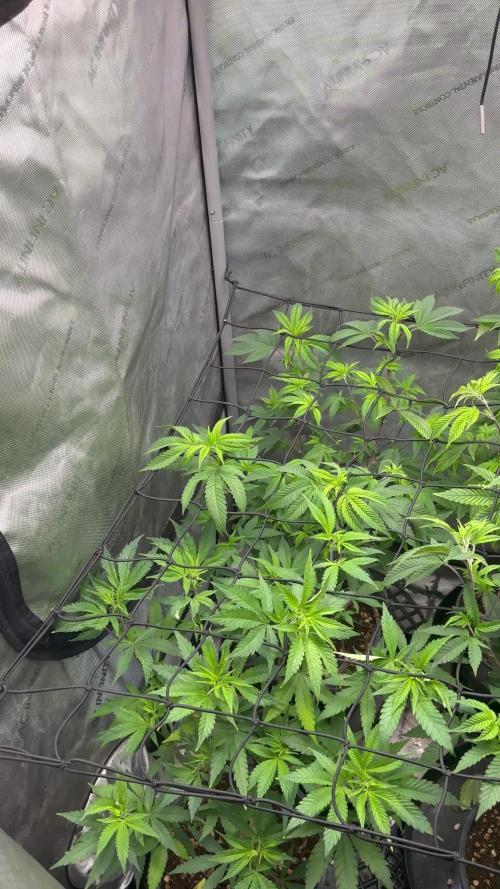
It’s growing pretty good. I’ve been debating on topping it or doing some LST on it 🤔