


Likes
Comments
Share


Likes
10
Share


@Stacy_smokez
Follow
Went into this week just using mute from fox farm ocean then began nutrients due to deficiencies, getting in under control but overall doing well also started 3 new plants going to start a diary for them soon


Likes
31
Share


@The_Doctor_Green
Follow
En esta nueva semana he trasplantado a macetas de 10 litros a 2 plantitas que estaban en macetas de 3L .
La que he planteado a tierra ha tenido un crecimiento significativo de una semana a otra.
Likes
54
Share


@rhodes68
Follow
2/12 Week 7
Hairs beginning to show up more each day and the growth tips are transforming.
Continuing to encourage bushing by defoliating the top canopy every couple of days. Lots of bud sites in their future.
Lowering Nitrogen by putting them on all Bloom nuets , prob should have done that weeks ago.
29 inches high no sign of slowing. No problems unless we hit 40 inches. Then I gotta think 😣
Don't see any reason to worry stretch should end in a week to 10 days or less and there are a few things I got up my sleeve.
Actually these are the kinds of problems I signed up for and Ive nothing to complain about, this stuff is fun. 😁
Here's hoping for a big arsed harvest!
I was asked why I am letting the lower end of the plants get so over grown.
The idea is that this will slow down the upward growth and maybe get them to bush more later.
When the room exists in the flower tent that will be cleaned up.
Hitting them with the kangaroots again one last time in the morning to see if we can get those root balls expanded for bud building.
2/13 Pics
Starting to get some height differences(less than 2 inches) between the plants under the LED and those under the HPS so I have changed the HPS out for a MH light to slow down the height gains in the flowering tent. Their nodes could use some shortening.
Have other reasons but thats it for this grow.
Hung a small 2700K 30 watt LED directly over Aeryn out of the path of the main light to give her just a bit more red spectrum. Not much but something.
2/14
Rearranged the tent to give better access to the photos and allow better hanging of the small LED and give a bit more light from the MH.
Runoff tested on all plants and ranged from 550-600 ppm which just leaves us all kinds of room later for more nuets.
Heck this is perfect
2/17 Stepping down the nuets slightly
2/19 End week note:
Finally see some very slight nitrogen def on Aeryn so nuets back up, found the bottom end of of it.
Folding in PK at a low dose
Flipped week back to veg, only in flower the last day or so of the week


Likes
8
Share

@DogDoctorOfficial
Follow
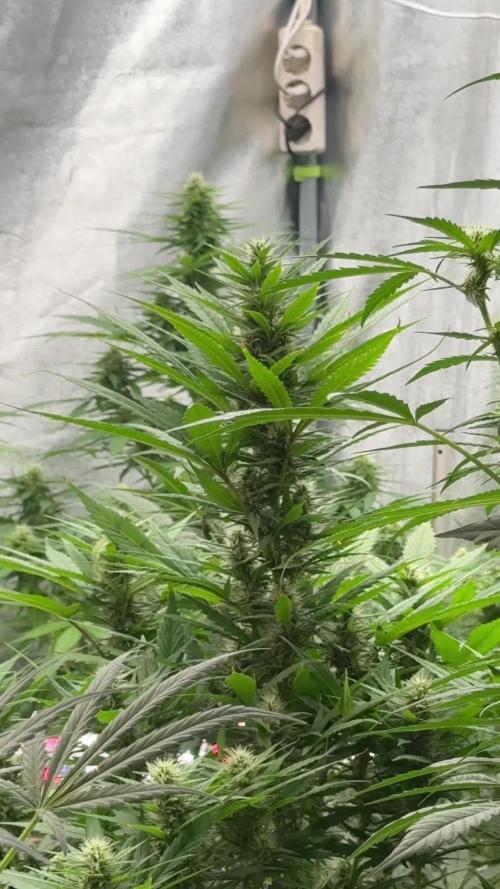
Mango Kush – Week 4 Flower (Week 8 from Seed)
The bulking begins: pistils, stacking, and balanced nutrition
Grower: Dog Doctor
Strain: Mango Kush (Pheno #1 & Pheno #2)
Environment: 8×8 Grow Room
Control System: TrolMaster Tent-X brain + WCS substrate sensors (The ThinkRoulette ecosystem)
Lighting:
• ThinkGrow Model One
• ThinkGrow ICL-300 (x2 inner canopy lights)
• Future of Grow Black Series 600W
• Lumatek Zeus 465W Compact Pro
⸻
🌸 Week 4 Flower – Bulking Mode Activated
Week 4 is an important checkpoint in any bloom cycle. The Mango Kush sisters are no longer just “in flower”, they are now building flowers. Pistils are everywhere, thick and vibrant, forming the foundation for what will become dense, resin-packed buds.
Both phenos are looking strong:
• Pheno #1 – More advanced, pistil clusters stacking into early budlets, filling her frame with confidence.
• Pheno #2 – A little behind, but catching up fast. She may have taken longer to flip (since she germinated later), but she’s now pushing out strong, healthy white hairs that signal the start of her bulking stage.
This week’s studio and improvised studio photos capture this perfectly—the transition from “flower set” to flower building.
⸻
💧 Feeding Update – Simplifying for Strength
This week, we made an important nutritional adjustment:
• Removed: Aptus All-in-One Liquid & Aptus Top Booster
• Kept:
• Aptus Regulator – 0.15 ml/L
• Aptus CalMag Boost – 0.25 ml/L
• Plagron Power Buds – 1 ml/L
• Plagron Sugar Royal – 1 ml/L
• Plagron Green Sensation – 1 ml/L
Why this change?
At this stage, the super soil’s NPK balance (nitrogen, phosphorus, potassium) is already strong enough to sustain healthy growth and flower formation. Adding the All-in-One Liquid or Top Booster would risk redundancy, too much nutrient overlap can actually slow the plant down, cause salt build-up, or push her into unnecessary stress.
By keeping only the boosters and biostimulants, we are:
• Supporting flower stacking and density (Power Buds).
• Enhancing terpene and resin production (Sugar Royal).
• Adding a multi-function bloom enhancer (Green Sensation, famous for its late-flower results).
• Maintaining structure, transport, and stress resistance (Regulator).
• Keeping calcium and magnesium in check (CalMag Boost).
🌱 Educational takeaway: Week 4 is about controlled nutrition, not force-feeding. Too much input can overwhelm plants; the art is in balancing what the soil already provides with just enough supplements to guide the plant’s energy toward flowers.
⸻
🌡️ Environment – Stability Matters
The Mango Kush girls continue to thrive under the TrolMaster Tent-X + WCS ecosystem, giving live readings of:
• Soil moisture (watering when ~19–20%)
• EC levels (tracking buildup)
• Temperature & RH (still peaking high at times, but stable airflow keeps the canopy safe)
The ThinkRoulette ecosystem (TrolMaster + lighting synergy) has been running flawlessly, creating a stable and responsive environment. This consistency is what allows the girls to focus their energy on bulking rather than on fighting stress.
⸻
💡 Lighting – Canopy in Harmony
The four-light setup continues to shine as a perfectly balanced orchestra:
• ThinkGrow Model One – Deep canopy penetration.
• ThinkGrow ICL-300s – Mid-canopy energy, no sites left behind.
• Future of Grow Black Series 600W – Spectrum balance.
• Lumatek Zeus 465W Compact Pro – Evening out the footprint.
Result: The canopy is even, pistils are popping from top to bottom, and no part of the plant is left in the dark.
⸻
🌱 Genetics Check-In – Mango Kush in Mid-Flower
Mango Kush (Mango × Hindu Kush) is famous for her fruity-sweet aroma with earthy Kush undertones. Week 4 is where the genetic potential starts to show:
• Bud structure is beginning to define itself—rounded calyx clusters forming the early shape.
• Aroma is still light, but brushing against the plants gives faint hints of fruit and spice.
• Phenotypic difference: Pheno #1 is flowering earlier and faster, while Pheno #2 lags a week behind. This may result in staggered harvest windows, giving two slightly different expressions of the same strain.
⸻
🔮 What to Expect & What Not to Expect
✅ What to Expect in Week 4–5:
• Noticeable bud bulking.
• Rapid calyx development, pistil clusters getting denser.
• First trichomes appearing under macro view.
• Water demand increasing steadily.
• Early terpene hints becoming stronger week by week.
❌ What Not to Expect Yet:
• Full aroma profile (that comes around Week 5–6).
• Major resin frosting (Week 5 onward).
• Final bud density or color changes (those happen in later bloom).
Educational takeaway: Patience is key. Week 4 is about building structure. The “icing” (frost, density, aroma explosion) comes later.
⸻
🔄 Recap So Far – The Journey
• Weeks 0–2: Seedlings established with Aptus Start Booster.
• Weeks 3–4 (Veg): Pheno #1 stretched tall, Pheno #2 filled out compact.
• Week 5: Flip to 12/12 → stretch begins.
• Week 6 (Flower Week 2): Bloom boosters introduced, lights upgraded.
• Week 7 (Flower Week 3): Clear flower set, pistils everywhere, irrigation system added.
• Week 8 (Now, Flower Week 4): Bulking stage, pistils thick and abundant, nutrition simplified, environment stable.
⸻
🙏 Gratitude
To the community—thank you for following along, for sharing knowledge, and for keeping the love of cultivation alive. These reports are more than just grow logs, they are learning tools, and together we’re documenting the journey of two Mango Kush sisters from seed to flower.
And to the gear, the TrolMaster, the ThinkRoulette ecosystem, and the full lighting orchestra, you make this possible. Technology doesn’t grow the plant, but it empowers the grower to let the plant reach her full potential.
⸻
📸 This week’s highlight: Studio and improvised studio shots capturing the moment where flower set becomes flower build.
✨ In short: Week 4 Flower is the week of foundations. The pistils are thick, the flowers are forming, and the stage is set for resin and density in the weeks to come.
📲 Don’t forget to Subscribe and follow me on Instagram and YouTube @DogDoctorOfficial for exclusive content, real-time updates, and behind-the-scenes magic. We’ve got so much more coming, including transplanting and all the amazing techniques that go along with it. You won’t want to miss it.
• GrowDiaries Journal: https://growdiaries.com/grower/dogdoctorofficial
• Instagram: https://www.instagram.com/dogdoctorofficial/ • YouTube: https://www.youtube.com/@dogdoctorofficial
There’s a new series blooming and it’s more than just plants. It’s about process, patience, and paying attention.
⸻
Explore the Gear that Powers My Grow
If you’re curious about the tech I’m using, check out these links:
• Genetics, gear, nutrients, and more – Zamnesia: https://www.zamnesia.com/
• Environmental control & automation – TrolMaster: https://www.trolmaster.eu/
• Advanced LED lighting – Future of Grow: https://www.futureofgrow.com/
• Root and growth nutrition – Aptus Holland: https://aptus-holland.com/
• Nutrient systems & boosters – Plagron: https://plagron.com/en/
• Soil & substrate excellence – PRO-MIX BX: https://www.pthorticulture.com/en-us/products/pro-mix-bx-mycorrhizae
• Curing and storage – Grove Bags: https://grovebags.com/
⸻
We’ve got much more coming as we move through the grow cycles. Trust me, you won’t want to miss the next steps, let’s push the boundaries of indoor horticulture together!
As always, this is shared for educational purposes, aiming to spread understanding and appreciation for this plant. Let’s celebrate it responsibly and continue to learn and grow together.
With true love comes happiness. Always believe in yourself, and always do things expecting nothing and with an open heart. Be a giver, and the universe will give back in ways you could never imagine.
💚 Growers love to all 💚
P.S. – Pheno #1 vs. Pheno #2
A quick note on the sisters’ timelines:
• Pheno #1 remains ahead—already deep in flower, stacking pistils fast and showing more advanced bud formation.
• Pheno #2, while it started later, is catching up beautifully. Her pistils are now bursting and forming thick clusters, but she still sits a bit behind her sister.
This difference is natural: Pheno #2 germinated later and is effectively running on a slightly younger internal clock. The 11/13 light schedule (11 hours on, 13 hours off) means she is easing into flower at her own rhythm.
👉 What this means: Both plants are thriving, but don’t expect them to bulk or finish at the same exact time. This staggered development could actually be a gift—two harvest windows, two terpene expressions, one journey.
Educational takeaway: Even seeds from the same strain can flower on different schedules. Rather than forcing uniformity, let each phenotype tell its story. Patience reveals the full genetic spectrum.
🌿 Grower’s Note
“This week felt like the real beginning of bloom. The room is alive—white hairs, bulking pistils, and that early whisper of aroma that promises so much more to come. Pheno #1 leads the charge, Pheno #2 follows on her own time, and together they remind me that growing is not about control, but about partnership. The plants teach us patience, and in return, we give them care.”

Likes
2
Share


@Kirsten
Follow
16.2.25:
I decided to check out the lower canopies of all plants to see if I need to get rid of any foliage.
I did get rid of a few small branches and leaves.
However, whilst I was doing this, I saw more garden pegs from my LST remaining.
There were about 6 or more in Pink Mist alone. Additionally, on Watermelon, there were some left in, too.
I'm so annoyed to see that because the plants are really stretching, and I could've potentially disrupted this by leaving the pegs in for all this time without realising it.
🤞 that I haven't compromised things too much. We'll see.
I watered today with 2ltrs of dechlorinated water PH'd to 6.3 containing the following nutrients;
♡ .8g Green Leaf Nutrients PK booster
♡ .5g Ecothrive Biosys
I ordered quite a few things for the garden. I got Greenleaf Nutrients Sea K(elp) and Mega Crop Parts A+B. To go with their PK Booster I got last month. I'm excited to try it all together. Next run, maybe just using these. We'll see how it goes.
18.2.25:
The plants are going crazy for water! Everything is getting used right up so fast!
Today, I decided to add some more Black Strap Molasses to add some carbs and other micronutrients. I'll add the jar with the label in the photos section above.
I watered a very small amount to each plant.
What I put in:
♡ Black strap molasses 150g
♡ 2g Sea K(elp) Greenleaf nutrients.
I dissolved everything in 4ltrs of dechlorinated water PH'd to 6.4.
19.2.25:
I received the majority of the garden purchases that I made. I'm still waiting for the Ecothrive Life Cycle. I wanted to top dress, but it's been delayed unfortunately.
I am using my Greenleaf nutrients products which I bought on Amazon. I got the Mega Crop 2 part system Part A and Part B. I have the Sea K(elp), and the bud explosion PK booster.
I really wanted to get some of their sweet candy asking read many positive reviews. Unfortunately, for me, this is unavailable to buy currently. So that's a little disappointing.
I needed to do a good watering so when my nutes were delivered today, I got excited 🤗
I watered 2ltrs of dechlorinated water per plant, PH'd to 6.4, containing the following nutrients:
♡ 1g Mega Crop Part A
♡ 1g Mega Crop Part B
♡ .5g Sea K(elp).
The plants drank this up within a few hours.
I'm going to try and hold off on watering in hopes that my Ecothrive Life Cycle will arrive so I can top dress and water it in then.
20.2.25:
My Ecothrive Life Cycle arrived yesterday, and the plants are ready for their top dress and a good watering in.
I have some Biobizz Light Mix, Canna Coco,and perlite. I'm going to use this as a base to mix my amendments in.
I'm going to fill my 5 gallon bucket with about 4.5 gallons of my top dress mix. I will distribute this across 6, 4-5 gallon pots. Then I will water in well with Greenleaf nutrients Mega Crop Parts A+B and Sea K(elp).
I've made a crude attempt to video mixing my top dress. Don't listen to the audio. lol, my YouTube didn't stop playing whilst I recorded this 😂
So anyway, I added the following amendments to the above base mix of 4.5 gallons;
♡ 3 TBSP Ecothrive Life Cycle
♡ 3 TBSP Vitalink Bat Guano
♡ 3 TBSP Ecothrive Charge
♡ 1 TBSP RHS Mycorrhizal Fungi granules
♡ 6 TBSP Ground Cinnamon.
Likes
22
Share


@Cgrow
Follow
Kicking off week 5.
Did some extra work on the LST. Making sure the light penetrates all bud sites.
I now understand that my initial goals are too far from what I actually will harvest..mainly due the PH issue we faced on week 4. Let's see how it goes.
Likes
Comments
Share

@PurpleBeen
Follow
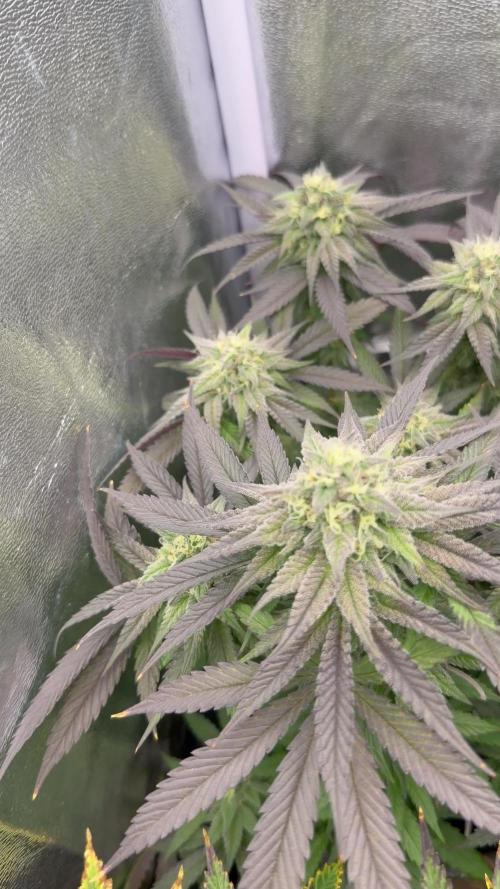
Week 6 /
On the way to week 6 , the majority of trichomes are clear/transparent, the buds are well developed but not finished yet. We will start gradually reducing fertilizers from now toward week 8–9.
12/12 switches : 12/06/2026
Back: Frosted Grape
Front left: Purple Cookie
Front right: Stick Berry
Watering remains moderate: ~600 mL for the larger plants and ~300 mL for the smaller ones, with 1 L being the maximum applied so far.

Likes
34
Share


@Salokin
Follow
Hello Growmies,
As we navigate through week 9, the crescendo of the Watermelon Candy F1 Hybrids’ flowering odyssey is near. Nestled within the verdant grove alongside the Epic Buzz and Red Banana Pudding strains, our Watermelon Candy troupe is displaying the telltale signs of impending harvest.
The plants exude a melody of sweetness, with trichomes glistening like morning dew under the subdued glow of the IR lights, revealing a spectacular array of colors not typically seen in the standard lighting spectrum. Despite the compact nature of the buds, which is a result of the 12/12 light cycle they've been flourishing under, the density of these floral clusters cannot be overstated—like tiny, aromatic asteroids.
Plant #1 continues its reign with a prolific bud structure that's nothing short of mesmeric. Plants #2 and #3 exhibit a bounty of floral nodes, each one a testament to the bounteous yields that are just a fortnight away. Their canopies spread wide, a testament to the cultivar's vigorous growth habit and the attentive care they’ve received.
Though the buds might not break records in size, their solidity is remarkable—a testament to the precise environmental controls maintained by our trusty TrolMaster. The buds are rock-solid, heavy with resin, and brimming with the promise of potent effects and delectable flavors.
Our nutritional regimen remains unchanged, delivering the essential elements for these final, crucial stages of bloom. The meticulous oversight of our automated systems ensures that our Watermelon Candy Hybrids are relishing in their peak conditions, as we nudge them gently toward full maturation.
With a harvest on the horizon, the anticipation is palpable. These final days are a mixture of excitement and the bittersweet acknowledgment that this chapter is closing. Soon, we’ll be able to savor the fruits of our labor, a sweet reward for the weeks of dedication and camaraderie in our grow community.
Until then, we'll continue to marvel at the transformation, watching as each plant fulfills its genetic destiny, soon to provide joy and relief in its final form.
Stay lifted,
Salokin
Likes
20
Share

@PhinolaGreen
Follow
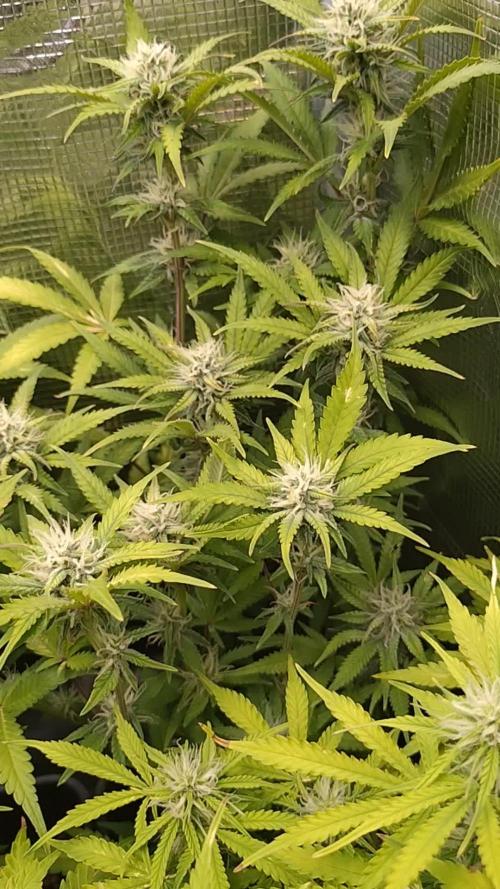
10. Woche
Die beiden Ladys wachsen und entwickeln sich prächtig, der Sativalastige Einfluss ist klar zu erkennen. Ich habe die Position mal bisschen verändert und muss noch bisschen mit Calmag nachhelfen 😄


Likes
102
Share


@OrganicNature420
Follow
Germination date 🌱 02/12/2021
Day 94 09/03/2022
Strain 🍁 Barney's Farms Biscotti Mintz
(Biscotti x Mintz)
THC% • 30%
💡 Mars Hydro FC-E6500
• Power draw 650W + 5%
• Max coverage 5 x 5
• LED 3978 pcs high quality chips
• Max Yield 2.5g / watt
• Noise level 0 DB
• Removable Driver & Light bars
• Daisy chain
• Fast cool system
https://marshydroled.co.uk/ 🇬🇧
PROMO CODE • (organicnature420) DISCOUNT
https://www.mars-hydro.com/ 🇺🇲
PROMO CODE • (ORG420) DISCOUNT 👍🏻
⛺ Mars Hydro 150 x 150 x 200cm
📤📥 AC infinity 6inch
💧 10lt dehumidifier
❄️ 3.1kw air con system
💉 Nutrients Dr Forest (dry amendments)
Grow
Bloom
Bloom2
🌱 Growing Media • Soil
Notes 📝
It's not been a good week. Had some family time last week and unfortunately caught covid with all the symptoms. I've been bed bound since Monday and today I'm starting to feel slighty better. Not asking for sympathy 🤣 but this explains why some of my girls have switched on me...
Looks like all 3 Frosted Biscotti have gone into reveg. Obviously have a light leak but think I've sorted it now. The mystery is just well under feed as I've run out of Bloom and big Buds and its also gone into reveg. The other coco ones haven't gone into reveg and almost look done. Biscotti Mintz and Bahama Bussdown look 🔥 well impressed. The mutant Biscotti Mintz (soil) has come along nicely and looks amazing. I don't get why that hasn't revegged as its surrounded buy the others that have. The 2 at the back, (Bahama Bussdown) ones taken a slight knock and revegged and the other one has just got to heavy and collapsed. Again looks near enough done so now need to think of a plan of action for curing as tent will be occupied for at least another month. So I think that's it with the problems 🤣 ..
Apologies again for not getting back to anyones dairys over the last 2weeks. I'm going to spend the weekend catching up with you all and sorting out the tent as long as I'm covid clear. My partner has been doing so much for my son and I I couldn't ask her to maintain the tent aswell. She did give them a water but no nutrients 🙈 half effort still wins my heart ❤️
Discount codes in bio for Mars hydro

Likes
35
Share


@NorCalCloset
Follow
At day 77 from seed, 31 days since the switch to 12-12, I hope she is done stretching because my light is as high as I can make it and as close as I want the plant. This girl is one stretchy beast. She is starting to smell a little more but still not strongly. I'm excited to watch her fill out. I will do very little defoliation from here on. She looks happy to me so far even though it looks like she has filled my tent out.

Likes
4
Share


@StickyHands
Follow
Flower day 21
Today I returned from vacation after 7 days. My first look was in the water tank, and it was indeed empty. Hopefully, I looked into the tent, and luckily, the ladies all looked healthy. The 40 liters had probably only recently been emptied.
The ladies have grown more than I expected. Some even grew a few centimeters up to the lamp, and so I was forced to supercrop the longest shoots.
I also lolipopt the plants properly.

Likes
9
Share

@420DeepGrow
Follow
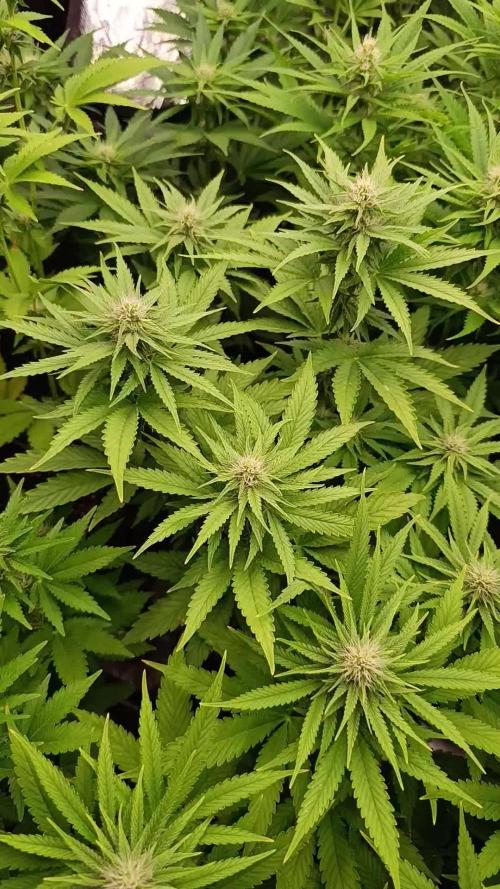
📆 Semana 4
La planta deja atrás el stretch y entra de lleno en la fase de engorde. Los cogollos comienzan a ganar volumen de forma visible, aumentando la producción de pistilos y resina mientras la estructura ya completamente formada sostiene un crecimiento floral uniforme.
El consumo de agua y nutrientes alcanza uno de sus puntos más altos del cultivo, especialmente en plantas de mayor tamaño. Mantener una nutrición estable permitirá sostener el ritmo de crecimiento y evitar carencias durante esta etapa de máxima demanda.
⚡ EC: 1.7–1.9
💧 pH: 6.2–6.5
🌡️ Agua: 21°C
🌫️ Humedad: 45–50%
💡 Intensidad: 1000–1100 PPFD
🔥 Nota de cultivo: Semana de máxima demanda nutricional. Un riego equilibrado y un ambiente estable favorecerán un engorde continuo y homogéneo de los cogollos.
¡Seguimos creciendo fuerte 💪!
Likes
567
Share


@Legendaryseedthumb
Follow
Day 16: what is happening to my girl? Anyone knows?🤔
Day 17: Flushed them through with my solution mix to stabilize the ph in coco
Installed my net today. I don’t really need it yet but it looks nice 😆🥦
Started with lst today
Day 19: started to defoliate today, not much just 2/3 leaves each plant!
Day 20: hey guys! Shit is about to go down!!!! Finally some work with the girls… I hate the early fragile days.
As you guys can see I topped my girls, but hahaha I just noticed that I accidentally FIMed one plant😂
I love training my plants as much as possible. I will let them recover some days before I defoliat again. I defoliate all the way to week 1 in flower.
Likes
12
Share
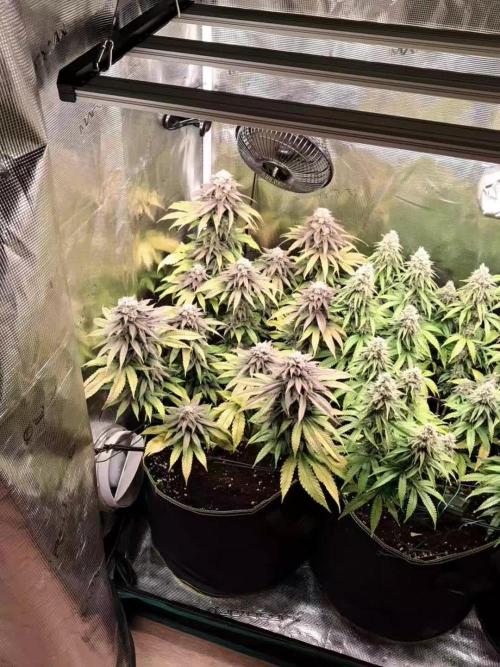

@Grow4ever
Follow
Wir befinden uns Ende Blütewoche 8.
Sobald das Zelt aufgeht kommt mir eine süße Welle entgegen. Die Buds der Lemon Orange sind im Vergleich zu den anderen Strains etwas kleiner. Auf die Ernte, in ich schätze 2 Wochen, freue ich mich wirklich sehr :)

Likes
39
Share


@King_Green21
Follow
Not really much to say this week all 10 are growing fine with no problems at all
I Will keep removing the larger fan leaves as I go along, I do this in order to try and get as much light to the bottom branches as I can before I switch them to 12/12. This will hopefully keep the canopy as even as it can be without having to do to much training or topping.
Day 34 - Looking abit skinny and after the defoliation, but had to remove the middle growth and large fan leaves to get light to them bottom branches and new growth tips. I’m aiming to keep them small and bushy

Likes
49
Share


@BATMAN_GROWS
Follow
Well guys first day of week 3 and she gets her head cut off, dont worry she didnt feel much pain and I soothed her with a little song to ease her pain nana nana nana nana BATMANNNN.
Let's see her recover over the week and boost her stems forth so I can start bending and building a shape for her
Likes
Comments
Share


@MellowVibes_CBD
Follow
Definitely satisfied with the results I m getting from purple punch by Fast Buds!! It’s definitely looking beautiful!!!