




Likes
15
Share


@Venabr96
Follow
Armario posto em fase de floraçao.
Rega de 4 a 4 dias com 2l de agua desmineralizasa.
Deixei a lampada cair sobre elas , piqueno incidente 😣😣
Mas esta tudo bem só perdi uma folha da piquena uma da grande e algumas queimaduras 😣😣

Likes
13
Share


@Growyourownathome2x2
Follow
7th of May Day 59 day 11 of 12/12 4 plants are looking healthy the stretch has started and and the canopy is starting to get a bit dense I may rom I’ve some large fan leaves on day 14 of 12/12 to give better airflow and allow for the lower growth to get more light, I can picture the colas already 😁🍁 ppm still going in at 650 ph 6.5, i top dressed each plant with fish blood and bone mean 3 table spoons to each 3gal pot on day 1 of flower

Likes
19
Share

@DogDoctorOfficial
Follow
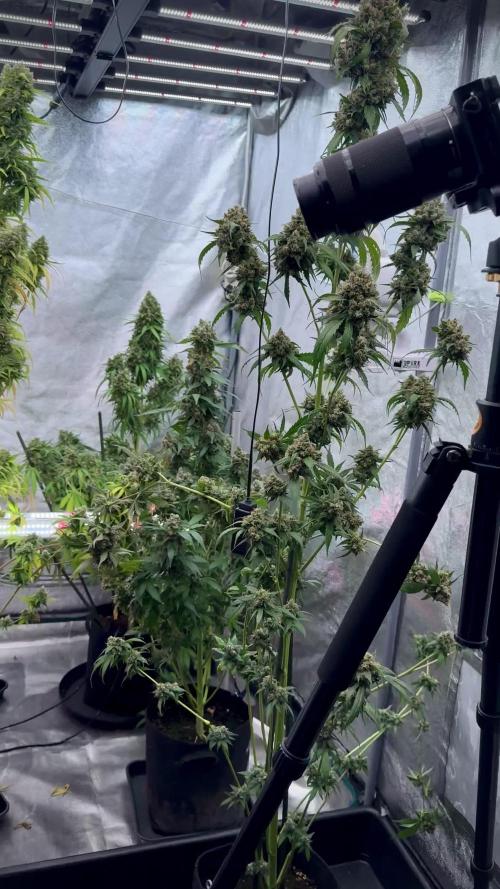
🌸 White Widow — Week 7 Flower (Week 11 from seed)
Status: Full flower, bulking rapidly.
Vibe: Dark foliage, compact form, heavy frost, 90s aroma profile.
Feeding: Aptus + Plagron lineup (Power Buds, Sugar Royal, Green Sensation, Regulator, CalMag, All-in-One)
Photos: Sony a6000 — loyal workhorse for studio shots. 📷
⸻
🧠 Deep dive — Why 12/12-from-seed makes a plant “go hard”
Plants evolved to reproduce. Their primary biological drive is to make seeds. Photoperiod (day length) is one of the most reliable seasonal cues plants use to decide: is it time to flower?
Mechanisms at play (simple → nerdy):
• Photoperiod sensing: Leaves detect day length via phytochrome systems (Pr Pfr). Short days (or the 11/13 rhythm) flip the hormonal cascade toward flowering.
• Florigen & flowering hormones: When the plant senses “short days,” it produces mobile signals (florigen) that travel to the shoot apex and shift gene expression from vegetative growth to reproductive development.
• Carbohydrate reallocation: Energy stops making more leaves/branches and is directed into calyxes, resin synthesis, terpene pathways, and seed/flower tissues.
• Result: A plant that thinks “the season’s ending — reproduce now!” goes all-in: denser flowers, rapid calyx swelling, intense trichome production.
Important point: they don’t know about pollination. The plant can’t tell you whether pollinators exist or whether pollen will land — it simply invests in attractive, resinous flowers to maximize reproductive success. As growers, we exploit that drive to produce potent sensimilla (unpollinated) flowers.
⸻
🔬 Why your White Widow is exploding in quality right now
• Immediate reproductive programming: Starting floral signals early (12/12 from seed) forces the plant to prioritize flower formation rather than vegetative mass. That yields compact, dense colas.
• High PPFD + short day = strong DLI in less time: With fewer hours of light, your lamp intensity is higher in those hours → powerful photosynthesis during the window the plant has chosen.
• Nutrition tuned to flower: the Aptus + Plagron stack feeds the metabolic surge — PK + biostimulators for bulking, sugar stimulators for terpene pathways, Ca/Mg for structural health.
• Genetics: White Widow is resin-happy; give it the right cues and it will frost up like a sugar cookie.
⸻
🌈 Why her colors are going dark (and why that’s beautiful)
Leaf & bud color comes from a balance of chlorophyll + accessory pigments (anthocyanins, carotenoids) and is influenced by:
• Genetic propensity (some phenos are naturally darker)
• Temperature swings (cooler nights often increase anthocyanin expression)
• pH / nutrient balance (some deficits/ratios nudge color pathways)
• Light spectrum intensity (strong red/far-red influence can shift pigment expression)
Dark phenos often correlate with high terpene and anthocyanin expression — visually stunning and often highly aromatic.
⸻
🔁 Quick timeline recap (for newcomers)
• Germination & early mistakes: initial heat-mat loss → restarted, one strong survivor.
• Veg: compact, short internodes under the 11/13/12-12 shuttle → stacked nodes.
• Early flower: slow to show, but once she flipped she committed.
• Now – Week 7 flower (Week 11 from seed): heavy bulking, thick trichomes, deepening color, classic White Widow aroma emerging.
⸻
🔭 What to expect next (this week → next week)
Expect:
• Continued bulking of calyxes and cola weight.
• Explosion of trichome coverage — white, cloudy glands multiply.
• Stronger terpene smell (earthy, spicy, resinous 90s profile).
• Possible color intensification — deeper greens, potential purples depending on phenotype & nights.
Do not expect:
• Major new stretch — she’s committed to flower and will remain compact.
• Immediate harvest — typical White Widow still wants its weeks; plan for patience (mid-late flower bulking happens over several more weeks).
⸻
⚖️ Should you run all seeds 12/12 next cycle? (pros & cons)
You asked if you might run every seed 12/12 — here’s the honest rabbit-hole:
Pros
• Much faster cycle → less time to harvest.
• Compact plants → ideal for small spaces or stealth grows.
• Often denser single-plant yields; less training needed.
• Great for experimentation, multi-strain rapid rotation.
Cons
• Generally lower total biomass per plant vs. long veg runs.
• Some genetics need veg time to express full canopy & branching; yields may be lower for those strains.
• Root systems can remain smaller → may stress under high PPFD if not supported.
• Less flexible for heavy-topping/lst/manipulation strategies.
Bottom line: for strains with good genetics for flowers (like White Widow), 12/12-from-seed can be very rewarding. For sativa-dominant, tall strains you might lose yield without long veg.
⸻
📷 Gear love — Sony a6000 shoutout
I’ve got to echo it: that camera is a workhorse for growers. Compact, responsive, great color fidelity, and perfect for low-light studio shots when paired with proper exposure. The a6000 captures the leaf texture, color depth, and bud gloss in a way phones struggle to match. Long live the loyal shooter. 📸✨
⸻
🙏 Gratitude — the usual and the real
Thank you to:
• Zamnesia — for the genetics & the nostalgia.
• Aptus & Plagron — the chemical & biological push that lets the plant sing.
• ThinkGrow / Future of Grow / TrolMaster — lighting, control, and environment orchestration.
• You — the makers, lovers, critics, curious readers — your energy fuels this diary.
And to our White Widow — for showing up, forgiving mistakes, and giving back in beauty. 💚
⸻
Week 7 flower — Week 11 from seed. Darker colors, heavy frost, the classic 90s scent, and a compact structure that proves 12/12-from-seed can produce absolute fire. We went full-in on Aptus + Plagron, kept the Emerson red-lead sunrise/sunset, and trusted the genetics. Watching her build is pure joy. Come see the series in 4K on YouTube — every detail, every shimmer. 🌿🔥📷 #WhiteWidow #Zamnesia #GrowDiaries #12fromSeed #EmersonEffect #Aptus #Plagron
📲 Don’t forget to Subscribe and follow me on Instagram and YouTube @DogDoctorOfficial for exclusive content, real-time updates, and behind-the-scenes magic. We’ve got so much more coming. You won’t want to miss it.
• GrowDiaries Journal: https://growdiaries.com/grower/dogdoctorofficial
• Instagram: https://www.instagram.com/dogdoctorofficial/
• YouTube: https://www.youtube.com/@dogdoctorofficial
⸻
Explore the Gear that Powers My Grow
If you’re curious about the tech I’m using, check out these links:
• Genetics, gear, nutrients, and more – Zamnesia: https://www.zamnesia.com/
• Environmental control & automation – TrolMaster: https://www.trolmaster.eu/
• Advanced LED lighting – Future of Grow: https://www.futureofgrow.com/
• Root and growth nutrition – Aptus Holland: https://aptus-holland.com/
• Nutrient systems & boosters – Plagron: https://plagron.com/en/
• Soil & substrate excellence – PRO-MIX BX: https://www.pthorticulture.com/en-us/products/pro-mix-bx-mycorrhizae
• Curing and storage – Grove Bags: https://grovebags.com/
⸻
We’ve got much more coming as we move through the grow cycles. Trust me, you won’t want to miss the next steps, let’s push the boundaries of indoor horticulture together!
As always, this is shared for educational purposes, aiming to spread understanding and appreciation for this plant. Let’s celebrate it responsibly and continue to learn and grow together.
Friendly reminder all you see here is pure research and for educational purposes only,
With true love comes happiness. Always believe in yourself, and always do things expecting nothing and with an open heart. Be a giver, and the universe will give back in ways you could never imagine.
💚 Growers love to all
P.S. — Deep dive on DLI (Daily Light Integral) — short, clear, and a little nerdy (in the best way). 🌞🌿
1) What is DLI, simply?
DLI = the total amount of photosynthetic light (photons) a plant receives over one day.
It’s expressed in moles of photons per square metre per day (mol·m⁻²·day⁻¹).
While PPFD (μmol·m⁻²·s⁻¹) tells you instantaneous light intensity, DLI tells you how much light the plant actually used that day.
⸻
2) The formula (how to calculate it)
Use this exact formula:
text{DLI (mol·m}^{-2}text{·day}^{-1}) = frac{text{PPFD (μmol·m}^{-2}text{·s}^{-1}) times text{seconds of light per day}}{1{,}000{,}000}
Where seconds of light per day = hours of light × 3600.
I’ll show worked examples so it’s easy to follow.
⸻
3) Worked examples (digit-by-digit so it’s crystal clear)
Example A — your reported PPFD ≈ 766 μmol·m⁻²·s⁻¹ and 11 hours light
• seconds of light = 11 × 3600 = 39,600 s
• photons per day = 766 × 39,600 = 30,333,600 μmol·m⁻²·day⁻¹
• convert to moles: 30,333,600 ÷ 1,000,000 = 30.3336 mol·m⁻²·day⁻¹
So: 766 μmol·m⁻²·s⁻¹ × 11 h → DLI ≈ 30.3 mol·m⁻²·day⁻¹
Example B — same PPFD but 12 hours
• seconds = 12 × 3600 = 43,200
• photons = 766 × 43,200 = 33,091,200
• DLI = 33,091,200 ÷ 1,000,000 = 33.0912 mol·m⁻²·day⁻¹
Example C — other quick refs
• 700 μmol × 11 h → DLI ≈ 27.72
• 800 μmol × 11 h → DLI ≈ 31.68
• 400 μmol × 11 h → DLI ≈ 15.84
• 1000 μmol × 12 h → DLI ≈ 43.2
(You can plug any PPFD and hours into the formula — those are ready-made reference points.)
⸻
4) What DLI targets are useful for cannabis?
• Vegetative (gentle): ~12–25 mol·m⁻²·day⁻¹
• Flower (typical good range): ~25–40 mol·m⁻²·day⁻¹ — most home/pro growers aim here
• High-intensity/CO₂-enriched commercial: 40–60+ mol·m⁻²·day⁻¹ (needs CO₂, stronger conditioning)
So your example (≈30 mol·m⁻²·day⁻¹ at ~766 PPFD × 11h) sits very nicely in the flower range. That explains the dense bulking + heavy resin you’re seeing — our DLI is right where White Widow loves to convert energy into flowers.
⸻
5) Practical implications — what DLI affects and what to watch
• Higher DLI → higher photosynthesis → more carbohydrate to drive bud bulking and terpene/trichome production.
• Higher DLI requires more water and nutrients. Plants transpire more and pull more minerals; be ready to feed and irrigate appropriately.
• Leaf temperature / heat stress: pushing PPFD up increases canopy energy/heat — keep airflow, VPD, and room temps under control.
• CO₂ matters: if aiming beyond ~40 mol/day, elevated CO₂ (e.g., 800–1200 ppm) becomes productive; otherwise additional light won’t be used efficiently.
• Distribution matters: DLI is an average over the canopy. Hotspots or shaded pockets mean some flowers get too much or too little — even light spread (and PAR mapping) matters.
⸻
6) Actionable tips for your run (based on your 11/13 / 12/12 experiment)
• We’re hitting excellent flower DLI (≈30 mol/day at 766 μmol × 11 h). That’s why buds are dense/frosty — keep the rhythm.
• If you shorten hours (e.g., 11 h) keep PPFD high to maintain target DLI. If you lengthen hours (12 h) you can reduce peak PPFD slightly and still hit the same DLI.
• If you raise PPFD to chase more DLI, ramp slowly (a few μmol/sec per day) to let stomata and roots acclimate — avoid sudden bleaching.
• Watch watering & EC — higher DLI → faster uptake → more frequent but measured feeding.
• If you ever push DLI 40 mol/day consider CO₂ enrichment and perfect VPD control to have that extra light used efficiently.
⸻
7) Quick rules of thumb
• Want to hit ~30 mol/day with 11 hours on the clock → aim for roughly 700–800 μmol·m⁻²·s⁻¹.
• Want ~33 mol/day at 12 hours → ~766 μmol·m⁻²·s⁻¹ matches that nicely.
• If you see leaf cupping/bleaching, you’ve likely exceeded safe PPFD for that canopy or temps are too high — back off, check VPD.

Likes
13
Share


@CannaIGrow
Follow
Still just been removing leaves blocking bud sites. The plant has had 2 waterings without any nutes due to tds reading. I put 2 cup fulls of new happy frog on top a few days ago so I'm assuming that's why the tds is staying higher for a longer period right now. Plant has some burnt tips probably from the extra nitrogen if I had to guess. Seems to be growing ok and stretching. I added 2 trellis nets to try to help support the bud.


Likes
6
Share


@Headies
Follow
I topped and trained them two more times. I also lolipopped them, that is cut the bottom 2 sets of leaves and branches.
Likes
6
Share

@RockoCalenberg
Follow
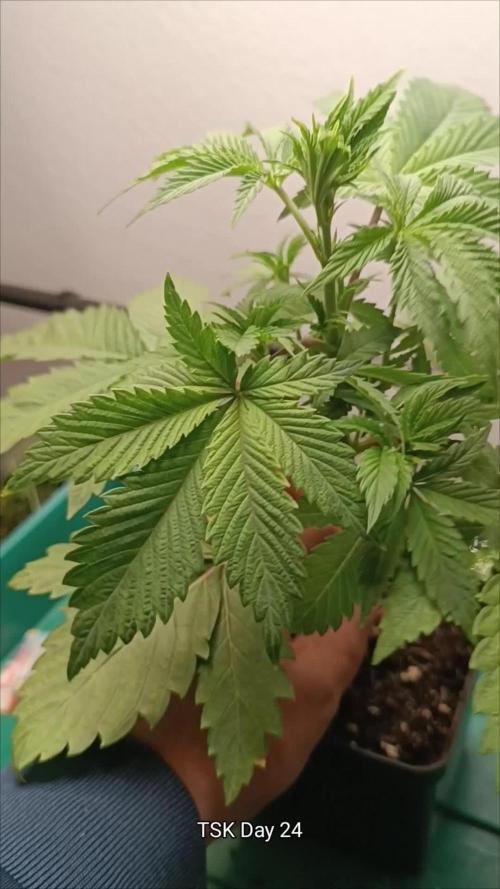
Die 4. Woche beginnt, haben sich soweit schön entwickelt, beide sind sehr kräftig 💪
Werde etwas Mg geben weil sie mir etwas zu "fleckig" aussehen.
Könnte demnächst auch umtopfen, die nächsten Töpfe stehen schon bereit : es geht in 20l airpots
Tag 24 habe ich umgetopft - es wurde auch höchste Zeit!! Aber ich wollte eigentlich warten bis das Zelt frei ist und die Mädels umziehen können, doch die Töpfe waren einfach zu klein und sie zeigten leichten Mg Mangel, also musste ich jetzt doch schneller umtöppeln

Likes
5
Share


@pHilosophy420
Follow
She is getting nice and fat next few weeks and it will be harvest time. This strain should taste nice so another strain I'm looking forward to smoke
Likes
55
Share


@nonick123
Follow
Día 64 (17/03) Riego con 500 ml H2O EC 0,45
Estamos en el día 36 de floración y empieza a mostrar una senescencia preciosa 😍💥
Día 65 (18/03) Riego con 500 ml H2O EC 0,45
Día 66 (19/03) Dia 39 de floración y la senescencia empieza a avanzar en algunas hojas. Unos colores preciosos!
Riego con 150 ml H2O EC 0,45
Día 67 (20/03) Riego con 500 ml H2O EC 0,45
Día 68 (21/03) Riego con 500 ml H2O EC 0,45
Día 69 (22/03) No riego (vacaciones)
Día 70 (23/03) No riego (vacaciones)
🚀 Khalifa Genetics - https://khalifagenetics.com/product/lemon-blanco-v3/ @khalifa.genetics
💦 BioTabs 15% DISCOUNT code "GDBT420" biotabs.nl/en/shop/ @biotabs_official
🌱Substrate PRO-MIX HP BACILLUS + MYCORRHIZAE @promixmitch @promixgrowers_unfiltered
💡2 x Mars Hydro FC1500 EVO Led Grow Light (2024 NEW FC 1500-EVO Samsung LM301H 150W LED) - https://marshydro.eu/products/fc1500-evo-led-grow-lights/ - https://www.amazon.de/dp/B0CSSGN5D8?ref=myi_title_dp

Likes
5
Share


@NordicClosetGrower
Follow
Another week of slow growth has gone by, thought I end it with another round of topping on one of the plants. I'm looking to make up for the previous grow where I didn't top at all and it produced so little, hope I don't go overboard with things :D


Likes
22
Share


@ButterfliesLittleFarm
Follow
Hello Diary.
The first week of flowering on my little farm is over, so I started photographing the plants in more detail and I will now start photographing on a black background as well now that they are much more interesting and beautiful. 😍
I changed the light regime in the Box, now the plants have 4 hours of darkness and 20 hours of light.
As you can see in the photos, Fat Banana grew 72cm in the first 30 days which I would say is the average for Automatic on my Farm. Compared to Haze Berry it is slightly lower, but considering the strain, it was also to be expected.
We’ll see how much more it will grow, I hope it stays lower than 100cm. 😏
My plan is to do defoliation in a day or two. Watering has become quite difficult due to the amount of leaves and branches but I think it will come in handy to aerate them anyway.
The flowers develop nicely and there are many of them, Fat Banana is not somehow symmetrical, the branches developed differently, so it looks a little strange, but I really like it because of its naturalness.
I still add BioBizz as scheduled for the current week and add CalMag but only preventively in a smaller dose. Watering is on average every two to three days.
Another Haze Berry who keep her company on the Farm, I put in the middle and put a pot underneath to bring it closer to the light. It is now a real little jungle on the Farm so defoliation is a must.
I am satisfied with how the plants are developing, they have good conditions and I think they are enjoying my "Little Farm". 😎
Let’s take a look at what happened this week.
17/10/2020 - Day 23.
Watering and changing the light. I added BioBizz according to the schedule for the first week of flowering, I replaced Fish-Mix with Bio-Grow. I still add 1.5 ml / lit of CalMag for prevention. p.H. I dropped to 6.6 with Plagron’s Lemon Kick.
After watering I changed the light mode to 20/4.
Temp / Humidity on the farm - 25.2 degrees and 41% humidity.
20/10/2020 - Day 26.
Watering. Same procedure as three days ago. p.H - 6.5
Temp / Humidity on the farm - 26.2 degrees and 43% humidity.
22/10/2020 - Day 28.
Photographing and measuring plant height. Since the beginning of flowering, the motives for photography have doubled , so the number of photos has increased.
Temp / Humidity on the farm - 25.5 degrees and 45% humidity.
Fat Banana Auto - Day 28. - 72 cm
This is it for the first week of flowering, now I still have to do defoliation and then with pleasure follow the development of flowers. See you soon. 🙌
Likes
20
Share

@For2itous
Follow
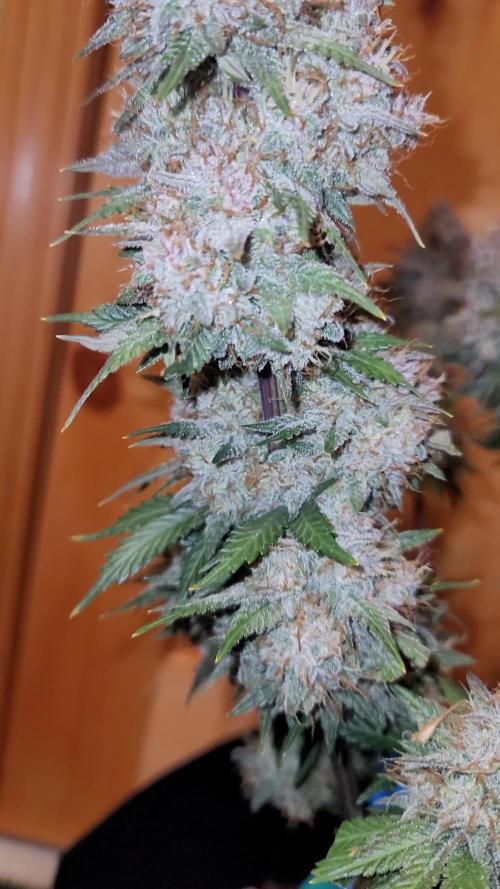
The plant grew superb and was everything you want in an autoflower just the terps aren't my cup of tea. Got 74g good bud and 27g of lowers. The smoke is still really smooth and pleasant high I'm just more about in your face terps which this plant slightly lacks. Happy growing 🌴 Happy 420
Likes
87
Share


@Mrs_Larimar
Follow
This is Harvest Part2, i harvested the Topbuds 10 days ago
First part were 100g dry, iam guessing for 60 gram more( dried)
This Growoff was alovely Journey and I had alot of fun
I want to thank all the Sposors, that helped us to raise Doations for Woman in Need
@weedseedsexpress
@urban_chili
@greenbuzzliquids
@Herbiesheadshop_com
@genoneeleven_nutrients
@zamnesiaxseeds
@spilffseeds
@Inseediousseeds
@sgreenlab
@royalqueenseedsrqs
@viparspectraled
and all the follower on Instagram and here who liked our Postings
Likes
3
Share

@Emerald_Gardens
Follow
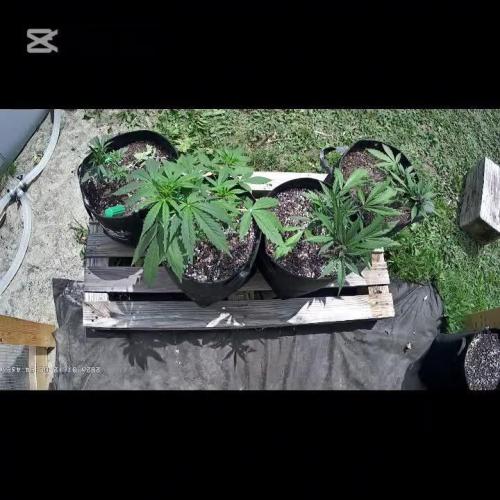
Purple lemonade smelling super lemony. Og kush looks like its just about starting flower. Mystery plant is still very compact and nice dark green. Purple lemonade and mystery strain is not getting any taller and the purple lemonade is starting to stack flowers
Likes
35
Share


@SooSan
Follow
90x60x140 (Mars Hydro)
FC-E4800 (Mars Hydro)
Easy2go Aquavalve5 (Autopot)
Living Soil (Demetearth)
Bruce Banner (PEV Seed)
Gorilla GG4 (Ganja Farmer)
Cream Caramel (Sweet Seed)
Gorilla Gelato (Ganja Farmer)
Blueberry (00 Seed)
Kalini Asia (Zamnezia)
Biscotti Mintz (Barney's Farm)
Blackberry Cake (Sensi Seed)
Amsterdam Amnesia (Dutch Passion)
Gelato Cookie (Ganja Farmer)
Purple OG Punch (Ganja Farmer)
Sweet ZZ (RQS)
Rainbow Road (Paradise Seed)
Substrat ~50L:
30L Super Light Mix Biotechnologie
18L coco
2L perlite
1,7kg lombricompost
350g guano de chauve-souris
350g Zéolithe
350g Basalte
170g guano vers de farine
170g biochar
0,7g Endomychorise glomus intraradices
0,7g Bacillus Amyloliquefaciens
Paillage de luzerne alfalfa
Arrosage avec 2ml/L de mélasse de canne 1x par semaine
Pulvérisation avec 1% d’huile de neem jusqu'à la 2eme semaine de floraison


Likes
37
Share


@RFarm21
Follow
Boas growmies!
O gráfico dos nutrientes corresponde à alimentação da royal gorilla #1 (a mais desenvolvida) foram misturados em 2L de água, foi a primeira vez que usei o bio bloom nela! (21/07/2021).
Alimentacao das Royal Cheeses (21/07/2021) - usei 3L para as duas:
BioGrow - 1,8 ml ; BioHeaven - 2 ml; Activera - 1ml; CalMag - 0,3 ml; E.C = 0,37 /pH = 6,3 - Na próxima semana irei adicionar o BioBloom
Alimentação da Royal Gorilla #2 (21/07/2021) - 1,5L
BioGrow - 1 ml; BioHeaven - 1ml; Activera - 1ml; CalMag - 0,5 ml;
E.C = 0,41 / pH 6,3
Embora o seu desenvolvimento esteja um pouco estranho, ja apareceram os primeiros pistilios. Os ramos da planta parecem fracos quando tentei fazer LST apenas com as maos, por isso nao irei realizar qualquer treino nesta, vou deixar crescer naturalmente para ver no que dá.
Boa semana a todos e espero que gostem do diario.
Likes
27
Share


@Wicked_Stix
Follow
We are at 21 days from these girls breaking the surface and they are making progress. I noticed at the beginning of the week that they were a little overdosed on nitrogen so I added 2 gallons of tap water to the reservoir and adjusted the ph to 6. They are still looking a little heavy on N but their growth rate is going great so I think it should balance out by the end of next week. I dont plan on doing a water change until I flower them. I left the plants alone most of the week. Tied most of them down to spread them out and defoliated a few lower leaves on day 20. The branches on most of these plants are thick and solid already. They don't budge easily. Bananasicle is looking pretty funky with uneven branch and node growth but we are just going to push forward. Still pumping nutrients and beaming light 24 hours a day. I'm thinking day 28 we will switch them to flower and see if any of these ladies can bring some❄️🔥💨