


Likes
Comments
Share



Processing
Likes
6
Share


@dank604
Follow
Coming along now, I think her early breaching caused a bit of a slow-down, could also be due to the transplant or combination but she's on her way. I don't plan on feeding any nutes until week 4 this time around, FFOF seems to be a hot soil so I want to learn from my 1st grow.
Happy growing y'all!

Likes
12
Share


@Wilstang
Follow
Shout-out to the award winning Spliff Seeds for the amazing opportunity to test there phenomenal strains. This one of a kind company has so much to offer from great customer service to unique one of a kind strains. They have many top notch new and classic seeds to choose from. It's an honor to grow this seed 🌱💪

Likes
10
Share


@Itslegalnow
Follow
Smells are wonderful. Might get some seeds from one of them. The short one is nothing to write home about but i really love the grapefruit smell coming from the taller gal.

Likes
5
Share


Likes
15
Share

@Highsenberg82
Follow
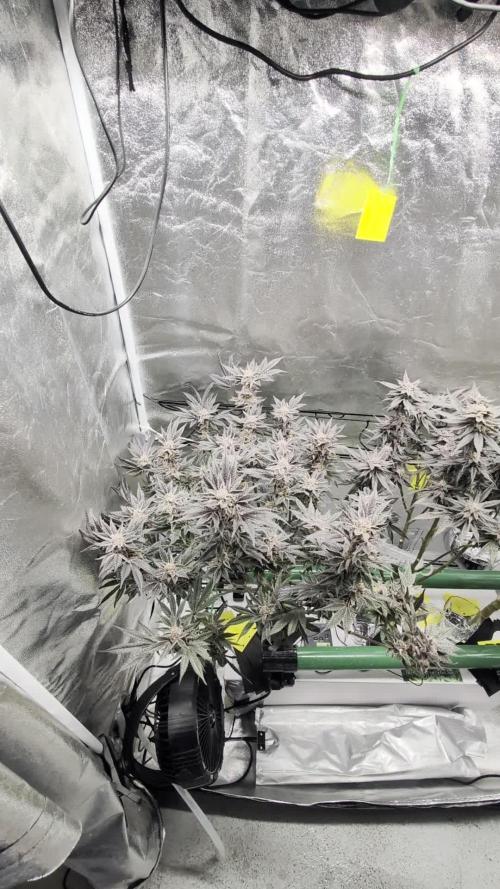
(Maybe) final week. Trichomes ckeck looks like there's still some time. Nice color so far. Cherry Gar-see-ya is pretty dark now.
For the last 4 days just Flawless Finish and Cleanse.
03/25/2026
It looks like the grape balls are taking the longest of all of them. I should probably remove some leaves so the buds lower down get a bit more light. Also new white stamps on sour fraise buds. Another week until hanging them?
03/27/2026
Sour Fraise and Cherry Gar-see-ya will go to drying the next 24h. Grape Balls of Fire e needs another week.

Likes
2
Share


@PapaTerps
Follow
Shake Back - Compound Genetics
Week 3 of Bloom
🌸 She has finished her stretch and has grown incredibly well considering she's only in a 5L. She has been vigorously developing her flower and is working hard on bulking now. Her aroma has appeared too, a fresh green apple scent with a gassy undertone. The temperatures have been up and down over the last week or so, so I've added the AlgAMix into her feed to help the plant deal with the fluctuating.👌🏻 From today, all the girls will be moved into a 8x4 tent, because the 5x5 has been hard to manage.
✂️ I've lollipopped her again after she finished her stretch, removing all leaves stems and budsites below the top 6 nodes from the canopy - these lower branches won't develop into anything and will more than likely cause problems later down the line. I've also removed a couple of the larger fan leaves from her center, to improve airflow and light penetration 💪🏻
💧 Watered every three days with 3L of RO water, with nutrients mixed individually, in order and then finally, I pH'd the solution to 6.3. I've increased some of her nutrients and added the Alg-A-Mix as a precaution to any temperature fluctuating that might occur this time of year. The Grow and Bloom nutrients won't change much from her, but the other supplemental nutrients will fluctuate depending on her needs.
💡 PPFD: ~850
♒ VPD: 1.38kPa
🌱 Days from seed: 86
🌸 Days in Bloom: 25

Likes
19
Share


@Homegrown93
Follow
She’s looking strong this week. I can tell her buds are starting to fatten and she looks like she’ll be taking her time to finish. Also stoked about the new beans!

Likes
70
Share


@Santica_Garden
Follow
Things are abit hectic at the moment in the garden as all my tents are currently occupied so these guys have to share for the next few days.... More information on the video I have uploaded.... Sorry I couldn't give you guys a better update

Likes
34
Share


@rhodes68
Follow
11/22 Week 14 One has fallen five remain
FFT-11-1 is in dry
Rate of harvest as much weather driven as anything dont want a lot exposed at once. Planning every 2-3 days
FFT-10 is in full bud building mode still so keeping the pedal down on them with a 10/10 finishing feed till we see some closure on those buds.
FFT-9 is really showing great color purple so deep almost black water only
FFT-11-2 is waiting her turn water only
11/23
pics
Harvest FFT-11-2 in the morning
11/24
Yield on FFt-11-1 : 189 grams dry
FFt-11-2 in dry (1100 grams wet)
11/25
Unless the weather turns on us will harvest both FFt-9s tomorrow
FFt-11-2 still in dry be finished tomorrow
11/27
The FFT-10 stands alone , showing signs of ending, putting them on a finishing feed and reduce as the buds close
11/28
Welp those signs of ending backed off and she making buds heavy again.
Go girls go not reducing feed till this goes as far as it will zero pressure to harvest.
Lights on pics
Built a better jute cage for FFT-10-2 she is very wide and there was a danger of branches breaking from weight of buds.
Increased Bloom and Peak PK hitting them a bit harder as dont want noticeable def beginning until I want them as much as practical.
Buds still spikey and hairs strong though seem a few less its not much.
Seems every time we switch up our PK for them it triggers another round of production.
See what what when they begin to slow again.
This is fun dont get to do this... ever... no space pressure finally although thats due to problems in germ more than my design going forward I think.
Plants are at max par being under their individual ts-2000s so I killed the side lights not doing a lot anyway with the tent near empty
11/30
At lights on the buds seem to be slowing, reducing the Bloom nuets and PK after a single hard hit to see if they pick up

Likes
158
Share


@ClubRiot
Follow
Tropicanna Banana
Week 14
11L Pot
LED: SP250 (245W) for Flow. Stage
Canna COCO
Mineral Nutrients:
👇
Sensi Cal-Mag Xtra: 1 ml/L
Power House Part A: 1.5 ml/L
Calcium Plus Part B: 1.5 ml/L
Stimulus: 1.5 ml/L
Bud Explosion: 1.5 ml//L

Likes
3
Share


@Out_of_flowers
Follow
Nice flowering
lower first branches cut off..
New change nutrients on PLAGRON for a blooming.
Likes
74
Share


@AsNoriu
Follow
Day 88. Girl down ;)
Think she will be in 70-80 g area, with about 50W light per plant - not bad ;)))
Presume all girls left will brake that plank ;)
Happy Growing !!!


Likes
12
Share


@BudMunchies
Follow
09/24: flowing away! They are looking good. Water hooked up today. Looking forward to seeing how they progress this week. Purple is coming in! 😀
Likes
9
Share


@RhodiesGrow
Follow
Twenty20 Mendocino Cosmo Auto from the Speakeasy line. Freebie from NASC. Germinated in rapid rooter placed in AC Infinity propagator. Temp 75º RH 85% +
Lineage: Biscauto x Whiskey Zulu
Filial Generation: (F1)
PVI (Phenotypic Variation Index): Above Average
First sign of flower in days: 16-20 days
Total life cycle in days: 74-80 days
Aroma/Nose: Cinnamon, rubber, fuel, musty grapes
GERM UPDATE 5/10/23: COSMO is an absolute powerhouse! She was first to pop and has the thickest stem of all the ladies at only 4 days old. I'm seeing excellent genetics at this early stage and can't wait to see her blossom.

Likes
16
Share


@AutoCrazy
Follow
Week 5
I am happy with the progress of this plant. She has 4 tops now so it won’t be long until I get her up to the magic number, 8. Things are chugging along nicely so far.
Cooler internals:
6.2pH
0.4 EC
65 F solution temp
Onward 😎🍻
Likes
51
Share


@MadeInGermany
Follow
Info:
Unfortunately, I had to find out that my account is used for fake pages in social media.
I am only active here on growdiaries.
I am not on facebook instagram twitter etc All accounts except this one are fake.
Flowering day 51
since time change
since 12/12 h.
Hey guys :-) .
The buds keep getting bigger and smelling better and better. Since she will be ready in the next 12-16 days, she received Clean Fruits for the first time today (see table above).
It was poured twice this week and the tent was cleaned.
Stay healthy 🙏🏻
A thank you for this wonderful strain goes out to
Herzog
https://instagram.com/herzog030?utm_medium=copy_link
and the Exotic Seeds team
You can buy this Nutrients at :
https://greenbuzzliquids.com/en/shop/
With the discount code: Made_in_Germany you get a discount of 15% on all products from an order value of 100 euros.
You can buy this Strain at :
https://www.exoticseed.eu/
Type:
Herz Og
☝️🏼
Genetics:
Larry OG X Kosher Kush
Indica 60 % / Sativa 40 %
👍
Vega lamp:
2 x Todogrow Led
Quantum Board 100 W
💡
Bloom Lamp :
2 x Todogrow Led
Cxb 3590 COB 3500 K 205W
💡💡☝️🏼
Soil :
Canna Coco Professional +
☝️🏼
Nutrients :
Green Buzz Liquids :
Organic Grow Liquid
Organic Bloom Liquid
Organic more PK
More Roots
Fast Buds
Humic Acid Plus
Growzyme Big Fruits
Clean Fruits
Cal / Mag
Organic Ph - Pulver
☝️🏼🌱
Water: Osmosis water mixed with normal water (24 hours stale that the chlorine evaporates) to 0.2 EC. Add Cal / Mag to 0.4 Ec Ph with Organic Ph - to 5.8 - 6.4

Processing
Likes
10
Share


@VovaFarms
Follow
Another good week i would say. I do simple lst but just to shape up the plants. Next week will be the last veg week. I decided to switch to 12/12 by the end of the next week. I am considering a nice pre-flower flush with pure ph-ed water mixed with some organic molasses. I won't defoliate the plants but i will do lollipop some time at week 3 of flowering.

Likes
4
Share


@The_Projexx
Follow
Welcome to week 4! The plants are really growing along now so we will be looking to transplant as soon as possible into their final homes ( 5 gallon ) I will be topping the plants this week to get some of that branching going and we will be looking to start the flowering process sooner then later. Im aiming for 2 weeks more of veg then flower time if things are in order.
Huge shout out to @MarsHydroLED for allowing me to grow with their kick ass equipment!
Huge huge shout out goes to all my followers and to the people who stop into the diary alike you guys are kick ass keep on keeping on!
-The Projexx
Day#22 Pictures N/A Things are starting to grow along nicely , aiming to transplant in a few days!
Day#23 Pictures N/A Transplanted plants into their 5 gallon homes except for 2 went into 7s and 2 stayed in their same buckets. Watered 1/2L each at 550PPM
Day#24 Plants are digging their new homes , we took some video action. Its getting hard to fit all the plants in 1 frame haha.
Day#25 Pictures N/A Plants are just growing along , going to top in the near future.
Day#26 Watered ladies 1L each from the bottom at 550PPM. Going to be bottom feeding from here to see if it makes a difference.
Day#27 Topped the plants let the branching begin!
Day#28 Ladies look unhappy but thats them adjusting for their new nodes!
Recap: Things are pushing strong this week we topped the plants and they are growing like nothings happened. I dont know that Im a fan of bottom feeding the plants but well see how things develop in the near future, I may have to practice the technique until im comfy with it as I would normally top feed.
Likes
12
Share


@Marihumama
Follow
Harvested by cops last Friday. emptied my garden competely😢😢😢😢 but forgot one tiny little girl😇they complimented the Dark Devil 😈😍

Likes
90
Share


@Mrs_Larimar
Follow
The Tanraka were vigor growing from the Beginning.
The plant is well structured, i just topped once.
the 2 potted Plants were ready , the biggest, stanfing in the Ground would have loved to stay 2 more Weeks,
but Weather was so bad this Year,
I had to harvest due the high Risk of Mold
The Plants built long colas, those were stuffed with dense , lovely smelling Flowerbuds
2 Plants had magenta Pistils
Iam very fine with this Grow. Plants had anice aesthetic look, and crowned my Garden
Thank you @James, for the Support, over the last Years.
#Legalize Worldwide
