The Grow Awards 2026 🏆
Likes
Comments
Share
@DniceWJ
Follow
Day 1 I’m looking forward to more days.😍 LSD journey September 14, 2021 day one of germination temperature is 71° My germination technique is to put the seed into the soil And keep the little pot warm and wet, light schedule is 18 hours of light. I’m using a MARS HYDRO Grow Tent Kit Complete TS 600W LED Grow Light 2x2ft Full Spectrum Indoor Grow Tent Kit 24"x24"x55" Hydroponics Grow Tent 1680D Canvas with 4” Ventilation Kit for Grow Setup Kit Tent Kit (Amazon) , General hydroponics power grower Kit (Amazon). The grow light is 8” from the pot keeping my little girl warm. Starting today I will be following the recommended feeding schedule for week one floral micro 2.5 mL a gallon floral Gro 2.5 mL a gallon floral bloom 2.5 mL a gallon, I will be doing this once a week increasing the amount of nutrients as needed. I will be Change your nutrients every 7 to 10 days and topping off with fresh water between nutrient changes on September 21, 2021 I will be topping off with freshwater and adding nutrients on September 22, 2021
Likes
2
Share
@nickeri
Follow
9.7.2k24✅ 💚 Flowering 🌸👌 Nutri: Plagron Alga Bloom = 4 ml/l Plagron PK 13-14 = 1,5 ml/l Plagron Sugar Royal = 1 ml/l 🌹🌹🌹 Fan adjusted and large leaves torn off 🌿 13.7.2k24 + Biobizz Alg-a-Mic = 4 ml/l
Likes
18
Share
Green light is radiation with wavelengths between 520 and 560 nm and it affects photosynthesis, plant height, and flowering. Plants reflect green light and this is why they appear green to our eyes. As a result, some growers think that plants don’t use green wavelengths, but they actually do! In fact, only around 5 – 10% of green light is reflected from leaves and the rest (90 – 95 %) is absorbed or transmitted to lower leaves [1]. Green wavelengths get used in photosynthesis. Chlorophyll pigments absorb small amounts of green wavelengths. Light that doesn’t get absorbed is transmitted to leaves that are shaded out from direct light. This means that leaves at the bottom of the canopy get more green light than leaves at the top. A high proportion of green wavelengths compared to other colors tells lower leaves that they are being shaded out, so they are able to react accordingly. Lower leaves may react by opening or closing their stomata or growing longer stems that help the leaves reach brighter light [1, 2, 3]. When it comes to growing cannabis, many cultivators are interested in the quality of light used for the flowering stage. In many plants, flowering is regulated by two main photoreceptors: cryptochrome and phytochrome. Both photoreceptors primarily respond to blue light but can also respond to green, although to a lesser extent. Green can accelerate the start of flowering in several species (although cannabis has yet to be tested) [1, 4, 5]. However, once flowering has begun, it’s important to provide plants with a “full spectrum” light that has high amounts of blue and red light, and moderate amounts of green, in order for photosynthesis to be optimized. Green light mediates seed germination in some species. Seeds use green wavelengths to decide whether the environment is good for germination. Shade environments are enriched in green relative to red and blue light, so a plant can tell if it is shady or sunny. A seed that senses a shaded environment may stay dormant to avoid poor growing conditions [1]. Some examples of plant species where researchers have documented this response are: ryegrass (a grass that grows in tufts) and Chondrilla (a plant related to dandelion) [1, 6]. Although green wavelengths generally tell plants NOT to germinate, there are some exceptions! Surprisingly, green wavelengths can stimulate seed germination in some species like Aeschynomene, Tephrosia, Solidago, Cyrtopodium, and Atriplex [1, 6, 7]. Of course, light is not the only factor affecting seed germination – it’s a combination of many factors, such as soil moisture, soil type, temperature, photoperiod, and light quality. When combined with red and blue light, green can really enhance plant growth [1, 8]. However, too much green light (more than 50% of the total light) can actually reduce plant growth [8]. Based on the most current research, the ideal ratio of green, red, and blue light is thought to be around 1:2:1 for green:blue:red [9]. When choosing a horticultural light, choose one that has high amounts of blue and red light and moderate amounts of green and other colors of light. Not many studies can be found about the effect of green light on cannabis growth or metabolism. However, if one reads carefully, there are clues and data available even from the very early papers. Mahlberg and Hemphill (1983) used colored filters in their study to alter the sunlight spectrum and study green light among others. They concluded that the green filter, which makes the environment green by cutting other wavelengths out, reduced the THC concentration significantly compared to the daylight control treatment. It has been demonstrated that green color can reduce secondary metabolite activity with other species as well. For example, the addition of green to a light spectrum decreases anthocyanin concentration in lettuce (Zhang and Folta 2012). If green light only reverses the biosynthesis of some secondary metabolites, then why put green light into a growth spectrum at all? Well, there are a couple of good reasons. One is that green penetrates leaf layers effectively. Conversely red and blue light is almost completely absorbed by the first leaf layer. Green travels through the first, second, and even third layers effectively (Figure 2). Lower leaf layers can utilize green light in photosynthesis and therefore produce yields as well. Even though a green light-specific photoreceptor has not yet been found, it is known that green light has effects independent from the cryptochrome but then again, also cryptochrome-dependent ones, just like blue light. It is known that green light in low light intensity conditions can enhance far red stimulating secondary metabolite production in microgreens and then again, counteracts the production of these compounds in high-intensity light conditions (Kim et al. 2004). In many cases, green light promoted physiological changes in plants that are opposite to the actions of blue light. In the study by Kim et al. blue light-induced anthocyanin accumulation was inhibited by green light. In another study it has been found that blue light promotes stomatal opening whereas green light promotes stomatal closure (Frechilla et al. 2000). Blue light inhibits the early stem elongation in the seedling stage whereas green light promotes it (Folta 2004). Also, blue light results in flowering induction, and green light inhibits it (Banerjee et al., 2007). As you can see, green light works very closely with blue light, and therefore not only the amount of these two wavelengths separately is important but also the ratio (Blue: Green) between these two in the designed spectrum. Furthermore, green light has been found to affect the elongation of petioles and upward leaf reorientation with the model plant Arabidopsis thaliana both of which are a sign of shade avoidance symptoms (Zhang et al. 2011) and also gene expression in the same plant (Dhingra et al. 2006). As mentioned before, green light produces shade avoidance symptoms which are quite intuitive if you consider the natural conditions where the plants grow. Not all the green light is reflected from the highest canopy leaves in nature but a lot of it (50-90%) has been estimated to penetrate the upper leaves at the plant level ((Terashima et al., 2009; Nishio, 2000). For the plant growing in the understory of the forest green light is a signal for the plant of being in the shade of a bigger plant. Then again, the plants growing under unobstructed sunlight can take advantage of the green photons that can more easily penetrate the upper leaves than the red and blue photons. From the photosynthetic pigments in higher plants, chlorophyll is crucial for plant growth. Dissolved chlorophyll and absorb maximally in the red (λ600–700 nm) and blue (λ400–500 nm) regions of the spectrum and not as easily in the green (λ500–600 nm) regions. Up to 80% of all green light is thought to be transmitted through the chloroplast (Terashima et al., 2009) and this allows more green photons to pass deeper into the leaf mesophyll layer than red and blue photons. When the green light is scattered in the vertical leaf profile its journey is lengthened and therefore photons have a higher chance of hitting and being absorbed by chloroplasts on their passage through the leaf to the lower leaves of the plant. Photons of PPFD (photosynthetic photon flux density) are captured by chlorophyll causing an excitation of an electron to enter a higher energy state in which the energy is immediately passed on to the neighboring chlorophyll molecule by resonance transfer or released to the electron transport chain (PSII and PSI). Despite the low extinction coefficient of chlorophyll in the green 500–600 nm region it needs to be noted that the absorbance can be significant if the pigment (chlorophyll) concentration in the leaf is high enough. The research available clearly shows that plants use green wavelengths to promote higher biomass and yield (photosynthetic activity), and that it is a crucial signal for long-term developmental and short-term dynamic acclimation (Blue:Green ratio) to the environment. It should not be dismissed but studied more because it brings more opportunities to control plant gene expression and physiology in plant production. REFERENCES Banerjee R., Schleicher E., Meier S. Viana R. M., Pokorny R., Ahmad M., Bittl R., Batschauer. 2007. The signaling state of Arabidopsis cryptochrome 2 contains flavin semiquinone. The Journal of Biological Chemistry 282, 14916–14922. Dhingra, A., Bies, D. H., Lehner, K. R., and Folta, K. M. 2006. Green light adjusts the plastic transcriptome during early photomorphogenic development. Plant Physiol. 142, 1256-1266. Folta, K. M. 2004. Green light stimulates early stem elongation, antagonizing light-mediated growth inhibition. Plant Physiol. 135, 1407-1416. Frechilla, S., Talbott, L. D., Bogomolmi, R. A., and Zeiger, E. 2000. Reversal of blue light -stimulated stomatal opening by green light. Plant Cell Physiol. 41, 171-176. Kim, H.H., Goins, G. D., Wheeler, R. M., and Sager, J. C. 2004.Green-light supplementation for enhanced lettuce growth under red- and blue-light emitting diodes. HortScience 39, 1617-1622. Nishio, J.N. 2000. Why are higher plants green? Evolution of the higher plant photosynthetic pigment complement. Plant Cell and Environment 23, 539–548. Terashima I., Fujita T., Inoue T., Chow W.S., Oguchi R. 2009. Green light drives leaf photosynthesis more efficiently than red light in strong white light: revisiting the enigmatic question of why leaves are green. Plant & Cell Physiology 50, 684–697. Zhang, T., Maruhnich, S. A., and Folta, K. M. 2011. Green light induces shade avoidance symptoms. Plant Physiol. 157, 1528-156. Wang, Y. & Folta, K. M. Contributions of green light to plant growth and development. Am. J. Bot. 100, 70–78 (2013). Zhang, T. & Folta, K. M. Green light signaling and adaptive response. Plant Signal. Behav. 7, 75–78 (2012). Johkan, M. et al. Blue light-emitting diode light irradiation of seedlings improves seedling quality and growth after transplanting in red leaf lettuce. HortScience 45, 1809–1814 (2010). Kasajima, S., et al. Effect of Light Quality on Developmental Rate of Wheat under Continuous Light at a Constant Temperature. Plant Prod. Sci. 10, 286–291 (2007). Banerjee, R. et al. The signaling state of Arabidopsis cryptochrome 2 contains flavin semiquinone. J. Biol. Chem. 282, 14916–14922 (2007). Goggin, D. E. & Steadman, K. J. Blue and green are frequently seen: responses of seeds to short- and mid-wavelength light. Seed Sci. Res. 22, 27–35 (2012). Mandák, B. & Pyšek, P. The effects of light quality, nitrate concentration and presence of bracteoles on germination of different fruit types in the heterocarpous Atriplex sagittata. J. Ecol. 89, 149–158 (2001). Darko, E. et al. Photosynthesis under artificial light: the shift in primary and secondary metabolism. Philos. Trans. R. Soc. B Biol. Sci. 369 (2014). Lu, N. et al. Effects of Supplemental Lighting with Light-Emitting Diodes (LEDs) on Tomato Yield and Quality of Single-Truss Tomato Plants Grown at High Planting Density. Environ. Control Biol. 50, 63–74 (2012).
Likes
10
Share
Chopped her down after 2 days of darkness before a slow dry for 1-2 weeks Keeping humidity at 58-63 and temperature in mid to low 60s.
Likes
9
Share
Day 15: Cosmo is looking strong. No more top heavy look after a full day of full fan and a night's rest. First big feed: 4ml FloraMicro, 6ml FloraGro, 3ml FloraBloom, 2ml CALiMAgic, 1ml RapidStart, 1ml Floralicious Plus and 2.5ml Armor Si. RO water PH 6.0 Temp: 75º RH: 63% PPFD: 450 VPD: .53 kPa Day 16: Cosmo doing well. New leaf growth showing this morning. No water no feed. Temp: 76º RH: 61% PPFD: 475 AVG VPD: .46 kPa Day 17: Looking healthy and happy. Applied some LST this morning. Feed tomorrow. Temp 77º RH: 55 % PPFD: 500 AVG VPD: .6kPa Day 18: All is well the nursery. Fed 250ml of 4ml FloraMicro, 6ml FloraGro, 3ml FloraBloom, 1ml RapidStart, 2.5ml ArmorSi, 2ml CALiMAGic and 1ml Floralicious in RO water PH 6.2 PPM: 750 Solution Temp: 69º. Tent Temp: 77º RH: 60% PPFD: 500 VPD: .44 kPa Day 19: Looking good. Tent Temp: 77º RH: 60% PPFD: 550 VPD: .44 kPa Day 20: Still looking good. New growth. Fed another 250ml RO water with 1ml RapidStart PH: 5.7 Tent Temp: 77º RH: 60% PPFD: 550 VPD: .44 kPa Day 21: End of Veg Week 3! Looking strong and healthy so far. Almost feeding/watering daily at this point, will up the solution volume and see if it will last a day or two longer. Fed 350ml-400ml of 4ml FloraMicro, 6ml FloraGro, 3ml FloraBloom, 1ml RapidStart, 2.5ml ArmorSi, 2ml CALiMAGic and 1ml Floralicious in RO water PH 6.2 PPM: 750 Solution Temp: 69º. Tent Temp: 77º RH: 60% PPFD: 500-550 AVG VPD: .44 kPa
Likes
15
Share
I would definitely recommend the White Widow Max Auto to a beginner grower! I hope it tastes as good as it looks.
Likes
14
Share
@Mr_Dior21
Follow
Another slow week. I increased light schedule to 13/11. I’m going to slowly lower the time of light until by the time harvest day comes it’ll have a longer dark period. I’m also going to stop feeding the bottle nutrients my soil is moist still so I gotta wait. I’m predicting a couple ounces this grow.
Likes
3
Share
The girl is looking good, though it could have been much larger by this time. I wish I gave it more light and more nuts in the previous weeks. Well, it will have to spend more time in veg. It got topped this week, at the 6th node, and I will do it once more before flipping them, so in total there will be 10 lower branches + 4 tops. I also started misting with CalMag just in case.
Likes
12
Share
@Kakui
Follow
Estuve un tiempo sin actualizar el diario porque me contagie de COVID, ahora un poco mejor vuelvo a actualizar. Flower14, las plantas crecen bien, se cambió el LED de 480w por 3 LED de 240w, para un total de 720w y mejor distribución de la luz.
Likes
29
Share
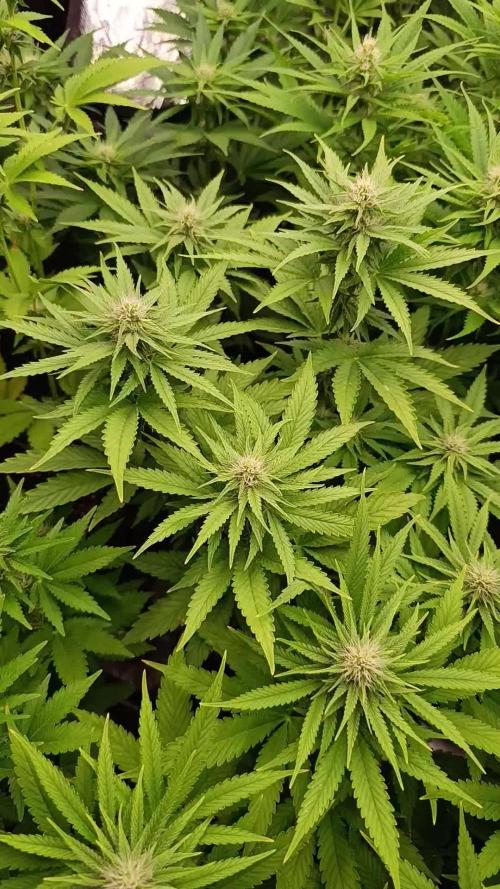
My ladies are developing AWESOME under the SANlight EVO4-120 LEDs inside my HOMEBOX growtent. All 12 have a healthy green color and grow more flowers every day now. New flowers appear every day, they look like little crowns on top of the plants. The supercropped plants have healed and are developing increased amounts of buds now as well. The nutrients from BIO NOVA have been increased to an EC-value of 1,5 now, so the plants can support their increased photosynthesis for flowering. Especially the adding of PK 13/13 brings added bud growth. Until now I LOVE how this round is going...😍
Likes
3
Share
White hairs starting to show everywhere so happy with this thanks zamnesia the genetics are crazy good and strong
Likes
53
Share
Hey Grow Diaries fam, Welcome back to another update on our PCR adventure! We're at Week 9, which marks Week 4 of the flowering stage, and things are getting exciting! Overview The PCRs are flourishing, and the transformation is nothing short of spectacular. The tent is buzzing with energy, and every day brings new developments. The buds are swelling beautifully, and the trichome production is off the charts. This week has been all about maintaining optimal conditions and ensuring our ladies get everything they need to reach their full potential. Environment and Conditions Tent: 3x3, cleaned and prepped from top to bottom to ensure a pristine environment. Lighting: ViparSpectra P2000, delivering a perfect spectrum for this stage of growth. The balanced PAR output and efficient energy use keep our girls happy and thriving. Watering: TDS at 410, pH 5.8, and water temperature at 21°C. This ensures the nutrients are perfectly balanced and readily available. Nutrient Regimen We’ve kept up with our Aptus Holland feeding schedule, and it's paying off big time. Here's the current mix: Nutritional Spray: Aptus Holland NutriSpray to keep those leaves lush and healthy. TopBooster: Replaced StartBooster with TopBooster to promote flower development. P-Boost: Added to the mix for that extra phosphorus kick, crucial for blooming. K-Boost: a must for them to go fat as we like. The results speak for themselves – lush green foliage and robust bud formation. Defoliation At the end of this week, we performed a mass defoliation. It's always a bit nerve-wracking, but the results are worth it. Removing excess leaves ensures better light penetration and airflow, reducing the risk of mold and pests. Plus, it allows the plant to focus its energy on bud production. And let me tell you, after the defoliation, the PCRs look sexy as ever with their long legs and sculpted structure! Clones Update Our clones are thriving, showing the longest and whitest roots I've ever seen. We treated them with a water mix that included K-Boost and Mycor Mix at 1 gram per liter. This combination has worked wonders, promoting vigorous root development and overall plant health. Reflections This week has been a testament to the importance of a clean environment and precise nutrient management. The PCRs are responding exceptionally well, and I couldn’t be more thrilled with their progress. We're well on our way to an incredible harvest, and I can't wait to see these beauties in full bloom. A huge shout out to: Aptus Holland: For the top-notch nutrients and constant support. You guys rock! Art Genetix: For creating such an incredible strain. The PCRs are truly something special. Grow Diaries Community: Your support and feedback are invaluable. Keep the positive vibes coming! Here’s to another fantastic week of growing! Stay positive, keep pushing forward, and enjoy every moment of this beautiful journey. Genetics - P.C.R. @Art_Genetix_Team https://artgenetix.world/ Nutricion @aptusholland https://aptus-holland.com/ LED Power @Lumatek and @viparspectra As always thank you all for stopping by , for the love and for it all, i fell blessed to have you all with me for one more love journey Thank you Thank you Thank you , you guys are great and have been amazing , thank you for everything ! #aptus #aptusplanttech #aptusgang #aptusfamily #aptustrueplantscience #inbalancewithnature #trueplantscience #dogdoctorofficial #growerslove
 With true love comes happiness , Always believe in your self and always do things expecting nothing and with an open heart , be a giver and the universe will give back to you in ways you could not even imagine so ! Growers love to you all
Likes
42
Share
Desde 13/12 a 20/12 13/12: empezó el día con lluvia en la madrugada y mucho viento. Esperemos no haya sufrido la planta ya que estaba atada y no pude ir a cortarle los hilos. El pluviómetro marcó 130ml. El viento fue fuerte pero lo soportó como una campeona. El problema es que los caminos estan feos y no se puede entrar. Tendré que esperar hasta el miércoles o jueves para poder ir a verla. 14/12: temperatura de 29ºC. Humedad de 63%. Me dicen que sigue creciendo bien, aun no se mejoran los caminos rurales así que hoy no podré ir a verla. Mañana posiblemente si y subo fotito. 15/12: tuve que pedirle a un amigo que me lleve en moto porque en auto no se puede entrar, hay mucho barro y aún no se escurre el agua de los caminos. La nena no sufrió nada. Crecio mas de 15cm desde la ultima vez que la vi. Parece que con el viento se desataron los hilos así que volví a atarla. No hizo falta riego ya que aún dura la humedad de la lluvia del domingo. 16/12: hoy fui a verla y a regarla. Me llamo la atención la fuerza que hace para irse para arriba, tanta fuerza que desató varios hilos. Tuve que volver a atarla. Se marcó a tal punto de casi quebrarse el tallo en la punta, donde doblé la planta. Le puse aloe vera natural para que cicatrice, espero de buen resultado. Por otra parte regue con 20 litros y saque muchas arañas blancas, muchos huevos y varias chinches. No nos olvidemos que el lugar de cultivo está cerrado por monte autóctono y virgen, hay cualquier cantidad de insectos. Suelo ponerle musica a la planta cuando voy a verla, hoy escuchamos el CD “Lobo suelto, cordero atado” de Los Redondos. ¿Ustedes creen que las plantas disfrutan de la música como nosotros? 18/12 - mucho calor durante la siesta/tarde. Conserva bien la humedad. Hoy regué con manguera. No encontré ningún huevo de araña, pero si una araña pequeña. Ayer no pude venir a verla por falta de tiempo, y hoy note el crecimiento de los dos días. Va bastante bien. Esta semana descansa de fertilizantes. Esperaré a fertilizar fuerte pasado el cuarto menguante. 19/12: como de costumbre fui por la tarde antes de que cayera el sol, y me encontre con la sorpresa de que tenia mucha araña roja varios sectores de la planta, muchos huevos debajo de las hojas grandes. Tuve que volver a mi casa a buscarlo Jabón Potásico para hacerle aplicación foliar. Le puse 1 litro con dos tapas de jabón; esperemos haga resultado. Mañana tendré que dedicarle más atención a la nena y sacarle todo lo que pueda de forma manual. Hoy es luna llena y alumbra muchísimo, la nena lo siente, le gusta.
Likes
79
Share
Лимонад продолжает мутировать. Была надежда, что всё успокоится, но каждый следующий узел был кривой и не симметричный, и в результате всё пришло к раздвоению основной колы, теперь у меня их две😱(см. фото). Я на 99% уверен, что не потеряю в качестве урожая, но почти также уверен, что потеряю в количестве😥 Все растишки показали пол(кто же сомневался? 420!), у лимонада начался предцвет. Поднял лампу, раздвинул горшки, примерно так они и будут стоять до конца цикла. Обрезал ручки с мешков, они мне только мешали. Спасибо, что заглянули, и будьте здоровы! 🙏 Продолжение следует ...😶
Likes
8
Share
@SkunkyDog
Follow
Hallo zusammen 🤙. Sie wächst sehr schön und fängt langsam an zu riechen.
Likes
8
Share
@Lickey
Follow
Into the 4th week of flower already. Got a bit stressed from the massive leaf stripping I did at week 3 and slow to start drinking again. Same strains drinking at 1/2 the speed of my previous grow. Lesson learned here to give the plant time to grow into the large pot before flipping to flower.