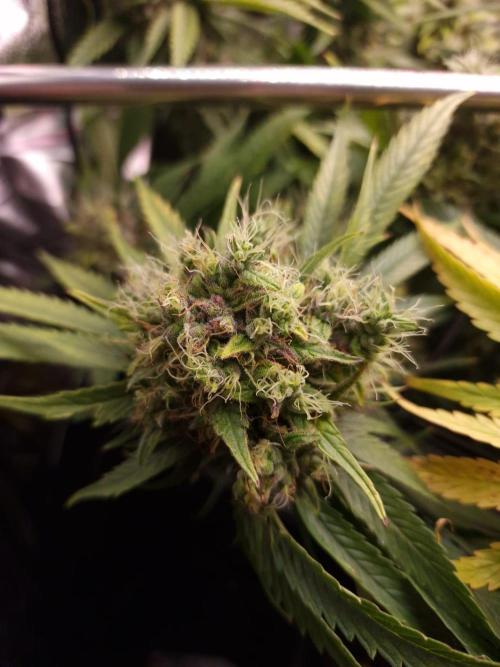
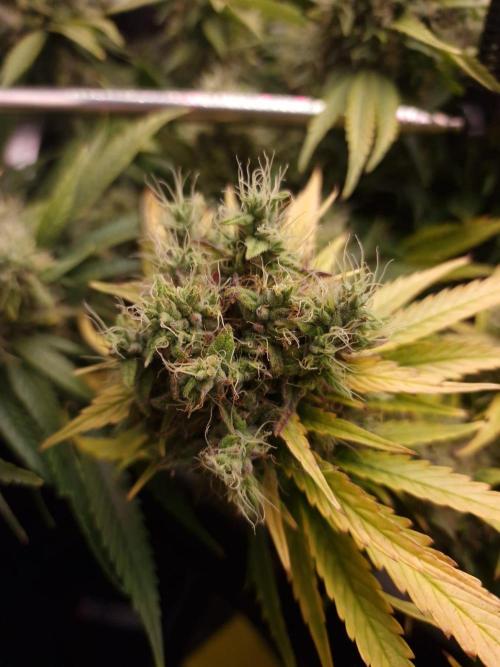
Bazooka_ HPA System Configuration
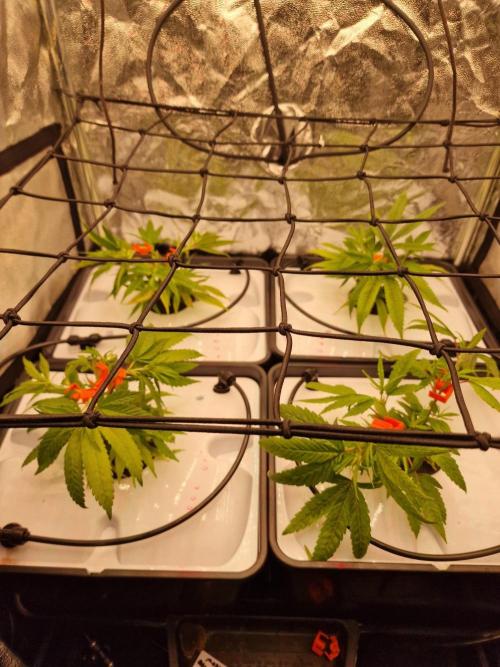
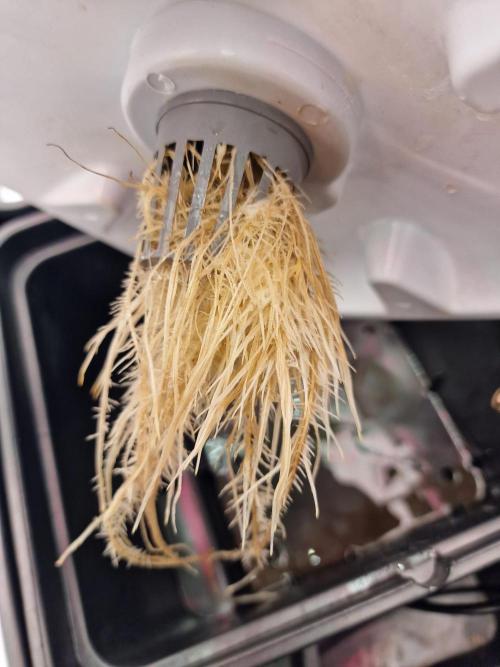
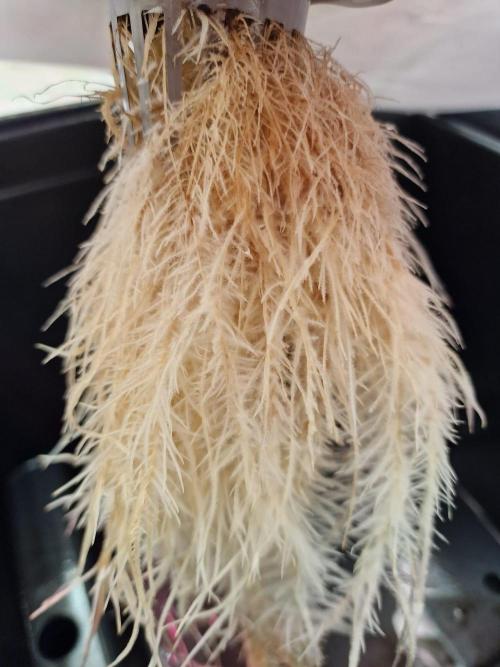
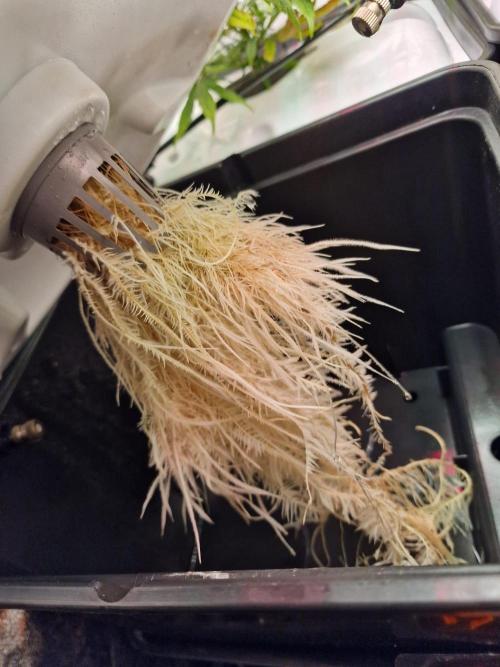
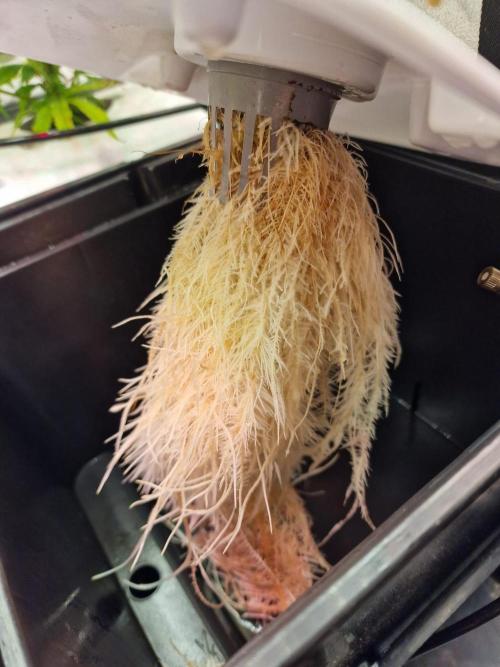
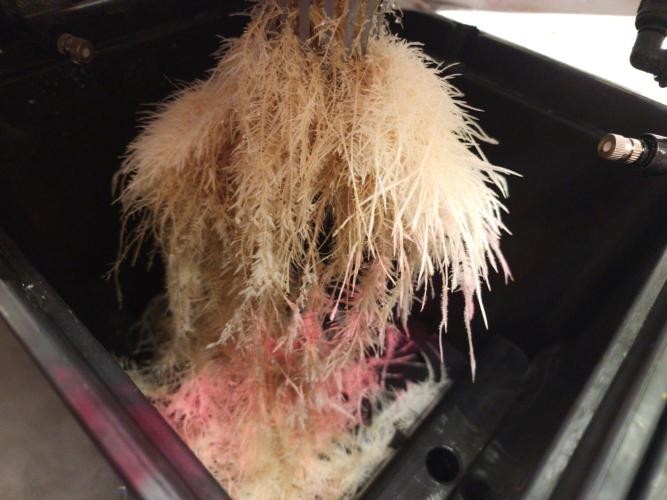
Update: Installed two sprayers per root chamber.
Nozzle Specs: Diameter 0.2 mm operating at 8-9 bar.
Cycle Timer: 3 sec ON / 15 min OFF.
Environment & Feeding
Lighting: PPFD increased daily from 400 to 800 umol/(m2*s).
Nutrients (EC): Slowly raised EC from 0.8 to 1.4 in increments of 0.2.
Plant Health
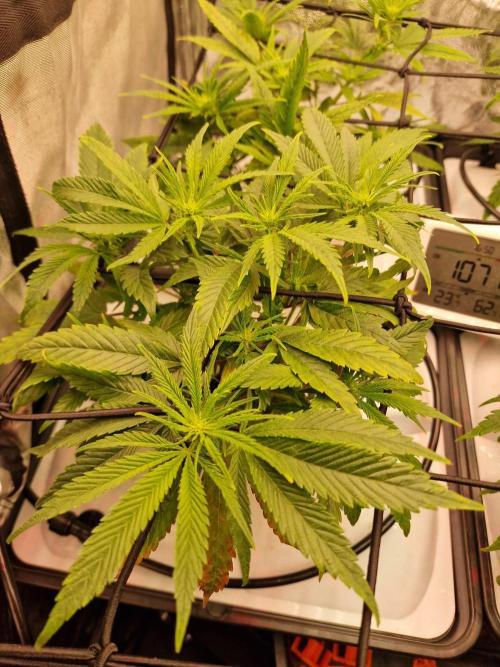
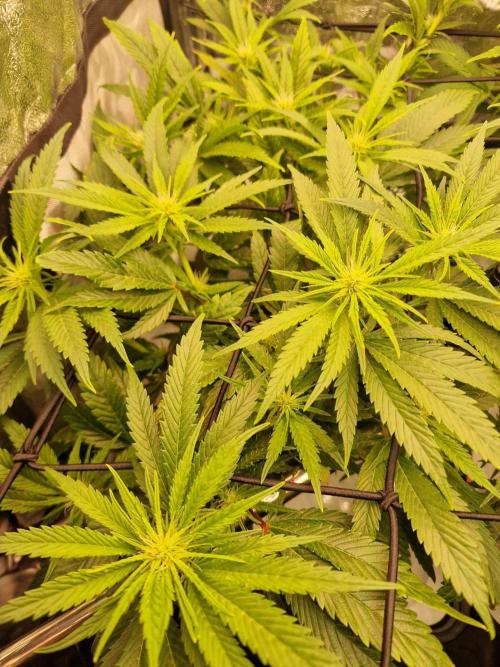
Observation: Magnesium Deficiency.
likes
comments
Share
Used techniques
LST
Technique
ScrOG
Technique
3
Week 3. Flowering
1mo ago
1/3
15 cm
Height
12 hrs
Light Schedule
24 °C
Day Air Temp
5.8
pH
No Smell
Smell
60 %
Air Humidity
19 °C
Solution Temp
20 °C
Night Air Temp
30 cm
Lamp Distance
1200 PPM
CO₂ Level
Bazooka_ Cycle Settings
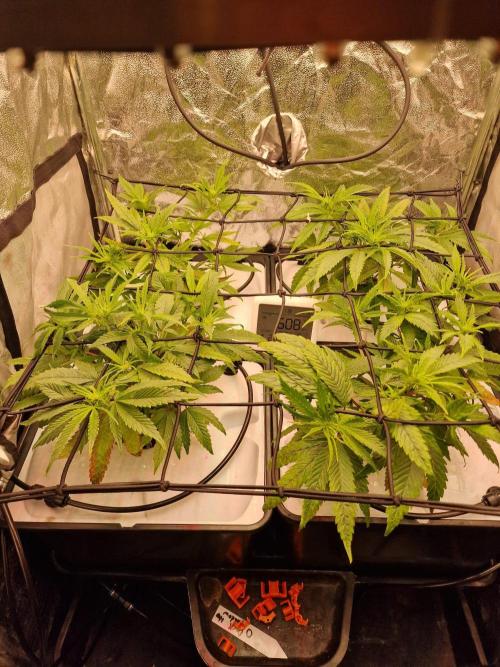
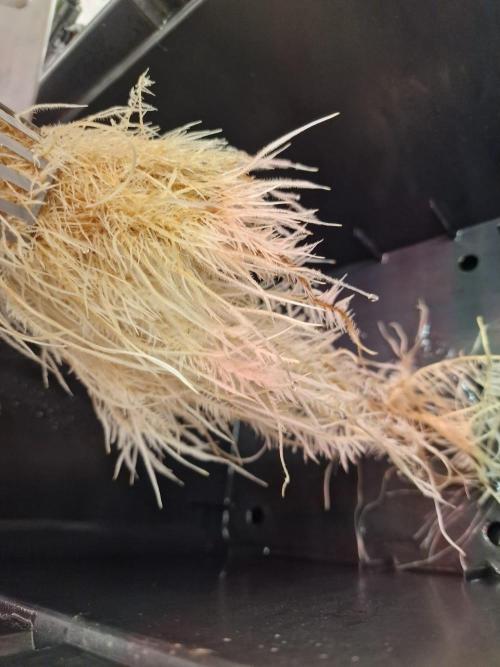
Timer: 3 sec ON / 10 min OFF
Nutrients
EC: 1.4
Environment (CO2 & Light)
Lights ON: 07:30 AM
CO2 Levels: Levels rise from morning to evening, peaking at a maximum of 1300 ppm.
Ramp-up: From approx. 11:00 AM, levels reach 1000 ppm.
likes
comments
Share
Used techniques
LST
Technique
ScrOG
Technique
4
Week 4. Flowering
1mo ago
1/6
25 cm
Height
12 hrs
Light Schedule
24 °C
Day Air Temp
5.8
pH
Weak
Smell
800 PPM
TDS
60 %
Air Humidity
19 °C
Solution Temp
19 °C
Night Air Temp
30 cm
Lamp Distance
1100 PPM
CO₂ Level
Nutrients 7
Silica Power
0.2 mll
Grow fertilizer MR1
1.4 mll
Flower fertilizer MR2
0.2 mll
Bazooka_ Update FD 20: Strategy Shift & AI-Driven Optimization
Methodology Note: This grow is executed with the support of advanced AI analysis. I feed my specific sensor logs (CSV) into an AI to analyze the data patterns deeply (e.g., correlations between fan speed and VPD stability) and to optimize my HPA cycles based on real-time data. We discuss and develop custom strategies together, leveraging the vast knowledge base available for Cannabis physiology. This diary entry is a result of that collaborative analysis.
Image Analysis: Additionally, I use AI-based visual analysis to monitor plant health. High-resolution photos are scanned to detect early signs of deficiencies or stress (like leaf angle or discoloration) before they become visible to the naked eye. This provides an extra layer of quality control.
Genetics & Training History: Started with 10cm clones of Dark Shadow Haze (Sativa-dominant).
The Fear: Massive vertical stretch.
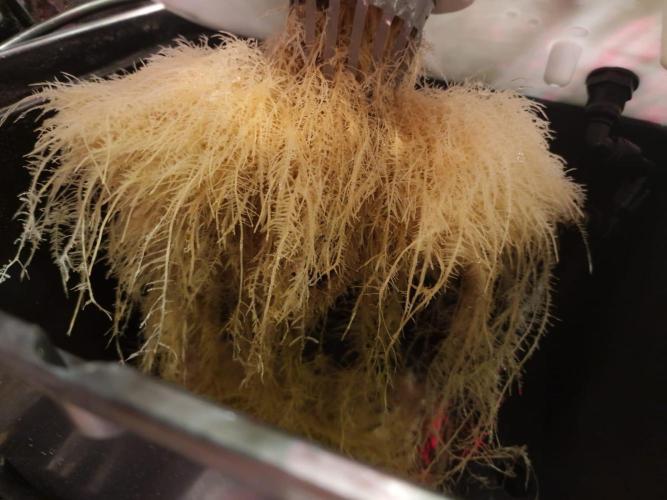
The Action: Topped early, which resulted in a 5-day stall in top growth but massive root explosion in the HPA system.
The Surprise: The high intensity of my 25W 660nm (Deep Red) LEDs kept them extremely squat and compact.
The Fix: Activated 730nm (Far Red) to induce stretch via shade avoidance. It worked perfectly – the canopy opened up, and plants are showing extreme vigor.
💨 Fan Evolution (The Game Changer):
Original Setup: Prima Klima AC Fan (2-Speed). Issue: Too dumb.
Upgrade 1: 6-Inch (150mm) EC Smart Fan. Issue: Too powerful. Minimum speed (25%) was still too much for the 60x60cm tent, stripping humidity instantly.
Final Solution (Incoming): Downsizing to a 4-Inch (100mm) EC Fan. This will allow precise low-end control to smooth out the VPD curve.
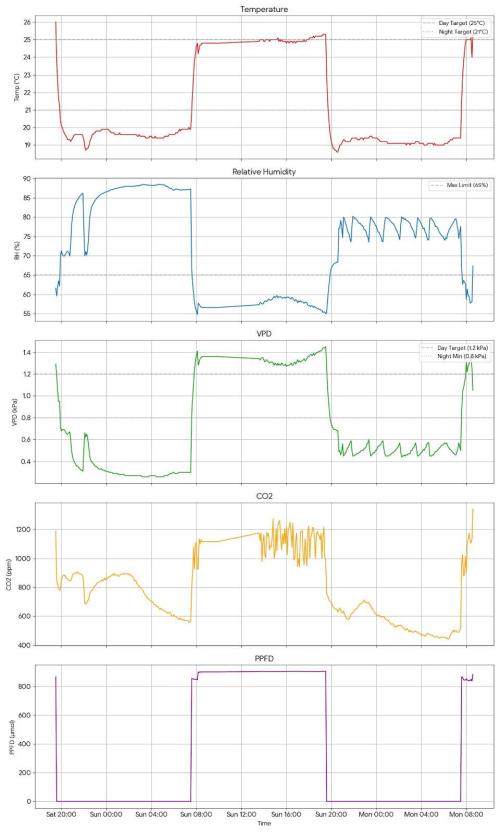
📊 Weekend Data Summary (Sat Night - Mon Morning):
DAY Phase (Optimized):
Temp: ~24.7°C (Stable)
VPD: ~1.28 kPa ("Flatline" stability achieved by reducing light to ~900 PPFD)
CO2: ~1092 ppm (Human powered + Tank boost)
NIGHT Phase (Critical Challenge):
Temp: Avg 19.6°C (Min 18.6°C)
RH: Avg 79.6% (Max 88.5%!)
Action: Night heating upgrade is mandatory to keep temps 21°C and lower RH.
CO2 Strategy: Hybrid: Tank boosts to 1000 ppm at start-up. Human respiration maintains ~1100 ppm during office hours. No waste, full saturation.
HPA Cycle: Tuned to 3s ON / 5min OFF to match the high metabolic rate.
Future Strategy (Post-Upgrade): Once the new 4-inch fan is installed and VPD control is fully regained, I will reactivate the Turbo Mode: Pushing back to 1100 umol for maximum yield potential while maintaining 1200 - 1300 ppm CO2 continuously.
UPDATE FD 17
Parameter & Nutrients
EC 1.6
Switched completely to Metrop
Maximal feathering ()
Cycle Settings
Timer: 3 sec ON / 8 min OFF
Plant & Phase
Genetics: Dark Shadow Haze (Sativa-Dominant).
Current Status: Flowering Day 17 (Peak aggressive stretch).
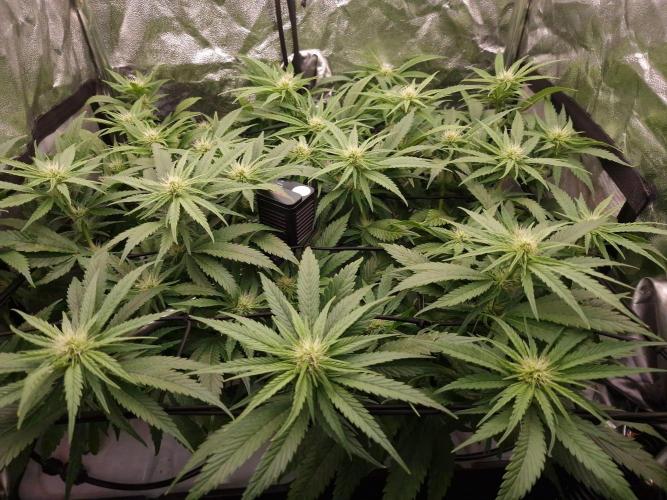
Phenotype: Extremely compact, short internodes (approx. 1 cm at the tip).
Lighting Adjustment: Added 730nm (Far Red) because internodal spacing is partly only 1 cm.
1 like
comments
Share
Used techniques
LST
Technique
ScrOG
Technique
5
Week 5. Flowering
1mo ago
1/6
25 cm
Height
12 hrs
Light Schedule
24 °C
Day Air Temp
5.8
pH
Weak
Smell
900 PPM
TDS
60 %
Air Humidity
19 °C
Solution Temp
19 °C
Night Air Temp
30 cm
Lamp Distance
1100 PPM
CO₂ Level
Nutrients 6
Purolyt
0.5 mll
Silica Power
0.19 mll
Flower fertilizer MR2
1.3 mll
Bazooka_ FD 24 – HPA Rescue, Sativa Paradox & Optimized Control
⚠️ The Scare (Overnight Root Dry-out): Between FD 22 and FD 23, every HPA grower's nightmare occurred: A displaced reservoir line caused the pump to run dry overnight. The roots received no fresh nutrient mist during the entire dark period.
The "Luck" Factor: Because the failure happened during the night, transpiration was minimal, and the high humidity in the root chamber ("Darkroom Effect") prevented the fine root hairs from immediately dying off.
Immediate Action: As soon as I discovered it at lights on, I initiated emergency protocols – dimmed lights to 350 µmol, increased humidity to 70%, and applied a heavy foliar feed.
Foliar Feed Mix: Metrop Root+, Metrop AminoXtrem, and Superthrive (as a stress killer) were used to bypass the stressed roots.
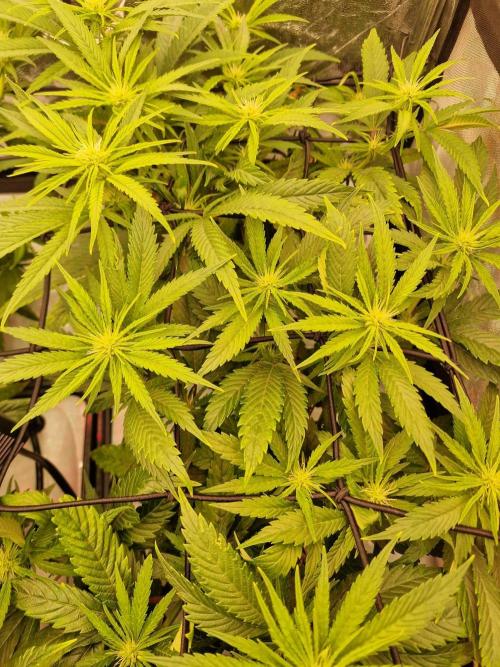
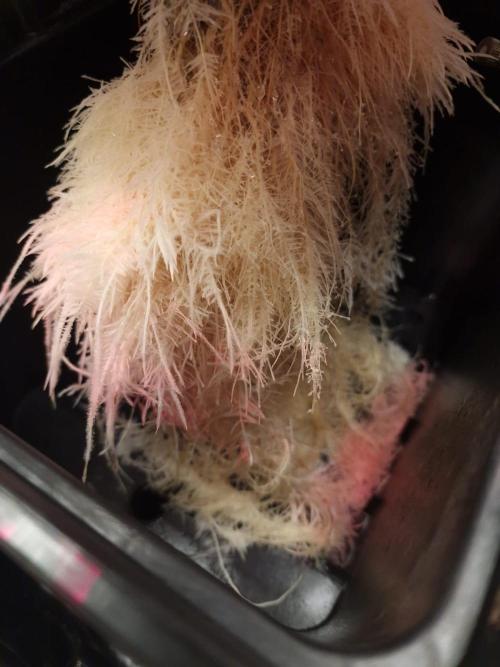
Status: The plants have fully recovered. Turgor is 100% restored.
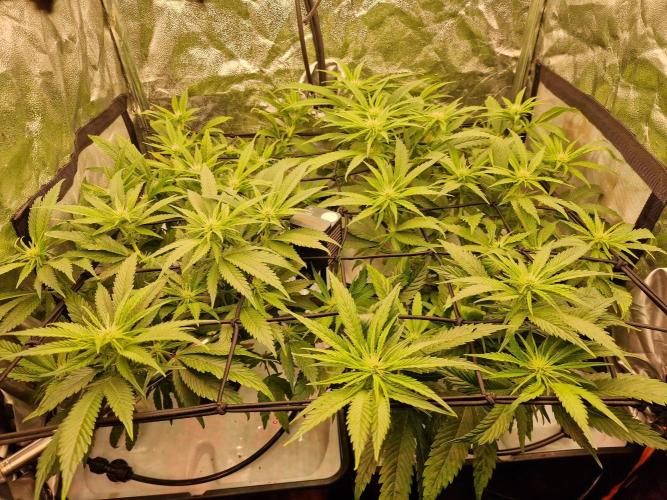
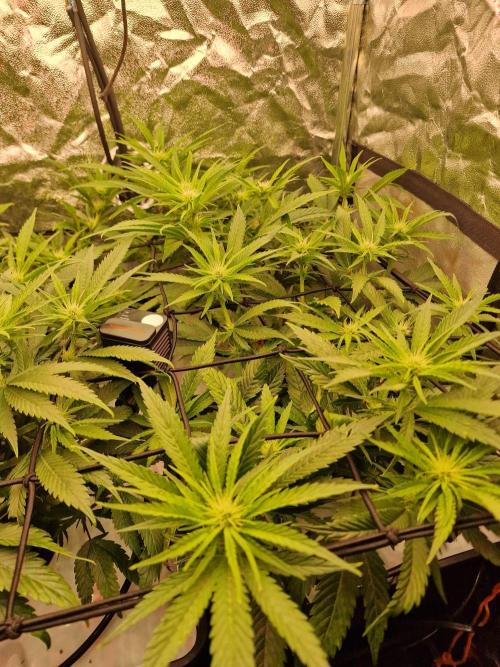
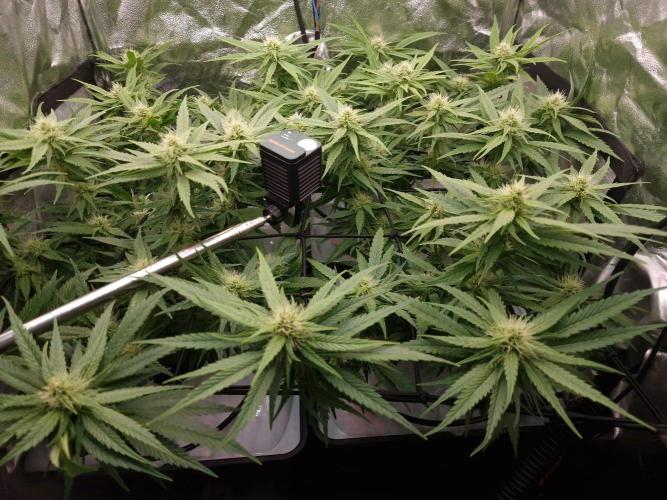
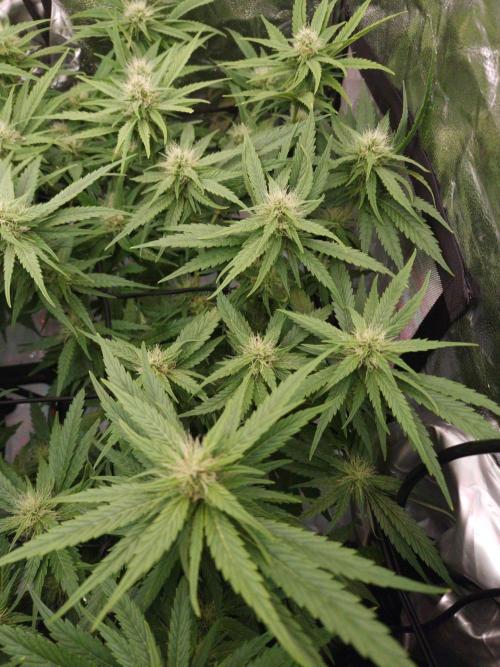
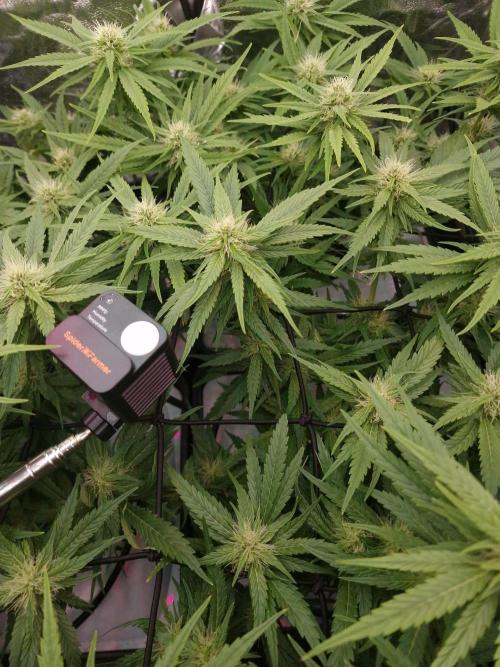
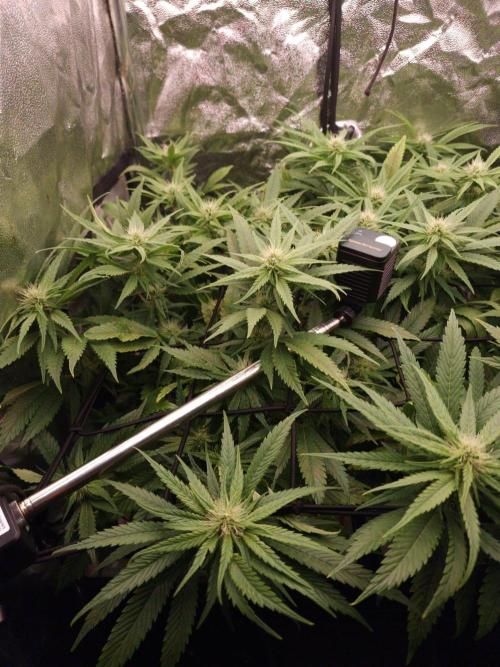
📏 The Sativa Paradox (25 cm): Despite having Sativa genetics (DSH) in a powerful HPA system (which usually creates "monsters"), the plants are extremely compact (approx. 25 cm).
Analysis: This compactness was a result of conscious caution and effective steering. To tame the Sativa stretch in the 60x60 tent, I initially kept Far Red (730nm) off and Deep Red (660nm) on, combined with a progressive ramp-up of light intensity (from 400 to 700+ µmol).
The Learning: This result proves how strongly light acts as a steering instrument. Even vigorous Sativa genetics can be fully structured and "tamed" by the right spectrum and high intensity—almost stronger than the genetics itself.
The Goal: I still expect "Buds on a Stick". Since the light (now back at 900+ µmol) penetrates all the way to the bottom, the density will compensate for the lack of height.
📸 Visual Update: I optimized the camera White Balance to 3500K (Settings: ISO 250 | WB 3500K) to finally show the true, healthy deep green color without the purple LED cast. They are praying hard!
Next Steps: Since the recovery was so fast, I will proceed with defoliation tomorrow (FD 25) to open up the canopy for the final bloom development.
UPDATE FD 20: NUTRIENT SWITCH & SYSTEM HYGIENE PROTOCOL
Today marks the transition to the Early Flower phase (Phase 2). To ensure a sterile system without stressing the root zone, I used a specific "Seamless Switch" technique.
SYSTEM HYGIENE (THE "SEAMLESS SWITCH") Since High-Pressure Aeroponics (HPA) is unforgiving regarding pathogens, a clean transition is vital.
Buffering Strategy: Before draining the main reservoir, I filled the HPA accumulator tank completely with the old nutrient solution. This provides a buffer of ~2 hours of feed time, allowing me to mix and sterilize the new tank without interrupting the spray cycle or drying out the roots.
Sterilization & Mixing Process:
Silica First: Added BAC Silica to fresh RO/Tap water and let it mix/react for 15 minutes. This ensures stability before any other chemistry is added.
pH Adjustment: Lowered the pH to ~6.0. This is crucial because Purolyt (HOCl) disinfects far more effectively at a lower pH.
Disinfection: Added Purolyt and allowed the solution to sit for 2 hours to sterilize the tank and lines.
Nutrients: After the sterilization period, I added the new nutrient profile (MR2, CalGreen, Additives).
THE NEW MIX (PHASE 2 - EARLY FLOWER) The focus shifts from vegetative nitrogen to potassium and phosphorus to support bud sites.
Target EC: 1.80 mS/cm
Target pH: 5.80
Mixing Recipe (My 40L Tank vs. 100L Standard Ref):
1. BAC Silica Amount (40L): 7.5 ml Amount (100L): 19 ml Function: Cell wall strength (Mix first & wait!)
2. Metrop MR2 Amount (40L): 51.5 ml Amount (100L): 129 ml Function: 10-20-40 NPK (Primary Flower Food)
3. Metrop CalGreen Amount (40L): 15 ml Amount (100L): 37.5 ml Function: Calcium/Nitrogen (Structure)
4. Metrop AminoXtrem Amount (40L): 36 ml Amount (100L): 90 ml Function: Metabolism & Stress Relief
5. Metrop Enzymes Amount (40L): 10 ml Amount (100L): 25 ml Function: Root zone hygiene
Note: Metrop Root+ has been removed from the regimen as root mass is sufficient.
LOGIC This specific ratio (approx. 3.4 parts MR2 to 1 part CalGreen) pushes the EC to 1.80, providing the necessary osmotic pressure for the high-metabolism setup. By limiting Nitrogen, we shift the hormonal focus to flower production. However, we keep 730nm (Far Red) active to induce vertical stretch mechanically, ensuring an open plant structure for better airflow before the buds densify.
LOGIC This specific ratio (approx. 3.4 parts MR2 to 1 part CalGreen) pushes the EC to 1.80, providing the necessary osmotic pressure for the high-metabolism setup.
Nutrient Strategy: We are limiting Nitrogen to shift the plant's focus from vegetative leaf production to flower site development.
Light Strategy: Simultaneously, we keep 730nm (Far Red) active to mechanically induce stretch. This creates an open structure with longer internodes, which is crucial for airflow and light penetration, even as the nutrient mix signals "blooming".
3 likes
2 comments
Share
Used techniques
ScrOG
Technique
LST
Technique
12-12
Technique
6
Week 6. Flowering
1mo ago
1/11
25 cm
Height
12 hrs
Light Schedule
28 °C
Day Air Temp
5.8
pH
Strong
Smell
950 PPM
TDS
60 %
Air Humidity
19 °C
Solution Temp
0 °C
Substrate Temp
20 °C
Night Air Temp
30 cm
Lamp Distance
1200 PPM
CO₂ Level
Nutrients 7
Purolyt
0.5 mll
Magnesium
0.125 mll
Silica Power
0.19 mll
Bazooka_ Day 29 – Tech-Overhaul & Start of Bulking Phase
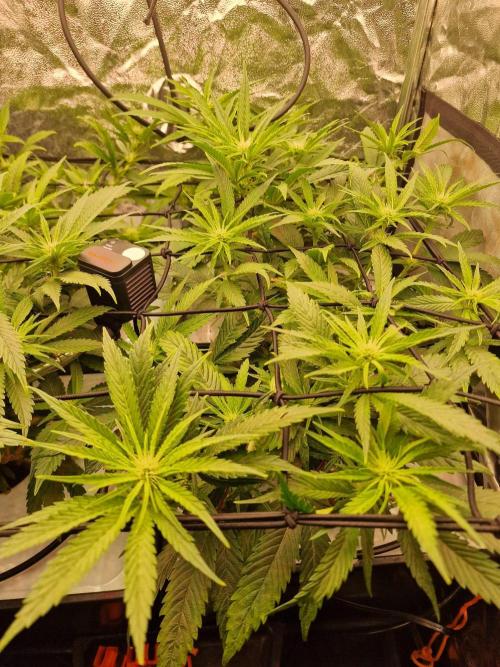
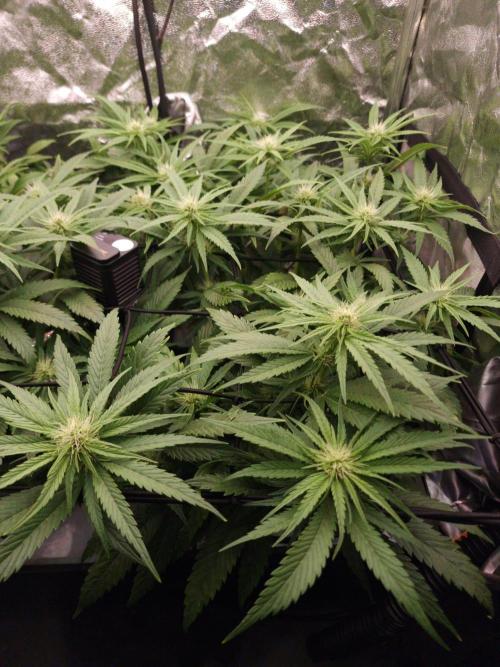
Summary: We are entering Week 5. The plants (Dark Shadow Haze) received heavy defoliation over the weekend. Combined with the high light pressure, this caused brief stress (lighter tips / "lime green"), but turgor is top-notch ("Praying Leaves"). I have massively upgraded the system to keep parameters perfectly stable for the upcoming high-flowering phase.
🔧 Tech-Upgrades (The "Fort Knox" Build): I have completely integrated the setup into the Spider Farmer Ecosystem for centralized control:
Light (High-Power DIY): My DIY lamp (power reserves up to approx. 1500 µmol) is now connected via PWM to the Spider Farmer Controller - PPFD control is active.
Air: Switched to the 4-Inch EC Fan (205 CFM) by Spider Farmer. The previous fan was too powerful for the 0.6 x 0.6 m tent; the new EC fan allows for much finer control, especially at low RPMs, without creating excessive negative pressure/imploding the tent.
Climate: New Humidifier and Compressor Dehumidifier (both Spider Farmer) are integrated. The dehumidifier runs in "Continuous Mode" (outside the tent) to utilize its waste heat as a heating source during the night.
CO2 (High-End Setup): Since the gas tank is located externally (garage) with a long supply line (10 m), I designed and installed a 3-Valve System:
Night Shut-off: One valve directly at the tank (timer).
Synchronous Switching: Two additional valves (one in the garage, one directly at the tent intake) are switched simultaneously by the controller.
The Concept: When the valves close, CO2 is "trapped" in the long line. Ambient temperature builds up pre-pressure in the hose. On the next dosing impulse, pressure is applied instantly at the tent nozzle - extremely fast response time with zero lag and absolutely no "overshoot" or leaking after shut-off.Safety: Monitored by a VDL Monitor (Alarm set at 4000 ppm).
Distribution: I built a Custom DIY CO2 Ring (micro-perforated) positioned directly above the main circulation fan. This ensures instant, uniform gas dispersion across the canopy and prevents local hotspots.
📊 Climate Log (Last 24h):
Day: 27 - 28°C (Target for CO2 metabolism) / 63% RH / VPD approx. 1.4 kPa (High Metabolism).
Night: Avg. 20.3°C / 65.0% RH / 0.83 kPa (VPD). (Optimization ongoing: Currently utilizing dehumidifier waste heat. Spider Farmer Heater is ordered for final stability. Working on integrating PWM-controlled PC-fans into the controller for gentle night circulation).
Nutrient Profile (Week 5 - Bulking & Repair Mix): Due to high metabolic demand (CO2 + High PPFD) and the pale color, I adjusted the recipe to allow for more Nitrogen and Calcium. Recipe calculated for 40 Liters (DTW Tank) | Target EC: 1.9
Metrop MR2: 40 ml (1.0 ml/L) - High P/K for flower mass.
Metrop CalGreen: 12 ml (0.3 ml/L) - Increased to upper limit (30ml/100L) to fix the "Lime Green" color (Nitrogen boost).
**Metrop CalGreen:** **18 ml** *(0.45 ml/L)* - Adjusted to reach EC 1.8 and fix pale leaves
Add-On: +5 ml Canna Mono Mg - Extra Magnesium backup.
AminoXtrem: 36 ml (0.9 ml/L) - Stress relief & metabolism booster.
Enzymes: 10 ml (0.25 ml/L) - Root hygiene.
Next Steps: Monitoring how the plants react to the increased nutrient strength (EC 1.9) and full light intensity while the buds begin to bulk up daily.
2 likes
comments
Share
Used techniques
Defoliation
Technique
ScrOG
Technique
LST
Technique
7
Week 7. Flowering
22d ago
1/4
25 cm
Height
12 hrs
Light Schedule
28 °C
Day Air Temp
5.8
pH
Strong
Smell
950 PPM
TDS
60 %
Air Humidity
19 °C
Solution Temp
0 °C
Substrate Temp
21 °C
Night Air Temp
30 cm
Lamp Distance
1200 PPM
CO₂ Level
Nutrients 7
Purolyt
0.5 mll
Magnesium
0.125 mll
Silica Power
0.19 mll
Bazooka_ 📝 Update: Start of Flowering Week 6 (Day 36) – The Haze in a Straitjacket
Strain: Dark Shadow Haze (Rare Dankness) System: High Pressure Aeroponics (HPA) DTW Light: Full Power (1100 µmol) CO2: 1000 - 1200 ppm
🌿 Phenotype & Growth: Sativa in a Corset
We are starting Week 6. Even though I'm not entirely sure if Nevil's Wreck alone is dominating (a pure Nevil's Haze would have even thinner leaf fingers), the Sativa influence is unmistakable. We definitely have a Haze-leaning phenotype here, but I have forced it into a technical "corset."
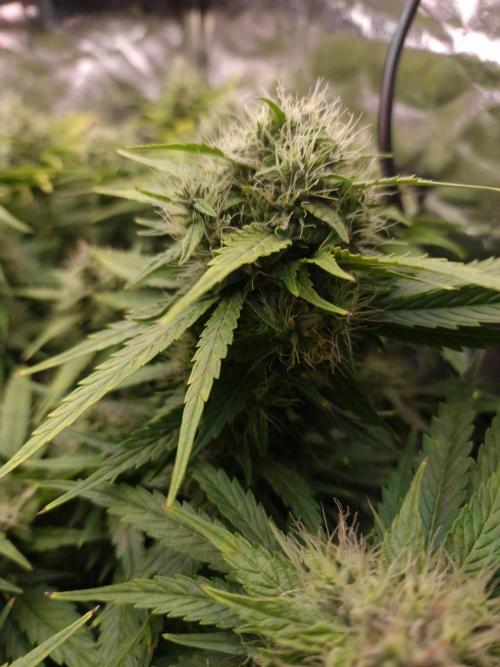
Visuals: The leaves show sharp "sawtooth" serrations, and the buds are growing as elongated spears rather than round golf balls.
Aroma: The scent is shifting strongly towards the chemical side: "Lemon Cough Drops" – very sharp and fresh.
However, the plant was never able to live out its urge to grow tall. Out of fear of it stretching too much, I double-braked it:
Topping directly at the switch (12/12) – this cut the hormonal push at the most critical moment.
Light Pressure: The combination of 1100 µmol and a lot of 660nm (Deep Red) without balancing Far Red completely suppressed the stretch. The result: A 25 cm "Sativa Bonsai" that stands there perfectly healthy and "praying," but remained extremely compact.
⚙️ Technical Deep Dive: The Nozzle Problem
The irregularities in leaf color have now been fully analyzed. Several factors came together here:
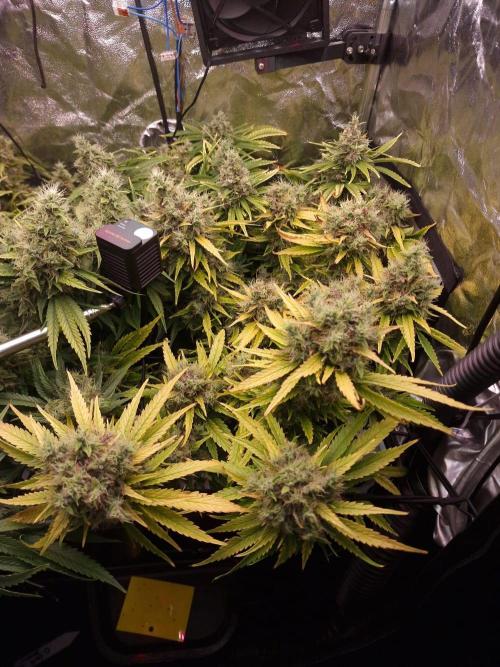
The Symptom: Within just one day, it became apparent that the plants in the back area were turning significantly lighter ("Lime Green") than those in the front. In an HPA system, this is the alarm signal for nutrient deficiency caused by a lack of mist.
The Cause (Legacy Residue): It was residue from a wild mix of various different fertilizers used previously. These different products interfered with each other, causing chemical reactions and precipitation (organic ballast) that settled in the system.
The Validation: This incident confirms exactly why I switched to Metrop. I chose this line specifically for its high purity and compatibility to keep the system clean. The clogging was caused by the incompatibility of the previous fertilizer cocktail, proving that a clean, consistent mineral fertilizer is the only right decision for HPA.
The Mistake (Filtration): I relied on the sinter filter inside the tank. That was an error – for fine HPA nozzles and sludge/residue, this is too coarse.
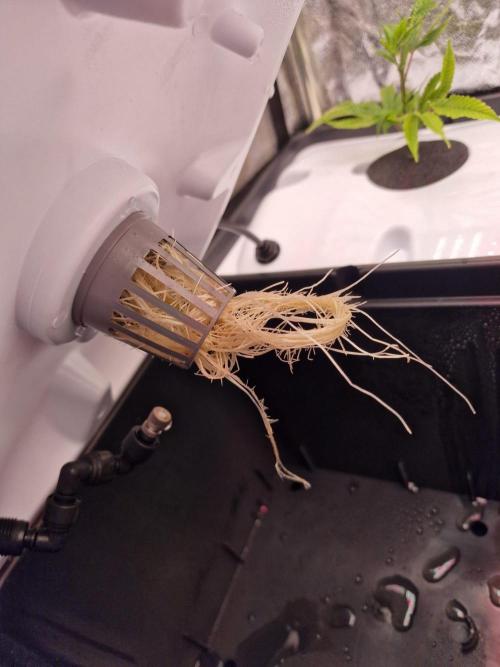
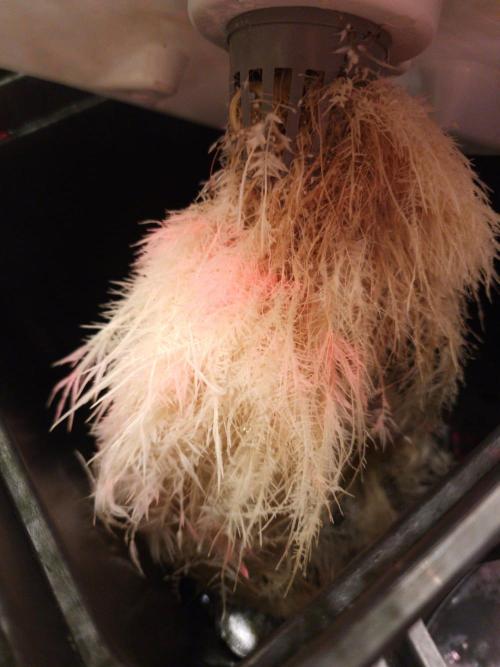
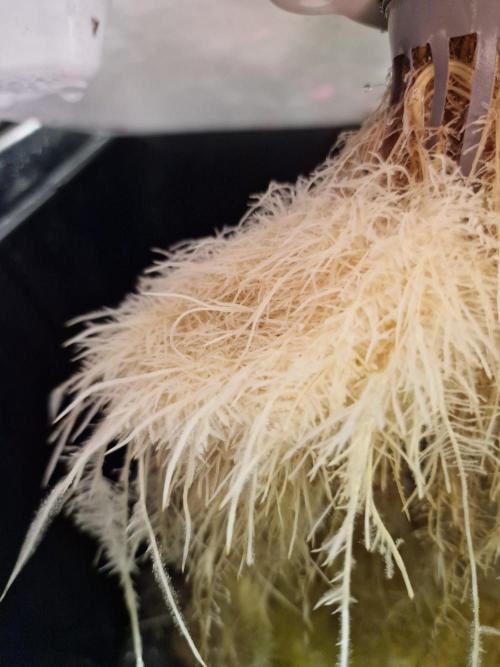
Plant Reaction: Interesting detail when checking the chamber: The roots actively grew towards the sputtering nozzle (hydrotropism), searching for the remaining mist.
Differentiation of Damage:
Back (Light/Pale): Acute deficiency due to the clog (reversible).
Front (Rust Spots): These are old scars from a previous Magnesium deficiency – they have nothing to do with the current clogging issue.
Solution: Inline filters have been purchased and will be installed to directly protect the sprayers in the future.
Nutrient Solution (Metrop) & Plan
The remaining tank is being run to empty, followed by a reset with an adjusted recipe.
New Recipe for Week 6 (for 40L):
Base: Metrop MR2 (40 ml)
Additive: Metrop CalGreen (15 ml) - Slightly reduced, as uptake is more efficient again with clear nozzles.
Booster: AminoXtrem (36 ml)
Hygiene: Enzymes (10 ml) - Mandatory to break down any potentially dead root parts.
Targets: EC approx. 1.8 / pH approx. 5.8
🏎️ Conclusion: Racing at the Limit
This run dramatically demonstrates what this setup actually entails: The combination of extreme values – 1100 µmol light, CO2 supplementation, and HPA – is like driving a race car. You are moving extremely fast, but you have absolutely zero tolerance. One small error (like the missing inline filter or incompatible residues), and you instantly hit the wall. In soil, it takes days to see a reaction; here, hours decide between a crash or a podium finish. We managed to take the corner just in time.
2 likes
comments
Share
Used techniques
12-12
Technique
Defoliation
Technique
Topping
Technique
ScrOG
Technique
LST
Technique
8
Week 8. Flowering
15d ago
1/9
28 cm
Height
12 hrs
Light Schedule
28 °C
Day Air Temp
5.8
pH
Strong
Smell
900 PPM
TDS
58 %
Air Humidity
19 °C
Solution Temp
0 °C
Substrate Temp
21 °C
Night Air Temp
30 cm
Lamp Distance
1200 PPM
CO₂ Level
Nutrients 6
Mono-silicic 40%
0.03 mll
Magnesium
0.125 mll
Flower fertilizer MR2
1 mll
Bazooka_ 🚀 Optimization Log – Day 42: Quality Upgrade & Efficiency
Strain: Dark Shadow Haze (Sativa) | System: HPA Aeroponic (High Pressure)
✅ Strategic Win: Turning a Glitch into an Upgrade
Today, a brief pH fluctuation (caused by a manual dosing error) was turned into a decisive advantage. The immediate response not only stabilized the system but also unlocked a better nutrient profile for the late flowering stage.
The Move: Instead of just buffering with pH-Up, we added 7.5 ml CalGreen to the approx. 26 Liters of existing nutrient solution and topped it up with hard tap water.
The Gain: This provided a massive, instantly available Nitrogen & Calcium boost, exactly what the pale top leaves needed to recover from the high light intensity. The system is now running at a perfect pH 5.75.
💎 "Best of Both Worlds" Strategy
We are now running a hybrid climate strategy that balances maximum yield with maximum quality (Terpenes).
CO₂ Power: We are pushing CO₂ levels to 1000-1300 ppm during the day to fuel rapid stacking.
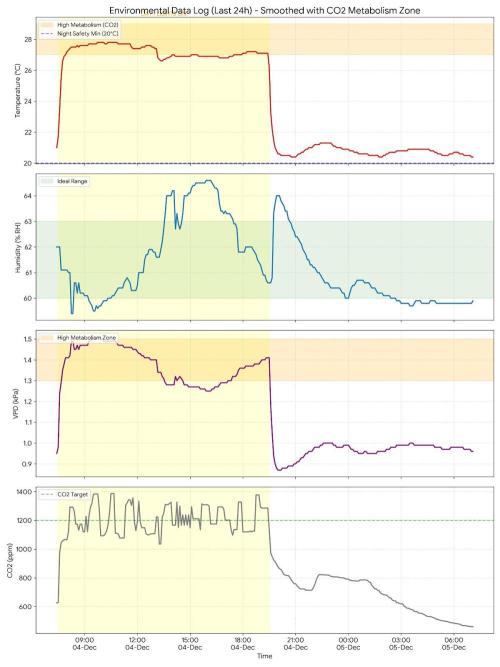
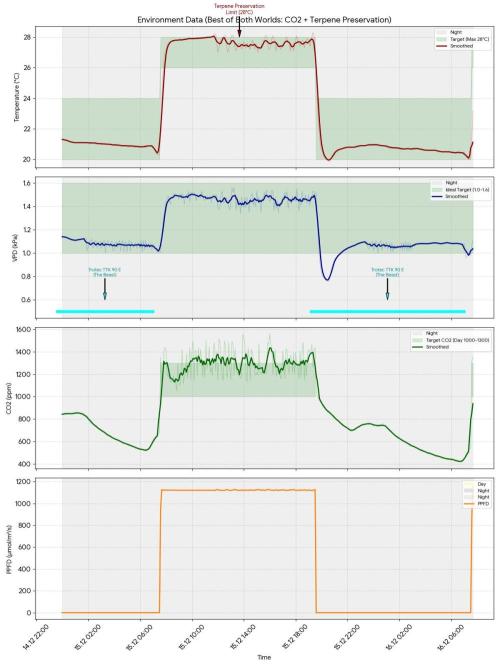
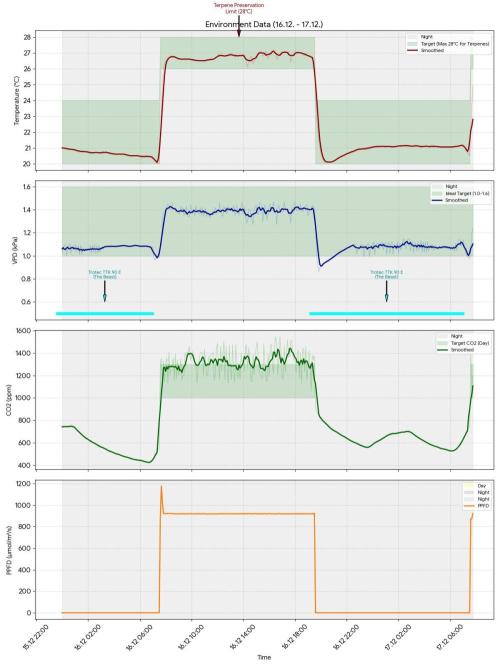
Terpene Protection (The Limit): As shown in the chart, we are deliberately capping the temperature at max. 28°C (green zone).
Why? While we could go hotter for more biomass, we choose to protect the volatile terpenes. This ensures the unique aroma of the Dark Shadow Haze is preserved.
⚙️ Technical Upgrades & Efficiency
Silica 2.0 (Mono-Silicic Acid): Upgraded to Mono-Silicic Acid to eliminate pH drift and prevent nozzle clogging. Essential for HPA reliability.
The "Night Guard" (Trotec TTK 90 E):
Performance: Running on a "Pre-Emptive" schedule (ON 30 mins before dark), it keeps the night VPD stable and safe.
Energy Hack (Smart Heating): A massive side benefit is the energy efficiency. The waste heat from the Trotec completely replaces the heating in the lung room. We are effectively using the energy twice (dehumidifying + heating), saving costs while maintaining perfect conditions.
🌿 Plant Status (Day 42)
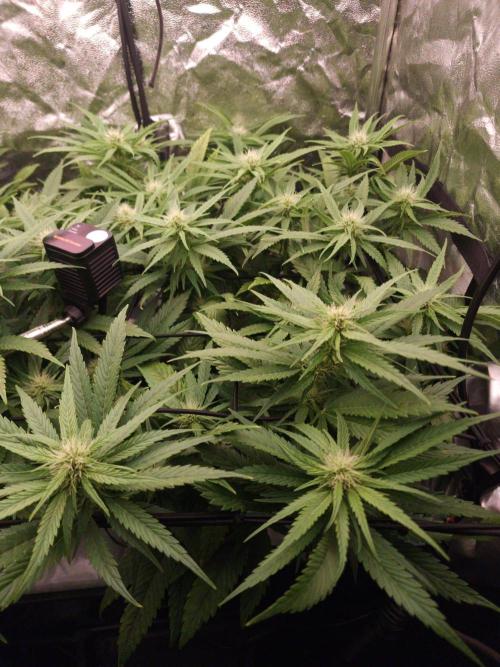
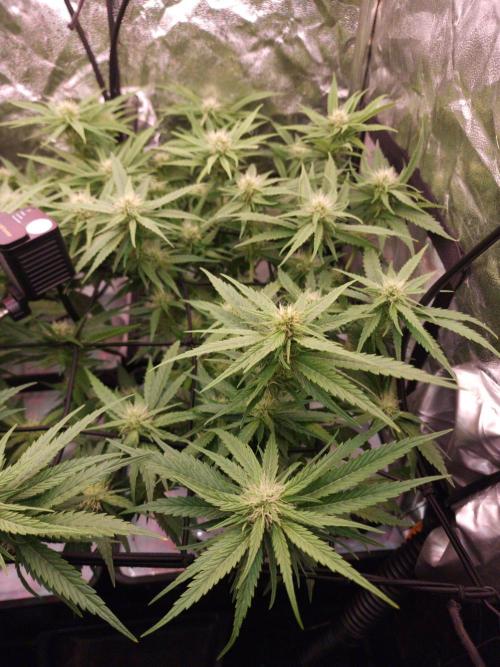
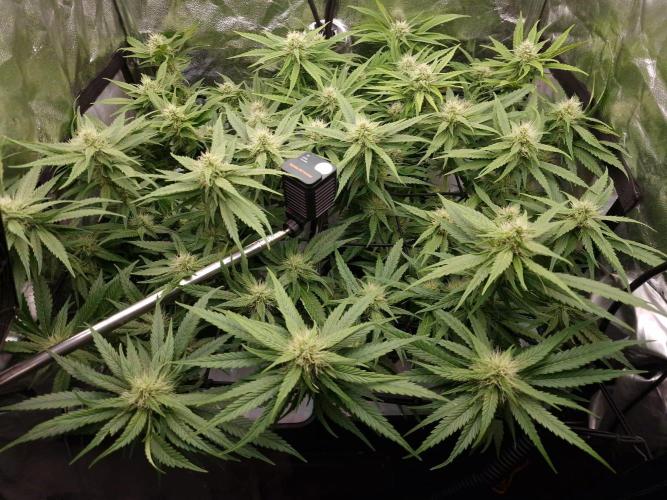
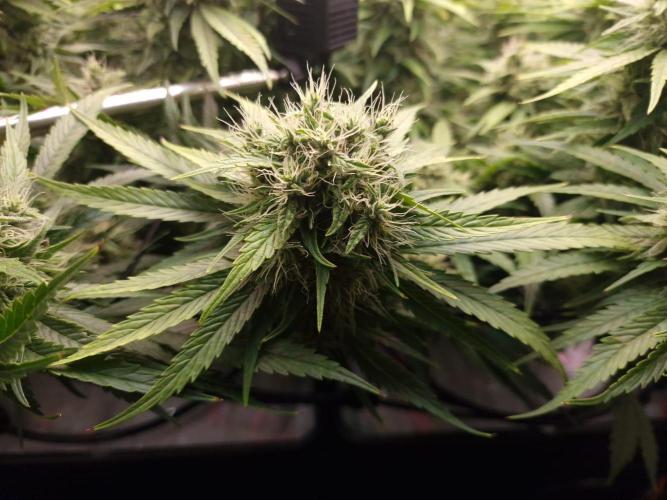
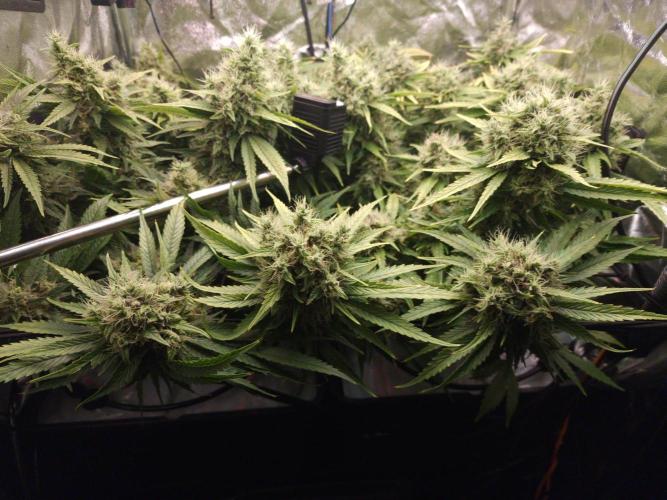
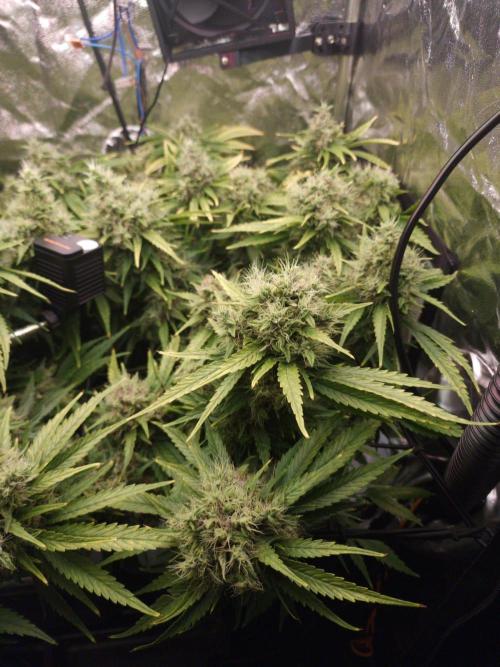
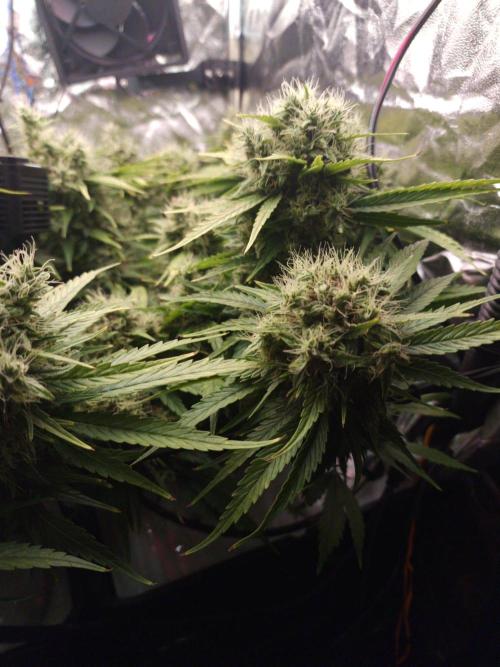
Visuals: The buds are developing beautifully into long, dense "spears".
Maturity: We are seeing the first few brown stigmas and a stunning purple hue emerging on the calyxes.
Recovery: Light is temporarily set to 900 µmol to let the plants absorb the new nutrients without stress.
📊 Chart Analysis
The attached graphic environment_data_final_v7_co2update visualizes our precision control:
Green Corridors: Show the ideal targets we are hitting (CO₂ 1000-1300 ppm).
Terpene Preservation: Note the temperature cap during the day.
Trotec Active: The cyan marker shows exactly when the dehumidifier takes control.
3 likes
2 comments
Share
Used techniques
ScrOG
Technique
LST
Technique
Topping
Technique
12-12
Technique
Defoliation
Technique
Aeroponic
Technique
9
Week 9. Flowering
7d ago
1/5
32 cm
Height
12 hrs
Light Schedule
27 °C
Day Air Temp
5.8
pH
Strong
Smell
800 PPM
TDS
55 %
Air Humidity
19 °C
Solution Temp
0 °C
Substrate Temp
21 °C
Night Air Temp
30 cm
Lamp Distance
1200 PPM
CO₂ Level
Nutrients 5
Mono-silicic 40%
0.03 mll
Flower fertilizer MR2
1 mll
Calgreen
0.4 mll
Bazooka_ Optimization Log – Day 48: Root Hair Recovery & VPD Precision
Strain: Dark Shadow Haze (Sativa) | System: HPA Aeroponic System (High-Pressure Aeroponics)
✅ Strategic Win: Root-Centric Nutrient Adjustment
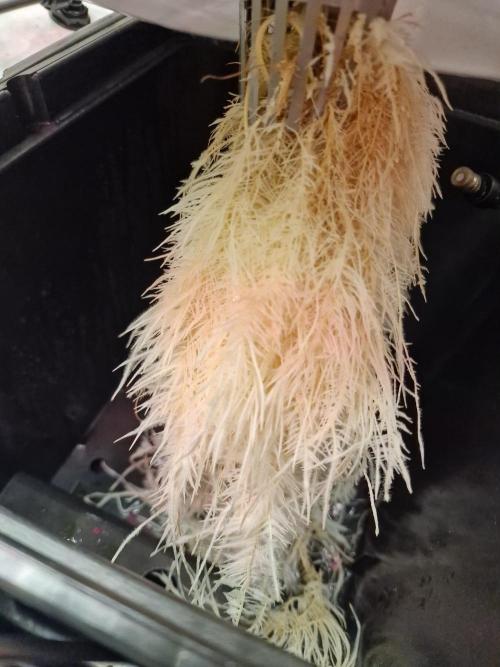
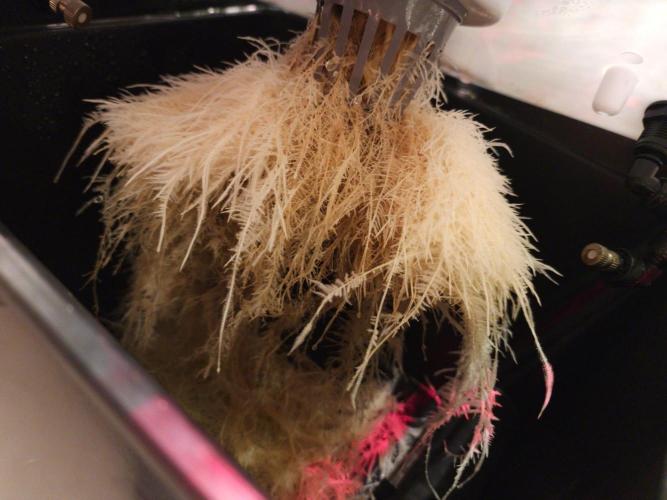
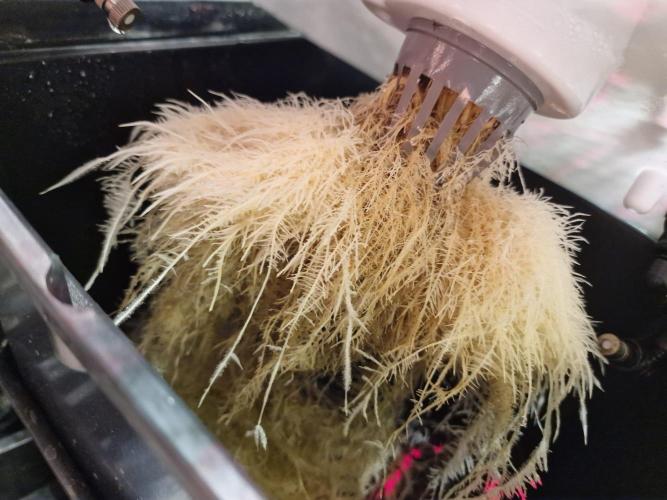
Visual inspection of the root zone revealed a decline in the "white fuzz" (root hairs). This is a critical indicator of early osmotic stress caused by previous nutrient saturation levels.
The Move: I have decided to skip the planned increase to 1.8 mS/cm and instead implement a 1.6 mS/cm regeneration cure.
The Gain: Reducing the salt concentration in the mist lowers the osmotic resistance at the root surface. This provides the plant with the necessary buffer to regenerate fine absorption hairs, while the buds continue to bulk up fueled by 1200 ppm CO2.
💎 Incoming Tech-Upgrade: APEXstrip UVA
The lighting setup will be expanded this or next week with APEXstrip UVA (385 nm) modules.
Objective: Target provocation of secondary metabolites. UVA radiation acts as a trigger, forcing the plant to produce more trichomes and terpenes as a natural "sunscreen."
Integration: The UVA strips will complement the existing DIY Elite-LED (Samsung LM301B + Hyper/Far Red) for the final quality finish.
⚙️ Advanced VPD Synergy & System Stability
Precision IR measurement is being used to perfectly control transpiration and avoid stress.
Air VPD (1.76 kPa): The pure air value at 27.0 °C would normally signal high stress.
Leaf VPD (1.35 kPa): Based on the measured leaf temperature of 25.4 °C to 26.0 °C, the plant is actually in the ideal metabolic range.
Stability: The system is running extremely smooth. The pH remains rock-solid at 5.8 - 6.0 once set. Maintenance is minimal (DTW).
🌿 Plant Status (Day 48)
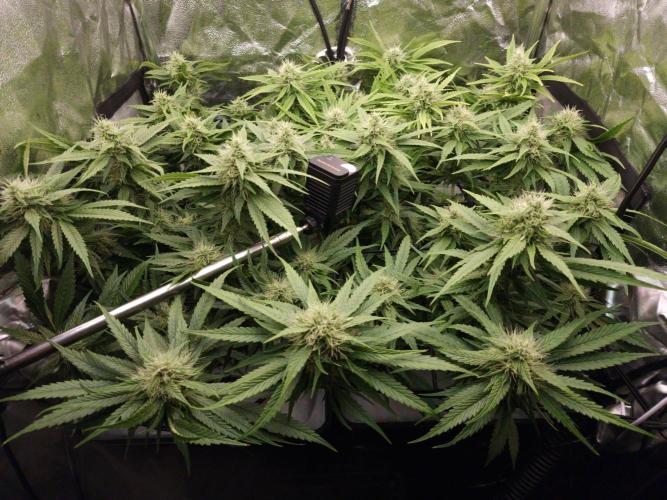
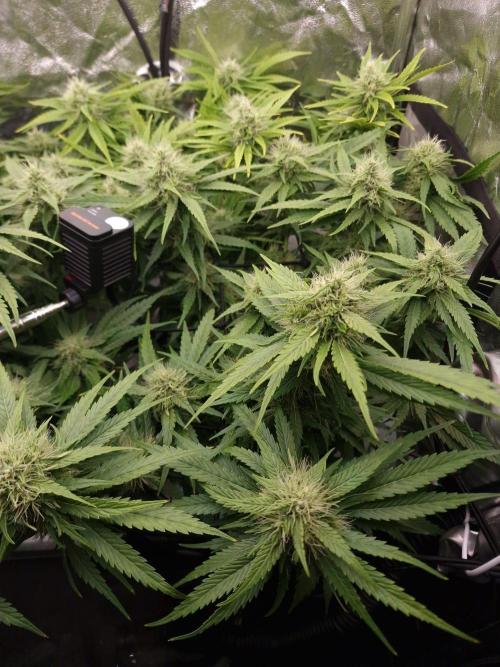
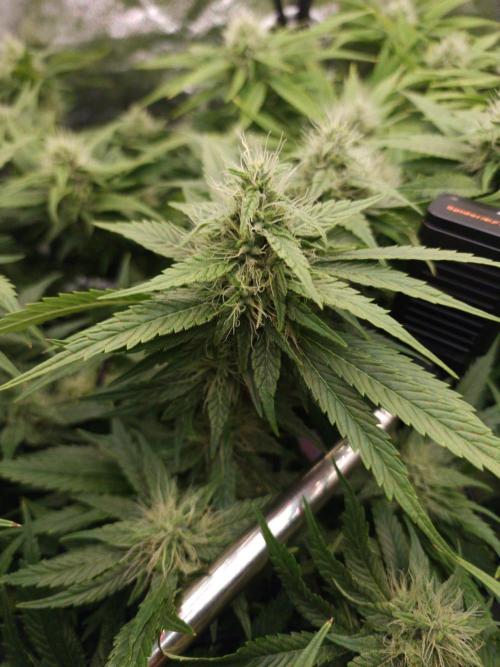
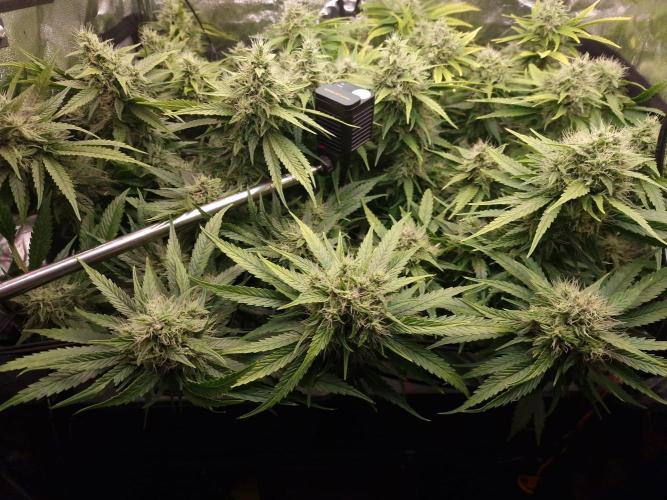
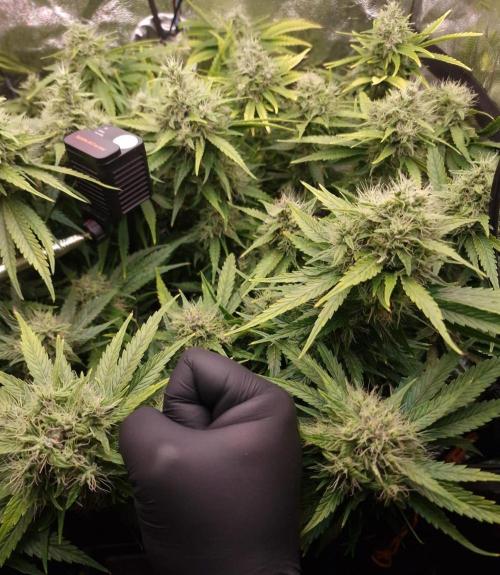
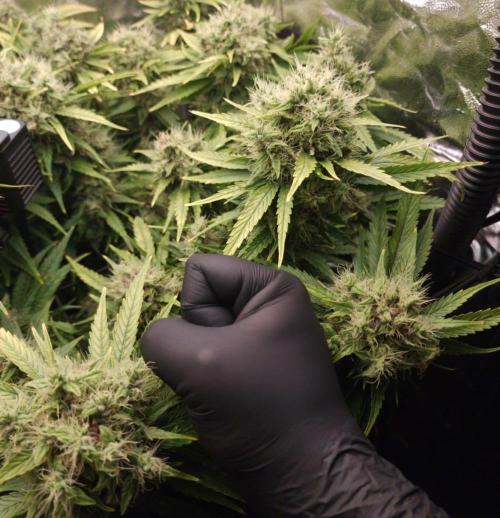
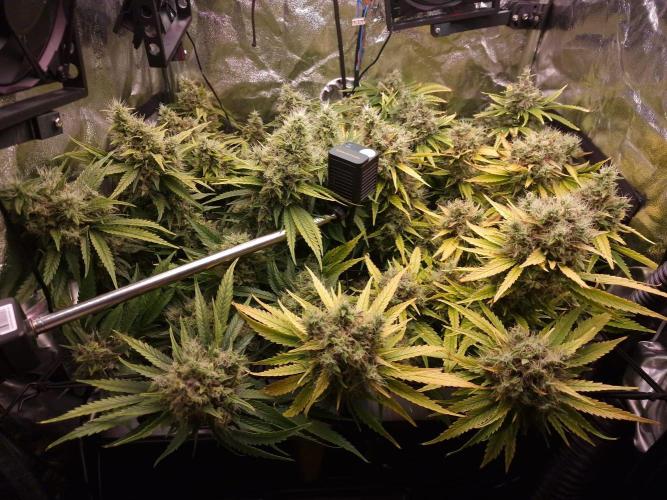
Visuals: Buds have already reached fist-size. The structure resembles perfect "buds on a stick" with a compact total height of only 32 cm.
Temp Guard: Day temperature stable at 27.0 °C +/- 1 °C with a night drop to 21.0 °C +/- 1 °C.
Interval: The 4 min OFF interval is maintained to maximize oxygenation of the roots within the HPA chamber.
📊 Nutrient Configuration (HPA Flowering Tent)
Critical Mixing Process: After adding the Silica and allowing for the required waiting time, the pH is pre-adjusted to approx. 5.8 to 6.0 before adding the Metrop MR 2. This optimizes the stability and solubility of the nutrients within the system.
Reference Calculation for 100 Liters:
Grow Genius Silizium Dünger (40%): 3.0 ml
Metrop MR 2: 100.0 ml
Metrop Calgreen: 40.0 ml
Metrop AminoXtrem: 90.0 ml
Metrop Enzyne: 25.0 ml
Current 40 Liter Tank (Regeneration Mix):
Silica (40%): 1.2 ml
Allow for waiting time
pH Correction: Adjust to approx. 5.8 - 6.0
Metrop MR 2: 40.0 ml
Metrop Calgreen: 16.0 ml
Metrop AminoXtrem: 36.0 ml
Metrop Enzyne: 10.0 ml
Final EC (Input): 1.6 mS/cm
4 likes
7 comments
Share
10
Week 10. Flowering
1d ago
1/4
32 cm
Height
12 hrs
Light Schedule
26 °C
Day Air Temp
5.8
pH
Strong
Smell
900 PPM
TDS
52 %
Air Humidity
19 °C
Solution Temp
0 °C
Substrate Temp
20 °C
Night Air Temp
30 cm
Lamp Distance
1000 PPM
CO₂ Level
Nutrients 5
Mono-silicic 40%
0.03 mll
Flower fertilizer MR2
1 mll
Calgreen
0.4 mll
Bazooka_ Optimization Log – Day 56: System Sanitation & Silica Solubilization Breakthrough
Strategic Sanitation & Radical Hygiene (IPM)
Due to a persistent fungus gnat infestation, drastic measures were taken to secure the entire cultivation environment:
• System Overhaul: All mother plants in the Mother Tent have been moved from coco to Hugo Blocks (Rockwool)1.
• Waste Management: All coco substrate was disposed of because I could no longer manage the infestation levels within that medium.
• HPA Insight: Contrary to my expectation that gnats would lack a food source without substrate, I discovered they thrive in the humid environment of the HPA root chamber.
• Action: All systems and plants were inoculated with a BTI (Bacillus thuringiensis israelensis) solution.
• Direct Treatment: The plant in the bottom-right of the flowering tent received a direct root application.
• Enzyme Boost: I increased the dosage of Metrop Enzyne to approximately 20.0 - 25.0 ml per 40L.
• Objective: To aggressively "clean up" necrotic root tissue damaged by larvae, preventing rot and maximizing oxygen uptake for the remaining healthy roots.
Tech-Deployment: APEXstrip UVA Pulsing
The APEXstrip UVA (365 nm + 385 nm) is now fully operational.
• Pulsing Protocol: 5 min ON / 20 min OFF during the light phase to trigger secondary metabolite production and provide surface disinfection for the flowers.
• Goal: Maximum stress-stimulus for resin production without increasing the thermal load on the head buds3.
Advanced Nutrient Synergy: The "Crystal Clear" Protocol
After transitioning from BAC to Grow Genius Mono Silica, I optimized the mixing procedure to ensure maximum stability:
1. RO-Preload: Started with pure RO water + Grow Genius Silica (30 min reaction time).
2. LW-Buffering & pH-Lock: Added Tap Water (LW) for mineral balance and pre-adjusted the pH to 5.75 - 5.8.
3. Stabilization: The mixture was left to settle overnight.
4. Final Loading: Added Metrop MR 2 and remaining additives this morning.
• Current Status: The nutrient solution is currently crystal clear.
• Observation: I will monitor the tank over the coming days to see if it remains stable or turns milky, which is critical for maintaining the high-pressure nozzles.
Environmental Parameters
• CO2 Level: 1000 ppm4.
• PPFD: 950 µmol/m²/s5.
• Interval: 4 min OFF time maintained for optimal root oxygenation6.
• Status: System is running stable; allowing the plants to complete their final ripening phase.
Nutrient Configuration (40 Liter Tank – Final Ripening)
Mixing Protocol: "When preparing nutrients, after adding silicon and waiting, I correct the pH to about 5.8 or 6 before adding Metrop MR 2, as this is better for the fertilizer."
Component Amount (40L)
Grow Genius Mono Silica 1.2 ml
Wait 30 min, add LW, pH correct, wait overnight
Metrop MR 2 45.0 ml
Metrop Calgreen 16.0 ml
Metrop AminoXtrem 36.0 ml
Metrop Enzyne 20.0 - 25.0 ml (Enhanced Cleanup)
Final EC (Input): 1.8 mS/cm
@Aeromatics, Thanks! The stacking at Day 48 is intense. I'm focusing on root recovery right now to prep them for a UVA upgrade next week. Glad to have you following along!