


God's Gift (Blimburn Seeds)





Fan
AeroWave E6 Gen2, Grow Tent Clip Fan 6"


Cond
8,000 BTU Portable Air Conditioner
TOSOT


Indoor
Room Type
Topping
weeks 3
12-12
weeks 4-16
LST
weeks 3-11
Defoliation
weeks 4-11
11 liters
Pot Size
1.89 liters
Watering
Start at Harvest
G
Germination5mo ago
MichaelTheBarnOwl Grow #5, Entry #1: Germination and First Emergence
Days Since Emergence: 1
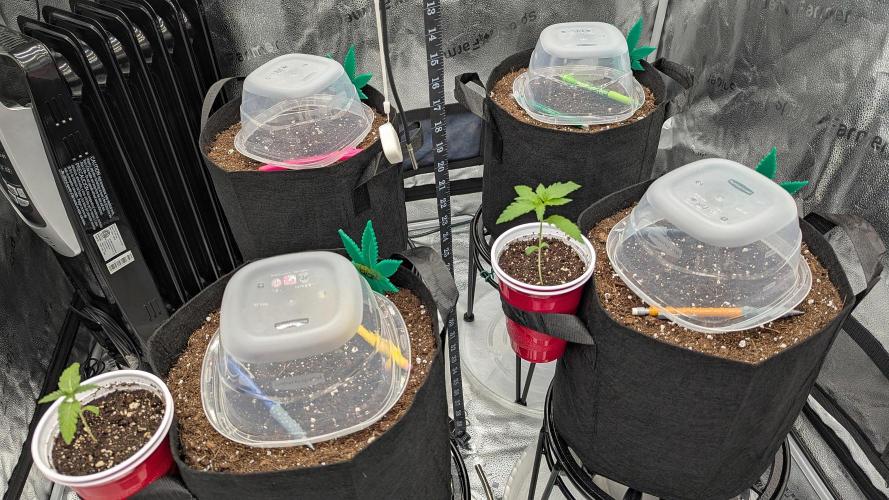
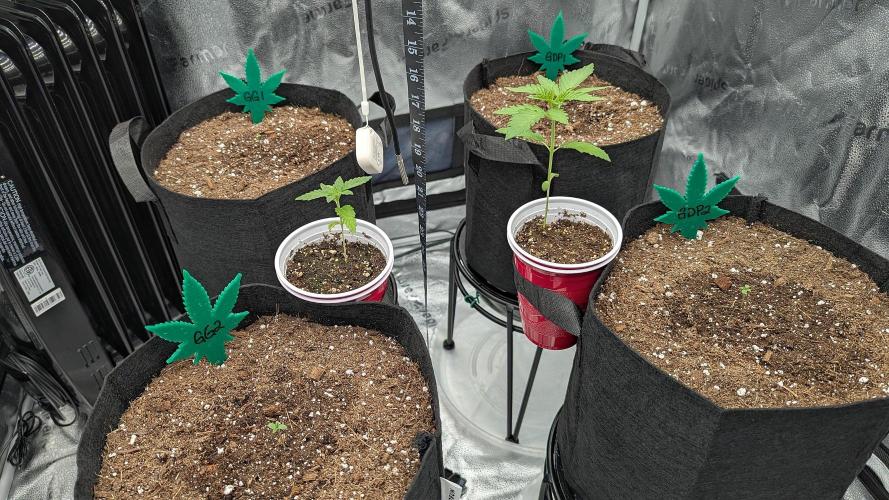
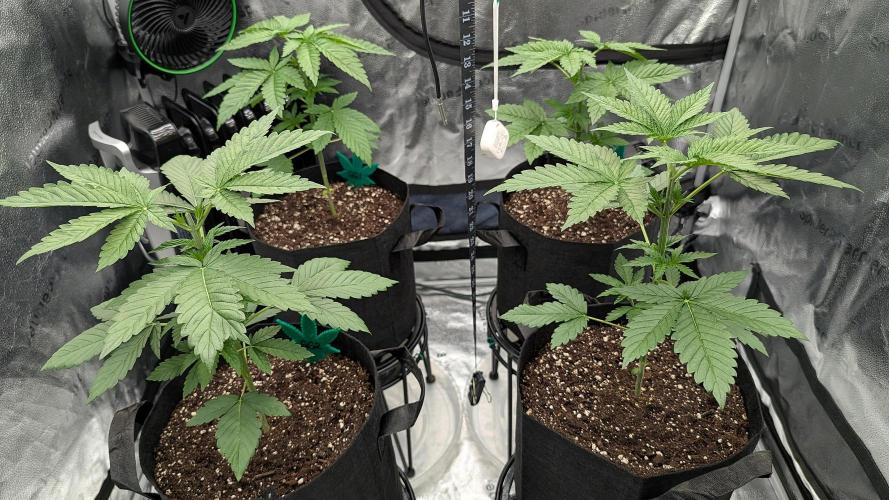
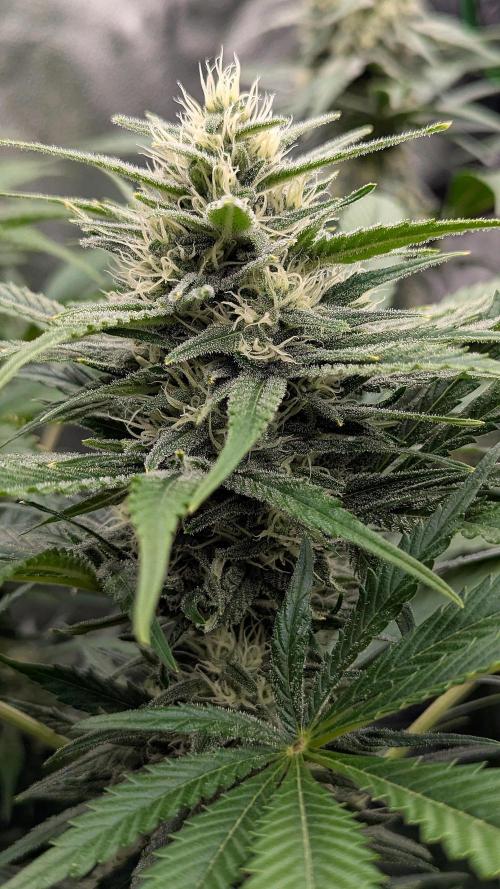
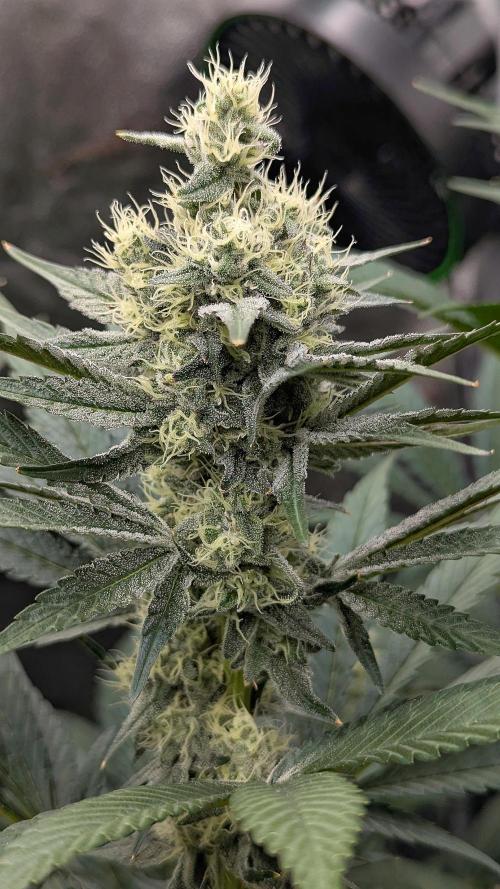
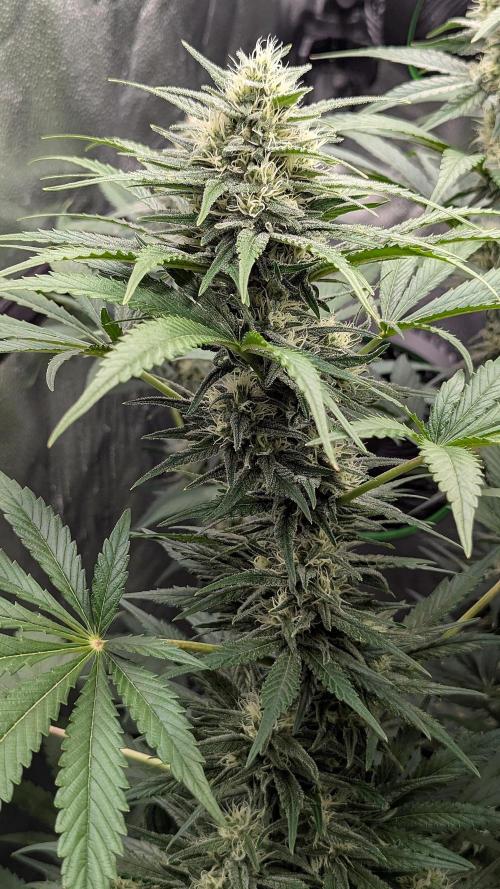
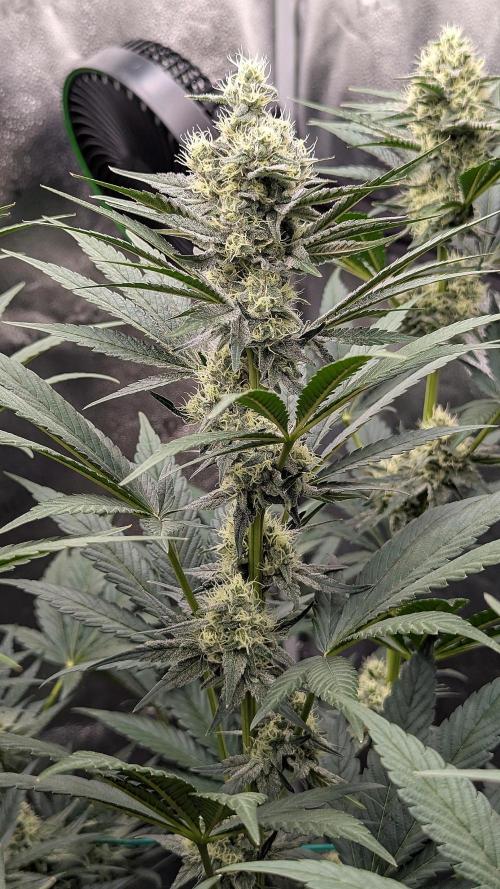
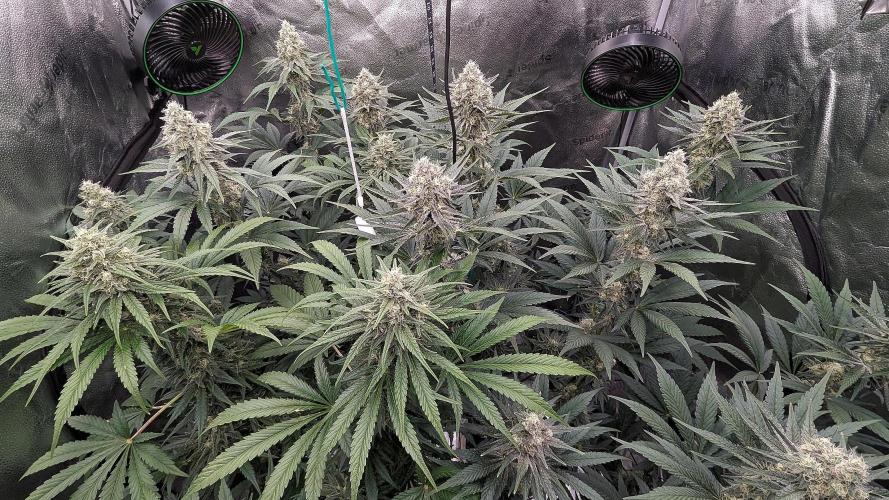
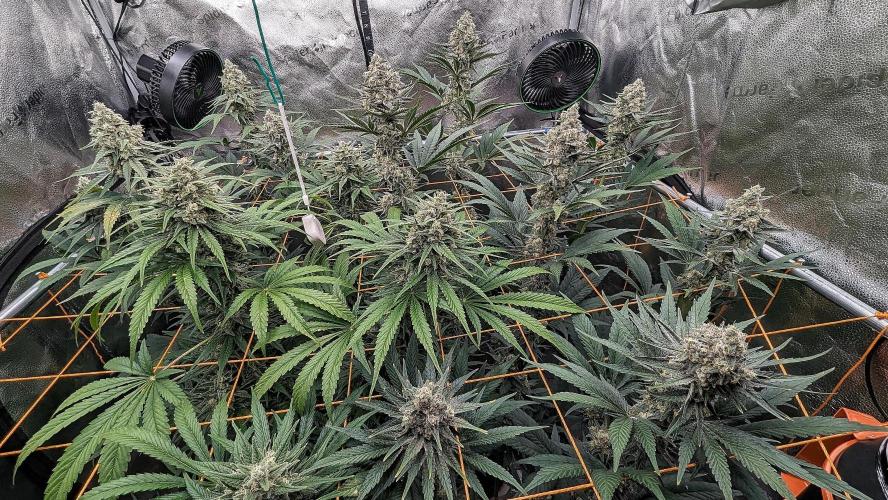
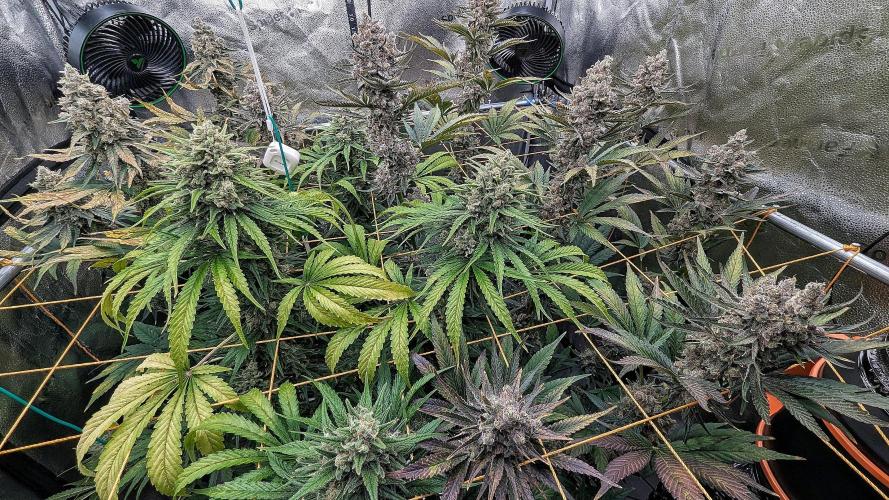
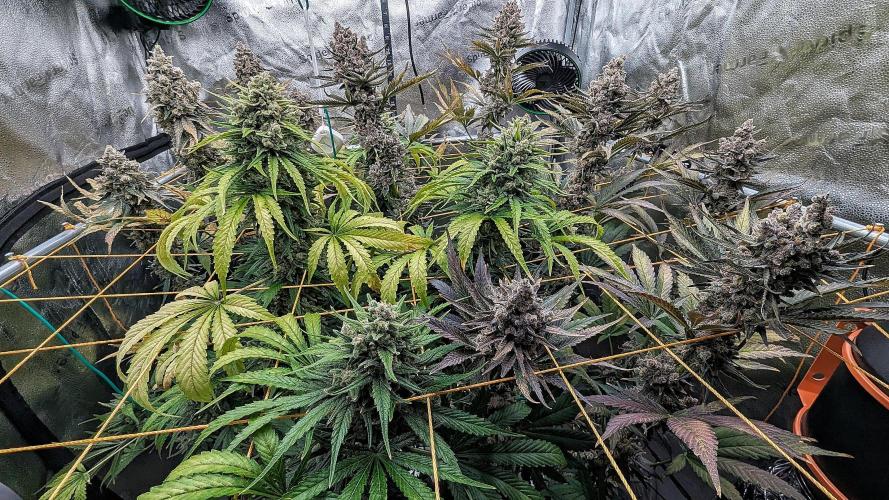
This grow consisted of four feminized photoperiod plants: two God’s Gift (Blimburn) and two Grandaddy Purple (Blimburn) established directly into final containers to avoid transplant stress later in development. Because both cultivars were grown together under a shared canopy, some wide-angle photographs throughout this journal will show both varieties. Unless otherwise noted, all observations, measurements, and grow-specific commentary documented within this diary refer specifically to God’s Gift.
Seeds were soaked in distilled water for approximately 12–15 hours at 78–82°F before being planted approximately 0.25 inch beneath the surface into final containers. Plants were grown in 3-gallon fabric pots filled with lightly pre-moistened Pro-Mix HP with Mycorrhizae, selected for its high porosity, drainage characteristics, and root-zone oxygen availability while allowing complete control over nutrient delivery throughout the grow. No dry amendments or pre-amended soils were incorporated at planting.
Moisture management remained conservative during establishment. The medium was pre-moistened prior to planting and subsequent water applications were localized around the planting zone rather than fully saturating container volume, maintaining adequate hydration while encouraging early root exploration.
Environmental conditions during germination were maintained toward the warmer end of the target range to support rapid metabolic activity and promote uniform emergence. Lighting was provided continuously beginning at sowing so that seedlings emerged directly into their target environment without transition. The fixture remained positioned approximately 20 inches above the soil surface, delivering approximately 300 PPFD (DLI 19) at emergence - sufficient to encourage compact development while minimizing unnecessary transpiration before root establishment.
Humidity domes were used during germination to preserve surface moisture and encourage emergence but were removed immediately once seedlings broke the surface to maximize air exchange and unobstructed light exposure.
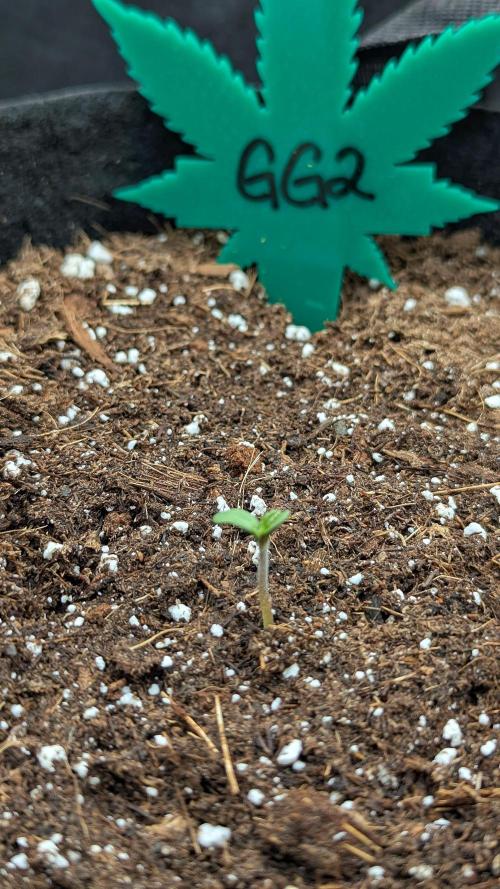
Emergence occurred rapidly and uniformly, with God’s Gift seedlings breaking the surface within approximately 48 hours of sowing.
2 likes
comments
Share
Used method
Glass Of Water
Germination Method
2
Week 2. Vegetation5mo ago
11.43 cm
Height
18 hrs
Light Schedule
28 °C
Day Air Temp
5.9
pH
440 PPM
TDS
58 %
Air Humidity
18 °C
Solution Temp
19 °C
Substrate Temp
21 °C
Night Air Temp
11.36 liters
Pot Size
0.19 liters
Watering Volume
39.37 cm
Lamp Distance
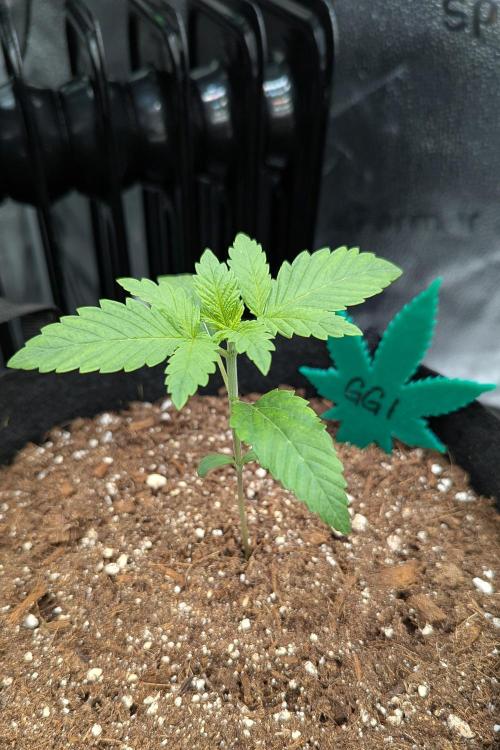
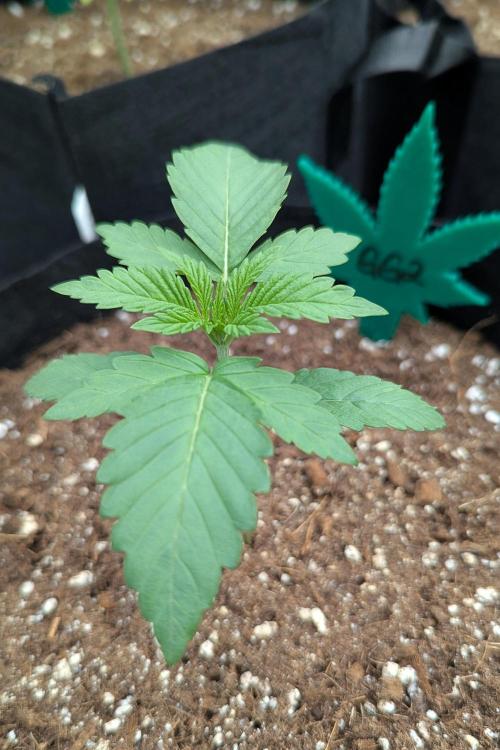
MichaelTheBarnOwl Grow #5, Entry #2: Entering Early Veg
Days Since Emergence: 11
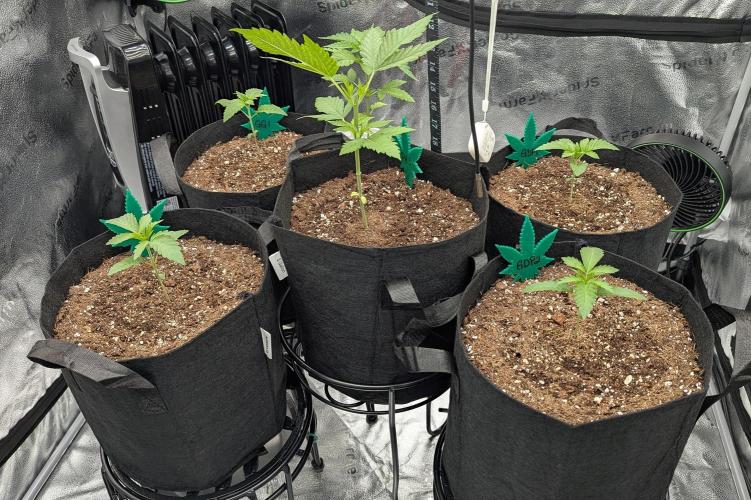
God’s Gift transitioned into early vegetative growth during this period following approximately 9 days in the seedling stage. By Day 11 post-emergence, both plants had established two fully developed nodes with active development of a third. Vertical growth accelerated relative to the prior week while overall plant structure remained compact with tight internodal spacing and controlled upward development.
Irrigation strategy evolved during this stage away from localized seedling hydration and toward gradual expansion of the active root zone. Because this grow utilized PRO-Mix HP-CC Mycorrhizae High Porosity, nutrients were supplied with each watering event to maintain consistent nutrient availability within the inert media profile. Irrigation continued to be applied in a circular pattern surrounding each plant rather than directly at the stem in order to encourage lateral root expansion and avoid concentrated root establishment beneath the crown.
Water volume increased progressively in response to increasing transpiration demand and continued root development. Early in the week, approximately 0.25 L per plant was applied on an every-other-day schedule. By Day 11, irrigation volume increased to approximately 0.33 L per plant per event. Water pH remained tightly controlled within a target range of 5.8–6.0.
Nutrient strength continued increasing gradually as plants transitioned into sustained vegetative growth. General Hydroponics Flora Series remained configured for Early Veg, with overall solution strength increasing from approximately 340 ppm on Day 7 to 440 ppm by Day 11. Supplemental CAL-MAG increased from 2 mL/gal to 3 mL/gal to support increasing metabolic demand and continued vegetative expansion. Silica supplementation had not yet been introduced.
Near-infrared supplementation remained incorporated at both the beginning and end of the photoperiod for a combined 30 minutes per light cycle, while UV-A exposure increased from 15 minutes earlier in the week to 30 minutes per cycle.
Light intensity increased incrementally throughout the period while fixture height remained fixed at approximately 20 inches above the soil surface, allowing canopy distance to decrease naturally through plant growth rather than repeated fixture adjustment. Early-week measurements remained near 375–405 PPFD (24–27 DLI). Fixture output was gradually increased from 50% to 55% as plants demonstrated the ability to utilize additional intensity without undesirable stretch.
Day 11 Light Measurements:
GG1: 470 PPFD (31 DLI)
GG2: 465 PPFD (30 DLI)
Day 11 Height Measurements:
GG1: 4.50"
GG2: 4.00"
Final canopy distance narrowed to approximately 15.5–16 inches by the end of the period, supporting compact structure, tight node spacing, and increasingly efficient light utilization as vegetative growth accelerated.
likes
comments
Share
3
Week 3. Vegetation5mo ago
32.39 cm
Height
18 hrs
Light Schedule
28 °C
Day Air Temp
6.1
pH
800 PPM
TDS
58 %
Air Humidity
18 °C
Solution Temp
19 °C
Substrate Temp
21 °C
Night Air Temp
11.36 liters
Pot Size
1.89 liters
Watering Volume
37.47 cm
Lamp Distance
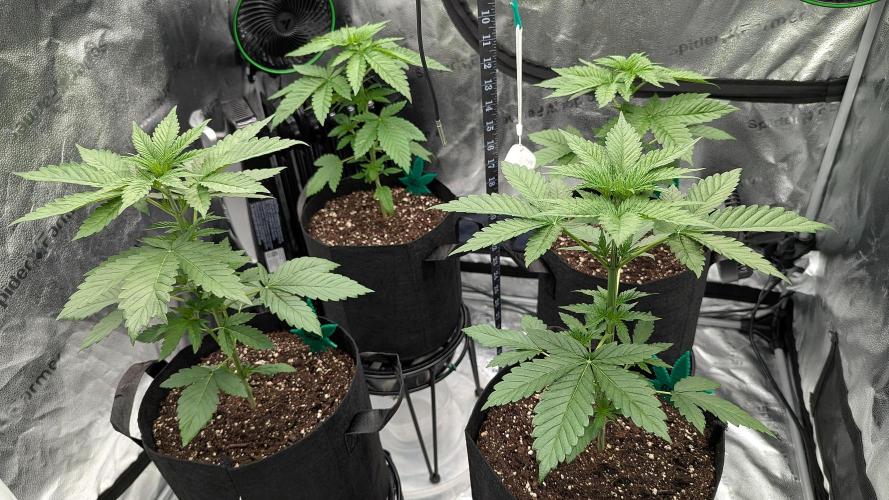
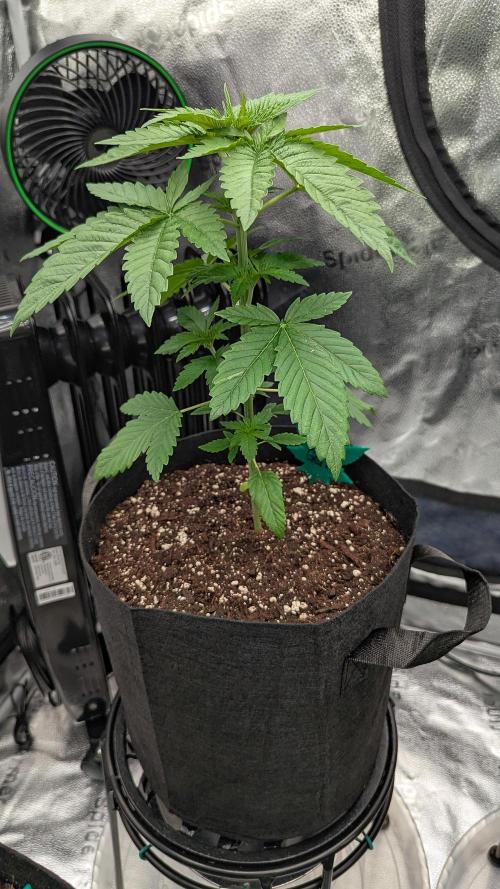
MichaelTheBarnOwl Grow #5, Entry #3: Vegetation, Topping, and Preparing for Flip
Days Since Emergence: 21
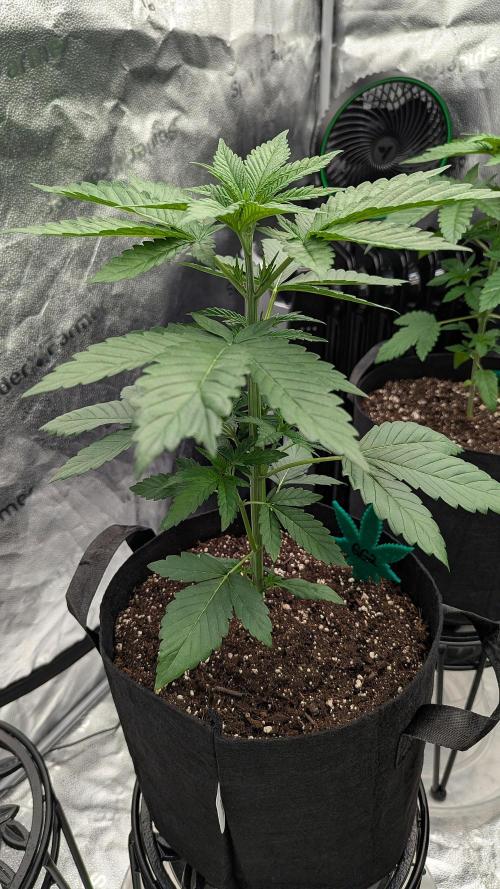
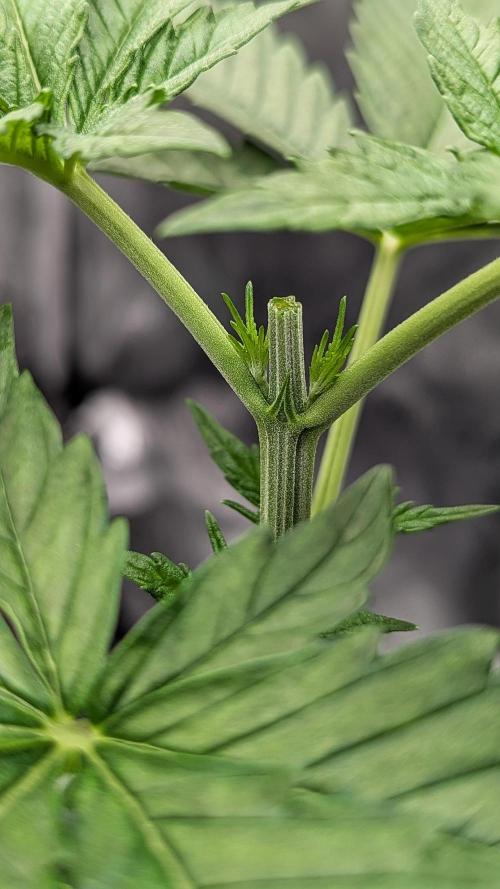
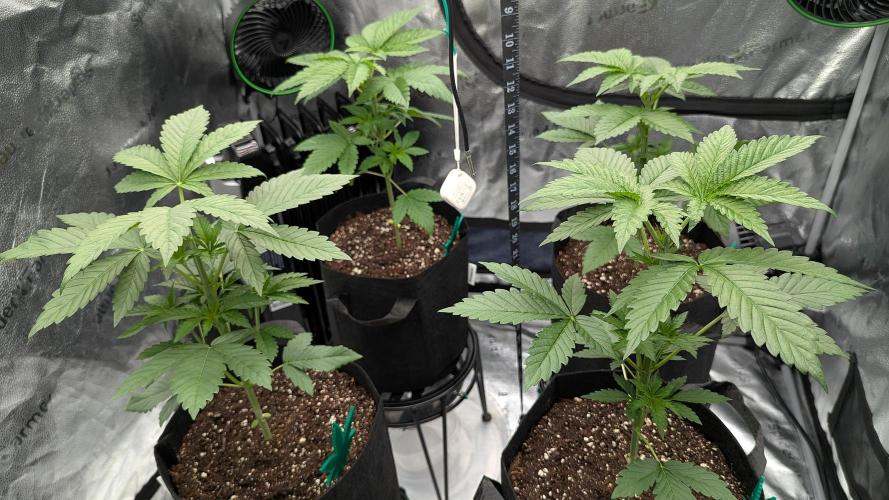
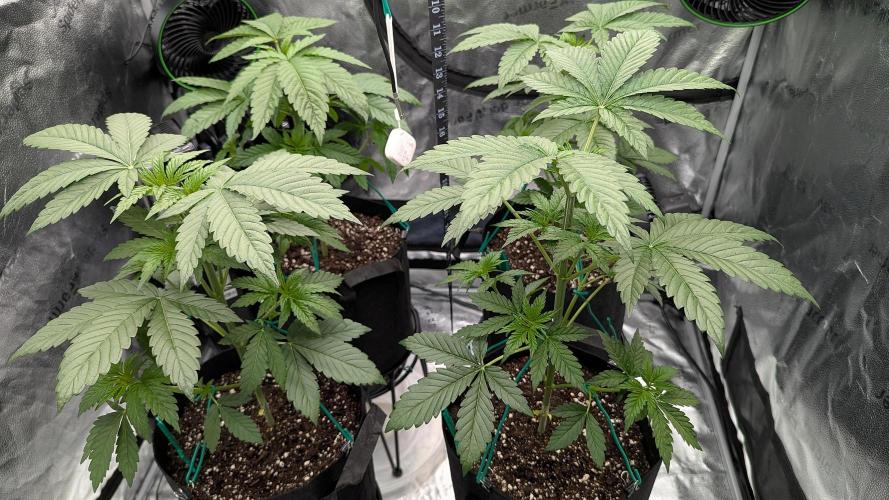
God’s Gift progressed rapidly through vegetative growth during this period. At the previous entry (Day 11), plants had established two fully developed nodes with a third actively developing. By Day 12, the third node continued expanding with a fourth developing. By Day 15, all plants had established four nodes with a fifth developing. By Day 19, both plants had established five nodes with active sixth-node development.
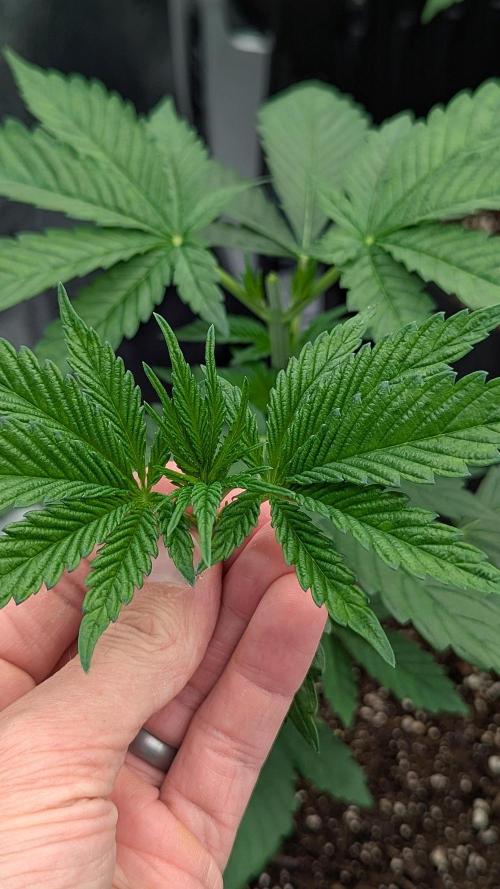
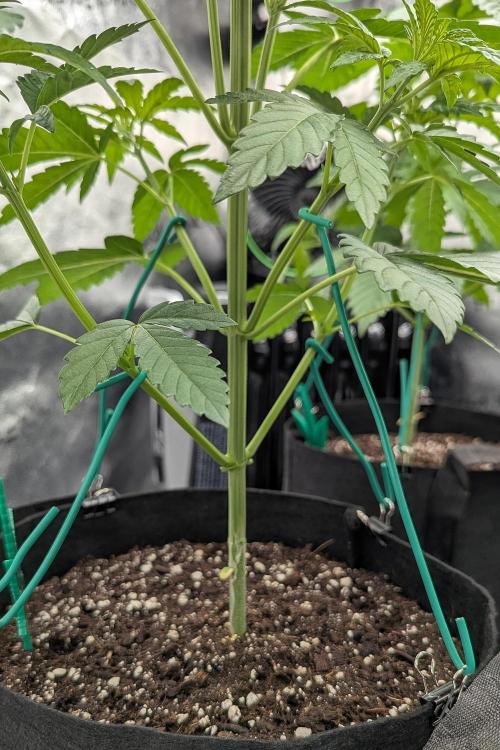
Day 19 marked the first structural training event of the grow. Plants were topped above Node 5 and Node 1 was removed, leaving four branch sets per plant as the intended structural framework moving forward. As of this entry, plants have been recovering from topping for approximately two days. Recovery appeared favorable and growth resumed quickly following the cut. Low stress training began this week.
Pre-Topping Heights (Day 19):
GG1: 13.00"
GG2: 13.25"
This period also marked a transition in cultivation approach relative to prior grows. Previous runs had been performed in amended soil systems, while this grow utilized PRO-Mix HP as an inert medium. Nutrients therefore continued to be supplied with irrigation events throughout the period. Looking back, irrigation volume increased more aggressively than necessary early in the cycle as I adapted to the different watering behavior of the new media. The approach did not create observable issues, but this grow became an early lesson in adjusting irrigation strategy to the medium rather than carrying forward assumptions from previous runs. As a good friend of mine says: "experience is life’s greatest teacher."
Water volume increased from approximately 0.5 L per plant every other day on Day 11 to approximately 1 gallon per plant every other day by Day 21 as plant size and water demand accelerated.
Nutrient strategy progressed alongside growth stages, transitioning from Early Veg (Week 1) into Early Growth (Week 2) and finishing the period in Late Growth at Light concentration. Overall solution strength increased from approximately 440 ppm to 800 ppm. CAL-MAG increased from 3 mL/gal to 4 mL/gal, while silica was introduced during this period and increased gradually from 0.5 mL/gal to 2 mL/gal by the end of the week.
Lighting was adjusted upward to match increasing canopy demand while maintaining controlled structure. Fixture height increased from approximately 20 inches above soil to 23 inches mid-period, and later to 25 inches. PPFD began the period in the mid-400 range and increased to approximately 600 PPFD prior to topping.
UV exposure remained unchanged at 30 minutes per light cycle throughout the period.
Day 21 Light Measurements:
GG1: 580 PPFD (38 DLI)
GG2: 575 PPFD (38 DLI)
Day 21 Height Measurements:
GG1: 12.50"
GG2: 12.75"
Looking back, this was also the grow that changed how I approached photoperiod structure management. At the time, I was applying techniques that had worked well in prior autoflower runs. In later grows, this experience led me toward earlier topping, earlier flowering transitions, and greater emphasis on structural training to maintain height control.
2 likes
comments
Share
Used techniques
Topping
Technique
LST
Technique
4
Week 4. Vegetation5mo ago
63.5 cm
Height
12 hrs
Light Schedule
26 °C
Day Air Temp
6.1
pH
900 PPM
TDS
55 %
Air Humidity
18 °C
Solution Temp
19 °C
Substrate Temp
22 °C
Night Air Temp
11.36 liters
Pot Size
1.89 liters
Watering Volume
25.4 cm
Lamp Distance
MichaelTheBarnOwl Grow #5, Entry #4: Transition Post-Flip
Days Since Emergence: 28
Days Since Flip: 5
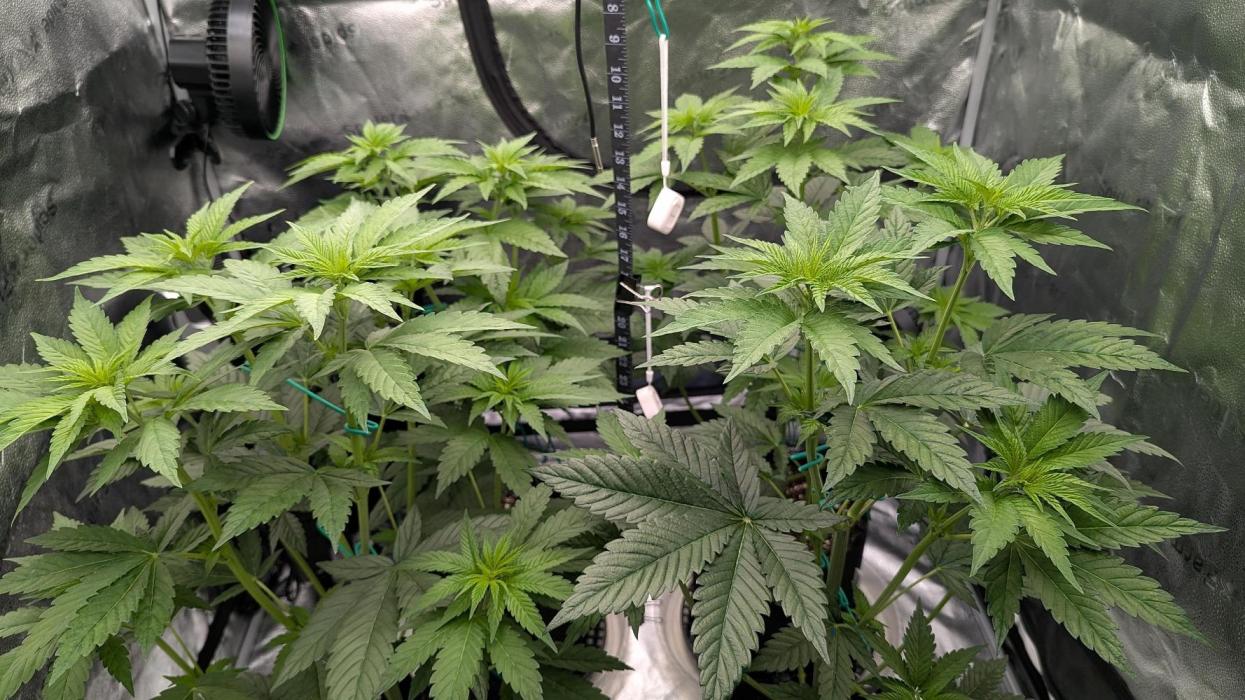
Following topping on Day 19, plants were allowed approximately four days of recovery before initiating the transition to flower. The photoperiod was flipped to 12/12 on Day 24 post-emergence. This entry documents Day 28 post-emergence (Day 5 post-flip), capturing the beginning of transition growth and early stretch response.
During this period, vertical growth accelerated following the flip while structural training continued to maintain canopy control. Low stress training was deployed across all primary branch sets and selective removal of lower growth began intermittently to improve airflow and reduce congestion near the base of the canopy. To maximize available vertical space, plant stands were removed entirely from the tent.
Light intensity increased gradually in preparation for flower initiation while avoiding abrupt environmental changes. Measurements at the beginning of the period remained near 580 PPFD (GG1) and 575 PPFD (GG2). By Day 28, canopy measurements increased to 615 PPFD (27 DLI) for GG1 and 665 PPFD (29 DLI) for GG2. Fixture output increased from 55% to 60% during the week while plants entered rapid vertical expansion. To maintain appropriate canopy distance, fixture height was increased three times, raising the distance from soil to fixture from approximately 27.5 inches to 33 inches. Final canopy-to-light distance measured approximately 10–12.5 inches.
Nutrient strategy transitioned alongside the change in photoperiod. Feeding progressed from Late Growth at Light concentration into a 50/50 blend of Late Growth and Early Bloom at Medium strength. Overall solution strength increased from approximately 800 ppm to 900 ppm by the end of the period. CAL-MAG increased from 4 mL/gal to 5 mL/gal, pH remained tightly controlled between 6.0–6.1, and silica continued at 2 mL/gal every other feeding.
UV supplementation increased from 30 minutes to 45 minutes per light cycle during this period.
The transition response became increasingly apparent by the end of the week as plants continued adapting to the new photoperiod while recovering from topping and responding to structural training.
Plant Height - Flip Day vs. Flip + 4 Days:
GG1: 16.25" → 22.50" (+6.25")
GG2: 17.50" → 25.00" (+7.50")
By Day 28, canopy expansion had accelerated enough that future structure management would increasingly depend on continued training and vertical space management.
3 likes
comments
Share
Used techniques
LST
Technique
Defoliation
Technique
12-12
Technique
5
Week 5. Flowering5mo ago
96.52 cm
Height
12 hrs
Light Schedule
26 °C
Day Air Temp
6.1
pH
Weak
Smell
900 PPM
TDS
52 %
Air Humidity
18 °C
Solution Temp
19 °C
Substrate Temp
20 °C
Night Air Temp
11.36 liters
Pot Size
1.89 liters
Watering Volume
40.64 cm
Lamp Distance
MichaelTheBarnOwl Grow #5, Entry #5: Transition Post Flip, Early Flower Begins
Days Since Emergence: 35
Days Since Flip: 12
Days in Flower: 3
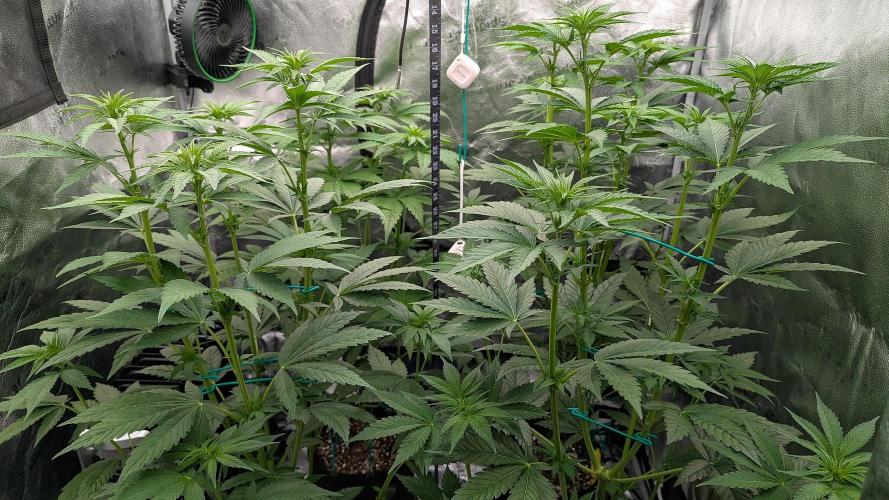
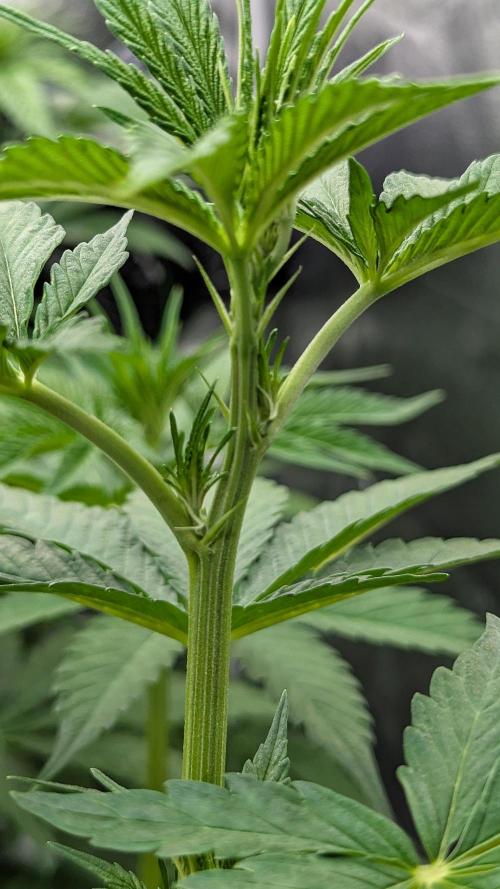
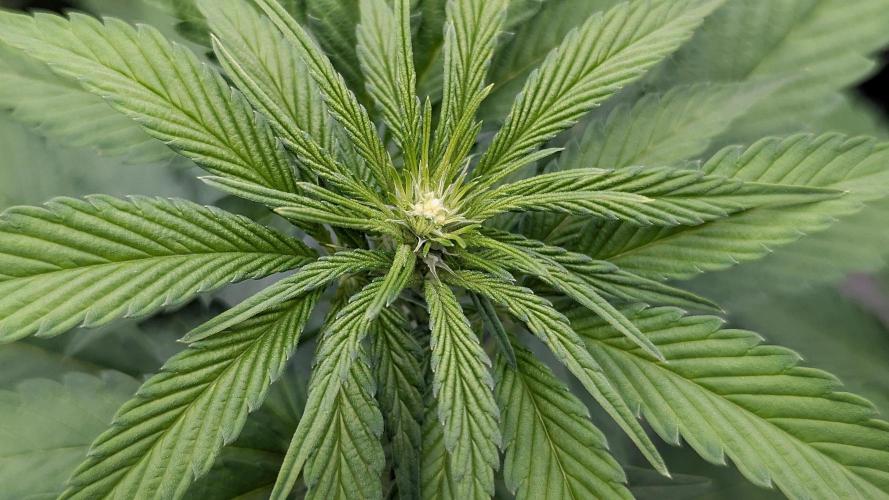
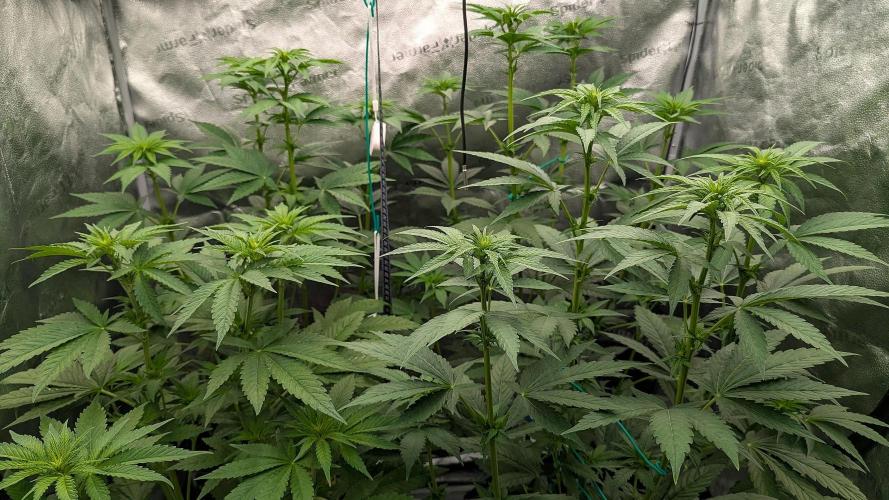
God’s Gift completed the transition period and entered early flower during this stage. Pistils became established across multiple nodes and flowering activity became consistent enough to transition nutrition fully into bloom-oriented feeding. Stretch remained active following the flip, although plant-to-plant differences in vertical growth became more apparent by the end of the period.
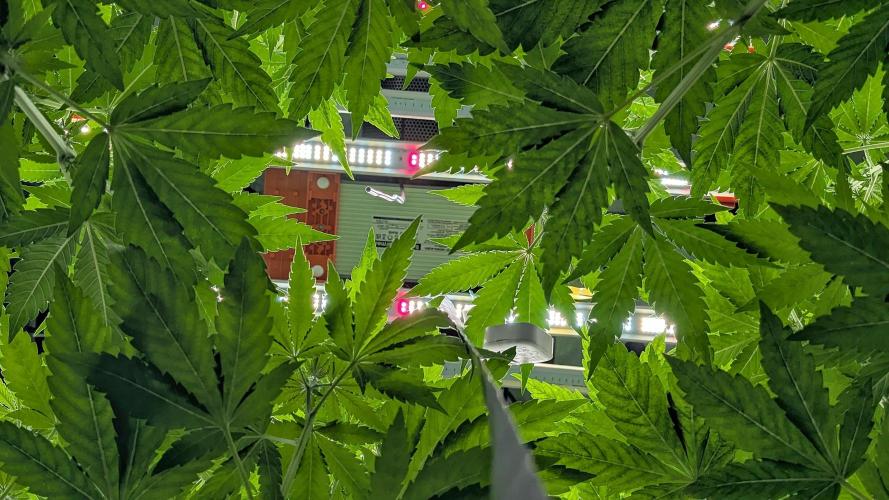
Light intensity increased steadily throughout the period in preparation for flower establishment while maintaining manageable canopy conditions. Measurements at the beginning of the period were recorded at 615 PPFD (27 DLI) for GG1 and 655 PPFD (29 DLI) for GG2. By Day 35, canopy measurements increased to 670 PPFD (29 DLI) for GG1 and 800 PPFD (35 DLI) for GG2. Dimmer output increased from 55–60% at the beginning of the period to 65% by the end of the period.
UV supplementation increased from 45 minutes to 60 minutes per light cycle.
Irrigation volume stabilized between 1–1.25 gallons per plant every other day. An attempt was made to extend irrigation frequency to once every three days; however, plants showed early signs of drought stress and watering returned to an every-other-day schedule. Input pH remained tightly controlled between 6.0–6.1 throughout the period.
Nutrient strategy continued progressing alongside flower development. Plants entered the period receiving a 50/50 blend of Late Growth and Early Bloom at Medium concentration (900 PPM) and transitioned fully into Early Bloom at Medium strength (900 PPM) after pistils became established and plants officially entered flower. CAL-MAG remained unchanged at 5 mL/gal, while silica continued at 2 mL/gal every other watering.
Structural management became increasingly important as stretch accelerated. Extensive low stress training continued throughout the canopy and selective defoliation focused primarily on leaves restricting airflow, contacting developing flower sites, and reducing congestion within the lower and middle canopy while minimizing removal from upper growth.
Plant height increased rapidly through transition and into early flower.
Plant Height - Flip Day vs. Day 1 of Flower (Flip + 10 Days)
GG1: 16.25" → 31.00" (+14.75")
GG2: 17.50" → 35.00" (+17.50")
Plant Height - Day 35 Post-Emergence
GG1: 33.50"
GG2: 38.00"
Final canopy-to-light distance measured 16.0–20.5 inches.
By the end of the period, available vertical space was becoming a primary consideration. The fixture had already been raised to its maximum position and remaining expansion options were becoming limited to equipment relocation if additional headroom became necessary. Aroma became noticeable immediately following visible flower initiation, marking a clear transition from vegetative growth into reproductive development.
Differences between plants were becoming more apparent. GG1 remained noticeably shorter than GG2 and may require elevation later if the trend continues in order to maintain more balanced light distribution across the canopy.
1 like
comments
Share
Used techniques
Defoliation
Technique
LST
Technique
12-12
Technique
6
Week 6. Flowering5mo ago
116.84 cm
Height
12 hrs
Light Schedule
23 °C
Day Air Temp
6.1
pH
Normal
Smell
900 PPM
TDS
50 %
Air Humidity
18 °C
Solution Temp
19 °C
Substrate Temp
18 °C
Night Air Temp
11.36 liters
Pot Size
1.89 liters
Watering Volume
33.02 cm
Lamp Distance
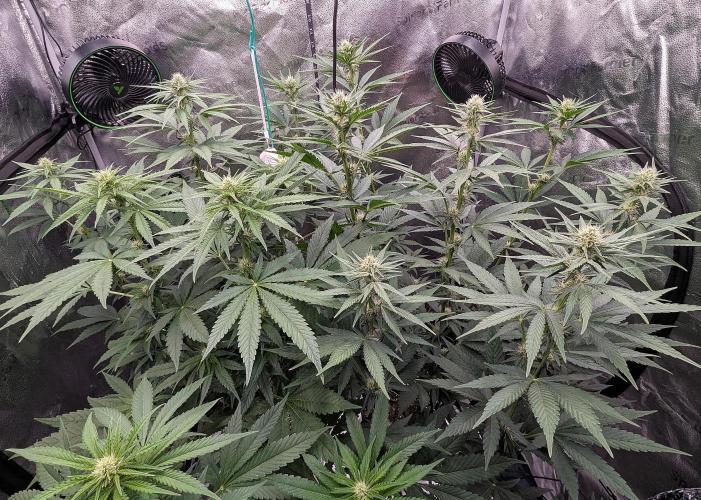
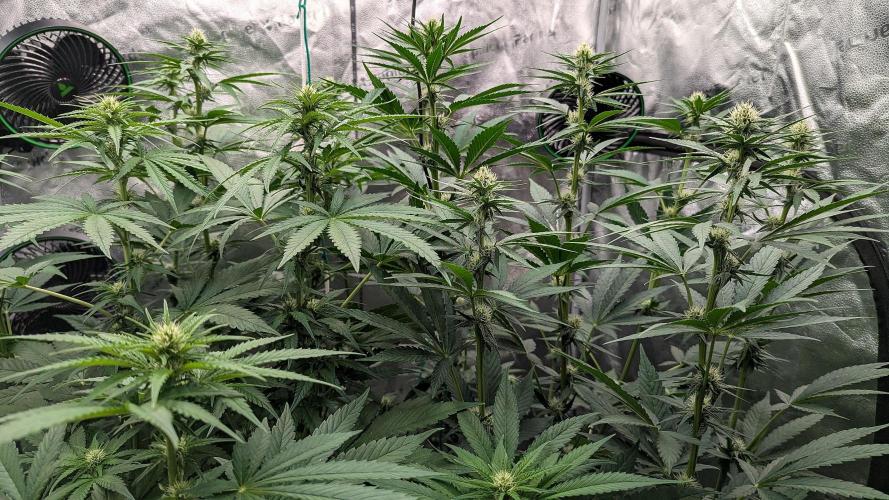
MichaelTheBarnOwl Grow #5, Entry #6: Early Flower
Days Since Emergence: 42
Days Since Flip: 19
Days in Flower: 10
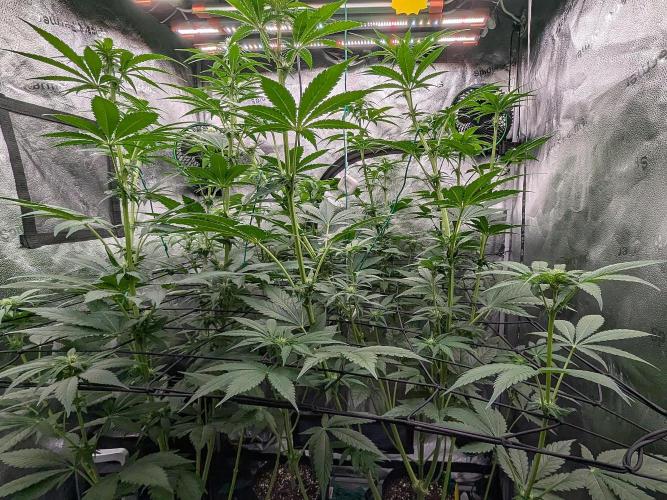
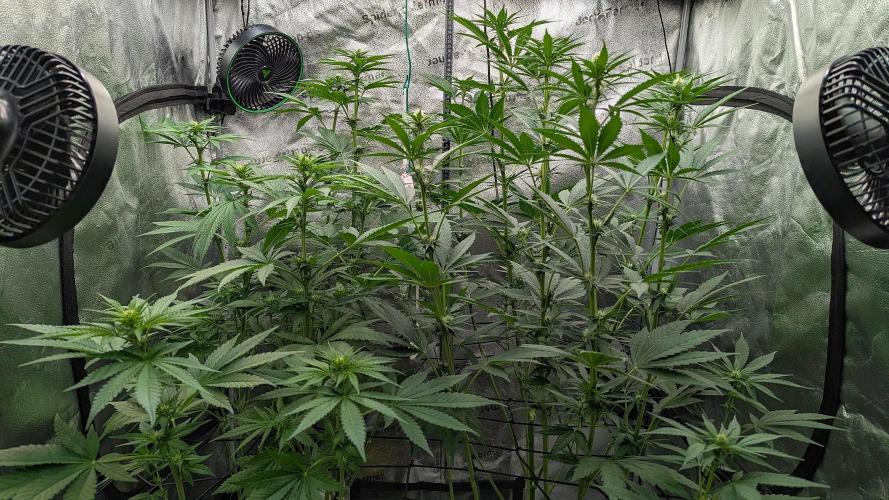
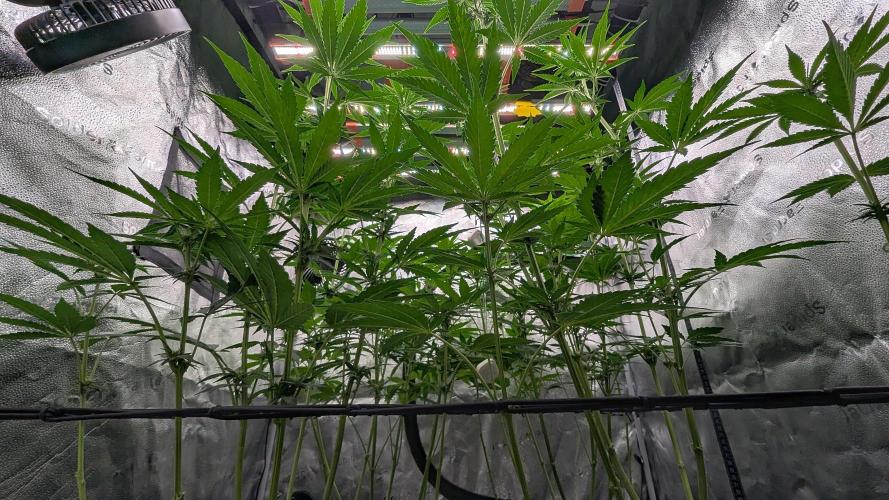
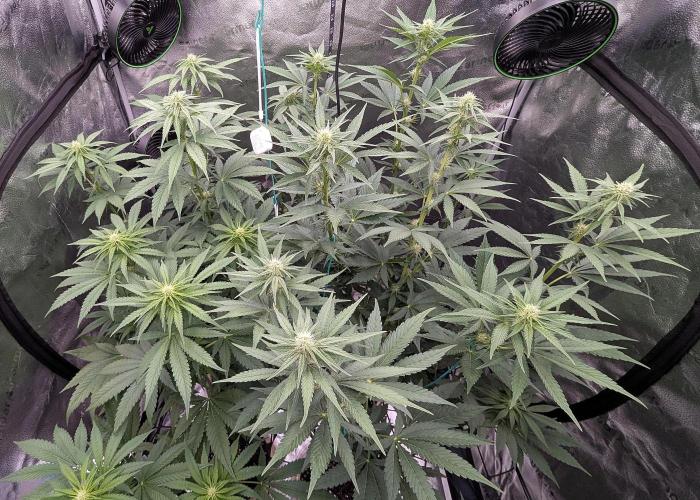
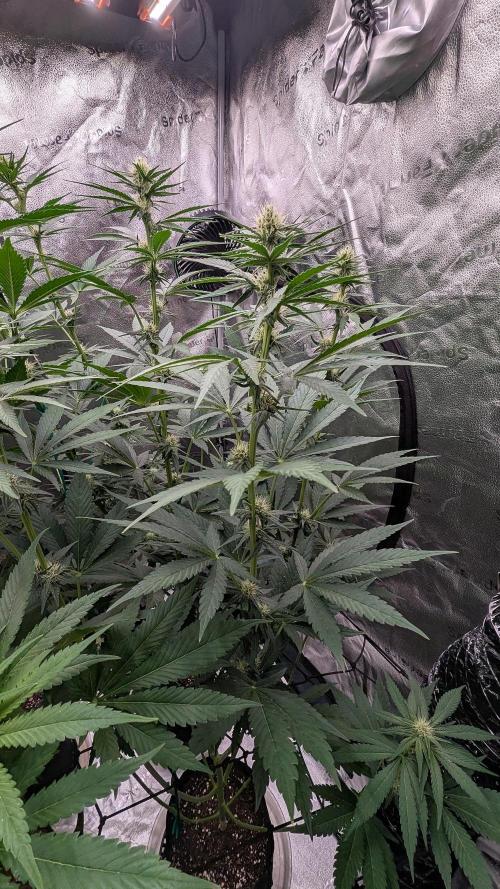
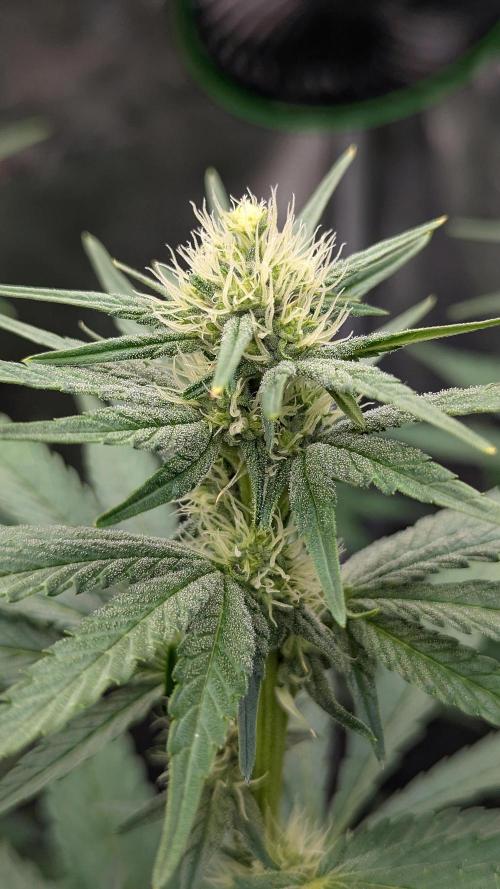
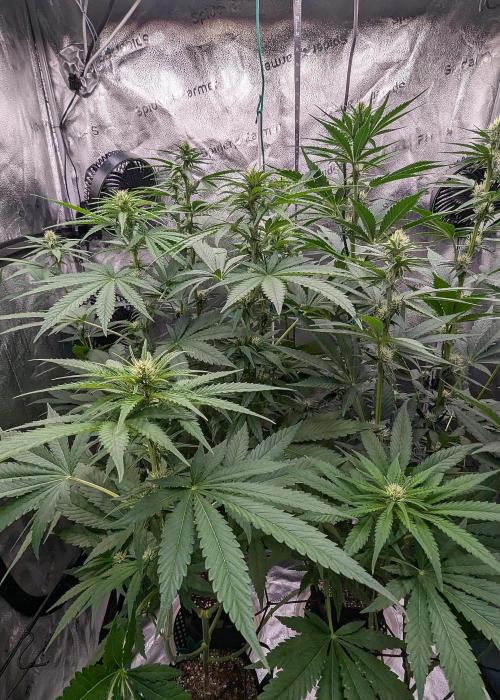
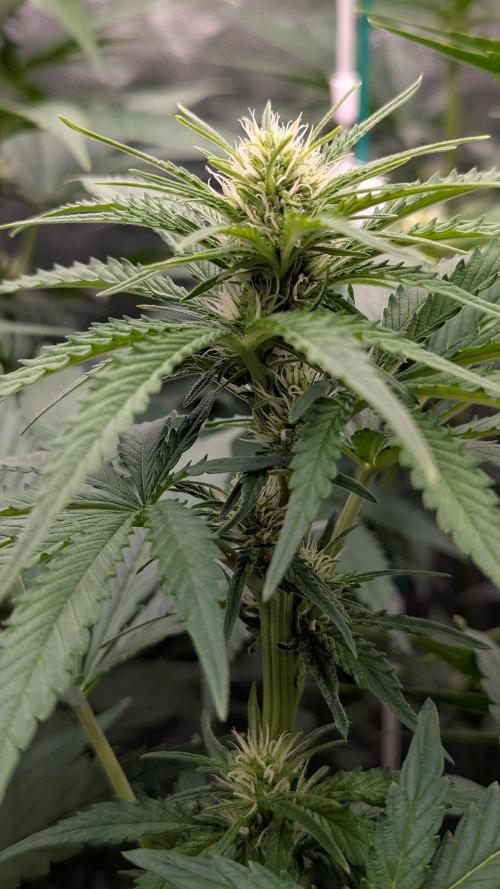
God’s Gift progressed further into early flower during this period while continuing vertical expansion and increasing flower development across the canopy. Structural management continued shifting toward maintaining airflow, preserving available vertical space, and improving light distribution between plants.
Light intensity continued increasing to support expanding flower sites while remaining within target ranges for early flower. Measurements at the beginning of the period were recorded at 670 PPFD (29 DLI) for GG1 and 800 PPFD (35 DLI) for GG2. By Day 42, canopy measurements increased to 770 PPFD (33 DLI) for GG1 while GG2 measured 700 PPFD (33 DLI). Dimmer output increased from 65% at the beginning of the period to 70% by the end of the period.
UV supplementation remained unchanged at 60 minutes per light cycle.
Irrigation remained steady at 1–1.25 gallons per plant every other day throughout the period. Input pH remained tightly controlled between 6.0–6.2.
Nutrient delivery remained stable during this stage with plants receiving Early Bloom at Medium strength (900 PPM) throughout the period. CAL-MAG remained unchanged at 5 mL/gal, while silica continued at 2 mL/gal every other watering.
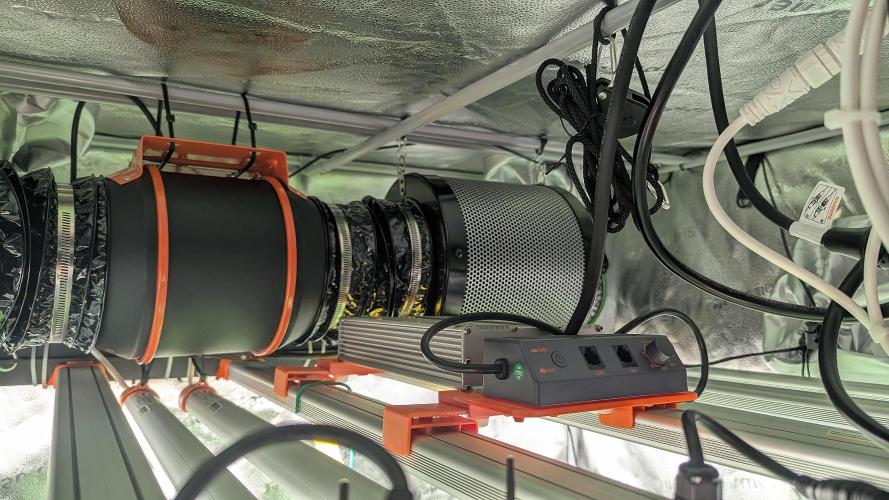
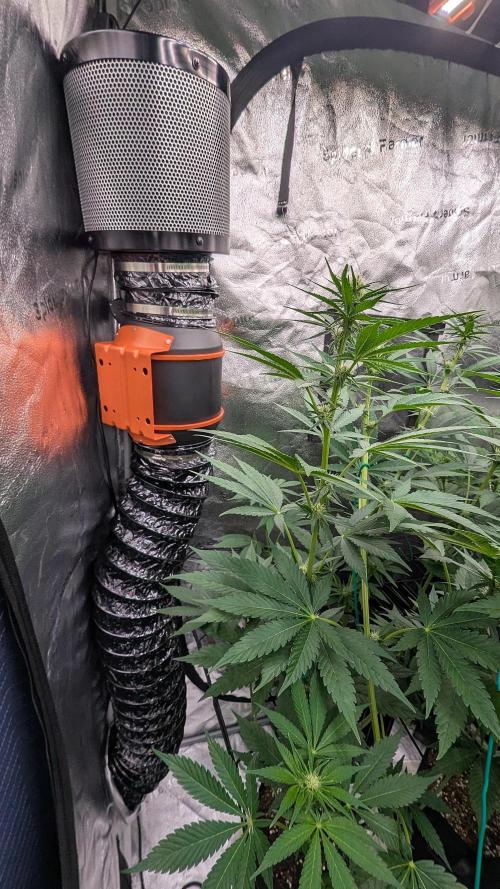
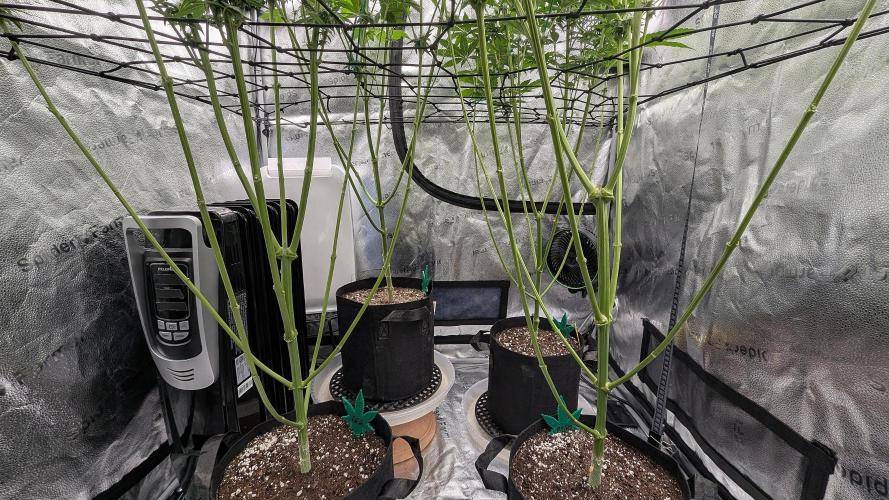
Structural management intensified as available vertical space narrowed. The exhaust system was relocated into the corner of the tent to recover additional headroom and preserve canopy distance. An AC Infinity trellis net was installed and tops were guided through the net to begin more active lateral control and height management.
Defoliation continued with emphasis placed on removing foliage from the lower one-third of each plant along with inward-facing, overlapping, and light-blocking leaves within the lower and middle canopy. Removal remained conservative in the upper canopy to preserve productive flower sites and maintain canopy momentum.
As canopy differences became more apparent, GG1 was elevated using a plant stand to improve light distribution relative to the rest of the canopy. This adjustment increased measured light intensity at GG1 from 665 PPFD to 770 PPFD and helped bring both plants into a more comparable operating range.
Plant Height - Day 42 Post-Emergence:
GG1: 41.00"
GG2: 46.00"
Canopy-to-light distance measured 13.0–20.0 inches.
Aroma intensified noticeably during this period as flower development progressed. The tent environment developed a strong profile combining roadkill skunk characteristics with layered citrus and berry notes that became increasingly pronounced as flowers continued establishing.
By the end of the period, height management had become one of the primary operational constraints of the grow. The fixture had reached its maximum practical height and future adjustments would increasingly depend on canopy management and equipment positioning rather than additional fixture movement.
1 like
comments
Share
Used techniques
LST
Technique
Defoliation
Technique
12-12
Technique
7
Week 7. Flowering5mo ago
127 cm
Height
12 hrs
Light Schedule
23 °C
Day Air Temp
6.1
pH
Normal
Smell
900 PPM
TDS
50 %
Air Humidity
18 °C
Solution Temp
18 °C
Substrate Temp
17 °C
Night Air Temp
11.36 liters
Pot Size
1.89 liters
Watering Volume
27.94 cm
Lamp Distance
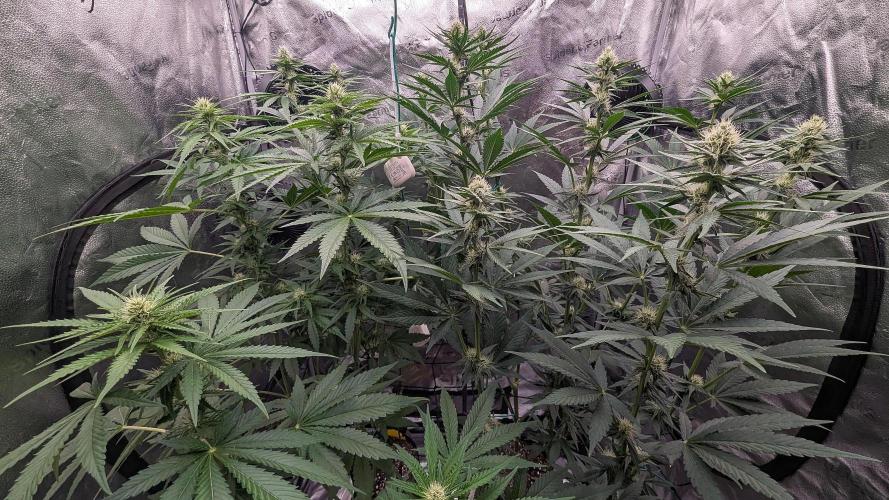
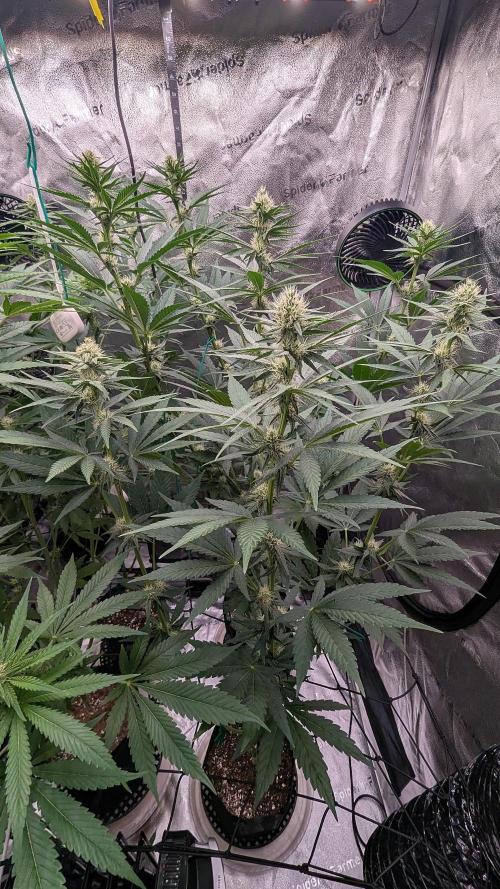
MichaelTheBarnOwl Grow #5, Entry #7: Early Flower, Stretch Ends
Days Since Emergence: 49
Days Since Flip: 26
Days in Flower: 17
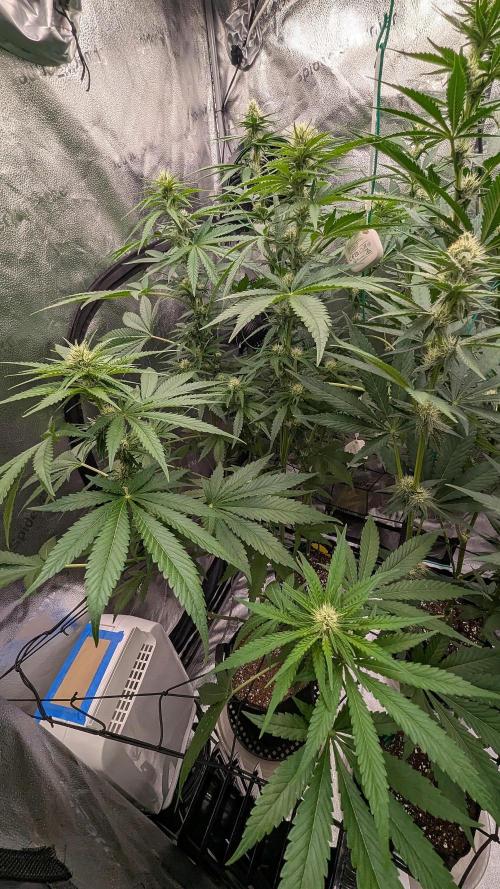
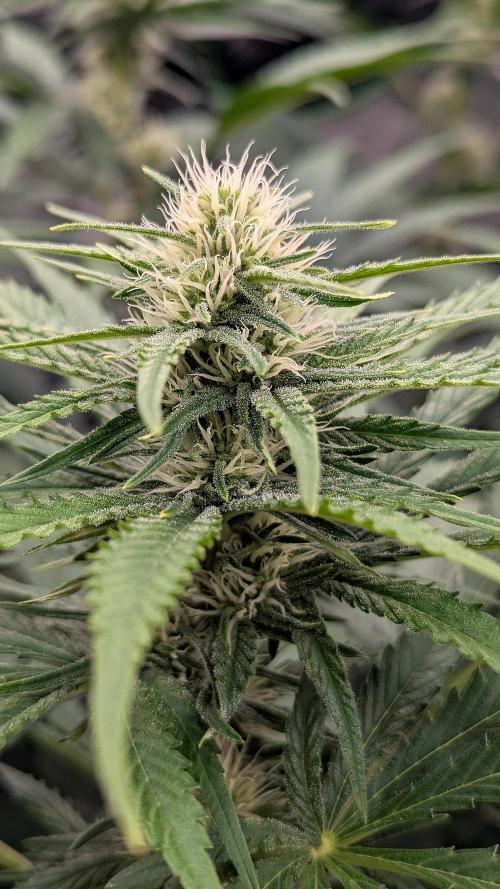
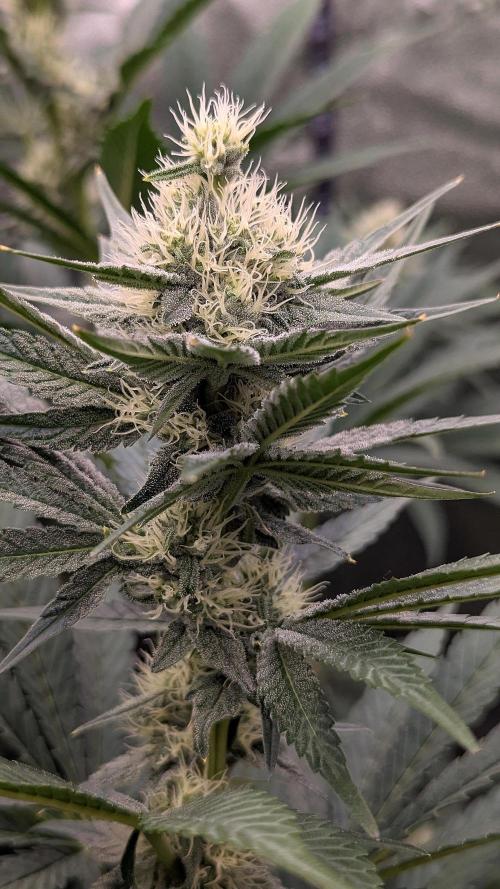
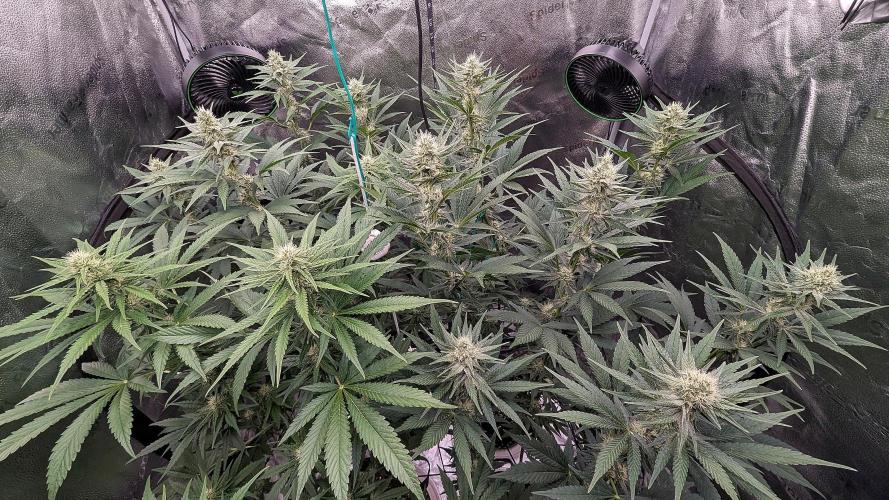
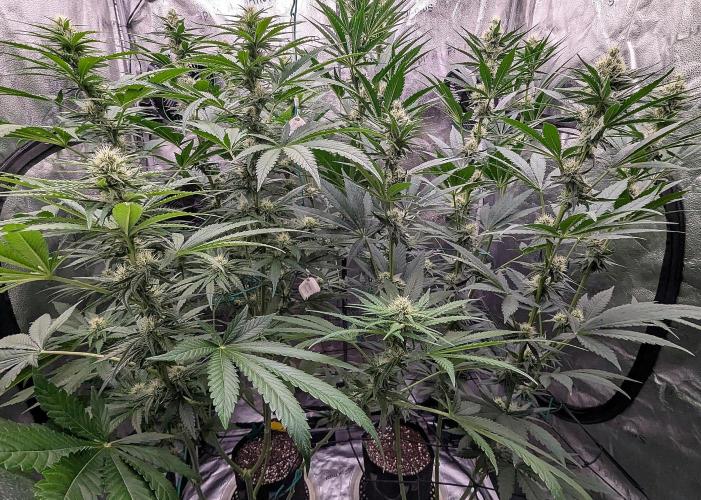
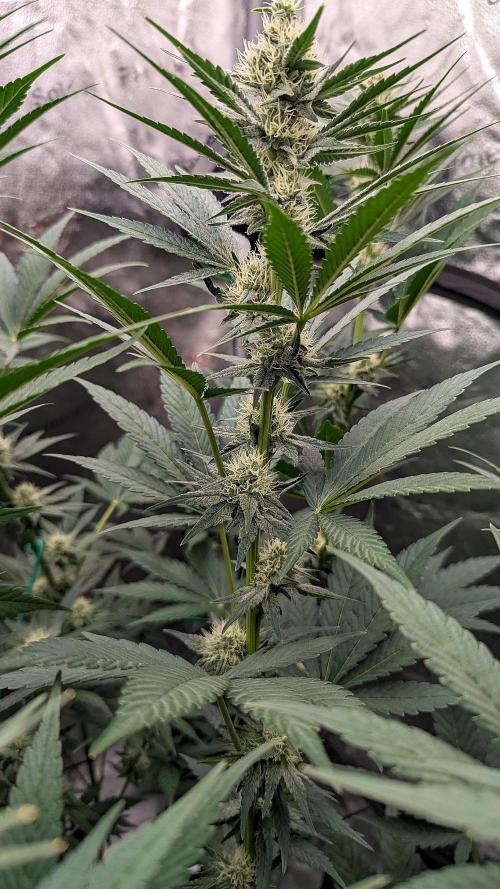
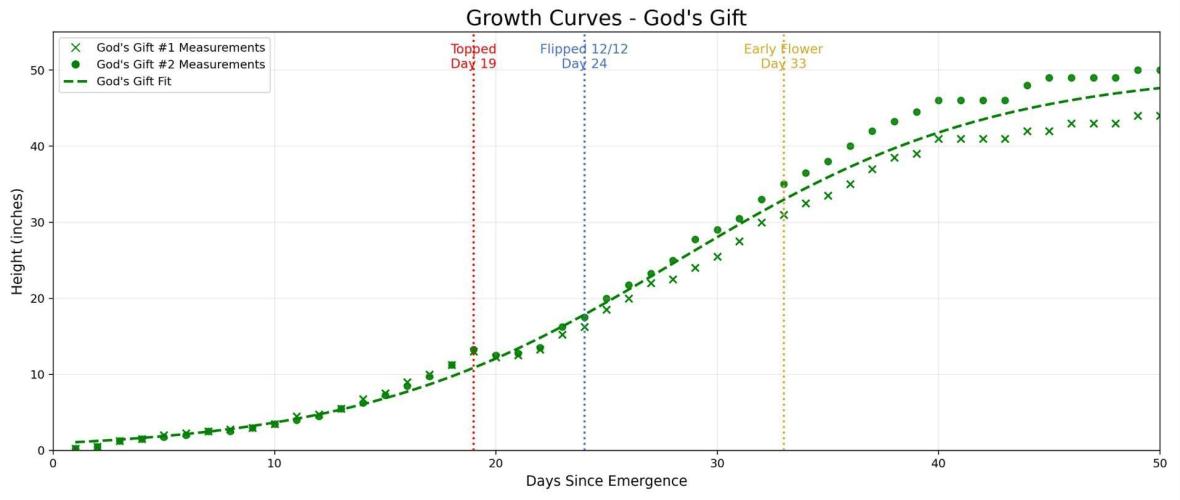
Although vertical growth had already begun slowing entering the week, measurements collected beyond Day 17 of flower showed no meaningful additional height gain and stretch was considered finished at that point. Management priorities shifted away from height control and toward optimizing light distribution, canopy structure, and directing energy into productive flower sites.
Light intensity increased further during the period to support early flower development while maintaining balanced canopy exposure. Measurements at the beginning of the period were recorded at 770 PPFD (33 DLI) for GG1 and 700 PPFD (30 DLI) for GG2. By Day 49, both plants were operating at 875 PPFD (38 DLI). Dimmer output remained unchanged at 70% throughout the period.
UV supplementation increased from 60 minutes to 70 minutes per light cycle.
Irrigation remained steady at 1–1.25 gallons per plant every other day with input pH maintained between 6.0–6.2.
Nutrient delivery remained unchanged during this stage with plants receiving Early Bloom at Medium strength (900 PPM) throughout the period. CAL-MAG remained at 5 mL/gal, while silica continued at 2 mL/gal every other watering.
Canopy management became increasingly selective as final plant structure emerged. Lower branch removal was guided primarily by available light, with nodes receiving less than 250 PPFD being removed if they could not be repositioned into productive canopy space. This resulted in the removal of eight branches during the period.
Early assumptions about maintaining four branch sets per plant ultimately changed as the grow progressed. Internodal spacing and overall plant height resulted in lower branches falling too far below the productive canopy to develop into high-quality flower. By the end of stretch, practical structure had been reduced to the equivalent of 2–2.5 productive branch sets per plant, concentrating resources into better-positioned flower sites.
Using final heights recorded at the time of flip and final heights at the end of stretch, final stretch multipliers were calculated as follows:
Plant Height - Flip Day vs. End of Stretch (Flip Day + 26 Days)
GG1: 16.25" → 44.00" (2.70×)
GG2: 17.50" → 50.00" (2.86×)
Final canopy-to-light distance measured 11.0–17.0 inches.
This period also marked an important adjustment in future training philosophy. Looking back, topping lower and training more aggressively would likely have improved both canopy uniformity and final plant height while preserving more of the branch sets originally intended to remain. Experience from this grow will later influence both topping height and structural planning in future runs.
1 like
comments
Share
Used techniques
LST
Technique
Defoliation
Technique
12-12
Technique
8
Week 8. Flowering5mo ago
127 cm
Height
12 hrs
Light Schedule
24 °C
Day Air Temp
6.1
pH
Strong
Smell
900 PPM
TDS
48 %
Air Humidity
18 °C
Solution Temp
18 °C
Substrate Temp
19 °C
Night Air Temp
11.36 liters
Pot Size
1.89 liters
Watering Volume
27.94 cm
Lamp Distance
MichaelTheBarnOwl Grow #5, Entry #8: Mid Flower
Days Since Emergence: 56
Days Since Flip: 33
Days in Flower: 24
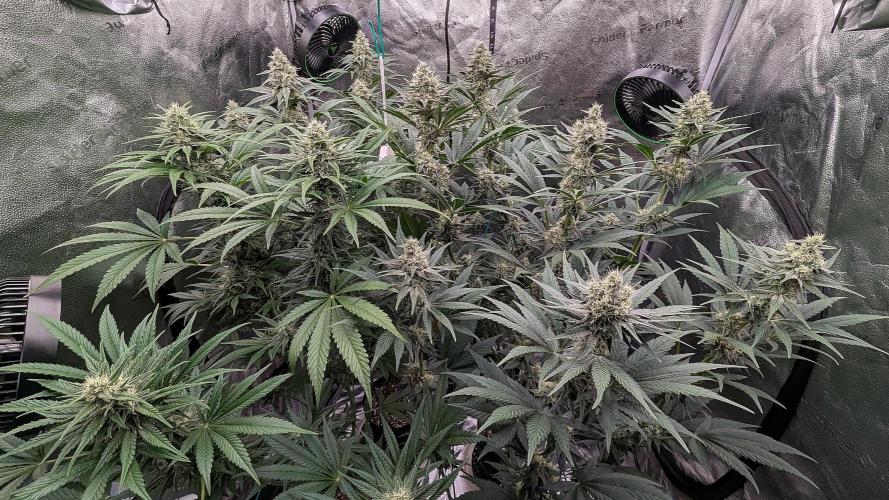
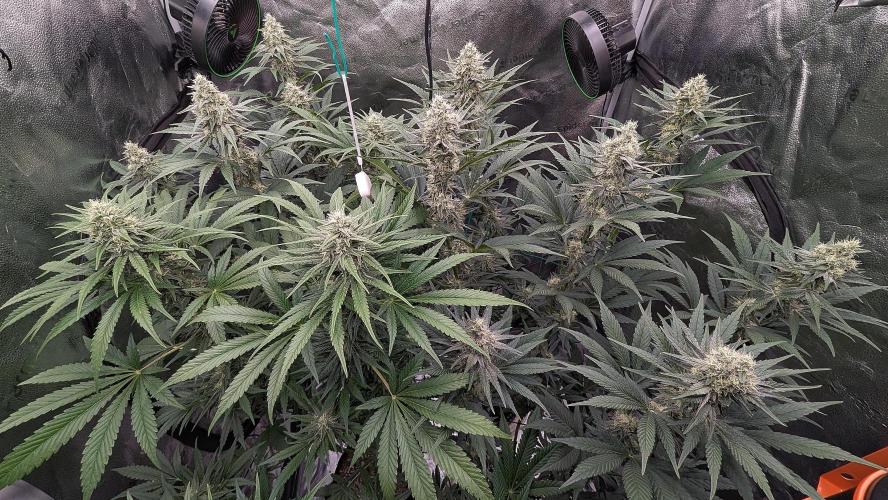
With stretch concluded, management efforts focused on maintaining light distribution, preserving airflow, and supporting continued flower development during the bulking phase.
Light intensity remained unchanged throughout the period with canopy measurements held at 875 PPFD (38 DLI) for both plants from beginning to end. Dimmer output remained steady at 70%.
UV supplementation increased from 70 minutes to 120 minutes per light cycle.
Irrigation remained stable at 1–1.25 gallons per plant every other day with input pH maintained between 6.0–6.2.
Nutrient delivery transitioned gradually through bloom progression while maintaining stable solution strength. Plants entered the period receiving Early Bloom at Medium strength (900 PPM) before progressing into a 50/50 blend of Early Bloom and Mid Bloom at Medium strength, ultimately finishing the period receiving Mid Bloom at Medium strength. Solution concentration remained unchanged at 900 PPM throughout the period.
CAL-MAG remained unchanged at 5 mL/gal. Silica supplementation was reduced from 2 mL/gal every other watering to 1 mL/gal once per week.
Canopy work became lighter and more selective compared to prior periods. Small amounts of defoliation continued with emphasis placed on removing leaves wrapping around developing flowers, inward-facing leaves, and foliage reducing airflow through the canopy. Additional adjustments were made to improve light distribution across the outer canopy, with efforts focused on positioning edge colas into a target range of 550–650 PPFD where possible.
Plant Height - Day 56 Post-Emergence (unchanged since the end of stretch):
GG1: 44.00"
GG2: 50.00"
Final canopy-to-light distance unchanged and measured at 11.0–17.0 inches.
Aroma intensified noticeably during this period as flowers continued developing and filling in. With structural work largely complete, the canopy entered a more stable phase where the focus shifted toward maintaining conditions and allowing flowers to mature with minimal additional intervention.
1 like
comments
Share
Used techniques
LST
Technique
Defoliation
Technique
12-12
Technique
9
Week 9. Flowering5mo ago
127 cm
Height
12 hrs
Light Schedule
24 °C
Day Air Temp
6.1
pH
Strong
Smell
900 PPM
TDS
51 %
Air Humidity
18 °C
Solution Temp
18 °C
Substrate Temp
18 °C
Night Air Temp
11.36 liters
Pot Size
1.89 liters
Watering Volume
27.94 cm
Lamp Distance
MichaelTheBarnOwl Grow #5, Entry #9: Mid Flower
Days Since Emergence: 67
Days Since Flip: 44
Days in Flower: 35
Light intensity increased modestly during the period while maintaining stable conditions across both plants. Measurements at the beginning of the period were recorded at 875 PPFD (38 DLI) for GG1 and 895 PPFD (38 DLI) for GG2. By Day 67, canopy measurements increased to 910 PPFD (39 DLI) for GG1 and 955 PPFD (42 DLI) for GG2. Dimmer output remained unchanged until Day 63 post-emergence, when output increased from 70% to 75%.
The increase in light intensity during this period was driven in part by canopy balancing, helping maintain stronger light delivery to God’s Gift despite remaining slightly shorter than Granddaddy Purple.
UV supplementation increased from 120 minutes to 150 minutes per light cycle.
Irrigation remained stable at 1–1.25 gallons per plant every other day with input pH maintained between 6.0–6.2.
Nutrient delivery remained unchanged during this stage with plants continuing on Mid Bloom at Medium feed strength throughout the period. CAL-MAG remained at 5 mL/gal, while silica continued at 1 mL/gal once per week.
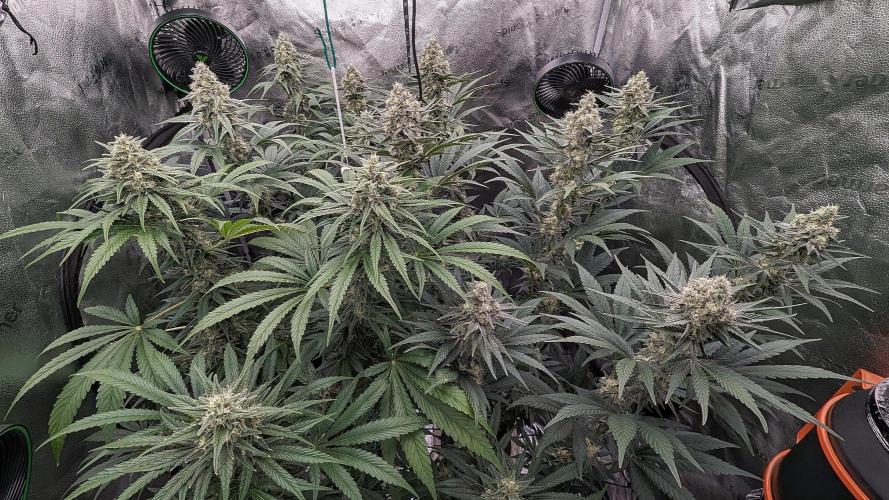
Canopy intervention became minimal compared to prior periods. No additional defoliation was performed beyond selective removal of a small number of leaves contacting or wrapping around developing flowers. Structural work shifted toward observation and support as flower mass continued accumulating.
Flower mass is clearly building. Stems began leaning under accumulating bud mass.
1 like
comments
Share
Used techniques
LST
Technique
12-12
Technique
Defoliation
Technique
10
Week 10. Flowering5mo ago
127 cm
Height
12 hrs
Light Schedule
25 °C
Day Air Temp
6.1
pH
Strong
Smell
900 PPM
TDS
48 %
Air Humidity
18 °C
Solution Temp
19 °C
Substrate Temp
19 °C
Night Air Temp
11.36 liters
Pot Size
1.89 liters
Watering Volume
27.94 cm
Lamp Distance
MichaelTheBarnOwl Grow #5, Entry #10: Mid Flower
Days Since Emergence: 74
Days Since Flip: 51
Days in Flower: 42
Light intensity remained unchanged throughout the period. Measurements at the beginning of the week were recorded at 980 PPFD (42 DLI) for GG1 and 955 PPFD (41 DLI) for GG2 and remained unchanged through Day 74. Dimmer output remained fixed at 75%.
UV supplementation remained unchanged at 150 minutes per light cycle.
Irrigation remained stable at 1–1.25 gallons per plant every other day with input pH maintained between 6.0–6.2.
Nutrient delivery remained unchanged during this stage with plants continuing on Mid Bloom at Medium feed strength throughout the period. CAL-MAG remained at 5 mL/gal, while silica remained at 1 mL/gal once per week.
Canopy intervention remained minimal. Only small amounts of leaf removal were performed as needed to prevent friction against developing flowers and maintain airflow through the canopy.
As flower mass continued accumulating, additional structural support became necessary. A secondary support screen was installed higher in the tent to assist branches that had begun leaning under increasing flower weight and branch length.
Early Trichome Analysis - Tops:
Clear: 25–30%
Cloudy: 65–70%
Amber: Trace
A wind storm caused a power outage lasting roughly one hour during the light cycle. Airflow was temporarily lost and humidity increased sharply; however, inspection following restoration showed no visible condensation on foliage, tent walls, or other surfaces and environmental conditions returned to normal without issue.
Aroma intensified further during this period with a strong berry and skunk profile becoming increasingly pronounced as flower development continued.
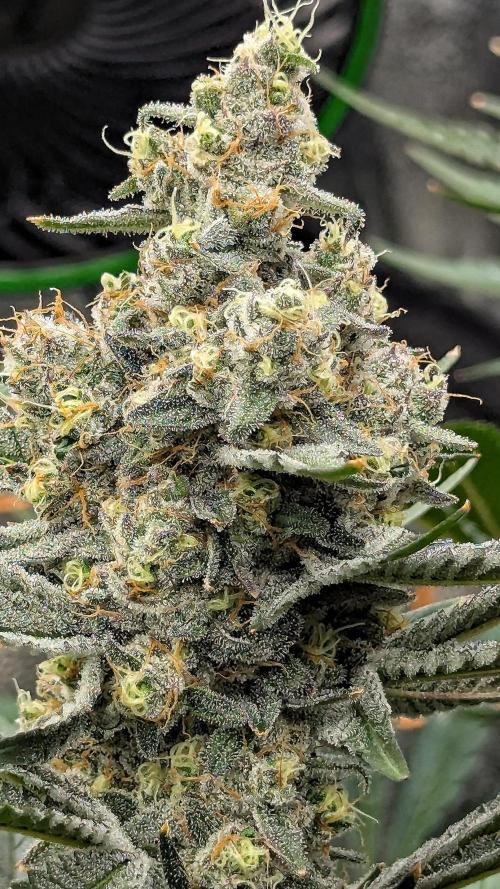
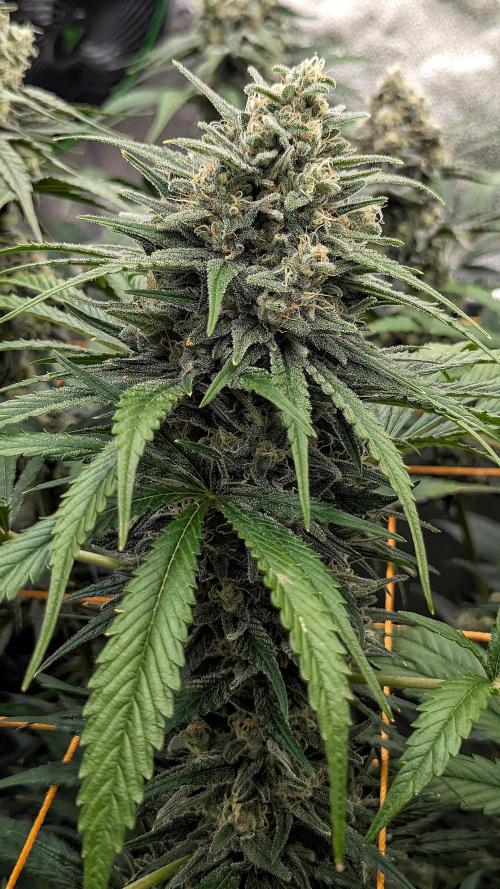
Differences in phenotype expression became increasingly apparent during this period. GG1 developed a noticeably looser, fluffier flower structure with stronger kush-like characteristics, while GG2 produced denser flowers with tighter stacking and mild foxtailing. The contrast highlighted the range of expression present within the cultivar.
2 likes
comments
Share
Used techniques
LST
Technique
Defoliation
Technique
12-12
Technique
11
Week 11. Flowering5mo ago
127 cm
Height
12 hrs
Light Schedule
24 °C
Day Air Temp
6.1
pH
Strong
Smell
640 PPM
TDS
51 %
Air Humidity
18 °C
Solution Temp
19 °C
Substrate Temp
18 °C
Night Air Temp
11.36 liters
Pot Size
1.89 liters
Watering Volume
27.94 cm
Lamp Distance
MichaelTheBarnOwl Grow #5, Entry #11: Mid-Late Flower Transition
Days Since Emergence: 84
Days Since Flip: 61
Days in Flower: 52
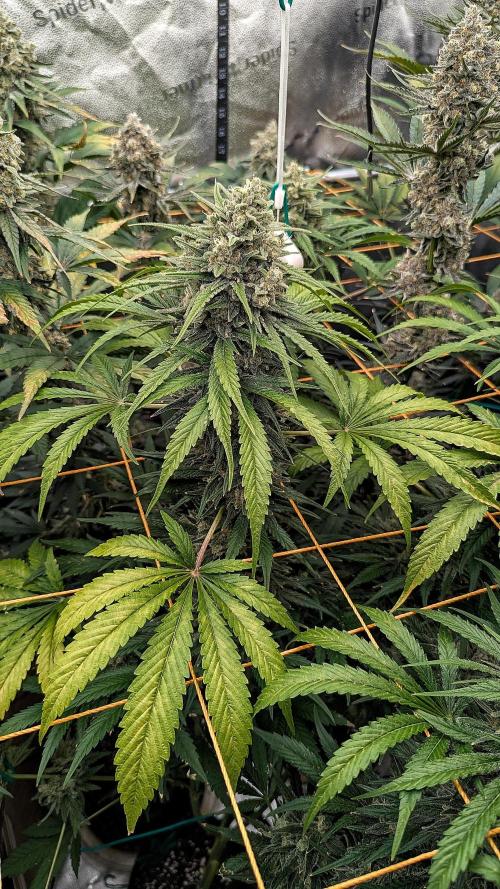
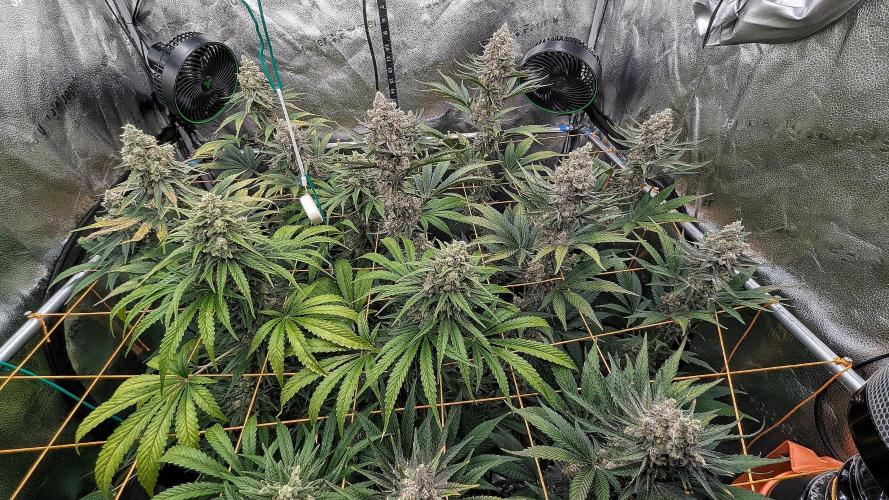
God’s Gift progressed through the transition from mid flower into late flower during this period as environmental intensity and nutrient inputs began shifting toward final maturation. Continued trichome development and visible signs of senescence supported the decision to begin gradually reducing light intensity and transitioning nutrition toward finishing.
Light intensity was reduced incrementally throughout the period in preparation for late flower. Measurements at the beginning of the period were recorded at 980 PPFD (42 DLI) for GG1 and 955 PPFD (41 DLI) for GG2. By Day 84, canopy measurements measured 875 PPFD (38 DLI) for GG1 and 870 PPFD (38 DLI) for GG2. Dimmer output decreased from 75% at the beginning of the period to 70% mid-period and 65% by the end of the period.
UV supplementation was reduced from 150 minutes to 90 minutes per light cycle.
Irrigation remained stable at 1–1.25 gallons per plant every other day with input pH maintained between 6.0–6.2.
Nutrient delivery transitioned further into late flower. Plants entered the period receiving a 50/50 blend of Mid Bloom and Late Bloom at Medium strength (885 PPM) before progressing fully into Late Bloom at Medium strength (640 PPM) by period end. CAL-MAG was reduced from 5 mL/gal to 3 mL/gal as nutrient requirements shifted later into flower. Silica supplementation was discontinued.
Trichome Analysis - Average of Upper, Middle, and Lower Sites:
Clear: 25%
Cloudy: 70%
Amber: 5%
Canopy intervention remained minimal outside of structural support. Smaller branches continued requiring support from trellis wire and adjacent stems as flower mass accumulated and branch loading increased.
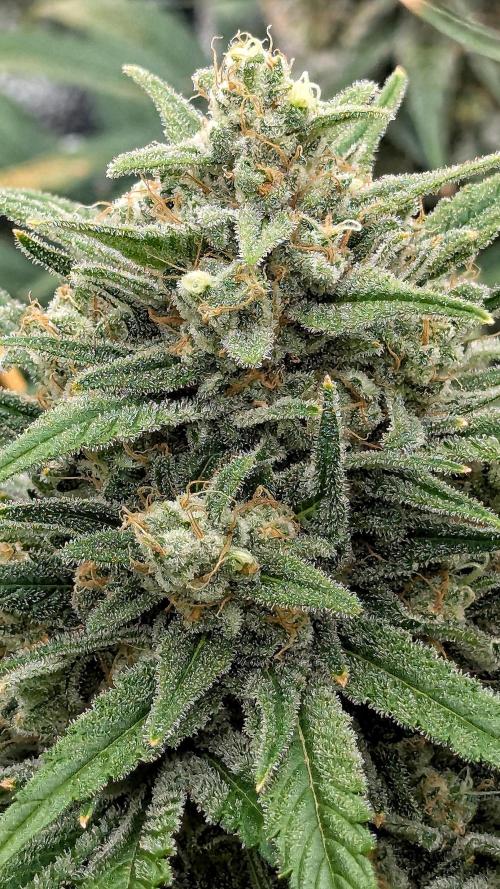
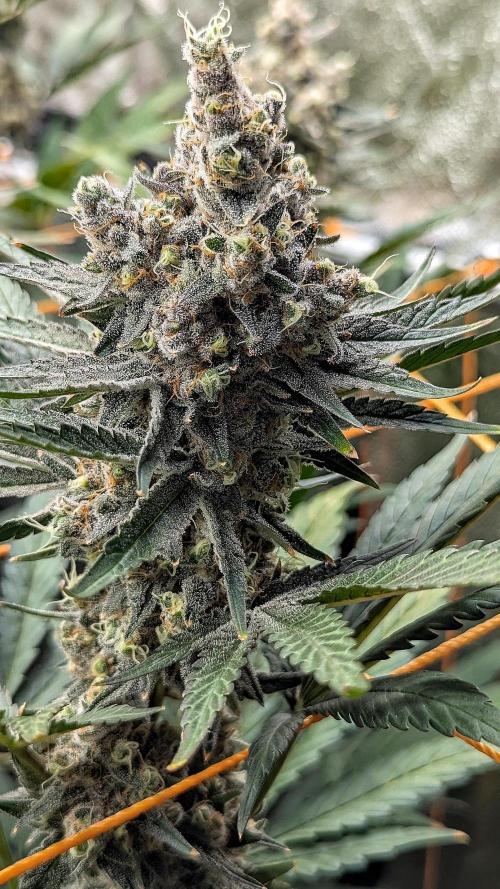
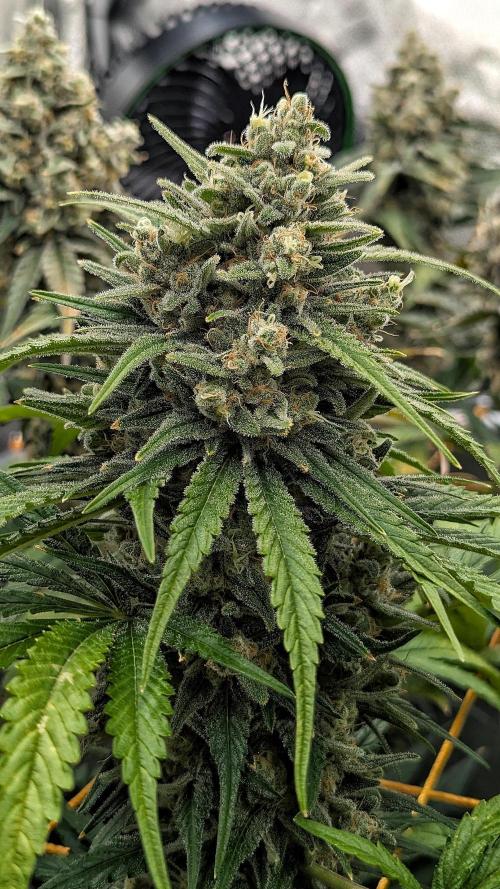
Aroma continued evolving throughout the day and remained one of the more interesting observations of the grow. Evening observations produced a noticeably stronger skunk profile, while daytime aroma shifted toward a more berry-forward expression as flowers continued maturing.
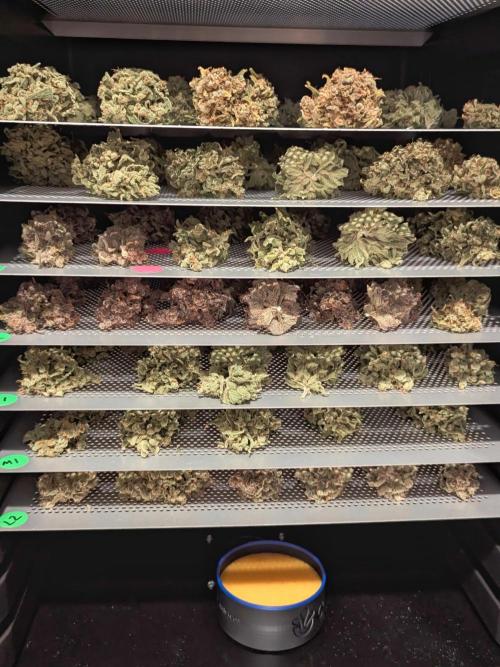
One aspect of my harvest strategy that differs from breeder timelines is that I intentionally stagger harvests rather than harvesting all plants simultaneously. If drying capacity were unlimited, I would prefer to harvest each plant at its individual peak regardless of timing; however, my current drying and curing process is performed in a Cannatrol with capacity for only two plants at a time, requiring harvest events to be separated by roughly two weeks.
Because of this limitation, I begin monitoring trichomes during mid flower. Once the majority of trichomes begin transitioning cloudy - signaling movement into late flower - I perform a more formal trichome analysis across upper, middle, and lower flower sites on all plants. That analysis, combined with observations of overall plant maturity and visual cues from foliage, is used to estimate which cultivar appears furthest along and therefore most likely to finish first.
For this run, trichome progression suggested that Granddaddy Purple was advancing more quickly than God’s Gift. Visual observations of senescence and overall plant development supported that conclusion, leading me to intentionally progress Granddaddy Purple more aggressively through late flower while allowing God’s Gift additional time under late flower and ripening conditions. Since I generally do not mind allowing indica-dominant plants to continue slightly beyond peak maturity, harvest timing remained flexible and plants continued being evaluated until final harvest decisions were made.
2 likes
2 comments
Share
Used techniques
12-12
Technique
Defoliation
Technique
LST
Technique
12
Week 12. Flowering5mo ago
127 cm
Height
12 hrs
Light Schedule
24 °C
Day Air Temp
6.1
pH
Strong
Smell
400 PPM
TDS
43 %
Air Humidity
19 °C
Solution Temp
19 °C
Substrate Temp
18 °C
Night Air Temp
11.36 liters
Pot Size
1.89 liters
Watering Volume
27.94 cm
Lamp Distance
MichaelTheBarnOwl Grow #5, Entry #12: Transition to Ripening
Days Since Emergence: 91
Days Since Flip: 68
Days in Flower: 59
Light intensity was reduced incrementally throughout the period in preparation for ripening. Measurements at the beginning of the period were recorded at 875 PPFD (38 DLI) for both plants. By Day 91, canopy measurements measured 755 PPFD (32 DLI) for GG1 and 775 PPFD (33 DLI) for GG2. Dimmer output decreased from 65% to 60% by the end of the period.
UV supplementation was reduced from 90 minutes to 45 minutes per light cycle.
Irrigation remained stable at 1–1.25 gallons per plant every other day with input pH maintained between 6.0–6.2.
Nutrient delivery transitioned fully into ripening conditions during this period. Plants entered the week receiving a 50/50 blend of Late Bloom and Ripening nutrients at Medium strength (640 PPM) before progressing into Ripening nutrients at Medium strength (440 PPM) and ultimately finishing the period receiving Ripening nutrients at Light strength (400 PPM).
CAL-MAG decreased from 3 mL/gal to 1 mL/gal across the period. Silica supplementation remained discontinued.
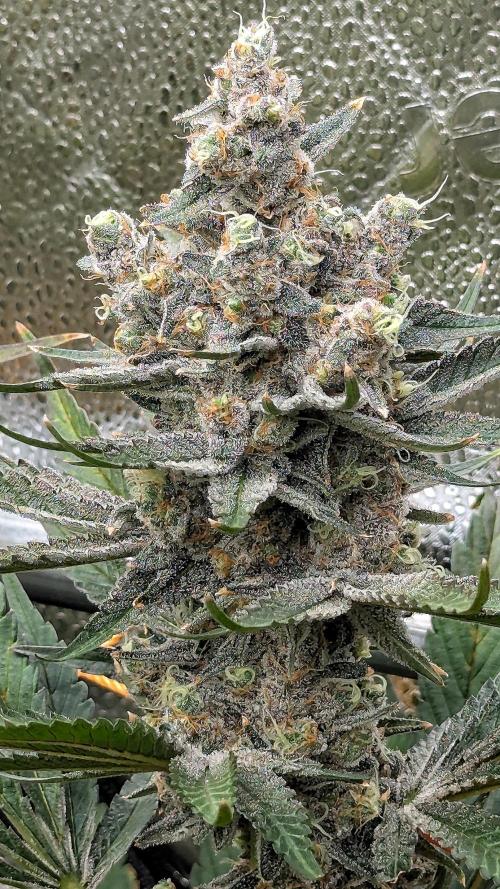
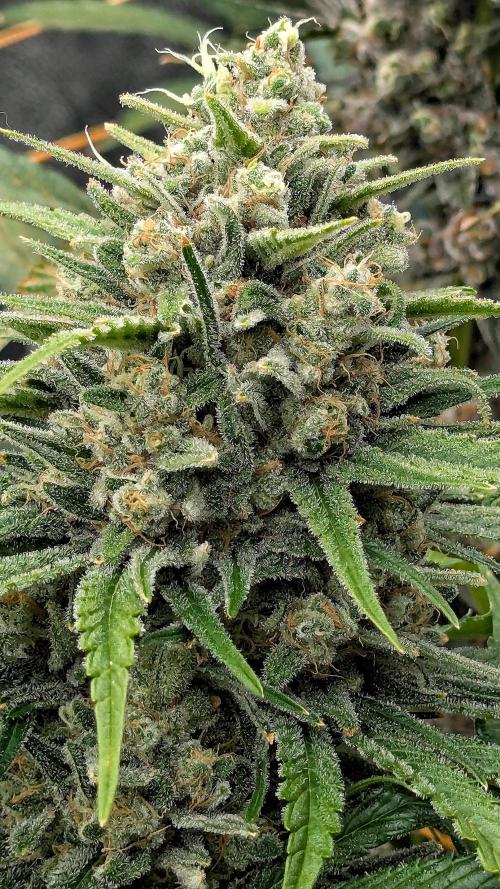
Trichome development continued progressing toward maturity, although significant differences remained between upper and lower flower sites.
GG1:
Top: 20% clear / 70% cloudy / 10% amber
Middle: 35% clear / 60% cloudy / 5% amber
Bottom: 50% clear / 45% cloudy / 5% amber
Overall: 32% clear / 61% cloudy / 7% amber
GG2:
Top: 15% clear / 75% cloudy / 10% amber
Bottom: 35% clear / 60% cloudy / 5% amber
Overall: 25% clear / 68% cloudy / 7% amber
Differences in maturation rate between plants and between canopy levels remained clearly visible during this period. Tops continued progressing faster than lower buds, reinforcing the decision to continue allowing God’s Gift additional finishing time under reduced environmental intensity and ripening-focused nutrition.
1 like
comments
Share
Used techniques
12-12
Technique
13
Week 13. Flowering5mo ago
127 cm
Height
12 hrs
Light Schedule
23 °C
Day Air Temp
6.1
pH
Strong
Smell
400 PPM
TDS
43 %
Air Humidity
19 °C
Solution Temp
19 °C
Substrate Temp
21 °C
Night Air Temp
11.36 liters
Pot Size
1.89 liters
Watering Volume
27.94 cm
Lamp Distance
MichaelTheBarnOwl Grow #5, Entry #13: Ripening
Days Since Emergence: 96
Days Since Flip: 73
Days in Flower: 64
God’s Gift continued progressing through ripening during this period as environmental intensity and nutrient input were reduced further to encourage final maturation. Development slowed noticeably compared to prior weeks with visible changes now occurring primarily through trichome progression, senescence, and continued flower swelling.
Light intensity continued tapering through the period. Measurements at the beginning of the period were recorded at 875 PPFD (38 DLI) for GG1 and 870 PPFD (38 DLI) for GG2. By Day 96, canopy measurements measured 660 PPFD (28 DLI) for GG1 and 705 PPFD (30 DLI) for GG2. Dimmer output decreased from 60% to 55% by the end of the period.
UV supplementation was reduced from 45 minutes to 30 minutes per light cycle.
Irrigation remained stable at 1–1.25 gallons per plant every other day with input pH maintained between 6.0–6.2.
Nutrient delivery remained focused entirely on ripening conditions with plants receiving Ripening nutrients at Light strength (400 PPM) throughout the period.
CAL-MAG remained steady at 1 mL/gal.
Trichome development continued progressing steadily toward maturity while differences between upper, interior, and lower flower sites remained visible.
GG1:
Top: 5–10% clear / 80–85% cloudy / 10–15% amber
Middle: 10–15% clear / 75–80% cloudy / 5–10% amber
Bottom: 20–25% clear / 70–75% cloudy / 0–5% amber
Overall: 12–15% clear / 77–80% cloudy / 7–10% amber
GG2:
Top: 10–15% clear / 80–85% cloudy / 5–10% amber
Bottom: 25–30% clear / 70–75% cloudy / 0–2% amber
Interior: 35–45% clear / 55–65% cloudy / 0% amber
Overall: 20% clear / 74% cloudy / 6% amber
3 likes
comments
Share
Used techniques
12-12
Technique
14
Week 14. Flowering5mo ago
127 cm
Height
12 hrs
Light Schedule
23 °C
Day Air Temp
6.1
pH
Strong
Smell
115 PPM
TDS
41 %
Air Humidity
19 °C
Solution Temp
19 °C
Substrate Temp
20 °C
Night Air Temp
11.36 liters
Pot Size
1.89 liters
Watering Volume
27.94 cm
Lamp Distance
MichaelTheBarnOwl Grow #5, Entry #14: Ripening
Days Since Emergence: 105
Days Since Flip: 82
Days in Flower: 73
God’s Gift continued progressing through late flower during this period while environmental intensity and nutrient inputs were reduced further in preparation for final maturation. With Granddaddy Purple harvested during this stage, the remaining focus shifted entirely toward allowing God’s Gift additional finishing time under reduced environmental intensity.
Light intensity remained unchanged throughout the period with canopy measurements holding at 660 PPFD (28 DLI) for GG1 and 705 PPFD (30 DLI) for GG2. Dimmer output remained unchanged.
UV supplementation was reduced fully from 45 minutes to 0 minutes.
Irrigation remained stable at 1–1.25 gallons per plant every other day with input pH maintained between 6.0–6.2.
Nutrient delivery tapered further through the period. Plants entered the week receiving Ripening nutrients at Light concentration (400 PPM) before transitioning fully into plain pH-adjusted water (115 PPM) by period end. CAL-MAG was reduced from 1 mL/gal to 0 mL/gal across the period.
With Granddaddy Purple removed from the tent, canopy spacing and light distribution became easier to manage for the remaining God’s Gift plants. Environmental conditions remained stable and intervention was intentionally minimized as flowers continued their final maturation phase.
No formal trichome analysis was performed during this period for God’s Gift.
3 likes
comments
Share
Used techniques
12-12
Technique
15
Week 15. Flowering5mo ago
127 cm
Height
12 hrs
Light Schedule
23 °C
Day Air Temp
6.1
pH
Normal
Smell
115 PPM
TDS
41 %
Air Humidity
19 °C
Solution Temp
19 °C
Substrate Temp
19 °C
Night Air Temp
11.36 liters
Pot Size
1.89 liters
Watering Volume
27.94 cm
Lamp Distance
MichaelTheBarnOwl Grow #5, Entry #15: Ripening
Days Since Emergence: 110
Days Since Flip: 87
Days in Flower: 78
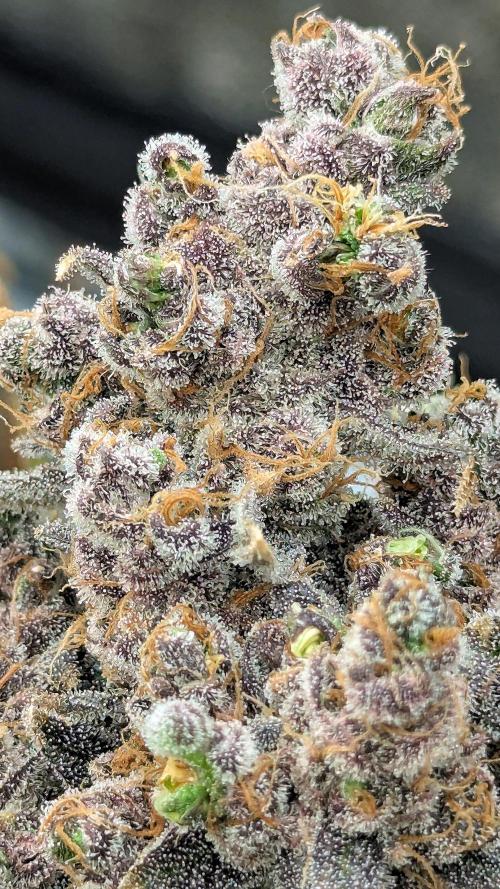
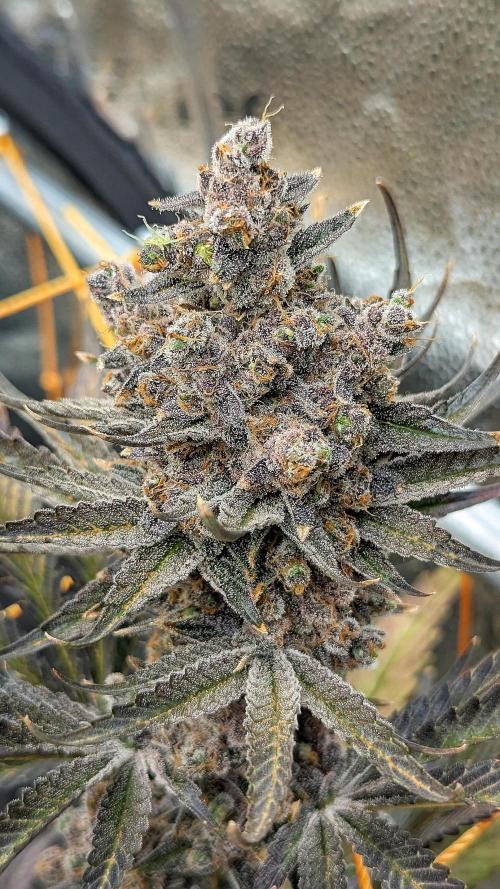
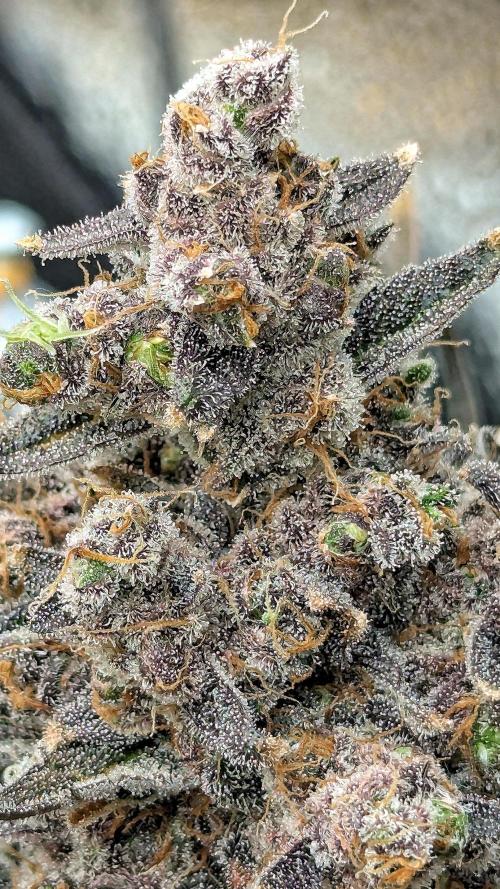
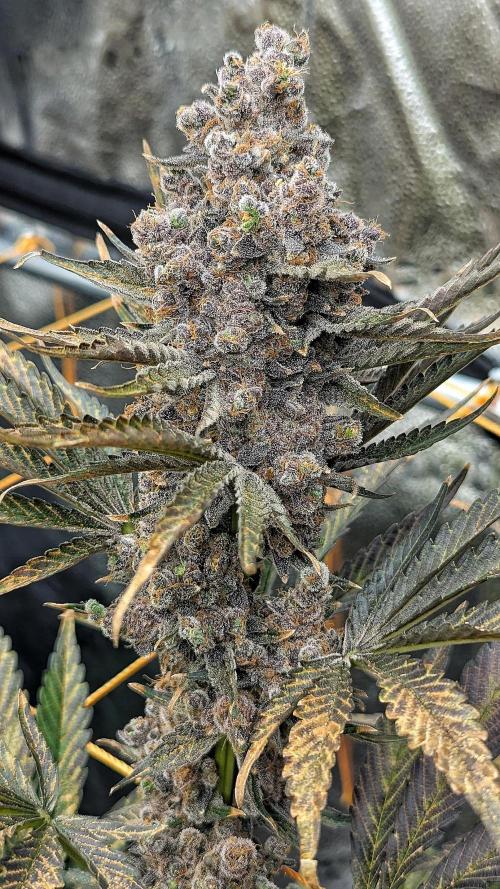
God’s Gift continued progressing through the ripening phase during this period with environmental conditions intentionally held stable and intervention minimized. With nutrient delivery already discontinued and Granddaddy Purple removed from the tent, the remaining focus shifted entirely toward final maturation and observing continued trichome progression.
Light intensity remained unchanged throughout the period with canopy measurements holding at 660 PPFD (28 DLI) for GG1 and 705 PPFD (30 DLI) for GG2. Dimmer output remained unchanged.
Irrigation remained stable at 1–1.25 gallons per plant every other day with input pH maintained between 6.0–6.2.
Plants continued receiving only plain pH-adjusted water (115 PPM) throughout the period.
4 likes
1 comment
Share
Used techniques
12-12
Technique
16
Week 16. Flowering5mo ago
127 cm
Height
12 hrs
Light Schedule
23 °C
Day Air Temp
6.1
pH
Strong
Smell
115 PPM
TDS
41 %
Air Humidity
19 °C
Solution Temp
19 °C
Substrate Temp
18 °C
Night Air Temp
11.36 liters
Pot Size
1.89 liters
Watering Volume
27.94 cm
Lamp Distance
MichaelTheBarnOwl Grow #5, Entry #16: Ripening
Days Since Emergence: 119
Days Since Flip: 96
Days in Flower: 87
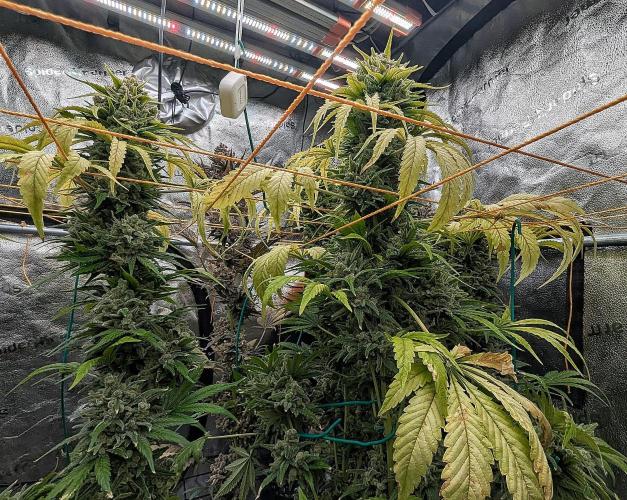
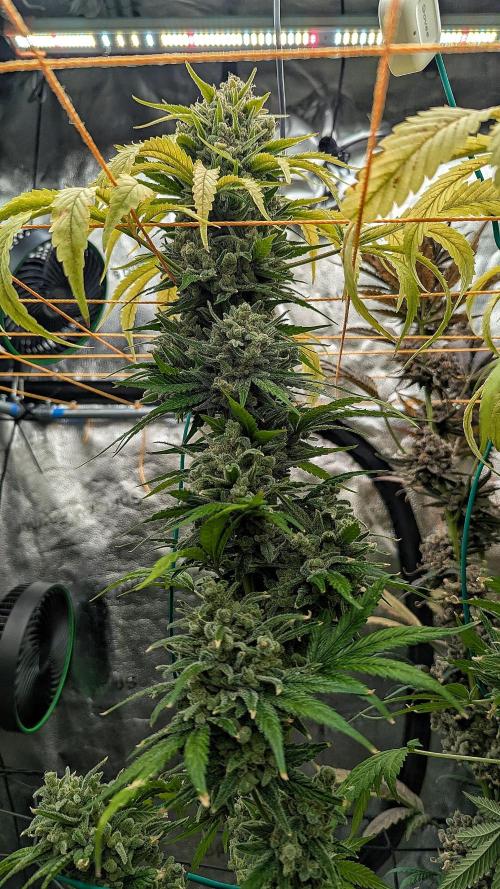
God’s Gift completed its lifecycle during this period and was harvested in its entirety following final maturation assessment. With the canopy fully transitioned into ripening and environmental intensity already reduced in prior weeks, final adjustments focused primarily on maintaining stable finishing conditions while allowing continued trichome maturation.
Light intensity was reduced further during the final ripening phase. Canopy measurements began the period at 660 PPFD (28 DLI) for GG1 and 705 PPFD (30 DLI) for GG2 before decreasing to 585 PPFD (25 DLI) for GG1 and 600 PPFD (26 DLI) for GG2 by harvest. Dimmer output decreased from 55% to 50%.
Irrigation remained stable at 1–1.25 gallons per plant every other day with input pH maintained between 6.0–6.2.
Plants continued receiving only plain pH-adjusted water (115 PPM) throughout the period. CAL-MAG.
Final trichome observations at harvest were recorded as follows:
GG1
Top: 15% clear / 80% cloudy / 5% amber
Mid: 22% clear / 75% cloudy / 3% amber
Bottom: 30% clear / 68% cloudy / 2% amber
Overall: 22% clear / 74% cloudy / 3% amber
GG2
Top: 12% clear / 83% cloudy / 5% amber
Bottom: 32% clear / 66% cloudy / 2% amber
Overall: 22% clear / 75% cloudy / 3% amber
Harvest was performed methodically with branches removed individually and flowers lightly rough trimmed prior to drying. Environmental intervention remained minimal during the final phase, with the focus centered on preserving flower quality and allowing the cultivar to finish naturally under stable conditions.
Compared with Granddaddy Purple, God’s Gift required a noticeably longer finishing period before reaching the desired stage of maturity, validating the staggered harvest strategy established earlier in flower through trichome observation and overall plant progression.
3 likes
4 comments
Share
Used techniques
12-12
Technique
17
Week 17. Harvest5mo ago
Happy Harvest Day!


10/10
Rated
Very impressed with God’s Gift overall. This ended up being one of the more interesting cultivars I’ve grown because of the clear difference in phenotype expression between the two plants.
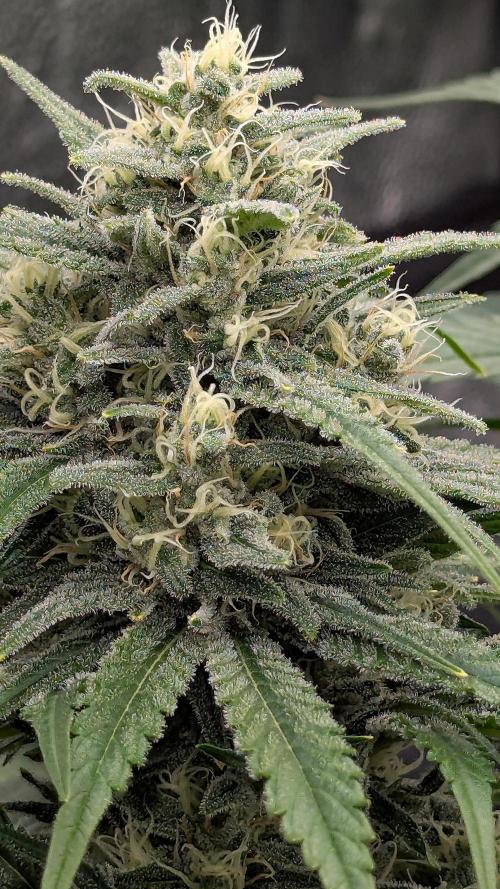
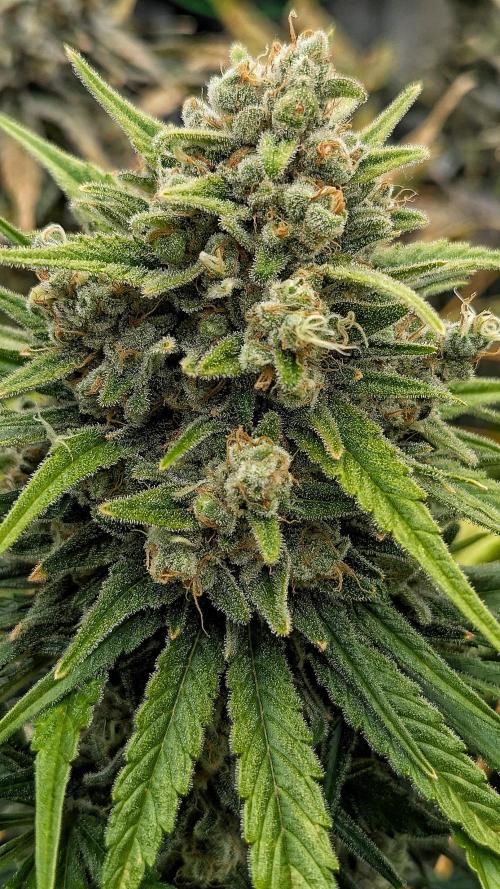
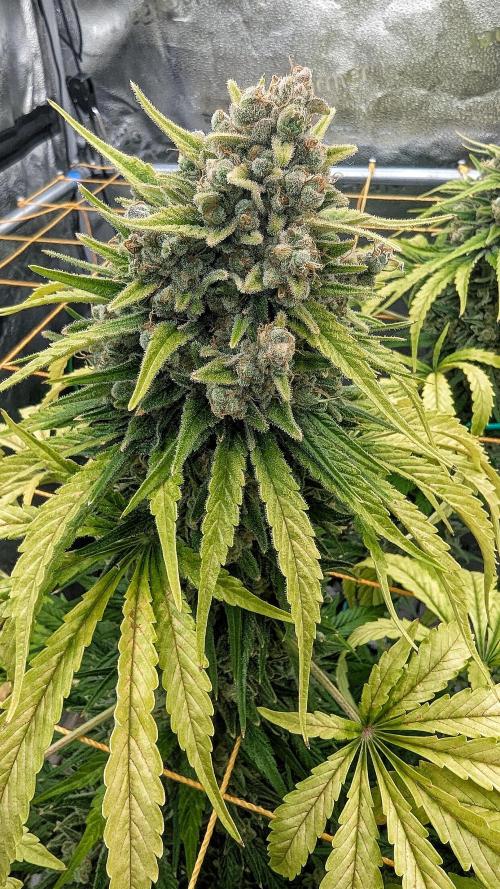
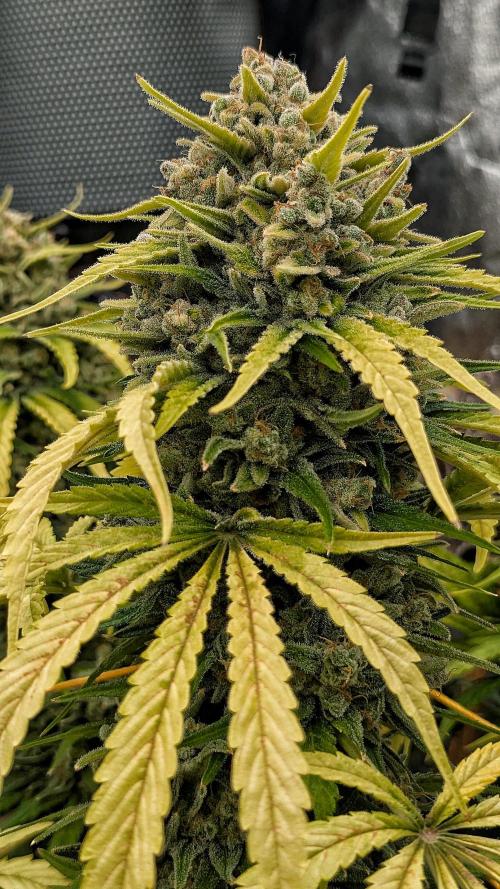
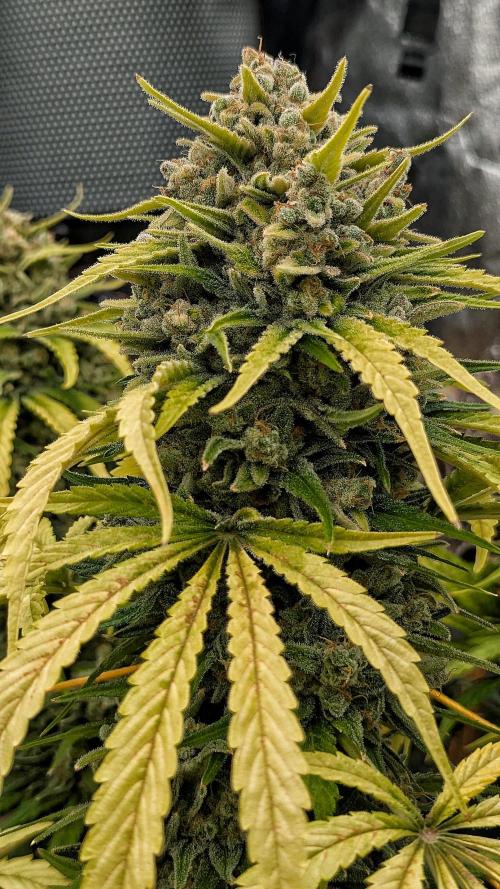
One phenotype leaned heavily toward the OG Kush side of the lineage with lighter green coloration, longer spear-shaped colas, a fluffier flower structure, and an extremely loud terpene profile dominated by skunk, spice, earth, and sweetness. The effect from this phenotype is very relaxing physically while still creating a noticeable headspace shift that melts away anxiety and tension without becoming overwhelmingly sedating.
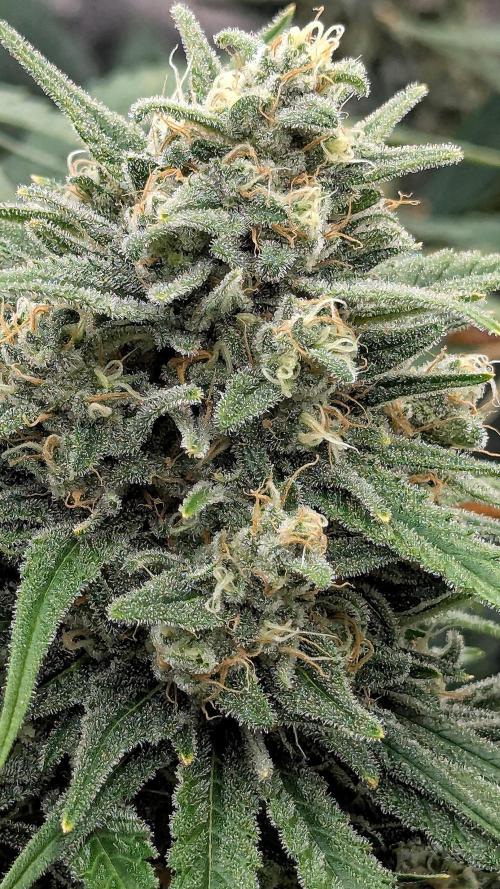
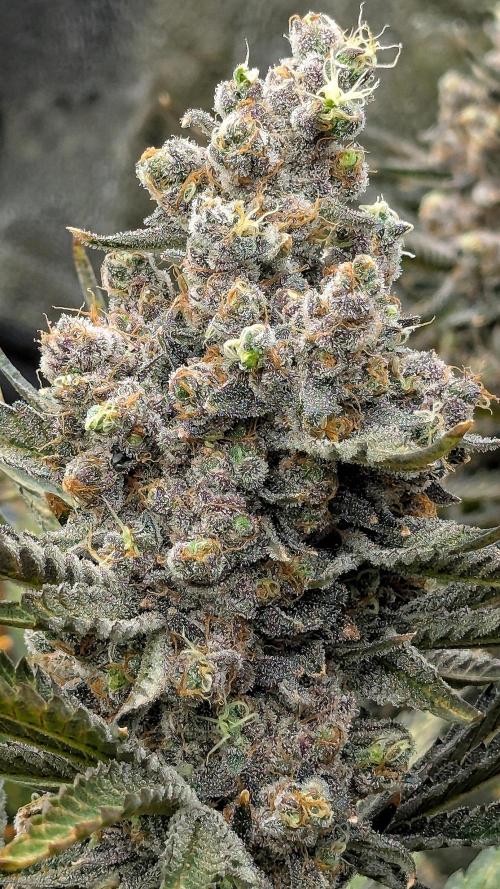
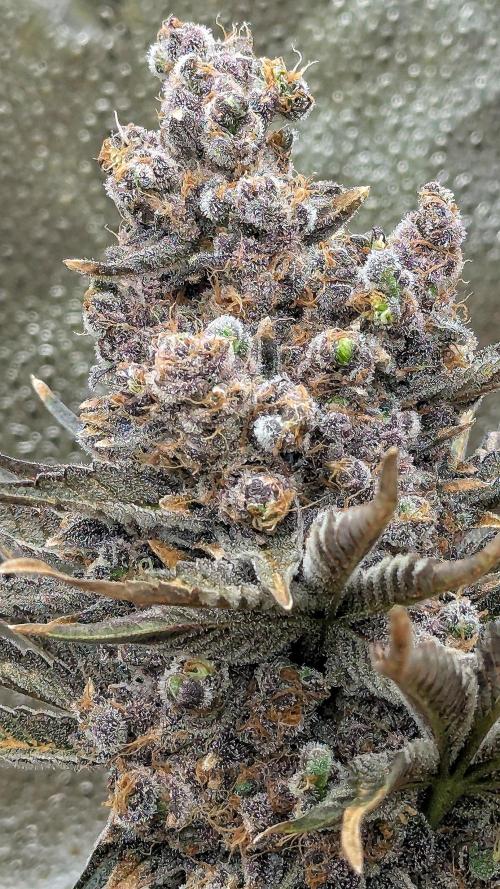
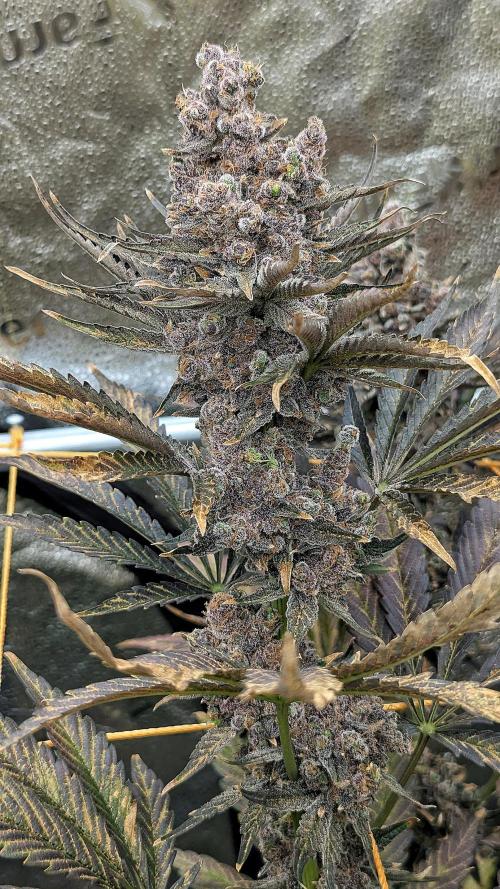
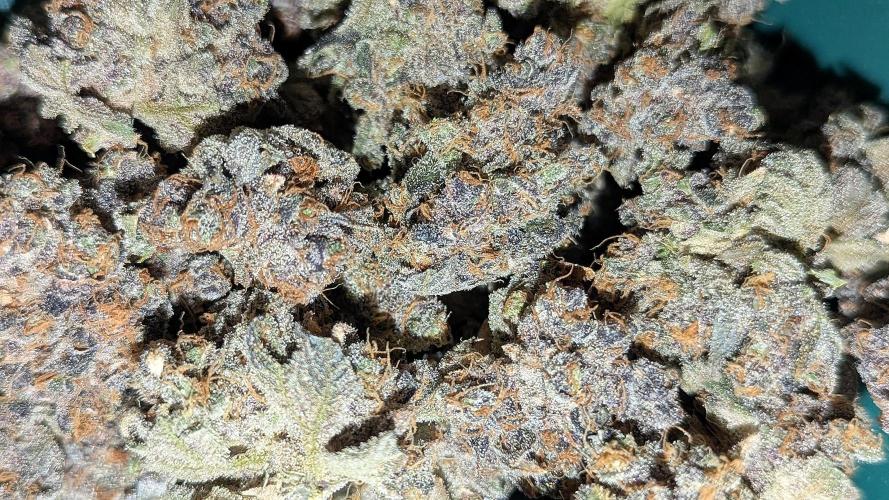
The second phenotype expressed much more like Granddaddy Purple, developing darker coloration late in flower along with denser, chunkier buds and heavier frost coverage. Structurally it looked like a completely different plant despite coming from the same seed line.
For some growers, strong phenotype variation might be viewed negatively, but personally I love it. One of my favorite parts of growing multiple plants is seeing the different genotype expressions emerge even within the same cultivar. Different structures, aromas, visual traits, and ultimately different effects make the grow much more interesting and rewarding.
Overall, both plants were healthy, vigorous, highly aromatic, and produced excellent flower. God’s Gift ended up being one of the more unique and enjoyable runs I’ve done so far.
Show more
Translate
Spent 107 days
Ger Veg Flo Har
172 g
Bud wet weight per plant
2
Plants
40.64 m²
Grow Room size
Normal
Difficulty
Height
Day air temperature
Air humidity
PPM
PH
Light schedule
Solution temperature
Night air temperature
Substrate temperature
Pot size
Lamp distance
MichaelTheBarnOwl Grow #5, Entry #17: Harvest and Cure
Days Since Emergence: 119
Days Since Flip: 96
Days in Flower: 87
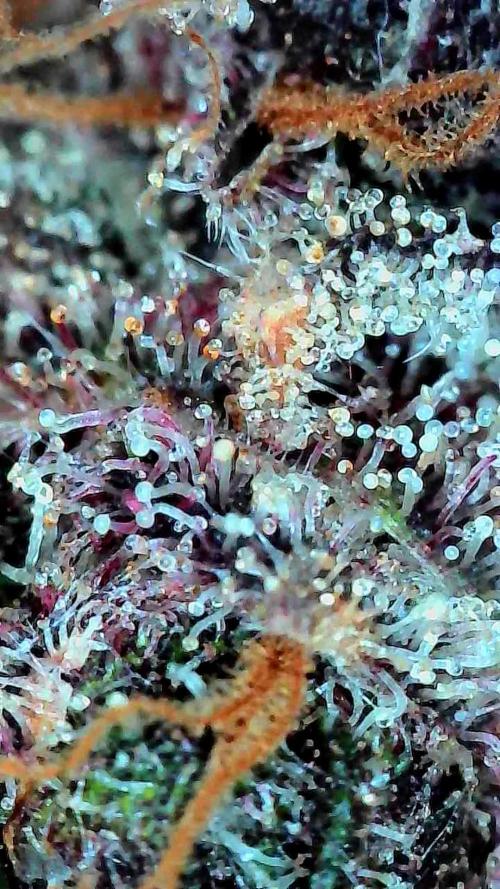
Final trichome observations at harvest were recorded as follows:
GG1:
Top: 15% clear / 80% cloudy / 5% amber
Mid: 22% clear / 75% cloudy / 3% amber
Bottom: 30% clear / 68% cloudy / 2% amber
Overall: 22% clear / 74% cloudy / 3% amber
GG2:
Top: 12% clear / 83% cloudy / 5% amber
Bottom: 32% clear / 66% cloudy / 2% amber
Overall: 22% clear / 75% cloudy / 3% amber
Harvest was performed methodically from the bottom up to maintain structural stability. Branches were removed individually, lightly rough trimmed, and flowers reduced to manageable size prior to drying.
Flowers were processed in a Cannatrol using a 4-day dry, 4-day cure, and 4-day hold cycle before being transferred into Grove bags with 62% two-way humidity packs for 2–3 weeks and later moved into mason jars for long-term storage.
Final Dry Weight:
Total: 344 g
God’s Gift (Kush-leaning phenotype): 208 g
God’s Gift (GDP-leaning phenotype): 136 g
The aroma during harvest was overwhelming in the best possible way. As branches were cut and handled, terpene release became so intense that it filled the entire house. The smell was thick, heavy, and almost nauseating from the sheer concentration of terpenes in the air. It carried a pungent blend of spice, skunk, earth, and sweetness that lingered everywhere and made it immediately obvious just how resinous and terpene-rich these plants had become by the end of the cycle.
One of the most interesting aspects of this run was the clear difference in phenotype expression between the two plants. Although both came from the same God’s Gift seed line, the expressions separated strongly into what appeared to be a Kush-dominant phenotype and a Granddaddy Purple–dominant phenotype.
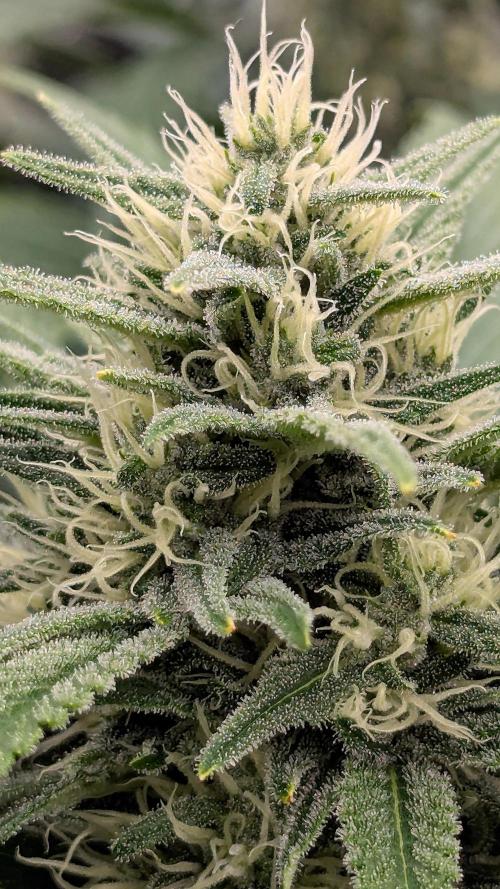
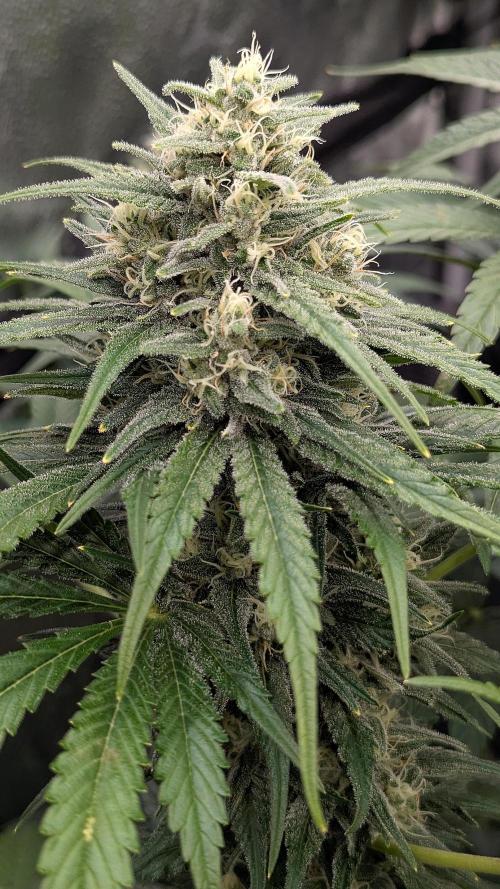
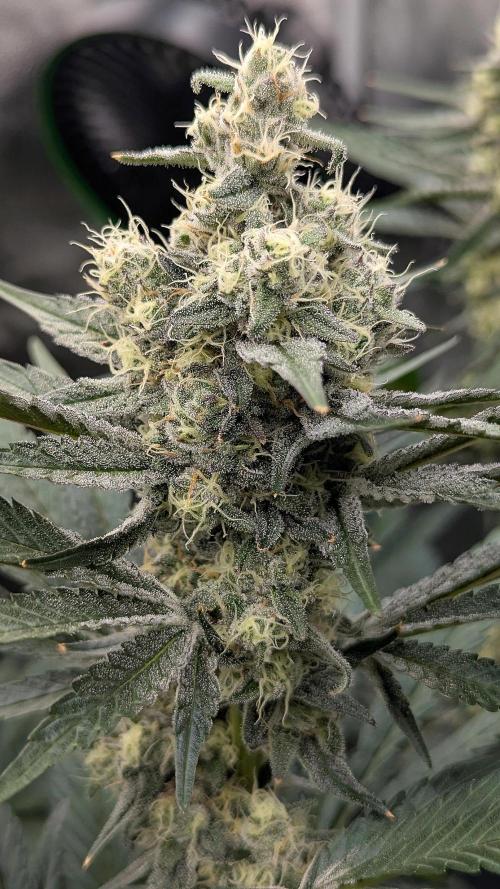
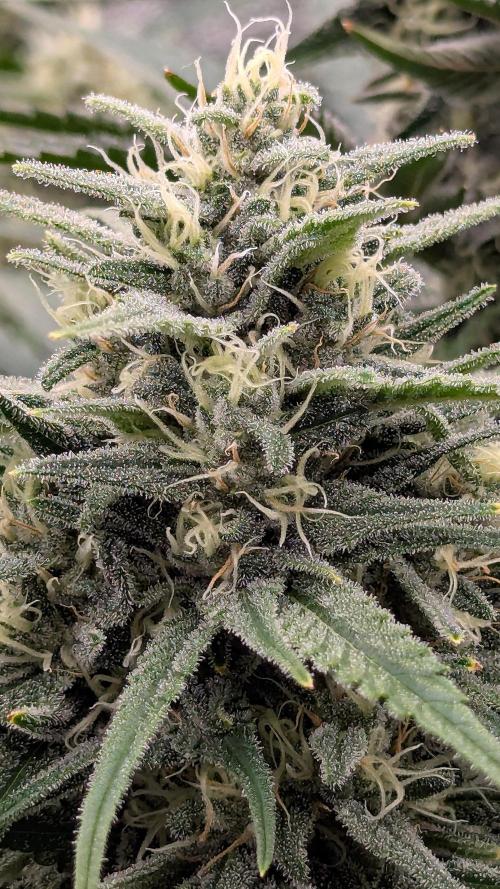
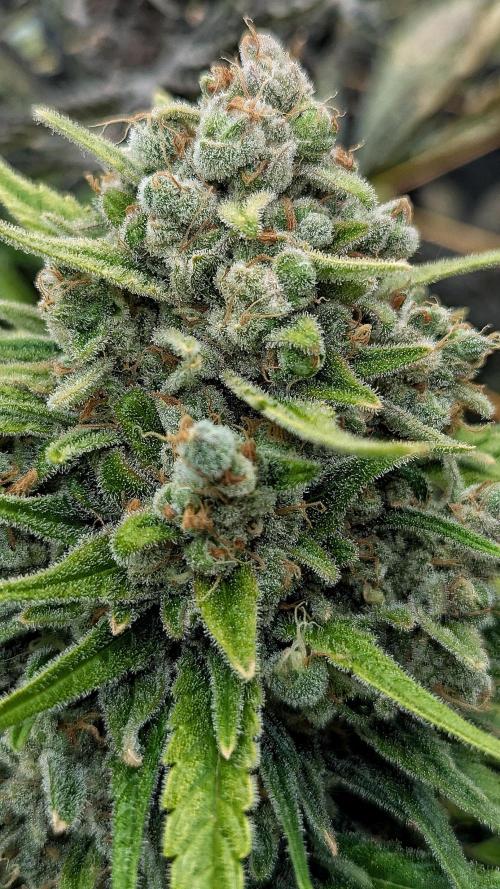
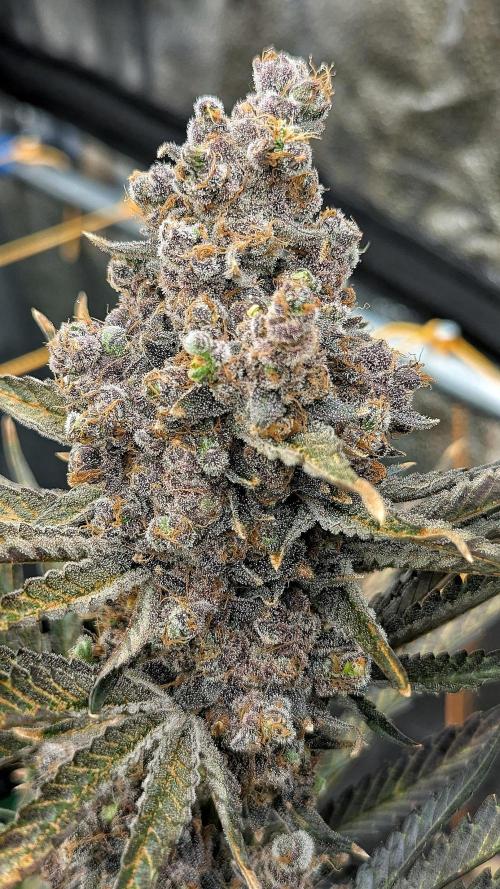
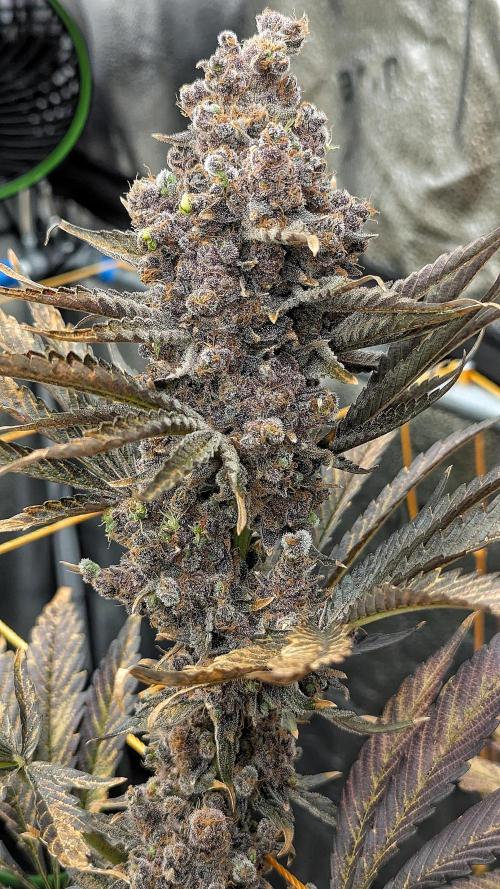
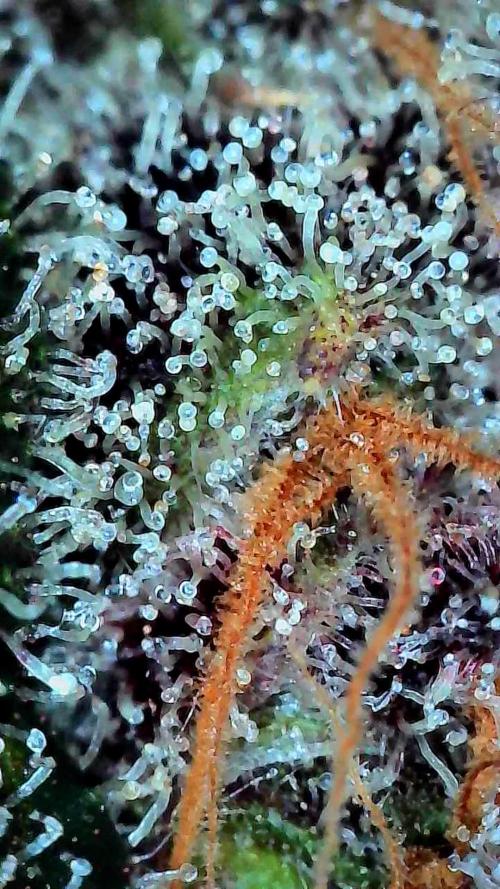
The first plant, pictured in the first photo, displayed a much more Kush-like expression. The plant remained lighter green through most of flower and produced long, spear-shaped colas with a lighter, fluffier flower structure. Buds stacked aggressively while remaining somewhat airy rather than forming extremely dense clusters. Leaf structure was slightly narrower and the overall morphology carried a more OG-style appearance. The aroma profile on this phenotype is exceptionally strong, dominated by spice, skunk, earthy notes, and sweetness with a subtle floral quality when broken apart.
This is the phenotype I have sampled so far and the smoke is exceptionally smooth. The effect creates a noticeable shift in headspace while remaining deeply relaxing physically. Anxiety and body tension seem to melt away, producing a calm and comfortable state without becoming overwhelmingly sedating.
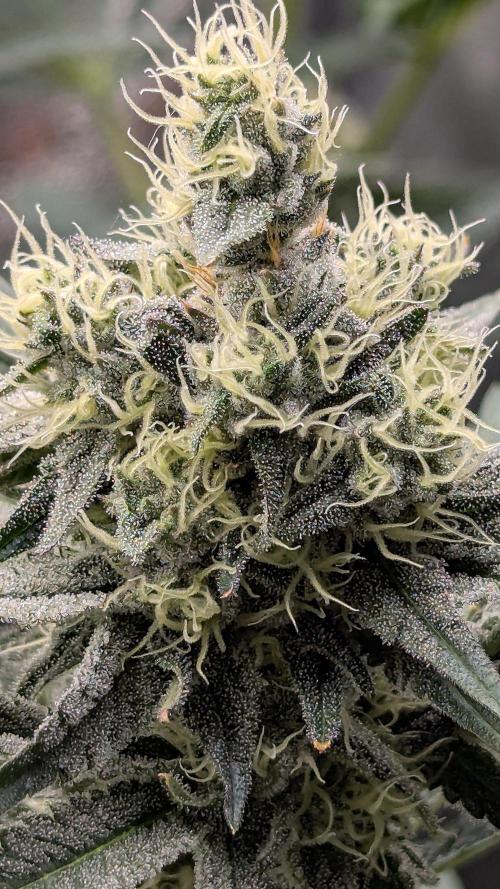
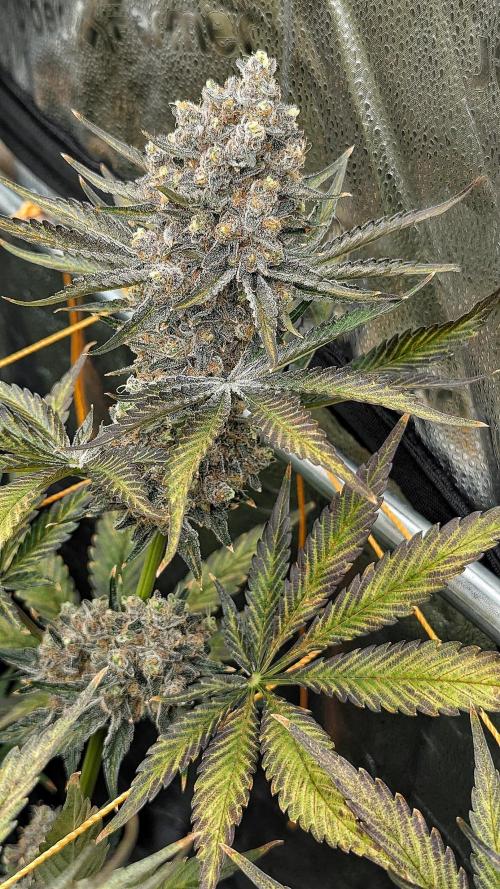
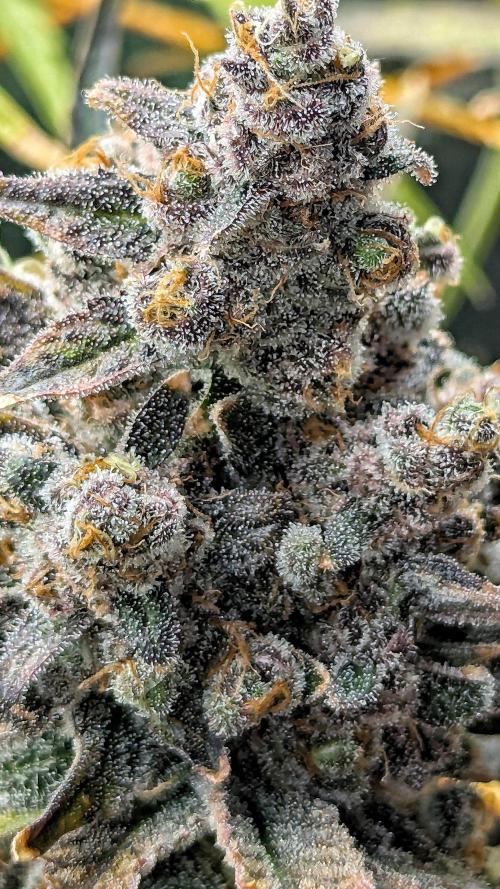
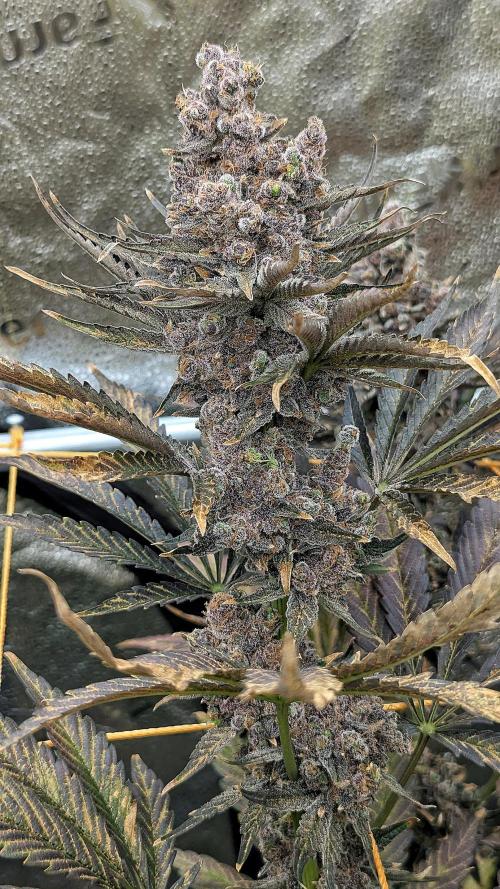
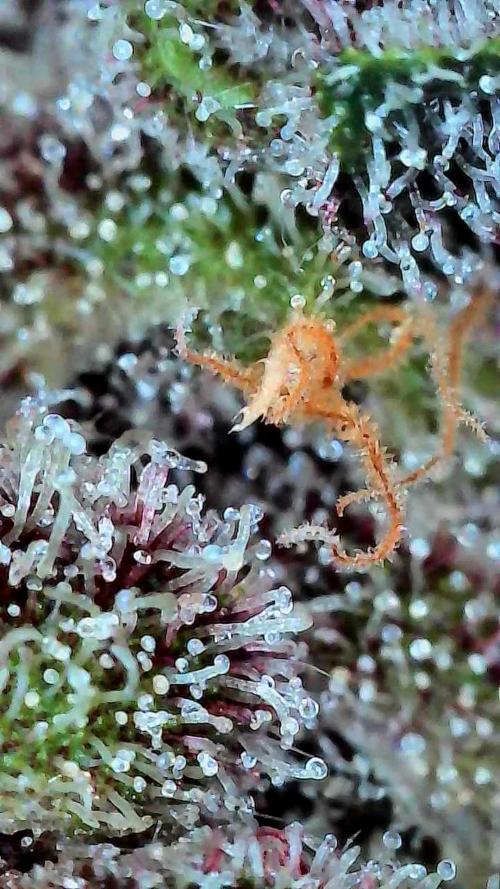
The second plant, shown in the second photo, expressed a much stronger Granddaddy Purple influence. As the plant matured, flowers and surrounding foliage began developing darker coloration with deep purple and darkened tones appearing late in flower. Bud structure became noticeably denser and chunkier than the Kush-leaning phenotype, with tighter flower formation and heavier visual frost coverage. The overall appearance leaned much more toward a classic dense Indica structure.
Seeing both plants side by side highlighted just how much variation can emerge within the God’s Gift cross. One phenotype leaned strongly toward the OG Kush side of the lineage with lighter structure, intense terpene output, and a relaxing headspace effect, while the other expressed the darker coloration, denser flowers, and visual traits commonly associated with Granddaddy Purple.
Lifecycle Summary - God’s Gift:
Emergence: 2 days from seed
Seedling Stage: 9 days
Vegetative Stage: 13 days
Topped: Day 19 post-emergence
Flip to Flower: Day 24 post-emergence
Transition Period: 8 days post-flip
Flowering Stage: Began on Day 33 post-emergence; flowering lasted 87 days
Total Time (Seed to Harvest): 119 days
7 likes
2 comments
Share
Equipment Reviews


9 comments
Sort by
popularity
popularity
newest
oldest

NattyMeds commentedweek 165mo ago
Looks amazing. Speaking of OG kush x GDP I've never understood how Purple punch transcended the genetics and not Gods gift. always thought that cross was a superior version and had a much more enjoyable toke.
like 1

MichaelTheBarnOwl commented5mo ago
@NattyMeds, I was always curious about PP but have never grown it. I tend to go after the nostalgic strains if that makes sense. Thank you for your comment!
likes
NattyMeds commented4mo ago
@MichaelTheBarnOwl, I love nostalgic strains. Gods gift is def one of those, that when i held years ago, I was dreading reaching the bottom of the bag. Haven't had it since. :(
like 1

420DNAJUNKIES commentedweek 155mo ago
she is nice good work
like 1
MichaelTheBarnOwl commented5mo ago
@420DNAJUNKIES, thank you!
likes
420DNAJUNKIES commentedweek 115mo ago
beautiful colors brother
like 1
MichaelTheBarnOwl commented5mo ago
@420DNAJUNKIES, thank you! I agree! I am a sucker for colorful plants!!
likes
420DNAJUNKIES commentedweek 175mo ago
beautiful colors very pretty
like 1
NattyMeds commentedweek 165mo ago
Looks amazing. Speaking of OG kush x GDP I've never understood how Purple punch transcended the genetics and not Gods gift. always thought that cross was a superior version and had a much more enjoyable toke.
like 1

the end.
Enjoying this diary? Follow for more updates!

Prefer the old Diary view?
Go back to the old Diary view