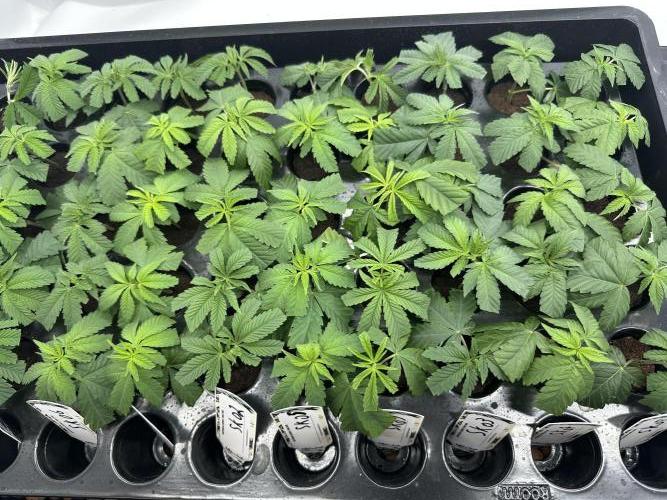
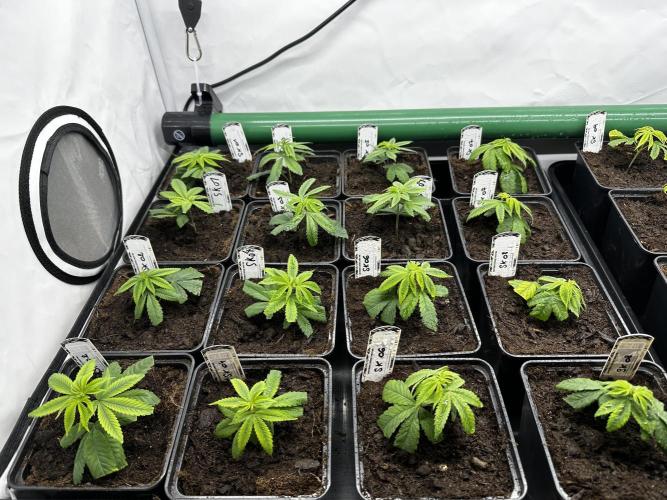
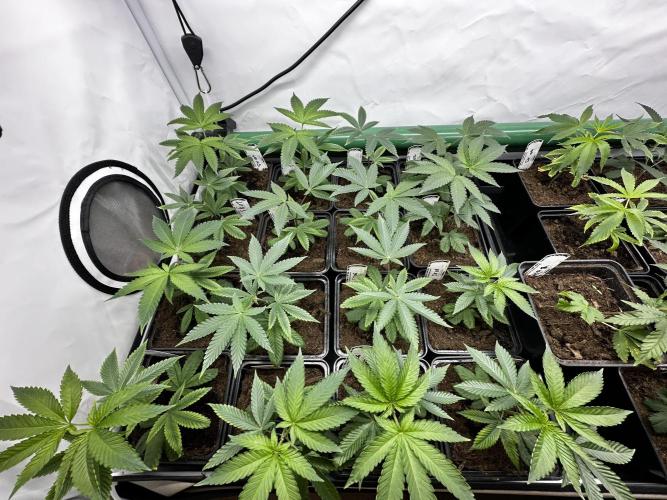
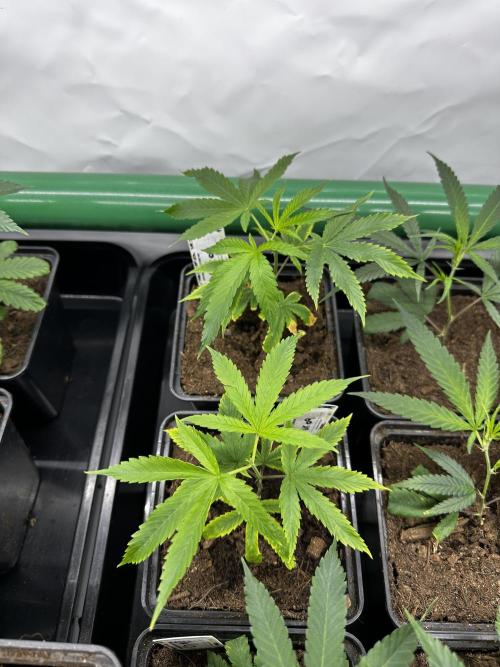
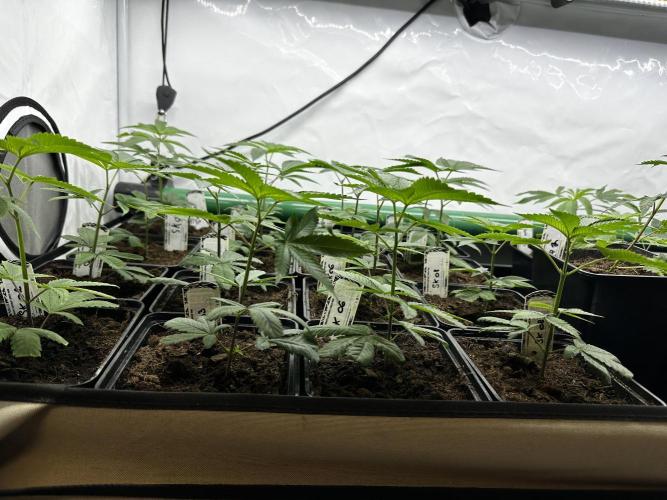
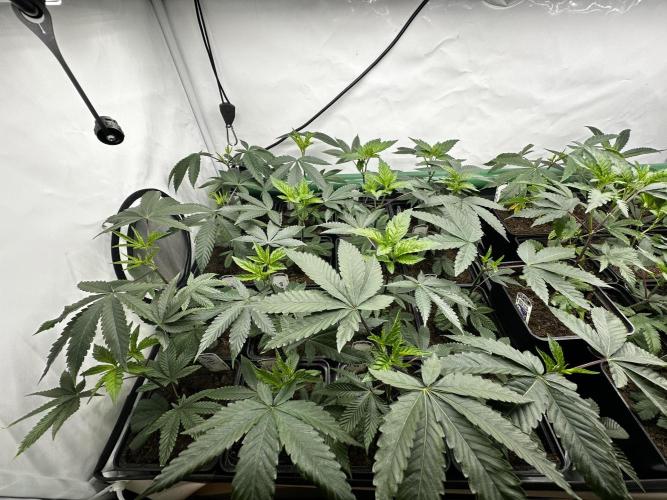
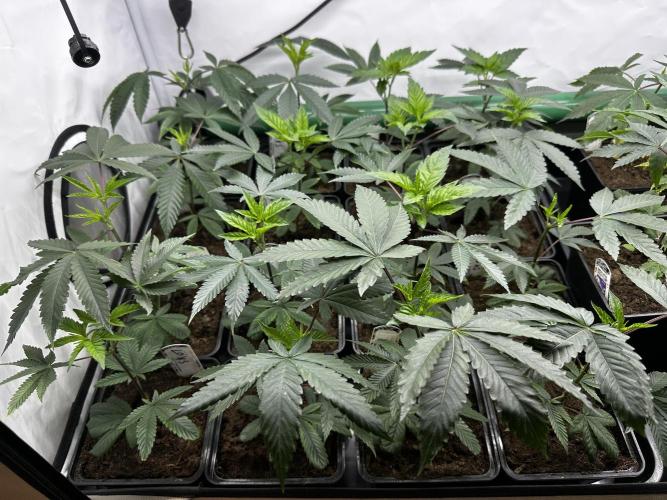
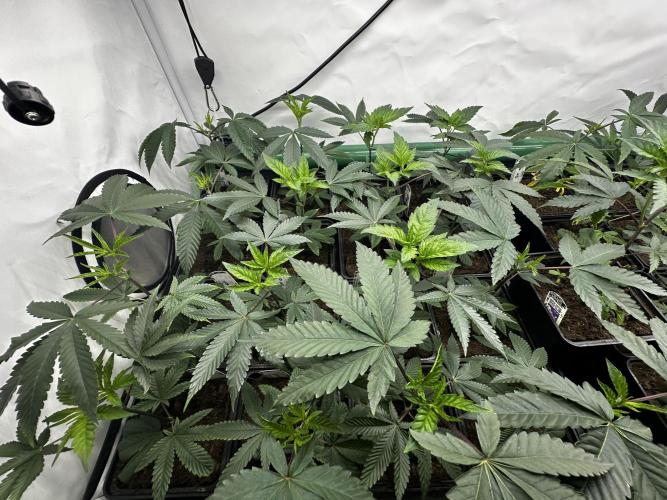
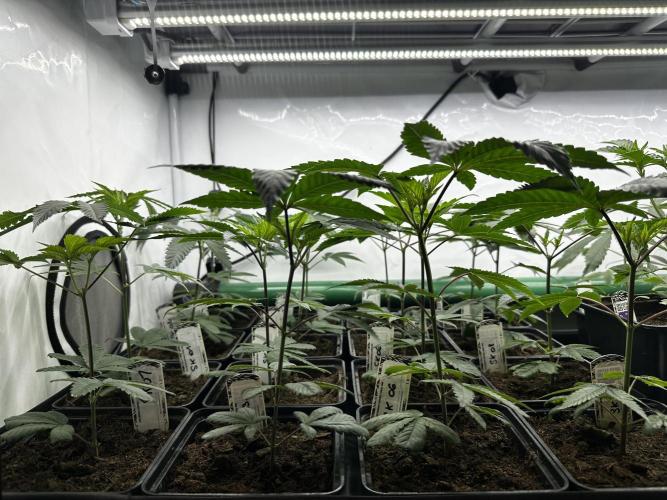
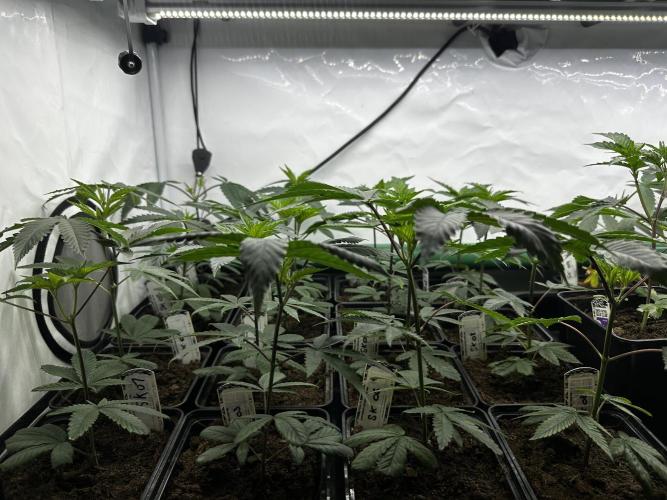
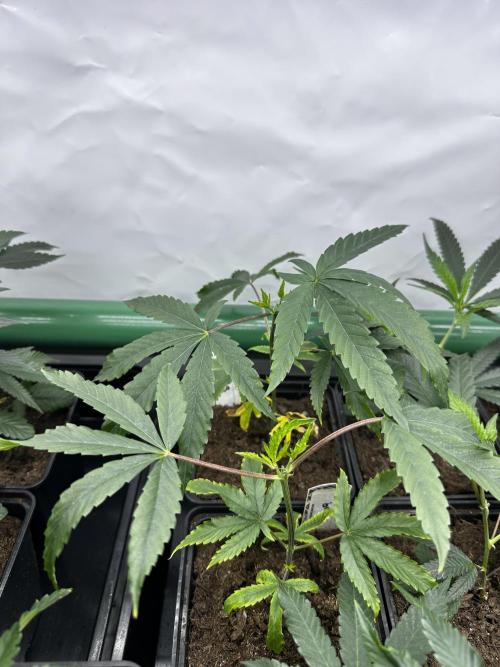
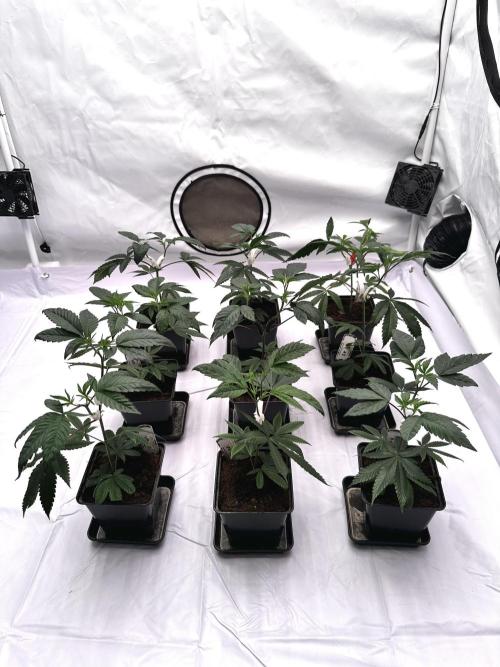
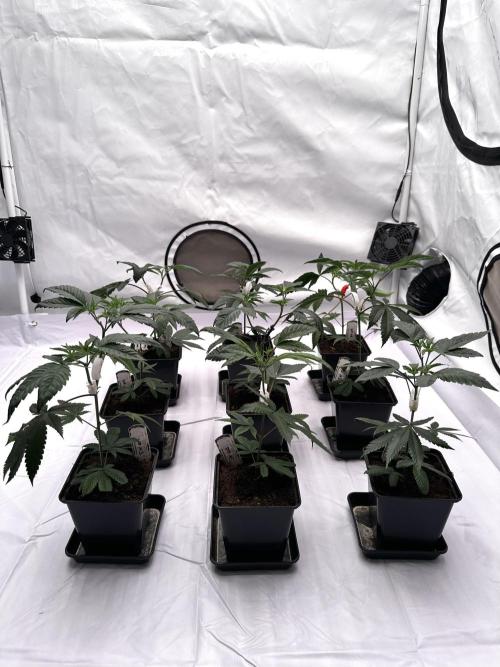
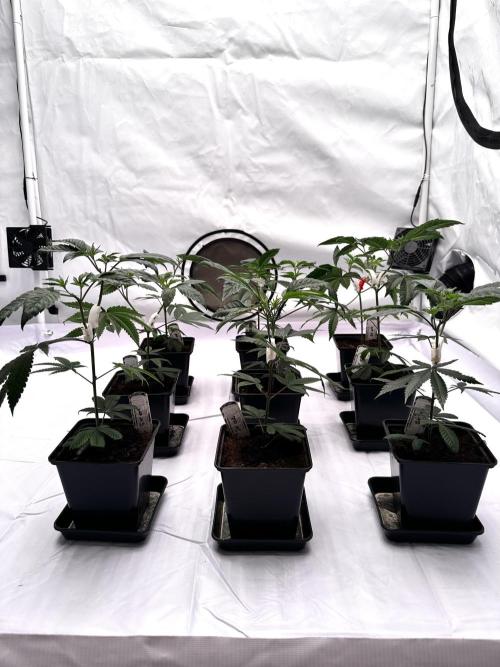
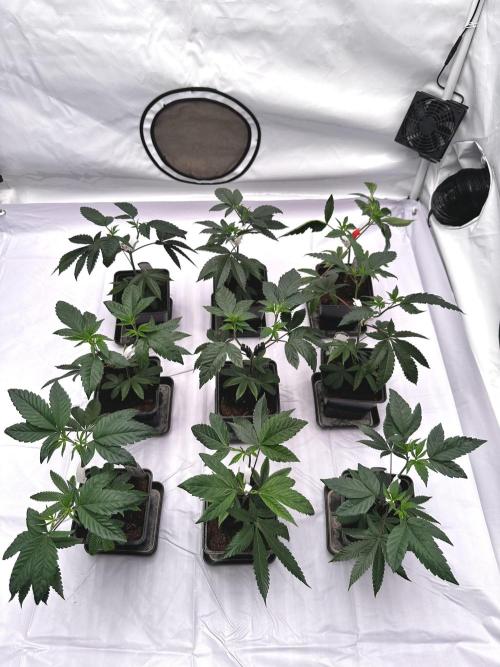
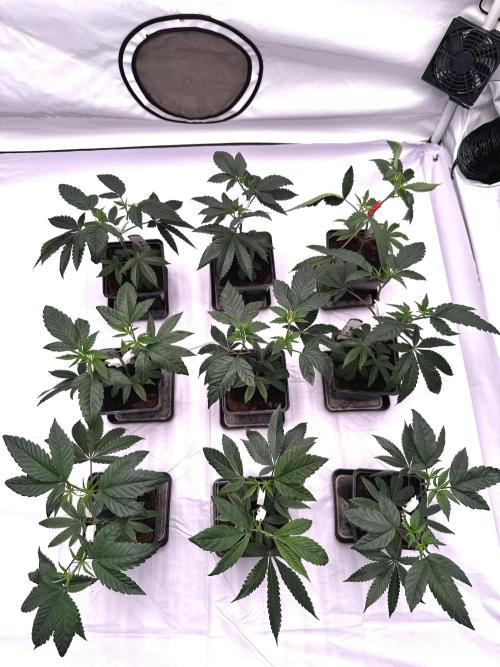
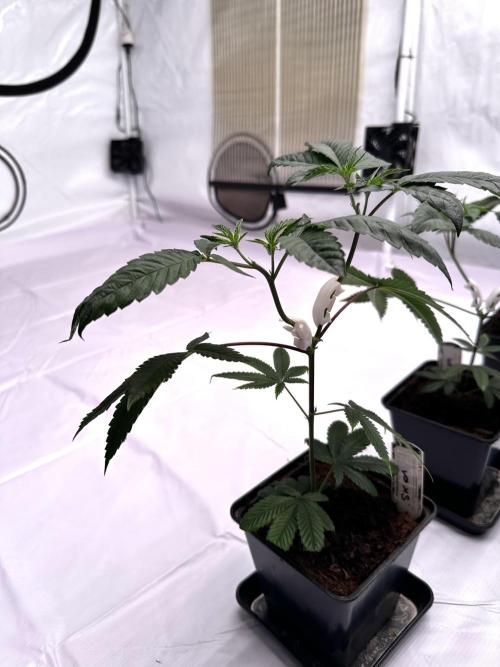
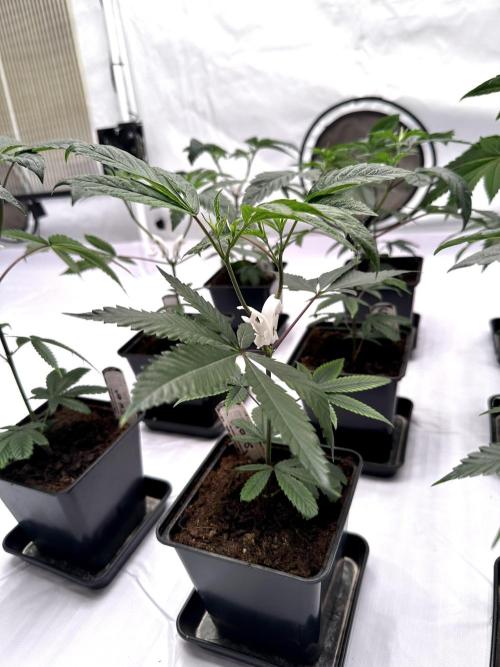
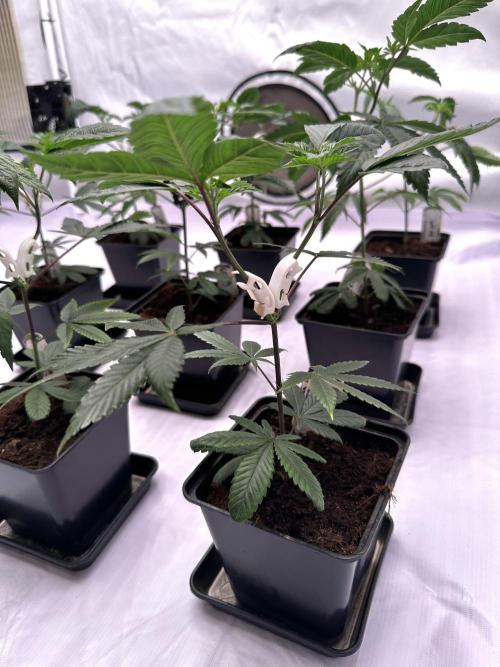
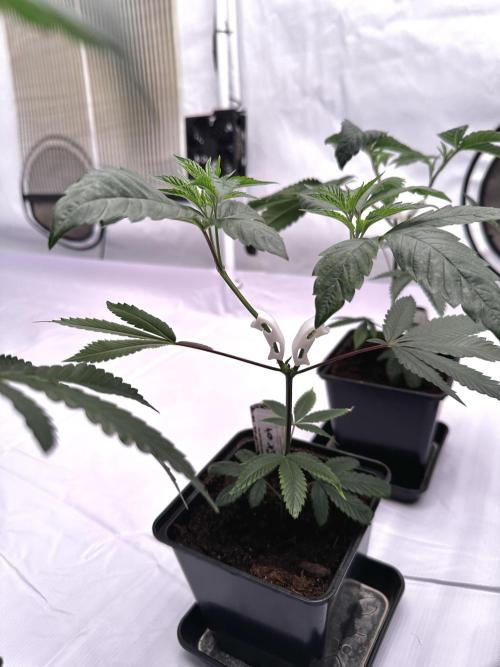
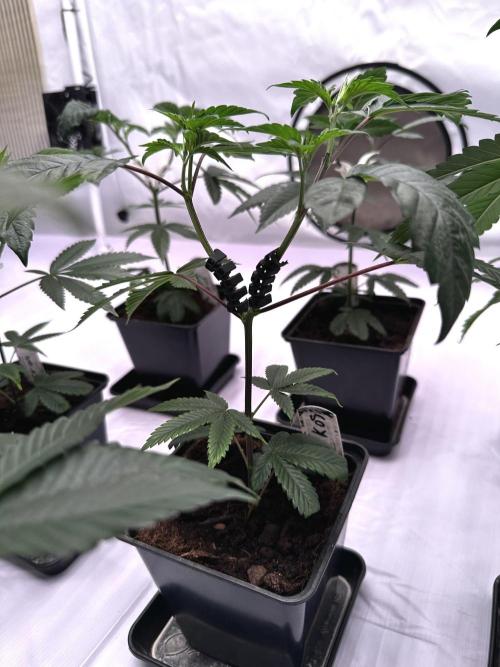
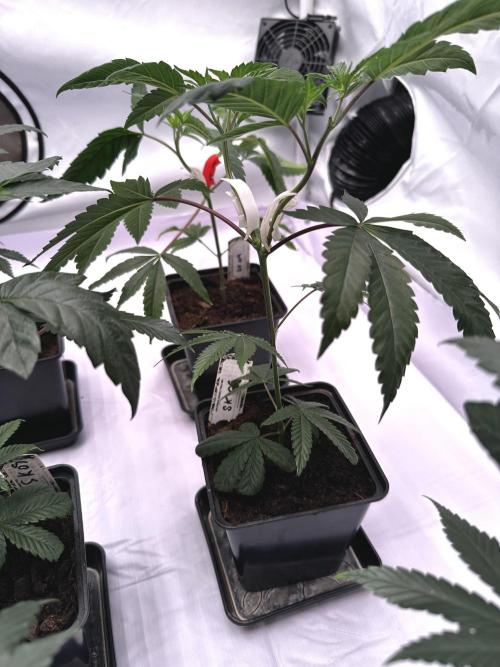
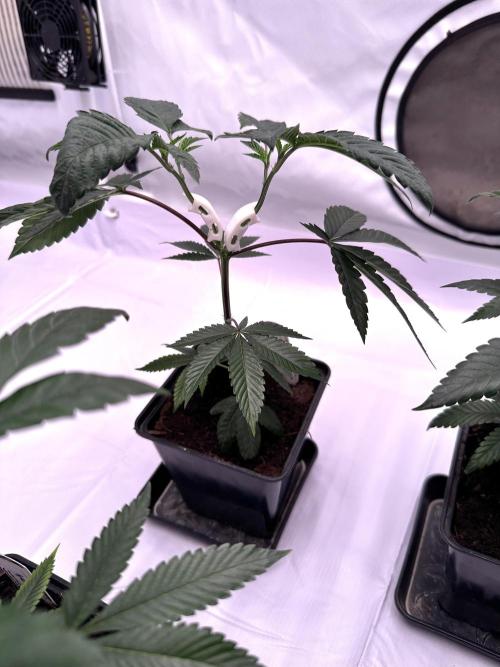
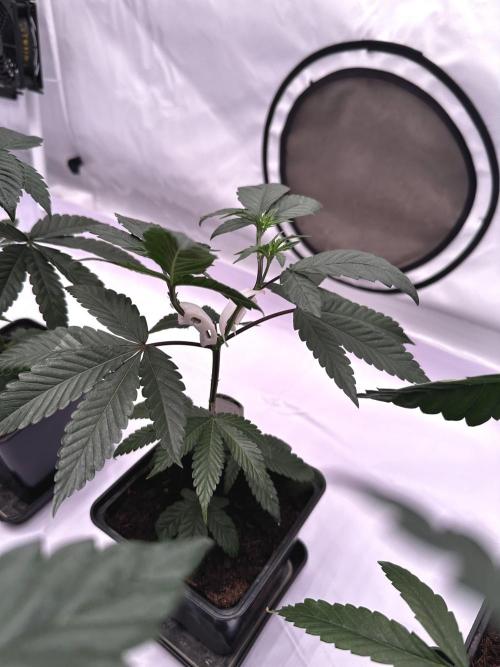
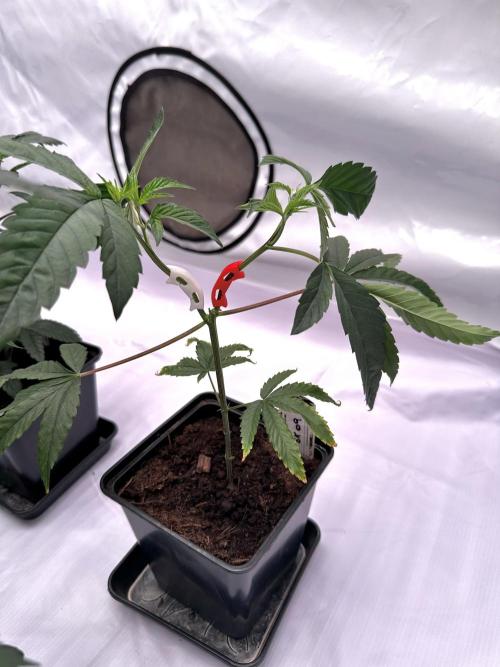
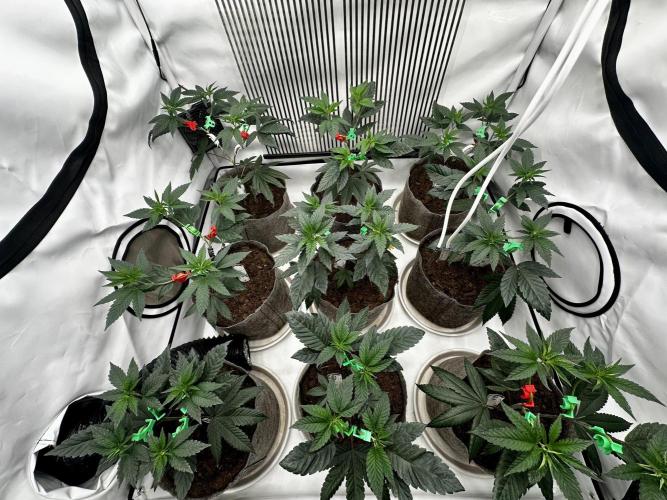
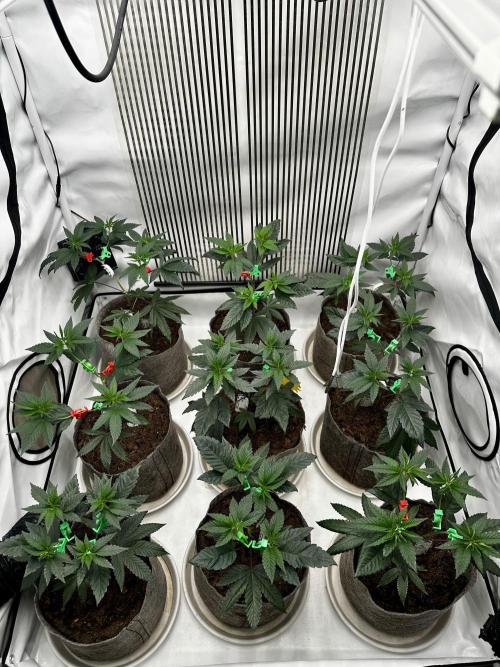
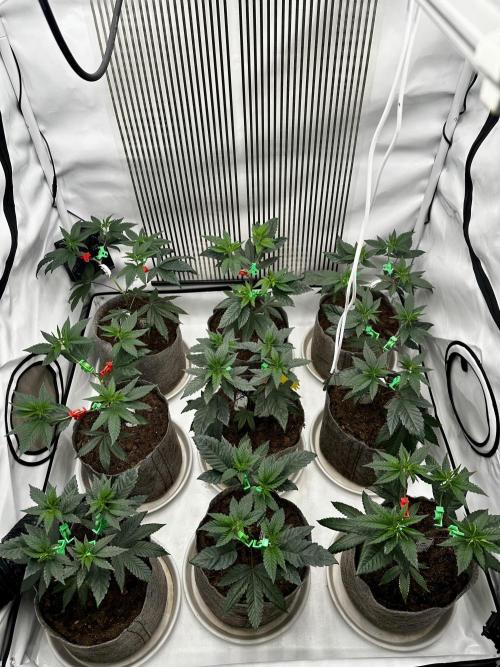
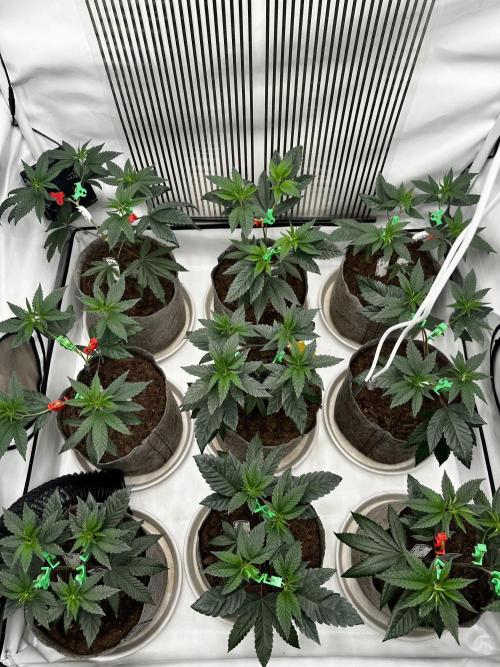
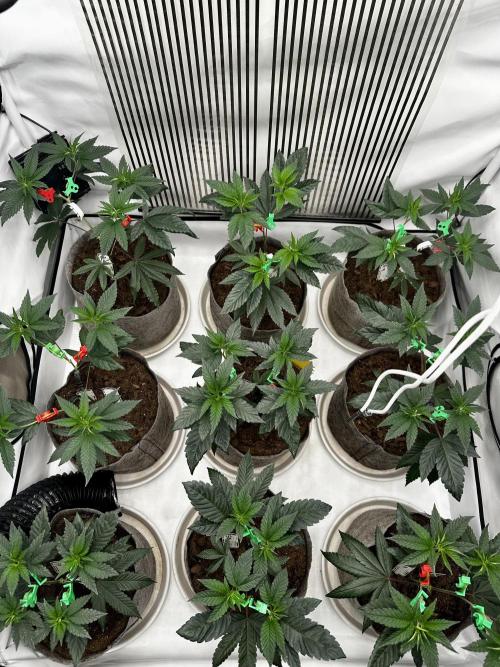
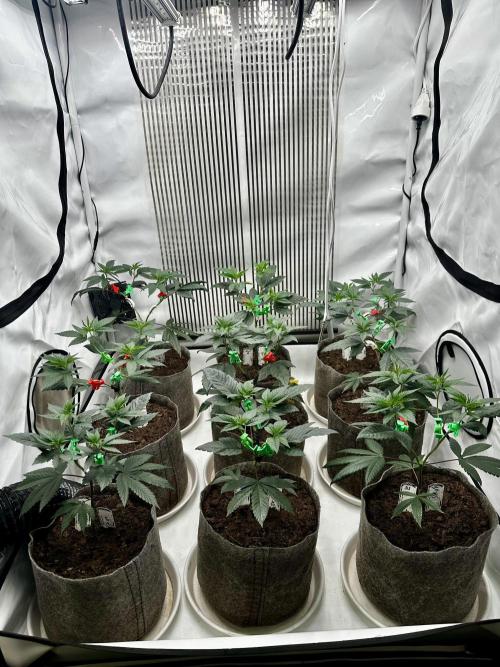
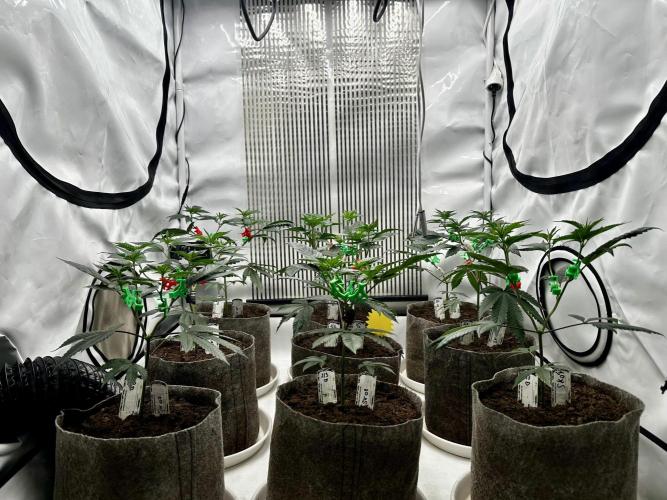
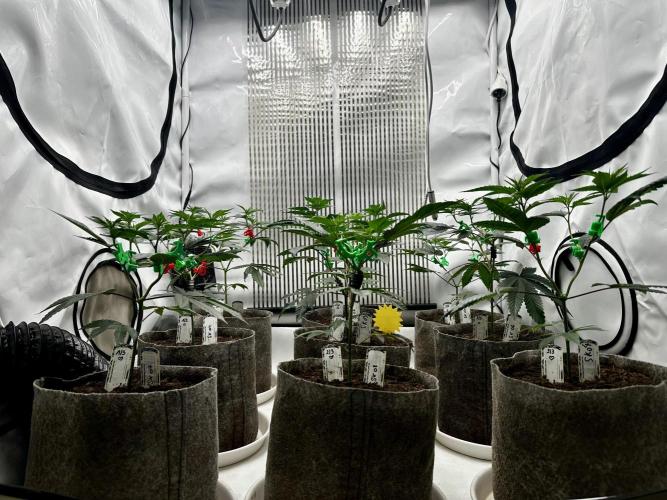
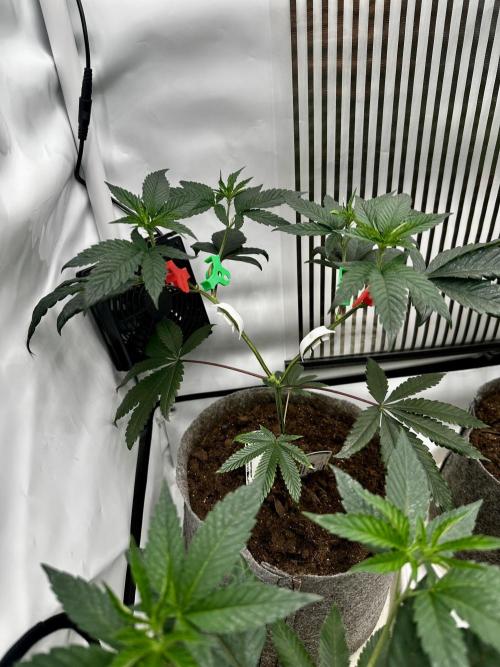
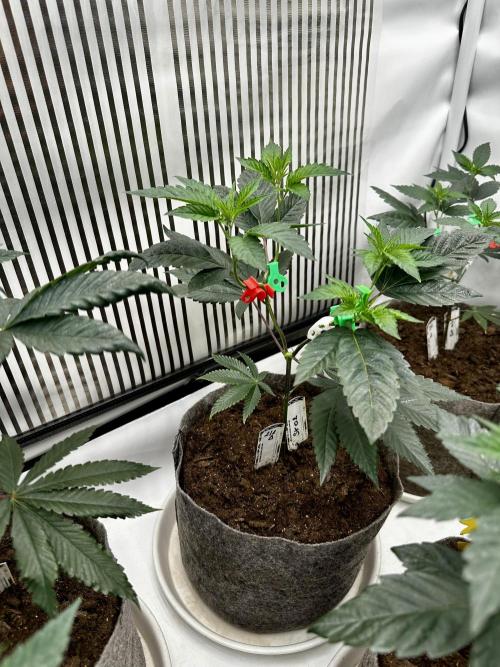
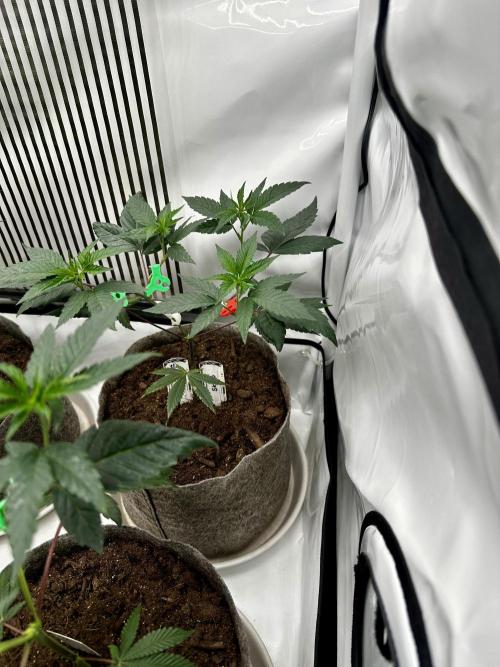
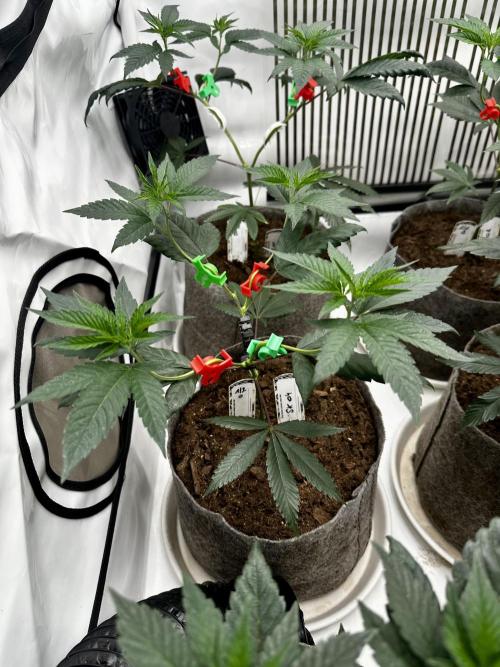
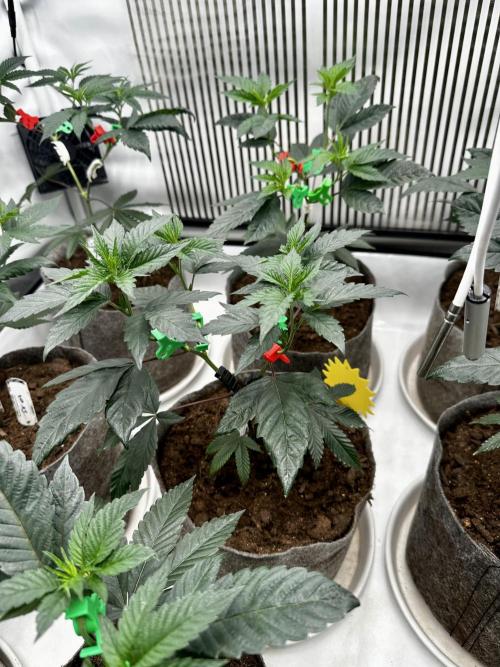
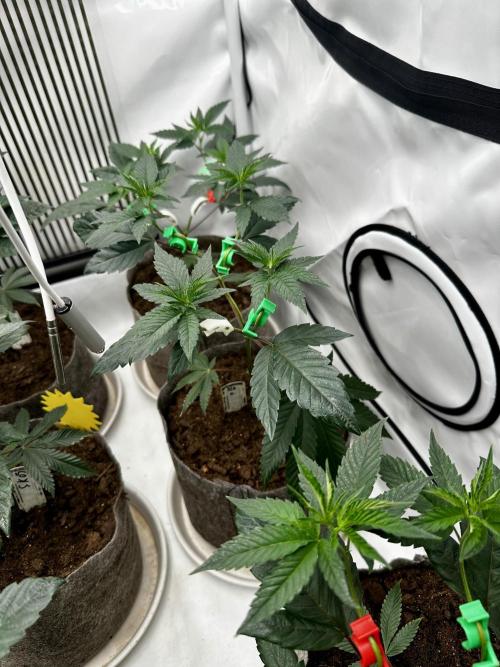
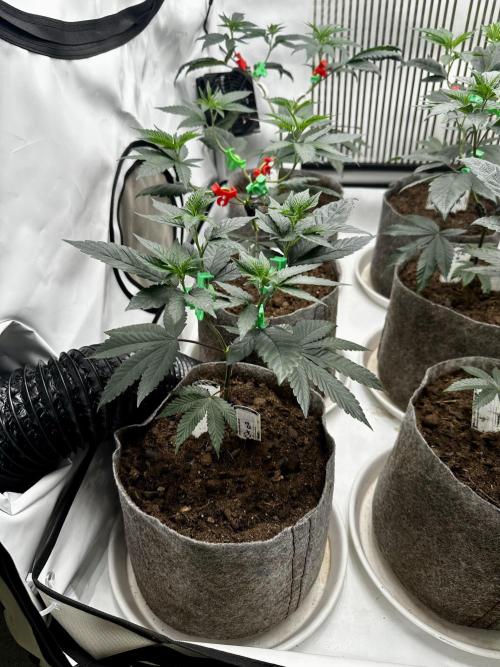
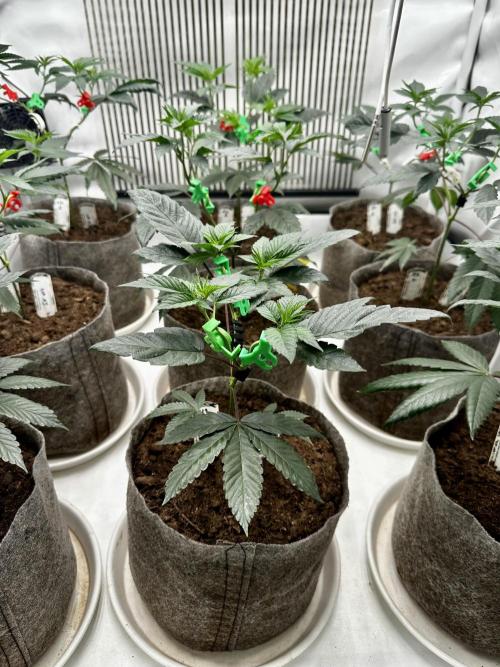
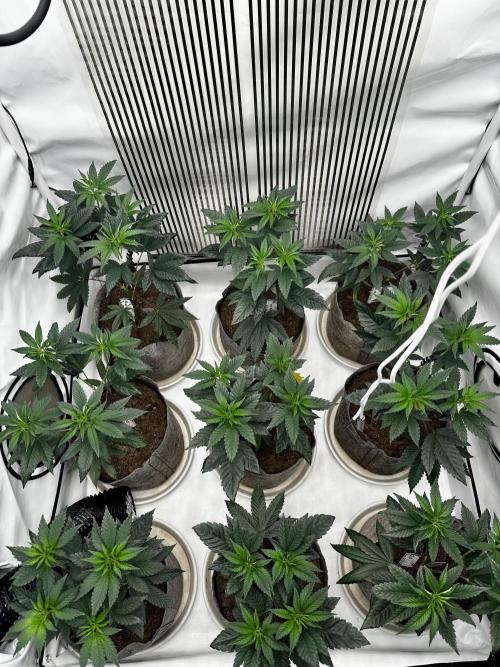
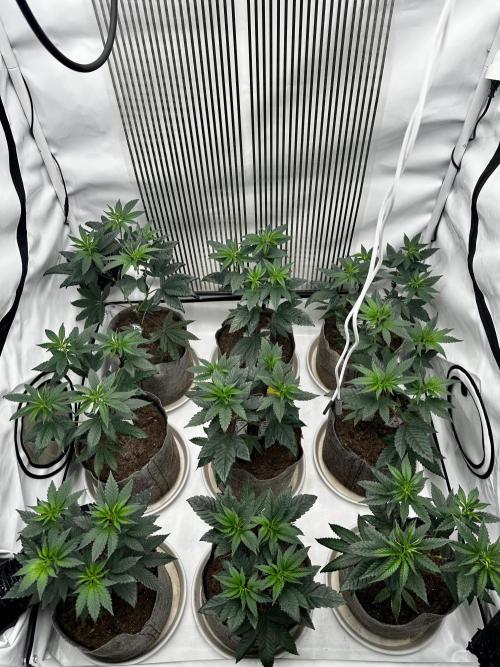
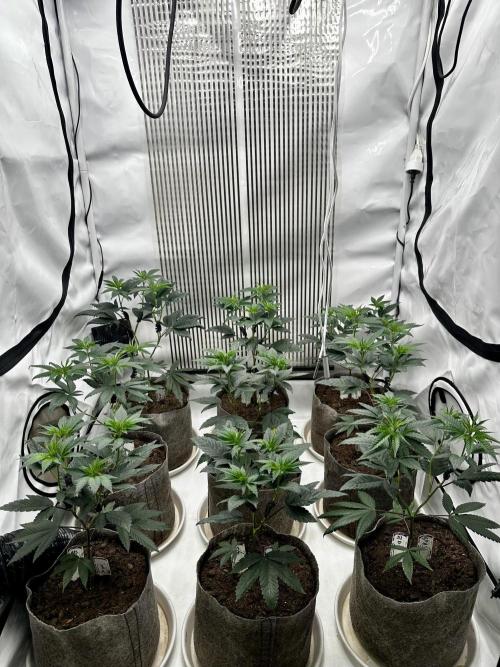
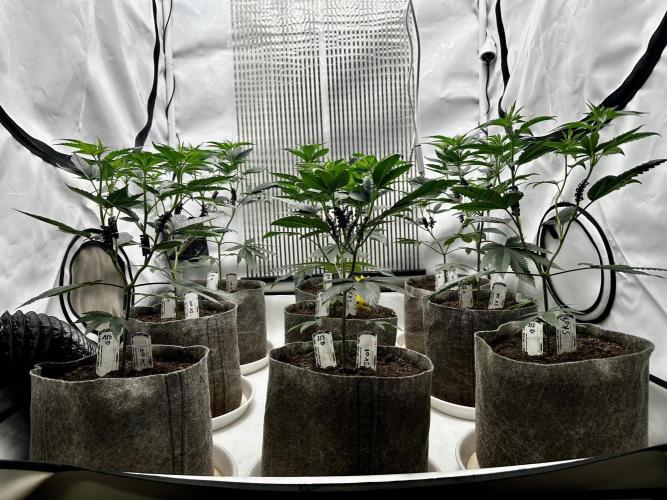
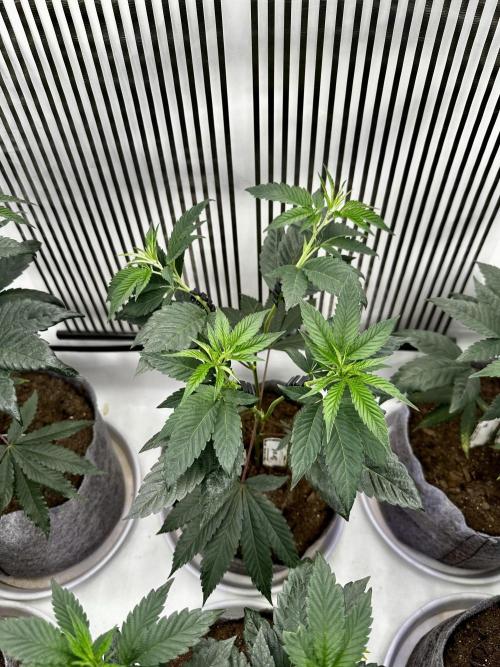
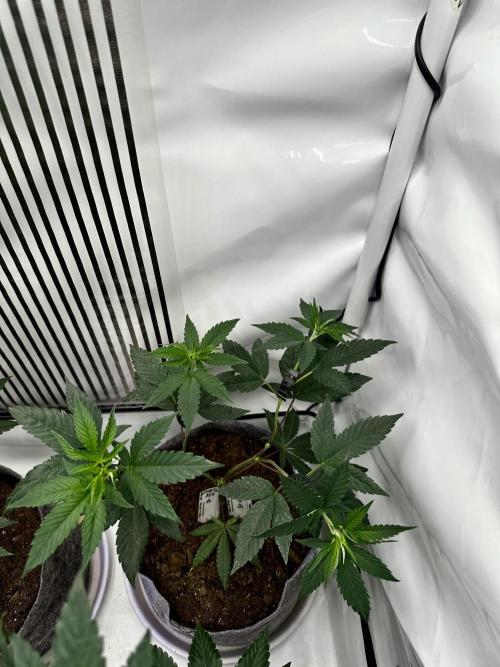
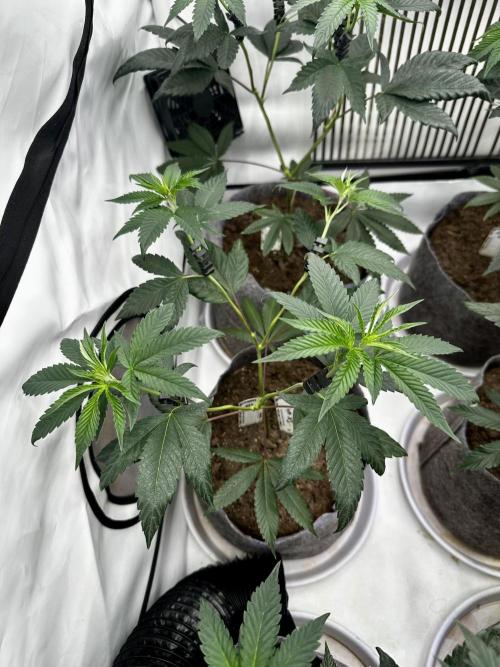
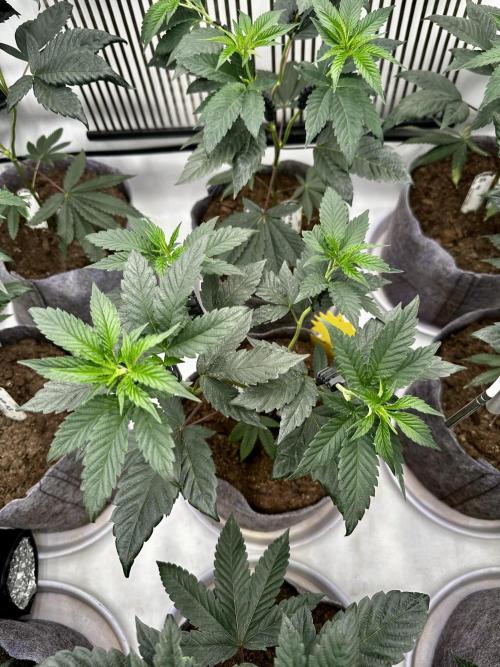
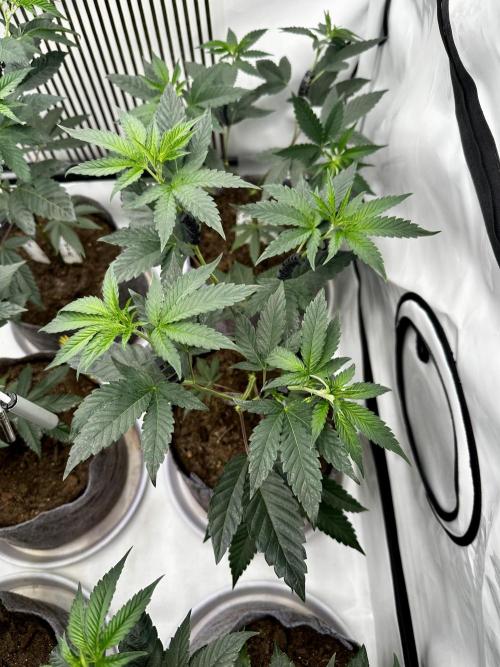
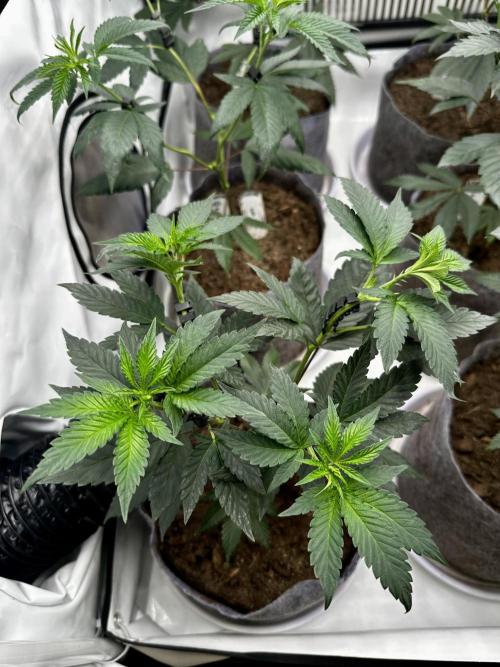
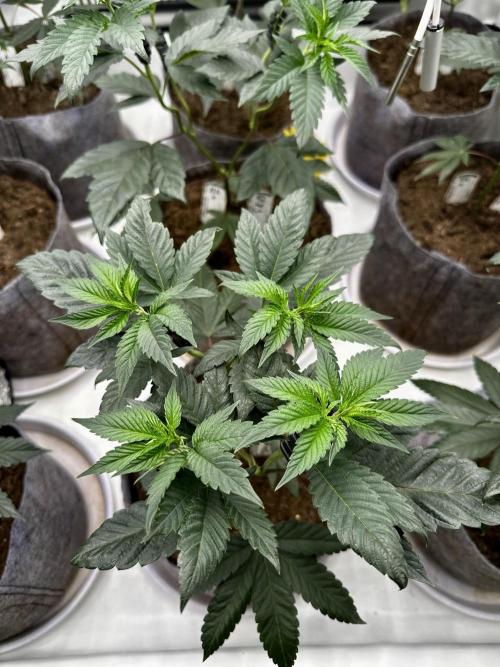
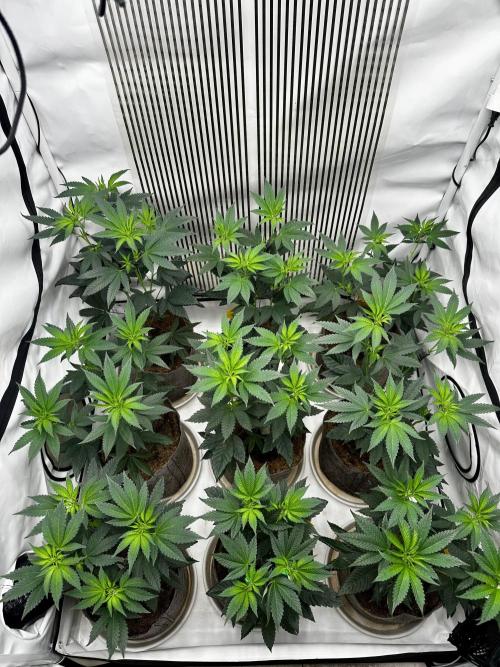
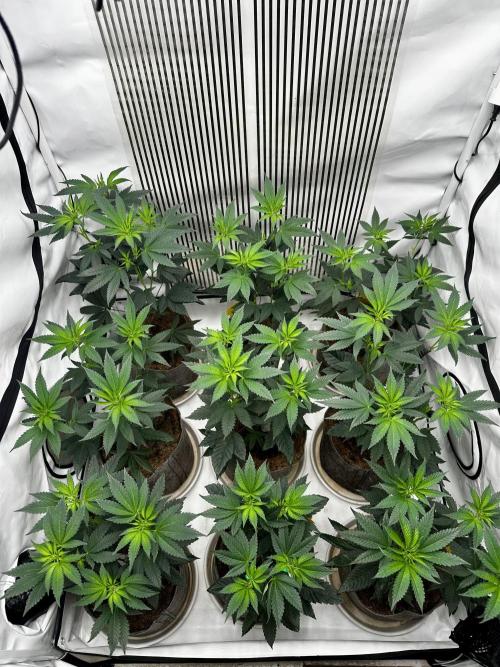
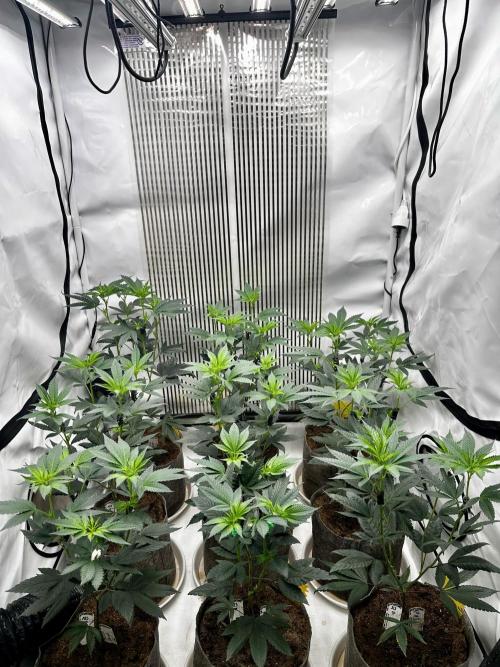
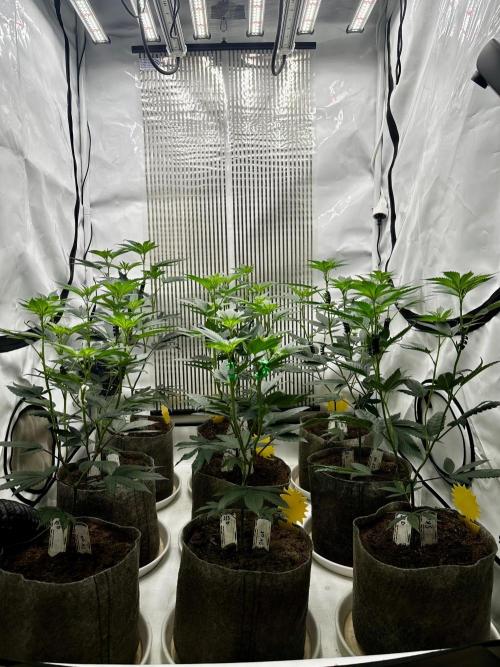
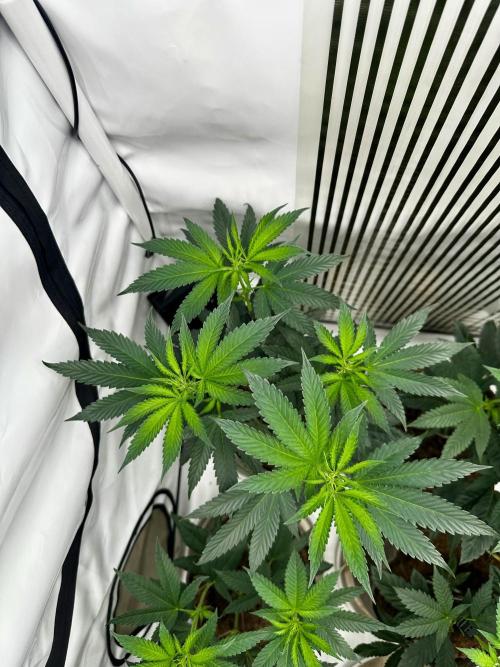
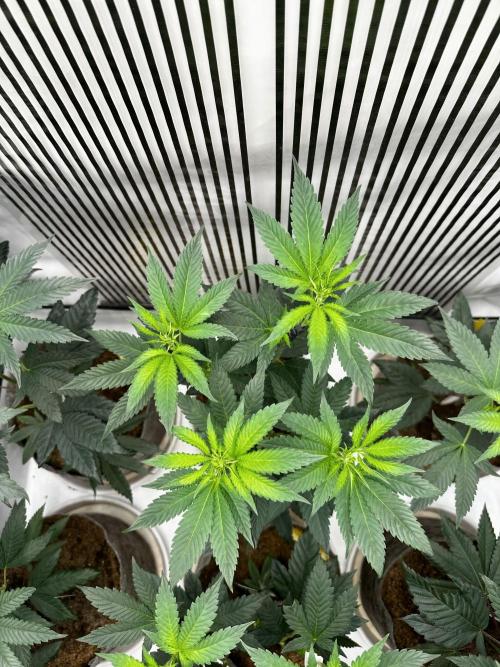
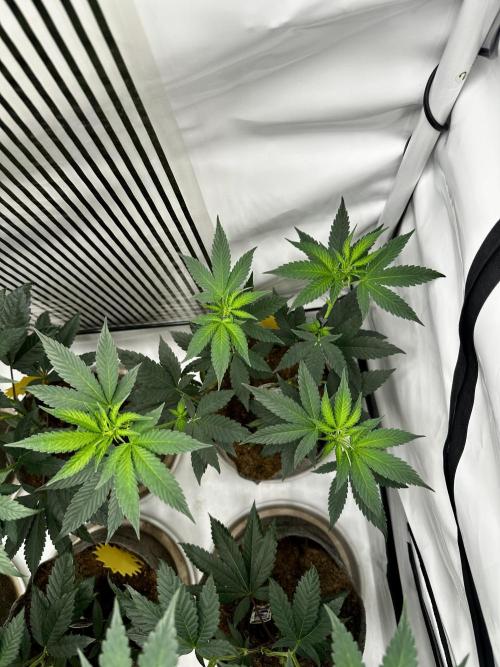
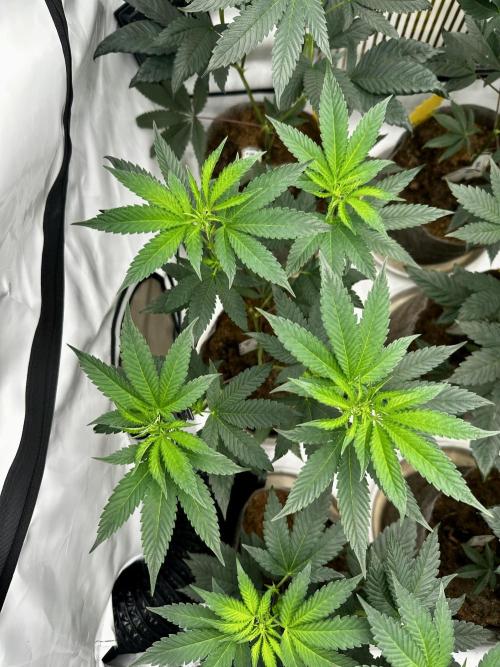
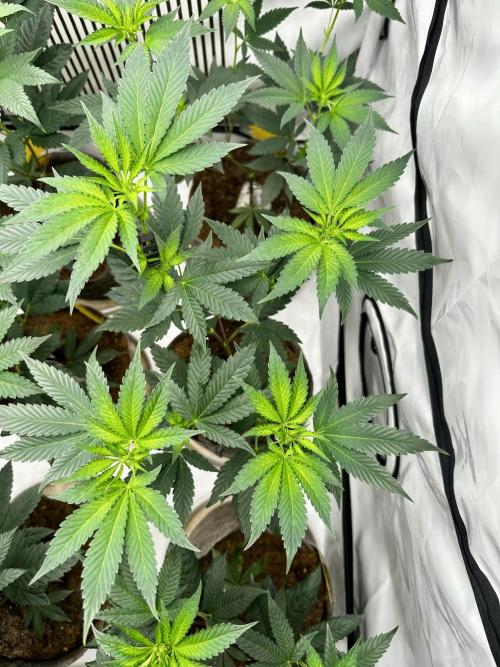
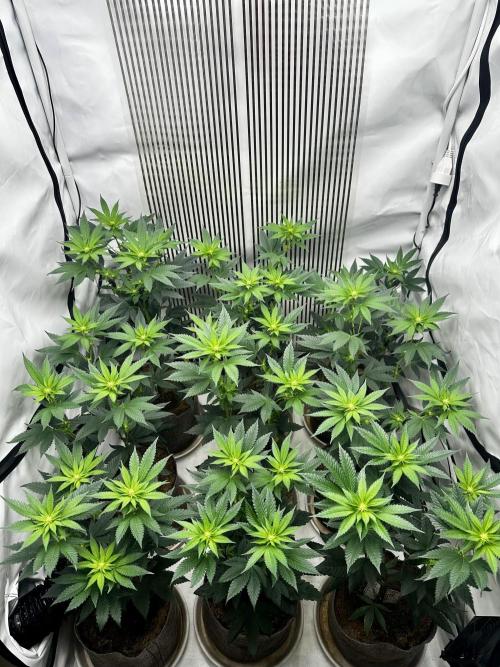
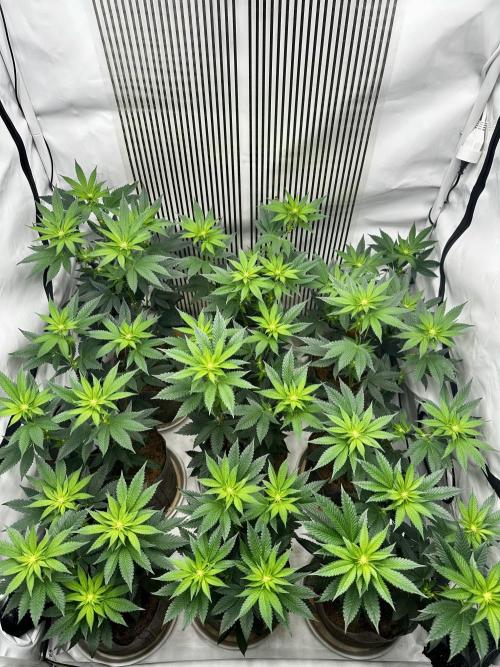
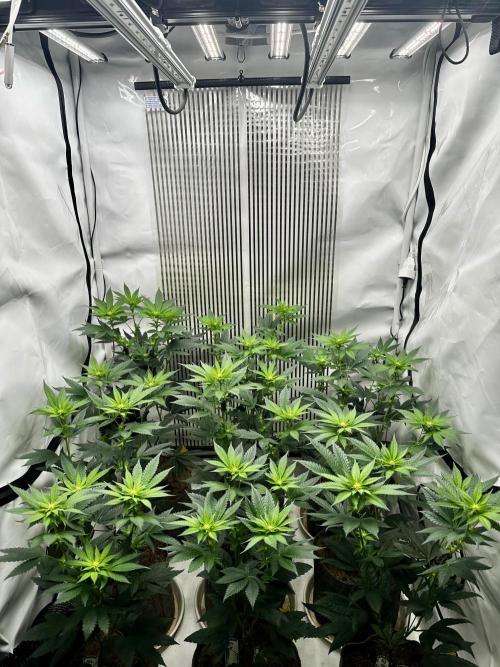
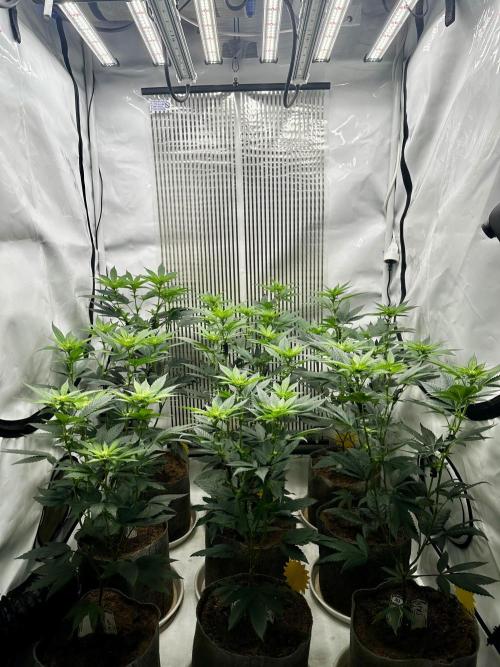
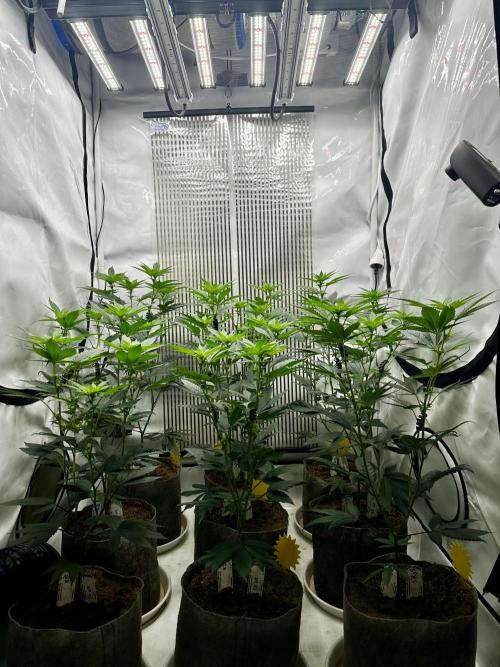
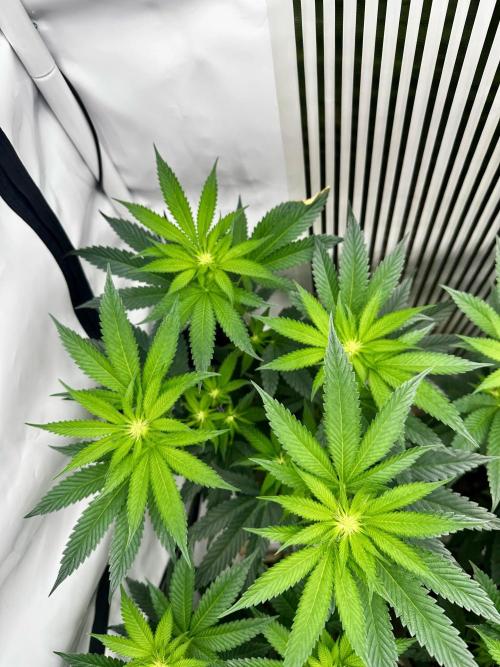
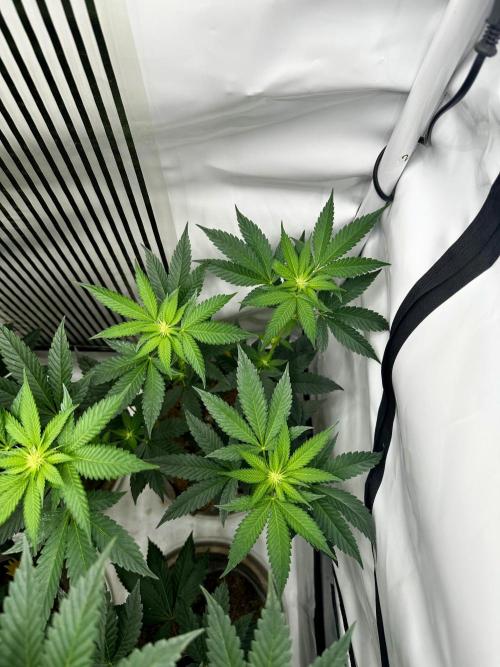
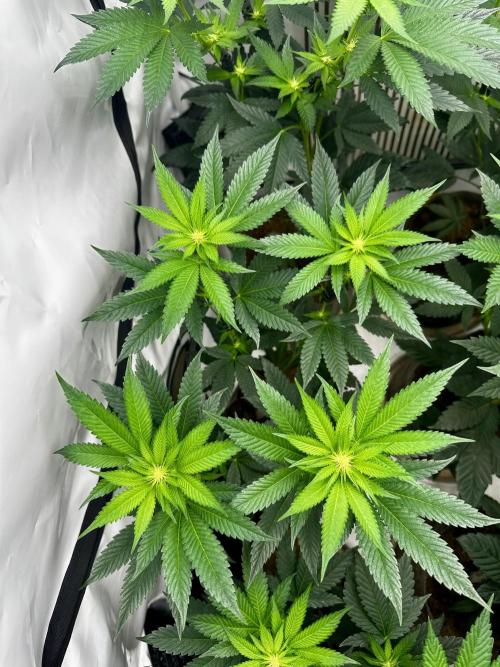
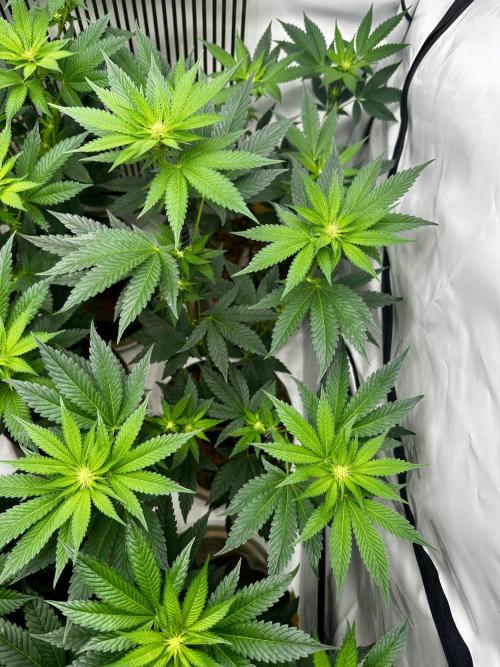
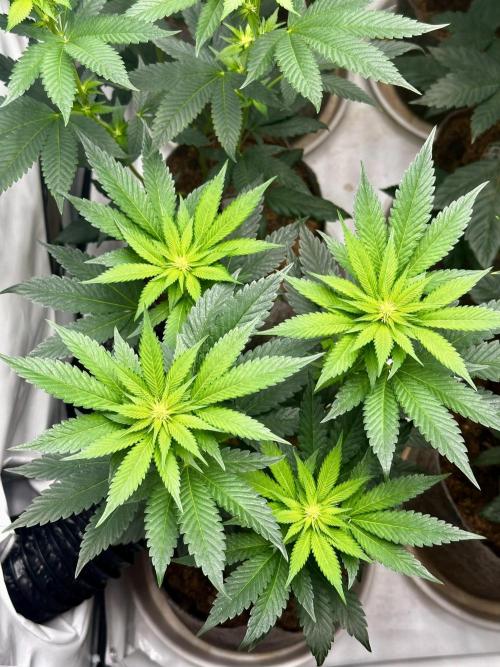
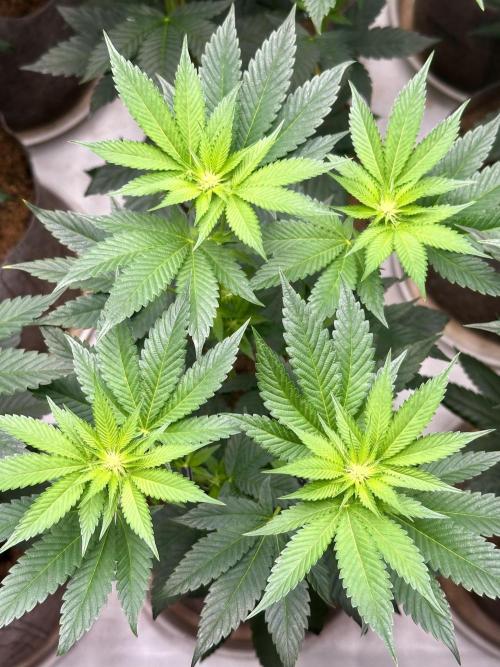
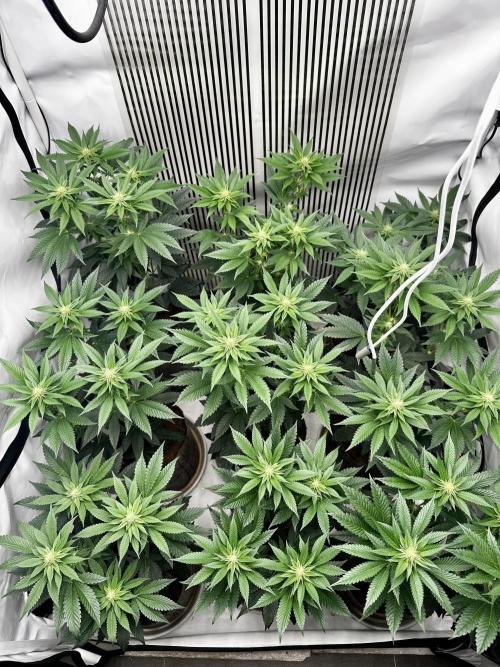
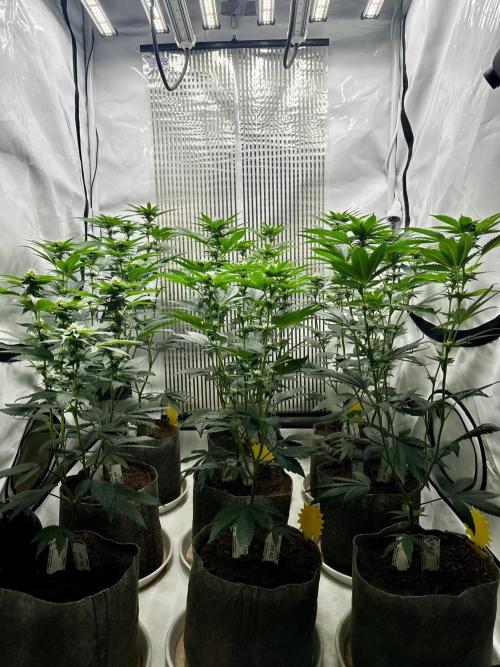
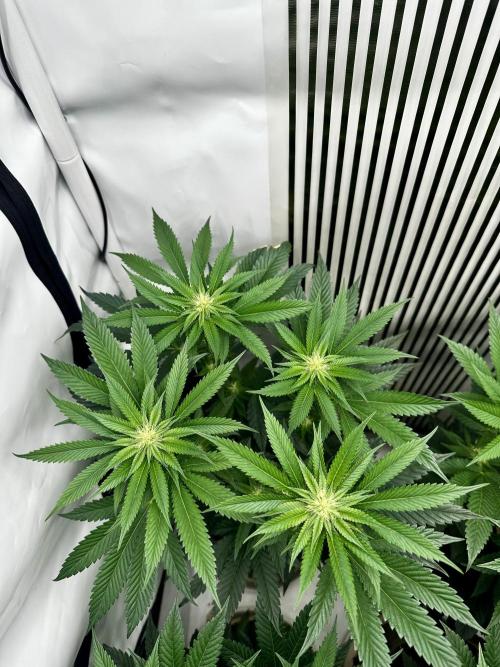
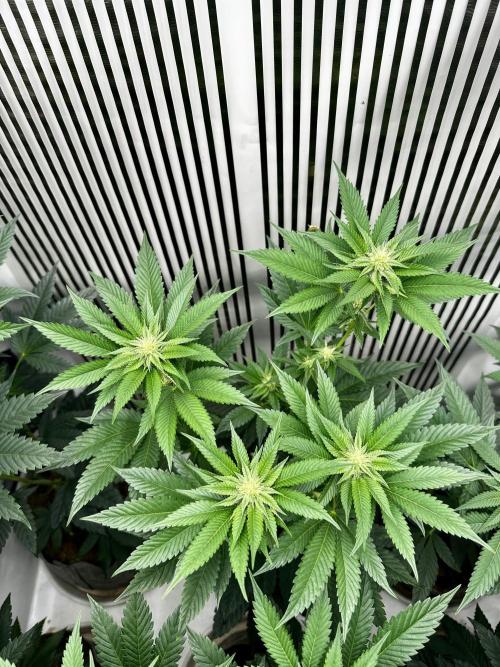
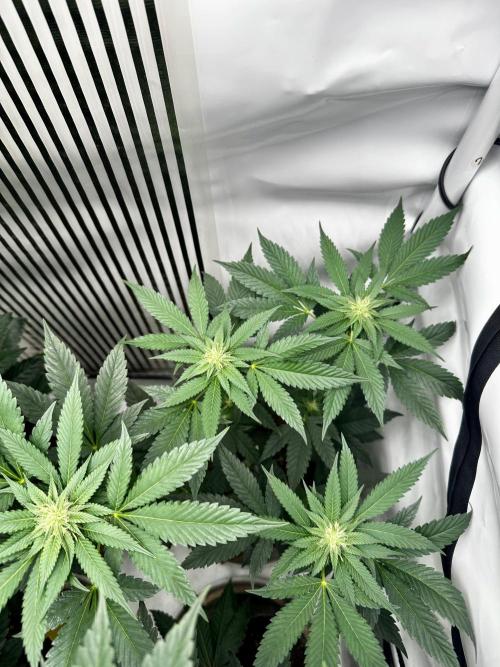
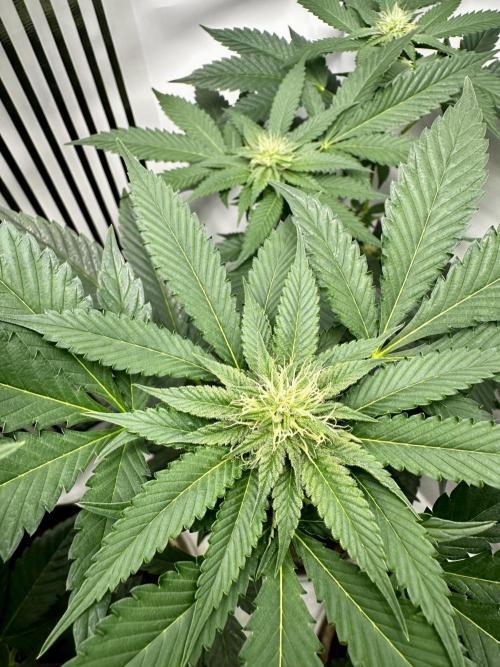
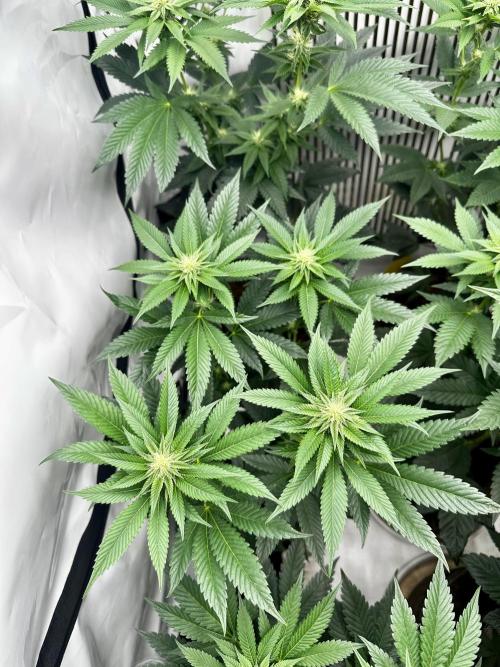
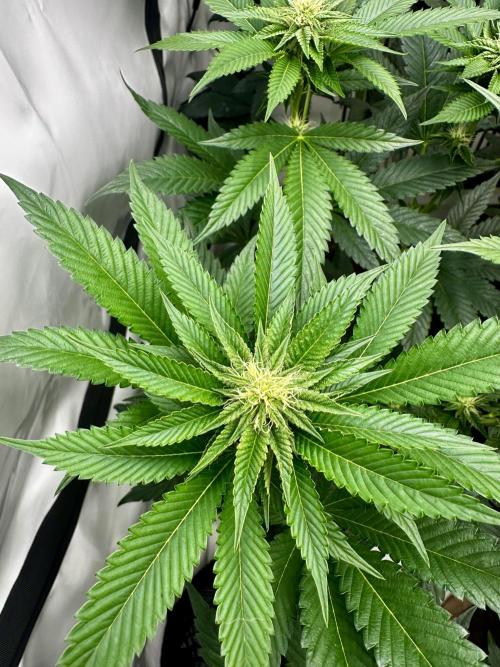
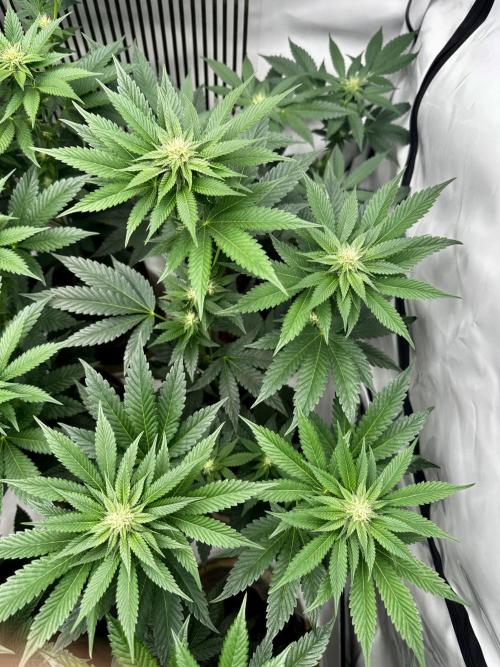
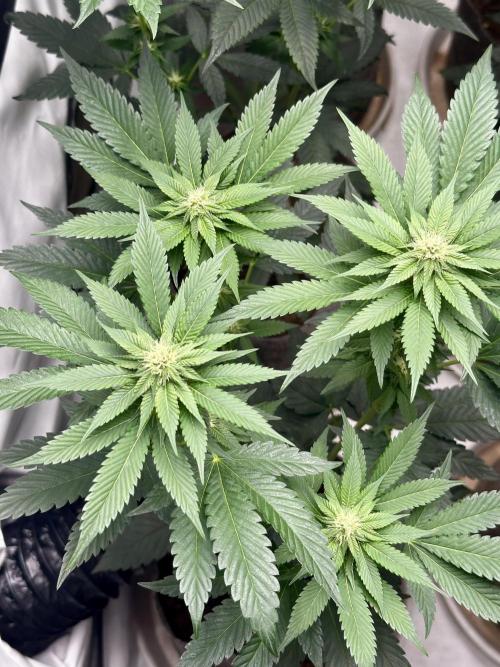
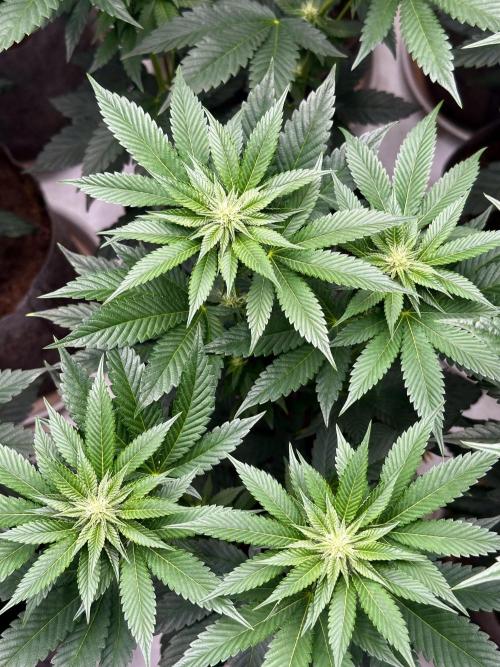
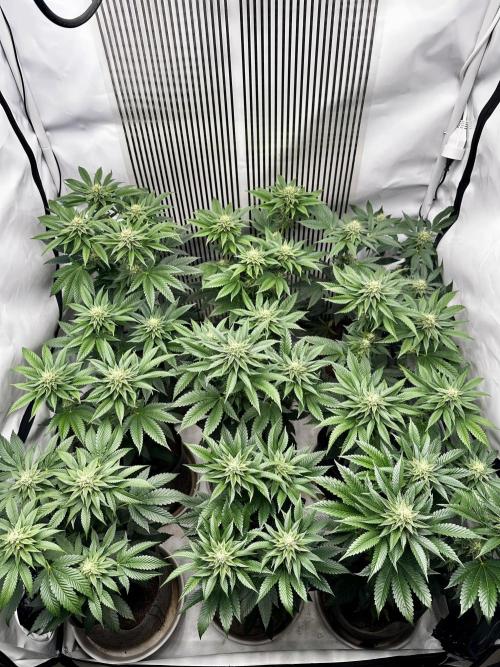
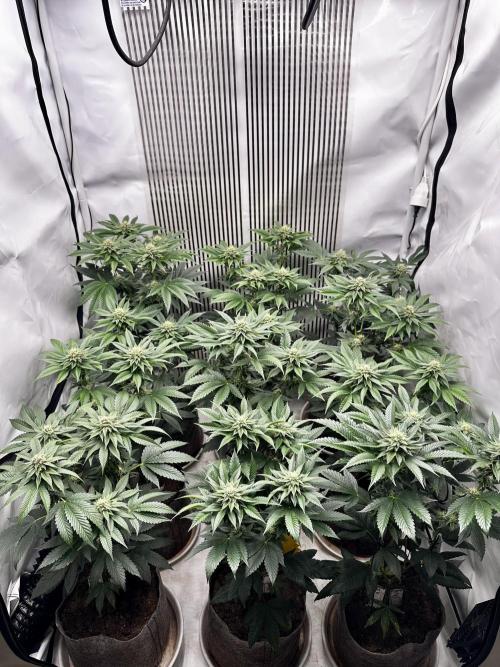
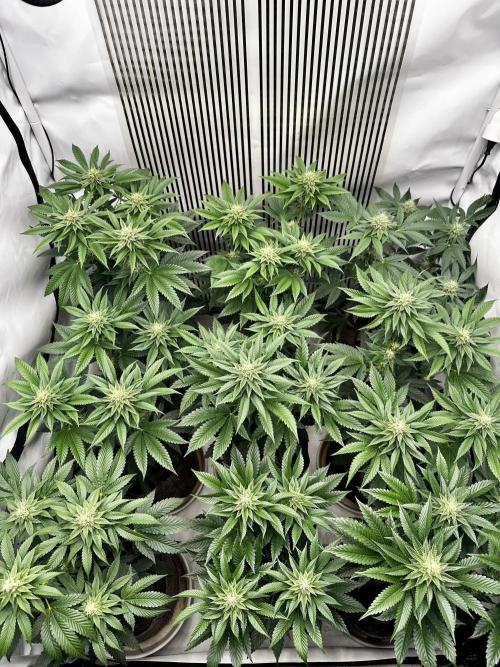
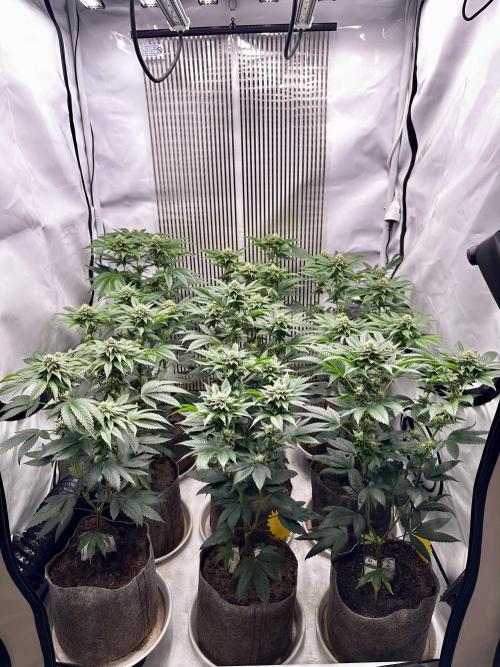
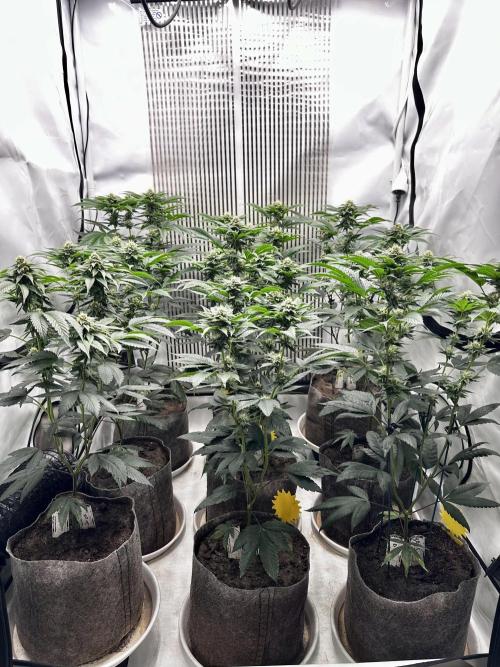
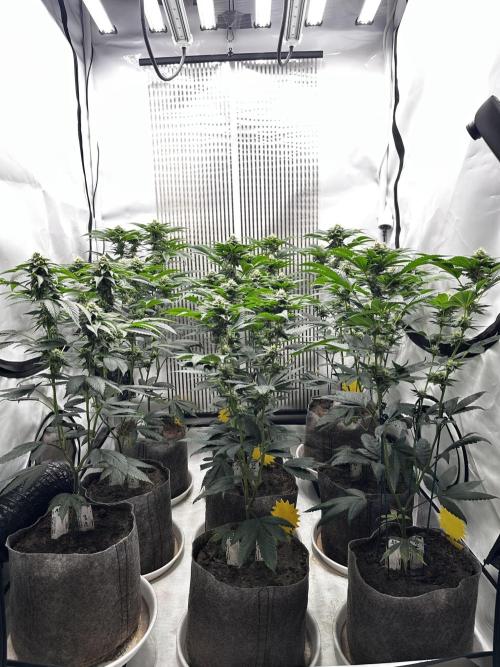
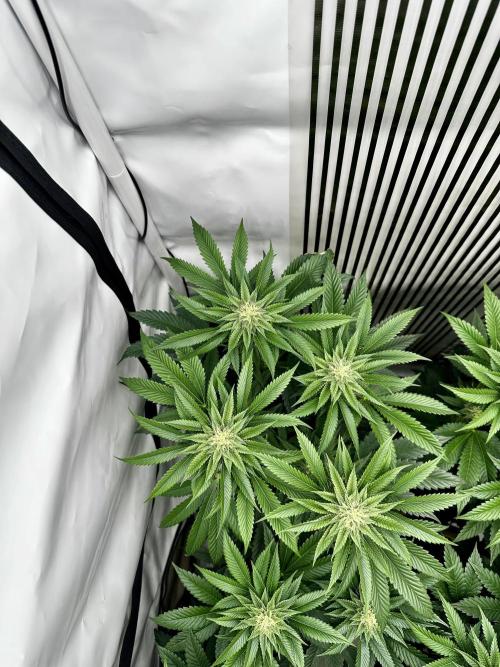
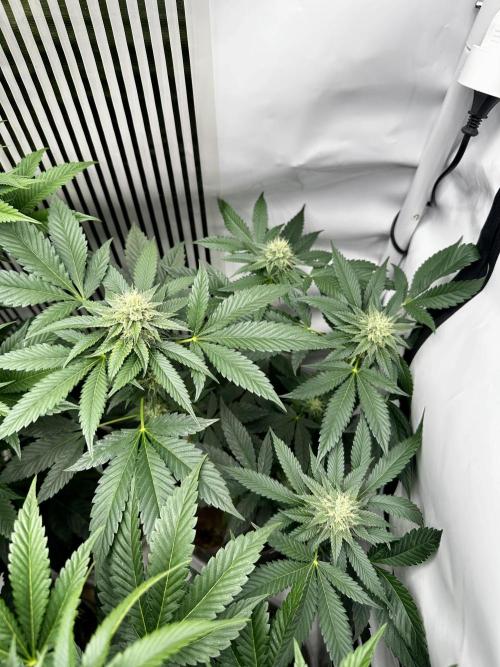
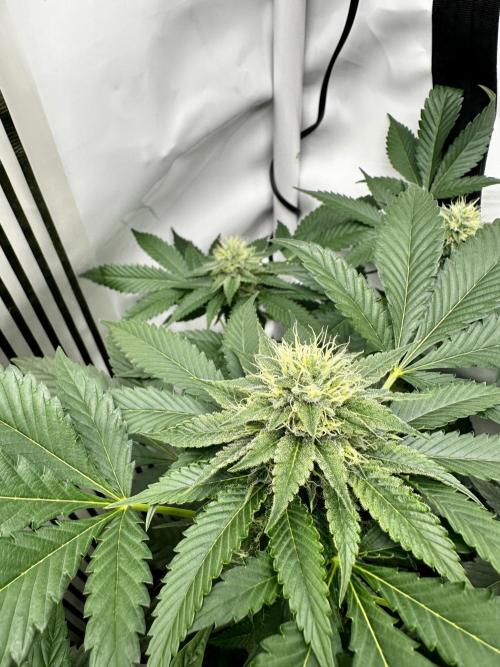
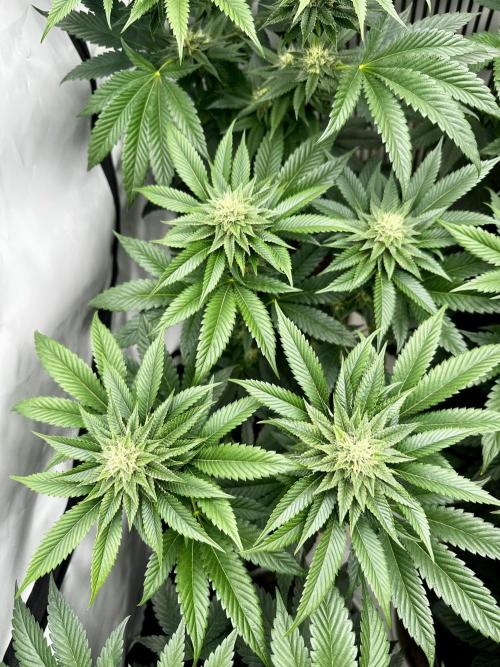
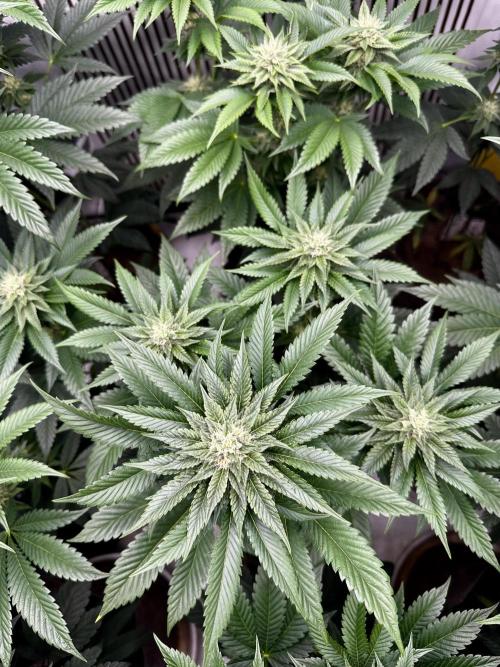
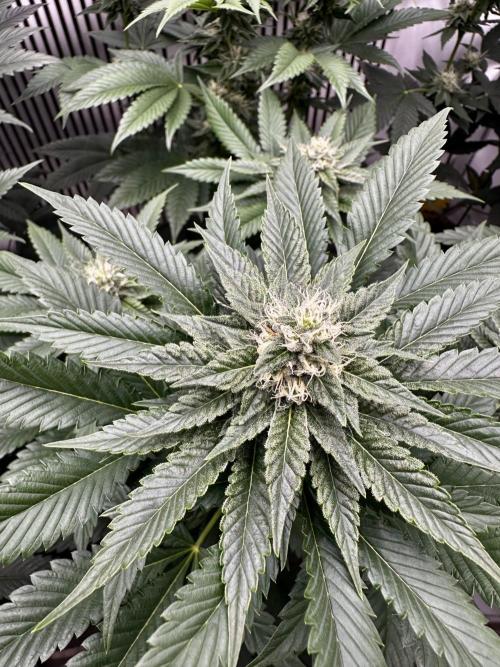
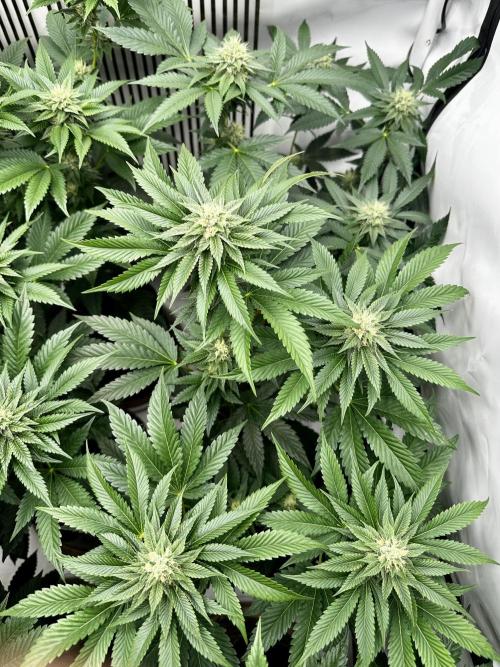
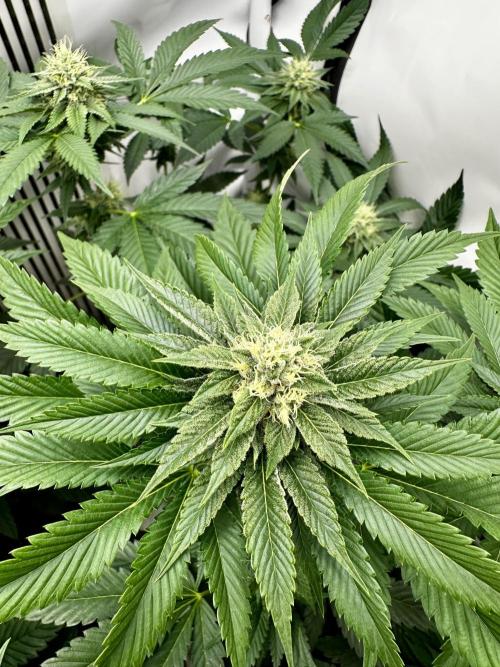
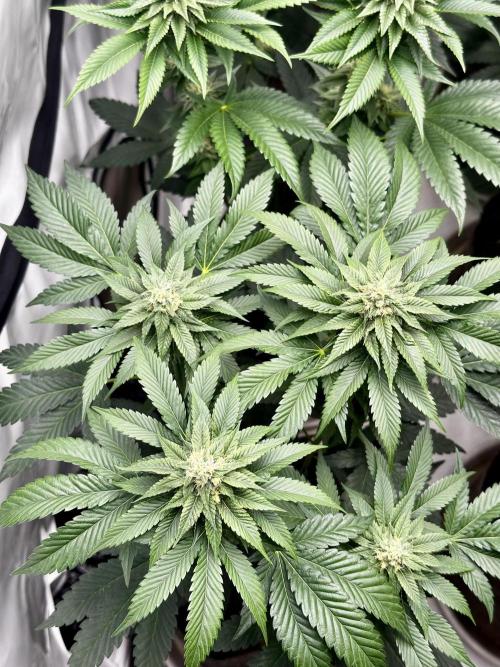
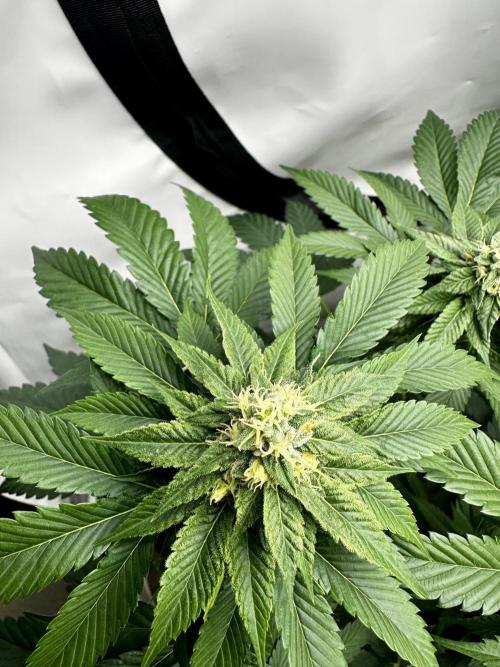
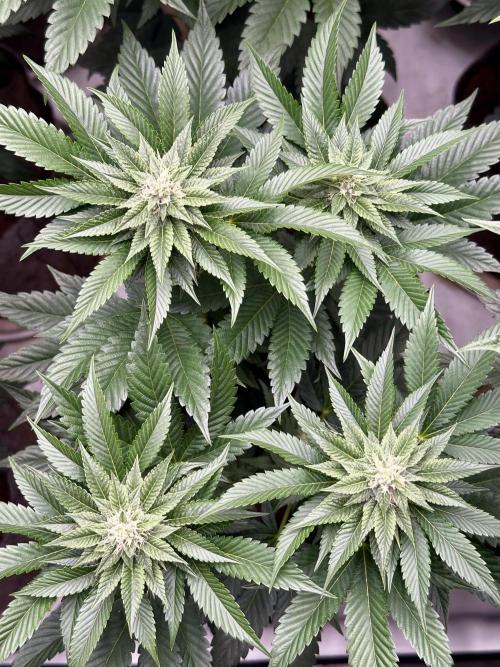
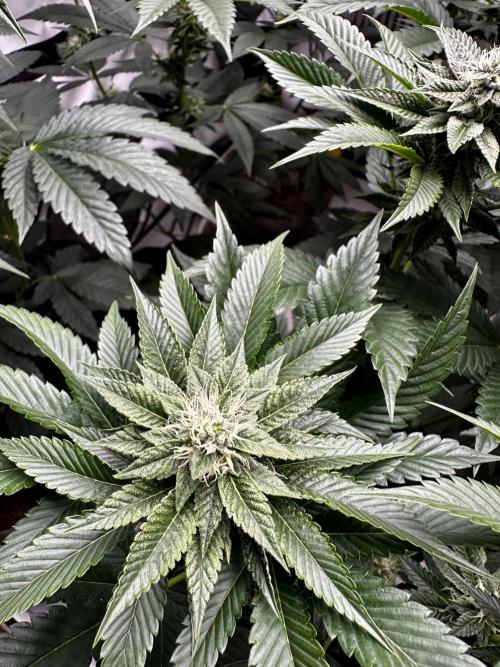
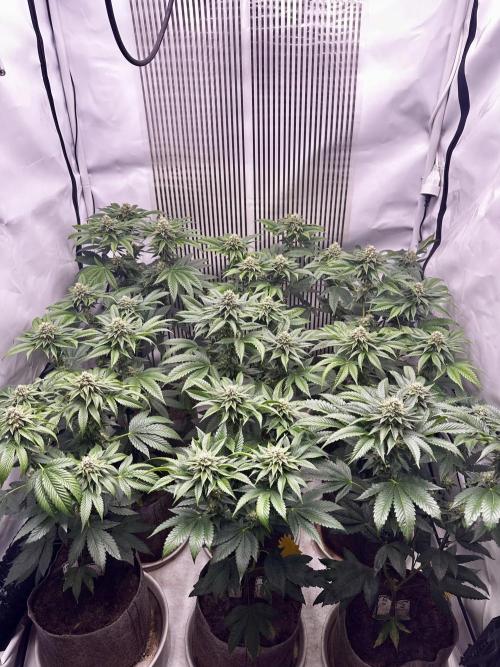
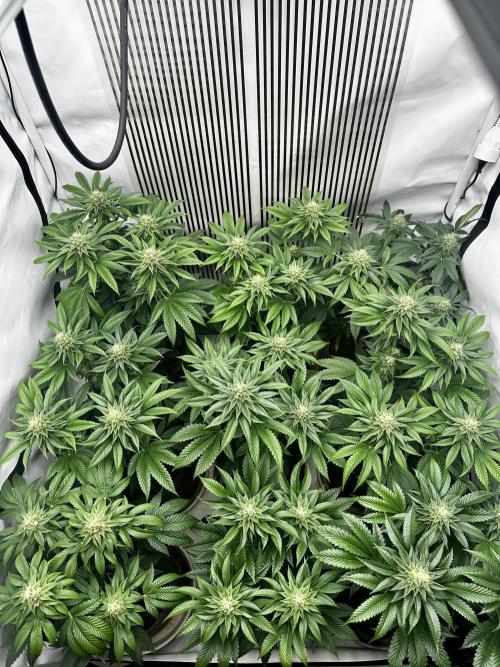
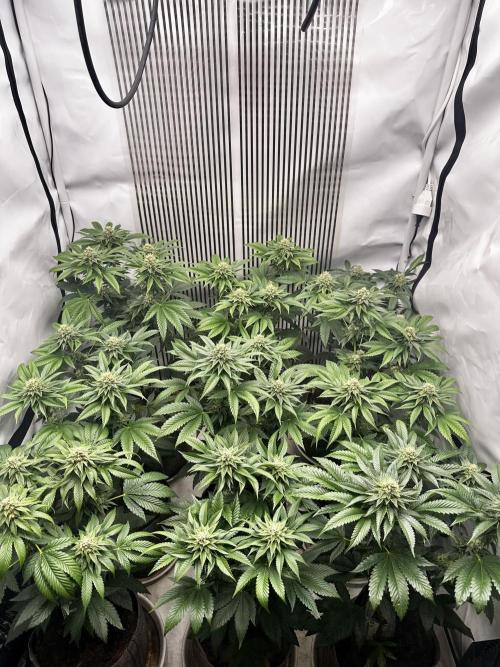
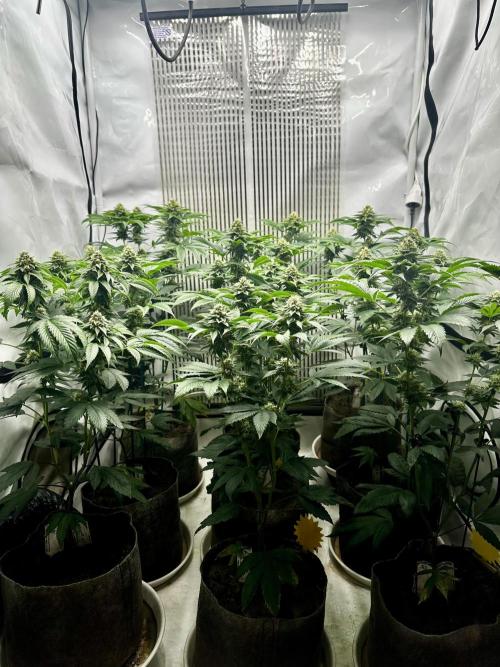
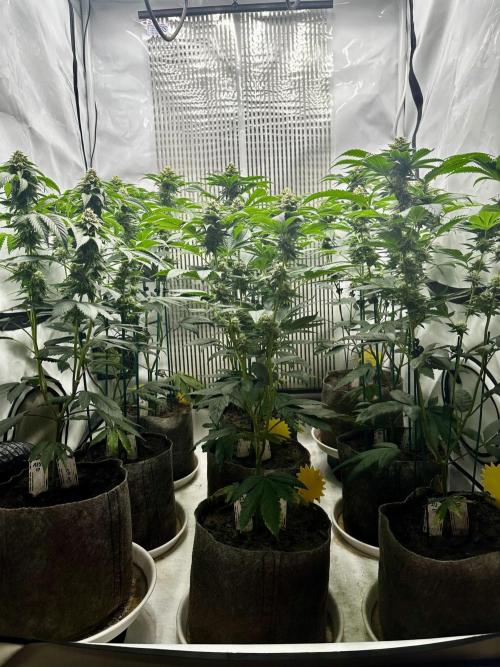
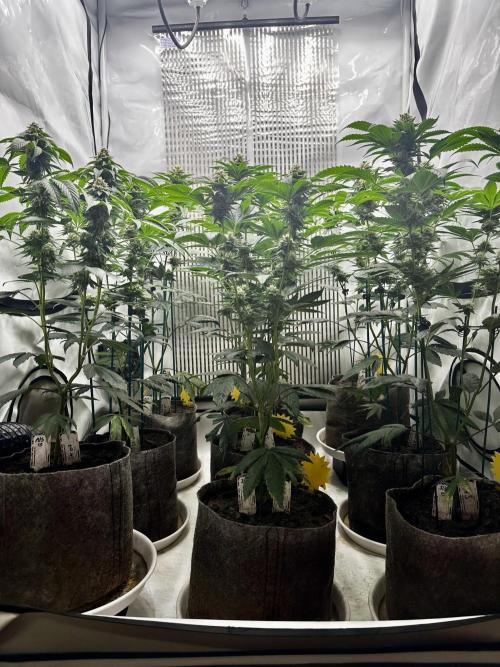
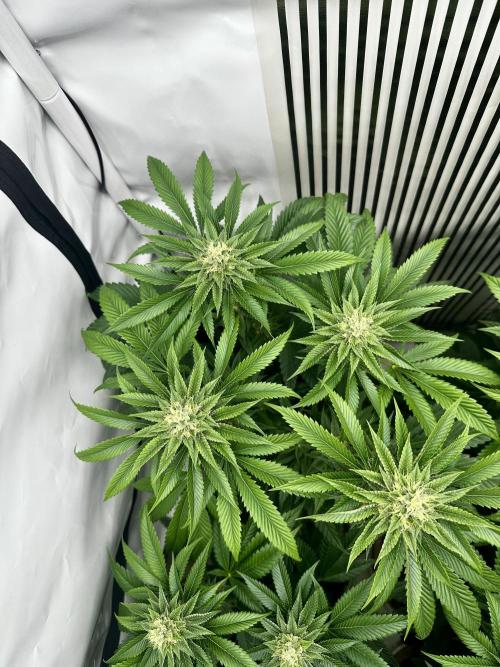
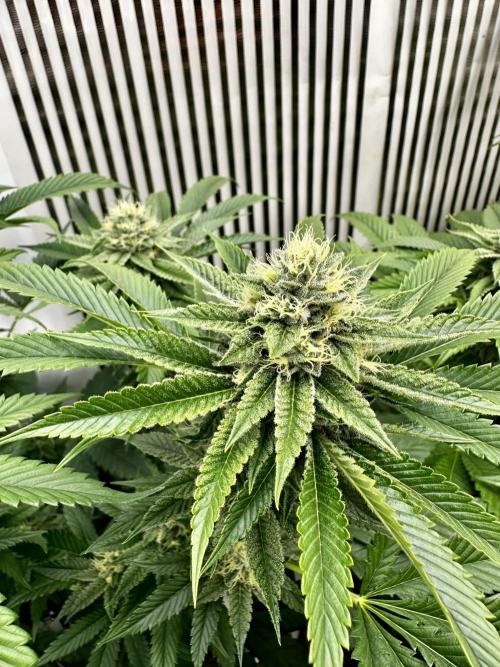
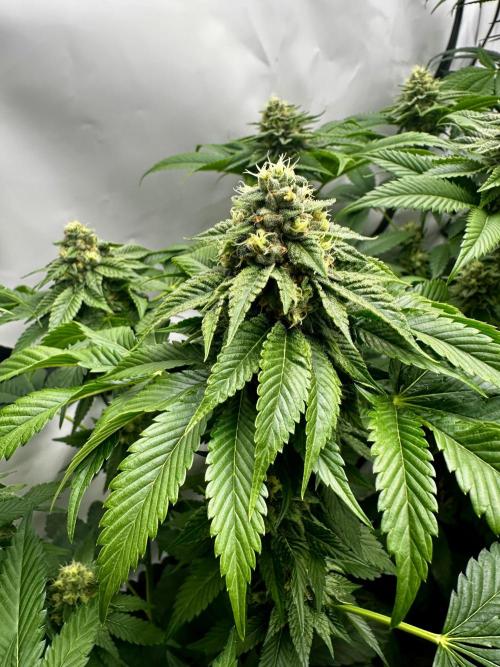
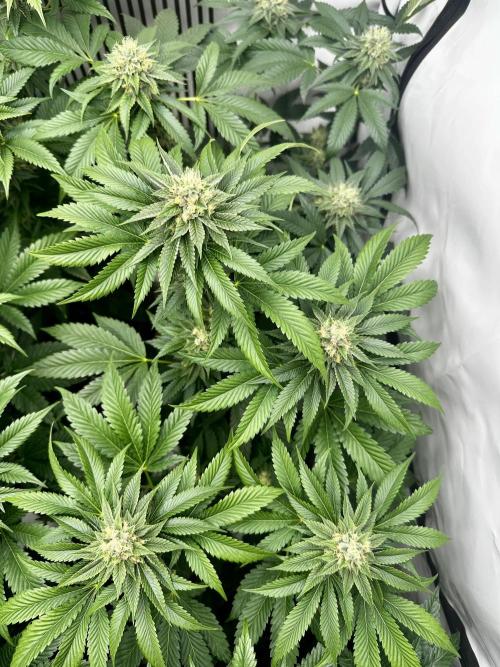
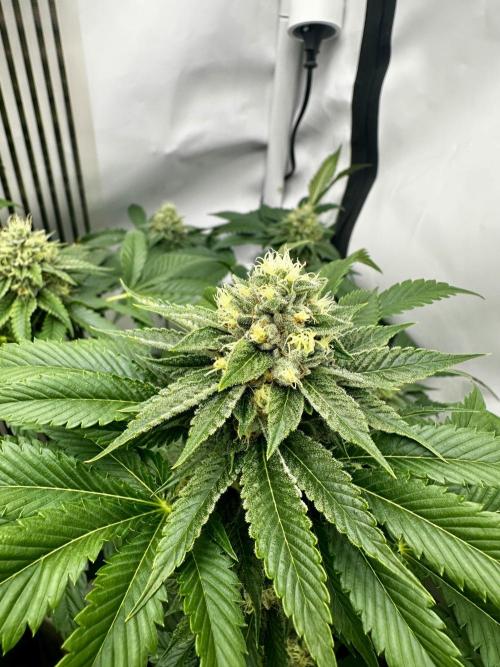
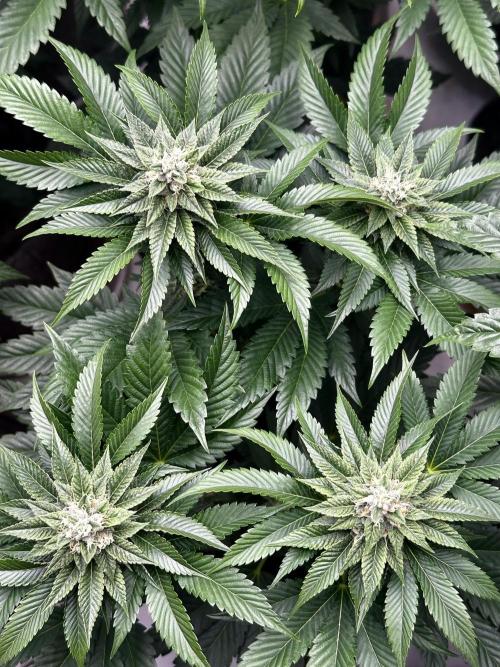
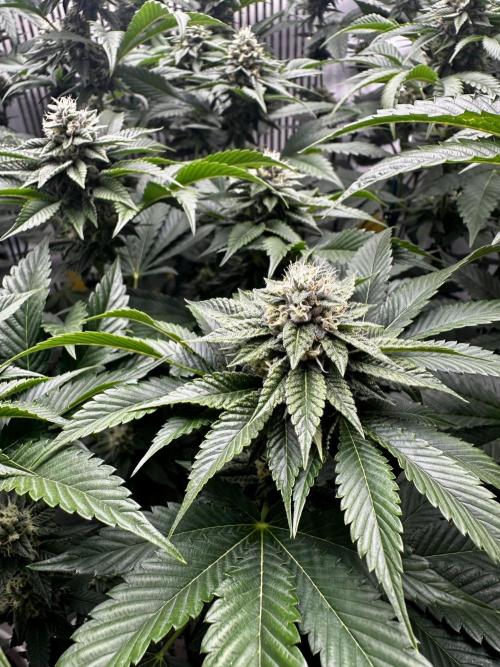
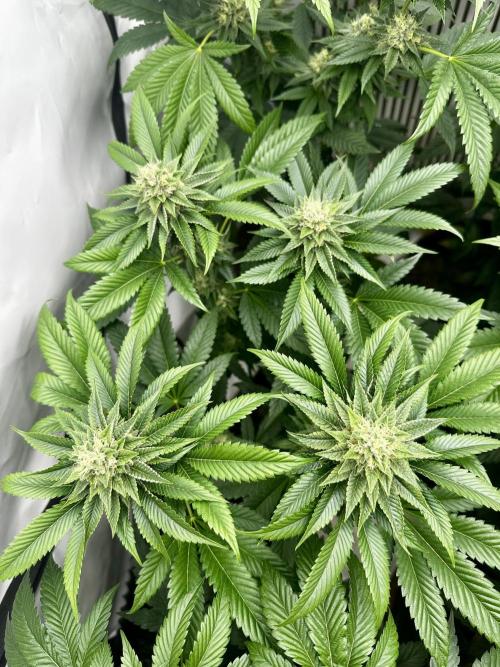
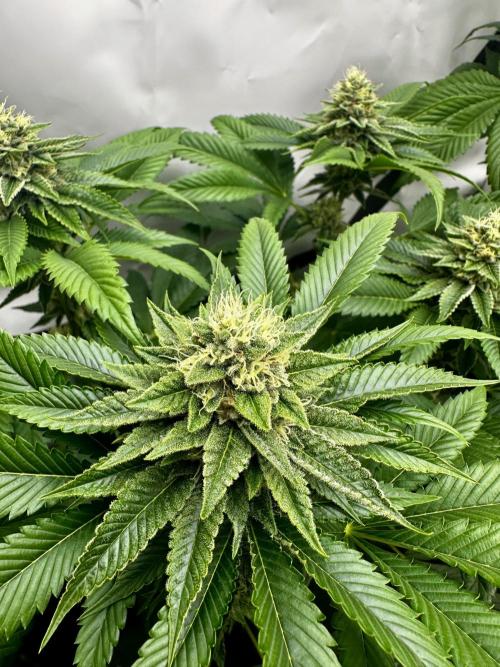
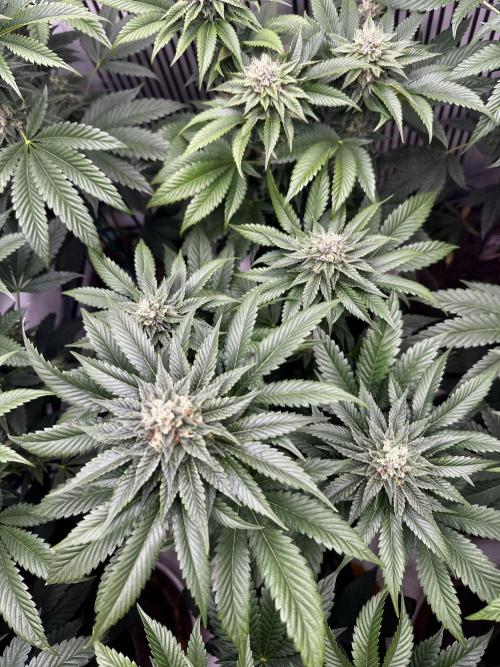
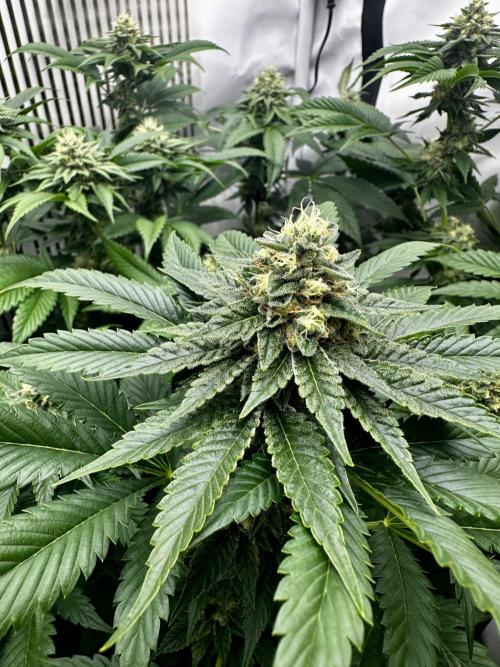
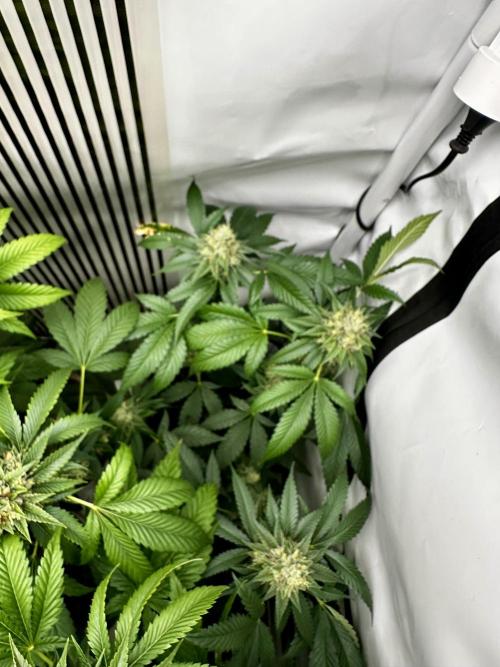
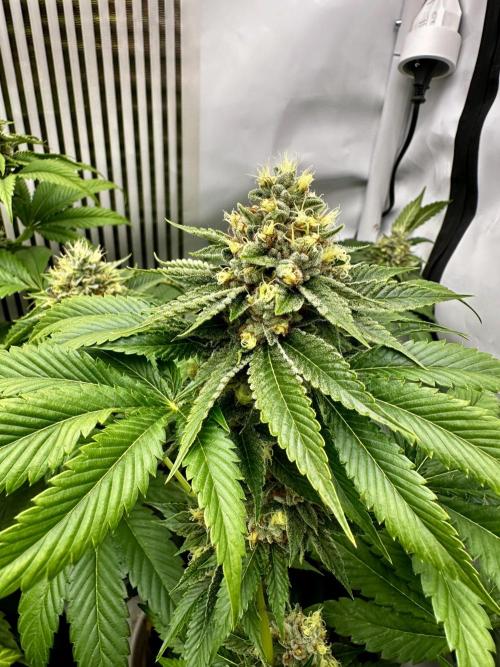
Daz_Method first week after repotting the rooted clones into 1.65L pots. They were transplanted into a 100% organic soil mix that I prepared myself using dry organic amendments only — no bottled organic products.
This is a keeper hunt for Skywalker Kush by DNA Genetics. I don’t flower the original seed plants directly. I first grow and train them according to my usual process, make an early pre-selection, then clone every remaining candidate and run the actual hunt from clones. This gives me more uniform starting material and allows for a cleaner comparison between phenotypes.
Germination went very well, with 9 out of 10 seeds successfully sprouting. During the cloning stage, SK7 developed the largest root mass and rooted the most easily, with SK3 also rooting well. SK2 and SK5 took the longest and had the most difficulty producing roots.
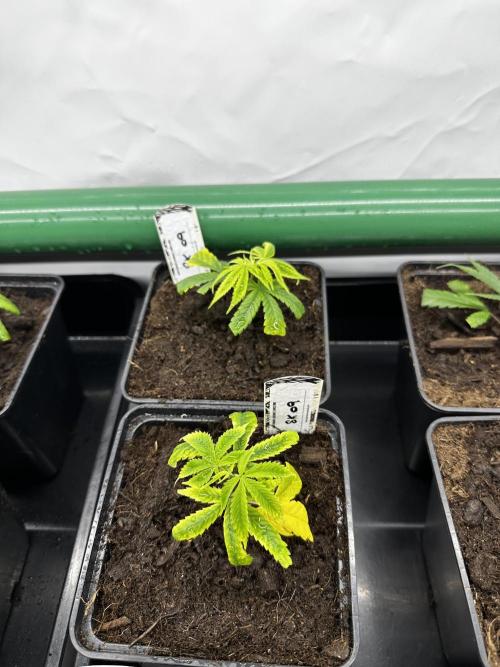
One candidate to monitor closely is SK9, which was noticeably yellower than the others. This could simply mean that it has a higher nutrient demand, but yellowing at this stage can also reflect less efficient nutrient uptake, slower recovery after cloning, or lower overall resilience. Root presence alone does not necessarily mean that a clone is functioning efficiently, so the next few days will be important. If SK9 quickly regains a healthy color and resumes strong growth after repotting, it will remain in the hunt. If it stays yellow, slow, or fragile while the others move forward, it may be removed from the selection before reaching the flowering box.
4 likes
comments
Share
Used techniques
Transplantation
Technique
2
Week 2. Vegetation
3mo ago
1/4
13 cm
Height
18 hrs
Light Schedule
27 °C
Day Air Temp
6.5
pH
No Smell
Smell
80 %
Air Humidity
21 °C
Solution Temp
21 °C
Substrate Temp
22 °C
Night Air Temp
1.65 liters
Pot Size
0.15 liters
Watering Volume
30 cm
Lamp Distance
Nutrients 1
dry organic amendment
1 mll
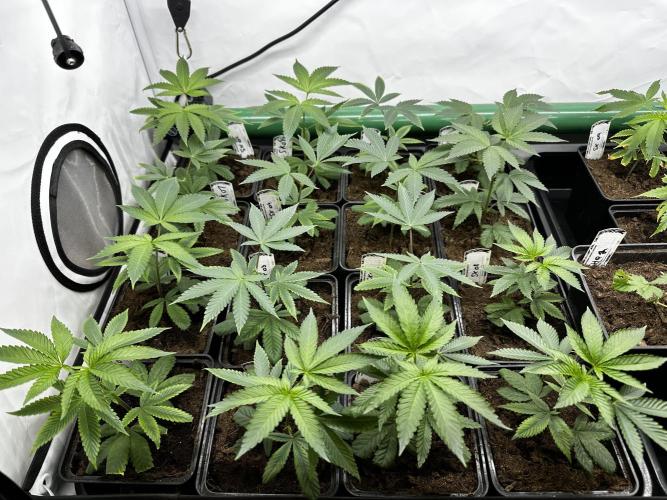
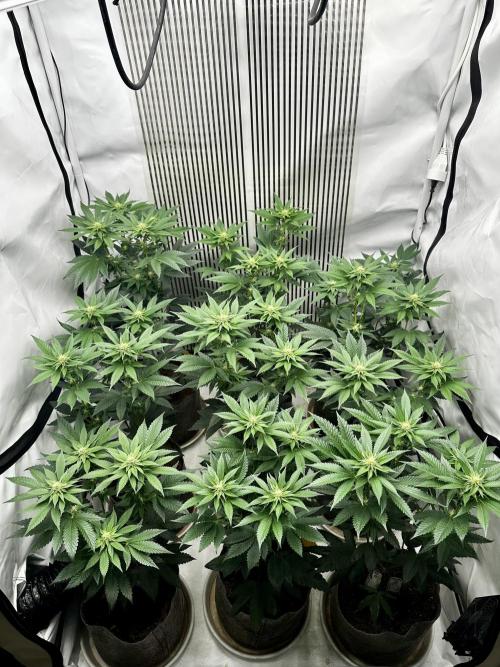
Daz_Method Week 2 of veg: the first topping was done, along with a light compost tea watering to help kick-start microbial life in the pots. Overall, the plants are developing well, but SK9 is still struggling to recover and remains slightly behind the others. I’ll continue monitoring its color, growth rate, and overall response before deciding whether it stays in the keeper hunt.
4 likes
comments
Share
Used techniques
Topping
Technique
3
Week 3. Vegetation
2mo ago
1/6
22 cm
Height
18 hrs
Light Schedule
27 °C
Day Air Temp
6.5
pH
No Smell
Smell
80 %
Air Humidity
21 °C
Solution Temp
21 °C
Substrate Temp
22 °C
Night Air Temp
1.65 liters
Pot Size
0.15 liters
Watering Volume
30 cm
Lamp Distance
Nutrients 1
dry organic amendment
1 mll
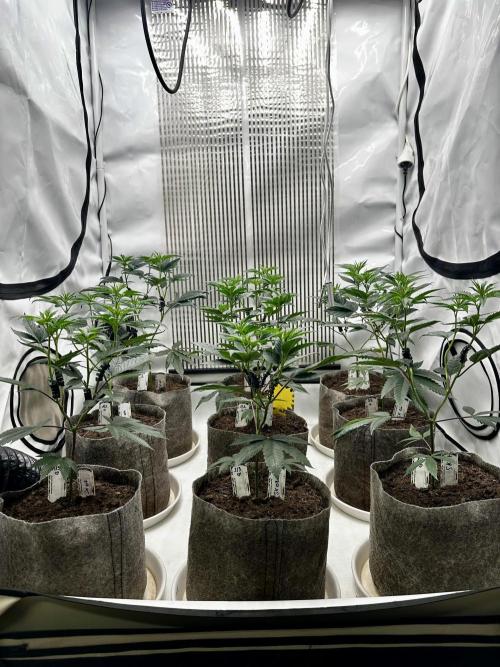
Daz_Method Start of Week 3 of veg: not much to report this week. Overall, the plants are progressing normally, but SK9 still hasn’t fully recovered and remains behind the others. If it continues like this, I don’t think it will make it into the flowering run and it will be removed from the keeper hunt.
3 likes
comments
Share
4
Week 4. Vegetation
2mo ago
1/14
27 cm
Height
18 hrs
Light Schedule
27 °C
Day Air Temp
6.5
pH
No Smell
Smell
80 %
Air Humidity
21 °C
Solution Temp
21 °C
Substrate Temp
22 °C
Night Air Temp
1.65 liters
Pot Size
0.15 liters
Watering Volume
30 cm
Lamp Distance
Nutrients 1
dry organic amendment
1 mll
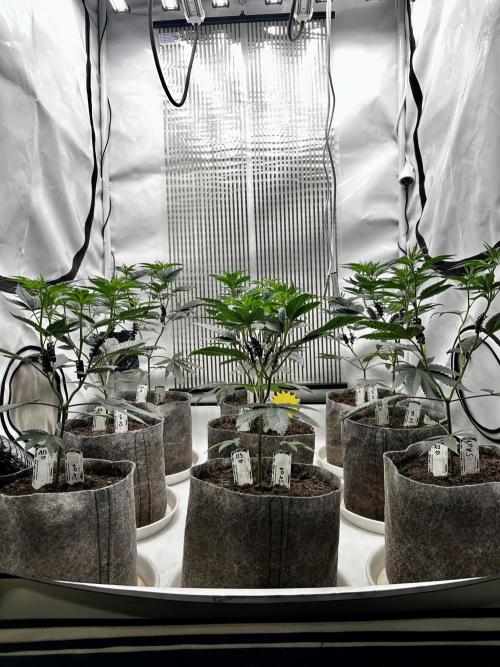
Daz_Method Start of Week 4 of veg: the second topping was done 3 days ago, and today I added plant benders to gradually open up the center of each plant and start shaping the canopy. Everything is going well overall. They still have one more week in the 1.65L pots before being transplanted into their final 10L containers.
SK9 is still the odd one out — the leaves continue to look unusual, so I’ll keep monitoring it before deciding whether it deserves a spot in the flowering run or gets removed from the hunt.
SK1 is currently showing the strongest vertical growth, but it also has the widest internodal spacing of the group. Apart from that, the other candidates are staying fairly close to each other for now.
3 likes
comments
Share
5
Week 5. Vegetation
2mo ago
1/16
30 cm
Height
18 hrs
Light Schedule
27 °C
Day Air Temp
6.5
pH
No Smell
Smell
80 %
Air Humidity
21 °C
Solution Temp
21 °C
Substrate Temp
22 °C
Night Air Temp
1.65 liters
Pot Size
0.15 liters
Watering Volume
30 cm
Lamp Distance
Nutrients 1
dry organic amendment
1 mll
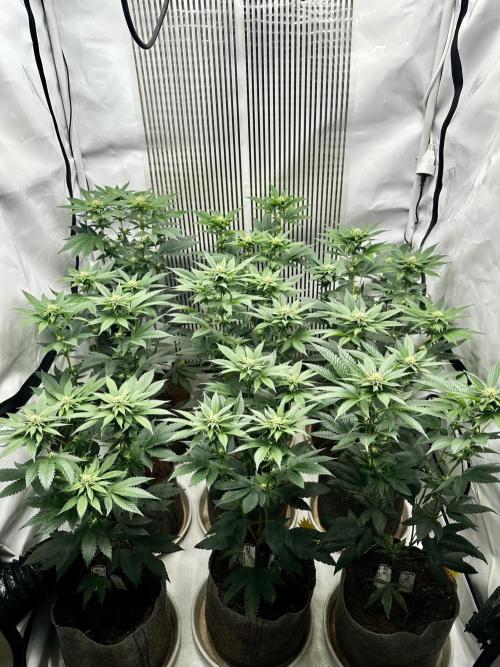
Daz_Method Week 5 of veg: repotted into the final 12L pots using a 100% organic soil mix I made myself with dry organic amendments only — no bottled organic products. Watered with compost tea, and bent/trained the plants to shape the canopy for a SOG setup.
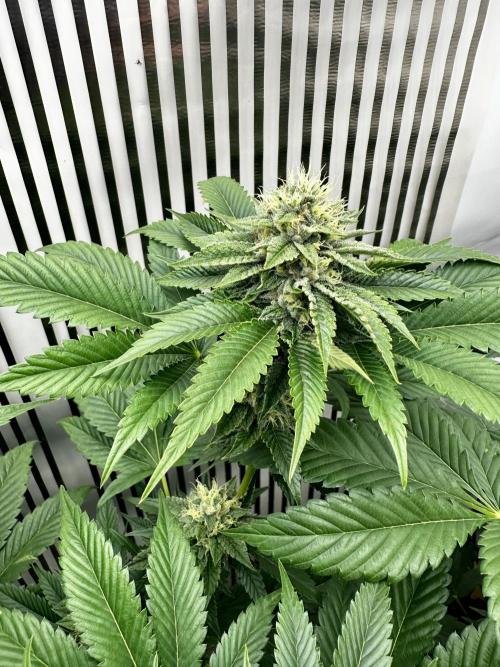
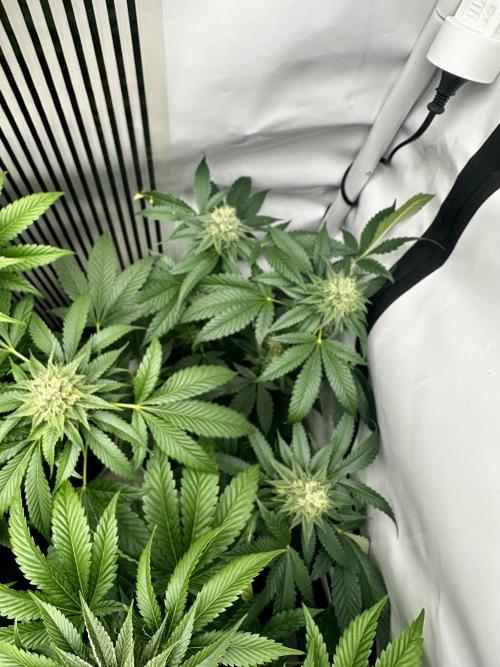
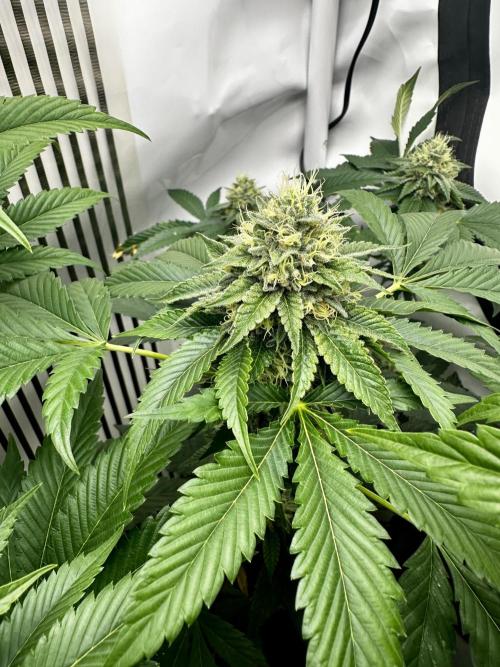
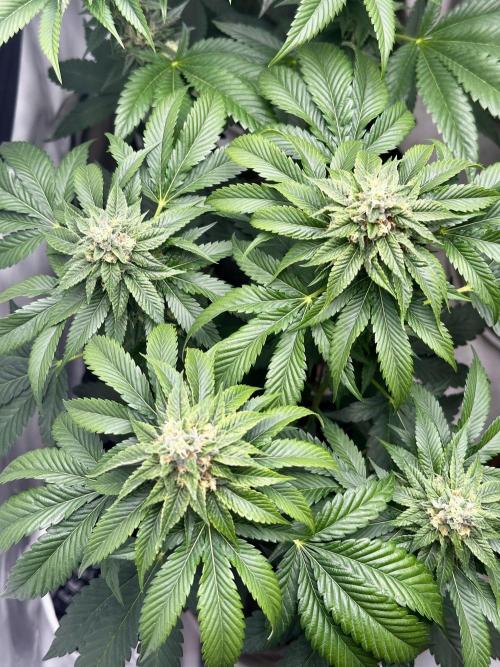
For this **Skywalker Kush by DNA Genetics keeper hunt**, we’re starting the flowering run with **8 different phenotypes: SK1 through SK8**. SK9 was removed from the hunt before reaching this stage because it continued to show unusual growth and leaf development, and I simply wasn’t confident enough in it to give it a spot in the flowering run.
For now, the remaining eight plants are fairly consistent overall. **SK1 is showing slightly stronger growth than the others, but also has noticeably longer internodal spacing**, so that will be something to watch during stretch. **SK7 is currently the smallest of the group**, although the difference is still reasonable and not significant enough to consider removing it.
Apart from those two observations, the group is staying pretty close at this stage. Let’s see how the differences start to show once the stretch begins.
2 likes
3 comments
Share
Used techniques
SoG
Technique
Transplantation
Technique
6
Week 6. Flowering
2mo ago
1/16
37 cm
Height
12 hrs
Light Schedule
27 °C
Day Air Temp
6.7
pH
No Smell
Smell
70 %
Air Humidity
21 °C
Solution Temp
21 °C
Substrate Temp
22 °C
Night Air Temp
12 liters
Pot Size
0.15 liters
Watering Volume
50 cm
Lamp Distance
Nutrients 1
dry organic amendment
1 mll
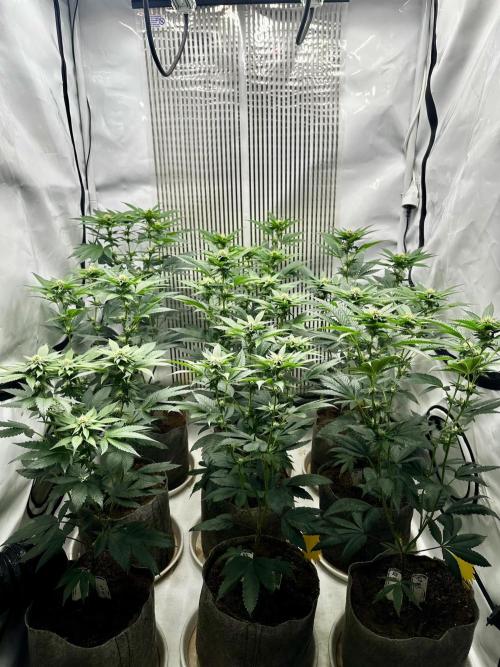
Daz_Method Week 1 of flower: just flipped them today. A second veg compost tea watering was applied, along with some light LST using plant benders to open up the canopy and shape a better SOG structure.
2 likes
comments
Share
Used techniques
12-12
Technique
SoG
Technique
LST
Technique
7
Week 7. Flowering
1mo ago
1/14
49 cm
Height
12 hrs
Light Schedule
27 °C
Day Air Temp
6.7
pH
No Smell
Smell
65 %
Air Humidity
21 °C
Solution Temp
21 °C
Substrate Temp
22 °C
Night Air Temp
12 liters
Pot Size
0.15 liters
Watering Volume
50 cm
Lamp Distance
Nutrients 1
dry organic amendment
1 mll
Daz_Method Week 2 of flower: everything is going well and the stretch is accelerating. A top-dress was applied to support the increased demand during this phase, and I’m still gradually raising light intensity. So far, all the phenotypes are staying fairly close overall. SK1 is still stretching slightly more than the others, SK8 remains the smallest of the group, and SK6 is currently showing the widest and most open canopy.
likes
comments
Share
8
Week 8. Flowering
1mo ago
1/13
55 cm
Height
12 hrs
Light Schedule
27 °C
Day Air Temp
6.7
pH
No Smell
Smell
60 %
Air Humidity
21 °C
Solution Temp
21 °C
Substrate Temp
22 °C
Night Air Temp
12 liters
Pot Size
0.15 liters
Watering Volume
50 cm
Lamp Distance
Nutrients 1
dry organic amendment
1 mll
Daz_Method Start of Week 3 of flower: the flowers are already well established, and we’re moving into the end of the stretch — bulking should begin soon. I haven’t done any defoliation yet, since the leaves are not really blocking the secondary sites and the canopy is still fairly open overall, with the space not fully filled yet. At the moment I feel the balance is good, with neither too much nor too little leaf mass. That’s also normal because the fill is not fully optimized with 12L pots in a 1x1m space. I did add a second light top-dress though, because I feel the leaves are still not quite green enough to enter the bulking phase comfortably. Light is currently at 75%; by the end of the week it should be at 100% and around 25 cm from the canopy.
3 likes
comments
Share
Used techniques
SoG
Technique
9
Week 9. Flowering
1mo ago
1/21
55 cm
Height
12 hrs
Light Schedule
27 °C
Day Air Temp
6.7
pH
No Smell
Smell
58 %
Air Humidity
21 °C
Solution Temp
21 °C
Substrate Temp
22 °C
Night Air Temp
12 liters
Pot Size
0.15 liters
Watering Volume
30 cm
Lamp Distance
Nutrients 1
dry organic amendment
1 mll
Daz_Method tart of Week 4 of flower: the stretch is almost done. Trichome production has already started nicely, and the smell is becoming more noticeable too. A light defoliation was done, along with removing the last unnecessary lower shoots.
1 like
comments
Share
Used techniques
Defoliation
Technique
SoG
Technique
10
Week 10. Flowering
22d ago
1/21
55 cm
Height
12 hrs
Light Schedule
27 °C
Day Air Temp
6.7
pH
Weak
Smell
58 %
Air Humidity
21 °C
Solution Temp
21 °C
Substrate Temp
22 °C
Night Air Temp
12 liters
Pot Size
0.15 liters
Watering Volume
30 cm
Lamp Distance
Nutrients 1
dry organic amendment
1 mll
Daz_Method Start of Week 5 of flower: bulking is now well underway. A castor ash top-dress was applied to give the plants some extra PK support during this phase. So far, no hermaphrodite bananas have been found, which is definitely a positive point for this line.
At the moment, SK6 and SK7 are showing the strongest aroma, while the others are still fairly mild and haven’t really stood out yet in that department. SK1 remains the most vigorous plant, while SK3 and SK7 are currently the smallest, although we’re only talking about roughly 10–15 cm difference, so nothing extreme.
Overall, the group is still fairly consistent with no huge differences between phenotypes at this stage. The real separation will probably come later once we can compare final yield, aroma, flavor, and overall flower quality.
1 like
comments
Share
11
Week 11. Flowering
17d ago
1/22
55 cm
Height
12 hrs
Light Schedule
27 °C
Day Air Temp
6.7
pH
Weak
Smell
58 %
Air Humidity
21 °C
Solution Temp
21 °C
Substrate Temp
22 °C
Night Air Temp
12 liters
Pot Size
0.15 liters
Watering Volume
30 cm
Lamp Distance
Nutrients 1
dry organic amendment
1 mll
Daz_Method Start of Week 6 of flower: I added a few stakes here and there for support. Overall, the run is still moving in the right direction, but judging by the leaf color, I’m starting to wonder how well senescence will develop toward the end — they are still very green and seem to consume less than some of the other varieties I’ve worked with.
We’ll see how the next few weeks unfold, but for now I’m slightly disappointed with the amount of bulk considering there are only around four weeks left to go.
2 likes
comments
Share
12
Week 12. Flowering
11d ago
1/21
55 cm
Height
12 hrs
Light Schedule
27 °C
Day Air Temp
6.7
pH
Normal
Smell
45 %
Air Humidity
21 °C
Solution Temp
21 °C
Substrate Temp
22 °C
Night Air Temp
12 liters
Pot Size
0.15 liters
Watering Volume
30 cm
Lamp Distance
Nutrients 1
dry organic amendment
1 mll
Daz_Method Start of Week 7 of flower: about three weeks left to go. Brown pistils are starting to appear, and the plants are finally beginning to enter senescence and lighten up a little. We’ll see over the next three weeks whether they were carrying too much nutrition into late flower haha. If that turns out to be the case, I’ll need to reduce the feeding next run, possibly by cutting back or removing one of the two stretch top-dresses.
As for the phenotypes, SK8 currently seems to have the smallest buds, while SK1 is showing the largest. At the moment, SK7 seems to have the best aroma of the group.
Overall though, the phenotypes are still fairly close to each other for now, with no clear winner yet. I think the real judgment will have to come at the end, after drying, curing, and properly testing each one for aroma, flavor, effect, and overall quality.
2 likes
comments
Share
13
Week 13. Flowering
4d ago
1/24
55 cm
Height
12 hrs
Light Schedule
26 °C
Day Air Temp
6.7
pH
Strong
Smell
45 %
Air Humidity
21 °C
Solution Temp
21 °C
Substrate Temp
20 °C
Night Air Temp
12 liters
Pot Size
0.15 liters
Watering Volume
30 cm
Lamp Distance
Nutrients 1
dry organic amendment
1 mll
Daz_Method Start of Week 8 of flower: around two weeks left before harvest. I’m switching to water-only irrigation now and letting them finish naturally.