


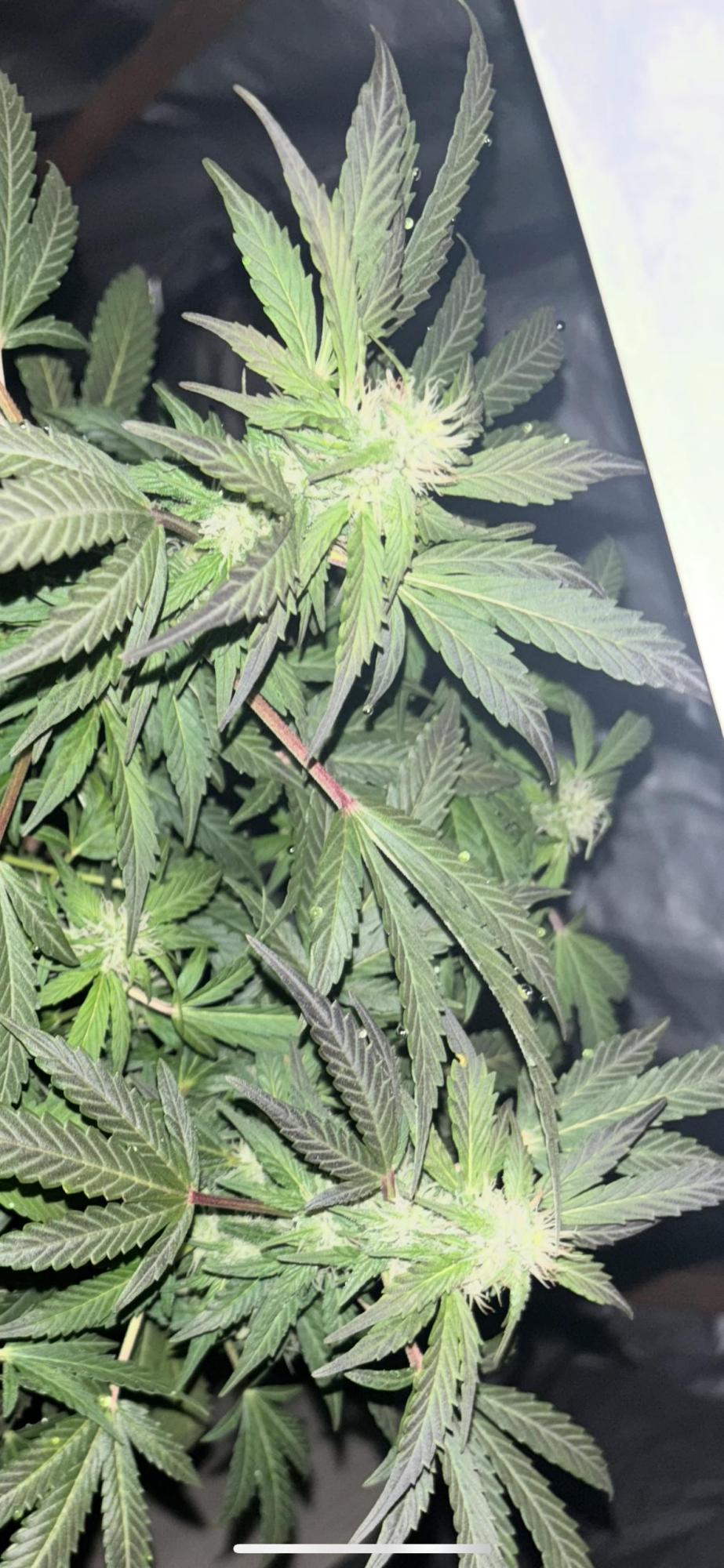
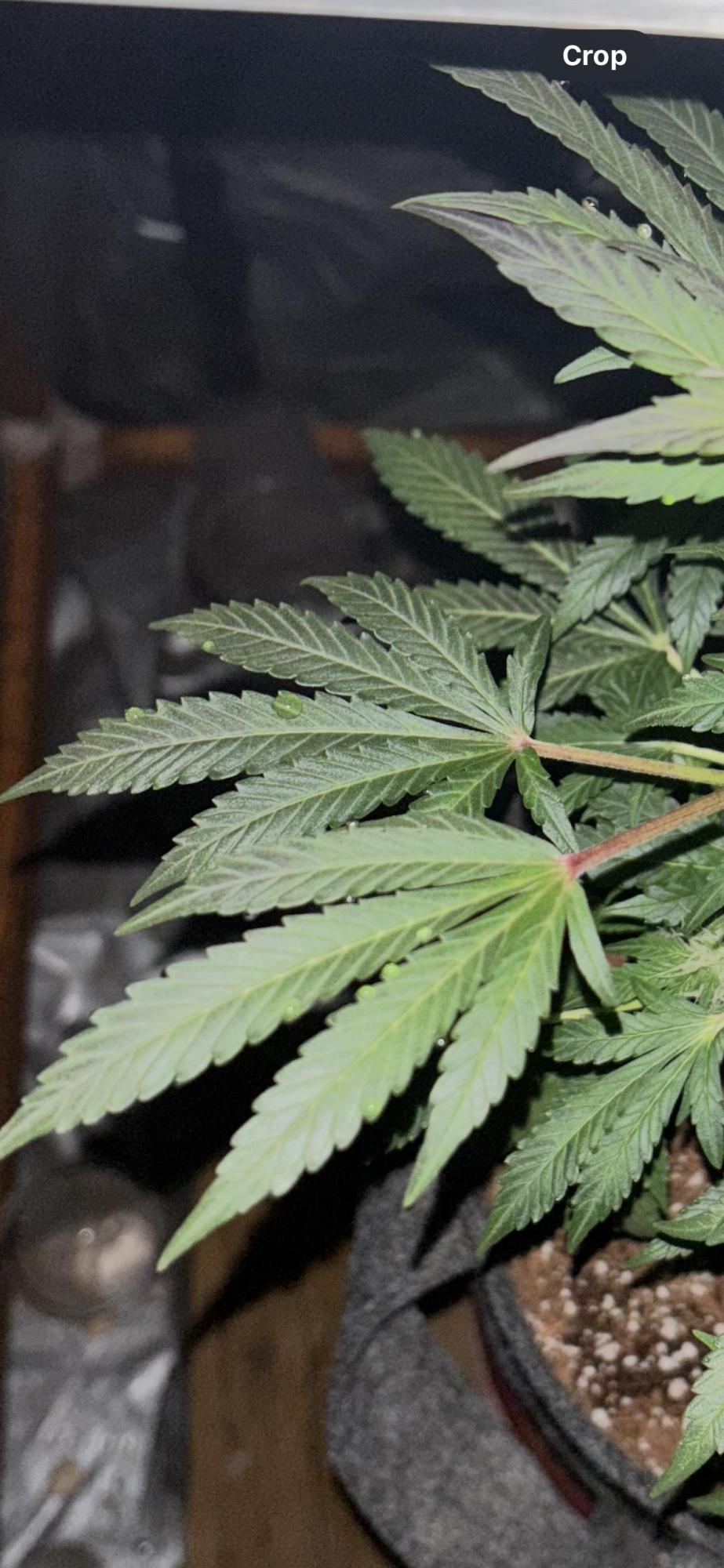
Droplets at night on leave’s edges

RisingDuststarted grow question 10mo ago
Im at the ending of maybe 5or 6 weeks on og kush from dinafem
Yesterday i watered 3.8L water
Ec 1900,Ph 6.8 little runoff
Temps around day is 18c,
can’t manage the temps i dont have equipments
But my question is today i saw droplets all over leaves edges
Its turing purple that
Solved
likes

Ultravioletanswered grow question 10mo ago
Guttation occurs due to positive root pressure, which is most common when the soil moisture is too high and the air is too humid, preventing normal transpiration. (Over night)
Plant roots continuously absorb water from the soil, even when the stomata (tiny pores on leaves used for gas exchange and transpiration) are closed during the night. This continuous water absorption creates pressure that forces water up the plant's vascular system. When the water reaches the leaf tips and edges, it is pushed out through specialized structures called hydathodes, which are essentially modified pores that cannot close like stomata. Unlike the pure water of dew, guttation fluid is a dilute solution containing various organic and inorganic compounds, such as sugars, mineral salts, and enzymes. While generally harmless, a build-up of these deposits (appearing as a white crust after the water evaporates) can occasionally encourage the growth of bacteria or fungi, or in extreme cases cause "tip burn" on sensitive plants.

Selkotanswered grow question 9mo ago
hey 👋
purple coloration isn’t ideal and natural for an OG, ur plant is simply cold ; but it will only slightly impact your harvest.
However, u absolutely need to get air circulating in your tent if you cant heat or dehumidify it; otherwise, expect to see fungi appear one morning… 😉
1 like
Complain
The_Wandereranswered grow question 10mo ago
The plant is going to keep transpiring, the humidity is going to remain a problem if you continue. Air exchange is in direct contradiction with heating, and as the root zone gets a few degrees colder, it will have uptake problems and eventually just shut down. Humidity not just condensing into droplets on the plant, but also the walls, and inside the unsealed build quality of the lamp... which is not waterproof. Eventually that moisture is going to cause corrosion on the internal components leading to a lamp failure, (What was that pop?) possibly a short circuit which could be a fire hazard. So its better just to stop now before you or someone else gets hurt, or property is damaged.
likes
Complain
The_Wandereranswered grow question 10mo ago
Running a circulation fan will distribute the humidity evenly through the tent, so not really a help with that problem. Part of the "problem", like you said, is you don't have the equipment to accomplish the grow. The rational way of doing it is to first get the necessary equipment, the necessary knowledge, then start gardening. You are playing the wrong end of the trumpet. The humidity problem is due to temperature, and temperature differences between day (lights on) and night (lights off). As the temperature changes its ability to hold water/moisture changes. Plant biology 101 tells you that plants have a temperature range that works well for them at each life stage. The further away from optimal temperatures, the worse off the plant is until it dies. The problem isn't really with the plant, the equipment, but with execution. To fix that you have to educate yourself on gardening and plant biology. Then you can start. Hope this helps. Good luck.
likes
Complain

Green_Clawsanswered grow question 10mo ago
Run a circulating fan when lights are off if you have no extractor.
likes
Complain