


DocWeedstarted grow question 7mo ago
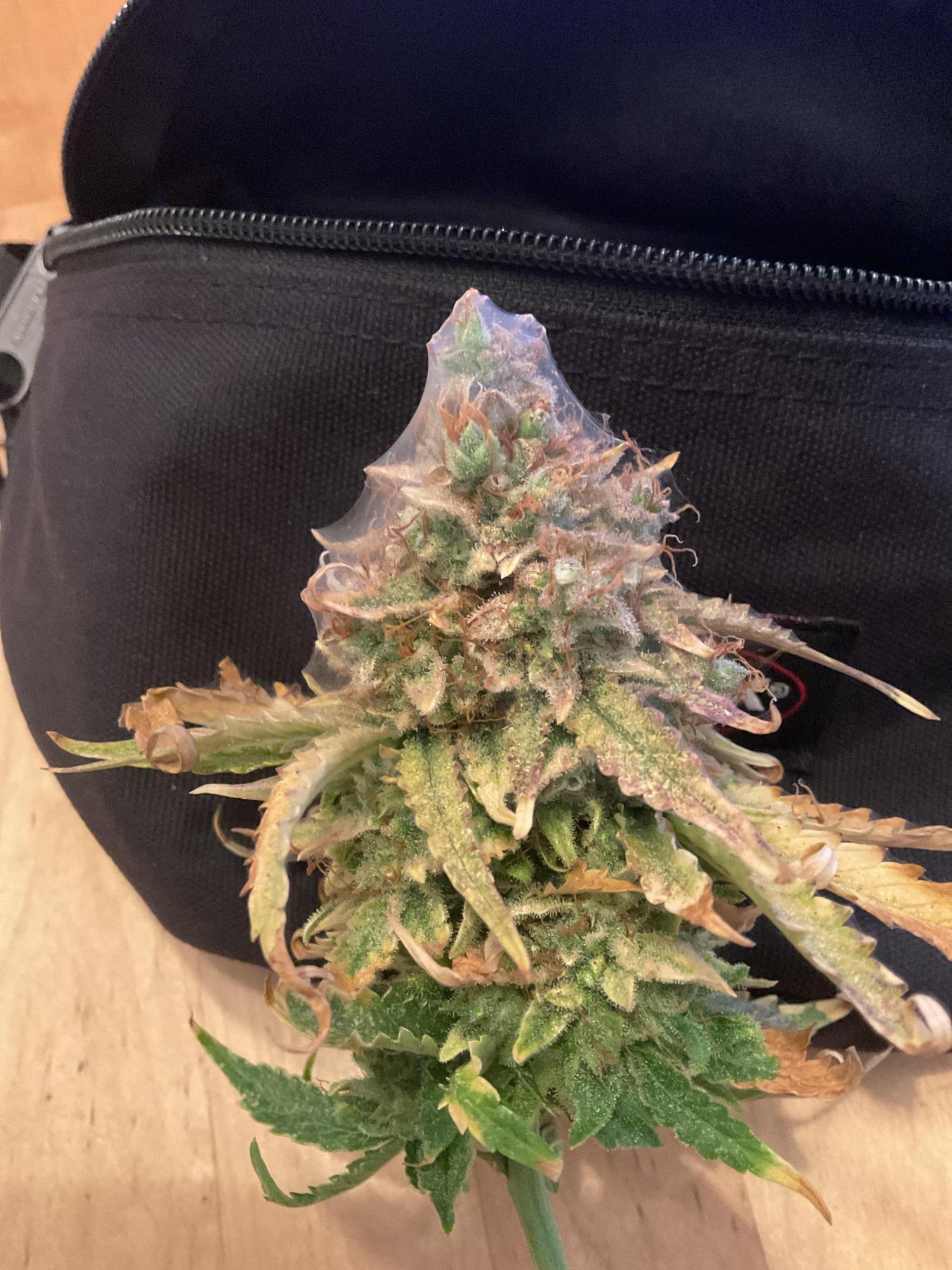
I have a really fine net around my top buds. What is that and what can I do about it?
Solved
likes

Green_Clawsanswered grow question 7mo ago
Hi there.
🕷️ The Culprit: Spider Mites
That fine, silky webbing around your top buds is a classic sign of Two-Spotted Spider Mites. These tiny arachnids love the heat and low humidity often found near the top of the canopy (closest to your lights). They pierce the plant cells to suck out the chlorophyll, which can stunt growth and ruin the quality of your flower.
🛠️ The Immediate Fix
Since you are already in the budding phase, you have to be delicate. You don't want to spray heavy oils or chemicals that will stick to your resins.
Physical Removal: Use a small vacuum or a damp cloth to gently remove the visible webbing.
Lower the Temp: Mites thrive in heat. Dropping your temps a few degrees and increasing airflow can slow their reproductive cycle significantly.
Organic Sprays: If you are early in flower, a diluted solution of citric acid or Dr. Bronner’s Peppermint Soap can help, but avoid spraying the actual hairs (pistils) if possible.
🛡️ How to Avoid Future Invasions
Quarantine: Never bring clones or outside plants directly into your main space.
Environment: Keep your humidity around 50-60% during veg to discourage mite settlements.
Cleanliness: Always change your clothes if you’ve been hiking or visiting another garden before stepping into your own.
The Power of Microbes & Bio-Control
If you want to handle this like a pro, look toward the microscopic world. Instead of "killing" everything, we want to balance the ecosystem.
Entomopathogenic Fungi: Look for products containing Beauveria bassiana. This is a beneficial fungus (a microbe) that specifically targets and consumes soft-bodied pests like mites without harming your plant or you.
Predatory Mites: This is the gold standard. Introducing Phytoseiulus persimilis—predatory mites that eat spider mites—is a "set it and forget it" solution. They’ll hunt through those buds better than any spray ever could.
Root Health: Maintaining a strong colony of Mycorrhizae and Bacillus subtilis in your soil ensures the plant’s systemic resistance is high, making the sap less "tasty" and the plant more resilient to the stress of an infestation.
Keep that passion growing! You’ve caught this in time to save the harvest, so don't sweat it too much—just act fast.
Sending you nothing but big yields and sticky resin! ✌️💚 😎

RasendeRollo92answered grow question 7mo ago
Ouch. Spider mites... unfortunately, there's nothing you can do, your stuff is gone.
I'm sorry to see that, hang in there. It looked good.
likes
Complain

JUNGLE_B4RNSanswered grow question 7mo ago
It is Spider mites webbing… from Spider mites…
THE ONLY THING IS TO THROW AWAY EVERYTHING !
I feel very sorry for you, but at this point your plant is infested with hundreds of thousands spider mites and all their eggs…
Throw away everything, clean everything in the growing area and put it in a dark cold and humid quarantine ( 40 days of darkness with very high RH )
likes
Complain

Ultravioletanswered grow question 7mo ago
Spider mites, I hate the little blighters. With that much webbing they must be easily visible.
I love the smell of napalm in the morning. If that's not a option and harvest is ready then you could do a bud washing as it is highly effective at removing mites, insect eggs, webbing, and dust from cannabis flowers after harvest. Really depends on the stage of growth, mites in veg, np, mites 2 weeks from harvest, np. Mites 1st week of flower is a bitch to deal with without drastic yield loses.
likes
Complain

AsNoriuanswered grow question 7mo ago
Spider mites.
Too progressed, i would chop, choose dry trim .
Clean all room, all equipment with soap and later with alcohol , two stage cleaning.
Webs will be easy to take off while trimming.
Btw you have seeds, either went hermie, or was polinated from outside.
1 like
Complain