


Barney's farm White Widow XXL yellow leaves

spaceweedgrowerstarted grow question 6mo ago
Hi
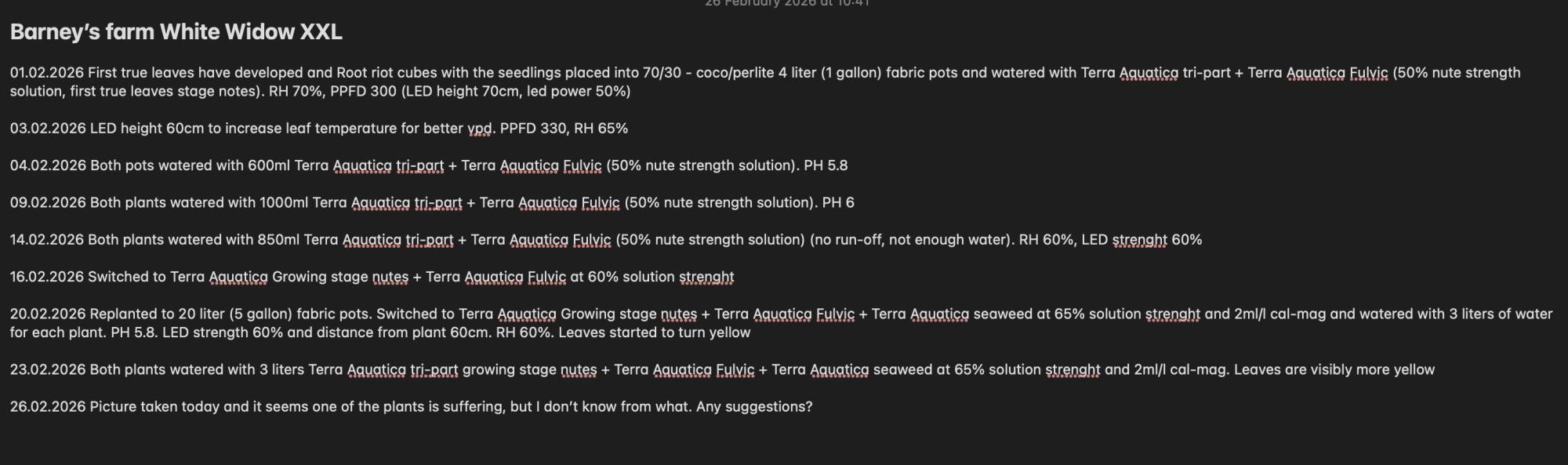
Ive attached my grow notes below. Any suggestions on what could be wrong?
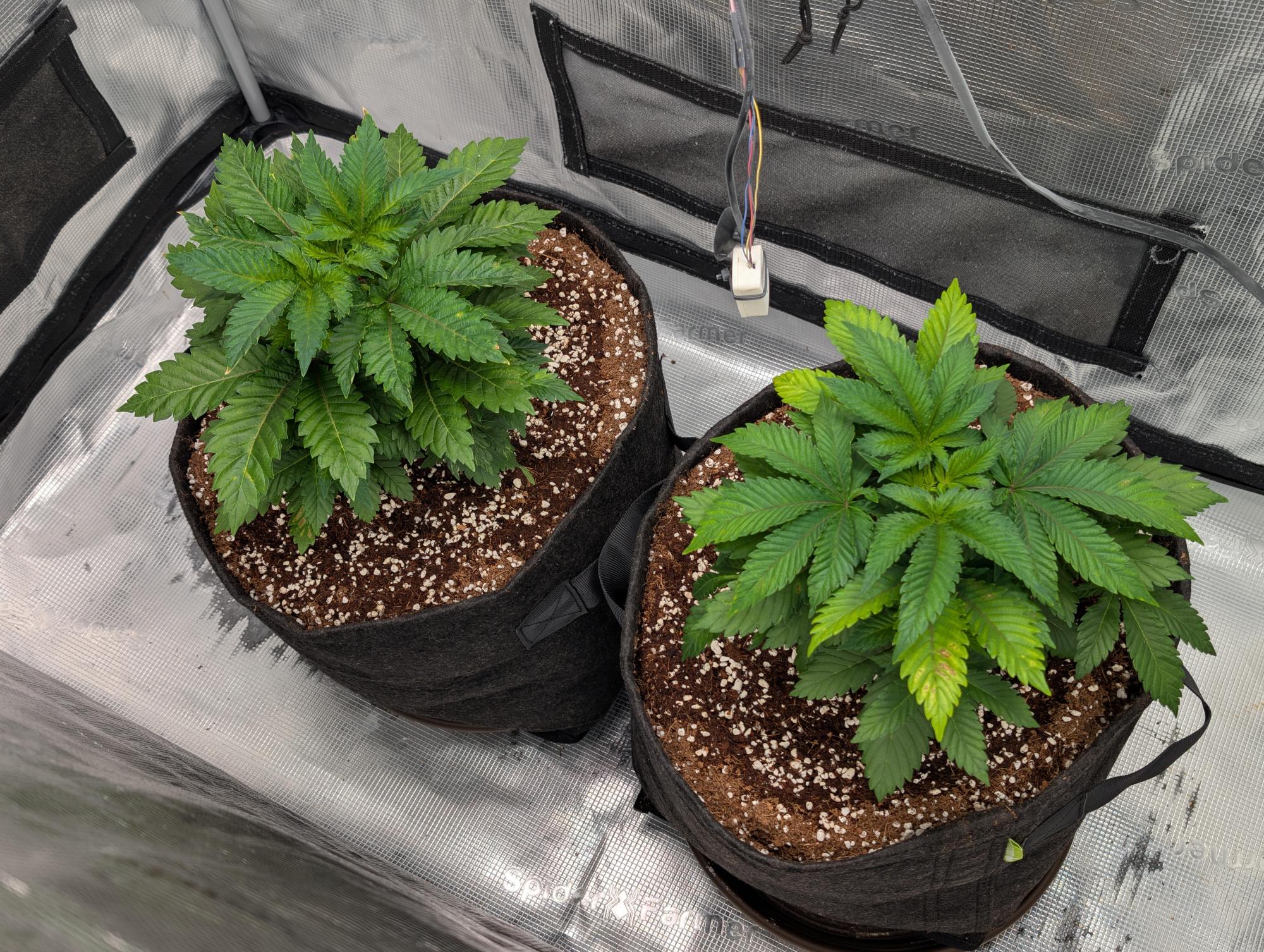
Both plants are watered the same, but the left one seems to do better, but it also has developed brown spots on the leaves.
Had the same problem on my last Do-si-dos autoflower grow as well...
Thanks :)
Open
likes
Answer


wolfvbanswered grow question 6mo ago
Salam @spaceweedgrower Habibi! 👋 Welcome to the diagnostic clinic! That White Widow XXL has some serious potential, but we need to make a quick adjustment to her engine. 🏎️💨
Looking at your detailed log and the photos through the lens of Modern Engineering, you have a classic case of mistaken identity: You are treating Hydroponics like Soil! 🛠️
Here is the mechanical breakdown of what is happening under the canopy:
1. The "Dry-Back" Trap (Watering Frequency): 🏜️
Your log shows you are watering your 70/30 Coco/Perlite mix every 3 to 5 days (Feb 4, 9, 14, 20, 23). In traditional soil, this is perfect. But Coco is a sterile hydroponic medium. When you let Coco dry out for several days, the water evaporates but the nutrient salts are left behind. The salt concentration (EC) inside the pot multiplies and skyrockets!
2. The Osmotic Lockout: 🛑
Because the salt pressure in the pot is now dangerously high, the roots are physically blocked from drinking water or absorbing nutrients. Even though you are feeding her a heavy 2ml/L of Cal-Mag, she cannot drink it! This is why your right plant is showing classic Magnesium Lockout (the pale yellowing spreading between the dark green leaf veins) and Calcium Lockout (the tiny brown rust spots starting to form).
3. The Transplant Factor:
On Feb 20, you moved them from 4L pots into massive 20L (5-gallon) pots. When you water a small rootball in a giant pot of Coco with only 3 Liters every 3 days, you create severe dry pockets of highly concentrated salts around the edges where the roots are trying to expand.
Your Engineering Rescue Protocol: 🚑
The Flush & Reset: Next time you water, mix up your nutrients at a slightly lower strength (about 50%), pH it to 5.8–6.0, and slowly pour it through the pots until you get at least 20% runoff out of the bottom. You must wash out the toxic salt buildup that has accumulated in the coco over the last few weeks. 🌊
Change Your Frequency: You must stop letting the coco dry out for 3+ days! Once the plants recover from the flush and start drinking normally again, you need to transition to watering them daily (or at least every other day). Always water until you see 10-15% runoff. This constantly flushes the old salts out and pulls fresh oxygen directly to the roots.
Wash away the heavy salts, increase your watering frequency, and watch that vibrant green color return! 🚀
Happy Growing! 💚
2 likes
Complain

Green_Clawsanswered grow question 6mo ago
The 1 on the left is calcium hungry and the right plant is nitrogen hungry, Treating plants the same will not give you same plants when there needs are different.. Good luck ✌️💚
likes
Complain

JUNGLE_B4RNSanswered grow question 6mo ago
Your pushing your plants higher than their photosynthetic capacity…
Starting at 300 PPFD when the recommended range is between 100-300 for seedlings you started at max.
Adding nutrients isn’t fixing the problem because this is called photoinhibition , light energy is exceeding the photosynthetic capacity of the plant. For this size of plant with this amount of foliage you should be somewhere between 150-200 PPFD max.
Back up your light for 2 weeks… and look at the new growth.
1 like
Complain

Organomananswered grow question 6mo ago
Calcium issues..........lack of.
LED lights and coco have unique effects on calcium requirements.
1 like
Complain

00110001001001111Oanswered grow question 6mo ago
improper watering habits and an imbalanced nutrition -- whether from medium or fertilization.. it all has to add up.
Leaf symptoms on their own or most often not enough to properly diagnose. e.g. many things can cause tip burn both deficiency and toxicity.
Using 70/30 coco+perlite like your last question? So it is a soilless context which makes this a lot easier to quantify in an accurate way.
Fixing your watering habits is paramount. It may solve what you see...
1) fully saturate along with a minimum 10% runoff
2) wait for top to change color and repeat (for coco only)
10% runoff is incredibly important. It maintains a consisntent level of nutrients around roots based on your formula and eliminates problem of buildup over time in the medium when done religiously.
Exactly when you trigger the next irrigation has some leeway, unlike step 1. If you re-irrigate at same loss of weight, it'll require a similar volume of water each time. You can irrigte more frequently but if you do it without enough drunk by the plant, you will rot the roots. Stick to a good wet-dry cycle early to promote proper root growth and if you want to ramp up a bit in flower, that's fine. Make sure it's losing at least 1/3rd of its weight, give or take to warrant an irrigation.
Incomplete watering will train superficial roots as well as long-term risk of various root zone problems. Not getting runoff will cause a buildup of nutrients in the medium over time. Both are bad.
When done right, any symptom you see is amatter of amending your formula. you provide 100%of nutrition through fertilization. This is an advantage and makes diagnosing straight-forward. Re-assess how you fertilized up to the point of the problem, make some common sense adjustments for next grow, and avoid the problem in future.
In this case, i'd fix the watering habits before tweaking formula, as it could be a contrubuting factor. If anything takes a quick nosedive, that is reason to also tweak the formula at the same time. Better to do one thing at a time to recognize what effect it has than doing multiple things at once and having no idea what worked, if possible.
Symptoms
Mid-level interveinal chlorosis with soem necrotic spots
and seperately,
Some tip burn
These are not discrete symptoms with 1 cause, so it's not 100% clear given the info provided.
compare PPM of this formula.. if anything is drastically different, good chance it is related. Small differences are irrelevant. Local variables impact exactly how much oyu need to provide to keep the plant well-supplied given its growth rate, as well as other ratios that can work well but need more or less of something to overcome lockout etc...
Mature vege PPMs:
N 120-130
P 40-60
K 180-200
Ca 100+
Mg 75-80
S 100 ish
By flower, you want to drop that N to ~80ppm.. lushness of plant is the guide on that, but it will coincide with end of vege growth (aka stem elongation and leaf growth). How you feed earlyimpacts needs later. Fertilization is a culmination of everything you do since day 1. This is why you'll say many different ways that can work well. It can stock up on various elements early or you may need to provide more later on etc... but as long as it maintains a supply that can match growth, it'll be healthy.
There are website and apps that can calculat ppm from percent of mass off your gauranteed analysis labels. Google can help there. I have a spreadsheet that definitely works for dry nutes but not sure if i implemented specific gravity properly for liquid nutes... google drive link is availabing in "G" week of recent feminized seed breeding diary. Will need kg/L specs of your liquid nute bottles.
EC convereted to PPM is garbage. It'snot a number you can trust and it doesn't tell you individual concentrations, just an overall concentration which does not help with diagnosis.
If you track this tuff, you'll quickly learn what trends toward a deficiency or toxicity over time and easily avoid it. I barely think about fertilization and expect healthy plants deep into flower even if pulling off of 1 reservoir for numerous strains. The idea that they all need something different is a product of esoteric formulas that lack consistent results. Some variation is possible but it should be minimal when you have it dialed in properly.
Be systematic. Make slow adjustments over time until everything runs smoothly seed to harvest 95-99% of the time. You shouldn't have to tweak formula every week... a simple change at flower or possibly a transition is likely necessar,y but otherwise can provide a consistent level without playing mad scientist. that's just a masturbatorial behaviour... to make things overly complicated in order to feel sophisticated.
2 likes
Complain