



Pattyirish84started grow question 5mo ago
Hi All
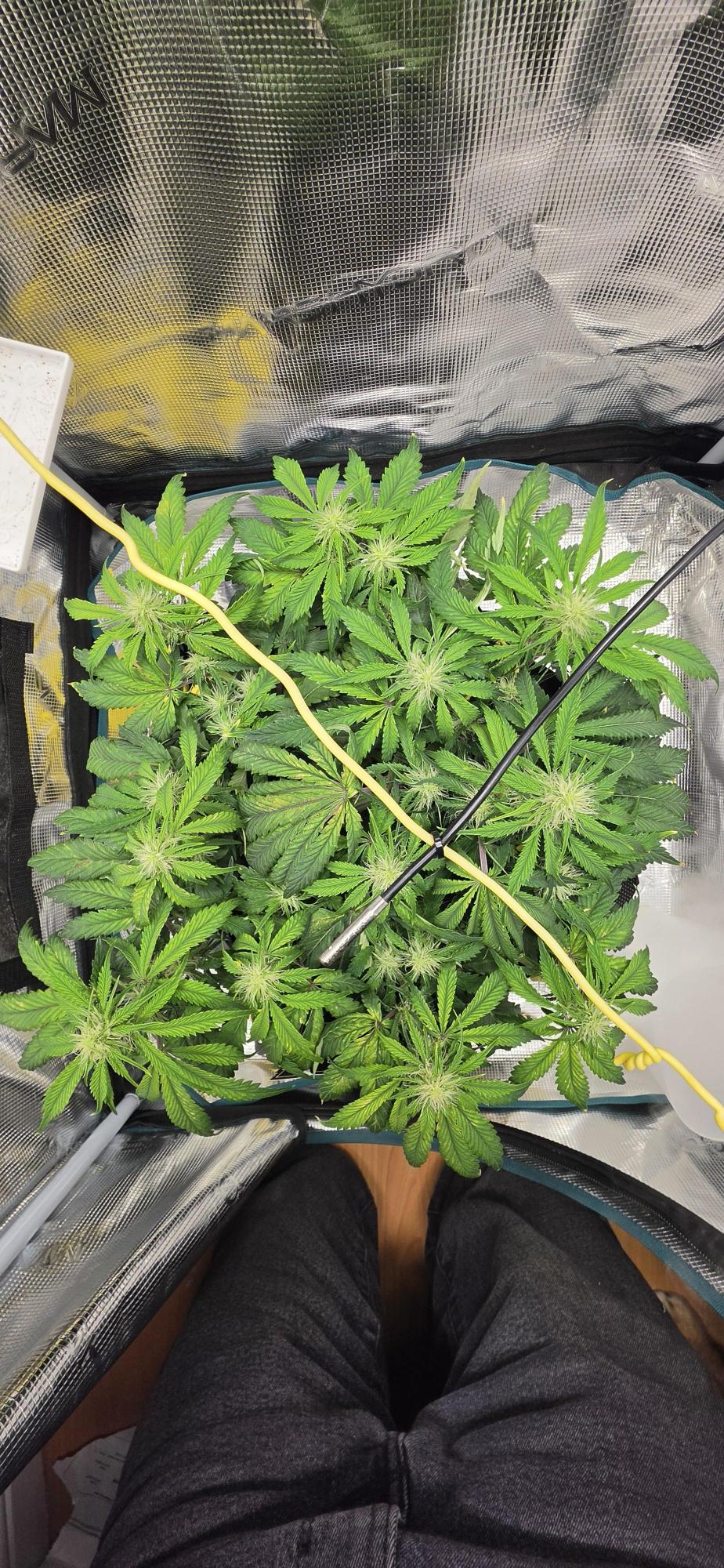
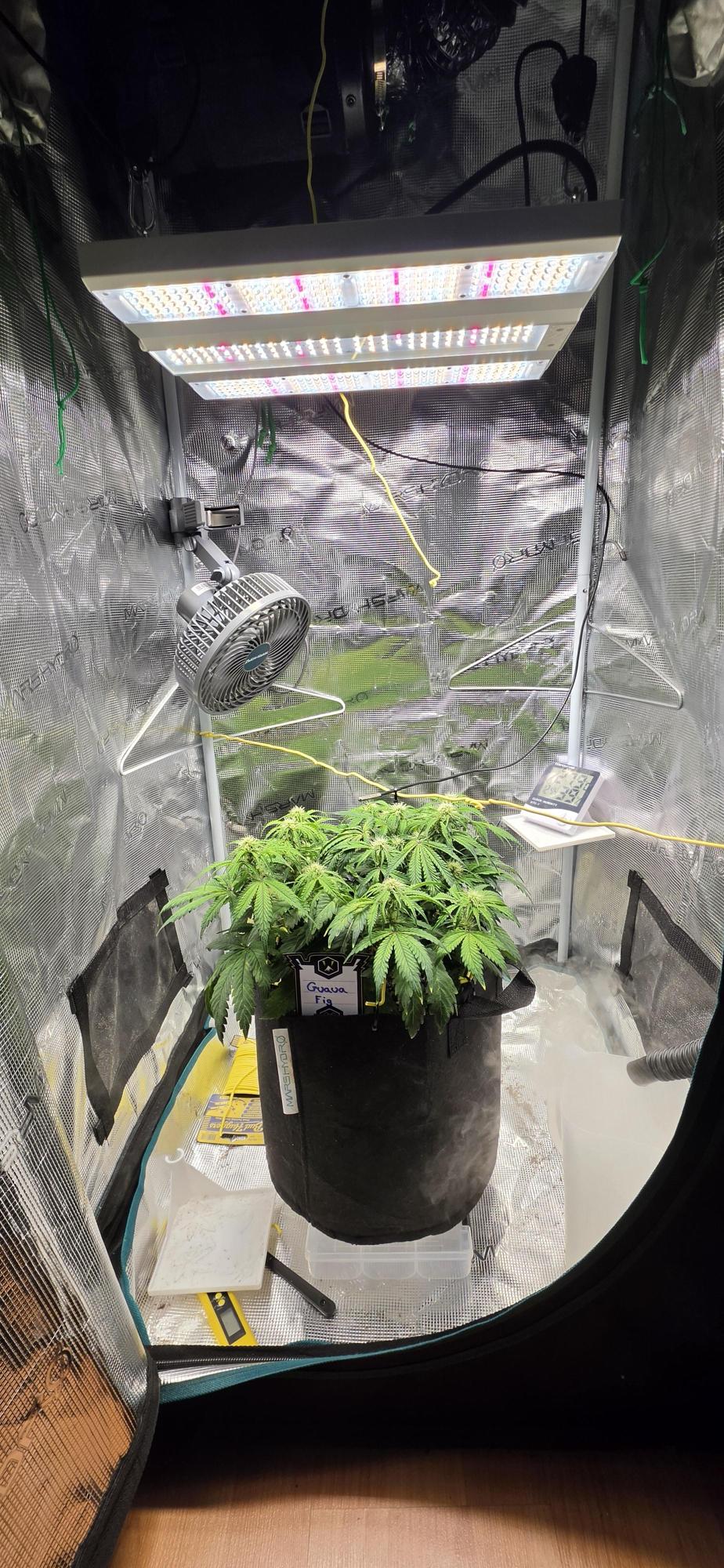
This is my Guava Fig at Day 36 from Sprout. I had some early Nitrogen and Calcium issues but caught it early.
First time growing Mephisto and first time attempting LST.
Any advice or tips are welcome.
Solved
2 likes
00110001001001111Oanswered grow question 5mo ago
The light is or was possibly too close. Easier to assess that in vege based on node spacing. See some potential damage at the top. could be related to the droopiness seen, too. Pics are too far away to properly assess the leaf symptoms.
Canopy is a bit over-crowded, but nothing serious. Can also exacerbate what's causing the droop with lower transpiration rates.. plant can't "breathe" as well as it should..
Not much you can do about that. MAybe, remove a leaf or two, but removing leaves is something to avoid as much as possible. if some physical overlap is causing condensation on leaf surfaces, that'd be a good reason to remove one.
irrigation practices could be the cause of the droopiness, too, so the basics:
1) fully saturate (with 10% runoff minimum, if this is a soiless medium)
2) wait for appropriate dryback (or loss of weight) before repeating.
if not adhering to those basics, it could definitely be related to any and all problems seen in these pictures. You can get away with esoteric watering practices in the short-term, but over the long-haul it greatly increases risks of problems. "it worked for 3 weeks" is not an excuse to keep doing something wrong. Not all effects occur immediately after the cause.. sometimes there's a long delay or lag time before a problem is visible due to that behaviour..
----
whether using lst or topping, should have a plan based on a target canopy, and get there the most efficient way without wasted growth and excess pruning etc... 2-3 colas per sq foot is all you need to maximize yield. With an autoflower, that's difficult becasue you don't really know exactly how long you have to train before vege growth ends. So, it's just a guess as far as how longn to train. I'd argue you trained a bit too long with this plant as there's very little depth to the canopy and vege growth looks about tapped out or nearly tapped out.
You want a bit more depth than what you have with a bit less over-crowding. i.e. Distribute / allow a bit more growth vertically. 16-20" deep is a good target.. realtive to growth patterns of various genetics...the lanky plants obviously can go a bit deeper and their structure allows more light penetration that allows for better nugs deeper into canopy. As long as either side of growth pattern spectrum isn't too extreme, doesn't make too much of a difference in outcome.
More colas does not increase yield. The light absorbed dictates potential to build plant mass. So, canopy size is more correlated with yield than number of colas. Training is just a matter of impacting distribution of that mass.

John_Krameranswered grow question 5mo ago
ckecked ur diary... 😂😂😂
u rly don't know what u see
first u were underwatering and underfeeding bs if u use 24h cycle u'd feed half more then usual
then i thought it's Ca deficiency so u uped Ca fert which led to lockout and severe starvation
these Santa's helpers will ruin ur grow... be carfull whose u listen 😤
likes
Complain
John_Krameranswered grow question 5mo ago
BS detected xD
there is no wrong with 24h it's actually must have for autos
the problem is Salts, to much and u're Fucked, like on ur photo, too little also Fucked
These guys clearly can't see shit, bs it's all shown on the leaves
👇👇👇😂😂😂
likes
Complain
00110001001001111Oanswered grow question 5mo ago
i said the light was 'too close' but probably better worded as too much light -- could be related to the 24/0 schedule someone else mentions.
24/0 can only be justified with a severely underpowered light realtive to area of coverage. If you need the extra 6 hours of light compared to 18h becasue you need 133% more photons for a proper DLI, that might be worth it... If the light is properly sized and following their recommendations for 18/6, then you are likely giving too much light running it 24hours.
"dark" processes in the plant do happen in the light, but it's still best to have some dark cycle. A severely under-powered light might justify 24/0, but the better option is to just use the light properly to cover a smaller space, if that is the case.
based on output at diode, you only need 35-40 DLI to maximize ambient co2. Divide the umol/s PAR output (ppf or ppe, NOT PPFD) by area in meters-squared to calculat max PPFD possible. Reference a dli table with that value and hours the light is on. If the DLI is 40 or higher, the issues at the top of the canopy are increasingly more likely to be light-related.
likes
Complain

Organomananswered grow question 5mo ago
Never grow at 24/0...............all cannabis plants NEED "sleep"!
Certain metabolic processes can only occur during the dark period...........without a dark period, your plant will have a messed up metabolism.
A plant with a messed up metabolism will never reach its peak potential or have prime health.
18/6 is the most sensible schedule.
The myth that it is ok to grow at 24/0 and without "sleep" needs to be removed from urban folklore!
likes
Complain

Growingdaddyoanswered grow question 5mo ago
Greetings,
I don't have any experience with the breeder Mephisto myself, but your first LST looks really nice, a beautiful canopy. To showcase the flower sites better, you might want to defoliate a bit.
But overall, I really like your approach! It reminds me a lot of my own method, as it looks very similar visually.
This is going to be great, keep it up and enjoy your lovely lady..
All the best and continue to have fun with the best hobby in the world✌️😉
likes
Complain

Philhsyanswered grow question 5mo ago
Plant looks healthy and on track for early flower
Nice structure, good bud sites, no major damage.
-But there are a few signals:
The top growth is noticeably lighter than the lowers.
This usually means:
Mild nitrogen deficiency OR
Early Cal/Mag imbalance
Maybe slight overwatering?
likes
Complain
John_Krameranswered grow question 5mo ago
the plant looks bad, most of the leaves are damaged
what's ur feeding schedule? and what's ppm ?
likes
Complain

cangrowzanswered grow question 5mo ago
Yo Patty, looking solid for Day 36!
Honestly, for your first time running Mephisto and messing with LST, you’ve nailed the canopy. It’s nice and flat—exactly what you want to make sure those lower sites actually get some light.
Don't sweat those early Nitrogen and Cal issues too much. Most people miss them entirely, so the fact that you caught them early is huge. Just keep an eye on the new growth as she stretches into flower. If the top looks healthy, you're golden.
She's looking like she's gonna be a beast. Keep doing what you're doing!
Happy Growing, Growmie! 🌱?💚
likes
Complain
squalinoanswered grow question 5mo ago
hello my friend .Quick tips for your current growth stage:
LST Management: At Day 36, your plant is likely entering the "stretch" phase (pre-flower stretch). Keep maintaining the canopy as flat as possible to ensure light penetrates down to the lower bud sites.
Nutrition: Since you’ve had Nitrogen and Calcium issues, keep a close eye on your water pH. Often, Calcium deficiencies aren't caused by a lack of nutrients, but by a pH that is too low, which "locks out" and blocks its absorption.
have nice day
Regarding the LST (Low Stress Training), I invite you to come check out my Oasis Permanent White Marker or my Cola Cherry to see the results
likes
Complain

TruTraTrianswered grow question 5mo ago
Not too many Infos. Okay for me. Just the Ventilation makes frw sense (for my setup) i dont want to blow hot air from the ligjt towards the plant. Also i wouldnt blow directly on the plant . If you took the picture After sunrise its fine, otherwise droopy leaves... pH/watering/root issue ..or high rh and too ffew transpiration... many possibilites without Info.. so.... its more or less fine?😅
likes
Complain