


Likes
Comments
Share


@GrowerGaz
Follow
Just water till the end now , last feed was just water and Hesi boost .


Processing
Likes
22
Share


@BladeCutter
Follow
~~~~~~~~~~~~~~~~~~~~~~~~~~~~~~~~~~~~~~~~~~~~~~~~~~~~~~~~~~~
==> Comments From Other "Living Soil/Super Soil" Growers Are Always Welcome <==
~~~~~~~~~~~~~~~~~~~~~~~~~~~~~~~~~~~~~~~~~~~~~~~~~~~~~~~~~~~
INTRODUCTION
I am very excited about this grow as it is the first time with a new setup. I have added a new light and am going to try a super soil grow for the first time. I have a Mephisto Genetics Double Grape between paper towels and waiting to sprout. The space is about 18 inches by 24 inches. The ceiling slopes down, so I don't have much room at the rear of the space. For medium I am using Fox Farms Happy Frog augmented with perlite. The bottom third contains 0.5 pounds autoflower blend of a "super soil" additive from Nature's Living Soil. (https://amzn.to/2PUHc6k) I am using three-gallon cloth pots. The light is a Horticulture Lighting Group 135W QB V2 R-Spec LED kit.
NUTRIENTS
Tap water pH’d to 6.5. pH lowered using 1.5 TBS unsulfured blackstrap molasses and apple cider vinegar. One-half TBS of vinegar lowered pH about 0.5 points.
The medium was very dry. Slowly watered to allow the moisture to be equal throughout the soil
ISSUES
My while I have yet to put the seed in the dirt, I am concerned about temperatures. They are currently running at about 86F. I would like to get it down to about 80F.
DAILY LOG
DAY -2: STARTED SEED
* Started seed in my traditional manner. Between paper towels soaked in 5% bleach solution, 0.25 tsp/0.5 Cup water. Temp 82F.
DAY -1: ACTION
*The smallest of tip has appeared. Will put in soil in a few hours.
Day 0: SEED PLANTED.
* Refrigerator filtered water. pH 6.5. 1 cup (250ml) added very carefully.
* Covered with humidity dome.
* Light from Soil: 32.5”
* Temperature: 82F
DAY 1: SPROUT
The sprouted seed has shown itself above the soil. A nice Christmas morning surprise. Now I can start counting the days.
* Watered with about 200ml of water at pH 6.5. Used apple cider vinegar to lower the tap water pH.
* I was pleased to find that my tap water does not contain chloramine. I was reading bad things about chloramine and "living soil." It can kill beneficial microorganisms. All I did was ask my water company and they replied saying "we found no mention of chloramine use in the system:" Just what I wanted to hear.
* After looking at other diaries using 250W LEDs, I moved my light down to 25 inches.
DAY 2: NO WATER FOR YOU
* No watering today. There is plenty of water in the soil and I want the roots to stretch and work.
* Working on increasing the humidity and getting more control over the temperature.
DAY 3: WATER PLANT, NOT POT. ADDED MYCORRHIZAE.
* Following the GrowWeedEasy watering suggestions for Kind Soil
* 500ml water at 6.5 pH, around the plant and not across the full 3-gallon bag.
* The fan gently moves the seedling to keep it strong.
* Had minor unexpected run-off. I hope to avoid that in the future.
* Added 1/8 tsp Great White Mycorrhizae dissolved in 100 ml of 50 ml water/50 ml molasses mix. Did not pH as it is such a small amount of solution compares to the watering earlier today.
DAY 4: NO WATER, NO PICTURE
* Nothing really new. So no reason for a picture.
* The soil is dry on top, but the bottom of the pot is still damp. So I will watch it, but I don't expect to water today.
* Adding a small intake fan has dropped the temps to about 82F, I think they can live with that.
* A humidifier arrives tomorrow and I think that will be my last step to improve the environment.
DAY 5: 500ml WATER, LOOKING GOOD
* The plant is looking good. The second set of true leaves has a bend, but nothing to worry about.
DAY 6: 500ml WATER. NEW HUMIDIFIER
* It wasn't really necessary to water today, but I did simply to stay on the schedule I am using.
* Given the lightness of the soil and the moving air, I don't anticipate any problems.
* Added a humidifier yesterday evening. It's bringing the humidity up, but I need to keep the space closed and I'm a bit concerned about having to provide it with distilled water frequently.
~~~~~~~~~~~~~~~
WEEK ONE IN REVIEW
~~~~~~~~~~~~~~~
* Watered with 750 ml pH's tap water. Watered slowly to avoid any runoff.
* The plant is looking very healthy. It looks as if the roots are really starting to work as the plant is darker green.
* Balancing temperature and humidity is tricky, but I think I will be able to get it stabilized with a bit more work.
* Target Relative Humidity: Seedlings - 65-70; Vegging - 40-70; Flowering - 40-50
==> Beginning Next Week I Will Only Post Twice A Week, Mid-week And End Of The Week. <==

Likes
6
Share


@Spearfish
Follow
Day 63 I cut out the bottom of my tent to raise it to the top of the rdwc buckets giving me another 15" of space. It was getting tight and i don't want to keep dimming my light. Had to remove my screen, I'll build in another one if the buds get too heavy.
Starting week four in flower for the two on the left (few days seperation) starting week 2ish for the girl on far right.

Likes
26
Share


@Nistnov
Follow
I finally had some time to harvest everything, left her for 2 days in the dark in a vase.
The smell was so intense in comparison to the painkiller. Since it rained a lot there was some bud rot but I guess that was inevitable.
The honey cream still grows strong has no bud rot since the buds seem fluffy enough for a good airflow.

Likes
10
Share

@Ruthlez
Follow
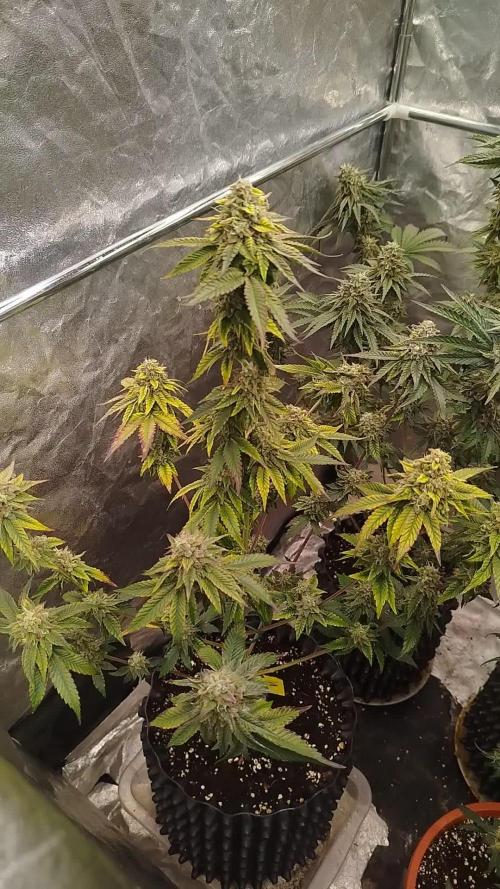
🌱 Blütewoche 7 – Endspurt
Wir sind Anfang Blütewoche 7 und langsam geht es in die heiße Phase. In ungefähr einer Woche steht die Ernte an.
Die Biscotti zeigt seit einigen Tagen sehr deutlich, dass sie sich dem Ende nähert. Die Pflanze entwickelt zunehmend ihre typischen Herbstfarben und wirkt insgesamt schon ziemlich weit. Die Z42 und die beiden Papayton hängen momentan ungefähr eine Woche hinter der Biscotti und brauchen entsprechend noch etwas länger.
Die Buds werden mittlerweile ordentlich schwer. Ich musste heute deshalb nochmal einige Äste abstützen, damit die Pflanzen unter dem Gewicht der Blüten nicht umknicken oder beschädigt werden.
Heute starte ich außerdem mit dem Spülen, damit die Pflanzen sich auf die letzten Tage bis zur Ernte vorbereiten können.
Bei der Kontrolle der Trichome sind aktuell bei allen Pflanzen überwiegend milchige Trichome zu sehen. Bei der Biscotti sind bereits etwa 2–3 % bernsteinfarbene Trichome vorhanden – ein weiteres Zeichen dafür, dass sie deutlich weiter ist als die anderen drei Pflanzen.
Jetzt heißt es also: die letzten Tage aufmerksam beobachten, die Trichome im Auge behalten und den Endspurt genießen. 🌿🍂


Likes
3
Share

@Livetimegrower93
Follow
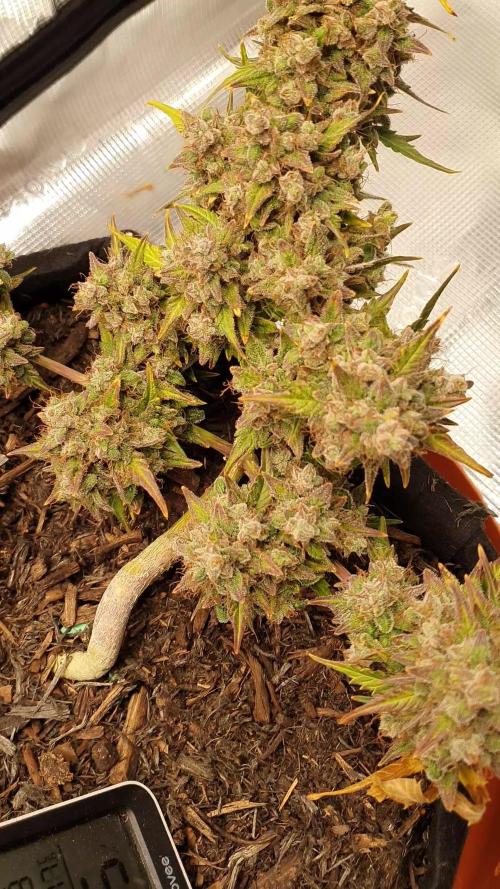
Stay turned as I'm looking to do alot in the comeing months. and hopefully collab witha fellow grower but that's between us and the rest of the Internet lol thank yo to everyone that ha commented an given advice. This is why this app is the nuts. Because it gives us a place to talk to one another and we are all of te same mind set chill and grow some bangin grade an learn along the way
Processing
Likes
3
Share


@Grownewgenetics
Follow
These amazing genetics are after 12 hours on the ground, comming out these strain's cream caramel auto is the second faster after the dark devil auto.

Likes
8
Share


@SupaDank
Follow
It’s been awhile since my last update but all was missed was 3-4 weeks of veg. She is on day 7 of flower as of this moment. There’s 2 Royal Gorilla’s with each having 6 main stems and one being LST. LST is the shortest one and hoping she will stretch a lot more to catch up to the one not being LST. Also have 2 White Widows at the same age as RG doing the same comparison but with 8 main stems. Got 1 White Widow that’s 14 days ahead with 8 main stems and she’s coming along really good. Will be updating every week since there in flower now. Take care....


Likes
42
Share


@Red_Rockst4r
Follow
Deliciously grow, without problems - super fine and satisfactory result.
Unfortunately I forgot to weigh it wet, but I will update with the dry weight as soon as it is dry - but a good bet is that it has been about 200+ grams wet and there will probably be about 50 grams dry.
I have added some videos from before and after, the top cola was cut - and some close up photos 😘
Update: 42 grams in total 😍
She taste so damn nice, super great !!
Likes
16
Share


@Naujas
Follow
The girl is getting lighter little by little, but at the same time her flowers are getting fuller :) very aromatic variety!!! She drinks 3 liters every other day, today I increased the light efficiency to 85%. She looks beautiful to me :) good luck everyone :).

Likes
2
Share


@Semi-Auto
Follow
I topped the two healthiest the Bruce banner and the bigger blackberry auto I also tied down two of them I will let the smaller blackberry run naturally I don’t know if I will do lst though I will see with a little more observation I am still trying to get the watering schedule down pat so I will let the soil dry out a little at least to half the weight it is now oh yeah Ac Infinity holla at me let work!!!!!
Likes
12
Share


@Northstar_cannabis
Follow
Just a beautiful east growing plant. Added supplemental lighting due to the large canopies. I take a very hands off approach, let the gentics and the plant do it their way.
Looks like it will live up to its name, so many buds on this girl.
Likes
2
Share


@Cannaapeace
Follow
hey,
I think she looks pretty good and is growing without any problems.
I think I'll top it for the first time next week :)
I'm curious to see how she copes with this.
cannaapeace

Likes
4
Share
@Chrisandweed
Follow
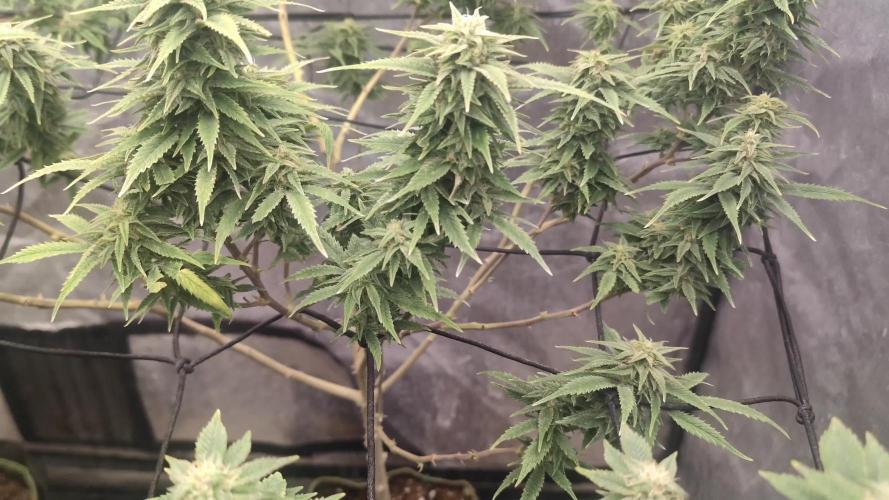
Engorde weenooo engoorde real jajajajaja
Bueno, pues buenas noticias dado que la población tan bestia de araña roja ha descendido a minimos! Por lo general ni veo ya, pero se que aún queda alguna, por ello, les meteré una limpieza mas con aceite de neem y jabón potásico, pero una sola mas, quizá esta noche o ya mañana. A partir de esta aplicación ya se acabo el uso de estos productos, y el siguiente lavado foliar que le haré será un té de canela, haré un concentrado hirviendo agua y con canela en polvo, filtrándolo para wue no quede residuo. Esto lo haré con intenciones antifungicas y de controlar un poco mas la humedad para mantener los bichos controlados.
Likes
14
Share


@Kakui
Follow
15 Noviembre:
-Hoy se instaló el sistema de riego "Drip to Waste" que me permitirá hacer riego de precisión, con protocolo "Crop Steering".
-Se instalaron sensores de humedad de suelo, para saber cuándo y cuánto regar, el sistema manda datos de humedad de suelo, temperatura y humedad ambiente, etc vía internet a mi celular.
-Mañana se comienza con el primer riego de precisión.
17 Noviembre: Segundo día de riego automático, 3.0EC y 5.9pH, las plantas crecen a buen ritmo, las raíces ya están saliendo por los orificios de drenaje a 2 días de transplantadas.
20 Noviembre: Se realizó una pequeña defoliacion de las hojas tipo abanico muy grandes.

Likes
10
Share


@UGrowGuy
Follow
01/03 Just Flipped going to leave a MH for a week pr two to counteract stretch. I will stake and turn up the lights over the next couple days. They do not all feed the same. So some I will dilute 25%.
01/05 The pics do not do justice to how big these girls have gotten, so i busted out a measuring tape lol.
Likes
3
Share


@BushDoctor740
Follow
Well she is really doing well with the recent LST and will have lots of colas.Ill start training the other branches later on this week but she’s looking great day 22
Likes
9
Share


@Ronin716
Follow
Loved it!! Relatively easy going!! Couple off moments but not worth getting into but the smell!!! It’s not super strong where you smell it throughout the house when you burp the jars but she has a very (what I could only reference as sour, sweet and lemony, almost like that lemon pledge your mom use to clean the house with) smell but I love it!!!

Likes
92
Share


@DogDoctorOfficial
Follow
🌸 Week 3 Flower – Growing Strong, Tall, and Vibrant! 🌱
Hey Grow Fam! It’s already Week 3 in flower, and I’m thrilled to bring you this update because these plants are doing phenomenally well! Some are stretching up so tall that I might have to get creative in the coming weeks! Fruit production is well underway, and it’s absolutely amazing to watch the canopy fill out as these girls reach their potential.
Aptus Holland Pack Unboxing & New Additions
This week kicked off with a big arrival: the Aptus Holland nutrient pack! 🙌 I couldn’t wait to share the unboxing with you all; there’s a video up where I go through all the goodies, so check it out if you haven’t yet! Between the photos and videos, you’ll be able to see just how well these nutrients are already feeding these green beauties. Having a blast sharing more content lately—I’m in the zone with editing and creating, so get ready for even more shares!
🌡️ Environmental Control and Fine-Tuning the Reservoir pH
Temps this week have been holding around 27.2°C with RH at 65.2% and CO2 at 800 ppm, creating a VPD of 1.26 for ideal flower development. The lighting intensity is at 833 PPFD, and the solution in the reservoir is fine-tuned to a pH of 6.22, EC of 475, with a temp of 21.8°C.
Let’s talk pH in the reservoir: it’s a dynamic process, and I’m constantly adjusting it to keep everything at the right level. The pH tends to rise throughout the week, and each day, I work it back down, fine-tuning it to keep those plants happy and balanced. Managing pH is truly a hands-on job, and it’s worth every moment. I love staying on top of it for optimal nutrient uptake—it’s all about consistent effort and keeping that perfect range dialed in.
Leaf Maintenance & Selective Defoliation
These leaves are HUGE and gorgeous, creating a lush canopy that’s nearly too perfect! I’ve been taking a few leaves here and there, focusing on leaves that may be blocking light from reaching lower parts of the plant. Selective defoliation at this stage is key because it opens up airflow and allows light to penetrate deep, boosting energy distribution across the whole plant.
Big, healthy leaves mean we’re getting excellent photosynthesis, but a gentle, strategic defoliation can guide that energy toward those developing buds. Leaf removal is all about balance, giving the plant space to breathe and thrive while still maximizing growth in flower!
🌐 TrolMaster + App – Real-Time Precision
Huge shoutout to the TrolMaster system and the app—keeping everything in sync and at peak performance is honestly effortless with this ecosystem. The app provides a full overview of each environmental parameter, allowing me to make real-time adjustments as needed and track trends over time. The precision here is unbeatable, giving me complete control over temps, humidity, CO2, and VPD, ensuring my girls are in a controlled paradise 24/7.
What I love most is how the app records everything automatically, so I always know exactly where things stand without having to keep separate records. If you haven’t tried TrolMaster yet, it’s a total game-changer for any grow setup!
💥 Shoutouts & Gratitude
Massive shoutout to TrolMaster and Aptus Holland for powering this grow with tech and nutrition that’s second to none. And, of course, gratitude to Pro-Mix for the superb growing medium and to the seed banks behind the genetics. We’re running strong thanks to each of you.
And to the whole community—thank you, everyone, from new friends to seasoned followers, lovers to haters. Your energy, whatever form it comes in, is all part of this journey, and I’m so grateful for it all. Special shoutout this week to my brother Daggadna—head over to IG and give him a follow! And if you’re loving the journey, remember to like, comment, and subscribe—it really helps the channel grow and reach others who may also dig this content!
Discount Codes so you can save big on your next check out 💚💚💚
Kannabia - DOGDOCTOR 30% off
SeedsmanSeeds - DOGDOCTOR 10% off
CannaKan- DOGDOCTOR 15% off
terpyz.eu - DOCTOR 15% off
The Neutralizer - PORKIT5-DOG 15% off
As always thank you all for stopping by, for the love and for it all , this journey of mine wold just not be the same without you guys, the love and support is very much appreciated and i fell honored and so joyful with you all in my life 🙏
With true love comes happiness 💚🙏 Always believe in your self and always do things expecting nothing and with an open heart , be a giver and the universe will give back to you in ways you could not even imagine so 💚
Friendly reminder all you see here is pure research and for educational purposes only
Growers Love to you all 💚💚💚


