


Likes
Comments
Share


@Ferinky
Follow
Hola y gracias por pasarte a ver mi diario.
Conocí esta variedad hace 20 años. En 2001, en mi pueblo, mi padre y sus amigos cultivaban una marihuana a la que llamaban "Madre", hacían crecer plantas de hasta 4 metros de alto y otros tantos de ancho, verdaderos monstruos del cultivo de guerrilla en las montañas del levante español.
Cuando, con 18 años la probé, supe que era algo realmente especial, era una época en la que los viajes a Ámsterdam eran habituales y de vez en cuando algún amigo traía alguna muestra de lo mejor que encontraba; pues bien, siempre decíamos que si esta "Madre" estuviese en los coffee shops Holandeses podría competir y desbancar a muchos mitos de aquella época.
Cuando le pedí a José, uno de los amigos de mi padre que mantenía la especie, que me explicase más sobre esta variedad me decía que sólo me la podía pasar en esqueje, ya que no habían estabilizado la cepa y las semillas tenían fenotipos muy variopintos. Estuve 2 años pudiendo cultivar dicho esqueje (hoy en día conocido como el Clon Mario), con muy buenos resultados, pero con 18 años mis habilidades como cultivador eran escasas, mi conocimiento sobre esquejado y mantenimiento de madres era nulo y acabé perdiendo aquel clon, posteriormente y por redadas policiales en aquellas montañas todo aquel que mantenía durante años esta genética acabo perdiéndola, conservando semillas que nunca llegaron al nivel de la cepa original.
Hasta que Mario Bellandi, creador de la variedad, y su banco de semillas Delicatessen Seeds consiguieron estabilizarla mediante semillas regulares y feminizadas. En 2014 compré un paquete de semillas feminizadas y el resultado fue más que bueno, recordando sin duda a aquella joya ancestral pero sin llegar al nivel del Clon original.
Esta vez cultivé la Reina Madre partiendo de 3 semillas regulares y el resultado creo que ha sido aún más próximo al original, lo cual es todo un éxito para mí. Una de las 3 semillas murió antes de llegar a la madurez y las otras dos resultaron ser dos hembras, muy parecidas entre sí. Una la puse en maceta de 50L y la otra en maceta de 20L.
Las plantas crecieron sin ningún problema excepto alguna carencia que presentó antes de tiempo, especialmente de nitrógeno.
Al ser un cultivo 100% orgánico y únicamente con riegos de agua del grifo sin añadir abonos líquidos era esperable, aunque el resultado final me deja muy satisfecho. Además, el hecho de añadir todos los nutrientes al sustrato me ha permitido facilitar la tarea del riego y no tener que realizar el lavado de raíces.
La planta que se desarrolló en una maceta de 20L ha producido 120g de cogollos secos, esponjosos, espigados y con una relación flores/hojas bastante buena. La planta que puse en maceta de 50L sufrió la podredumbre del tronco principal y tuve que cortarla antes de tiempo, desechando buena parte de la producción, aun así he obtenido de ella 80g de rica yerba old school.
El olor de las flores húmedas era bastante intenso y con matices cítricos y especiados.
Respecto a plagas y enfermedades ha sido muy resistente, no he apreciado signos de araña roja, pulgón ni trips gracias al aporte de harina de Neem en el sustrato.
Tampoco he sufrido el temido y habitual ataque de las orugas (ni la oruga de las hojas ni la del cogollo) gracias a las pulverizaciones en las fechas clave con Bacillus Thuringiensis.
Tampoco se ha visto afectada por el Oídio que normalmente aparece al final de la floración en la zona donde vivo, ni tampoco de botrytis , por lo que la pastilla de Micorrizas y Trichodermas ha funcionado a la perfección, no sólo reforzando el sistema radicular sino también frente a los hongos invasores.
El clima también me ha acompañado este año, vivo en una zona cálida donde la temperatura suele ser óptima para el cultivo de exterior de cannabis, el mes de mayo llovió algún día de forma agradable, junio, julio y agosto fueron especialmente secos, solo llovió un par de noches a finales de agosto, y septiembre también ha sido muy respetuoso lloviendo solo 2 veces.
Por todo esto, siendo la primera vez que elaboro un supersoil, estoy seguro que para la temporada 2022 repetiré el sistema, haciendo algunos ajustes a la mezcla para evitar estas carencias que he comentado.
Quiero agradecer a Growdiaries.com la herramienta que nos brinda a los cultivadores (en mi caso cultivador clandestino) para poder realizar el seguimiento de nuestros cultivos y como, en mi caso particular, ha hecho que mi motivación y trabajo hayan sido una constante semana tras semana, por lo que ha influido directamente en el buen resultado final de la cosecha.
También agradecer a todo el que pasó por aquí durante el seguimiento ya que me dieron el apoyo necesario para mejorar en mi cultivo.
Un saludo.
Ferinky

Likes
10
Share


@420pete
Follow
Chop day. Everything is looking and smelling incredible. The range of smells I've got so far are: floral, grape, blueberry, gas, burnt rubber, tangerine, funk. Everything appeared fully mature beside the Cambodian x Meat Breath and Pak Man so decided this was the best time to cut them down.


Likes
6
Share


@Dairon
Follow
Me están sorprendiendo gratamente las dos genéticas que he puesto, no paran de crecer y eso que llevan 21 días a 12/12, buena ramificación e internudos bien juntos, de momento y hasta que vea que entran en floración seguiré con la misma EC, intercalando riegos con agua de ósmosis, subida de EC a 0.4 con Calmag de Biobizz, un suplemento de Calcio y Magnesio, con el que puedes cultivar en coco de forma orgánica con Biobizz o subir la EC si usas agua de ósmosis ... . Al menos han bajado las temperaturas un poco y las plantas lo agradecen, espero que empiecen a echar flores pronto, buenos humos


Likes
6
Share


@Reidy_B
Follow
So far so good! These ladies are looking great thus far! They have grown faster than I could have imagined. I look forward for the coming weeks!

Processing
Likes
5
Share


@CecilioJardinero
Follow
Entrando ya en tierra derecha 😑😑😑😑
Modo zen en este proceso, ser paciente estar atento al engorde y esperar. 🤯🤯🤯
Así va el mix fem en sus últimas 3 semana 4 semanas para el corte 🌲🌲
Una de las #critical47 de @positronicschileoficial es la que estará primero y ya podemos ver que lograremos plantas sanas y limpias al final.
Las de mayor producción son las #fatbanana y la #greenpunch. La deaoyr resina hasta el mentó es una de las #critical47 y las #Toxic.
Durante todo el proceso y desde hace ya 5 años confiamos el cultivo a los fertilizantes de @topcrop. 🍒🌽🍍🌼💐💮


Likes
5
Share


@birdmountain
Follow
Es war Zeit für die Ernte, im Urlaub hatte sich an der Pflanze im Folientunnel Schimmel an der Hauptcola gebildet und auch etwas an der Pflanze auf der Terrasse. Es hatte in dieser Woche sehr viel geregnet. die Pflanze wurde geschnitten und zum Trocknen aufgehängt.

Likes
12
Share


@BudXs
Follow
Super busy with a move and a big garden reno. Sorry, this is the only update for this week

Likes
19
Share


@AutoDevilHQ
Follow
Just a phenomenal plant from start to finish.
For a first grow yielding 160g is just mind blowing.
Very easy to grow long veg period so windows of LST are large enough to have room for error. Lots of Defoliation needed and at its peak was drinking 6 Litres of water a day.
Likes
53
Share


@Boomer911
Follow
Week 3 Update:
Plant Growth:
Progress has been slower than anticipated due to persistent cloudy and rainy weather.
Despite the setbacks, I've noticed some signs of growth in the plants, albeit at a slower pace.
Implemented Low Stress Training (LST) on a few of the stronger plants, including the Gorilla Glue and Gelato varieties, to encourage more robust growth.
Weather Conditions:
The weather continues to be a challenge, with only a few sunny days throughout the week.
Rainfall has been frequent, making it difficult to provide the optimal growing conditions for the plants.
Adaptations and Solutions:
To counteract the lack of sunlight, I've constructed a mini tent equipped with LED lights to provide supplemental light and warmth to the plants.
Despite the less than ideal conditions, the plants seem to be responding positively to the additional light and warmth.
Nutrient Management:
Feeding schedule adjusted to once every 2-3 days, alternating between water and nutrient-rich solutions.
Using a combination of guano, worm tea, and a basic Grow NPK Autogrow mix to provide essential nutrients to the plants.
Observations:
Although growth has been slower than expected, I'm encouraged by the resilience of the plants and their ability to adapt to challenging conditions.
Keeping a close eye on the plants for any signs of stress or nutrient deficiencies and adjusting care accordingly.
Looking Ahead:
Hoping for a change in the weather in the coming weeks to provide better growing conditions for the plants.
Despite the challenges, remaining optimistic and committed to nurturing the plants to their fullest potential.

Likes
Comments
Share

@Cruzito
Follow
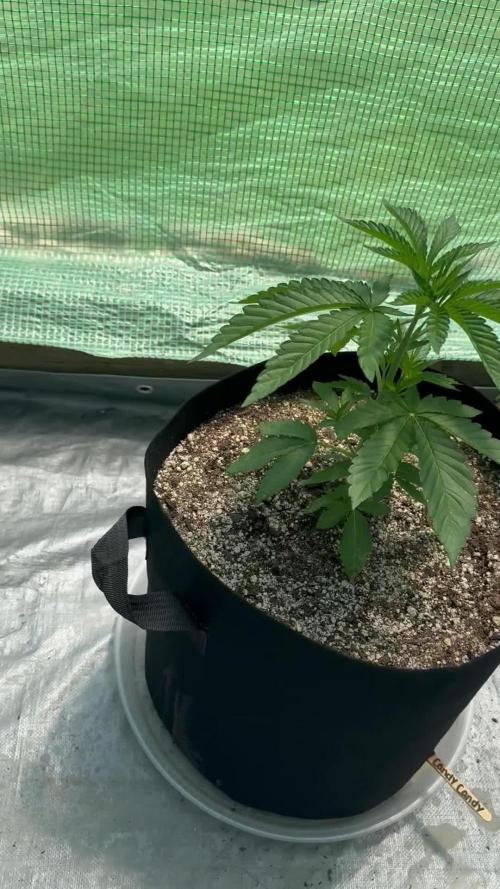
Almost killed one of the candy candy plants today by watering too fast ended up LST-ing all of the plants with the exception of the other candy candy which I am letting grow natural.


Likes
8
Share


@ButterfliesLittleFarm
Follow
Hello Diary,
White Widow has completed its last week, the journey has come to an end.
Two days after the photo shoot, I harvested White Widow along with her roommates.
73 days since I put the seeds in the ground.
65 days since the start of the vegetation.
Really very fast, although it has somehow become the standard on my small farm.
But I am still fascinated by how quickly the plant goes through its cycle when it has the most ideal conditions.
I don't necessarily mean myself, I try to give the plants the best I can and know how.
As you can see in the photos, the result is impressive, White Widow turned out to be a real beauty.
This phenotype painted White Widow in purple.
The flowers are hard and dense, the branches bend under their weight.
One branch even broke when I was setting it up for the photo shoot.
That purple color gives it a special look.
Some of the leaves have taken on autumn colors, which is also one of the signs that it has matured.
This week I continued to observe the samples under the microscope, waiting for the trichomes to turn milky.
On the day of the photo shoot, which was day 63, most of the trichomes were milky, some even brown.
The smell is very intense, the whole room smells like plants when I open the grow box.
I barely wash my fingers after examining the plants.
Watering was standard, every three days.
This week I stopped adding nutrients, I just lowered the p.H. to 6.0 and water the plants with clean water.
After the photo shoot, she was in the grow box for two more days to drink all the water from the soil so that the drying would be more efficient.
Before cutting, I removed all the leaves from the plant to also make drying easier and have less work to trim the dried flowers.
But also to prevent the formation of potential mold.
After cutting, I left her upside down in the grow box to dry.
Now I'm waiting for the flowers to dry well and to see how much White Widow has really rewarded me.
See you when that happens.
Here's what the last week looked like.
19/09/2024 - Day 57.
Watering.
I prepared 9 liters of water, lowered the pH to 6.0 and used that amount to water all three plants on the farm.
22/09/2024 - Day 60.
Watering.
I repeated the same procedure as three days earlier.
24/09/2024 - Day 62.
I watered them all with 1.5 liters of water each plant so they would be fresh for the photos.
25/09/2024 - Day 63.
End of the last, 9th week since Purple Lemonade began its journey. Photos.
27/09/2024 - Day 65.
White Widow has been harvested.
That's almost all from me for this diary, the final report that follows after drying and testing remains. Thank you all again for your support and comments.
Likes
8
Share


@DonPerion1983
Follow
So today my 3 big sensi skunk fem seeds are 71 days old today! Temperatures been good!
Feeding every other day 2 litres each plant!
But then I have a auto gsc fem plant which I reckon could be getting ready to harvest before my bigger plants! Increased canna a+b nutrients! Beginning to smell a little fruity in my tent now! All plants still look healthy which is pleasing coming into week 10! The buds seem like there fattening up abit more now each day! Come so far just don’t wanna mess things up now! Any advice is welcome still especially now harvest time is next cheers

Likes
6
Share


@CanadianFillmore
Follow
Start of week 8. Week 7 went well as this girl slowed down her nutrient consumption, she did not need any extra feed during the week. Cleaned up a lot of small dead leaves that had tucked themselves up into bud sites. In this past with this strain, those small drying leaves have caused some bud rot and mold to develop. She smells incredible and is insanely sticky! My best grow of this strain ever! Will flush in 5-7 days, depending on trichomes.

Likes
4
Share


@blaze_fpv
Follow
Start of Week 3 flower | cut only 2-3 leaves blocking light | stretch is done
End of Week 3 flower l gave them another light defoliation to have the whole canopy reaching light | buds really start to form rapidly | smell is also really nice
Currently running :
28° C at 50% rlf
630 - 750 ppfd
1200ppm CO2

Likes
11
Share


@Walligator
Follow
Everything is going great, I also think my plants have stopped stretching/growing, although really close to the lights.
I am not seeing lightburn, is this is something should be concerned about? The leaf temp is about 75 degree under the light.
Also just sticking with AN Bloom, Big Bud, Bud Candy.
Should I be using B52?
Also is overdrive worth it? it seems expensive for two weeks worth of work?
One more question? Is superThrive bad in flowering?
I read somewhere it could make bad things happen in flower because of the hormones it has. thus my question about B52.


Likes
58
Share


@Haoss
Follow
This beautiful girl is actively blooming, she is fed every day,
she feels very good 🌋
Likes
17
Share


@Mr_nugs_lover_David
Follow
Beautiful plant to grow, super sweet flowers, she's showing some purple notes as well, very happy about her development and the flowers she's producing, let's see how she keeps developing in this run!

Likes
422
Share


@Crashoverite
Follow
Hi all🧑🌾
Welcome to my final 🍌💜👊 week update.
First of all. I would like to thank you all for such an amazing support on this bananas journey. I am amazed of the amount of love received from community here. Thank you Grow Diaries and Fastbuds for opportuniy to share and grow this amazing genetics. Love you all❤️💜💚
Was looking for strong indica dominant strain and after reading and hearing so much about this one. Just couldn't resist to not give a go. Was a bit worried before planting seeds that my final yield outcome may not be satisactionary as only have 0.26msq and Fastbuds advertising this strain as 450-550g msq but thankfuly my result was way above this scale.
My 2 beautiful ladies
Athena - right corner lady. She was slighlthly more dominant over entire grow cycle. She got more space on scrog earlier and that's why she developed the most.
Xena - left corner lady, I belive that she could outgrew her sister if she just have more space and another week of time. Did not expect her to turn so well on the end.
Both girls were put in darkness for 48h before chop. Wet trimmed and hang for a week. Daily jars burbing for 10 days and every 2-4 days now.
Weights
Wet trimmed
Athena 870g
Xena 632g
Total 1502g
Dry trimmed
Athena 172g
Xena 147g
Total dry 319g
Bubble hash 6g (37g of trims)
I am very happy with this result.
In my opinion Banana Purple Punch Auto its a masterpiece.
Thank you so much for all the support, likes, follows and comments 🙏❤️💜❤️
Peace and love brother and sisters ✌️💚🧑🌾
Smoke review coming in shortly
Links
https://2fast4buds.com/seeds/banana-purple-punch-auto
https://plagron.com
https://www.biobizz.com/
https://fishheadfarms.com/