




Processing
Likes
1
Share


Likes
18
Share


@BlueSmokeFarms
Follow
Starting week 5... Buds are filling in and connecting. Just gave them another Weekly Top Dust.. Started seeing a little nitrogen problems so i gave them another dose of Nitrogen Boost. Just going to see how things turn out before i start to flush..
Any comments on when i should start flushing???

Likes
68
Share


@Hawkbo
Follow
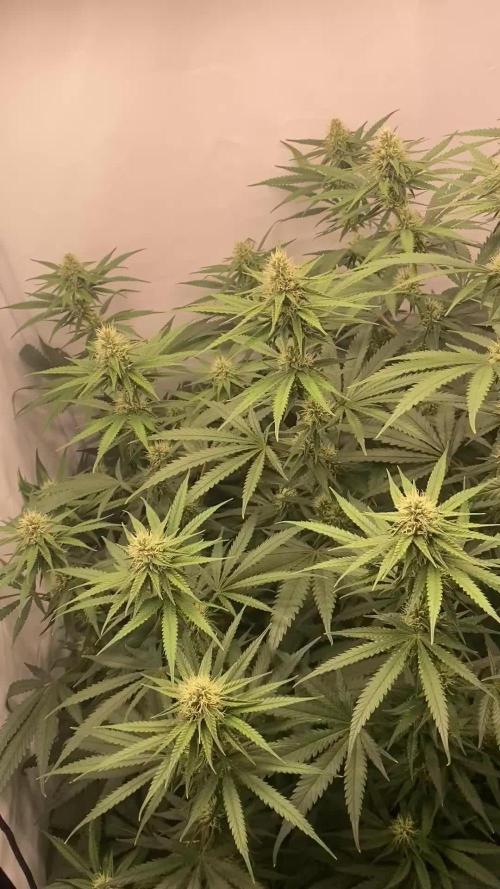
Back on track today is Day 35. In the past I have fed lightly I dont like burnt tips but with the variety of strains in this grow with the co2 I bumped it up a little. Some strains like the Polar Vortex 6 are much more sensitive than some others so it was unavoidable. Other than the tips they are all doing pretty well. The Cherry kush mints in the 4x8 in my eyes is clearly a beast it had the shortest veg time and caught up to most of the big girls. Also its development has been impressive with a unique terp profile at this stage. The sleeper is the garlicane 5. I've grown most of these once or twice before but with the upgrades and the co2 that one has developed nicely and looks like it will put on some serious weight. Things will start to heat up over the next couple weeks. See my IG for some promo codes @bangdangbuds

Likes
4
Share


Processing
Likes
29
Share


@IndicaRising
Follow
=================================================================================
CRIB NOTES - I'M USING A LIGHT CYCLE OF 6 ON 2 OFF THIS SHOULD KEEP THE LADIES FROM STRETCHING AND GROW VERY COMPACT.
Many growers advocate the use of an 18/6 light schedule (18 hours on, 6 hours off) while plants are in Veg. However, this may not be the most beneficial light schedule. Switching to a series of 6/2 (6 hours on, 2 hours off) light patterns may increase plant growth while also potentially creating a more stable controlled environment.
While this new schedule may sound risky, it actually comes with a number of benefits.
Cannabis is a “short-day plant,” meaning that it will only flower when exposed to long periods of darkness and short periods of light. For cannabis to flower, there must be at least 12 hours of continuous darkness. This allows for the use of a series of shorter light schedules while the plant is in Veg – as long as the plant receives less than 12 hours of continuous darkness, it will stay in Veg.
BENEFITS OF A 6/2 LIGHT SCHEDULE
There is a lot of research that suggests that cannabis plants can only process a certain amount of light per day. After that level has been reached, the plant can no longer absorb more light, and any additional light is essentially wasted. By breaking the light cycle into multiple 6 hour periods, the plant is able to rest and process the light it has received. When the lights come back on 2 hours later, the plant will be ready to process additional light, allowing you to get the most plant growth out of every minute your lights are on.
At a biological level, cannabis’s inability to grow more once it has received a certain amount of light can be attributed to the way the plant processes carbon dioxide (CO2). A majority of the mass accumulated in cannabis is associated with the amount of CO2 found inside plant cells. While under light, cannabis tries to prevent CO2 from leaving its cells by cutting off transpiration. However, this prevents new CO2 from entering into the cell, blocking new growth. When the lights are turned off, and no photosynthesis is occurring, the plant is able to absorb new CO2 into its cells.
Additionally, when plants are exposed to 18 straight hours of intense light, they become stressed. Signs of stress – droopy or curled leaves – will usually appear towards the end of the light cycle. While some stress can be beneficial to plant growth, too much stress can cause harm to your plants and prevent them from reaching maximum growth potential.
Giving plants 6 hours of intense light at a time not only puts less stress on the plants, it also spread out the load on your cooling system over a longer period of time. The cooling system works the hardest when lights are on. By turning off the lights for 2 hours at a time throughout the day, your cooling system will get a break between light cycles, allowing the room to be cooled to desired temperatures before the lights come back on. With a properly sized cooling system, this benefit will be minimized as the system will be designed to handle the heat load throughout the entire light cycle.
While there are many approaches to Veg light cycles for cannabis, a 6/2 schedule allows for maximum plant growth. A 6/2 schedule allows plants to process more intense light, prevents plants from becoming stressed and puts less stress on your cooling system. It’s a win all around. Give your plants a break every 2 hours and you’ll be amazed at the results.
=================================================================================
Day 1 October 1st - 2018 - The 3 Seeds are in germination at the present. The seeds were soaked in reverse osmosis water for 16 Hr. then transferred to a paper towel.
DAY 2 October 2nd - 2018 - 2 out of the 3 seeds have germinated. the first 2 will be put into hydrofarm soilless seed starters using Revers Osmosis water and placed under 3 grolux flor 45 watt.
Day 2 October 2nd - 2018 1:00 Pm. All 3 seeds planted into hydrofarm soilless seed starters using Revers Osmosis water and placed under 3 grolux flor 45 watt
Day 3 October 3rd - 2018 - 9:00 Am. 2 ladies have popped out there little heads.
Day 4 October 4th - 2018- 9:30 Am Seedlings are doing fine. All 3 seeds have germinated.
Day 5 October 5th - 2018 ROW being installed. 2:30 Pm ROW installed.
Day 5 October 5th - 2018 Seedlings are getting first set of single serrated leaves.
Day 5 October 5th - 2018 The tent is setup and running R.O.W.
Day 5 October 5th - 2018 Washed all Hydroton Clay Pellets in ROW. NO DETERGENTS. Rinse and Rinse again. Using R.O.W. so the medium has a practically no Ph.
Day 6 October 6th - 2018 - Transferred the best 2 seedlings to tent under Veg. 1000 Watt L.E.D. Each bucket contains 19 liters of R.O.W. no nutrients added. This will continue for the next 2-3 weeks depending on growth.
Day 6 October 6th - 2018 Seedlings put under Light Cycle of 6 On 2 Off Ect.
Day 7 October 7th - 2018 - Seedlings looking good. Seems everything is fine on 6 on 2 off light cycle.
Day 7 October 7th - 2018 - The 3rd seed germinated is looking very healthy. Transplanted it from the hydro seed starter to a 1 gallon planter with soil. Placed this in between the 2 main plants in the D.W.C. & used R.O.W.
Likes
28
Share


@DutchFarmer
Follow
Flipped the tent
Removed two male trop cherry
Replaced them with Cherry Gar see Ya from Ethos and Miami Madness and Strawneapple
Light intensity: 65%%
PPFD: approx. 2000 umol
Light distance: 35 cm
hours day/night: 18/12
Temperature day: approx. 31.5 degrees
RLF day: 78%
Temperature night: 25-27 degrees
RLF night: approx. 70%
VPD value: approx. 0.8-0.9
PH value water/fertilizer solution: 5.9
EC value: 4.5
ventilator oscillation: level 4
Humidifier: off
Dehumidifier: on
🌿 Check Out My Cannabis Community! 🌿
👇 Like, Follow, Comment, and Subscribe to My YouTube Channel 👇
❄️🌱🍻 DutchF4rmer on YouTube (https://www.youtube.com/@DutchF4rmer)
----------------------------------------------------------
🎁 Join Our Discord Community for Weekly Giveaways! 🎁
👉 Join Our Discord Server (https://discord.gg/VMu6rH4a7V)
----------------------------------------------------------
🌟 Get Exclusive Help, Advice, and Mentoring on Patreon! 🌟
👉 Join Our Patreon. (https://www.patreon.com/DutchFarmer)
----------------------------------------------------------
📸 Follow Me on Instagram 📸
👉 DutchFarmer1 on Instagram (https://www.instagram.com/dutchfarmer1)

Violet BAG · Robin Hood Seeds

Tropicana Cherry · Relentless Genetics

Miami Madness · Solfire Gardens

Cherry Gar-see-ya R1 · ETHOS Genetics

Strawneapple · Exotic Genetix

Black Valentine · LIT Farms (Lost In Translation)

Sugar Cane · In House Genetics

Gorilla Cookies Auto · Fast Buds
Banana Purple Punch Auto · Fast Buds

Cereal Milk · Cookies Seed Bank
Processing
Likes
13
Share


@TheAutoflowerShow
Follow
Day one of this week entailed me going to the hydro shop, grabbing so blue sky organics super soil, some 1 gal fabric pots and off I went. I always pot my soil then water the pots down and wait 24 hours for everything to acclimate so as to not shock my seeds. I germinate straight into the soil. I will post more pics to beef up this week! I will be planting 2 fastbuds orange sherbet beans, 1 in a 1gal fabric pot and 1 in a 3gal from the bucket company.
Likes
1
Share



Likes
59
Share


@Rap_a_cap
Follow
Outdoors........time passes slowly....
Tropical weather here, this week. Hot morning, evening storms , cooler nights, high humidity, wind. What else?
No problems to report, fantastic grow, girls full of life. Lots of work to bend and rearrange plant's shape every day, sometimes twice a day. Defoliation. Plant is responding fantastically.
Pineapple Kush is a monster, she has almost 20 big branches, every single branch is big as an indoor plant. I've growth 30 strains in my life but I never seen a plant with a such LTS attitude. You bend her, she responds quickly, you bend her again? She responds faster. Little bit late on flowering.

Likes
Comments
Share


@gottagrowsometime
Follow
Overall she grew good. No harsh reactions so I'm happy to put some bud in the jar. She vegged out 20cm and got to 35-38cm and finished with a lovely fade. Amazing scents. (More to come after some review next month. This pheno gets 9☆ the other 10☆ as the yield on my last Highcloudz was like 3-4x. But the buds are of a much higher grade. So, its a very high rating. Just sad there's not much of it. In saying that, now that you can change the rating I've no doubts I'll be giving it a 10 upon my smoke review..
I've fems left so ill be doing a SOG soon and this fem will defo be in it.
15+3-4 grams i quick dried. This defo needs a cure. The taste is so confusing, I get the scents of watermelon, typical zkittlez smell with a twist, the confusing part. Is f there's different smells coming from different buds. Smoking there is a very light panty taste. Very stoney, uplifting, very happy with when I harvested. Has much more of an energetic buzz with a nice mellow high. Very strong but not couch locking so things can be done. It kinda puts me in the zone. Been one of my smaller harvests. I have 2g left to keep out for 2moro day, I'll be putting this on 4-6 week cure. I'm gonna leave it out for another 12hrs or so. The stuff that came off the stems just now is very very slightly till wet. It would be able to put into the cure jar, but would need a lot more burping. So, id rather leave it to dry out properly and I'll burp every 12hrs, leave lid of for 4-5m and after a week, I'll slowly start burping it less. Knowing how weed dries you really can't set times on curing you go with how the weed feels. There is no hay smell. (I didn't have any worries about a hay smell. My drying room is 15c and 60-63% RH.


Likes
27
Share


@R_Dank
Follow
Before and after the defoil!!
Slow flush with water only, cleaning them veg nutrients away!
Net down to manage the stretch in next 3 weeks 🤞 first time using this tech, I usually just topt like a radical!!


Likes
6
Share


@illforwill
Follow
These fast bud genetics have given me a new hope for autos. For 53 days I have some nice sized colas and buds with beautiful color and the most amazing smells. I can’t believe these things just get better by the day. Can’t wait to grow my next set of fastbuds genetics
Likes
4
Share

@Randagio
Follow
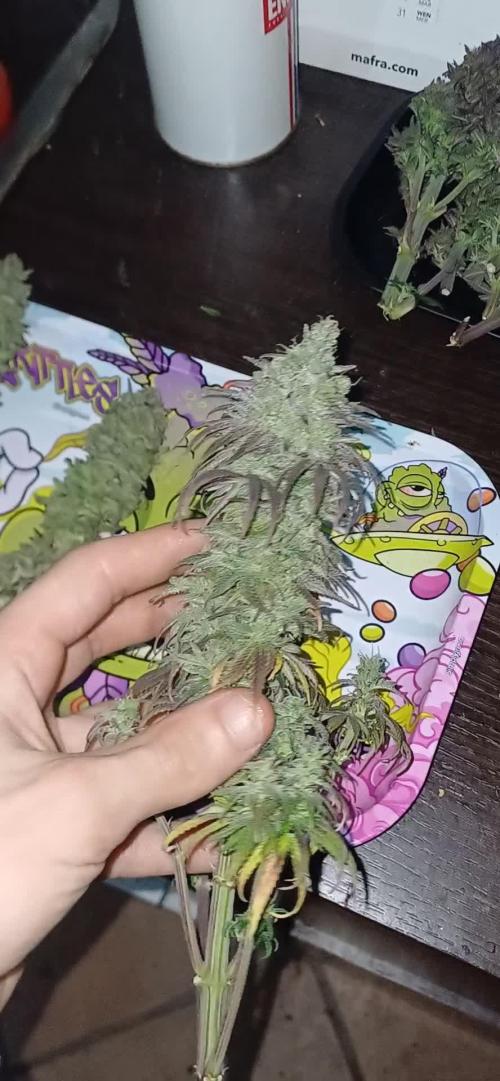
Farò un Aggiornamento del ricavato e dell'efficacia dei fiori appena saranno pronti


Likes
20
Share


@Mazgoth
Follow
With the water I was going from 50/100ml slow to the 400/500,so I'm changing time to time my water until they are big enough and then I only feed 1/1,5L water,That's how it goes every time I'm growing the water cycle
Likes
35
Share


@eldruida_lamota
Follow
Pues por último vamos a terminar con actualizar las red hot cookies de sweetseeds, que me parece que son las primeras que recibirán machetazo.
Ya están recibiendo los últimos riegos con fertilizantes agrobeta, y pronto les tocará el lavado de raíces y el estrés hídrico para que termine de marcar bien todos los tricomas.
Como veis empezaron ya a inchar, hay varias avanzadas pero todas serán cortadas el mismo día , así que solo toca esperar unas semanas más y pronto prepararé cosecha de red hot cookies.
.
La humedad esta al 45% la temperatura está entre 21/25 grados , y como siempre el ph , ya que es de lo más importante,está en 5,8/6,0.
.
AgroBeta:
1 ml x L Flowering black line , vía radicular.
0,2 ml x L Beta shark, vía radicular.
0.5 gr x L mega PK , vía radicular.
0,8 ml x L Terminator, vía radicular.
0,5 gr x L Engordacogollos, vía radicular.
0,3 ml x L Tucán , vía radicular.
0,1 ml x L Betazyme, vía radicular.
0,3 ml x L Tricoma, vía radicular.
0,05 ml x L Gold Joker, vía radicular.
0,2 ml x L Silver, vía radicular.
.
Hasta aquí todo familia 🕸️ , un saludo y buenos humos fumetillas💨💨💨.