


Likes
Comments
Share


@madlangs
Follow
All going well. Apart from cream mandarine who’s leaves are not happy.
25.10.21
Dg
Week 6.
3.5L
Wc
Week 5.
3.0
Gb
Week 5
3.5
Chem
Week 5
3.5
Cream. Week 5.
2.5
Hubba. Week 4.
3.5
Orange. 1. Week 4.
3.0
0range 2
Week 4.
3.0
Silica 2ml/1. Calmag 0.5ml/1. Gave grow instead of fish
27.10.21
Dg
3.5. Ph6.7
Wc
3.3
Gb
3.0
Chem
3.3
Cream.
2.5
Hubba.
3.0
Orange. 1.
0range 2
2.0
Gave all week 5 except dg got winter frost. Silica 2ml/1. Gave fish instead of grow. ph6.4 forgot to give calmag
27.10.21
Spectrum king 80cm
Lumatek 53cm
29.10.21
Dg
3.0L ph6.5
Wc
2.5
Gb
3.0
Chem
3.0
Cream.
3.0
Hubba.
3.5
Orange. 1.
3.0
0range 2
2.5
Gave all week 5 except dg got winter frost. Silica 2ml/1. Calmag 0.8ml/L. Gave grow instead of fish. Recharge. Mammoth p


Likes
1
Share

@Grow_for_Happiness
Follow
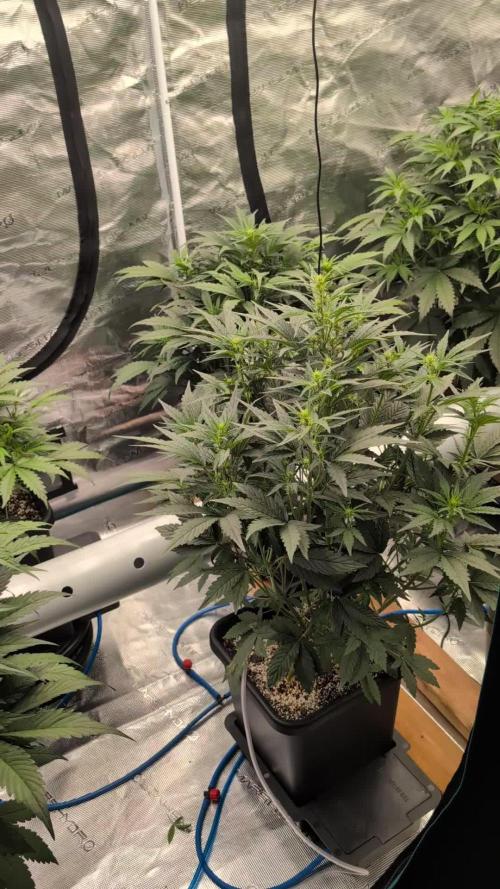
Well another week is done, and guess what we're now in flower! These girls shot up and really bushed out this week. Bud sites popping up everywhere, nice and bushy with very even tops. Main colas maybe 2" higher than the rest of the canopy. Gotta love blueberry strains for their even, wide canopies.
No work otherwise, just watching them do their thing and keeping the environment locked in. Lights 580 umol/s @ 30" hanging height. Humidifier barely running by the end of the week, will probably be able to pull it next week just to free up some space.
Likes
12
Share


@Jays_Not_Here_Man
Follow
Nearing the finish line! OMG these ladies are blowing me away 😳 the Tricomes are carpeted, the buds are fat and dense. I’ve been. Tapering off all the nutrients and feeding ph’d water until I get 10-15% runoff from the pot to help break up the pockets left behind and to use up what’s left in the plant. Have some very distinct phenos, all of them are stellar but there are a few standouts… won’t be much longer 🇨🇦👊❤️

Likes
1
Share


@Mr_Fuki
Follow
10th Week
Last week of vegetation. Vanilla Ice is ready :)
Conditions:
Sub: Atami cocos
Box: 80x80x100
Light: CLF 6100K 125W veg, CLF 2700K 85W flowering
Airflow: 1 10W PC cooler inside box to cool CFL, 1 20W airflow fan to get air in
Day time: 18h day / 6h night veg, 12h day / 12h night flowering
Main nutrients: wooden ash, ATAMI, GREEN HOUSE POWER FEEDING, homemade special for flowering
Feeding: first 12 days every 3rd day, next every 4th day, in flowering after switch 20 days every 4th day, next every 3 days
Water: 0,3-0,6l per watering, every time it is on place = if sub is OK to water or with nutrients
Training technic: harsh training for plant resistance and performance
Genetics Skunk x Northern Lights x Afghani
THC 17%
Flowering time +/- 55 days
Type Indica dominant
Height indoor 60 - 90cm
Height outdoor 170 - 200cm
Yield indoor g/m² 550 - 600g
Yield outdoor g/plant 450 - 550g

Likes
30
Share


@Fatnastyz
Follow
Still growing! She started showing some hunger signs....increasing her ppm to about 1100-1200 now.
Her top half seems to be about a week ahead of her bottom.
I think I'm going to have to learn how to harvest in stages this time. Her lower half is just soooo far away from the light.
She slowed down to only growing a half inch a day now....then....She FINALLY stopped growing (i think) Topped out at 44"! At least I hope, I have no more room LOL.
I had the light as high as I could get it...then I took it off the hooks and tied it to the top tent bars. and got it a bit higher LOL She's only 2 to 3 inches away from the light now so fingers crossed she stopped growing.
I got my first smell off of her this week too! Straight ORANGES, loved it!
6/19 - 39.2"tall
6/20 - 41"
6/21 - 42"
6/22 - 42.5"
6/23 - 43"
6/24 - 43.5"
6/25 - 44"
6/26 - 44"

Likes
60
Share


@BudBoutique
Follow
Welcome to Bud Boutique Grow Diary - really appreciate all your love and support :)
Dont forget to check out my other current grows!
🗓️ This Week:
- Day 9 transplanted 2/2 with mycorrhizal Powder from Great White Shark into a 0.3 liter pots)
- all still inside AC Infinity Germination Kit
- keep up high humidity with about 80% and open the little air vents of the humidity dome to start with a minimum of air circulation
Thank you for still staying with me 💚
___________________________________________
--- 🌱 Strain (Sponsor) 🌱 ---
🏷️ Cookie Haze by Kannabia Seed Company
https://www.kannabia.com/en/feminized-cannabis-seeds/cookies-haze
--- 🥗 Nutrients and Feeding (Sponsor) 🥗 ---
* 🍸 XPERT NUTRIENTS: Master Grow A+B, Master Root, Enzymes
* 📅💪 baseline + additives: 2ml/l
https://xpertnutrients.com/
---💡 Lighting ---
💡AC INFINITY - Germination Kit
https://acinfinity.com/grow-accessories/propagation/humidity-domes/humidity-dome-germination-kit-with-seedling-mat-and-led-grow-light-bars-5x8-cell-tray/#product-warranty
--- 🏭 Grow Setup ---
* 🏠🌿 Indoor: Homebox 120x120x200cm (4x4)
* 📐🌀 PrimaKlima exhausting Fan 1180m3/h (running on 60-80%) & Can Light Filter 800m3/h & 1x Fanbox 1x Dyson fan for Air circulation
https://primaklima.com/de/shop/ventilatoren-de/ec-ventilatoren/pk160ec-tc/
https://canfilters.com/products/filters/
All Likes and comments are highly appreciated!!!
don't forget to check out my Instagram: budboutiquee
- Bud Boutique

Likes
2
Share


@High_Grade_Dadli
Follow
Week went smoothly cant complain....cutting are doing well also took 4 cutting of seed(think it's from applelicious) they already rooted n transplanted going to veg for a lil n send to flower to see if it's worth


Likes
17
Share


@BB_US
Follow
These ladies are solid and filled with tons of orange hairs. The smell is like no other of citrus and fresh cut wood. One week then I am going to flush her.

Likes
16
Share


@GeorgeMaas
Follow
Still having loads of trouble with light burn / stressed out plants. Leaves pointing up, turning yellowish. Lights are now even at 80cm above plants, can hardly go any higher. I'm surprised, because the Hans Panel 180w is used at 30cm in numerous grow reports online with no issues. Must be the combination thats too much. 420 watts in a grow tent, and leaves are burning alive. If that ain't proof that LED's can't 'outperform' HPS ;)
Does anyone have tips & tricks for making my plants healthy? It feels just silly to remove a light and continue with only 180 or 240 watts total.. Should I use CO2 tabs or something? Do they actually work at this point? Questions questions.

Likes
15
Share


@Stash074
Follow
Finally the day has arrived. Today is the official day the ladies go into flowering. I ended up setting up my 2×4 tent over the weekend and took some clones from the ladies. 1st time cloning so we will see how it plays out. The ladies overall looks very healthy. I will keep yall updated in my next upload
Likes
20
Share


@Fergie
Follow
Hey guys so not much happened in last week buds are forming nicely everywhere 😀 the bigger 2 of them are smelling amazing and the crystals are just insane @tryhard heavy hitting hazes the way forward 😁anyway will continue as doing til next week guys

Likes
5
Share


@Eljardindemargarita_grower
Follow
Buenas compis .
Iniciamos vida
12 bombas de los compañeros de @gbsatrain
Con ganas de darle ganas y fuerza
Con toda mi energía para ellas
Siempre es positivo y satisfactorio iniciar vida
Vamos al lío

Likes
32
Share


@ArtisticGrown
Follow
Over all it was a hell of a ride, but a good one. My first grow ever learned so much and still learning. Started with 4 plants ended with 3. One of them was mutated or something during veg so decided to pull. This strain grew strong and thrived the whole time. I learned a lot about ph and air flow and VPD still learning and trying to find that sweet spot! I loved getting to know these girls it’s crazy how plants talk to you! Also watching these girls flower and bloom! Into some sweet sticky dank yummy nuggs was amazing such a good feeling! Emm Over all I’m happy with 3 oz ready to keep on growing more and learn to get a better yeild! Super thankful and happy growing
Likes
10
Share


@TherealNICOGREEN
Follow
Har ENDELIG FÅET EN SPONSOR GØDNING DERSAMTIDIG DRÆBER BLADLUS OG FLER OG ANDRE KRYBso. Ikke er sunde det er sponsoret af Gro-lys.dk i Århus Denmark! Og har reddet mine piger! Tusind tak for hjælpen til Gro-lys.dk! Fra therea
Likes
Comments
Share

@JVKdopegrow
Follow
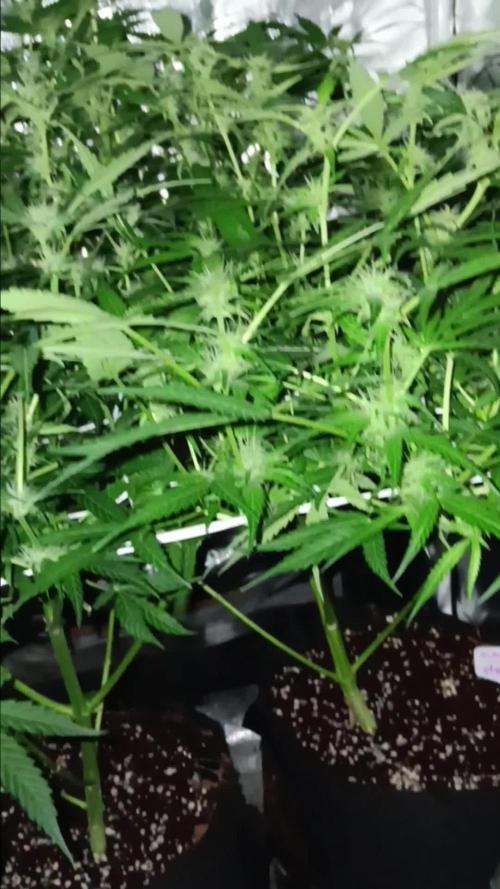
I am seing the benefits of the SCRoG technique. Fairly even canopy growth with bud sites all reaching for the light. My snippy ways have me trimming a handful of fan leaves every couple of days. I am noticing an uptick in water/nutrient consumption as she grows. No smell yet at all, buds forming well.
Likes
2
Share


@OGG420
Follow
Olor terroso característico de las orillas creo le falta menos de 1 semana para cosechar
Likes
57
Share


@SmokieMcPot
Follow
what do they say about different strains on the same RES, in the same pot??? welp, here goes nothing...
Last time I saw this waterfarm I was still a teenager. Ran it in a closet with two 4ft flouro shop lights either side going vertically upward like the letter "A". Had two BIG ASS plants roughly 4ft tall in it side by side going STRONG! Healthy asf, huge ass healthy leaves, some 13 fingered. Flipped em and turned out BOTH were male... Been toying with the idea of doing it again... So what the hell... Here goes, 2 Girls 1 Cup or "pot"... One Herbies Godzilla Cookies Auto and one Fastbuds Wedding Glue Auto.
Current setup:
-36x36x60 tent
-"1000w" led light (130w from the wall)
-4in extraction fan/scrubber
-20+ yr old GHE Waterfarm fitted with ice probe w/ controller and PLENTY of insulation around RES.
-Multiple circulation fans
-Taotronics humidifier
Stay tuned to watch me fuck this up too 🤣
*Sow'd em both in organic peat pellets after a 24hr soak. Getting them acclimated to their new home early. Doing environment tests and dialing it in with the new to me ice probe, and the change to hydro versus soil plants that were in there. Will be more moisture in the air until a canopy covers my balls with the evaporation from the light.
**lookey lookey, BOTH have come to life and are making way to the surface. Not long and they'll be in their new "cup". Last update on germination week as once they pop we start counting I suppose.
Likes
19
Share


@SirBudAlotts
Follow
This week I just let her stretch..
Normal feeding schedule with no training..
With this strain I would love to test how she does with absolutely no pressure on her..
Likes
29
Share


@Seldom_Seen
Follow
Day 34: Watered with first dose of flowering nutrients (1ml B, 1ml SR).
***I’m gonna break character here for a few mins. If that messes with anyone’s head because you are so deep into the storyline, then you can just pretend this is the director talking. I really wasn’t liking the look of the plant. There was loads of leaves with big very long stems. If it was earlier in the summer I would just put it outside and start another one inside. I don’t have that luxury so I’ll just have to see how it goes. I done some serious defoliation, removing more than 20 leaves. I’m not holding out much hope for a big yield.
Day 37: Watered with just PH’d water.
Day 39: Watered with Nutrients (1ml B, 1ml SR)
***Character break again. I saw the plant today for the first time in six days. More leaves are after growing big long stems. The few flowers on this plant are topping away nicely. It looks like 3 good bud sites maybe and 2 smaller ones. I have a Rhino Ryder in a 4ltr pot growing next to this Skywalker which looks like it will produce a bigger yield. Either way we have to just see what happens. I’ll hand you back to Luke now for the rest of the grow.
Day 40: Continued to use the Force to make the plant grow. This place is really starting to remind me of my time training with Master Yoda on Dagobah. Removed a few leaves with long stems.
