Likes
Comments
Share
@Smokwiri
Follow
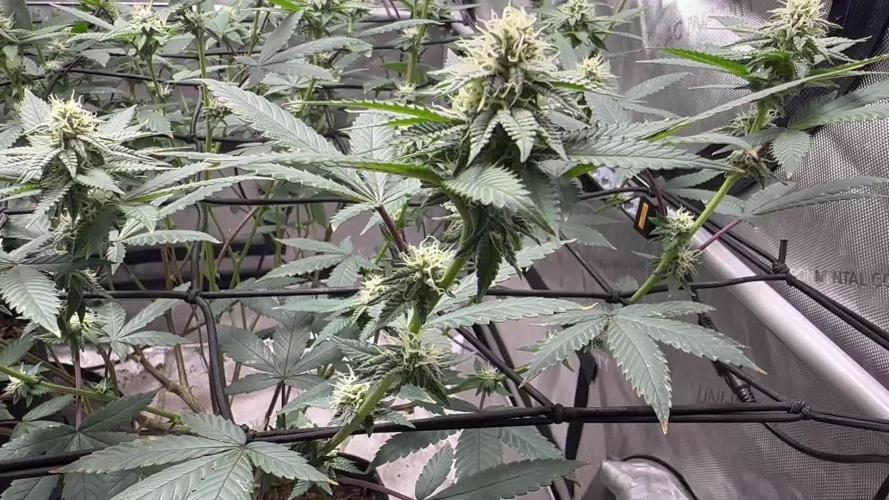
Welcome to week 8 of my Sour Betty by Anesia Seeds diary Plant looks great, i love the colours. Flowers have started to grow, i like the way the buds are taking shape. Added some pk
Likes
6
Share
Likes
4
Share
@m0use
Follow
***Sponsored Grow*** = Medic || https://medicgrow.com || Grow = ***Sponsored Grow*** Plants still looking good from last week, the yellowing has seemed to stop spreading, still some dull green in some leaves, I think I was under feeding them, but runoff says otherwise. Noticed some more pink/purple stems on the plants and decided to increase the phosphorus content in the feed by mixing in half grow and half bloom from the nutrient lineup. I'd use the PK booster I have but its to high in K for my liking. The entire lineup is very high in K. mixing grow and bloom gives a NPK ratio of 7-7-14 then done 1:1 equal parts. Grow=8-4-15 Bloom=6-10-14 Boost=1-15-30 Run off was a bit high for my liking but only seeing minimal signs of nutrient burn. Still watering once with feed and runoff and then later in the week with water and no/little runoff for my watering cycle.The number in the nutrient section are wrong but the EC and ratio are correct. Also impressed the roots have started popping out the bottom of the container already after only being transplanted for a week. Good root growth on these ones. Lights doing well. The V1 spectrum is good on the medic grow mini sun-2's 240w. No issues so far, dimmed at 80% . Till next week. ***Sponsored Grow*** Official Website: https://medicgrow.com/ + https://seedstockers.com/ Facebook: https://www.facebook.com/medicgrowled + https://www.facebook.com/SeedstockersBarcelona/ Twitter: https://twitter.com/medicgrow + https://twitter.com/seedstockersb Instagram: https://www.instagram.com/medicgrow420/ + https://www.instagram.com/seedstockers_seeds YouTube: https://www.youtube.com/channel/UCNmiY4F9z94u-8eGj7R1CSQ + https://www.youtube.com/channel/UC4GiFYrIWeNtwtXjcivCmfw Growdiaries: https://growdiaries.com/grower/medicgrowled https://growdiaries.com/grow-lights/medic-grow + https://growdiaries.com/grower/seedstockersofficial https://growdiaries.com/seedbank/seedstockers
Likes
25
Share
ANTHOCYANIN production is primarily controlled by the Cryptochrome (CR1) Photoreceptor ( !! UV and Blue Spectrums are primary drivers in the production of the pigment that replaces chlorophyll, isn't that awesome! 1. Diverse photoreceptors in plants Many civilizations, including the sun god of ancient Egypt, thought that the blessings of sunlight were the source of life. In fact, the survival of all life, including humans, is supported by the photosynthesis of plants that capture solar energy. Plants that perform photosynthesis have no means of transportation except for some algae. Therefore, it is necessary to monitor various changes in the external environment and respond appropriately to the place to survive. Among various environmental information, light is especially important information for plants that perform photosynthesis. In the process of evolution, plants acquired phytochrome, which mainly receives light in the red light region, and multiple blue light receptors, including his hytropin and phototropin, in order to sense the light environment. .. In addition to these, an ultraviolet light receptor named UVR8 was recently discovered. The latest image of the molecular structure and function of these various plant photoreceptors (Fig. 1), focusing on phytochrome and phototropin. Figure 1 Ultraviolet-visible absorption spectra of phytochrome, cryptochrome, phototropin, and UVR8. The dashed line represents each bioactive absorption spectrum. 2. Phytochrome; red-far red photoreversible molecular switch What is phytochrome? Phytochrome is a photochromic photoreceptor, and has two absorption types, a red light absorption type Pr (absorption maximum wavelength of about 665 nm) and a far-red light absorption type Pfr (730 nm). Reversible light conversion between the two by red light and far-red light, respectively(Fig. 1A, solid line and broken line). In general, Pfr is the active form that causes a physiological response. With some exceptions, phytochrome can be said to function as a photoreversible molecular switch. The background of the discovery is as follows. There are some types of plants that require light for germination (light seed germination). From that study, it was found that germination was induced by red light, the effect was inhibited by subsequent far-red light irradiation, and this could be repeated, and the existence of photoreceptors that reversibly photoconvert was predicted. In 1959, its existence was confirmed by the absorption spectrum measurement of the yellow sprout tissue, and it was named phytochrome. Why does the plant have a sensor to distinguish between such red light and far-red light? There is no big difference between the red and far-red light regions in the open-field spectrum of sunlight, but the proportion of red light is greatly reduced due to the absorption of chloroplasts in the shade of plants. Similar changes in light quality occur in the evening sunlight. Plants perceive this difference in light quality as the ratio of Pr and Pfr, recognize the light environment, and respond to it. Subsequent studies have revealed that it is responsible for various photomorphogenic reactions such as photoperiodic flowering induction, shade repellent, and deyellowing (greening). Furthermore, with the introduction of the model plant Arabidopsis thaliana (At) and the development of molecular biological analysis methods, research has progressed dramatically, and his five types of phytochromes (phyA-E) are present in Arabidopsis thaliana. all right. With the progress of the genome project, Fi’s tochrome-like photoreceptors were found in cyanobacteria, a photosynthetic prokaryotes other than plants. Furthermore, in non-photosynthetic bacteria, a homologue molecule called bacteriophytochrome photoreceptor (BphP) was found in Pseudomonas aeruginosa (Pa) and radiation-resistant bacteria (Deinococcus radiodurans, Dr). Domain structure of phytochrome molecule Phytochrome molecule can be roughly divided into N-terminal side and C-terminal side region. PAS (Per / Arndt / Sim: blue), GAF (cGMP phosphodiesterase / adenylyl cyclase / FhlA: green), PHY (phyto-chrome: purple) 3 in the N-terminal region of plant phytochrome (Fig. 2A) There are two domains and an N-terminal extension region (NTE: dark blue), and phytochromobilin (PΦB), which is one of the ring-opening tetrapyrroles, is thioether-bonded to the system stored in GAF as a chromophore. ing. PAS is a domain involved in the interaction between signal transduction-related proteins, and PHY is a phytochrome-specific domain. There are two PASs and her histidine kinase-related (HKR) domain (red) in the C-terminal region, but the histidine essential for kinase activity is not conserved. 3. Phototropin; photosynthetic efficiency optimized blue light receptor What is phototropin? Charles Darwin, who is famous for his theory of evolution, wrote in his book “The power of move-ment in plants” published in 1882 that plants bend toward blue light. Approximately 100 years later, the protein nph1 (nonphoto-tropic hypocotyl 1) encoded by one of the causative genes of Arabidopsis mutants causing phototropic abnormalities was identified as a blue photoreceptor. Later, another isotype npl1 was found and renamed phototropin 1 (phot1) and 2 (phot2), respectively. In addition to phototropism, phototropin is damaged by chloroplast photolocalization (chloroplasts move through the epidermal cells of the leaves and gather on the cell surface under appropriate light intensity for photosynthesis. As a photoreceptor for reactions such as escaping to the side of cells under dangerous strong light) and stomata (reactions that open stomata to optimize the uptake of carbon dioxide, which is the rate-determining process of photosynthetic reactions). It became clear that it worked. In this way, phototropin can be said to be a blue light receptor responsible for optimizing photosynthetic efficiency. Domain structure and LOV photoreaction of phototropin molecule Phototropin molecule has two photoreceptive domains (LOV1 and LOV2) called LOV (Light-Oxygen-Voltage sensing) on the N-terminal side, and serine / on the C-terminal side. It is a protein kinase that forms threonine kinase (STK) (Fig. 4Aa) and whose activity is regulated by light. LOV is one molecule as a chromophore, he binds FMN (flavin mononucleotide) non-covalently. The LOV forms an α/βfold, and the FMN is located on a β-sheet consisting of five antiparallel β-strands (Fig. 4B). The FMN in the ground state LOV shows the absorption spectrum of a typical oxidized flavin protein with a triplet oscillation structure and an absorption maximum wavelength of 450 nm, and is called D450 (Fig. 1C and Fig. 4E). After being excited to the singlet excited state by blue light, the FMN shifts to the triplet excited state (L660t *) due to intersystem crossing, and then the C4 (Fig. 4C) of the isoaroxazine ring of the FMN is conserved in the vicinity. It forms a transient accretionary prism with the tain (red part in Fig. 4B Eα) (S390I). When this cysteine is replaced with alanine (C / A substitution), the addition reaction does not occur. The effect of adduct formation propagates to the protein moiety, causing kinase activation (S390II). After that, the formed cysteine-flavin adduct spontaneously dissociates and returns to the original D450 (Fig. 4E, dark regression reaction). Phototropin kinase activity control mechanism by LOV2 Why does phototropin have two LOVs? Atphot1 was found as a protein that is rapidly autophosphorylated when irradiated with blue light. The effect of the above C / A substitution on this self-phosphorylation reaction and phototropism was investigated, and LOV2 is the main photomolecular switch in both self-phosphorylation and phototropism. It turns out that it functions as. After that, from experiments using artificial substrates, STK has a constitutive activity, LOV2 functions as an inhibitory domain of this activity, and the inhibition is eliminated by photoreaction, while LOV1 is kinase light. It was shown to modify the photosensitivity of the activation reaction. In addition to this, LOV1 was found to act as a dimerization site from the crystal structure and his SAXS. What kind of molecular mechanism does LOV2 use to photoregulate kinase activity? The following two modules play important roles in this intramolecular signal transduction. Figure 4 (A) Domain structure of LOV photoreceptors. a: Phototropin b: Neochrome c: FKF1 family protein d: Aureochrome (B) Crystal structure of auto barley phot1 LOV2. (C) Structure of FMN isoaroxazine ring. (D) Schematic diagram of the functional domain and module of Arabidopsis thaliana phot1. L, A’α, and Jα represent linker, A’α helix, and Jα helix, respectively. (E) LOV photoreaction. (F) Molecular structure model (mesh) of the LOV2-STK sample (black line) containing A’α of phot2 obtained based on SAXS under dark (top) and under bright (bottom). The yellow, red, and green space-filled models represent the crystal structures of LOV2-Jα, protein kinase A N-lobe, and C-robe, respectively, and black represents FMN. See the text for details. 1) Jα. LOV2 C of oat phot1-to α immediately after the terminus Rix (Jα) is present (Fig. 4D), which interacts with the β-sheet (Fig. 4B) that forms the FMN-bound scaffold of LOV2 in the dark, but unfolds and dissociates from the β-sheet with photoreaction. It was shown by NMR that it does. According to the crystal structure of LOV2-Jα, this Jα is located on the back surface of the β sheet and mainly has a hydrophobic interaction. The formation of S390II causes twisting of the isoaroxazine ring and protonation of N5 (Fig. 4C). As a result, the glutamine side chain present on his Iβ strand (Fig. 4B) in the β-sheet rotates to form a hydrogen bond with this protonated N5. Jα interacts with this his Iβ strand, and these changes are thought to cause the unfold-ing of Jα and dissociation from the β-sheet described above. Experiments such as amino acid substitution of Iβ strands revealed that kinases exhibit constitutive activity when this interaction is eliminated, and that Jα plays an important role in photoactivation of kinases. 2) A’α / Aβ gap. Recently, several results have been reported showing the involvement of amino acids near the A’α helix (Fig. 4D) located upstream of the N-terminal of LOV2 in kinase photoactivation. Therefore, he investigated the role of this A’α and its neighboring amino acids in kinase photoactivation, photoreaction, and Jα structural change for Atphot1. The LOV2-STK polypeptide (Fig. 4D, underlined in black) was used as a photocontrollable kinase for kinase activity analysis. As a result, it was found that the photoactivation of the kinase was abolished when amino acid substitution was introduced into the A’α / Aβ gap between A’α and Aβ of the LOV2 core. Interestingly, he had no effect on the structural changes in Jα examined on the peptide map due to the photoreaction of LOV2 or trypsin degradation. Therefore, the A’α / Aβ gap is considered to play an important role in intramolecular signal transduction after Jα. Structural changes detected by SAXS Structural changes of Jα have been detected by various biophysical methods other than NMR, but structural information on samples including up to STK is reported only by his results to his SAXS. Not. The SAXS measurement of the Atphot2 LOV2-STK polypeptide showed that the radius of inertia increased from 32.4 Å to 34.8 Å, and the molecular model (Fig. 4F) obtained by the ab initio modeling software GASBOR is that of LOV2 and STK. It was shown that the N lobes and C lobes lined up in tandem, and the relative position of LOV2 with respect to STK shifted by about 13 Å under light irradiation. The difference in the molecular model between the two is considered to reflect the structural changes that occur in the Jα and A’α / Aβ gaps mentioned above. Two phototropins with different photosensitivity In the phototropic reaction of Arabidopsis Arabidopsis, Arabidopsis responds to a very wide range of light intensities from 10–4 to 102 μmol photon / sec / m2. At that time, phot1 functions as an optical sensor in a wide range from low light to strong light, while phot2 reacts with light stronger than 1 μmol photon / sec / m2. What is the origin of these differences? As is well known, animal photoreceptors have a high photosensitivity due to the abundance of rhodopsin and the presence of biochemical amplification mechanisms. The exact abundance of phot1 and phot2 in vivo is unknown, but interesting results have been obtained in terms of amplification. The light intensity dependence of the photoactivation of the LOV2-STK polypeptide used in the above kinase analysis was investigated. It was found that phot1 was about 10 times more photosensitive than phot2. On the other hand, when the photochemical reactions of both were examined, it was found that the rate of the dark return reaction of phot1 was about 10 times slower than that of phot2. This result indicates that the longer the lifetime of S390II, which is in the kinase-activated state, the higher the photosensitivity of kinase activation. This correlation was further confirmed by extending the lifespan of her S390II with amino acid substitutions. This alone cannot explain the widespread differences in photosensitivity between phot1 and phot2, but it may explain some of them. Furthermore, it is necessary to investigate in detail protein modifications such as phosphorylation and the effects of phot interacting factors on photosensitivity. Other LOV photoreceptors Among fern plants and green algae, phytochrome ɾphotosensory module (PSM) on the N-terminal side and chimera photoreceptor with full-length phototropin on the C-terminal side, neochrome (Fig. There are types with 4Ab). It has been reported that some neochromes play a role in chloroplast photolocalization as a red light receiver. It is considered that fern plants have such a chimera photoreceptor in order to survive in a habitat such as undergrowth in a jungle where only red light reaches. In addition to this, plants have only one LOV domain, and three proteins involved in the degradation of photomorphogenesis-related proteins, FKF1 (Flavin-binding, Kelch repeat, F-box 1, ZTL (ZEITLUPE)), LKP2 ( There are LOV Kelch Protein2) (Fig. 4Ac) and aureochrome (Fig. 4Ad), which has a bZip domain on the N-terminal side of LOV and functions as a gene transcription factor. 4. Cryptochrome and UVR8 Cryptochrome is one of the blue photoreceptors and forms a superfamily with the DNA photoreceptor photolyase. It has FAD (flavin adenine dinucle-otide) as a chromophore and tetrahydrofolic acid, which is a condensing pigment. The ground state of FAD is considered to be the oxidized type, and the radical type (broken line in Fig. 1B) generated by blue light irradiation is considered to be the signaling state. The radical type also absorbs in the green to orange light region, and may widen the wavelength region of the plant morphogenesis reaction spectrum. Cryptochrome uses blue light to control physiological functions similar to phytochrome. It was identified as a photoreceptor from one of the causative genes of UVR8 Arabidopsis thaliana, and the chromophore is absorbed in the UVB region by a Trp triad consisting of three tryptophans (Fig. 1D). It is involved in the biosynthesis of flavonoids and anthocyanins that function as UV scavengers in plants. Conclusion It is thought that plants have acquired various photoreceptors necessary for their survival during a long evolutionary process. The photoreceptors that cover the existing far-red light to UVB mentioned here are considered to be some of them. More and more diverse photoreceptor genes are conserved in cyanobacteria and marine plankton. By examining these, it is thought that the understanding of plant photoreceptors will be further deepened.
Likes
10
Share
Nicole kush ya es conocida dentro de mi carpa y en todo el mundo. una planta muy vigorosa, su aroma dulce y cítrico deleita incluso a los que no entienden el cannabis. Su sabor denso y refrescante queda grabado en la mente del experimentador. Una hermosa y transformadora planta con flores. Tendré esta joya en mi jardín en otras ocasiones.
Likes
49
Share
@Ferenc
Follow
Day 71, 29th of November 2021: Nice group strong girl! They are different in sizes and structure but all of them are lovely! We just getting closer to the final week as we just entered to the 5th week of the flowering stage. The only changes I made is the ventilation and the extraction fan is off at the same time with the lamp so only switches on when the lamp does. So this is the set up and and operation schedule now: ViparSpectra XS2000 is on full power which is 240W so 100% capacity. Ventilation: As I mentioned it is off when the lamp is off so 12 hours. When the lamp is on it switches on in every hour and off for one hour. The extraction fan is on 12 hours when the lamp is, and then it takes a rest with the lap together lol ;) Watering pretty much remains the same. Humidity quite is approx 50%, temperature as well approx 26-27 Celsius. Fertilization remains the same since last week, the BioBizz family raised up to be 2ml/L each so it is like 2ml/L of BioGrow, 2ml/L of BioBloom, 2ml/L of TopMax... see the ratio above. The schedule of the fertilization has not changed happnes 2x a week except epsom salt just 1x a week.
Likes
57
Share
PSA!! PSA!! PSA!! WATCH those ZeroWater pitchers... when the filter goes, it goes FAST. Leaves you with a ton of undesirables, and AN EXTREMELY ACIDIC PH!! Acidity in the body leads to CANCER! will kill your plants fast as fuck too. ======================================================================================================== 2 Girls 1 Cup week 11? We should come to a finish this week... oh the excitement. Can't wait to see WG without her leaves. Going to have to cut each branch and hang individually due to the density of its structure. Got this far, don't want to risk moldy weed.. damn I'm gonna get bored while drying/curing not having a plant or diary to occupy the time. Day 77- currently flushing the girls. GC isn't ready for it, but she isn't in charge here. She should have stuck with WG when she extended a helping hand. Since falling behind, WG has thrown up a peace sign to GC as to say "see ya sucker". It's my favorite bud by far on WG. Bitch has got an attitude 🤣. RES sitting at 87ppm @5.9. Yellowing has started.. going to have to check trics more often so I get that sweet spot I'm looking for. ======================================================================================================== Day 78- these girls are starting to stink! Come on WG... ripen up so we can get this over with.. lowered lights power a bit today. RES climbed from 87 to 137. Drained 2gal, added 2gal RO. down to 38ppm. Forgot to mention the ice probe has been unplugged for over a week now. Been putting a 3/4 full 1L frozen bottle in the RES to chill. Rotate out every 12hr with a fresh. At lights on, and 12hr later. Full bottle got Temps too low for my liking. ======================================================================================================== Day 79- tick tock.. tick tock.. come on WG.. she's showing a little fade on her leaves. Seeing more of a calcium difficiency on her fans than fading honestly. Trichomes taking their time ripening as well. I'm SURE this strain ambers up.. taking their time for me though.. dont know how long I feel comfy flushing hydro though.. I did notice a few exploded trichomes up top, which has me thinking I need to go ahead and chop within the next couple days. If I notice any more ruptured anywhere else I haven't poked it with the scope.. I'm hanging the bitch that night. May give her 24hr dark period, since I've tried some other bro-science and it seemed to help. *edit* felt bad starving WG and she's not more amber coated. Gave her a bit of nutrition tonight. GHE aggressive ripen. M-2.8mL/g G-2.8mL/g B-4.5ml/g and 5mL calmag (using RO). Came out high @ 867 so I pulled 2L and dumped 2L RO in. Sitting at 613 @ 5.9. ======================================================================================================== Day 80- well, the 3 days starving the girls kicked their metabolism back in gear. I want more amber before chop chop. They quit eating and were drinking MUCH less signaling the end. Was down to topping off once a day, maybe a liter to a liter and a half. Since feeding yesterday, they've started eating and drinking like they were on week 10 again. Topped off 3.5L in the last 16hrs. TDS dropping with water level, even more when topped off with straight RO. I'm not giving em any more nutes. Last push for some extra weight before the end. ALLOT more frosty today than yesterday as well. ======================================================================================================== Day 81- Started flushing again. Maybe starting their metabolism again will help ripen these trics. If not, they're getting chopped @ day 84. Don't want to let em go too long and regret it. I may have f'd em up feeding again after the 3 days starving. Time will tell ======================================================================================================== Day 83- still waiting... 💤 Going to order some bubble bags. Freezing all GC and trim/larf from WG for some bubble hash. GC is frosty and all white like WG, just tiny popcorn shit everywhere since it's been neglected and abused over and over and over and over 🤣. ======================================================================================================== As always, thanks for stopping by and checking out my current grow. full timelapse added to this week 27-70 (looks better on YT.. https://youtu.be/8JdUkR36Wfc)
Likes
Comments
Share
I had originally planted 2 purple kush and 2 fucking incredible autoflower seeds by crop king seeds. 1 purple kush never sprouted. So I planted in its place a white widow.
Processing
Likes
7
Share
@Dunk_Junk
Follow
Chugging on through flowering. 10cm vertical growth this week. Stretch slowing down now.
Likes
11
Share
@BlaKX
Follow
Ai Gude Growmies es wird langsam richtig frostig auf den Buds❄️🌌 Seit Blüte Tag 50 überschritten wurde sehe ich täglich wie die Buds Immer mehr Trichome produzieren und Gewicht!❄️❄️❄️ Mimosa die wie beim vorherigen Grow etwas länger brauchen wird nur dieser Klon entwickelt wahrscheinlich wegen Phosphor Mangel zu diesen bunten Spektakel. Aber die Mutter Pflanze wo jetzt davor in die Blüte kam war schon ziemlich groß und musste diesen Klon im aktuellen grow auch Reveggen und trotzdem hat er Größere und schönere Buds entwickelt! Im bekannten Kreis sagen sie auch man meint es wären 2 verschiedene Strains und keine Klone. Habe die White Widow XXL ordentlich entlaubt da ich etwas nachlässig war haben sich an 3 stellen Mehltau niedergelassen. Ich komme nie über 45% LF Nachts eher so 38-42% im Durchschnitt ,Tags über sogar 30-35% LF. Mehltau infiziert waren sie alle leider aber hatte ihn erfolgreich behandelt jetzt am Ende der Blüte entferne ich die Blätter und tupfe sie vorher mit bio Mehltau EX ab. AK47 Hatte auch vorbeugend einen kahl schlag unten rum. Ein Klon aus Feminisierten Samen der sich zuerst absolutes Bastard Cannabis war entwickelte sich zu einem stämigen kompakten Indica zwerg mit schlechten Blüten/Blatt Verhältnis dafür extrem starken oldshool Skunk Duft mit Chemie,Erde und nassen Hund. Die Super Lemon Haze sollte eigentlich eine neue Mutter Pflanze werden aber wurde zu spät geschnitten die hätte ich eher austauschen. Weil man erkennt wenn die Bilder vom Start sieht das die nur 1 bis 3 finger Blätter hatte bzw nur ganz wenige mit mit mal 5 und die Buds sind diesmal auch nicht so Groß und fluffig wie davor sondern sehr kompakt und erinnert mehr an Indica von der Blüten Struktur und Festigkeit. Der Geruch ist auch mehr in Richtung Chemie/Katzenpisse was ich sehr begrüße. Nach ndl und 1 led grow und jetzt der 3 mit den selben Genetiken kann ich jetzt schon sagen dass ich Super Lemon Haze und Ak47 erstmal lange Zeit nicht mehr growen. Ich weiß nicht ob es Einbildung ist oder wirklich so das ich konstant zu jeden Durchgang bessere Ergebnisse bekam aber die Pflanzen von Serious Seeds und Green House Seeds nicht so darauf ansprach wie die Genetiken von Barney's Farm. Grade die White Widow XXL hat mich wirklich überrascht ich war anfangs enttäuscht weil die Pflanze fast wie eine reine sativa wächst in der vegi Phase die ohne toppen safe über 150cm geworden. Wenn man die mit der SLH vergleichen will habe beide lange Internodien Abstände und kaum Blätter wuchs bzw Super Blüte/Blatt Verhältnis! Nur an den Blüten der WW die extrem Kompakt und Schwer werden zeigt sich der angebliche 75% Indica Anteil mit bis zu 26% THC. Das XXL am ende hat sich der strain verdient!!! Was in den 90er WW und AK47 waren und in den 2000er Die SLH als hype Strains hat es Barneys farm geschafft für mich die WW so zu updaten Dass sie sich Aroma und Geschmack so wie Wirkung wie damals Riecht, schmeckt und kickt. Konnte mehrfach bei Bekannten das Apotheken White Widow unterschiedlicher Preise und Herkunft probieren und je nach Qualität war es OK für den Preis. Mr nice guy seeds Black Widow oder die ww Inbreed line von GHS ist auch absolut empfehlenswert wer den Hype von damals nachvollziehen möchte. Die WW von Barney's Farm will ich mit GMO mal "ersetzen" oder aus Regulären Samen Mutter Pflanzen selektieren. Die Mimosa Evo war was die Genetik angeht es neuste im Zelt und habe vorher lange recherchiert weil mir die ganzen neuen Candy Ice Dessert sweet tutti frutti breath nicht so zusagen aber ich eine Sorte wollte die bis zu30%THC erreichen kann und mit Farbe:D Mich hat damals schon Tangerine Dream absolut positiv überrascht mit Süßen Mandarine am anfang und g13 und Nevilles A5 Haze im abgang und sehr stark war die zu der Zeit. Mimosa Evo riecht hauptsächlich fruchtig nach Orange, Zitrone und Waldbeeren beim Rauchen kommt PP durch und Erde,Diesel gasig. In diesem Grow verwende ich das erste mal CANNA Terra Professional Plus Erde und Hydrokugel im Topf Boden. So wie CANNAZYM und CANNA Calmag Agent. Man sieht und riecht den Unterschied schon zum vorherigen Grow mit BioBizz All Mix Erde und BB Calmag. Ich möchte die Erde von Canna wiederverwen weshalb ich mir CANNAZYM holte. Bin vorsichtig bei Zusätze Dünger wie z.b Wurzel Stimmulator hatte bis her nie Probleme im wurzel Bereich. MONO Präparate sind absolut brauchbar wenn man gezielt Mangel Erscheinungen bekämpfen will. Habe vor 21 angefangen zu Growen mal größer mal kleiner aber konstant mit kleinen Pausen seitdem dünge ich Mineralisch mit CANNA und Guano. Organisch Düngen werde ich allein deswegen schon testen wegen Geschmack und Aroma. Denke bis spätestens 22.5 sind alle rdy und Mein Grow report ist dann abgeschlossen 😍🌈🌌 *Update * muss die Leistung der Lampe drosseln sie wird einfach zu warm aber bei fast 26C° tagsüber kann ich schwer die heiße Luft austauschen obwohl die abluft in einen anderen Raum geleitet wird.
Processing
Likes
28
Share
Cruising right along. Baby girl is definitely devilish. Week 11 feed this week ph 6.4 runoff at 6.6 environment high of 81.9F 51%RH low 67.5F 39%RH. She’s stacking at top still shooting pistils out slowly. Taking slot of real estate in tent had to get rid of one other plant :( but this one shall prevail. Super eager for the buds. The scent she leaves on your fingers after interaction is lovely.
Likes
28
Share
What an amazing lady! In-house Blue Java has a smaller bud, but that means less wood—- less wood, means bight THC—- based on the taste test, I’m guessing this lady is at least 27%. Growing it was super easy! She was grown in a 5 gallon pot of promix hp and fed almost daily. The resin production was off the chart. Flavor is a woody sandalwood, with a sweet backend. Super delicious and burns real slow. Great genetics, great flavor, easy to grow, and a true stunner! ✌️🏻💚🌿💨
Likes
52
Share
I've uploaded a quick video for you guys showing how the ladies are looking at the end of Week 4 of Flower 👍🏾 Going Great! Could be going alot better to be honest but still doing really good.
Likes
18
Share
my dry and cure style is this: 4 days of hanging upside down to get water activity lower to around 0.6 in 50% humidity and 26 C temp (i know its a little high but we are in a hot summer right now and i cant get it lower even with air conditioner) and then after 4 days of drying i remove leaves and stalks, trim buds and move them to jar for the rest of their life :D . and in the first 4 days of curing i open the jar door and let hem get some fresh air in the jar for about 5 minutes and close the jar door again, after 4 days of curing like that buds are smokable but they will get better as they getting cured about 1 month. buds are one of the hardest as fucking rocks type of buds! very dense , compact , sticky , smelly , amazing at every aspect growing stage was 56 days and flowering stage was 75 days total (harvested tops at day 64th) the total weight of dry buds was : (plant #1 & #3 top buds 56 G + lower buds 22 G ) 78 G + (plant #2 top buds 47 G + lower buds 18 G ) 55 G + (plant #4 top buds 120 G + lower buds 67 G ) 187 G = 367 G