


Likes
Comments
Share


@GrowersParadise
Follow
apologies for the washed out photos, didn't look as bad on my phone but now I can see it. will try to take better photos here forward under the lights.
18/6 lighting
Daily Light Integral
The daily light integral (DLI) you provide is 13.3 mol/m²d whereas the ideal is 12 mol/m²d.
For the most part, all is well this week. Temp and RH has been very steady around 73-74 degrees and 45-55% RH. Decent growth on all four except the one plant, Apex by Ethos. The plants taproot grew up instead of down. It was a little light in color as well, I believe that it has since corrected itself and found the right path downward. I’ve been hand watering about half a gallon a day from the reservoir to make sure the roots are getting water and food.
I increased the EC of megacrop to 0.8, roots are just now hitting the water with all the plants (except Apex). I’ll keep hand watering until they do. I lowered the water height to .5” below the net pots, I suspect they’ll be off to the races now.
Added an air stone inside of the reservoir itself as well, to help keep everything nicely mixed at all times.
PH still sitting perfect at 5.8.
So far so good outside of that.


Likes
4
Share


@AustinRon
Follow
OG 4Q24 Flower Week 7
Orangegasm (Fem) [ IRIE Genetics ]
12/12 @ Bolt (Day 21)
Germination: 20 November 2024
#3A Earliest Harvest Date: 9 February 2025
#3B Latest Harvest Date: 19 February 2025
_________________________________________
Start of Week: [Wed Jan 22,
2024 CR2 4Q24 43:F:6:1]
End of Week: [Tue Jan 28, 2024 CR2 4Q24 49:F:6:7]
OrangeGasm Fertigation:
- MAX: EC: [ 2.4, mS]
- LightIntensity MAX: [ 850, µMol/m2/s]
______________________________________
__
Wed Jan 22, 2025
OG 4Q24 43:F:6:1
- [x] R&R Each Drip Ring Assembly (Assure NO Fertigation/Bio Build up)
Runoff
- Amount: [ .5, l]
- EC: [ 3.8, mS/cm]
- EC∆: [ 1.2, mS/cm] # Danger!
Refresh Res (Filtered, pH’d Tap Water)
- [x] Amount: [ 2, gal]
- [x] Primer A&B: [ 35, ml]
- [x] SLF-100: [ 10, ml]
__
Thu Jan 23, 2025
OG 4Q24 44:F:6:2
Refresh Res (Distilled Water, pH: 7, EC: 0.0)
- [x] Amount: [ 2, gal]
- [x] Primer A&B: [ 39, ml]
- [x] SLF-100
Runoff
- Amount: [ 1.2, gal]
- EC: [ 4.3, mS/cm]
- EC∆: [ 1.6, mS/cm] # DANGER
__
Fri Jan 24, 2025
OG 4Q24 45:F:6:3
Runoff
- Amount: [ 0.3, gal]
- EC: [ 4.1, mS/cm]
- EC∆: [ 1.4, mS/cm] # DANGER

__
Sat Jan 25, 2025
OG 4Q24 46:F:6:4
Dump Res
- [x] Remove Chiller and Fertigation Pumps
- [x] Dump and CLEAN Reservoir, Note Sediment
- [x] Detach Main Feedline
- [x] Clean Chiller Pump
- [x] Clean Fertigation Pump
- [x] Dry ALL Components
- [x] REASSEMBLE When Dry
- [x] Clean 1/2” Fertigation Mainline
Watered In Primer A&B, CalMag Fuel, Silica Skin
- Amount: [ 1.9, l]
- EC: [ 2.7, mS/cm]
Refresh Res w/ Full Hydro (Primer A&B, Silica Skin)
- [x] Amount: [ 4, gal]
- [x] EC: [ 2.7, mS/cm]
- [x] Primer A & B: [ 73.1, ml]
- [x] SLF-100: [ 40, ml]
Runoff
- Amount: [ 0.25, gal]
- EC: [ 4.1, mS/cm]
- EC∆: [ 1.4, mS/cm] # DANGER
__
Sun Jan 26, 2025
OG 4Q24 47:F:6:5
Refresh Reservoir - 2 Gal, EC: 2.7
- [ ] Check, R&R Fertigation Manifold Filter as Needed
- [x] SLF-100: [ 10, ml]
- [x] Primer A & B: [ 40, ml]
Runoff
- Amount: [ 1.25, gal]
- EC: [ 4.2, mS/cm]
- EC∆: [ tbd, mS/cm]
__
Mon Jan 27, 2025
OG 4Q24 48:F:6:6

Watered In Primer A&B, CalMag Fuel, Silica Skin
- [x] Amount: [ 1.9, l]
- [x] EC: [ 2.7, mS/cm]
IPM
- [x] Spray sides - cover Air holes of Airpot
- [x] Spray tops of pots to drench
- [x] Dr. Zymes, 28ml/quart @ 85°F
- [x] APPLY Mosquito Bits to Top of Containers
Runoff
- [x] Amount: [ 1.5, gal]
- [x] EC: [ 4.9., mS/cm]
- [x] EC∆: [ 2.2, mS/cm] # *** Plants Should Be Fried!
Need to R&R Pre-Filter again. Fan Flow significantly diminished.
__
Tue Jan 28, 2025
OG 4Q24 49:F:6:7

Replace ACI Pre-Filter
- [x] Remove Plants
- [x] Disconnect Irrigation Emitters
- [x] Remove and Rinse Drain Tray
- [x] Drop Front of Light
- [x] Remove & Replace Pre-Filter
- [x] Verify Airflow (Make sure we don’t need to change the carbon in the filter)
- [x] Raise front of light to run position
- [x] Replace Drain Tray - Reposition Shims
- [x] Replace Plants AS THEY WERE
- [x] Replace Emitters
- [x] Verify Irrigation
Runoff
- [x] Amount: [ 0.5, gal]
- [x] EC: [ 4.8, mS/cm]
- [x] EC∆: [ 2.6, mS/cm] # *** Plants Should Be Fried!

Processing
Likes
24
Share


@rasta_puri
Follow
Finally did the last topping and achieved the shape i wanted so much! Can see the "H" on top, this gonna serve as base for the next following branches. quite symmetrical.

Likes
27
Share


@adam_pawloski87
Follow
Let’s go Day 36 !!! This week went real great, girls built up a lot of structure, and stayed super healthy ! Today they got fed just water phd at 6.5 ! They been really loving that balance! I also removed a lot of under trim since we are going into preflower , so had to shave up those legs lol ! It’s really great for them , the love that airflow , but don’t take off too much or you could shock your plants so be careful ! Can’t wait to see what these girls do this week ! Hope you all enjoy an are ready for another amazing productive week ! Peace , Love , an positive vibes to y’all Cheers LetsGrowwww!!! 😶🌫️💨💨💨💨


Likes
3
Share


@Ukbuds
Follow
Week 2 using Dutch pro grow A and B
Dutch pro root solution
Calmag , multi total
Likes
30
Share


@ChitownCannaChica
Follow
First week of flower has been completed. Much happier in the warmer tent with more intense light and a bigger pot. I trimmed her up to have 4 mains and a couple of strong side branches. Hoping for a stretch.
✌️💚🌿💨

Likes
170
Share


@Master_weeda
Follow
Bonjour à tous les padawans et maîtres jedis
Quel plaisir mes amis tout y est dans ce diarie !
À par le rendement 😁 mais bon ce n'était vraiment pas le but car je me suis rendu la tâche encore plus difficile en tentant l'expérience solo cup challenge avec main-lining sur une autofloraison.
Merci pour tout vos compliment votre soutient et votre gentillesse.
Je me suis vraiment amusé et j'ai pris beaucoup de plaisir avec ce diarie, mais j'ai surtout beaucoup appris. Que la force soit avec vous 💪

Likes
21
Share


@SkunkyDog420
Follow
Hallo zusammen 🤙.
So das war es für sie. Sie riecht so schön nach Fanta richtig lecker, ich hoffe das der Geruch so bleibt.
Wir sehen uns in 3 Wochen.
Sie erhalten 25 Prozent Rabatt in unserem Shop
Mindestbestellwert beträgt 75 Euro
https://greenbuzzliquids.com/en/shop/
Code: GD42025
https://seedsmafia.com/de/

Likes
6
Share


@TheSTRAFF
Follow
Same as the previous week, temps and humidity are way better, getting closer to the end of winter, its Spring Day tomorrow.
This will be the last week of using Rippen. next week will be the final week before harvest.
The Flower Smells comes and goes as the fans stop and start...

Likes
2
Share


@Daddyhancocc74
Follow
Every Thursday is a new week so this Thursday will be 3 weeks into flower
Likes
15
Share


@Haoss
Follow
Flowering described earlier than I expected, more than 1 week after the vegetation phase would be bigger and more beautiful, has an effect with pleasant sensations and euphoric as the sativa dominant is accustomed to the aroma of lemon and citrus.
Likes
4
Share


@ShambhalaGardens
Follow
Everything is looking good. Gave these girls a shot of recharge and fish shit. Prepping there new homes and getting ready to transplant.


Likes
3
Share


@High_Grade_Dadli
Follow
2 of dem from the 2nd set don't seem to catch dem self yet🤷🏾♂️ but the rest are taking off....those from the 1st set still ain't transplanted and they are pushing hard ties ain't holding dem back. 2 that where transplanted previously jus tryin to get dem a good size n send dem on a breeding project for the beginning of the
Most of new cutting have visible root

Likes
3
Share


@CreoWeed
Follow
Building up!
Hey pals, this week went pretty fine, she finally stopped stretching at 99cm and the lady drinks like never before. Buds are finally building up.
I count to give the next weeks just plain water to flush away all the nuts she absorbed during the cycle.
Smell start to be strong, but a sort of sweat and delicate smell... hmmm like a Gelato cream 😍😍😍🍨🍨🍨... Delicious...
Some buds are more mature than others and the main branches are far away from being ready.
I cannot wait to update this diary in the next 2 weeks and see how she get.
Will keep you guys posted, stay tuned stay high!

Likes
7
Share

@Mosquito_Haarlem
Follow
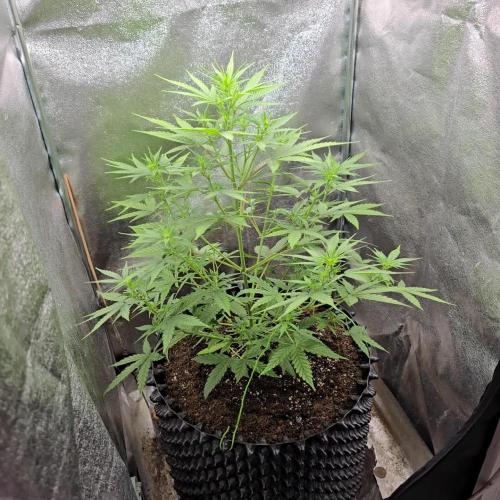
Een week gemist met foto's maken, maar ze is echt prachtig zoals je kan zien.
Likes
5
Share

@Mr_NYceguy
Follow
Coming down to the wire. Pumping these girls full of overdrive again this week, next week will start flushing. Looking at a late Jan. Harvest for this tent.




Likes
43
Share


@Hashy
Follow
********************************************
Week 16 Fading (flower week 10)
********************************************
Light cycle=12/12
Light Power=100w 42%
Extractor controller settings
High temp= Day 26c, Night 20c
Low temp= c
Temp step=0c
High Rh= Day 50%, Night 55%
Low Rh= %
Rh step=0%
Speed max=10
Speed min=2
Smart controller settings (during lights on).
Lights on=9.00am
Top fan on=+22.5c
Top fan off=-22.0c
Dehumidifier on=+50% and -26c
Dehumidifier off=-50% or +26c
Smart controller settings (during lights off).
Lights off=9.00pm
Dehumidifier on=+55% and -20c
Dehumidifier off=-55% or +20c
VPD aim=0.6-1.3
DLI aim=30-45
EC aim=0.2-0.5
PH aim=6.0-6.5
NPK(0/0/0)
💧💧💧💧💧💧💧💧💧💧💧💧💧💧💧💧
Method= Autofeed 6 drippers.
Feed=water
Volume=8L
Easy Ph down= 0.02ml/L ( 4 drop total)
Ec=0.2 PH=6.5/6.5
Runs=16
Run times=5min (250ml each)
Gap times=15min×14, 45min×2
Total runtime=80mins (4.0L each)
Total flowrate= 100ml/min (50ml/min each)
Auto start time=10.00am
Auto stop time=4.05pm
💧💧💧💧💧💧💧💧💧💧💧💧💧💧💧💧
********************************************
********************************************
📅1/9/24 Sunday (day 106, day 64 flower)
📋H=99cm D=16cm Dli=38.9 Ppfd=900
📅2/9/24 Monday (day 107, day 65 flower)
📋
📅3/9/24 Tuesday (day 108, day 66 flower)
📋 a few issues through lack of light to some lowers. Plodding along nicely.
📅4/9/24 Wednesday (day 109, day 67 flower)
📋 where she's fading at the top a leaf has died, possible cause bud rot. Will investigate at the end of the week.
📅5/9/24 Thursday (day 110, day 68 flower)
📋 I'm not happy with a main cola, may have got rot because the buds have got so dense and close together, or could be because that particular cola is right near the light and its burned the leaves, I'll chop the top off that cola and inspect it. After inspection there a 8 very dense buds all clustered together and some inside leaves have died and the rot had started to form inbetween 3 buds, only a slight bit of rot but I'm discarding the whole top. Was 52g wet. Because of this and a few other colas have dense buds I'm only going to let her go for a few more days. Had a joint got paranoid and cut 3 more tops off, they was ready and no sign off rot 136g wet from those 3 tops.
Total weight so far 188g
💧
Method= automatic
Feed=water
Volume=10L
Ec=0.2 PH=6.1/6.5 (PH D=0.02ml/L) 5d
Volume left=1L
Volume used=9L (112ml/min)
Volume each=4.5L (56ml/min)
Runoff.
Total runoff=0.8L
Ec=2.4 PH=/6.5
💧
📅6/9/24 Friday (day 111, day 69 flower)
📋 Now in the tent on her own for a short while.
📅7/9/24 Saturday (day 112, day 70 flower)
📋 incrased light power to 125w
********************************************
Weekly roundup.
📋 Obviously I had the issue with rot starting to form on my main top and lost that which I'm gutted about, I could have chopped that off last week really. I'm just letting the lowers mature a little bit longer.
I gave her 3 more days after this week before harvest so next update is harvest. I encoded some pics from those 3 days.
Take it easy.
Back soon with harvest report.
********************************************
Likes
8
Share

@Highsenberg82
Follow
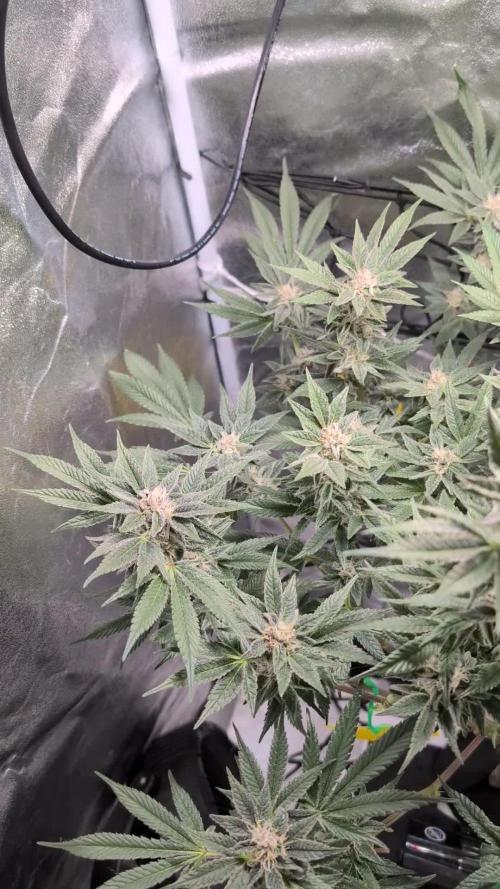
Still waiting for the buds getting bigger. Seems like the ladys will need 10 weeks of flowering, so I will switch to Athena Fade in the middle of week 8.
Sour Fraise looks so nice already. This will be nice fruity purple stuff 😋

