Likes
Comments
Share


@DRO420
Follow
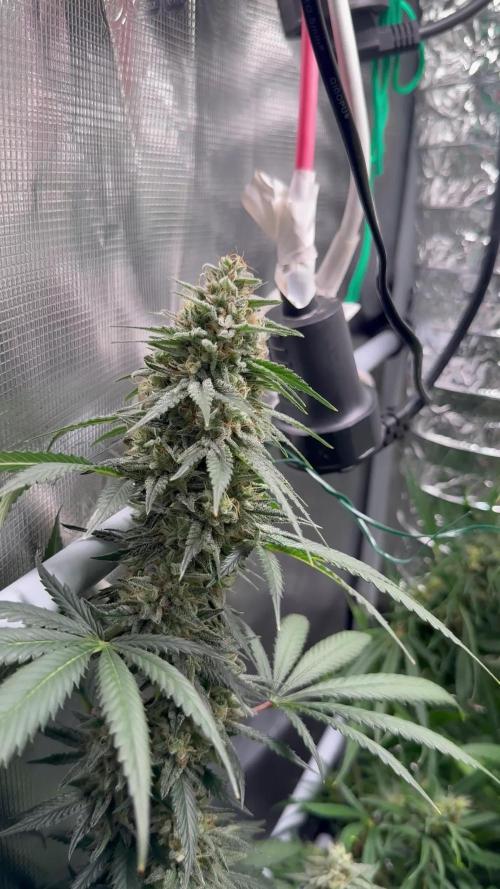
Final week of Flowering.. trichomes are looking milky very few amber.

Processing
Likes
13
Share


@Cheesefarmer420
Follow
This plant has a solid stench of pure ripe lemons. So much aroma and color in every bud, purples, to dark green, to lime green, to solid frost. This one definitely a fun strain to watch grow and tend too for the last few months. She’s definitely a hungry girl, seemed to be the only strain out of the three that accepted and thrived with full feed nutrients. Would definitely recommend this Strain to someone For a nice uplifting day smoke, also seems to do me good for some pain and stress relief.
Likes
17
Share


@JerryGallow
Follow
Everything is good now. They are healthy and smell very good! Having some troubles with the humidity, but everything looks very good at day 20 since switch.

Likes
2
Share


@SolitudeCorners
Follow
Vegetative stage
Light and Enviroments💡💧
Light 18/6 (06.00 AM - 12.00 PM)
Aim VPD around 0.7-0.9
Temp26-28 RH70-80
DLI 16-18 PPFD 200-300
22/2/24
Water 15L+Silica m/ fulvic 16ml(half) @0.1ec
+V1 130ml @1.2Ec+V2 125ml @2Ec
Ph 5.4 +Silica m/ Fulvic 25ml @PH6 Ec2.1
@11.00PM -Up to 6.2 @08.00AM
23/2/24
Last batch mix @ph5.7
2.30min shot 180ml
24/2/24
Tents feed 19 drippers @25min per min
Water3.8L+Silica mix Fulvic 6ml+1ml root exceluration+BushDoctor5ml total 0.3Ec
+V1 40ml @1.3Ec(50%)+V2 30ml final@2EC
Ph5.7
1min shot every 4and half hours total 4 shots
07.30 Am
12.00 Am
04.00 Pm
09.00 Pm
25/2/24
🏕️
Water 5L+Silica mix Fulvic+V1 45ml+V2 35ml Ph5.6 EC 2
1shot every 3hrs
First shot 12 AM
03.00 PM
26/2/24
🏕️ Last batch mix feed
1Min feed
12.00 AM
03.00 PM
Veg Foliar last 5min before lights off
27/2/24
🏕️ Water5L+Silica mix Fulvic 7ml+V1 40ml @1EC +V2 40ml @2EC Ph5.7
2Min feed
12.00 AM
03.55 PM
06.25 PM
09.15 PM 1min feed, hand watering to adjust any underwatering
28/2/24
Water 16L+Rhino Skin 15ml @0.1EC+Calmag 15ml @0.3EC PH6.9 + V1 125ml @1.2EC+V2 120ml @2EC PH6.2 adjust to PH5.6
Tray
FEED 1min(60ml) @27/2 at 11.50PM
28/2 Feed
11.00 AM 30Sec (30ml) WC from 52% goes up to 59%
02.42 PM 30sec
Dryback right now is 15% for 24hrs
⛺ Feed
08.50 AM 1.30Min
02.25 PM 1Min
04.50 PM 1Min hand watering to adjust any underwatering
Defoliation most big fan leaves
Likes
13
Share


@Gardengobblin
Follow
Les plantes étaient vraiment givré lord de la coupe . A manipuler avec gant 🤣
Agréablement surpris des terpene . Il ses vraiment installer une odeur de crème glacer à la vabille ses dernière semaine .

Likes
19
Share

@AlpenZilla
Follow
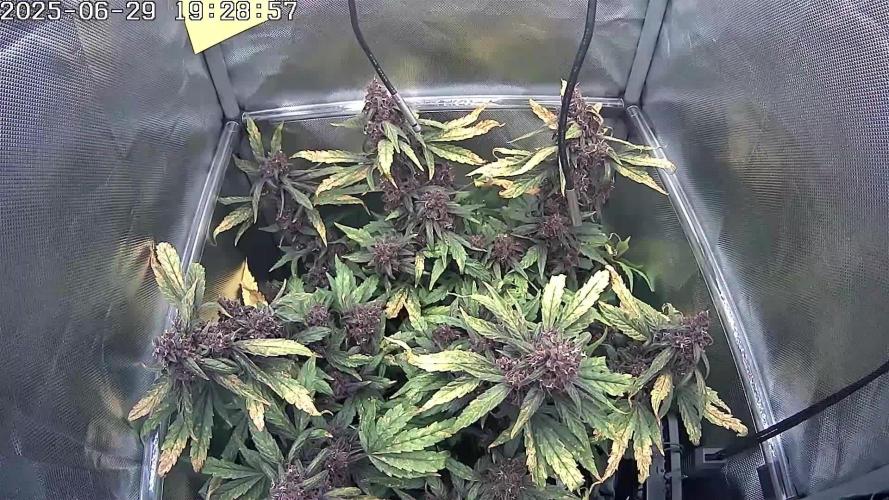
Harvest – Day 66 (BT42 / July 3rd)
✂️ Today was the day – RedPure#4 was harvested!
📅 Right on schedule at BT42, just as the breeder described.
⚖️ Wet weight: 454 g
Now it’s time to dry and hope I can beat the 50 g dry weight from the last run 😎
Fingers crossed! 🤞💨

Likes
5
Share


@Bdawg
Follow
Tied up few branches opened canopy up abit fpr better airflow for the last 2-3 weeks.
Likes
6
Share


@Shellshocked
Follow
This week went well I gave 1 cup of water per plant ph to 6.7 ocean Forrest will feed them for 2 weeks to a month (the soil there in)

Likes
13
Share


@Canadian
Follow
Thank you for reading I will continue to update once they are drying and ready for cure.
I have cut down in jar everything the wait was 91 grams please consider that when they comes to my scale weight i wait until the main stem breaks with a loud crunch and the buds are really dry to the touch reason for it I have a very busy life and at the end of the day this is just a hobby so I cannot be opening those jars many times a day at most one in the morning and one in night so I want to avoid mold on them.so I push in a Boveda pack to keep them nice.
After three weeks in jar that smell has incremented a lot be aware if where you are it's not allowed to smoke because once you open that bag or container everybody knows you open one of those buds it is incredibly powerful smoke and it is very very smooth great strain to have.
Taste 10 out of 10
Aroma 10 out of 10
High 10 out of 10 . Night. strong THC.
Yield 10out of 10.
Taste 10 out of 10
Aroma 10 out of 10
High 10 out of 10 . Night. strong THC.
Yield 10out of 10.
thank you for reading have a happy grow

Likes
11
Share


@Eddjack
Follow
La pianta è carica di nutrienti sana e forte. Continua una fioritura lenta non vedo l ora che esploda ..comunque ha già un buon profumo ed è bella appiccicosa ...promette bene
Dajeforte growers

Likes
6
Share

@CadillacGreen_420
Follow
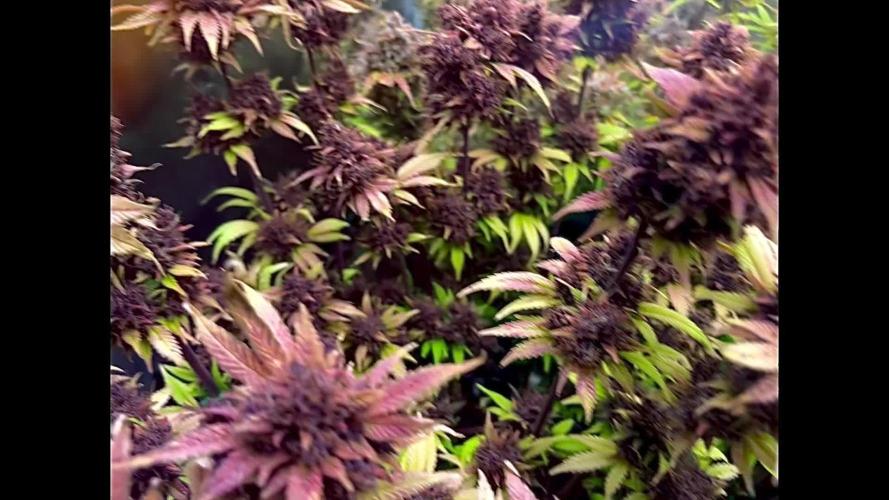
Week 13 – Ripening is now progressing slowly, as I had expected, due to my choice to provide a light stimulus that isn’t too intense but rather gentler. From flowering until now I’ve maintained 30 DLI and a steady 470 PAR.
In this run, the goal has been to keep the resin thick and sticky. Humidity has been kept between 57–62% max. My lamp is an Omega Pro 300W, which I’m currently running 37% (111 W).
This strategy seems to be working well: resin production has been abundant, and on this point—and not only this one—I’ve completely fallen in love with Gorilla Cookies.
The aroma is exquisite, and the resin… the flowers are covered in ointment-like resin.
The macro shots of the trichomes still don’t show any amber heads, so I believe harvest is probably about 10–15 days away. 🍮🤤
I think I’ll grow only Gorilla in the next run! 🦍👀
P.SThe leaf discoloration happened very quickly! The previous photos are from yesterday when it was still green — today it looks like this. Really interesting


Likes
Comments
Share

@fridge
Follow
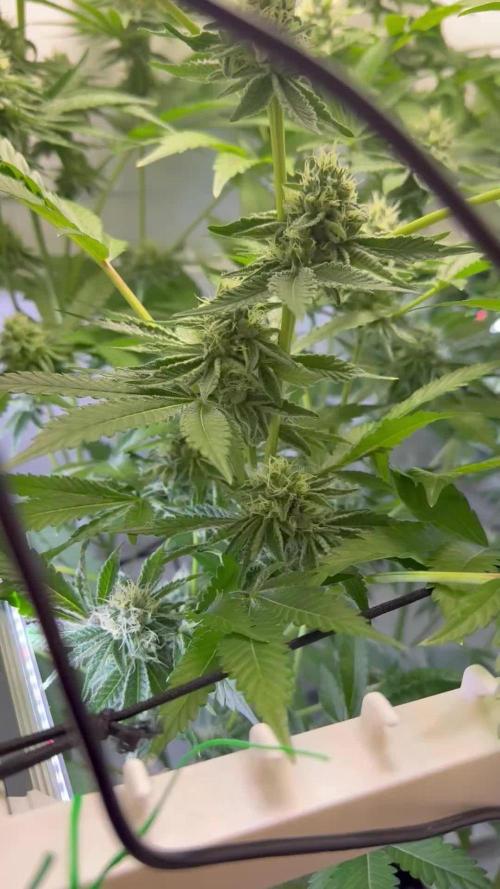
end of week 4 flower | bit more deficencies | this one is running on only 50% fertilizer |
Likes
32
Share


@Arcadium
Follow
Explosive growth this week! Must of doubled in size. Some kind of hungry insects, caterpillars maybe? Minor leaf damage, nothing major. Going to keep up with Neam/Aloe/Kelp spray. No rain in the foreseeable future, 26c every day, early summer for sure.
Doesnt appear to need any extra nutrients, will add some more Gaia Green next week.
I've had Lupins here for the past few years, which are Legumes and have great nitrogen fixing qualities, not to mention this entire patch of land had 20 years of old decaying blackberry bramble which were cleared 3 years ago when we bought the place, and the soil is some of the richest I've ever seen. No shortage of Nitrogen in there.
I'll be honest, this plant is twice the size this time of year then the last 2 years I've been growing outdoors. I'm a little concerned I'll need my ladder come Oct! I did FIM once earlier in the week, will FIM ever 2-3 weeks till July to try and keep the height under control.

Likes
25
Share


@BudHaks
Follow
As you can see, she is getting thicker as days go by! Looking to harvest her in 2 weeks! Minor light burn on the top cola, but other then that no deficiencies at all.

Likes
19
Share


@proud_to_grow_loud
Follow
I switched my nutrients to Nectar For the Gods because I didn't have the funds in the beginning to do so. I got their spartan regiment with the extras. Photo-plus and SLF-100 which I use separately and not during feeding. Im watering everyday and feeding every other day. Water days I use SLF-100 and the next water day I use tea with Photo plus. my tea I use bloom by cultured biologics organic easy bloom and compost worm castings from my personal vermicomposting bed. alternating water days with the slf and photo plus was a massive growth in buds. They dense' nd up and just started putting on trichomes. brilliant brand- Nectar! OCGFAM for life now. Feeding is a pain but damn its worth it.
Pricy but worth the investment!


Likes
27
Share


@GrammaGriller
Follow
Делали маникюр 5 часов в 6 рук, все липкое
Вкусно пахнет, много фиолетовых оттенков
Много листвы сахарной и вторичного продукта

Likes
19
Share


@TheCannaProphet
Follow
----------------------------------------------
~Sweet Seeds Sweet Zenzation (SWS84)~
----------------------------------------------
Zkittlez is one of the most famous and potent strains found on the west coast of the USA. Sweet Zenzation (SWS84) derives from a cross between an elite clone of Zkittlez combined with a specially selected Grape Ape clone, which is one of the strains used to develop the original Zkittlez.
The result is a predominantly Indica genetic hybrid. It produces a large amount of resin-soaked flowers. It is both relaxing and stress-relieving, yet it also stimulates the imagination and conversation, an effect that is normally associated with sativa strains.
The flowers have a high terpene content, an exquisite aroma and sweet taste, with hints of fruit-flavored candies, hardwood undertones, shades of lemon, cypress and subtle aromatic peppers.
Variety: Sweet Zenzation (SWS84)
Indica: 70%
Sativa: 30%
THC: 16-23%
CBD: 0.2%
Indoor Yield: 450-650 g/m²
Outdoor Yield: 400-700 g/plant
Effects: Creativity, Stimulating, Happiness, Relaxing
Taste: Spicy, Fruity, Citrus, Lemon, Candy, Cypress, Sweet
________________________________________________________________________________________________________________________________________________________________________________________________________________________________________________________________________________________________________________________________________________________________________________________________________________________________________________________
THE SETUP:
~Planted into Jiffy Peat Pellets that were hydrated with de-chlorinated water with SuperThrive added then ph'd to 6.0 @ 80℉
~Grown 100% organic in 10g fabric pots with Mother Earth 70/30 Coco/Perlite medium amended with 2tbs/g of Down To Earth 4-4-4 / 2 cups/g of Earthworm Castings / 1tbs/g of Dr. Earth Flower Girl 3-9-4, 1tbs/g of Dr. Earth Bat Guano, 3/4 cup of Down To Earth Azomite and 1 tsp/g Down To Earth Fish Bone Meal.
~24hr light cycle during Germination / 19/5 light cycle for Vegetation and 12/12 for Flower
~Straight water ph'd @ 6.2-6.8 when needed and weekly Compost Tea's.
__________________________________________________________________________________________________________________________________________________________________________________________________________________________________________________________________________________________________________________________________________________________________________________________________________________________________________________
Weekly Updates:
9/20- 💥BOOM!💥 Week Six of flower is here and my girl's in high gear, stacking her flowers and pumping out trichomes!
Today I watered her with 1.5g de-chlorinated water with 5ml/g of Botanicare CalMag+ added, then ph'd to 6.2 @ 72℉. I turned her pot and plucked a couple of yellow shade leaves...the basic daily maintenance.
9/22- I didn't water her yesterday as she looked great and was 'praying' hard. Today she was given 1.5g of de-chlorinated water which was ph'd to 6.2 @ 72℉ which I gave her through her drip pan (bottom chuggin) and I also gave her pot a turn.
I'm keeping an eye on what appears to be a few seeds developing. I'm hoping they're just fat calyx's that haven't matured yet however there's a strong possibility that, due to a temperature fluctuation that was excessive (20℉) may have caused her to stress and turn hermaphroditic... Fingers crossed! 🤔🤞
9/24- We're getting close to wrapping up Week Six of flower in a couple of days and she is right on track to be finishing up in the next 2-3 weeks.
I didn't water yesterday and today I went ahead and gave the last Top Dress of Dr. Earth Flower Girl 3-9-4, Dr. Earth Gold Premium 4-4-4, Down To Earth Bio-Fish, Down To Earth High Phosphorus Bat Guano and Worm Castings.
I watered in the Top Dress with 1.5g of de-chlorinated water which was ph'd to 6.2 @ 72℉ and let her enjoy her meal! 😜
9/26- After her heavy watering on the 24th I didn't water yesterday and when I checked her today at 'lights on' and she still had some weight to her pot and her leaves were praying hard so I held off on watering today and will hit her tomorrow with her usual 1.5g watering.
~Thanks for stopping in! Things should be getting a lot more interesting in the coming weeks...Stay lifted and be Blessed! 😎🙏~