


Likes
Comments
Share


@TiRobotProds
Follow
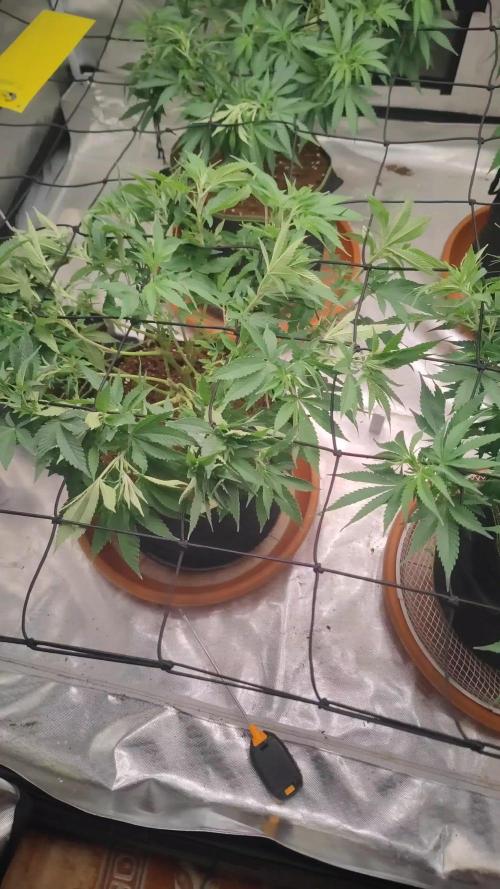
Quelques feuilles montrent des brûlures de noix prochain arrosage a l'eau.
13/12 cette dames mesure 104cm continue a s'étirer.
18/12 deux semaines de 12/12 stretch x5 pour cette dame.


Likes
28
Share


@MadeInGermany
Follow
Hey everyone 😃.
This week she has done great 👍.
It was done again on all the drifted topping and sprayed one last time with neem oil so that the last trips are finally gone 😁.
We haven't had any pests for so many years and all of a sudden we have such little shit parts 😅.
This week it was poured twice with 1.2 l of water.
GHSC enhancer was added during a pouring (1 g per l)
The tent was cleaned every day this week and the plants were checked for health.
The humidifier is filled once a day.
Next week I will decide how I will continue the training because I have space again in the flower tent 😀.
This week I'll decide whether it goes straight into the flower tent or is pruned again.
Until then, I wish you and your families a good start into the new year 2021 🙏🏻.
Stay healthy and let it grow 🍀
You can buy this Strain at :
https://www.royalqueenseeds.de/feminisierte-hanfsamen/220-pineapple-kush.html
Type:
Pineapple Kush
☝️🏼
Genetics:
Pineapple x O.G. Kush
👍
Vega lamp:
2 x Todogrow Led
Quantum Board 100 W
💡
Bloom Lamp :
2 x Todogrow Led
Cxb 3590 COB 3500 K 205W
💡💡☝️🏼
Soil :
Canna Coco Professional +
☝️🏼
Fertilizer:
Royal Queen Seeds Easy Boost Organic
☝️🏼🌱
Water:
Osmosis water mixed with normal water (24 hours stale that the chlorine evaporates) to 0.2 EC. Add Cal / Mag to 0.4 Ec Ph with Organic Ph - to 5.5 - 5.8 .

Likes
14
Share

@Northern_Ent
Follow
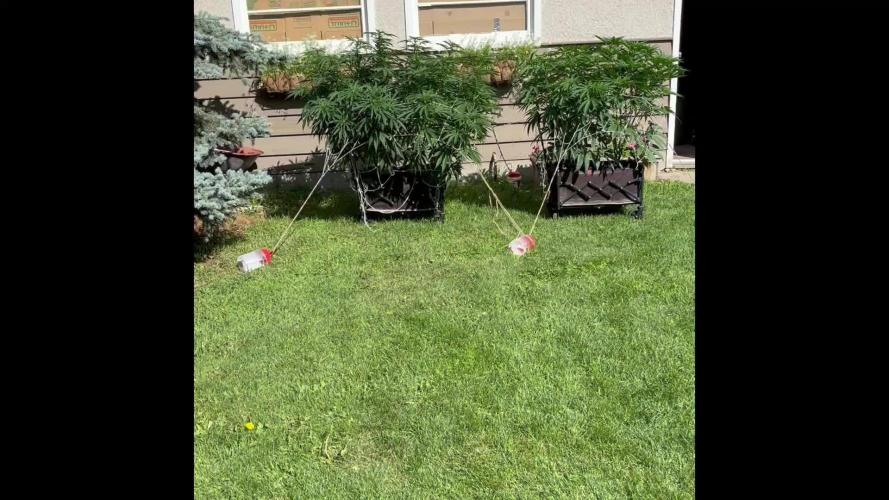
July 26: Lemon Cream Kush is doing just fine. Nicely recovered from me breaking one of the two main stems several weeks ago. I managed to tape it and she recovered quite well but it delayed things a bit and left her a bit asymmetric.
Did a fourth lazy compost tea, see video explaining how i do it without an air pump and using cheap ingredients like blackstrap molasses and Epsom salts.
July 29: defoliated lower fan leaves and small lower bud sites.
Aug 1: added another round of malted barley and Power Bloom because the cannabis plants are showing signs of P deficiency. Blue-ish leaves and reddish petioles on another plant should be fixed by the malt and Power Bloom.


Likes
5
Share
@Smev1337
Follow
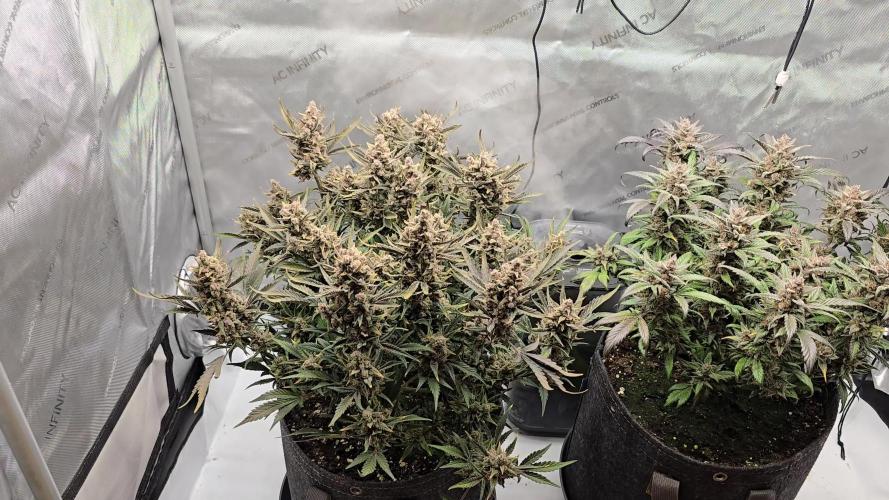
hey all! this week is kinda rough with the temperatures because outside its 35°C 😫 but the grow boxes are on 26°C stable but when i woke up both humidifiers had no water in them because they used it up all lol and the temperature got up to 27°C while they were off so shit haha but we survived it i think 😂 this is the last week in flowering and the next one will be the harvest!😎 happy growing all!

Likes
2
Share


@pzwags420
Follow
Plants are growing well. set up veg tent with new ac infinity tent and fan.


Likes
8
Share


@Edeplant
Follow
LED dimmed down to 40%, i.e. 48 Watt.
Tatanka Pure CBD Seed died on 2nd day (watch Video).
Replacing it with Painkiller XL and Northern Light auto - hopefully they spout fast and healthy this time.


Likes
21
Share


@PrairieFrostGrow
Follow
**** Week 7 Flower - October 31 to Nov 6, 2020, Days 43 to 49 *********
Sorry again gang......still have lots on the go.
This was flush week.......One watering at start of week had Rezin. Flawless Finish given on day 45. Wasn’t going to but they slowed down drinking quite a bit so they are also closer than I expected. They will see week 9 though, unlike Cream 47.
Swelling and trichome production has picked up last week and this one👍 Fade is coming but she is not producing the same purple fan leaves as the original seeds phenos🙁 They should lighten up yet though and feed on themselves more since they have another couple of weeks.
Sorry gang......busy life and November and holding the same.......will get the weekly details added in here sooner or later........I love this strain and want to put together a nice diary to convince others to give her a try.......she is powerful and grows big!👍
Purples starting to come in the bud........this is the week the leaves should change color but never did. Trichomes are building this week and you can tell as soon as you try and pick up anything else😀
Cheers Growmies and have an awesome week!!🙏

Likes
24
Share


@Smokwiri
Follow
This and the Z&Z will go together in the wide slab style container.
First letting it grow a bit larger for a week or two before transplant.
I had some awesome frost on these, so doing it again... (Added picture)
Not to sure what kind of training, i think some topping or fimming will be done with some lst bending to fill the space up
ViparSpectra XS series 8% DISCOUNT CODE on Amazon:
XSsmokwiri
US: https://amzn.to/3jNSANp
CA: https://amzn.to/3ekoz6v

Likes
5
Share


@Bdawg
Follow
Flipped with net about 90% full almost full now after abit of stretch. Gots change the rez today.
Processing
Likes
4
Share


@805homegrown
Follow
So I was really happy to have the opportunity to grow this strain I have my clones are ready My next grow will be sour headband and GDP they are all in veg

Likes
Comments
Share

@deseed_uy
Follow
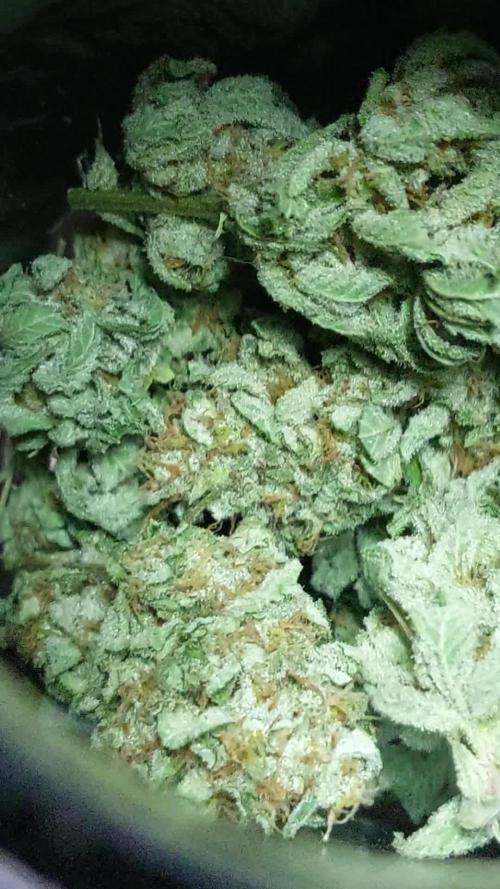
Llegó la cosecha, salió poco por factores climaticos pero muy buena calidad y exquisito a pesar del poco lavado. Muy contenta con el resultado iremos mejorando
Likes
2
Share


@Ultraviolet_
Follow
The nighttime VPD does not need to mirror the daytime VPD. Daytime VPD dictates the pull of water and nutrients, while nighttime VPD acts mostly as a prevention tool. A high nighttime VPD increases the risk of the leaf temperature dropping below the dew point, which can trigger bud rot and powdery mildew.
Switched down to 12's hours of light mid-week, changed spectrum, increased light intensity from 840umol up to 1150umol at current height. Overnight from 800ppm to 1500ppm, morning compensation point (microorganisms) 46-47 days from germination, she fills the canopy herself, once the apical dominance is broken.
Measuring a plant's overnight CO2 emissions provides an accurate estimate of its dark respiration rate. Because photosynthesis stops in the dark, you are isolating the respiration process, which allows you to gauge how much stored energy (glucose) the plant has consumed and estimate the scale of oxidative phosphorylation. Oxidative phosphorylation is the final stage of respiration that generates the bulk of the plant's ATP (90%) and relies directly on the oxidation of these respiratory substrates NADH and FADH2 along with the consumption of oxygen.
From a thermodynamic standpoint. Growth is an energy-capturing process, and the rate of that growth is bound by the available free energy (Gibbs free energy) and the First Law of Thermodynamics. While the ceiling or upper limit is dictated by free energy (such as photosynthetically active radiation), the actual amount of growth relies on how the plant balances that energy with other limiting factors. These are often described as the nine cardinal parameters of plant growth. 4 Above, 5 Below. If any one of the 9 becomes bottlenecked, the entire plant's cycle is restricted.
Operating an 80F+ environment at night to force rapid carbon conversion comes with major drawbacks, as the biochemical processes work differently than the deductive logic suggests. While raising nighttime temperatures to 80F indeed accelerates respiration and speeds up the conversion of captured sugars (sink activity), doing so also radically increases the plant's overall metabolic baseline. If the plant's metabolic rate is artificially forced too high via heat, it can actually "burn" through more energy than it managed to assimilate during the day. This leads to carbohydrate starvation, stretching, and a net loss in final biomass yield.
400 ppm is near the standard ambient level; the plant's stomatal intake is the primary limiting factor, not the dark-reaction enzymes. To push 45 DLI without burning out the plant. Trying to force the conversion of a massive daylight DLI in a compressed time frame (12 hours) becomes highly inefficient because the Rubisco enzyme simply hits a saturation limit. To successfully convert a 45 DLI into dense, productive mass, the ambient CO2 generally needs to be elevated to the 1000 to 1200ppm range. This creates a steeper concentration gradient, driving the stomata to inhale CO2 fast enough to match the high photon energy.
It's not all about the amount of light, but the ratio too, as this will dictate growth through the ratio of phytohormones. In order for correct bud development, there needs to be a correct ratio of RGB. Different wavelengths have different penetration depths. When one grows using top-down lighting, only the entire canopy is limited to 2-3 layers of leaf, meaning there will only be correct bud development in those layers, regardless of getting 45DLI.
The biomass potential of a plant is linked to root mass. Generally, when a plant reaches its maximum biomass, you can help to chop off parts of the plant that are in less than efficient areas of the plant (low light) so that it can create new biomass growing towards the light.
Strength is the maximum potential, and power is the rate of conversion. You can have the biggest veg period of 18 weeks, and it means nothing, as soon as you start flowering, the chronological clock starts ticking, the only metric that matters to bud size is how much energy you convert each cycle, not by how long it took you to build the framework, it helps a lot nonetheless.
Not saying anyone should not defoliate for a reason, only that you should have one, and at the right time. Don't defoliate 30+% on autoflowers or 4 weeks into the flower period and expect an increase in yields; it doesn't work like that. There is room for dictating growth patterns and clearing out overcrowded nodes, but it needs to be done in veg because once that timer starts and buds start growing, it's all just energy conversion. One barely needs to defoliate at all in a 4x4 because with side lighting, turning a 2d canopy penetration into a 3d, even lower buds are 90% the quality and density of top ones. The rate of photosynthesis and the ultimate density of lower buds aren't just about the sheer number of photons PPFD. The specific ratio of R:G:B dictates canopy penetration and drives different photochemical reactions. The Electron Transport Rate (ETR) measures the speed at which electrons are driven through Photosystem II (PSII) during photosynthesis. The ratio of Red, Green, and Blue (RGB) light heavily dictates this rate.
Plant leaves continuously perform cellular respiration regardless of the time of day, using energy and oxygen to fuel essential metabolic maintenance. If you over-defoliate, the remaining canopy may be unable to produce enough net sugars during the day to offset the constant respiratory demands of the plant. Must balance fixation with assimilation; there's no point in capturing 45 DLI if you only convert 20% every cycle due to an extreme lack of respiratory capacity to perform cellular oxidative phosphorylation.
You can have a 4x4 canopy or a 4x4x4 canopy, yes, we know that side lights are not as effective at absorption from the sides or underneath, but it's not about DLI, it's never been just about efficiency, it's about the penetration ratios of RGB that drive ETR of/photosynthesis and trigger correct bud development. The size of each bud is its own ability to perform the ETR required for its own personal growth, and bud development is dictated by the ratio of RGB. It drives localised growth and acts as a regulatory switch for that development. Turgor pressure is another very important factor in understanding if you want big buds, for it is the "steam engine" that dictates the rate of bud expansion. Simply, a lot harder to achieve metabolically at ambient 75F than at say 86F
Because buds have less chlorophyll, they do not suffer from the same photosynthetic shutdown that over-exposed, light-stressed leaves do. They can soak up direct light energy to swell in density and size. Their tolerance to intense light is heavily limited by the temperature and humidity, but if you can control those temps and keep the rot away, buds have a much, much higher tolerance to high light than leaves. Beneficial to hammer with high light before trichomes appear. Balancing this with trichome maturity is key for rich terpene and flavonoid profiles, want it just right, somewhere in the middle, not too much, not too little. Find cannabis plants can defoliate themselves come harvest, given the right signals. Every last ounce of potential is recycled into buds by the plant itself (senseceance), given you can keep the level of conversion high enough to prompt a need to do so.
Get the canopy @ optimal PPFD range, 45-55DLI, then let the plant "stretch" the stems into a "PPFD range much higher, one that leaves don't like to grow in, but buds thrive in. What is optimal for a bud is different from what is optimal for a leaf photosynthetically. Genes provide the blueprint, but the environment dictates how, when, and if those genes are expressed. Must first signal the condition to increase the expression you want to exist through stress and response, cause and effect. A well-buffered CEC medium prevents extreme nutrient swings, allowing plants to maximise their dedicated genetic expression.
A plant is either genetically expressing "growing" or "recycling" genes based on its nutrient starvation level in the medium. Constantly toggling between "growing" and "recycling" hormonal states creates a futile cycle that wastes valuable metabolic energy. Plants rely on sophisticated biochemical switches to manage this trade-off and prevent rapid fluctuations that disrupt that balance.
This energy inefficiency is a recognised biological challenge. Plants avoid this costly "flip-flopping" by using hierarchical master regulators (like the TOR and SnRK1 protein kinases) that act as strict molecular switches. These networks enforce cellular commitment to either growth or survival, preventing mixed signals.
This is something that was missing from previous grows.
Under nutrient-rich conditions, TOR promotes protein synthesis, cell division, and structural expansion.
Under starvation, TOR is inhibited, and SnRK1 is activated. This triggers autophagy—where the plant breaks down old macromolecules and organelles to scavenge and reallocate essential nutrients to critical sinks.
"What's the point in flushing?"
The core idea behind a PK booster is to deliver a massive, concentrated surge of P&K exactly when buds are swelling in conjunction with a N starvation. Because these are short, targeted windows, the nutrients must be highly bioavailable so the plant can process them immediately. As soon as you go "organic," that's out the window. Much slower release, uncontrolled, very difficult to "spike". to cause the ratio that will initiate a response.
High-volume PK spikes rely strictly on the immediate uptake capabilities of mineral fertilisers. Making it far less efficient in organic/living soil setups.
When you use organic nutrients, it changes the dynamic with which the plant delivers and trades its nutrients; organic is always releasing new nutrients into the immediate EC. This prevents a lot of autophagic responses from occurring due to a constant stream of new nutrients into the immediate medium's EC. This can prevent nutrient starvation from being signalled.
PK boost is essentially just N starvation, triggering an autophagic response. Concentrated ratio of P&K while tapering off the Nitrogen base. To the plant, the sudden drop in Nitrogen registers as a severe environmental stressor—essentially, the beginning of starvation protocols. She aggressively strips nutrients and proteins from older leaves and vegetative structures and shuttles them directly to the developing flowers and fruit. Ta daaa. Call it a PK booster and sell it. Nothing to do with the P and K itself, it's the ratio immediately available in the medium triggering a nutrient recycling mechanism within the plant itself; all the "booster" sells is the trigger to the signal.
PK BOOST with 50% ammoniacal N signals floral maturation.
PK BOOST with N starvation signals nutrient recycling/sinking.
Very difficult to initiate a response when organic nutes are doing their thing. It takes 4x5x more water significantly to leach or wash ammonia out than it does nitrates. This can prevent triggering N starvation from having its normal impact.
Manipulating the C:N ratio in the medium. One autophagic response has multiple potential signal triggers. Nutrient starvation is not an option.
Likes
2
Share
@Chrisandweed
Follow
Puuuues bueno, si alguien me explica la remontada historica de esta planta? Jajajaja
ESTOY SEGURO DE QUE LOS BREEDERS QUE LA SACARON HICIERON UN TRABAJO INCREIBLE!
Cultivé Oreoz en su dia, le saque +de 100 puntas principales haciendole apical y main lining, y la planta dio la talla para todo! Tooodoo! No pude cosecharla porque en ese armario metí un esqueje de un colega, que traia viruses, plagases y mierdases jajajajaja fallo mio no haber hecho un pequeño plan de cuarentena para asegurar pero bueno, entró el esqueje al armario, y de 6 plantas, sobrevivieron 2 porque las cortaba en breve, las que les quedaba mas ni del palo y Oreoz fue una de ellas, pero en esta ocasion me voy a poder redimir bien, o eso espero.
Cada vez mas cerca del objetivo, van flying que te cagas! Jajajajajaja están creciendo muuy bien, se expanden muuuy bien y los abonos se controlan. Hubo una ligera sobrefertilización al hacer el trasplante pero ya lo solucione, la planta mas afectada de las 4 fue la "Critical" normal, pero a esa le meti 10L de riego con flush para arrastrar todas las sales y demás. A las otras 3 les hice lo mismo pero con 5L. Ahora que ya están casi secas, han tardado 3 dias en secarse mas hoy el dia entero 4, están maravillosas, todas con sus hojas fuuuertes y mirando al techo, la critical es un poco la que aun le queda un poquito, pero con el proximo riego yo creo que ya se recupera. Luego, voy a ver si en breve planto alguna auto y la meto al indoor unas 2 o 3 semanas y me la saco al exterior... Ya veré sinceramente que en mi exterior tengo ciertos problemas dificiles de controlar, entre otros, vecinos que no saben lo que significa la palabra intimidad 😅.
Aaahh lo olvidaba!! Se ven hojas manchadas, eso es porque les metí ayer una limpieza guapa guapa foliar por delante y por detras a todas las plantas con un producto de estos tipicos de jabón potasico + aceite de neem, ya junto, en plan los 2 en 1. De entre las cosas que he ido aprendiendo con los cultivos, es que es muy importante hacer estas aplicaciones y ya no estas a modo preventivas, sino agua sola ayuda mucho, especialmente pulverizarla lo mas fuerte posible A LOS TALLOS, a la totalidad de los tallos/ramas de las plantas. Es verdad que los bichos suelen irse a las hojas a comer peeeeeeeeeero en mi experiencia, su base las hacen en los tallos y ramas, si, en la parte mas cercana a las hojas, peeero en las ramas! Por lo que minimo una vez a la semana procuro pegarle una buena pasada como si de una Karcher se tratara y si que el armario es nuevo y procuro tener cuidado, pero de momento todo bien respecto a plagas.
Cada vez mas cerca del objetivo, van flying que te cagas! Jajajajajaja están creciendo muuy bien, se expanden muuuy bien y los abonos se controlan. Hubo una ligera sobrefertilización al hacer el trasplante pero ya lo solucione, la planta mas afectada de las 4 fue la "Critical" normal, pero a esa le meti 10L de riego con flush para arrastrar todas las sales y demás. A las otras 3 les hice lo mismo pero con 5L. Ahora que ya están casi secas, han tardado 3 dias en secarse mas hoy el dia entero 4, están maravillosas, todas con sus hojas fuuuertes y mirando al techo, la critical es un poco la que aun le queda un poquito, pero con el proximo riego yo creo que ya se recupera. Luego, voy a ver si en breve planto alguna auto y la meto al indoor unas 2 o 3 semanas y me la saco al exterior... Ya veré sinceramente que en mi exterior tengo ciertos problemas dificiles de controlar, entre otros, vecinos que no saben lo que significa la palabra intimidad 😅.
Aaahh lo olvidaba!! Se ven hojas manchadas, eso es porque les metí ayer una limpieza guapa guapa foliar por delante y por detras a todas las plantas con un producto de estos tipicos de jabón potasico + aceite de neem, ya junto, en plan los 2 en 1. De entre las cosas que he ido aprendiendo con los cultivos, es que es muy importante hacer estas aplicaciones y ya no estas a modo preventivas, sino agua sola ayuda mucho, especialmente pulverizarla lo mas fuerte posible A LOS TALLOS, a la totalidad de los tallos/ramas de las plantas. Es verdad que los bichos suelen irse a las hojas a comer peeeeeeeeeero en mi experiencia, su base las hacen en los tallos y ramas, si, en la parte mas cercana a las hojas, peeero en las ramas! Por lo que minimo una vez a la semana procuro pegarle una buena pasada como si de una Karcher se tratara y si que el armario es nuevo y procuro tener cuidado, pero de momento todo bien respecto a plagas.
Likes
43
Share


@Sabac
Follow
Semana 4 de flora están a full mis plantitas. Creciendo cada día más y más.
Sanitas.


Likes
2
Share

Likes
18
Share


@Khalmenace
Follow
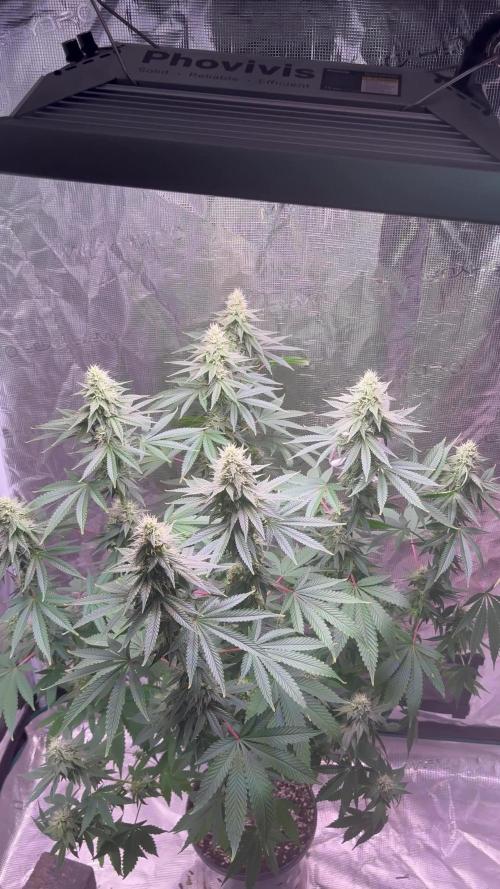
Start of week 9. Buds are filling out nicely, but trichomes are still mostly clear. Breeder says 8-10 weeks so im hoping they are ready in the next week. Both are starting to show a little bit of the leaves fading, not sure if its normal or the start of some sort of deficiency. Super strong smell on both phenos. I was expecting alot more in terms of weight but the quality dies look great. Cant wait! 💨💨


