Likes
Comments
Share
Giorni 28 Che spettacolo di odori!!! Le Rainbow sono lime/zkittlez/uva e ti impregnano le mani e ti viene voglia di staccarle e fumarle ora. Le due Pink sanno di gas/pesca (una mi ricorda l'erba più buona che ho mai fumato e cioè l' Oz Kush). Anche se una ha avuto problemi e l'ho dovuta sciacquare (#2) ora sembra stare meglio anche se alzando i fertilizzanti il colore è ancora un po' giallo. Le tre Barbara'Pie posso solo dire anche qui frutta allo stato puro ma con qualcosa ancora che non riesco a capire. Due sono molto simili l'altra è più cicciotta. La Baker Delight piena di resina e odora leggermente di biscotti ma è la pianta più indietro di tutte. Ci vediamo settimana prossima e ricorda di spendere il tuo tempo nella ricerca del seme e che nessuno ti regala niente di buono 😏
Likes
8
Share
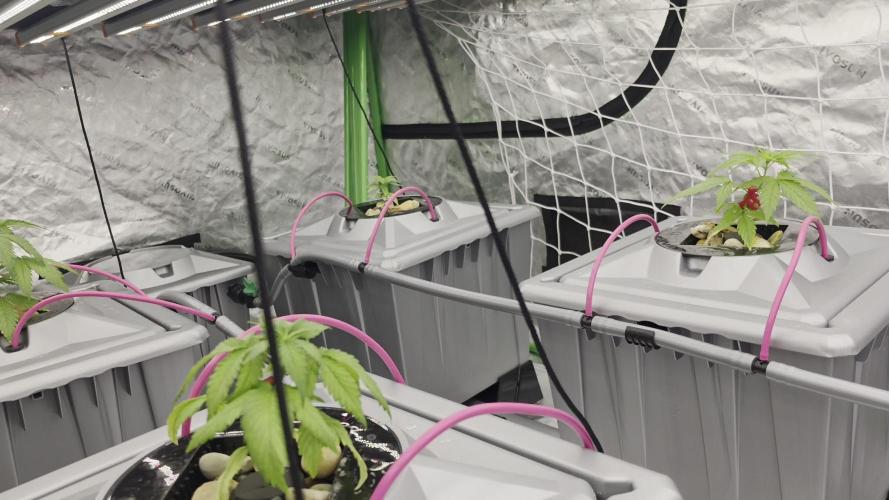
** Edición semana - se ha aportado al sistema 14 litros de agua con las cantidades discriminadas en función del número de litros considerado. Al sistema ya se ha empezado a introducir el Canna Zym y la consideración para el agua a 14 litros, se ha echo para que el día 17/08, se empiece la nutrición de floración y el cambio de ciclo lumínico a 12/12. Las próximas dos semanas corresponderán a un total de 5 semanas de vegetativo y por las tasas de crecimiento, seguramente en dos semanas tendremos la correspondencia a la dimensión final en altura del cultivar. (Mi cuenta a la altura del grow la hago, doblando la dimensión del grow cuando se produce el cambio de ciclo de luces. Así si a un vegetativo de 30 CMS cuando se produce el cambio a 12/12, representará que al final de floración la altura final estará siempre algo más del doble. O sea que si en dos semanas el grow esté sobre los 30/35 cma, al final de floración como máximo tendremos un grow sobre los 70 cms. Los grows siguen presentando un maravilloso desarrollo y la cepa fast afgana de Sweet Seeds se ha revelado un acierto magnífico para las condiciones de elevada temperatura y baja humedad que llevamos. Semana 1 1/2 - casi he cortado algo com tres días en total de la presente semana de desarrollo vegetativo y si miráis la entrada del diario anterior a esta, podrá resultar increíble lo cuanto se ha disparado el crecimiento de las "Afghanis" Fast de Sweet Seeds. Un acierto en casi toda la linea...líneas de fenotipo cara a la familia de genes del Hindu Kush. Plantas que reaccionan maravillosamente al calor y ya os había dicho que con una constancia de temperaturas que en luces está con más de 30ºC y que incluso a oscuras, sobre los 26,27ºC y donde la HR se.encuentra siempre entre máximos de 50% y mínimos abajo de 40%, y justo por su "pasado" de las montañas norte de la raya de Afghanistan/Pakistán, es muy claro que la genetica está lista para el calor...o también a frío, en otras cepas de las cuales destacó lo de Mazar-i-Shariff. Pues hoy la entrada de diario con video (en inglés) y con un nuevo set de fotos pone clara la cosa. Las plántulas pasada de jiffy al sustrato actual sobre el día 20 de julio, hoy 29 de julio - ocho días después, son muy reveladoras de lo que son las virtudes de asociar una de las más sencillas formas de hidroponia (pasiva o de APU, o sea de acción de gravedad) y que permite sin carencia ó exceso que la irrigación por Smart Mat (una forma especial de tejido, que toma la solución de agua y nutrientes desde un tablero/maceta de 10 litros y quedándose además otros 10 litros de solución en una cuba que irá vertiendo hacia el tablero por gravedad según la velocidad de absorción del sistema radicular de las plantas (o sea con gravedad se ponen a circular 20 litros en total del sistema y sobre el preparo de estos 20 litros que son la base para el calculo de PH y EC que los distintos momentos del cultivar,.necesitaran). Lo más sorprendente pasa por la siguiente análisis: cantidad de agua necesaria y cantidad utilizada, ahorro de nutrientes y cálculo mucho más efectivo en el control de cuestiones que cuando comparadas, por ejemplo, cuando hacemos riego por ejemplo, al echar 1.5 L con nutrientes y regarla cada dia y que conlleva desde temprano momento de desarrollo a aportar más agua y nutrientes que los necesarios y que al final, acostumbran a ser demasiado,.pues los cultivars se acostumbraran a una filosofía de "exceso" y con ello en regla, los flush finales muchas veces tienen que ser muy agresivos de modo a romper los cristales de nutrientes que se formam por exceso de sales en el sistema. Ya había tenido contacto con cultivars en coco, pero el cultivo en este medio cuando expuesto a las condiciones en que se hace uso racional de la introducción de agua y nutrientes en el sistema, se está revelando casi espectacular, el modo como dia pós dia, el crecimiento de las plantas sea un "espejo" del equilibrio de racionamiento de agua y nutrientes. Por ejemplo, comparar la anterior entrada antes de esta y ver lo que la estructura de tallo y hojas, su inserción y los cortos espacios internudos, es muy revelador de la principal virtud de los cultivos en coco y hidropónicos por gravedad. Algunos amigos con mayor experiencia, me habían referido que el crecimiento en vegetativo es simplemente, explosivo y lo que nos es enseñado en tan solo cuatro/cinco dias de vegetativo, pondrá el listón de calidad en esta temporada, muy por arriba. Según los entendidos, este crecimiento explosivo en vegetativo, ocurre por la manera proporcionada como el sistema de raíces que se encuentra junto al Smart Mat, termina siendo la única area mojada del medio de crecimiento Si comparáis con algunos de otros diarios que aquí presento y donde cultive en suelo, queda muy claro que tan solo en regla sobre la quinta a sexta semana se dá un estirón cualitativo y cuantitativo de los cultivars. En regla y si pensamos el riego normal en suelo y más en verano, lo primero serían las macetas que para suelo serían mayores que las padrones de hidroponia de 11 Litros. 11 litros en macetas de hidroponia corresponden a 23 litros en suelo regular. Después con temperaturas en la linea de las que estamos pasando, corresponderían a riegos de 2 Litros diarios de agua con nutrientes y con la temperatura y la adicción de agua necesarias, para suelo, en estas fechas, el estrés de temperatura y sobre todo el hídrico (por la cantidad de agua aportado) pasarían factura en el crecimiento. A contrário de otras temporadas (de suelo y riego diario), no tenemos, en primer lugar, áreas de suelo en la maceta que se sobrecargan de agua cuando aún no tiene materia radicular. Una de las señales que los grows en suelo y riego directo presentan en verano, suele ser las hojas curvadas hacia bajo y que el set primario de hojas, ya se habría puesto amarillento. Después uno de los sales más prófugo en bloquear otros sales por su exceso en el sistema, es el nitrógeno. Lo que los riegos diretos en verano crean, pasa por cuando saturan áreas de suelo que aún no tienen raíces, el nitrógeno tiende a quedarse fijado en sales en esas áreas y después si bien habrá muchas veces una cantidad muy larga de nitrógeno, al existir ese exceso, más tarde habrá influencia negativa en otros sales y sobretodo microelementos, que no se agregaran de la mejor manera al cultivar. Mucha gente no acostumbra a reflexionar sobre la forma como se hace la nutrición de raíces a través del suelo y si hay factores reductores en la integración de sales cuando más necesarios se convierten, eso pasa por ejemplo, por no haber conocimiento que por ejemplo excesos de nitrógeno pueden impedir que Fósforo o Magnésio o elementos como Boro, Hierro, Manganeso o Zinc, se integren al cultivar cuando más necesarios se hacen. En regla, los iniciados no entienden que un "overfert" de nitrógeno, que suele ocurrir más a común que se imagina (esa idea que se está haciendo la nutrición correcta cuando por ejemplo, el iniciado echa un vistazo a su "plantita" y la ve de un verde muy fuerte y lujuriante. En regla la gran mayoría de sobre fertilización ocurre con el aporte de agua. Un iniciado no será muy preocupado con el PH de su agua y con ello, también le dará poca importancia al EC y os dejo un poco esta idea " no es lo mismo preparar todos los días, soluciones de nutrición en base al preparo de 1,5 litro de solución (en base a una botella de agua de las normales) que por ejemplo preparar por ejemplo un botellón de 6 o 7 litros y usar ese botellón para riegos diarios sucesivos. Aún con medidas es muy distinto, que como en el sistema de hidroponia por gravedad que tengo a uso, pues preparó 20 litros de solución que pondré en una cuba, de esta cuba por una manguera con un sistema APU -bloqueo por gravedad- se llenará el tablero/cuba con cerca de 10 litros y en estos 10 litros estarán sumergidas las tiras Smart Mat, que al llenarse hasta el tope conducen el riego solamente en el área donde ya se encuentran formados los sistemas radiculares de la planta. O sea que en el sistema entrará justo el agua y nutriente necesario a lo que las raíces absorben....mientras que cuando haces riego directo sobre suelo, lo normal es que existan una área en proporción mucho mayor donde se satura el medio con agua y nutriente. Os explicaba que para lo que se puede controlar en PH y EC, hay diferencias muy significativas entre el preparo de 1,5 litros de solución para un día; que un botellón de 6/7 litros para riego a lo largo de 5 o más días ó que el preparo para mi sistema de hidroponia con 20 litros de solución que serán empleados tan solo por la estructura radicular que los absorbe paulatinamente. A quien en verano, perante el dilema del riego al ver incluso indoor que el suelo se seca rápidamente por la temperatura alta y baja humedad y que con eso puede en una maceta para suelo con 23 litros, llegar a hacer riego al menos dos veces al día con un total de 3/4 litros de agua y donde parte de esa agua con solución de sales será vertido en el suelo, pero en áreas del suelo donde no hay raíces...casi seguro, lo que estamos mirando con estos riegos es que tendremos seguro hojas de un verde muy bello y sin dar importancia a que las hojas se pondrán como gruesas y enrolladas hacia bajo y por el verde "bonito" no entender que la sobre fertilización ya esta en plena marcha y que más tarde en floración, por la presencia excesiva de cantidad de nitrógeno, por ejemplo lo que en floración ocurrirá, será que cuando necesitemos sobradamente de Fósforo y Magnésio, para las funciones de floración, engorda y evolución de terpenos y resinas, incluso para el "rippen", lo que suele pasar hace la alegría de los fabricantes de nutrientes, que se llenan de líneas de incluso 25 productos destinados en parte "a corregir las incorrecciones de formulación con que desarrollamos nuestros productos iniciales y a que decimos a nuestros clientes con menos experiencia, que debemos poner más que la cuenta, para que después necesitemos de otros productos en exceso, para equilibrar autênticas bombas químicas - ya sean biológicas o minerales-. Pues y sin alongar más el raciocinio, y por las evidencias y más por lo empírico de la cosa, lo que veo al menos para el periodo de verano y con la conjugación de los siguientes factores :FACTOR 1: semilla F1 Fast con genética Hindu Kush tanto por padre como madre y que guardan plantas que son por antonomasia, resistentes perfectas a las condiciones de mucho calor y poca humedad + FACTOR 2: sistema de hidroponia pasiva por gravedad, cuatro macetas de 11 Litros y responsable por una forma de riego óptima y en la cual la agua con la solución integra agua a partir de tejido Smart Mat y de aquí al sistema radicular que se desarrolla en el contacto del Smart Mat con el medio de cultura + FACTOR 3: medio de cultura formado por: Coco peat/powder con trichodermas naturales -bloque Ugro Basic 70 litros (75%) - Perlite fina (20%) + Bolas Arcilla Expandida Europebbles Plagron (5%) . A las áreas de colocación de las semillas germinadas en jiffy peat, se aporta como medio de refuerzo de protección mycorrizas Kraken - Glomus iranicus sob. + Tricofor 50 (Trichoderma harzanium) + FACTOR 4 - linea de nutrición CANNA Coco. Los cuatros factores son la base y eje de lo que de mejor tiene, en mi opinión, el sistema Quadgrow. Como hidroponia sencilla, creo que es muy buena cara a condiciones de verano, pues permiten que los riegos ocurran de modo muy regular. Habrá dudas con condiciones de invierno, pero en invierno a lo mejor habrá que contrarestar la cantidad de solución preparada y en vez a los 20 litros para una media de 12/14 días a lo mejor, será más interesante hacer el preparo de cubas de no más de 12 litros que podrán en máximo prorrogarse por un máximo de 11 dias. Para ejemplo, queda la enorme dimensión de este comentario y algunos análisis sobre las cuestiones técnicas del grow en hidroponia. Si todo lo técnico es importante, darle a la fé en el buen Dios Jah, para que todo pueda ocurrir en paz, para que los grows se hagan sin contratiempos y para que las miradas y habladurías de vecinos nunca acarreen problemas y eso siempre, por qué la más bella planta del universo, no es para generar una ganancia mayor que le de los amigos disfrutando de buenas películas, buena musica, buena compañía y en eso la mayor virtud de la cannabis como elemento de desarrollo del ser humano hace su hermano humano. Green greets y os invitó, a que disfruten del vídeo y de las fotos...
Likes
87
Share
Week 1 - 01/01 to 01/08 2021 HUGE THANKS TO @MARSHYDROLED and @VIPARSPECTRALED! New surge protectors/heavy duty timers/the good cords. The Red Poison by @Sweet_Seeds is right on track with the Dark Devil and Purple Lemonade from my other diaries. The LSD is a little behind but the genetics seems to keep it small if you get the wrong pheno. Will give it a week or so for it to really settle in with a root base before cleaning out my 5gal RootPouch pots from the last grow and getting them transferred into their final homes. I have all my seedlings under the P1500 from Vipar as my veg light for the first few weeks to a month. It's SO nice to not have a blurple anymore, the light is way better in my room and on the eyes. The new diodes had every single seedling grow more in 6 hours than it did in the first 7 days under the blurp LED. The Red Poison perked right up and threw another set of leaves in the first 6 hours under the new light just like the Dark Devil and Purple Lemonade. I noticed a bit of spotting on the Dark Devil in my other diary so I added some Hydrogen Peroxide to the spray bottle and it cleared up. All four have been getting constant spritzing from the spray bottle to keep humidity up. Excited to see how big i can get the autos under the new lights, will switch over from the Vipar to the Mars by end of week 2/mid week 3 once I transfer them and give them a day or so settle in. Thanks for stopping in! Throw down a like and/or follow so i can return the favour 🙌 -- Check out my Diary of the Year 2020 entry 🙏 https://growdiaries.com/diaries/54258-fastbuds-original-auto-sour-diesel-grow-journal-by-glazedgrow IG: @GlazedGrow CannaBuzz: @GlazedGrow
Likes
37
Share
@Capo420
Follow
Another Great Week Down! The ladies are looking great, these Orange Sherbets are a little ahead of the Six Shooters The stretch is REAL. Hahaha Everything going fairly smooth besides not being able to get this pH down a little. I have burned their tips a few time trying to flush with a high ppm low pH solution. Everything else seems to be in order though. Happy Growing! 🤙💚💪🌱😎🌱💪💚🤙
Likes
21
Share
@VicFor
Follow
Hey guys so it was an easy and nice run, a little bit disappointed with the outcome, only 223g with 3 plants but happy with the quality of the buds. Plant n.1 : 99g Plant n.2 : 63g Plant n.3 : 61g The curing phase start today so I will update soon for the smoke report.
Likes
Comments
Share
Going to run my light close to the dominant plant even if I burn it.
Likes
3
Share
Last week before harvest
Likes
66
Share
51 Days in flower have passed. This week i got myself an upgrade, new light the FC-E3000 and a 120x60 grow tent so i can grow some bigger and better medicine. I love the specs on the light, the price was right and so i have high expectations from looking at other peoples reviews of the light. We will see if im able to hit the jackpot with this! 🤠 The girls are looking great! Cheese left, Gorilla Girl right. the pictures and videos are self explanatory, its looking awesome!!! If you ever wondered where i stashed the Runtz and Bruce Banner; i took them out of the grow tent and just put them in the corner of my house without light only surviving off the light in the shadow from the sun, they have been neglected for a while but they still went on super strong, they started flowering 3 weeks ago so i had to put them into reveg so they look a little odd now but its all good. it was either that or i would have to throw them in the trash, and im not gonna waste some nice strains like that. Im impressed how they have survived with almost no light and water. ---1st time growing with FLO - Florian Living Organics.--- They claim that there is no need to pH when watering and that their living fertilizer is the only thing that i will need throughout the whole grow so i only need to mix with soil and just water with plain water. If this stuff works then it can simplify my future grows ALOT! Happy growing. 😎
Likes
12
Share
Checkout my Instagram @smallbudz to see the Small budget grow setup for indoor use, low watt, low heat, low noise, step by step. 01/11/2019 - Started using BioBizz Alg-a-Mic on spray, using it once per day at lights off, 1 or 2 puffs to create a light mist, only on non feed days, I mixed 0.1ml on 100ml water 6.4 PH. 03/11/2019 - Gave her 250ml plain water with 6.4PH 05/11/2019 - Gave her 0,15ml of each BioBizz Grow, Max and Bloom on 300ml water 6 PH didn't manage to get it higher to 6.3 at least. 06/11/2019 - She started to show some pistols, probably entering pre-flower. 07/11/2019 - Soil was to dry due to 2930c temps gave her 0,500ml of 6.5PH water with 0,25ml Grow, 0,25ml Max, and 0,45ml Bloom BioBizz.
Likes
1
Share
Lovely large buds all over even the bottom branches buds are as big as the tops, covered in thc and has a lovely citrus smell, very strong plant
Likes
4
Share
@Drtomb
Follow
Started the final week of nutrients. Then ill be switching to flawless finish and pure water the last week. The blue gelato big cola is finally starting to stack up. It has only one more week of nutrients, so hopefully it stacks quick.. Then a 1week flawless finish and a week of straight 100ppm water.
Likes
41
Share
Second week of flower has started They really grew after a heavy feeding Had to move my lights way up . LEDs tooo bright ..leaves were slightly curling
Likes
29
Share
Yet another Quebec Cannabis Seeds cultivar that exceeds all my expectations This strain is gorgeous & extremely potent. The dry stage took about 9 days... which is a little bit quicker than I'm used to, but everything turned out well. I'm very happy with this strain and I would recommend it to everyone In under 100 days I managed to get just over 28 oz off of four plants. I think the gaseous CO2 is directly responsible for this and I will be using it for every grow going forward.
Processing
Likes
49
Share
Day 49: Week 7 behind 8s mow and onto the final stretch now. These ladies have been great performers for me in the grow I wish I had more of them to do !!!... Fft#9 is bursting with fresh pistils again now and should swell like a trooper this week. Rhe bids are rock solid under the new pistils and her smellnis so sweet like picked fruit now.Their size is more than I expected but had hoped they would attain before the final swell and ripening. She has a good few hidden gems tucked away below decks too which will be fun to find on harvest and trim. Her biggest main is doing excellent and a great guide for her siblings to grow too hopefully. FFT#10 Is looking mean and nasty in a good way. Her darkness warns of impending loss of clarity and vision if messed with in my opinion !!!. lol She looks so different to the other ladies and her bud structure is below the main tops is a little less compacted. She is covered in trichs and her can sweetness is blatent at the slightest touch. She wanted to grow her way throughout the grow and even when tied and bent , she found a way to upset the symmetrical desire I had in mind Cant beat an independent lady who knows best !. She is so tacky when handled too. I thought she was so close to finish but she is still putting a few new pistils out over her mains so she may go another 2 weeks too. I am determined to hit the sweet spots with these two ladies and am also applying a little drought stress for the next 7 days This is to test the theory out a little and see if we can get them as pitent as possible too. fingers crossed Growmies. be safe and well. thanks for stopping by. UPDATE##### Day 54 and the FFT#10 is done she finished beautifully and will be trimmed for a low slow dry amd harvest.
Likes
Comments
Share
Day 45 of flowering all going well and girls looking healthy and happy, sensi’s Northern lights #5 x haze is a real magical plant like big solid buds with a great sent, 6 plants under a 720watt full spectrum led light covering 4’x4’ area looks like it is going to be a great yeild. Starting with ripen on day 50 can’t wait to see how these girls put out in there final few weeks. Happy growing to you all ✌️🏻
Likes
35
Share
@Jacks_Pot
Follow
The 3th week of 12/12 is history and flowering has entered the grow room. 😋 I marked day 53 (day 17 of 12/12) as the first day of actual flowering. Everyday I've checked if there were fungus gnats trapped on the yellow sticky traps and I've spotted a few. So not a total infestation. I've also checked for signs of hermies and I haven't seen any. I've had one a few years ago and it pretty much ruined the whole grow. Seeds everywhere. But that was another breeder and strain. Under the screen I did some final pruning and above a minor defoilation. The Runtz are stretching nicely and the screen is filled pretty much like I wanted it to. Gonna leave them alone now, done with bending those shoots under the screen. This weeks temperatures stayed between 20,6°C (69°F) and 24,2 °C (75,5°F) and humidity levels between 44 – 56 % Light pressure was raised from 244 watt at 70cm (27 inch) to 260 watt at 63cm (25 inch). Their diet consisted of ph adjusted tapwater (ph 6,38 – ec 0,49) most of the week. They were barely fed for 1 day. Gonna keep it that way as long as I don't see any signals of shortages or surpluses. Naturally, ec leves will rise next week but one day of feeding seems enough for now. Smell is coming in slightly, but the CAN-lite carbon filter is doing it's job. There's a 600m³ one hanging in the grow room connected to a 550m³ Airfan foam softbox that's dimmed at 40% since the start of this grow. That was the most important info for this week. Up to next week's flowers!✋ Do you want to grow this strain? 👉 https://www.zamnesia.com/6000-zamnesia-seeds-runtz-feminized.html 👈
Likes
11
Share
Diese Woche hat sie ihre ersten Wurzeln ausgestreckt, also erwarte ich demnächst Leistung.
Likes
2
Share
We become aware at such times of man's wonderful ability to bring seemingly unrelated elements into harmonic balance, and receive a glimpse into a world where everything exists in conscious sympathetic attunement to everything else. When we listen to a piece of music that seems to strike a beautiful chord somewhere inside us, or view a painting that simply glows with harmonic awareness well executed, we probably do not spare much time to contemplate the wonderfully intricate combination of vibrations that our sensors make it possible for us to perceive. We tend to appreciate the relationship between the parts of something by an awareness of the harmony or dissonance of the whole. This ability enables us to say "what a beautiful house!" instead of "analysis has proven that this collection of building materials exhibits certain elements of harmonic proportion." While this ability to instinctively appreciate the beauty of true harmony has an important role to play in evolution, a more analytical understanding of the laws involved can be most useful. This is especially so if we wish to create works of art where each part exists in true harmony, not only with the other part of that particular whole, but with the universe within which the creator and the created exist. Everything vibrates. From the most dense matter to the most subtle cosmic rays, everything which our senses allow our thoughts to become aware of, can be specified in terms of wavelength or frequency of vibration. These two terms define the same thing, but from different points of view. The following are the approximate wavelengths of various energy carriers: Cosmic rays 0.000,000,001 mm Gamma rays 0.000,000,1 mm X rays 0.000,500 mm Ultraviolet rays 0.003 mm Visible light 0.006 mm Infrared 0.01 mm Sound waves 1 meter Radio waves 300 meters Violet light 400 nm to 450 nm Blue light 450 nm to 500 nm Green light 500 nm to 570 nm Yellow light 570 nm to 590 nm Orange light 590 nm to 610 nm Red light 610 to 700 nm 1 nanometer (nm) = 0.000,000,1 cm = 1/10,000,000 cm If a guitar string is plucked and we hear a sound, it is not too difficult for the human mind to associate this sound with the vibration of the guitar string. With color it is quite different. It is difficult for us to conceive that the color of a substance is not an inherent property of the substance itself, but an indication picked up by our senses of that substance's ability to absorb or reflect the light which happens to be shining on it at that moment. Neither the matter nor the light is colored. What happens is that the brain learns to differentiate between the frequencies reflected or transmitted by the substance the eyes are focused on. The same thing happens with sound. When we say "Oh! Listen, they're playing my favorite song," what we really mean is: "My brain has stored within it a particular pattern of frequencies. I have compared the new information being received with this stored pattern and have deduced the answer that the two patterns are similar within certain specified tolerances." The 'pleasure' involved could have something to do with our running the pre-recorded pattern at the same time, in 'sympathy' with the new pattern as it is received. The word sympathy describes very well our ability to appreciate color and sound. It also describes the reason behind certain elements of harmony. For instance, if a substance vibrating at 100 cycles per second (tone 1) is in the proximity of another substance vibrating at 200 cycles per second (tone 2), we could perceive, if we had the right equipment, a certain sympathetic relationship between the two. We will see from this that there is a uniform doubling of the first tone seen in the second. At various points along the waves, the two are the same in amplitude. At other points, they are at opposite poles to each other. This doubled frequency has more points of similarity to the original than any other frequency except the original itself. If the equipment we had available for measuring these two frequencies was a soundboard amplifier and a pair of ears, then we would hear what would sound to us like one tone. If we had the opportunity to hear one at a time, we would hear that although they sound the same, one is higher in pitch than the other. This characteristic of 'the same but different in pitch', musicians have called the octave. Any two tones produced where one has exactly doubled the frequency of the other is called an octave. Speaking in ratios, an octave would appear then as the ratio 2:1 or 1:2, depending on whether we are talking of an octave up or down. A single note produced by almost any instrument will contain more than one wavelength or frequency. It will have a dominant frequency, the wavelength of which we would call the note's 'fundamental' or 1st harmonic. It will also have a varying number of upper harmonics, gradually fading in intensity into infinity or silence. Natural harmonics always have the same pattern of intervals between them. The interval between the 1st and 2nd harmonic is a perfect octave; between the 2nd and 3rd a perfect fifth; between the 3rd and 4th a perfect 4th; and so on, the intervals becoming smaller and smaller until they lose any relationship with the western 12 tone scale as it exists at the moment. Just as an octave has certain elements of sympathy with its fundamental, so some intervals have been noted to be more perfectly in sympathy with the fundamental than others. The ratio of the 'perfect 5th' or interval of 7 semitones, as it occurs in the harmonic series, is 3:2 or 2:3, while that of the 'perfect fourth" is 4:3 or 3:4. All the tones in the western 12 tone scale can be expressed in terms of the ratio between the upper tone and its fundamental. This would seem to be an ideal way of generating a scale from any given fundamental and several attempts have been made to do this, the Pythagorean system being probably the most well known. Although when working with a single tone instrument playing on its own, the Pythagorean formula works wonderfully well, if we had several instruments tuned this way together and asked them to play almost any western music, we would find that at times they sounded quite out of tune to each other. The lack of flexibility of the various scale systems based on the harmonic series has led to what is known as the 'tempered' scale. This uses as its primary unit of interval the ratio of the octave or 2:1. It then proceeds to divide the interval between any fundamental and its upper octave into 12 smaller intervals by applying the ratio: two to the one-twelfth power, to one (21/12:1). This equals 1.059463094, so by multiplying any frequency by this number, we will obtain the tempered semitone next up from our fundamental. We will also find that any tone twelve semitones up from any other tone, in a scale generated in this way, will have exactly double the frequency. If we took the note middle C on a piano and halved the wavelength, we would have the note C one octave above. If we halved this, we would have the C above, and so on. However, within about 6 octaves, we would find that although a 'sound' was being produced, no human ear could perceive it. If we kept on going, halving and producing upper octaves of our fundamental C, we would proceed through the infrared band, into the visible light spectrum. If we happened to be outside during the day, we would, for one octave only, see the note C with our eyes. The next octave above would already be in the ultraviolet band, and outside the eye's sensitivity range. If we can think of color as being an indication of a substance's vibratory rate or wavelength, we may begin to see a relationship that could exist between the color and sound spectrums. The logical extension of what has so far been said is that there exists a scale in the color spectrum that corresponds exactly to the scale in the sound spectrum, each color tone being an octave of the equivalent note in the sound range. This is not the end of the story but only the beginning. If we can for the moment accept that any wavelength in one band has upper and lower octave stretching out to infinity, then the next question is 'fine, but what shall we use as our fundamental? A particular color? A particular sound frequency?' The musicians among us will probably say 'A 440'. This means that the note A should vibrate at 440 Hertz, or 440 times per second. They would tell us that this is standard pitch has been adopted by most orchestras around the world; pianos are tuned to it, instruments are constructed to formulas based on it, and so to them it would probably seem the most appropriate place to begin. Some of these musicians may know of the battle that is still raging with regards to this being the standard, but few would know why A = 440 Hz was chosen except that it worked when it was set to be a suitable compromise between the many different pitches in use at the time. 432 Hz is said to be mathematically consistent with the patterns of the universe. Studies reveal that 432 Hz tuning vibrates with the universe’s golden mean PHI and unifies the properties of light, time, space, matter, gravity, and magnetism with biology, the DNA code, and consciousness. When our atoms and DNA start to resonate in harmony with the spiraling pattern of nature, our sense of connection to nature is said to be magnified. Another interesting factor to consider is that the A=432 Hz tuning correlates with the color spectrum, while the A=440 Hz is off. Audiophiles have also stated that A = 432 Hz music seems to be non-local and can fill an entire room, whereas A=440 Hz can be perceived as directional or linear in sound propagation. Once you adopt the idea that sound (or vibration in general) can have an equalizing and harmonizing effect (as well as a disturbing effect), the science of harmony can be applied to bring greater harmony into one's life or tune to specific energies. There is a form of absolute and relative harmony. Absolute harmony can, for example, be determined by the tuning of an instrument. The ancients tuned their instruments at an A of 432 Hz instead of 440 Hz - and for a good reason. There are plenty of music examples on the internet that you can listen to in order to establish the difference for yourself. Attuning the instrument to 432 Hz results in a more relaxing sound, while 440 Hz slightly tenses up the body. This is because 440 Hz is out of tune with both macro and micro cosmos. On the contrary, 432 Hz is in tune. To give an example of how this is manifested microcosmically: our breath (0,3 Hz) and our pulse (1,2 Hz) relate to the frequency of the lower octave of an A of 432 Hz (108 Hz) as 1:360 and 1:90. It is interesting to note that 432 Hz was the standard pitch of many old instruments and that it was only recently (19th and 20th century) the standard pitch was increased. This was done in order to be able to play for bigger audiences. Bigger audiences (more bodies) absorb more of the lower frequencies, so the higher pitch was more likely to “cut through”. One of the oldest instruments of the world is the bell ensemble of Yi Zeng (dated 423 BC), tuned to a standard F4 of 345 Hz, which gives an A= 432 Hz. The frequency of 345 Hz is that of the platonic year! Similarly, many old organs are tuned in A=432 as well; for example, St. Peter’s Capella Gregoriana, St. Peter’s Capella Giulia, S. Maria Maggiore in Rome. Maria Renold’s book “Intervals Scales Tones and the Concert Pitch C=128 Hz” claims conclusive evidence that 440 Hz and raising concert pitch above scientific “C” Prime=128 Hz (Concert A=432 Hz) disassociates the connection of consciousness to the body and creates anti-social conditions in humanity. The difference between concert pitch A=440 Hz and Concert A=432 Hz is only 8 cycles per second, but it is a perceptible difference of awareness in the human consciousness experience of the dream we share called existence.
Likes
10
Share
@TerpyOG
Follow
All three plants packing on weight, Buds fatter than my thumb! Full of color and smells super fruity, Very excited to grow this girl out and taste her.