


Likes
Comments
Share


@LoSBigBlue
Follow
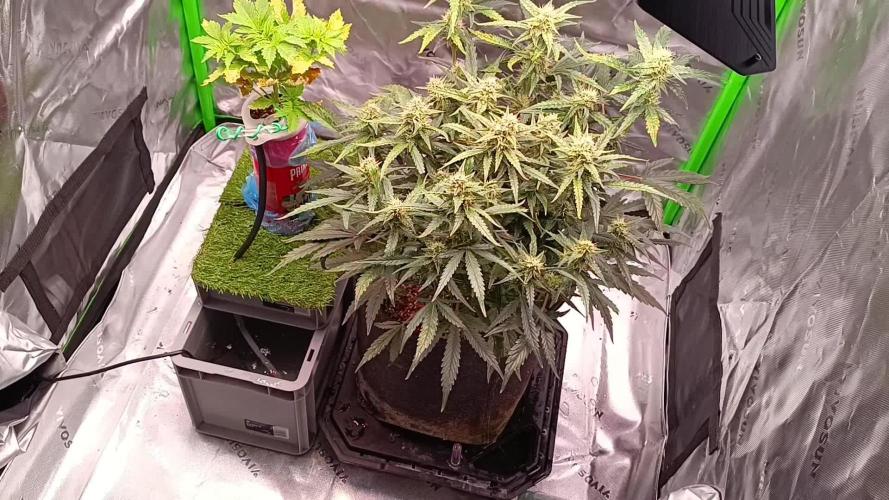
Week 8 is here and Budville is getting chunky and skunky. If this was not my first grow I would probably would have started some defoliation by now but decided to just be patient and see what the end result will be. She is right on track to be harvested around the end of this month, we shall see.
Waterings have picked up greatly, getting 2L about every 36hrs with BioBizz every other watering, @ full strength based on their schedule.
Set up an intake fan bringing in cool air from the A/C in the room. Able to keep the RH down around 40-45%, with temps running about 27C°.
Budville is getting between 900 & 1100µmol , 65/72 DLI from the TS1000.

Likes
7
Share

@GmiadlichGanjaGrown
Follow
Nachdem ich ja einige Probleme mit dem pH-Wert hatte, läuft es jetzt super. Die Spitzen der Blätter sind mir etwas zu braun, grundsätzlich strebe ich aber leicht "lackierte Nägel" an. Sonst gibt es nicht viel zu sagen, läuft.

Likes
97
Share


@Teamdirtbag2
Follow
There doing great at 36 inches. Looking healthy and getting 4 and 1/2 hrs extra light. Growing fast that is for sure. Did some defoliation bottom carp. Found thrips so I had to spray. Hope I killed them.


Likes
11
Share


@LittleBigTrees
Follow
This week they've stretched a lot , there using a lot more feed now .

Likes
7
Share


@Smiffy
Follow
Flowering started, plant stretching, have defoliated to allow light to lower canopy, light smell in the tent, good smell on touch of stems. Very light purple colour in centre of leaf fan/top of fan leaf stem


Likes
4
Share


@QixxGrows
Follow
Day36, 37, 38: Seems to be growing a set of leaves per day now. Super growth! Stretching to the top.
Day39: I had a hiccup with the camera. For some reason it stopped responding at 04:30 in the morning. I only realized it much later. I still don't really know why, but reseating the data ribbon fixed the issue.
Day40: After fixing the camera, I decided to take this view again. The Lady is starting to show some nice growth and this view will show it best. If you look carefully, you'll see that her branches are not green, but rather reddish. Definitely related to genetics :) Everything else is within limits. Plus, the leaves look super healthy.
Day41: Here you can see the stem colour better.


Processing
Likes
1
Share


@BudTowers
Follow
Growing growing growing. So, I have an extremely stressful job, and even though working with plants (of all types, not just weed) is how I unwind, it is coming to a head. Therefore, while I am still trying to get my updates up on Saturday or Sunday, sometimes, I spend the weekend just short of catatonic. However, enough about that shit.
These plants are BUSHY. B-U-S-H-Y. Thankfully, the plants have realized where each other are and aren't really growing into each other. We're getting closer to one square yard by the moment it seems like.
Other than that, not too much to report. Whenever I open the tent, I am hit by a blast of smell. I can't wait to see what these smell like when they're actually flowering. I have already decided what I will be adding in for the flower cycle, so we'll see.
Update: after a bunch of deliberation, I spent a good chunk of time between the past 2 days defoliating, LST, and supercropping these plants to stop growing into each other. I'm happy with the results, and pictures will be up soon.

Likes
75
Share


@DogDoctorOfficial
Follow
Week 7: Mastering VPD with Precision and Control
As we delve deeper into the cultivation journey with Panty Punch Auto, Week 7 brings us face to face with one of the most critical factors in plant health and productivity: Vapor Pressure Deficit (VPD). In this report, we'll explore the intricacies of VPD and how the innovative Tent-X controller, coupled with the TM+ Pro app, empowers us to achieve optimal environmental conditions for our thriving botanical companion.
VPD, often referred to as the "Goldilocks zone" of plant growth, represents the ideal balance between temperature and humidity. This delicate equilibrium influences transpiration rates, nutrient uptake, and overall plant performance. Through meticulous monitoring and precise control, we strive to maintain VPD within the optimal range to maximize Panty Punch Auto's growth potential.
With the assistance of the Tent-X controller, managing VPD has become a streamlined process of precision and efficiency. By integrating sensors that measure temperature, humidity, and CO2 levels, the Tent-X controller provides real-time data insights into our grow environment. This invaluable information allows us to make informed adjustments to airflow, temperature, and humidity levels, ensuring that VPD remains within the optimal range for Panty Punch Auto's flourishing growth.
In our ongoing quest for cultivation excellence, the TM+ Pro app emerges as a game-changer in remote control and monitoring. With a simple tap of our smartphones, we gain access to a comprehensive suite of features that put the power of precision cultivation at our fingertips. From adjusting light intensity and spectrum to fine-tuning PFD (Photosynthetic Photon Flux Density) levels, the TM+ Pro app offers unparalleled control over every aspect of our grow environment.
But the benefits of the TM+ Pro app extend beyond mere convenience. Its intuitive interface and robust functionality empower us to make data-driven decisions in real-time, ensuring that Panty Punch Auto receives the optimal conditions for her continued growth and development. Whether we're at home or on the go, the TM+ Pro app keeps us connected to our garden, providing peace of mind and confidence in our cultivation endeavors.
As we marvel at the impressive trichome development and overall health of Panty Punch Auto, it's essential to express our gratitude to those who have played a pivotal role in our journey. A heartfelt thank you to TrolMaster for their groundbreaking technology and unwavering support, to Aptus Holland for their exceptional nutrients that fuel our plant's vitality, to Grow Diaries for fostering a vibrant community of growers, and to all fellow cultivators for their endless encouragement and inspiration.
In conclusion, Week 7 marks another milestone in our cultivation journey, as we harness the power of innovation and technology to master VPD and cultivate excellence in every leaf and bud. As we continue to push the boundaries of what's possible, let us remain vigilant in our pursuit of perfection, guided by the unwavering commitment to nurture Panty Punch Auto to her fullest potential.
Stay tuned for more updates as we witness the ongoing evolution of Panty Punch Auto and explore the limitless possibilities of precision cultivation. Together, we'll continue to redefine the art and science of growing, one harvest at a time.
#PantyPunchAutoAdventure #RootsAndFruits #TrolMasterControl #GrowDiariesCommunity #CultivationExcellence
Genetics - Panty Punch Auto - https://seedstockers.com/
Plant nutrition - Aptus Holland - https://aptus-holland.com
LED Photons - Lumatek - https://lumatek-lighting.com
Controls - Trol Master - https://www.trolmaster.eu/
Watering - myself
Love and attention - Me, myself and i
As always thank you all for stopping by, for the love and for it all , this journey of mine wold just not be the same without you guys, the love and support is very much appreciated and i fell honored and blessed with you all in my life, With true love comes happiness. Always believe in your self and always do things expecting nothing and with an open heart , be a giver and the universe will give back to you in ways you could not even imagine so
More info, the ocasional give-away and exclusive updates from all my adventures can be found - links in the profile description
Friendly reminder all you see here is pure research and for educational purposes only
Growers Love To you All 💚 💚 💚

Likes
5
Share


@Mackdad4000
Follow
Plant is really hungry,I thought she was finished but she just keeps going. I’m assuming my particular pheno is got to foxtail, buds are growing out the buds ! Wtf, she’s bigs asf her little sister is filling out


Processing
Likes
3
Share


Processing
Likes
20
Share


@Cannibalgardens
Follow
She has been growing fine a little bit on the slower side but the container is small and I burned her in the beginning. The genetics are strong and she is pulling out all the stops .The growth and side shoots are starting can't wait to see how she does by week three I've got high hopes ...Cheers canna family ..

Likes
3
Share


@tangie
Follow
She doesn't fit in the box lol, will use ScrOG to restrain her vertically. Streeeeettttchyyyyyyy!
Accidentally snapped off a funky 10-bladed fan.


Likes
13
Share


@GanjaFarmar
Follow
To be honest overall this strain done good so as the others. Reflecting back on how i started with just a tent and light, and slowly buying the fans and filters whiles the plants were growing.
But i did want these plants to grow naturally without topping and Low Stress Training. I regret not removing the lower branches becuase i did get alot of small airy buds down there. But it was all trial and error. All i done was remove some fan leaves when good to do so every now and then. Not on a mad level tho, i did have alot of sugar leaves which i will be making some stuff with!
At veg the plants had deficiencies due to out of date Biobizz bottles. But that got sorted with the magic of Algimac and Calmag.
Overall
Next time I will definitely train the plants and maybe top a few.
Final Yield:
Plant #1 21.88 Grams
Plant #2 33.36 Grams
Plant #3 56.06 Grams
Which yield exactly 110 grams! Ounces come out very fat with these light buds
Not bad for the conditions they were brought up in, and with no training!
Thanks for everyone who has followed this diary throught out the journey! I hope this diary will help people out.
And thank you to Seedstockers for very cheap and quality seeds.
And special thanks for the GrowDiaries Team for providing the best platform for growing journals! I couldnt explain how much this Diary helped me. Its like a dream come true finding a site like this! And if you do see this message, i would love to see a Iphone app coming soon!
Kind Regards!
One love!
Likes
12
Share


@Italianganya88
Follow
Habe alle Pflanzen Entlaubt, um eine bessere Luftzirkulation und um den unteren Blüten mehr Licht zu bekommen.


Likes
9
Share


@NanoLeaf
Follow
Week 2 was simple.
Transplanted the rooted clones in to 500ml plastic cups (Clear - helps to see how the roots are developing)
Used unamended coco perlite 70/30 mix and Inoculated with GHF BioEnhancer as well as foliar feeding.
Just tried to be gentle and turned the wattage down on my ballast to 250W.
Getting the ladies cozy and comfortable in their new environment.
The humidity and the temperature was stable, tried keeping the RH around 75%.

Likes
23
Share


@Firepharmer
Follow
In to week 7 now starting to flush!!
Very impressed with this run 💚🌱💚🌱
I’m now running the Futur vert 30 W uv led for 5 hours of the 12/12 with the Futur vert flora max series
