




Likes
Comments
Share


@radagastgrower
Follow
A planta que parecia que juntava mais água de fato demorou mais pra secar e acho que a colheita foi um pouco antes da hora, ela aguentaria e se beneficiaria de mais uma ou duas semanas. Acabou que ficou mais fraca. Dei mole na forma de tirar o SCroG também e posso ter perdido um pouco pela falta de habilidade, vale mais a pena já cortar e pendurar pra secar somente os galhos e não a planta inteira, até pra retirar do SCroG.
Likes
7
Share


Likes
30
Share


@SooSan
Follow
13 jours de 12/12
OK il y a du changement !
Dans la partie du scrog vertical le stretch n’a pas été assez fort
J'ai donc abandonné la culture verticale pour cette fois
J'ai donc fusionné le bas de la tente pour avoir un espace de 90x60x90
Le ts1000 a été retiré pour laisser la place aux barres du FC-E 4800
Et bien sur gros LST pour gagner en surface et gagner 20 à 30cm de hauteur
1️⃣
🏠 90x60x90
☀️ FC-E 4800 => puissance a 20%
🍁
1x Black Bomb / Philosopher Seed
2x Amnesia Lemon / PEV Seeds
1x Blueberry / PEV Seeds
1x Blueberry / 00 Seeds
1x Wappa / Paradise Seed
1x Dark Phoenix / Green House Seed
1x Quick Sherbet / Exotic Seeds
1x Mango Cream / Exotic Seeds
1x Banana Frosting / Sensi Seed
1x Hindu Kush / Sensi Seed
4x Fast Mix / Sweet Seed
📎 https://growdiaries.com/diaries/122084-grow-journal-by-soosan
2️⃣
🏠 30x60x50
☀️TS1000 => puissance a 50%
🍁 4x Quick Sherbet - Exotic Seed
📎 https://growdiaries.com/diaries/122080-grow-journal-by-soosan
🏠
📎https://growdiaries.com/diaries/124052-grow-journal-by-soosan
3️⃣
Sponsorisé par Mars Hydro


Likes
76
Share


@Roberts
Follow
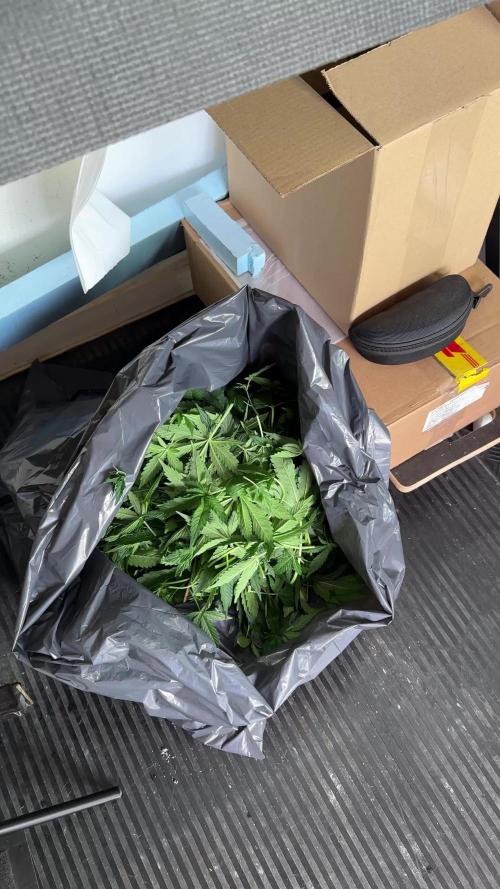
Auto creeper has grown really well. I probably could of harvested her a week ago. She has about 40 percent amber trichromes on tops. Mis judgement on my part. Plus just been super busy. Smells really strong. Heavy frost. Pretty purple hue to buds. I will be back for the smoke report in a few months once it has dried, and cured some. The Mars Hydro light worked great for the grow. Thank you Mars Hydro, and Super Sativa Club 🤜🤛🌱🌱🌱 I tried to upload my harvest video, and it won't let me. 😔
Thank you grow diaries community for the 👇likes👇, follows, comments, and subscriptions on my YouTube channel👇. ❄️🌱🍻
Happy Growing 🌱🌱🌱
https://youtube.com/channel/UCAhN7yRzWLpcaRHhMIQ7X4g

Likes
14
Share

@DogDoctorOfficial
Follow
🌱 Ghost Train Haze — Week 7 From Seed
🔁 Quick Recap — How We Got Here
• 12/12 from seed
• Mineral base in AutoPots (steady availability, no dry-back stress)
• Occasional top-feed with organic inputs
• Selective defoliation in the room — but these girls were left untouched
• Multi-layer LED canopy + under-canopy lighting
• Week 7 from seed → stretch phase still active
And now?
She’s around 70 cm, some phenos pushing 80 cm, praying nonstop, stretching like she has somewhere important to be.
That’s Haze.
⸻
🌡️ Environment Snapshot
• Day temp: ~28 °C
• RH: ~65%
• EC: ~2.9 (higher than the rest — intentionally)
• pH: ~6.5
• Height range: 40–80 cm
• LED full-spectrum, layered canopy
On paper?
Some growers panic at 28 °C in flower.
In practice?
Understanding numbers.
⸻
🍃 LED Physics — Why 28 °C Is Not 28 °C
Under LED:
• No infrared dumping
• Leaf surface runs 2–4 °C cooler than room
• Lower radiant load
• Different transpiration dynamics than HPS
So if:
• Ambient = 28 °C
• Leaf temp ≈ 24–26 °C
• RH = 65%
👉 Leaf-level VPD lands beautifully in early–mid flower comfort zone.
And the plants confirm it:
• Deep healthy green
• No tacoing
• No clawing
• No light bleaching
• Strong internode spacing
• Constant upward praying
That praying?
Not stress-praying.
It’s metabolic confidence.
⸻
⚡ Why EC Is Higher on These Girls (~2.9)
This is important.
Ghost Train Haze is:
• Vigorous
• Long-flowering
• High metabolic rate
• High transpiration under LED
She’s drinking more.
She’s moving nutrients faster.
She’s building vertical structure aggressively.
If we fed her like the others?
She’d outpace availability.
So EC is slightly higher here to match:
• Growth speed
• Stretch demand
• Structural building phase
We’re not pushing blindly.
We’re matching consumption.
And the uniform leaf color across the canopy confirms uptake is balanced.
⸻
Let’s Talk Genetics — Why She’s “Late”
Ghost Train Haze carries heavy Haze lineage.
That means:
• Longer stretch
• Longer flowering time
• Slower early flower stacking
• Higher final terpene complexity
• More cerebral profile
Compared to hybrids or more indica-leaning cultivars, Haze types:
• Take longer to show flower mass
• Spend more time building structure
• Finish later
But what do they give back?
• Airy-but-resinous spears
• Intense terpene complexity
• Electric, clear-headed medicine
• Beautiful, elegant bud architecture
They compensate.
Always.
⸻
📏 The Stretch Question — Will She Outgrow the LEDs?
At 70 cm in Week 2 flower?
Yes. She’s not done stretching.
Haze typically stretches:
• 2–3 weeks into flower
• Sometimes up to Week 4 depending on phenotype
Expect:
• Another 10–25 cm possible
• Internodes to slightly elongate
• Apical dominance to stay strong
Bringing LEDs up soon?
Smart move.
Better to anticipate than react.
⸻
🍃 Defoliation Choice — Why We Didn’t Touch Her
We left her natural.
Why?
Because:
• Haze structure is naturally airy
• She manages light penetration well
• Over-defoliation can slow stretch momentum
• She’s showing perfect airflow already
Sometimes restraint is the better technique.
⸻
🔮 What To Expect Next Week
You will likely see:
• Continued vertical stretch (but slowing by end of week)
• First real bud site stacking
• Slight shift from lime green to deeper flower tone
• Increased thirst
What you should NOT expect:
• Massive bud density yet
• Hard swelling
• Early frost explosion
It’s too early.
Haze builds in stages.
⸻
Stability Over Reaction
We are not chasing numbers.
We are reading the plant.
Temperature? Fine.
Humidity? Fine.
EC? Matching demand.
Structure? Strong.
Leaves? Praying but relaxed.
This is controlled vigor.
⸻
Final Thoughts
Week 7 from seed.
Week 2 flower.
~70 cm.
Still climbing.
And honestly?
This is exactly what you want from a Haze.
Patience now equals magic later.
⸻
🙏 Gratitude
To the OGs.
To the new followers.
To the lovers and even the skeptics.
To the GrowDiaries platform.
To the GD community.
To the sponsors.
To everyone watching silently.
Thank you.
We’re learning together.
We’re growing together.
We’re documenting honestly.
And in the end?
We grow medicine.
With respect. 🌿❤️
📡 Please stay tuned they can try and take us down but we never quit https://www.youtube.com/@DOGDOGTHEDOCTOR NEW
🙏 Thank you for your patience and continued support.
FOR DISCOUNT CODES AND MORE JUST FOLLOW THE LINK https://website.beacons.ai/dogdoctorofficial
📲 Don’t forget to Subscribe and follow me on Instagram and YouTube @DogDoctorOfficial for exclusive content, real-time updates, and behind-the-scenes magic. We’ve got so much more coming, including transplanting and all the amazing techniques that go along with it. You won’t want to miss it.
GrowDiaries Journal: https://growdiaries.com/grower/dogdoctorofficial
Instagram: https://www.instagram.com/dogdoctorofficial/
YouTube: https://www.youtube.com/@dogdoctorofficial Deleted by Youtube
Vimeo : https://vimeo.com/dogdoctorofficial Under construction stay tuned ⸻
Explore the Gear that Powers My Grow
If you’re curious about the tech I’m using, check out these links:
🔆 Lighting & Environmental Control
• Future of Grow — Advanced LED lighting technology
https://www.futureofgrow.com/
DISCOUNT CODE: DOG20
• Lumiflora — Under-canopy LED lighting
https://lumiflorade.com/
• TrollMaster — Environmental controllers and automation gear (past collaboration)
⸻
Genetics
• Zamnesia Seeds — Genetics used in this project
https://www.zamnesia.com/
⸻
🌱 Soil, Substrates, Boosters & Root Support
• Plagron — Substrates, bio mixes, and supportive products
https://plagron.com/en/
⸻
🎒 Storage, Curing & Preservation
• Grove Bags — Curing and storage solutions
https://grovebags.com/
⸻
📸 Photography Equipment & Tools
(Not sponsors, but part of my creative toolkit)
• Sony A6700
• Sony full-frame macro lens + few more
• Stacking photography workflow - learning
• iPhone (for behind-the-scenes shots)
We’ve got much more coming as we move through the grow cycles. Trust me, you won’t want to miss the next steps, let’s push the boundaries of indoor horticulture together!
As always, this is shared for educational purposes, aiming to spread understanding and appreciation for this plant. Let’s celebrate it responsibly and continue to learn and grow together.
With true love comes happiness. Always believe in yourself, and always do things expecting nothing and with an open heart. Be a giver, and the universe will give back in ways you could never imagine.
💚 Growers love to all 💚
📸 P.S. – The Eye Behind the Lens
All photos in this diary (for now — except for the ones showing the camera, which I took with an iPhone) are taken with a Sony A6700 paired with a Sony full-frame macro lens and a few more.
Photography is part of the story — it’s how we share the fine textures, the glow, and the quiet details that words can’t always capture.
I’ve also started experimenting with photo stacking — a technique where multiple images, each taken at a slightly different focus point, are layered together to create one perfectly sharp image from front to back.
It’s not digital enhancement or AI; it’s pure photography — a way to reveal the plant’s beauty in microscopic depth, from trichome to petal.
You’ll even see a few shots of "ghost me" capturing the shots — camera, lens, setup — because every grow deserves not just to be cultivated, but documented like art.
FOR DISCOUNT CODES AND MORE JUST FOLLOW THE LINK https://website.beacons.ai/dogdoctorofficial
NEW DISCORD - Official Server Invite Link : https://discord.gg/ksjAkA5T74


Likes
49
Share


@Bronhitis
Follow
This is first plant of 4, so total dry weight will be updated in about 2 weeks. I made a quick video about bud development, because i couldnt find it anywhere on the web.

Likes
10
Share


@Naujas
Follow
Week 10. The girl is looking a little red, with the next watering I will give her an epsom salt mixture, I hope this will help solve the problem, in general every day the daisies look brighter :) Everything is fine, good luck to everyone.

Processing
Likes
2
Share


@MephodMan
Follow
Just notice that one of the fan leaves that I put a small LST clip on has snapped off. Thinking that I may be better off sticking to the large clips
removed a few of the LST clips and tied down branches with garden wire. I think this may be the better solution.
Accidentally used 1 tsp for Bloom instead of 1/2 tsp. 5ml should be fine for a large plant, hopefully no nute burn as a result. So far she seems to be loving the extra nutes.
Plants appear to have loved the 5ml of Bloom. No signs of burn this morning.
Did some defoliation today to try and remove large leaves that were blocking light to bud sites

Likes
7
Share


@RBG
Follow
Smallest plant out all of them, unfortunately had to pull this one a bit early due to continuous bad weather, unfortunately, still excellent smoke for how much was pulled


Likes
14
Share


@MRTHC
Follow
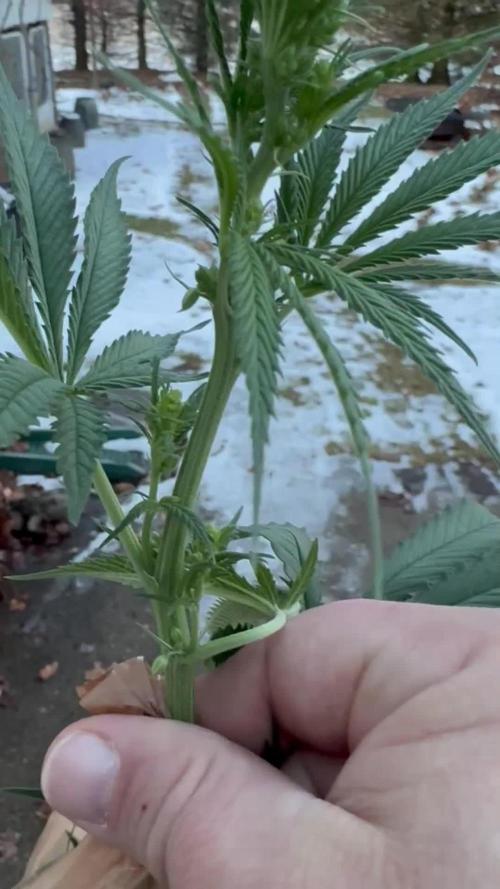
First few days of flower so nothing much happening. The stretch is in effect and she's going for it. Just a little of the bottom leaves removed for better air flow. Nothing major. Having issues keeping the R.H around 60%· Observed slight water condensation on leaves at lights on. Need to sort that out

Likes
10
Share


@Cronic
Follow
Week 8
Into the 9th week now, getting real close. The final feed until flush. It has gotten a little cooler however, temps are still in the high 20's and humidity is 70ish.
The Pineapples are shapping up very nicely. I walk up to the solarium and i'm hit by a wall of stinkin bud, it's delicious 😋 These aphids are very persistent however, i'm keeping them down to a minimum and with the time left i'm not concerned. PE1 should be ready on time however, PE2 isn't maturing as quickly and may need a little more but, even though she doesn't have quite the height as her sibling she's getting chubby.
The lemonade is a chunky little thing, she looks very dense. I now get a hint of homemade lemonade in there as she's maturing which is very cool. Pistils are browning quite quickly... steady now, mustn't get too excited 😁
Likes
7
Share

@PhinolaGreen
Follow
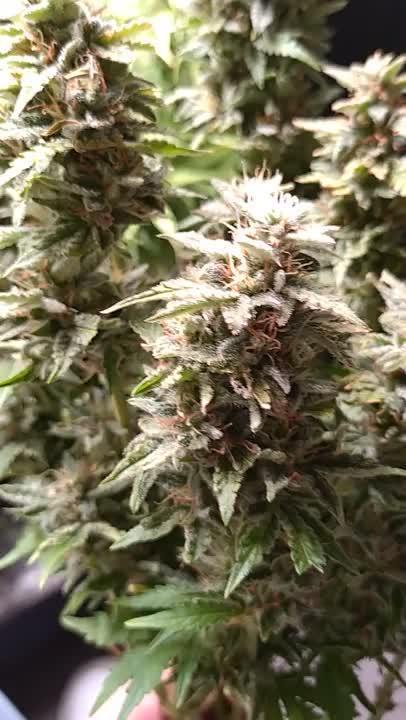
Harvest Die erste Hulkberry Auto hängt zum Trocknen 😌 Sie wächst wirklich wunderschön und ich bin gespannt, wie weit sie noch wird.
Der zweite Phänotyp braucht noch etwas Zeit, um fertig zu werden, und dann werde ich ein Update mit dem Erntebericht posten 😀
Update 3 Wochen später:
Hulkberry Auto Pheno 2 hängt jetzt auch zum Trocknen, bin gespannt, wie sie von der Wirkung wird. Sie hätte vllt noch 1-2 Wochen gebraucht aber egal, fand sie jetzt auch schon Klasse und habe dann heute Morgen den Cut gemacht. Also von dem was dran hängt bin ich wirklich überrascht, wie viel das am Ende wurde. Das wird wohl nur Strawberry Cheesecake Auto Barneys Farm toppen aus dem Durchlauf vom Gesamtergebnis der einzelnen Pflanzen im 6,7L Topf 😊 🦊

Likes
15
Share


@Siriuz
Follow
She's doing pretty good and we're so happy to have you in our greenhouse :3

Likes
2
Share

@birdmountain
Follow
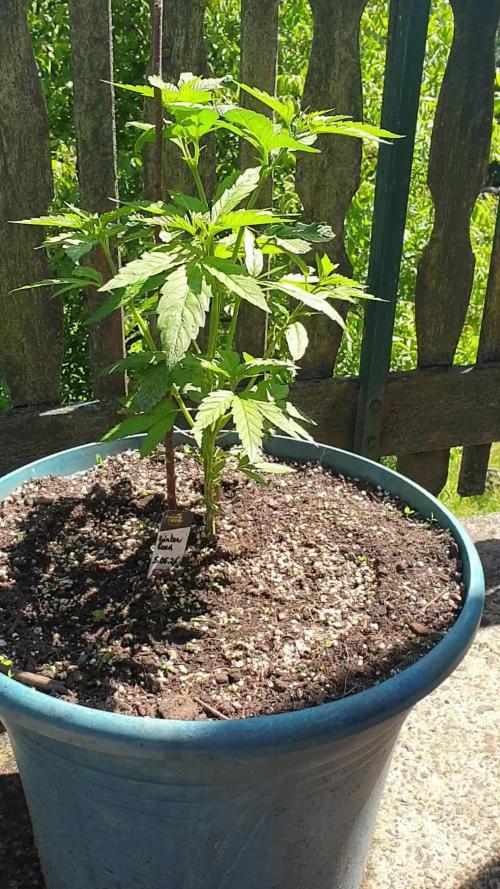
Sie hat ein beachtliches Wachstum in dieser Woche gezeigt. Endlich kommt sie in den geregelten Modus, ich hoffe, dass es so bleibt. 16 cm Wachstum in einer Woche, ich freue mich.
Kleine Reste meiner Schädigung sind noch in den älteren Blättern erkennbar, die neuen Blätter scheinen intakt zu sein. Ich frage mich, ob die teils panaschierten älteren Blätter ein Fehler meiner zu starken Neem-Behandlung waren oder ob es an der Genetik liegt. Auch die Auto Candy Bubatz XL und die Auto Sticky Brokkoli hatten im Anfangsstatus diese Blätter.
Jetzt jedenfalls kann es so weitergehen.
Vielen Dank für euren Besuch mit besten Wünschen für eine gute Grow-Woche!


