




Likes
43
Share


@MadeInGermany
Follow
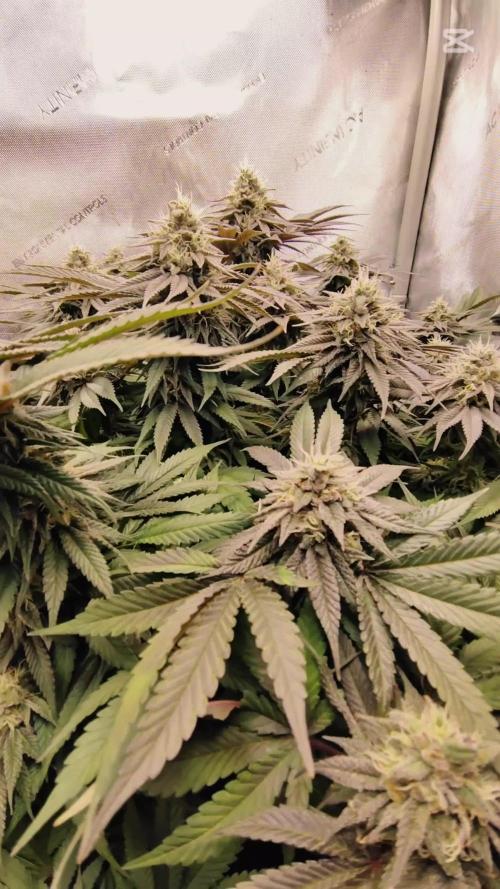
Flowering day 52
since time change
to 12 / 12 h
Hey guys :-)
All ladies look very healthy and delicious :-)
We're slowly getting closer to the end.
This week it was poured 3 times with 1.2 l each (sewing materials see table above)
At the next watering there is a very light rinse with Clean Fruits so that the last nutrients can be slowly used up.
The trichomes are now checked every day.
I'm looking for my microscope with an app so I can take pictures of it 👍.
I wish you a lot of fun with the update and stay healthy 💚🙏🏻
👇🏼👇🏼👇🏼👇🏼👇🏼👇🏼👇🏼👇🏼👇🏼👇🏼👇🏼👇🏼
You can buy this Nutrients at :
https://greenbuzzliquids.com/en/shop/
With the discount code: Made_in_Germany you get a discount of 15% on all products from an order value of 100 euros.
👇🏼👇🏼👇🏼👇🏼👇🏼👇🏼👇🏼👇🏼👇🏼👇🏼👇🏼👇🏼
You can buy this strain at :
https://www.exoticseed.eu/
Water 💧 💧💧
Osmosis water mixed with normal water (24 hours stale that the chlorine evaporates) to 0.2 EC. Add Cal / Mag to 0.4 Ec Ph with Organic Ph - to 5.8 - 6.5
MadeInGermany

Processing
Likes
9
Share


@Belverde
Follow
Goodmorning everyone👋...
Our beautiful plant of Girl Scout COOKIES (AMAZING STRAIN) seems to grow very well 🍪...
It looks for a lot of light, compared to the others in the grow-box ..
and it is also the only one to be in a 11l smart pot, always compared to the other autoflowering... In some day I will give you a little bit of root-juice to make you happy, hopefully.. Ah, and good news...
even the high seed has come to light and the plant is currently very good ...you can see it in the video, the last on the left ...but I will not post a diary with her too ..
However it is..for the moment all is well ... still soon...
see you next week👍 ...
Hope you enjoy it.. 🙏
Bye 😉

Likes
2
Share

@Avengergreen
Follow
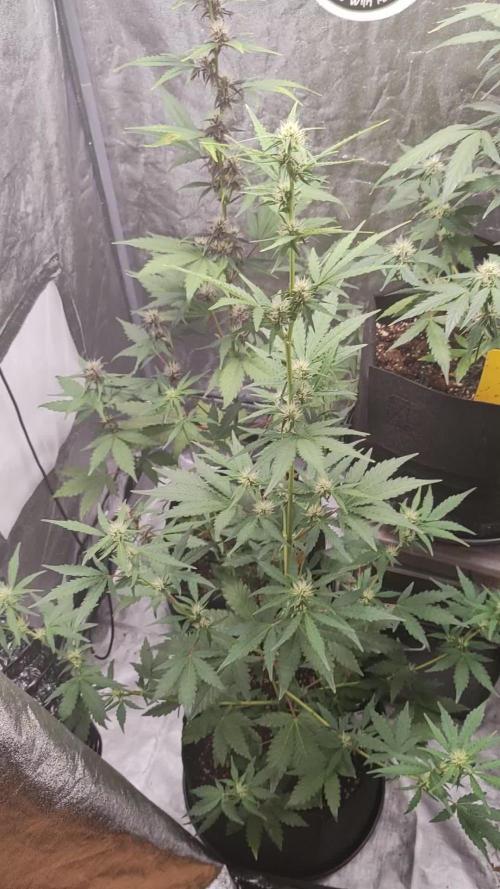
I am starting the third week of flowering. This week I will slightly increase the dose of fertilizers per flower. The plants are responding to the nutrients very well, which can be seen as the flower buds are becoming denser every day.

Likes
16
Share

@Shawneyboy85
Follow
This week has been good, no problems to say of. No changes to the light schedule or nutrients. I do have a Lemon Pie Auto doing something strange stuff it is @ 51 days old and is giving off some mutations in the fan leafs, and she stretched to double the height of the other 2 in the tent. Also has begun to develop a few small brown spots on a couple fans too but other than that all is well.

Likes
20
Share


@dataTwiiix
Follow
08/11: La troisième semaine de floraison commence enfin on devrait les fleurs prendre forme. J'espère que le stretch est fini car elle est assez grande et doit laisser un peu de place au autres.
08/12: la troisième semaine débute sur une note un peu amer. Certaines feuilles se détériore à une vitesse folle, ainsi que des tâches brune. Premier réflexe GHE essential et cal-mag agent de Canna ce matin. Espérons que les prochains jours seront plus cool et que cela vas arranger mon problème.
08/13: après avoir fait plus de recherche je suis enfin tombé sur un article sur le blog de pevgrow et mon problème correspond en tout point à une carence en magnésium. Je devrais voir voir des améliorations dans les 4 à 7 jours. Et bien-sûr continuer à donner du calmag. Le problème viendrai du fait que je tourne en 24/7 avec les auto's enfin c'est ce que je pense après avoir croisé les conseils et avis des "growers" de GD et certains articles.
08/14: c'est dernier jours ont été intense pour moi, lors de mon premier diaries j'avais déjà eu le même problèmes avec une purplequeen auto à l'époque je n'avais pas de calmag... enfin tous ça pour dire merci à la communauté growdiaries.com qui m'a conseillé et supporter. Maintenant cela c'est stabilisé et n'atteint aucune autre feuilles, les nouvelles feuilles sont belles et viguoireuses. Me voilà rassurer et surtout j'ai encore appris de nouvelles chose sur la cannabiculture 😎😨🤓
08/15: elle a créée une belle masse de feuilles entre temps, je vais appliquer une grosse defoliation après le prochain engraissâge histoire d'être que les carences ne sont plus d'actualités. À part cela je me contente de couper deux feuilles par jours. #46
08/16: tout est rentré dans l'ordre ouF :D - la production de trichromes à bien commencé, une légère odeur typique à la weed qu'elle que soit la variété en début de flo. se dégage de la growbox. je suis enchanté! Maintenant j'epère que le switch d'engrais càd changer "BioBizz bloom/topmax" pour "Canna PK13-14/Boost Accelerator" vas lui plaire à la jolie dame #47
08/17: apres une de nuit de réflexion: arrosage/engraisser (canna calmag (.6ml/L)/BB blom-topMax (1.2ml/L chaqu'un)/ AN BigBud-BudCandy (1ml/L chaqu'un) ce matin. J'essayerai canna pk 13 14 et boost accelerator sur mon prochain plant. #48
Likes
4
Share


@Mr_nugs_lover_David
Follow
She looks and smells amazing.
I wanna talk specifically about her amazing mango smell just pure mango,you'll only be able to feel it if you grow her 100% the organic way. It's a must,you don't think about smoking her when you smell it you think of eating her it's just so yummy,definitely I want to grow this amazing somango auto plant by gea seeds every time I can. 💚🌱💎🤤

Likes
10
Share


@Fonzo412
Follow
This will be the start of week #2 of seedling stage.
Had an issue 😢 with my blue dream plant I believe I’ve might of over watered . It looks bad hopefully it can recover. Yield may be stunted really lagging behind.
Also I have another blue dream seed so I’m thinking of starting that one fresh so I can pot into the finale medium. I didn’t want to use the cup but didn’t have enough soil at the time 🤷♂️
The strawberry 🍓 banana 🍌 auto and the power plant fem seems to be doing good 👍 so far.
All in all I’m happy 😊 with how things have been going throughout my grow .
I’ll will be feeding my plants nutrients and dropping the lights 💡 for the start of Veg next week.
Let’s goooo…
😎😏

Likes
9
Share


@Northstar_cannabis
Follow
Healthy and consistent growth. Plant is a little smaller, i think that's due to location in the tent. Buds look good.


Likes
9
Share


@Sato_Growing
Follow
My girls are going perfect they took about 10cm in height and become more bushy.
500-700 ml water per plant every day watering
About 3-4 times i water with nutrients and 3-4 times with water, depends on how many nutrients they want
Likes
92
Share


@gottagrowsometime
Follow
135 days 3 part harvest 1st was wk 16 430 wet= 97 dry: flowering 60+ days. 2nd part 105 wet= 20g Dry 3rd part well, I got a weight after 5 days of drying. It turned all the white hairs all amber and it actually finished off perfectly. The wet weight was a lot more than I was guessing. I got nearly 55g dry + 3 grams I've been picking up the last 2 days on bits that dried earlier as I hung it in my grow room. RH was 60% temp 21c. Had to remove nodes on the outside to allow the inner buds to dry. 40% was dry on day 3.5 rest took another 1.5 days to dry. This time I didn't over dry it. Still a nice bit of mostiure in it. I'd say the weight wait on this one was 200+ gave back 58Dry..
Was a task doing a 3 part harvest between partly flushing, restarting and then flushing and restarting and then finally I gave her a 10 day flush on flawless finish. She was dying off, showing she was coming to end of life. Really happy with the results of her, nice to get a decent amount of bud from the jars. This 1 plant will probably give more than the other 4.
Smoke report to follow soon.
Thanks for following, reading and commenting.
Be sure to like so I can visit your diaries
gottagrowsometime

Likes
14
Share


@Mycroft
Follow
The end is near !
The buds are developping quite well - i don't overfeed them so i don't expect are spectacular grow, but they are doinf very nicely on their level.
They still drink a lot and get wider with each new day. 🙌

Likes
14
Share


@GodZilla_Owner
Follow
Week 12+13 Update – Final Harvest & Reflections 🌱✂️
First off, sorry for the late update—super busy at the moment!
This will likely be my last report for now. I’ll still share the final results, but after that, I’m taking a break.
BioBizz#1 – BT59
Harvested, and as expected, a disappointing yield—typical for BioBizz.
Final weight: 71.88g
AN#4 – BT65
As expected, the biggest plant in the grow! This grow confirmed that I’d stick with Advanced Nutrients in the future.
Final weight: 163.88g
AN#3 – BT64
This grow was an experiment in 60x60x120cm, and let’s just say—not recommended!
Zero height control, only 2cm clearance from the LED.
Somehow, she survived. Now I’m super curious about the final yield!
Final Thoughts
Advanced Nutrients proved superior, and BioBizz didn’t impress me.
Stay tuned for the final numbers from AN#3! 😏


Processing
Likes
1
Share


@Teddy01500
Follow
Bonjour à tous, ces derniers jours ce sont bien passé pour mes petit bébés elles grandissent doucement mais sûrement.C’est la première fois que je travail avec cette gamme de produits (je vous est mis des photos des produits 😉) pour l’instant j’en suis satisfait après, il faut voir le résultat final ce qui est moins facile 😂. Mes petit bébés commence leurs 5ème semaine (je me suis trompé d’une semaine 😕 désolé 😉) trop pressé!!! 😂 de mettre de nouvelles photos 😜. Je vous dis à là semaine prochaine vivement 😉 bonne journée à tous. Je vous remercie 😉.


Likes
9
Share


@auto420
Follow
Ciceklenmenin 2. Haftasi bitti hersey goruldugu gibi guzel saksi kurumasi haftada 3 oldu.

Likes
29
Share


@SolitudeCorners
Follow
Best root of the season awards
Can't wait to blazeeee
Feeding💪
10/17 Water30L+Cleanse80ml+calmag@190ppm
Ph6.3
Ebb 10.42/11.32/12.26/13
Clone 11.35/12.21/13.05/14
Average runoff ec1.5
Keeper 300ml per pot
10/18 Water26L+Flawless90ml+calmag@300ppm
Ph6.3
Ebb 11.38/12.24/13.17
Average runoff ec1.2 ph6.5
Clone 12.38/13.56/15.20/16.10
Average runoff ec1.5 ppm750
10/19 Water26L+Cleanse80ml+calmag@200ppm
Ph6.3
Ebb 11.12/11.48/12.24
Average runoff ec1.4
Clone 11.50/12.12/12.37/13.37/14.40
Average runoff ec1.3 ph6.6
10/20 Water30L+Cleanse30ml+Calmag@190ppm
Ph6.4
Ebb11.42/12.22/13.20/14
Clone 12.40/13.20/14.20/14.45/15.15
Average runoff 1.2ec ph6.4-6.7
10/22 last light day
10/23 2 Pm Cut and hang
Plan 21day at 23temp 55rh
