


Likes
Comments
Share


@Onlysquifflehere
Follow
This week has been amazing nothing but growth and bud sites she is starting to fatten up now and within weeks it'll be stacked with those big nugs!!

Likes
70
Share

@RockoCalenberg
Follow
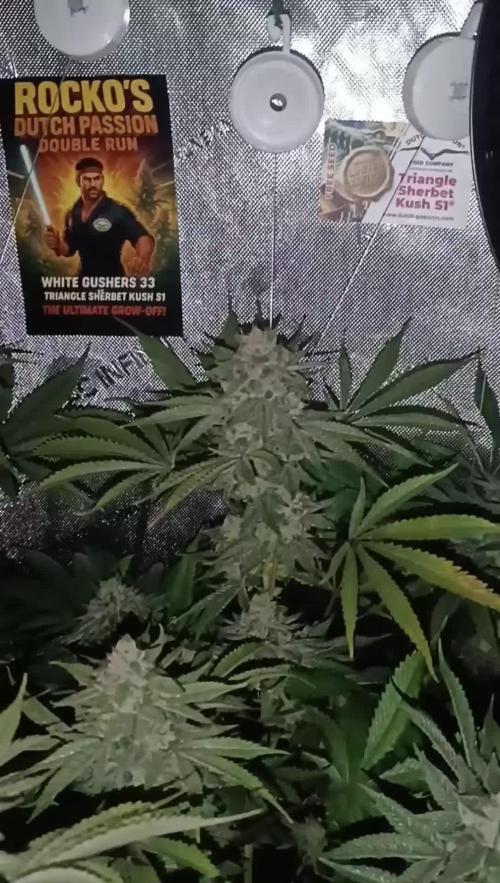
🌸 Blütetag 59 / 📅 Gesamttag 119
🌡️ Klima
Draußen merkt man inzwischen deutlich, dass Frühling ist.
Im Zelt läuft das Klima weiterhin ruhig und stabil und die VPD-Werte bewegen sich konstant im grünen Bereich. Insgesamt also sehr ähnliche Bedingungen wie in der letzten Woche.
🌱 Pflanzenstatus
Die Ziellinie kommt langsam in Sicht, auch wenn noch ein kleines Stück Strecke vor uns liegt.
Die beiden Pflanzen zeigen inzwischen deutlich unterschiedliche Reifestadien.
Die Triangle Sherbet Kush wirkt schon ziemlich weit: kaum noch neue weiße Härchen, stark angeschwollene Buds und insgesamt deutlich mehr Harzproduktion.
Die White Gushers 33 arbeitet dagegen weiter an neuen Blüten. Besonders an den Tops sind noch frische Pistillen zu sehen und die Buds legen weiter an Masse zu.
Interessant ist auch die Entwicklung innerhalb der Pflanze:
Die drei höchsten und kräftigsten Triebe foxtailen leicht, während einige der tieferen Seitentriebe bereits weiter wirken und teilweise deutlich weniger weiße Härchen zeigen.
🌼 Blütenentwicklung / Reife
Bei der Triangle Sherbet Kush zeigen sich inzwischen klare Reifezeichen. Unter dem Mikroskop sind bereits die ersten bernsteinfarbenen
Trichome zu erkennen 🔬.
Außerdem stehen einige Blätter bereits kanuartig nach oben, und die Pflanze beginnt sichtbar, Nährstoffe und Farbe aus den Blättern in die Blüten zu ziehen.
Die White Gushers 33 verfärbt sich ebenfalls zunehmend, wirkt aber insgesamt noch etwas später im Reifeprozess. Hier sind die Trichome überwiegend milchig, teilweise noch nicht ganz trüb.
👃 Aroma
Beim Öffnen des Zeltes entwickelt sich inzwischen eine schöne würzig-fruchtige Gesamtmelange.
Die Triangle Sherbet Kush bringt zunächst klar die würzige Kush-Komponente mit. Wenn man die Buds leicht berührt, kommt aber deutlich die bananige Note 🍌 aus der Sherbet-Abstammung durch – also ebenfalls fruchtig, aber eher cremig-bananig als süß.
Die White Gushers 33 geht aromatisch eher in eine gasigere Richtung ⛽, mit etwas Funk und Frucht darunter. Also keine Candy-Süße, sondern eher ein Mix aus Gas, leichter Frucht und einem kleinen funky Twist.
📊 Fazit
Aktuell zeigt sich immer deutlicher, wie unterschiedlich sich die beiden Genetiken in der Endphase entwickeln.
Die Triangle Sherbet Kush wirkt klar weiter und reifer, während die White Gushers 33 oben noch weiter Blüten nachschiebt, in den tieferen Bereichen aber teilweise schon erstaunlich weit ist.
🔭 Ausblick
Rein vom Eindruck her könnte die Triangle Sherbet Kush bald fallen, während die White Gushers 33 vermutlich noch etwas mehr Zeit gebrauchen kann. Da eine Teilernte hier nicht ganz unkompliziert wäre, bekommen beide vorerst noch etwas Zeit.
Mich würde aber interessieren, wie ihr das handhaben würdet:
Würdet ihr in so einer Situation schon separat die Kush ernten oder beide Pflanzen noch zusammen stehen lassen?
Und wie macht ihr das generell in der letzten Phase vor der Ernte – gebt ihr euren Pflanzen noch eine Trockenphase 🌵 oder Dunkelphase 🌑, oder lasst ihr alles einfach normal weiterlaufen?
Auch spannend: Zu welcher Tageszeit erntet ihr am liebsten? ⏰
Bis nächste Woche – bleibt sauber und gesund! 🌿
🌸 Flower Day 59 / 📅 Day 119 Overall
🌡️ Climate
Outside you can clearly feel that spring has arrived.
Inside the tent the climate remains calm and stable and the VPD values stay consistently in the optimal range. Overall the conditions are very similar to last week.
🌱 Plant Status
The finish line is slowly coming into view, even though there is still a little bit of track left.
The two plants now clearly show different stages of maturity.
The Triangle Sherbet Kush already looks quite far along: almost no new white pistils, heavily swollen buds and overall a lot more resin production.
The White Gushers 33 on the other hand is still working on producing new flowers. Especially on the tops fresh pistils are still appearing and the buds continue to gain mass.
An interesting observation inside the plant structure:
The three tallest and strongest tops are slightly foxtailing, while some of the lower side branches actually seem further along and already show far fewer white pistils.
🌼 Flower Development / Ripeness
The Triangle Sherbet Kush already shows clear signs of maturity. Under the microscope the first amber trichomes can already be spotted 🔬.
Some leaves are also starting to canoe upwards, and the plant visibly begins to pull nutrients and color from the leaves into the buds.
The White Gushers 33 is also starting to fade, but overall it still seems slightly behind in the ripening process. Here the trichomes are mostly milky, with a few still not fully cloudy yet.
👃 Aroma
When opening the tent a nice spicy–fruity blend fills the air.
The Triangle Sherbet Kush first presents a spicy kush profile, but when the buds are lightly touched a distinct banana note 🍌 from the Sherbet lineage becomes noticeable — fruity as well, but more creamy banana-like than sweet.
The White Gushers 33 goes into a different direction aromatically. It leans more toward a gassy profile ⛽, with some funk and fruit underneath. So not candy sweet, but more a mix of gas, light fruit and a slight funky twist.
📊 Summary
At this point it becomes increasingly clear how differently the two genetics behave in the final phase.
The Triangle Sherbet Kush clearly appears more mature already, while the White Gushers 33 is still pushing new flowers on the tops, even though some lower parts already look surprisingly advanced.
🔭 Outlook
From the current impression the Triangle Sherbet Kush might be ready quite soon, while the White Gushers 33 could probably use a bit more time. Since doing a partial harvest here would not be the easiest option, both plants will likely stay a little longer for now.
I’d be curious how you guys would handle this situation:
Would you already harvest the Kush separately, or leave both plants a bit longer and harvest them together?
Also interested to hear how you approach the final phase before harvest. Do you give your plants a dry period 🌵 or a dark period 🌑, or do you simply let everything run normally until harvest?
And one more thing that always comes up in discussions: what time of day do you prefer to harvest? ⏰
See you next week — stay safe and healthy! 🌿

Likes
3
Share


@Eldorado_ed
Follow
Some LST and defoliation very start of week happy with the result will repeat process end of next week 🌱🌳
Likes
19
Share


@UncleErrl
Follow
She’s getting really close! I’ve started the flush and trichomes are almost all milky probably around 80% and then just a few ambers. I’m hoping to stretch her out another week but we will see. She is so gorgeous tho and i can not believe it came from bagseed! Check out my other grows, say what’s up and give me a like and a follow! Thanks!

Likes
8
Share

@BudBrewerz
Follow
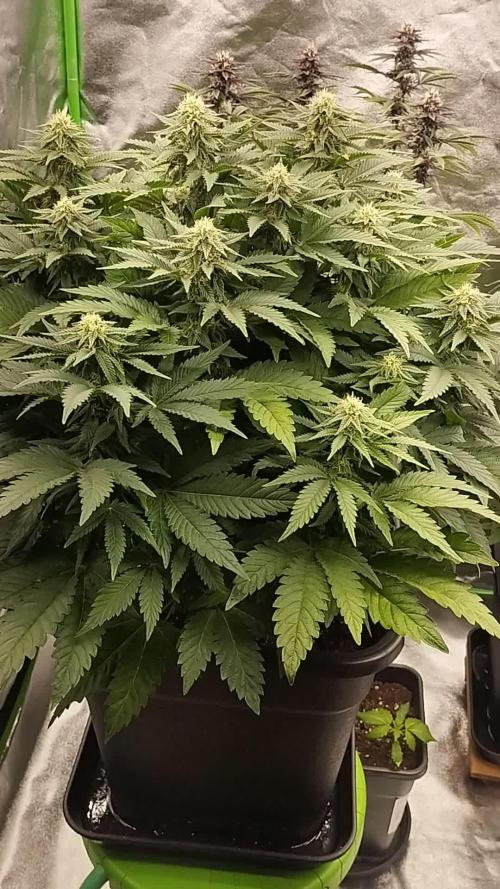
the White Widow is doing really good , she has become this very luscious bushy plant , with loads of pretty, firm buds, who will still have to thicken a whole lot, so I'm really looking forward to seeing her proceed in this pace 🙏🙏🙏



Likes
4
Share


@HIAZ_urbanbudfarmer
Follow
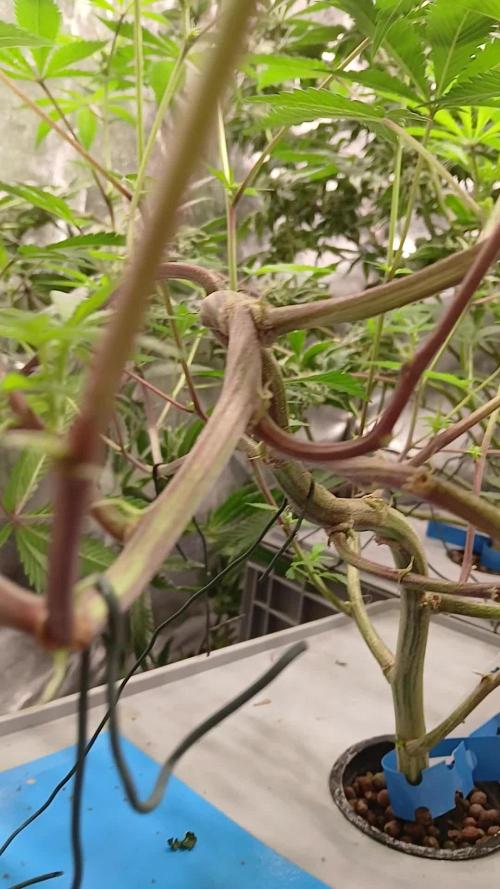
Hi Gromies all is well, just doing her thing, been training through the scrog net. This girl is ready to flower and will be changed over today . Pulling the 600W m/h - HPS out of retirement to flower this girl as I need the l.e.d. for an Auto grow that is just kicking off. Please give me a like & a comment thanks.
HI-AZ
Likes
10
Share


@Jbcultivates
Follow
Great week of growth, been doing a lot of LST. Spreading her out and tying it down! Roots are really growing. Pinching leaves as they get too big and block light.

Likes
5
Share


@TheSpoonieCrone
Follow
I am on so many learning curves right now with this grow and keeping diaries. It is a trip and I'm loving the journey. This Gorilla Glue is showing signs of the end of life and milky trichomes. I thought she'd be ready second but she's in the lead for harvest of the three. Can't wait to see what next week brings!


Likes
54
Share


@Belverde
Follow
Hi guys
Welcome 🙂
After more than month postharvest , I have tested this Blue Gelato #41 🍦🌱
In the end was passed 78° days in flowering for the right maturation
I can only say..
Awesome 🤩
About taste , perfume and effect
Also the grow inself was fun and not to hard
In the beginnig my plan was to growing her in a natural way
But in the end I have decide to topping her and create a multiple primary colas
And she was react very well: 1:🌳
Flowers are very dense , also after the dry and cure process
The aroma of smoke after my first pitch from a joint, obviously weed-only, reminded me a lot of Amsterdam
The bluberry taste is the first thing you feel, and it's clear and clean
Afterwards there are notes of earth and something similar to citrus on a sweet base
The effect is enough for the day because it keeps you motivated and creative too
But if you sit on the sofa and close your eyes, you can clearly feel a tingling on the forehead halfway between one eye and the other 🧠👁️
And the imagination is facilitated, expanding the creative process
For this reason it could be vaguely psychedelic
I personally love it
I want to spend two words about post-harvest artistic process😉
Personally I have spent more time figuring out the best way to have the tastiest, smoothest, cleanest and most perfect burning weed.
First I just want to say one thing...
..WEED SHOULD NOT SMELL DURING THE DRY PROCESS..
If this happens, it means that the temperature and humidity are too high and probably the fans are aimed directly at the inflorescences
The scent that is felt are all terpenes that are dispersing in the air and which consequently will be less intense during final consumption
The less trichomes remain in contact with air, the better If too exposed to air and light, these oxidize, thus removing much of the final experience
Personally, what interests me most is the taste, because it already creates the effect in itself
A bit like when you sit down to eat
I prefer a well-cared for dish with quality ingredients that leave me a great memory after consuming it, rather than a dish that only fills my stomach
Mc Donald weed vs Five star restaurant .
Sorry Mc lovers 🍔🍟🙌
Said this..
My method is that the cannabis is dried whole plant for a maximum of five days at constant and balanced temperature and humidity, the important thing is to maintain a narrow range between te ur, 20 ° or 24 ° C little changes, even if humidity remains between 55 and 60% is fine
The increase in temperature must also correspond to an increase in humidity
And so also in case of a decrease
In any case In the first few days it must lose most of its water 💧
When the branches are about to break, but still not cracking, I cut the branches one by one and perform a professional manicure
Afterwards, always with the flowers still attached to the branches, I put everything inside a classic brown bread bag (not white because it is colored and not the best)
For about two days I leave the buds inside, opening the bag several times a day to circulate air and to move the branches with the flowers
After a couple of days, the inflorescences usually have reached a good level of drying and are dense to the touch, but by pressing, you still have to be able to crush between the fingers
Explaining in words how hard they can be pressed to find out if the ur level is optimal is difficult to say
It is must necessary to try and make mistakes many times
And never be satisfied
You can always do better 😎: 1:💪
So, now we are about ten days after the cut of the plant and, at this point, the flowers can be placed in an airtight container
BASIC
The flowers are put in the vase "a moment before" that the branches break cleanly, this is important
An optimal method to understand when the right time is is to see if the popcorn buds are easily detached from the branch, without dragging with them the "thread" of the bark
Once placed in the pot, normally I leave it closed for 24h in order to let the moisture come out from the central area of the flower and distribute it evenly
After this first day, I start to open and close the pot several times a day, but always for a few seconds
At each opening I always move the flowers to allow a correct exposure to the little air present in the vase
The jars would be better not to fill them completely, but just a 3/4 or a little more
The important thing is that the flowers can move easily enough
This process generally lasts about four weeks, and every seven days I decrease the number of daily openings
Usually, after the first week, the scents that will be created begin to be felt
And this makes us realize that we are on the right track 🛣️🚀
After four weeks, if everything has been done in a workmanlike manner, the perfume will be pungent and intoxicating and the flowers will be dense and oily to the touch When the humidity level appears optimal, I insert a bag from the Boveda series to keep the ur around 62%
In all cases, I personally start using my flowers constantly two months after cutting 📆
I noticed that in general, Haze-type Sativas are tasty even after only a month
For the Kush the optimal terpene profile I appreciate it in the neglect only after a couple of months
In this way the flowers will be extremely fragrant, crunchy and smooth in flavor once consumed and always create a clear oil all around the rolling papers
As you can appreciate in the videos what place, and that I hope to be able to post for much longer every time I conclude a new cycle
You need to savor a lot of cannabis in order to have a clear idea of how a high quality finished product should look 🔥👌
This is my thought about our true works for having the best , I hope it can be useful 😉
About the Living Soil with my High-Brix formula
Like I say week by week , for this lady I have use a 20l geotextile pot with around 1/3 of the Living Soil I have made ( in this case in november 2019 )
First thing to say is
Trought this metodology we're not feeding the plants , but the soil ☝️
Basycally the important things are principaly four
Soil energy
Cation exchange
Microbial activity
Mineral balance
Soil energy is kept high with humus
Cation exchange with rock powders
Microbial activity is achieved with innoculants and some teas or other
Mineral balance is achieved by adding the micronutes and having everything in the right ratio's
For doing this I have use a base mostly of
light-mix soil with already perlite inside ( classic cannabis soil )
coco nut
humus
zeolite
then I have add
Neem soil , Kelp , Krill , Azomite , Basalt , Gypsum , Calcium Carbonate , Phosforite , Alfalfa and Leonardite
Then I was have "cooking" it for a month an half
And this was the engine that allowed the plant to stay in constant health, keeping the Brix level high 🌳🔥
During the flowering time I have add mostly only water , one times a week with molasses for feeding the microbs
I have also make a humus/nutrient tea for she and her sisters , just one time
I'm feel good doing in this way , like it and I understand so many more things about the lives into the ground in general
But just for be precis..
For having the high brix in plants we must need obviously a good soil with a right nutrition way, but we have also to maintain the environment around her in the best condition
Temperature , ur , right water dosage in right time , good ventilation and fresh air
The balance it's the key
Like in our daylife 🙂
And obviously a fundamental it's
First , the right strain selection from serious breeder 🏆🔥
Second , passion&love 💚 (Don't look for them in a growshop)
So, I think I said it all
I apologize for this long review
But I wanted to explain the best of the things that personally took the quality of my cannabis to a higher level
Thanks for everybody stopping by here in this few months or just now for the first time🙏
Thanks Barney's farm for create this and more strain 🤝
And like as always thanks the people behind Grow diaries for maintaine this creativity space👏🙌👉💪🏅
Hope you was enjoy
Or at least , hope you are stoned like me right now 😁
See you somewhere
Always growing 🌲
Looking for a clouds ☁️
Ciao ✌️
🇮🇹
FC


Likes
65
Share


@Dendegrow
Follow
The harvest is in! 🌿✨ The buds have turned out absolutely stunning – dense, frosty, and bursting with trichomes. The aroma and flavor are something truly special: a delicate blend of cherries with a refreshing hint of mint 🍒🍃.
The high is incredibly potent, deeply relaxing, and body-focused – the perfect companion for unwinding in the evening 🌌💤. These cuttings have truly delivered, and despite the challenges along the way, the results are impressive. I harvested them at the perfect moment, with fully milky trichomes, ensuring peak potency and a balanced effect 💎✨.
Thanks to everyone who followed this journey – stay tuned for more updates and new adventures. Until then, enjoy the vibes and happy growing! 🌺📸
---
Die Ernte ist da! 🌿✨ Die Buds sind einfach wunderschön geworden – dicht, frostig und voller Trichome. Das Aroma und der Geschmack sind etwas ganz Besonderes: ein leichter Hauch von Kirschen, kombiniert mit einer erfrischenden Minznote 🍒🍃.
Das High ist unglaublich stark, tief entspannend und vor allem körperbetont – perfekt, um den Abend ausklingen zu lassen 🌌💤. Diese Stecklinge haben wirklich abgeliefert, und trotz der Herausforderungen unterwegs bin ich mit dem Ergebnis sehr zufrieden. Ich habe sie genau zum richtigen Zeitpunkt geerntet, bei vollständig milchigen Trichomen, um maximale Potenz und eine ausgewogene Wirkung zu gewährleisten 💎✨.
Vielen Dank an alle, die diesen Grow begleitet haben – bleibt dran für weitere Updates und neue Abenteuer. Bis dahin, genießt die Vibes und happy growing! 🌺📸

Likes
18
Share


@emanresU
Follow
Edit from 16th May.
Ok, so... I got Fungus Gnats... I vacuum cleaned my plant my accident... Overwatered first 2 plants... This is not like riding bicycle, I had to re-learn few things.
But we going strong! The biggest plant (Fat Banana week #4) growing big and strong, every 2 hours I can notice some changes, she seems to like the environment (32C and ~40% Humidity), soil stays wet for weeks literally.
I have to buy bottom feeders and keep the top soil dry bone to prevent Fungus Gnats having sex in wet soil.
I have switched to 600W now and I put my lamp around 30cm higher then before.
I have a net for Sea Of Green hanging and waiting but Im not sure If Im gonna use it or If I'm gonna "lollipop" these plants just because there is so many of them now there. I didn't "top" because I believe that main cola produce some banger THC content and terps, so I want to focus on all main colas and just tackle the side ones.
Edit from 17th May.
It looks like Fungus Gnats don't like 24h light. I can see larvas trying to eat the roots (fuck you you fucking.... FuckYouGnat). But I don't see adults flying around. 4x yellow tape helps as well for sure. I ordered some Nematodes, they should be here next week. Until then I'm fighting manually. I placed a decoy on most of the pots. I'm hoping to attract larvas to the decoy instead of baby roots of my plants. They already eat one of my seedling before it even fully open the shell, so I think there are not so many of them to attack all plants at once. I feel like I'm having more and more control over them everyday. Moving the dry soil to the sides also helps a bit with killing larvas. Just uncover the wet parts with larvas and blast them with all the watts you have. So far 2 big plants looks good and healthy, some praying leafs every now and then. I think I'm gonna leave the lights for 24/7 until I'm gonna be sure these FuckYouGnats are gone.
Edit form 18th May.
Nematodes arrived, I mixed 1 pack in 2L and watered all 8 pots. I have 1 pack left that I'm planning to use next week or after 2 weeks.
Lady Banana is showing her sex. I was worried that it looks like hermie but I think it's just Calyx in very early stage. She also looks "wilt", I guess from all that dry period, she got some water today with nematodes, I'll check on her tomorrow.
Vacuum Cleaner Surviver going strong! I believe she would even survive a house fire!

Likes
Comments
Share


@Dankmark420
Follow
Still no pictures but plants progressing nicely and is starting to really show different growth patterns


Likes
35
Share


@valiotoro
Follow
Hello everyone 😎
Week 2 for my girl it’s time for Topping & some LST
She is doing very well,growing at fast pace and with a beautiful green colour on the leaves.
Have a nice day 😎
Likes
30
Share


@cheetah844
Follow
She's growing nicely. She's staying indoors this summer. This is suppose to be a good medical strain for headaches/migraines, I'm hopeful for my migraines will diminish with this strain.

Likes
7
Share

@Samsationalseeds
Follow
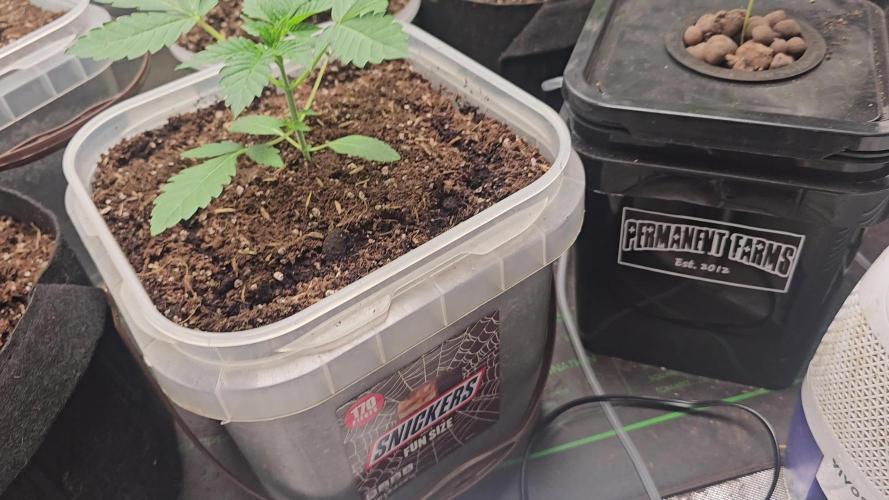
Week 3 most of the photos are in the plastic containers to grow in before being transferred outside
Likes
17
Share


@HowtoBubatz
Follow
The Banana Purple Punch is looking fantastic as it enters its 7th week of flowering!
After checking the trichomes, it’s clear this plant needed a bit more time to mature compared to others, but the wait has been worth it.🌱
This week, I’ve started flushing to prepare for harvest. If all goes as planned, it’ll be ready to cut and hang by the week after next.
The buds are looking dense and frosty, and I’m excited to see the final result!😊
So far, everything is progressing beautifully, and I’m really happy with how this plant is finishing up.
Likes
147
Share


@MrJones
Follow
MrJones Black Berry OG
🔹🔹🔹🔹🔹🔹GOALS🔹🔹🔹🔹🔹🔹
🌞Environment - 75/80℉ and 55% Humidity
💧 Feeding - Going to switch over to Advanced Nutrients OIM and see how this run progresses.
🍃Training / Will be topping and creating larger plants and placing to flower under a trellis
🕷️ IPM - Will be using Green Cleaner" 1 OZ per Gallon, and CannControl from Mammoth alternating between product each month for Integrated Pest Management.
💡Mars Hydro LED / Veg TS-1000 / Flower 480W FC 4800
🔹🔹🔹🔹🔹🔹🔹🔹🔹🔹🔹🔹🔹🔹🔹🔹🔹🔹
📜 Rambling - Week 6 is here, the girls are doing great under the Mars Hydro FC-4800
🔹🔹🔹🔹🔹🔹🔹🔹🔹🔹🔹🔹🔹🔹🔹🔹🔹🔹
They are loving the Mars Hydro FC-4800!!
▶️ Friday - 02.12.21 / Watered with Dechlorinated H20 PH @ 5.8 / 6.2
▶️ Saturday - 02.13.21 / Transplanted the girls into 5-Gallon pots, watered them in with Recharge, I may have to add an additional week before I flip, I want to see them get a bit taller so I can strip them down to 3 nodes.
▶️ Sunday - 02.14.21 / Plants are acclimating to their new 5-gallon pots, and the Mars Hydro 4800 is kicking ass!
▶️ Monday - 02.15.21 / Tonight fed the plants and di defoliation and massive LST on them!
▶️ Tuesday - 02.16.21 / Everything in check, plants are recovering well to the defoliation and LST
▶️ Wednesday - 02.17.21 / Watered with Dechlorinated H20 PH @ 5.8 / 6.2
▶️ Thursday - 02.19.21 / Plants are looking very healthy and getting close to flipping them to flower!
🔹🔹🔹🔹🔹🔹🔹🔹🔹🔹🔹🔹🔹🔹🔹🔹🔹🔹
📜 Cultivar Information - We have created this strain by crossing the best Black Domina available with Very Berry and our own Lost Coast OG Kush, this plant produces large colas with a super intense sweet berry flavor with a sweet-smelling aroma that varies from fruit and berries to sweet candy. This lady offers tight internal stacking giving a perfect structure for those super heavy colas, which is perfect for growth both indoors and out, if grown outside she is fairly resistant to mold and powdery mildew which is a real bonus with such large colas.
🔹🔹🔹🔹🔹🔹🔹🔹🔹🔹🔹🔹🔹🔹🔹🔹🔹🔹
📜SOIL MIX
COCO - 70/30% Tupur Royal Gold 30 GALLON
WORM CASTINGS 5 GALLON
LOBSTER COMPOST 5 GALLON
PERLITE 6 GALLON
INSECT FRASS 2 CUP
ORGANICALLY DONE GROW 5 CUPS
BUILD A SOIL COCO MINERAL MIX 6 CUPS
🔹🔹🔹🔹🔹🔹🔹🔹🔹🔹🔹🔹🔹🔹🔹🔹🔹🔹
