




Likes
48
Share


@D33jW
Follow
📅 Week 11 – Day 76 / FLO42
Conditions are still challenging – warm and humid, making it hard to maintain a high VPD.
This week I removed some fan leaves to improve airflow between the buds.
Despite the tough climate, the flowers are swelling nicely, and the trichome coverage is looking great – no complaints here.
The forecast says a cooler and rainy week is coming, so I'm hoping to push them further into ripening with the help of a dehumidifier.
We keep moving forward – the finish line is getting close! 💪

Likes
6
Share

@MisterTree
Follow
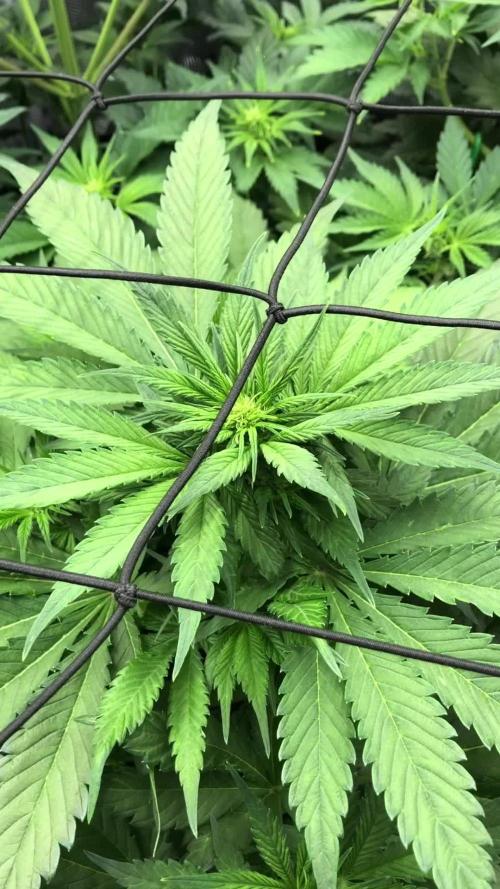
Tag 28 meiner Ladys sie wachsen gut - heute früh wurde das Netz eingesetzt.
Die Lady‘s sind noch gut feucht, werde heute nicht gießen- gestern zuletzt ( 7.10.25 ) 5/6 Liter (Tap-Water).
Habe LST letzte Woche bei allen 3 unternommen - und Leaf tuck in ( Blätter runter gesteckt )
Licht wurde auf 80% gedimt.
Werde die Tage Updates von den Pflanzen (zu dieser Woche) hoch laden und spezifische Veränderungen, falls welche entstehen sollten.
Bleibt Gesund und viel Spaß beim Grow
Update selber Tag : ( 8.10.25 ) / 6 Bilder
LST + Netz angezogen. Nicht ohne Verlust leider wie man auf den Bildern sehen kann.
Sehr gespannt auf die nächsten Tage.
10.10.25 - Alle 3 Pflanzen mit 6 Liter gegossen jeweils ca. 2 Liter pro Lady.
Punkte auf vereinzelten Blättern - gehe von Lichtstress aus, denke nicht es sind Insekten bin aber Anfänger ( untere Seite vom Blatt sieht auch gut aus, ohne Spuren )
Falls jmd ein Tipp hat gerne bitte kommentieren 🙏🏽
11.10.25 - Catwalk Video - lasst es euch gut gehen Leute 🙏🏽
Cya in da next Episode


Processing
Likes
7
Share


@Kushizlez
Follow
Day 56-63
(Day 57) I might have to fix the light to the roof of the tent so I can get another 3 inches up. The ppfd is just too intense at this height. The node stacking is super tight, I’m seeing some droop on almost every plant and the plants just look stunted. I might have to take out the big shelf I just paid 90$ for and raise the light to get the ppfd level down. This happened my last grow as well. It’s a great light for flowering but sucks ass for veg unless it’s hung 5’ above the canopy. I’ve seen videos of others with the same light and they have to fix it to the roof. The dimming function only works with a master controller I don’t have the money for right now.
Pulling bbb #2. I’m seeing very small but clear pollen sacks. It’s also drooping like crazy. The roots don’t look as healthy as some of the other males I pulled earlier. They have a slight brown tinge but still mostly white. I wonder if I accidentally gave top dressed it too many times when I mixed them all up a while ago.
I’m going to transplant bbb’s #1, #3, #6 & #7 into my 10 gallon destiny/coco pots lightly water. This is kind of a gamble because 2 of them are not showing definitively. Although I’m about 75% sure they’re fems. If not, I got my two backups.
(Day 58) I was reading about symptoms of high PH and I definitely have it indicated by the twisted and stunted growth on top. I’m going to try to water in a full gallon at 5.8 and see if I get a good response. I sprayed the pump nozzle directly into the soil after it was empty to put some oxygen into that big 10g pot.
The blackberry I gave the lowered PH water too noticeably responded within a few hours. The clawing has pretty much stopped and it now looks like the healthiest plant in the tent. I’m going to see how it responds over the next few days then try it with my other plants if everything looks good.
I’m going to try it with bbb #5 in the 1.7g pot and see if it responds in the same way. I ran a gallon of 5.8 water through 1.7g and got less than a 100ml of runoff which is a little surprising. The runoff measured 1750ppms which seems a little on the high side but isn’t insane for peat based soil.
(Day 59) Wow. The plants responded to that little PH adjustment insanely well. #5 isn’t dropping at all and the leaf wrinkles are actually flattening out. It’s starting to look like one of the healthiest plants in the tent. I’m still hoping for #5 to show female. 5 plants would cut my veg time down and give me another opportunity for a keeper pheno.
All 4 plants are looking like they’ve already recovered from their transplant. #1 in particular was drooping like crazy yesterday and today it’s bounced back and looking happier than ever. I’m seeing a bit of tip droop on a few plants but they still seem fine
I wonder if because my soil is 50% coco I should try watering on the acidic side, around 6.0-6.2 from now on. I’m almost certain that solved all the issues I was having.
(Day 62) Plants are all looking really healthy. They all seem to have outgrown the initial light stress actually but node stacking is still really tight and I hope to raise the light up next week sometime.
I’m going to drop the humidity to 60% for the rest of veg.
These pots are massive and I’m still a little worried about dry downs but they aren’t showing any signs of overwatering or lack of oxygen.
BBB#3 is starting to show some weird discoloring like an mag or nitrogen deficiency. Which is weird because it’s freshly transplanted into nitrogen rich soil. Guess I will give it a kelp foliar spray.
I’ve been looking for a good organic source of K without an absurd amount of magnesium and sulfur like langbeinite has. I found some 0-0-15 kelp/seaweed extract in soluble crystal form. So from time to time I will water that in at half strength or with compost teas to keep my soil K dominant.
(Day 63) I’m still waiting on #6 to show sex. I am shocked it hasn’t shown sex yet. Although it was started a week and a half after the others but still. I’m going to be so pissed if it ends up being a male. I’m taking a gamble but I’m confident it will show female when the time comes.
bbb#3 got a little more color back from that foliar spray. Hope that doesn’t get worse because it’s my favorite pheno so far. I will give a N boost in the form of compost tea tomorrow afternoon to both of my tents.
I’m starting to utilize the scrog net and boy does it make training way easier. This seems to be a much smarter style of growing for yield and quality.
I’m getting tired of these pH fluctuations every time I water. I’ve been eyeballing for the most part and I need a consistent formula. I found the perfect mix to stabilize my RO water and stabilize the pH at 6.2. I moistened the top soil of each plant and will watch for any reactions.
Water recipe:
60ml bottled water
2000ml RO water
3ml calmag
2ml microbes
Likes
32
Share


@hodette
Follow
I am so hyped with how the nugs turned out. I harvested a lot more then I ever thought I ever would. everybody just wants to see the headys


Processing
Likes
8
Share


@4F1M6
Follow
I started germination of 1 Gorilla Zkittlez bean on 29/12/2020. I pre moistened my rockwool cubes with ph balanced water to 6.4. Made sure the plug was just damp and not soaked. Using a small wooden dowel I increased the size of the plugs pre made hole. Than I sowed my bean into the hole. Ripped off a small piece of rockwool and mulched it up. Lightly filled the hole in with the mulched rockwool. Than stuck the plug into a misted humidity dome, to complete germination.
Shouldn't take anymore than 4-5 days to see a sprout. Once I see some cotlydon leaves bursting to the surface. I will get the plug planted into some 1 gallon pots. Plus get this lady situated into her home. Cant wait!
Some Background information on my experience with Gorilla Zkittlez. I've grown this variety out twice so far. Once in a 15 gallon container which became a super branchy beast. That yielded a large amount and filled up it's own 4x4 tent with a little training. The second and most recent time was in a 1 gallon SOG grow. She also flourished in a fast flip SOG grow banging off a fat head frosty main cola, with a few satellite buds. Very adaptive strain and seems to flourish in any environment and any size space. Looking forward too my 3rd adventure with Barneys farms masterpiece.

Likes
78
Share


@Basementganja
Follow
This is my second time growing a Girl Scout Cookies autoflower! She turned out amazing! She showed signs of high potency, from early on in flower!
Likes
19
Share


@RDWCGrowing
Follow
Week 1 Day 1 - 8/12/2023
1st Water change Day! Such a special time it is when you remove the little bit of Nutes that you gave them as an appetizer and you give them their first real meal.
Added
39 Gallons of Water to my system
SILICA= .5mil/Gal = 19.5 = 20mil
Root Drip = 1mil/Gal = 39mil
Cal Mag= .25mil/Gal = 9.75 = 10mil
FLoraMicro= 3.0mil/Gal = 114mil
FloraGro = 2.0mil/Gal = 78mil
FloraBloom = 2.0mil/Gal =78mil
ORCA= .5mil/Gal = 19.5 = 20mil
Week 1 Day 2 - 8/13/2023
Everything is looking good the roots are making thier way to the water and the new grow is looking nice and green.
Week 1 Day 3- 8/14/2023
Everything is right on track, they are looking beautiful and in the praying postition all leaves happily lifting towards the light.
Week 1 Day 4- 8/15/2023
Looking beautiful today and looked like she could use her first haircut.. gave her a TOP off. Roots are laying in the water everything is looking right on track..
Week 1 Day 5- 8/16/2023
walked in and the humidity was under 60.... ohh noooooo.. So I added 2 humidifiers to the tent and attached them to my InkBird controller which is set to 62. She had roots nicely in the water.. this grow is on!!!
Week 1 Day 6- 8/17/2023
Humidity was a little low this morning, so I refilled the humidifiers. Other than that, the temp looks great, the PH looks great, the PPM looks good the plant is in the praying position and all damage from the little drowning seems to have been fixed. Happy Happy.
Week 1 Day 7- 8/18/2023
Yay.. week 1 in the books, roots in the water growth has started first hair cut given and both side nodes are growing. Everything is looking good and on track.. A lot better than week one of the last grow when I had them drowning week 1.
Really excited on how this grow is going to come out.
Likes
8
Share

@TrickzGrowz
Follow
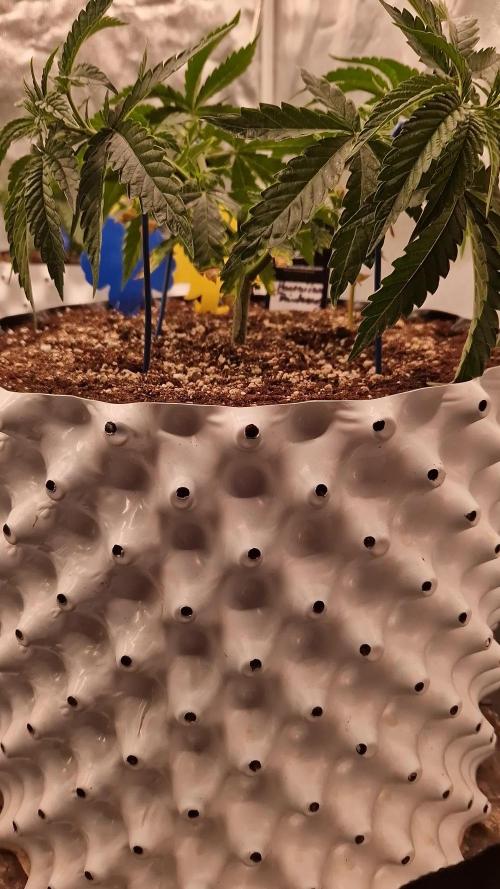
Einfach wunderschön anzusehen. Sie hat das umtopfen super vertragen. Heute habe ich sie ein wenig trainiert, damit die unteren Triebe auch Licht bekommen.
Likes
5
Share


@Crazy_Doofus
Follow
Gonna ripe her for a full More week, cut her half way. Leave the bottom for another week. Gonna leave the clones too, still full bloom ❤️❤️❤️ trichomes not ready yet
The top of the clones are the same size as the mother plant ♥️♥️♥️ very succesfull!!
05/01 not ready yet

Likes
117
Share


@Ageddd
Follow
Yesterday i give her last PK nutrients. Last week only used it (BioBloom) one time so leaves will be turning yellow next days. Last week used 2 doses of Plagron Green Sensation which i get from my growshop as free sample.
I am using last Sugar Royal dose(1 time each week - 27/9 -), and 3 more doses of Green Sensation (1ml/l every day - 27/9 - 28/9 - 29/9 -).
I thought about harvesting around -30/9-, think buds can get fatter than they are today, but i will check trichomes from a microscope and then decide.
Sensi Seeds info:
-Compact plant
-Flowering 50 - 55 days
-Heavy Yield
-95% Indica

Likes
7
Share


@Mr_nugs_lover_David
Follow
This plant looks absolutely gorgeous guys, I'm sad for not being able to film this Transplant because my phone just died when I was in the action, so this lady just like all her sisters have been Transplanted on day 39 since planted and I've prepared the 15L pot with the complete biotabs organic line, using 25g of startrex for every 5L of soil, a couple of grams of mycotrex on the transplant hole, and 3 tabs slow release fertilizer (1 tab for every 5L) and then just watered the plant immediately after the transplant with 1ml per liter of orgatrex and 1G per liter of bactrex,

Processing
Likes
29
Share


@Crazydaver
Follow
Bit of a difficult start to these girls seeing as this is my first grow and all, but they’re still growing and overall looking pretty healthy, good colour, springy, but I’m suspecting nute deficiency maybe but I’ve upped the food so we’ll see how we do!
Now, when to start topping 🤔...
Puff, puff, pass ✌️

Likes
18
Share


@UKauto
Follow
shes getting there now, considering shes under a 100w light shes doing well.
stinking now too, smells like a bag of haribo tangfastics, really sour with a mixed fruit hint, stem rub smells exactly like fresh cut grapefruit honestly haha hard to pick out a specific fruit smell from the bud though its just fruity, yous know what i mean anyway ha.
really sensetive to nutes, getting burn even after low dose and feed, water, water, feed schedule.

Processing
Likes
67
Share


@GreenZealand
Follow
OK, so we started the 6th week and the plant is showing some growing signals.
It's impressive how a plant that looks really bad, can actually keep growing and developing itself.
This week I've started to see some development on bud zone/spot, and I believe that even making some mistakes ate the beginning, I'll be able to taste some buds from this little girl.

Likes
9
Share


@SolitudeCorners
Follow
Animal Mints »»» Animal Cookies x SinMint Cookies X BlowPops Bx1 »»» BlowPops x CaliSunset
I named it as "Animal Pops"
These freebies really amaze me with the flavor than I expect ( Better than the purchase pack😹)
#1 got a taste of mild mints and head-high effects like it's massage your face
#3 more fresh mints than#1 and relax high
#4 got a dank smell after grind but not's good with joints
#5 got the best of mints scent and amazed me so I must grow it again!!
All of them got some sparkling feeling like soda or wasabi different among the 4 phenotype


Likes
1
Share


@hinterhofgrower
Follow
.
🌱 :
💧 : 4l day 64. 4l day 66, 7l day 68
💡 : Dli: 40 mol/m²/d
🤔 :
Likes
30
Share


@SAC87
Follow
Day 63 Flower
Well we’re coming to the end of the grow cycle. These plants are looking great. They’re starting to get a bit of purpling on the leaves and trichomes are clouding up. I flushed with 7 gallons of plain water with typhoon cleanse. It’s stripped about 300 ppm per gallon, got my runoff down to 110, and probably do an RO flush if I need to push it longer.
I am very happy with the stank, quality, density and trichome coverage on these buds. The smell is a ripe sweet lemon with and earthy hazy musk. Could use more lemon but I’m not going to complain. My house is rank and can be smelled outside even with the carbon filter going 24/7.
I’m super excited to see how the effect is on this strain. It’s one of my all time favorites and I’m pumped that it has turned out to be quality!!!
Happy Growing 🌱
