The Grow Awards 2026 🏆
Likes
Comments
Share
👉 This is the first staggered harvest I have done. The highest parts of the plant were definitely ahead of each lower level of flowers. So it made sense to give this a try. Also, there were so many sugar leaves in the flowers I knew I was facing some major trim time. So I started at the highest branch of colas and that was the main stem…what I call the Queen cola, on April 4. I was also very busy with work and life so I spaced out each successive branch by a day or two…or so. To harvest I would cut each major branch from the top down. There would be one major cola ( and best specimen) on each branch. That cola was trimmed so it was still on its stem and then weighed. I recorded the weight of the cola then assigned it a letter, put on a clothes pin, then hung on a rack. I would weigh the cola over a couple of days till it had loss 75% of it wet weight. I would cut from the stem for the final weight, then place in a jar with a hygrometer. I would monitor the jars and if they were above 62% I would take off the jar lid, then replace when humidity was back down. When stable I put a humidity pack in some of the jars, but not all, just to see if I can observe a difference after the cure. 👉 My last trim penance was served on May 1. Almost a full month. The first cola harvested is already being tested. I did a close trim and removed as many sugar leaves as possible. I think I spent over 10 hours in total. So glad I chose to stagger the job. I trimmed any frosty sugar leaves over a trim tray with a screen for a bottom. I also scissored a bunch of the larf buds into small bits to add to the trim. I made a nice small wafer of just trichomes with no plant matter. Very nice, sweet stuff. I’m letting the large pile of trimmed sugar leaves dry out till crispy and will hand grind them over that screen and press the kief produced into pucks. It’s green and has lots of plant material with it…but its still sweet, and a very nice topper to a bong or joint. 👉 There were a lot of nice buds of what I call secondary flowers. Those were on secondary branch ends mostly. These buds were placed on a dry net. After 24hrs, I placed them in a paper bag. When they had lost 75% of their wet weight they were put into a jar with a hydrometer. Almost everything that wasn’t a branch end flower was put in the larf bin. Lots of larf. I didn’t weight any of it dry and just the wet weight from a couple of branches. I plan on making bubble hash and extracts (oil and tincture) with the larf. Of course planning and doing are two separate issues. I have acquired all the proper gear and done lots of research. I am also experimenting with the drying environment. In the past I was using a direct fan to oscillate directly on the buds for 24 hrs. At 24hrs the buds were put in bags and also kept them in direct wind. After a couple of branch sets I decided to stop oscillating the fan and make the breeze indirect. I still put the buds in bags after 24 hrs and kept the wind indirect. It took a few days to get to 25% doing it this way, as opposed to 2 days in bags with direct wind. The slower is supposed to be better, but risks moldy buds. I’m not doing everything the same way so I’m curious to see if there are perceptible differences in jar aroma and taste. To further complicate things to eye-roll status, The staggered harvest should have improved the lower level of flowers to the same ripeness. I can honestly tell buds from the same plants taken at different levels. The lower ones are noticeably weaker. I won’t start testing to see if there is improvement till the flowers are at least 4 months cured.
Likes
52
Share
Its time to prepare for war. *Blows bagpipe* FISH SH!T THE ORGANIC SOIL CONDITIONER (used twice before and always noticed instantly) Fish Shit is a living product! It provides a complex Microbial profile that includes thousands of different species of bacteria, fungi, and protozoa. This profile is closer to a natural ecosystem than anything you will find on the market. Fish Shit helps release essential oils and terpenes which contribute to the building of a myriad of flavonoids. Flavanoids play a key role in the development of the most potent aromas and tasteful flavors of a plant and its fruit. Fish Shit contains beneficial microorganisms that help plants maximize nutrient uptake. It does this by transforming nutrients into more usable forms and keeping these nutrients in the soil longer. During photosynthesis plants naturally produce exudates (chemicals that are secreted through their roots). Through these exudates, plants can attract the types of good bacteria that are beneficial to them at different points in their growing cycle. These good bacteria cover the roots and act as a barrier to the invasion of disease-causing organisms that may harm the plant. What Are Enzymes? Before we dive headfirst into how, exactly, enzymes can benefit cannabis plants, it helps to understand a little about what these microscopic proteins do. Essentially, enzymes facilitate chemical reactions. They do so by binding with a substrate and forming or breaking molecular bonds. In this context, the substrate is the molecule upon which an enzyme acts to boost the efficiency of a reaction. •substrate /sŭb′strāt″/ •noun •The material or substance on which an enzyme acts. A surface on which an organism grows or is attached. An underlying layer; a substratum. Enzymes are proteins with complex 3D shapes that feature regions called active sites. When the substrate binds to these active sites, it forms an enzyme-substrate complex that causes a chemical reaction to take place, temporarily changing the structure of the enzyme and ultimately causing molecules to either come together or break apart. As a result, molecular products are released, and the enzyme returns to its original shape. Specific enzymes are capable of binding with certain substrates, as the substrate fits into the active site more or less via a lock-and-key principle. Although, new research suggests a more accurate theory of "induced fit", in which enzymes and substrates undergo structural changes to facilitate the reaction. If you take the human body as an example, we have an abundance of enzymes in our saliva and digestive system. These molecules bind with substrates in these regions (food particles), working to break down the food we eat into usable parts before converting them to energy. Enzymes in cannabis work in a similar way to the example highlighted above. Typically, enzymes occur in soil naturally, but if your soil mix is lacking organic material, or you're growing hydroponically, then adding enzymes directly to the substrate is crucial. By using them in cannabis growing, enzymes not only help break down essential nutrients into smaller, more readily available pieces, but they also support the digestion of dead root cells, clearing a direct path for nutrients. Overall, enzymes make it easier for your cannabis plants to absorb all the elements they need to reach their full potential. For growers, a plant that reaches its full potential means a bucketload of juicy buds come harvest. This is essential if you want to reuse a pot with old systems left over like mine. Common plant enzymes include: •Cellulase •Xylanase •Beta-glucosidase •Hemicellulase •Amidase Amino acids are a crucial, yet basic unit of protein, and they contain an amino group and a carboxylic group. They play an extensive role in the gene expression process, which includes an adjustment of protein functions that facilitate messenger RNA Nitrogen, phosphorus, and potassium are the three main pillars of nutrient solutions and fertilizers, but there are countless other nutrients that your cannabis plants need to produce the best possible harvest. Amino acids are one of them. You may have noticed that amino acids get a lot of attention from bodybuilders and other athletes. That’s because they play a key role in the synthesis of protein, which, as you probably know, is super important for sports recovery and muscle growth. Amino acids are the building blocks of protein and the foundation of both plant and animal life. But what do amino acids do for cannabis? WHY IS PROTEIN IMPORTANT FOR CANNABIS? Just like proteins are important for the human body, they are equally important for the growth and development of plants. For example, proteins help plants: •Facilitate the growth of intracellular plant structures •Promote energy generation •Stimulate metabolic processes •Facilitate the absorption and transportation of nutrients So, where do plants get these vital proteins from? Well, unlike humans, plants can’t source proteins or amino acids from other organisms. Instead, they need to create their own amino acids, and then use these to build protein. That's why gardeners, much like athletes, go wild for amino acid supplements. Amino acids help plants by… • Increasing their production of chlorophyll, which ultimately improves their ability to photosynthesize • Serving as an easily absorbable form of nitrogen • Stimulating the synthesis of key vitamins • Improving their resistance to pests and diseases • Boosting the strength of their cells Amino acids also serve as the precursors to auxins, a group of plant hormones produced in the meristems—the apex of the stems where new leaves and stems are born. Auxins play a key role in the plant, activating genes for plant growth and development by triggering a multitude of vital plant functions. In other words, they determine what its size and architecture will look like. Auxins influence the development of branches, flowers, and roots, and even help to regulate the photoperiod response of the plant. Some amino acids, like cysteine, also work together with antioxidants like glutathione to help cannabis plants deal with oxidative stress, which can be caused by high-intensity lighting, some nutrient solutions, and high levels of CO₂. Unlike humans, plants can synthesize all the amino acids they need to survive and develop properly. Unfortunately, however, amino acid synthesis is a really high-energy process, and plants may struggle to produce enough amino acids when exposed to stress. WHAT FACTORS AFFECT A PLANT’S ABILITY TO SYNTHESISE AMINO ACIDS? Any kind of stress can affect a plant’s ability to produce enough amino acids. This includes: • Drought • Temperature extremes • Poor soil health • Pests • Diseases • Poor lighting • Lack of space • Poor root health WHAT DOES ALL OF THIS MEAN FOR WEED PLANTS? If you want to push your plants to their extreme in terms of floral growth and resin production, you should look into amino acid fertilizers. By making amino acids readily available to your plants, they’ll be able to use crucial energy to grow and bloom, rather than focusing on synthesizing amino acids themselves. Game of Inches, this is another Plants can absorb amino acids via their roots and leaves. They can also benefit from amino acids during both their vegetative and flowering phases. The fastest way for plants to absorb amino acids is via their leaves. The foliar application of amino acids is believed to improve the transportation of nutrients, increase transpiration, and boost photosynthesis. Hence, I recommend feeding your plants with foliar amino acid fertilizers. When doing so, however, carefully measure the amount of fertilizer you use, as—like with any nutrient—overfeeding can damage your plants. FOLIAR FEED AND SOIL SOAK • 1 crushed queen anne carrot • Add 2 tbsp of NPK Raw powdered water-soluble cane molasses • 20ml h2o2 • 1 crushed radish • 0.25 tsp NPK Enzymes • 0.25 tsp NPK Amino Acids • 50ml coconut water ( nature's own amniotic fluid packed with amino, enzymes ) + The sound of songbirds. Onto the predators 1250 -Green Lacewings Lacewings are extremely voracious predatory insects that feed on several pests. In adulthood, it feeds on pollen and nectar. In the larval stage, it feeds on aphids, thrips, and mealybugs at all stages of growth. It can also attack spider mites in moderate quantities. It is initially an aphid predator, but very effectively controls thrips and mealybugs infestations. It is so voracious that in the absence of prey, it will feed on its congeners. Lacewings are cannibalistic if there is no food available for them. It is therefore important to introduce them into an infestation situation, and not just preventively. •congener /kŏn′jə-nər/ •noun •A member of the same kind, class, or group. •An organism belonging to the same taxonomic genus as another organism. •A thing of the same kind as. or nearly allied to, another; specifically, in botany and zoology, a plant or an animal belonging to the same genus as another or to one nearly allied. Ideal temperature 20°C – 26°C Ideal humidity 60% – 70% Predatory stage life cycle 21 days Introduction rate 4 weeks Storage Refrigerator Use Immediately Are there any specific instructions on how to use this predator? Lacewings are available on small paper cards that you can hang to plant stems. On the cards are dozens of eggs ready to hatch. There are also sterile eggs they can feed on once they have hatched before they are ready to disperse in the foliage. It is important to use them quickly upon receipt to avoid cannibalism. If you don't use them right away, you can store the cards in the refrigerator for 24 to 48 hours to prevent the eggs from hatching too quickly. Avoid storing them for longer than this or you risk losing eggs. 1250 eggs are divided into 7.5 cards, 2500 eggs on 15 cards, and 5000 on 30 cards. The application rate is one card per square meter of growing surface. Is this predator best used for preventive or curative treatments? Lacewings are used as a curative solution. Anything else I should know? Lacewing eggs hatch approximately 24-72 hours after the cards are exposed to room temperature. When they emerge, the lacewings are just 1.5-2 mm long. They are very small so they are difficult to see. Once hatched, they will stay on the cards for a few hours and then disperse in the foliage. You quickly lose sight of them if you have not witnessed the hatching. They then live in the foliage for about 3 weeks. Often, you will see them towards the end of their larval cycle. After feeding for 3 weeks, they will triple and even quadruple in size. At that point, they are easier to see. But they remain very discreet insects, it is not abnormal not to see them. Egg carcasses left behind on the cards do not disappear after the hatching has happened. It's normal to see eggs still on the cards. Visually it is very similar before and after hatching. Also, on the boxes, there are sterile ephestia eggs which are used to feed the lacewings once hatched. Not all lacewing eggs are viable either. Only a certain percentage of lacewing eggs will hatch. Once hatched, the eggs are white. You can observe this using a magnifying glass. With, 5000 Stratiolaelaps Scimitus It is used to prevent or control thrips pupae, fungus gnats larvae, and root mealybugs in the soil. It can also be used for red mites in bird farms or hen houses. The adult is about 1 mm long and is medium brown with a beige triangle on its back. Another fun fact about them is they can survive without prey. They can eat algae and plant debris. This is why they can reproduce and stay in plants for long periods. Ideal temperature 15°C – 23°C Predatory stage life cycle 18 days Introduction rate 2 weeks Storage Room temperature Use Within one week Are there any specific instructions on how to use this predator? Sprinkle directly on the growing media. They can live in all types of substrates like potting soil, coconut fiber, rock wool, cedar mulch, etc. Stratiolaelaps establish easily so they are permanently fighting pests. One introduction is generally enough unless you have an infestation. In this case, introduce them at least twice at a 2-week interval for best results. If you grow your plants in a 100% mineral substrate, it will have to be released more often since there is less organic matter than in traditional soil. Do I need to take any specific precautions? Stratiolaelaps breed in the top layer of the soil. So it is important not to disturb them in the first days following their introduction. They don't like temperatures below 8 ° C. So be sure not to introduce them in a water-saturated or cold environment. Release them 24-48 hours after your last watering. They are very sensitive to chemical acaricides and diatomaceous earth. These methods are incompatible with their use.
Likes
14
Share
@R_Dank
Follow
We'll begin With a spin Traveling in The world of my creation What we'll see Will defy Explanation
Likes
37
Share
🌿 Week 7 Veg Report: Terpyz Mutant Mentha de Croco 🌿 Hello, Grow Fam! We’re now into Week 7 of this exciting adventure with my Terpyz Mutant Mentha de Croco ladies, and what a week it’s been! The theme for this week? Patience and appreciation. These girls continue to grow at their own pace, each one showcasing their unique traits and incredible beauty. Week Recap: Slow and Steady Wins the Race The girls are still on the slower side in terms of growth, but that’s part of their charm. Each leaf is a masterpiece, more intricate and stunning than the last. Their prayer posture remains consistent—a true testament to their health and contentment in their environment. They may be taking their time, but their vitality and uniqueness shine through every step of the way. Environmental Conditions: Keeping Things Balanced This week has been about maintaining a steady environment despite the natural slowdown in growth due to cooler temperatures. • Temps: Daytime 18–20°C, nighttime 14–16°C. It’s a bit chillier than usual, but these resilient ladies are adapting beautifully. • Humidity: Stable at 65%, ensuring the girls remain hydrated and comfortable. • Airflow: Gentle but constant to keep the space fresh and prevent any stagnant air pockets. Feeding Program: Aptus Holland Perfection Feeding remains consistent, and the girls are loving the organic-mineral lineup from Aptus Holland. Here’s what’s in their mix this week: • Regulator: 0.15 ml/L – To strengthen cell walls and increase stress resistance. • CalMag Boost: 0.25 ml/L – For robust development and prevention of deficiencies. • StartBooster: 0.25 ml/L – Enhances early vegetative growth and root systems. The switch to All-in-One Pellets last week has eliminated the need for liquid All-in-One, and the girls seem to be thriving with this natural, slow-release food source. Watering: A Gnat-Free Approach This week, I continued with bottom watering. Filling the trays and letting the soil absorb the water has been a game-changer—not just for healthy root development but also as a part of the war against gnats. Paired with yellow sticky traps, this strategy has kept pests in check while ensuring the roots get all the hydration they need. Growth Observations: Slow but Stunning • Structure: The slow growth might test patience, but the payoff is worth it. The compact, vibrant structure of each plant is breathtaking. • Leaves: Dark green, uniquely shaped, and full of character. Each girl is like an artist’s brushstroke—no two alike. • Praying Posture: Their leaves reach for the skies like they’re soaking up every ounce of light. Still no cloning or flipping to 12/12 yet, as I want them to grow a bit more before making any big moves. Next week, I’ll decide whether to flip them for a brief period to determine sex or wait until cloning is feasible. Photography Spotlight: Capturing the Details This week, I took some time to immortalize their beauty with my Sony A6000 and Nikon DSLR cameras. The intricate details of their leaves, captured through different lenses, reveal their individuality. 📸 Photography Tip: • Cameras like my Sony and Nikon bring out fine details you’d never see with a phone camera. The larger sensors, interchangeable lenses, and manual controls allow for stunning clarity and depth. • Macro lenses, in particular, are fantastic for close-ups, like capturing water droplets or vein details in leaves. The difference between these and even the best phone cameras (like the latest iPhone) is night and day when it comes to quality and creative control. Looking Ahead: What’s Next? As we move into Week 8, I’m hoping for an uptick in growth speed, but I’m perfectly content to let these beauties take their time. The journey is just as rewarding as the destination, and these girls are proof of that. Shout Outs & Gratitude A massive thank you to: • Terpyz Genetics for these exceptional mutant seeds. • Aptus Holland for their top-tier nutrient lineup. • Future of Grow (FOG) for lighting that keeps these ladies praying. • Pro-Mix Soil for providing the perfect growing medium. • TrolMaster for environmental controls that make my life so much easier. • Grow Diaries for the platform to share this incredible journey. • And, of course, all of YOU—followers, supporters, and even the haters—for being part of this adventure. Your feedback, encouragement, and interaction mean the world to me. 🌟 If you’re curious about the journey, feel free to check out my Instagram and YouTube for behind-the-scenes content, photos, and more! Until next week, stay positive, stay curious, and as always: Growers Love! 💚 Genetics - Mentha De Croco https://terpyz.eu/products/menta-de-croco-fern-type?_pos=1&_sid=e9237cbcb&_ss=r DogDoctorOfficial Discount Codes @ terpyz.eu - DOCTOR 15% off Nutrition - @aptusholland https://aptus-holland.com/ Led Power @ F.O.G. Future Of Grow https://www.thefuturofgrow.com/en/online-store/BLACK-SERIES-600-p489093171 Controls @ TrolMaster https://www.trolmaster.eu/tent-x As always thank you all for stopping by, for the love and for it all , this journey of mine wold just not be the same without you guys, the love and support is very much appreciloved and i fell honored with you all in my life With true love comes happiness Always believe in your self and always do things expecting nothing and with an open heart , be a giver and the universe will give back to you in ways you could not even imagine so As always, this is shared for educational purposes, aiming to spread understanding and appreciation for this plant. The journey with nature is one of discovery, creativity, and respect. Let’s celebrate it responsibly and continue to learn and grow together! Growers Love To you All 💚
Likes
15
Share
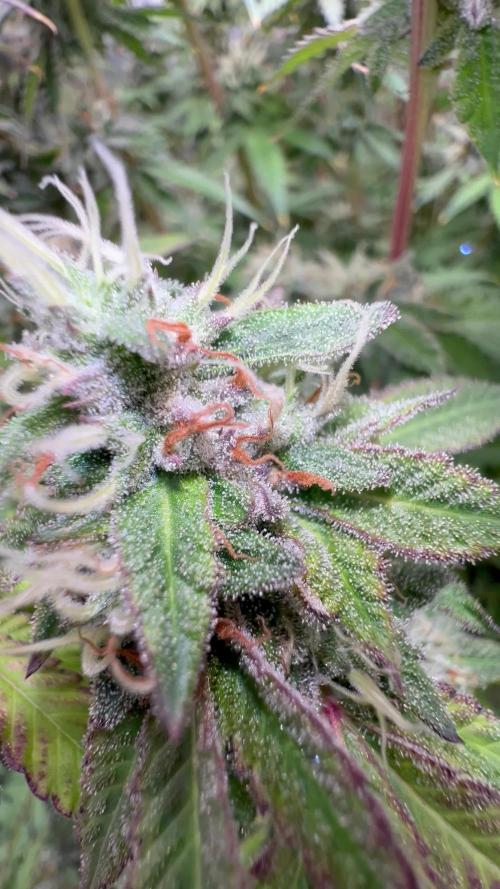
This girl has been one of my favorites. Pineapple express is true to it name looking like a pineapple once it fades the yellow, and the green are very beautiful together smells gassy with pineapple busting out of every tone
Likes
34
Share
Day 92: Moved the lights to a different hanging formation to get a few more inches up, was at 16" distance in most areas. I probably only have one more trick up my sleeve to get another inch or two if I need it. Video to give a full view. Day 93: Fed with 1Gal of purified water, 6.65 Ph. Day 94: Seems to be filling out, both leaves yet again, and buds now too. Day 95: Power outage yesterday about 3hrs before typical lights out. Battery backup to the timer function in the power strip is probably dead or jostled out of place. It wasn't notice until it had been off for 90 mins, so we choose to leave the light off for the rest of the day as I didn't want to stress anything out by having the lights off for 90m on for 90m and then off again for 12h. Day 96: Well I certainly understand the fruity smell growers referenced. Shout out to RockyRidger for the heads up - the smell is pervasive in the room even with the carbon filter in the tent. Wonderfully fruity and less musky, a bit diesel or citrus if you really get in there. I did another short round of defoliation, much less and more cautious than before. She has little crystals everywhere (better seen in white light tomorrow) near the buds and pistils. I can't seem to get the stickiness off my hands now and I've washed them three times with degreasing soap! Pics in the red spec as I kept just red on for 5 mins longer than normal as I finished up and fed her and wanted to get at least a pic or two in for today. Fed with 1Gal purified water. 2tsp FFBB, 1tsp FFGB, 1.5tsp FFTB, 2ml AN B-52. 6.71pH / 825ppm in, 6.52pH / 1200 ppm out. Day 97: Better shots of some of the glitter we've got going on. Day 98: 🎶 ooo, that smell 🎶 (Day 28 Flowering)
Likes
44
Share
@rhodes68
Follow
10/13 Day 43 Fed Bio-Bloom 15ml/ Bio-Grow 5ml/ Big Bloom 15ml per gal Mel and Lisa 1 gal each Kim and Jen 0.5 gal each, they just dont drink like their more sativa sisters. With Lisa being a green bud pheno think out of the 9 LSD-25s I have grown seen the most common phenos purple bud, green bud ,big leaf, thin leaf, dry leaf, oily leaf, yellow leaf (not sure about that) tall plant, short plant, and they come in all combinations it seems though I have only seen the "oily leaf" on the big leaf phenos. Have 20 more to grow in the coming year so time will tell.
Likes
12
Share
This week has went by well she is starting to fill in and smelling amazing small nugs but dense with some nice frost appearing she is starting to uptake water a litter more frequently can’t wait to see her over the next few days
Likes
6
Share
Eccoci di nuovo qui!!! Super eccitato per questa nuova collab con Exotic Seed, team davvero al top, che mi ha dato l’opportunità di testare questa nuova genetica e di condividere i progressi con tutti voi!!! Come sempre partiamo nei bicchieri per poi travasare.. Questa volta verrà svolto tutto sotto la Lumatek Zeus 465 ProC, mi aspetto molto da questo ciclo!! Settimana WOW mi h davvero sorpreso la crescita di questa piccola!!! Grazie a tutti per il supporto ❤️🍀🔥
Likes
5
Share
Likes
9
Share
Another beautiful lady chopped and drying with that whole plant hang really looking forward to these but they are so Frosty and so dense thank you for these amazing genetic and this amazing contest you guys really know how to bring the world together thank you again 💚👑👊🏼😎💨🏼
Likes
18
Share
@Growbody
Follow
Hallo und herzlich willkommen zu meinem Growbericht Outdoor 2025 mit den Sorten Power Flower Feminized, Royal Medic Feminized und Special Kush #1 Feminized, alle 3 von Royal Queen Seeds. Es ist das erste Mal, das ich Töpfe für den Outdoor grow verwende, bisher waren alle Gorilla grows und direkt in die Erde gepflanzt. Die URL der Power Flower Feminized: https://www.royalqueenseeds.de/feminisierte-hanfsamen/120-power-flower.html Die URL der Royal Medic Feminized: https://www.royalqueenseeds.de/cbd-samen/148-royal-medic.html Die URL der Special Kush #1 Feminized: https://www.royalqueenseeds.de/feminisierte-hanfsamen/138-special-kush-1.html Die Planung für den Grow ist, die Samen in easyplug Anzuchtwürfeln keimen zu lassen und danach in 0,6L und 2,2L Plastiktöpfen, dann letztlich in die neuen komplett doppellagigen ROOTIES 15 Liter Wide Version Stofftöpfe umzutopfen. Sobald die Witterung es zuläßt, sollen die Pflanzen an die frische Luft. Es ist schon eine Weile her, das der Grow losging, die Bilder sind jetzt aktuell. Tag 155: Endlich wieder 30°C und strahlender Sonnenschein bei leichtem Wind. Die drei Großen sind hinten am Zaun befestigt, so viel Coctailsauce kann ich gar nicht in die Töpfe füllen damit die bei stärkerem Wind stehen bleiben. Die Power Flower fem. ist jetzt 2 Meter hoch, die Special Kush #1 fem. misst 190cm und die Royal Medic fem. 155 cm. Alle haben mehrere Hauptstämme bekommen und sind sehr buschig. Tag 159: Bei den Temperaturen brauchen die Mädels 3x am Tag Ihren Cocktail. Mal sehen, ob ich die Töpfe etwas beschatten kann. Wenn's dir gefallen hat, schau wieder vorbei ✌️😎
Likes
142
Share
Hey everyone :-) This week a lot has happened 🤗🍀. The 5 that are already in the 12/12 cycle explode day after day 😍😅. All others have been repotted, and will remain in the vegi phase for 1-2 weeks. Otherwise there is not much to say 😃. I wish you all a good start into the week, let it grow and stay healthy 🙏🏻🍀🌱
Likes
33
Share
This was a strain I’ve had my eye on for a very long time and happy to say I have now fully experienced her from seed until harvest ! The ladies were harvested on Day 58 of flower and were hung to dry. Very easy to grow, not sensitive to anything and likes it a bit dryer in her pot. Beautiful plant to look at while in bloom - completely covered in trichomes and lots of beautiful calyxes While in flower she smells of fresh fruit and and very pungent. After dry she smells of cheese, earthy and peppery. I would love to send her off for some lab results as the effects tell me she is high in thc! Will definitely grow her again :)00
Likes
43
Share
@Growshh
Follow
This is the end of week 5. I've jus been giving them some brix calmag and silica in the water via drip 4 times a day. I have not top dressed any bloom since last application.
Processing
Likes
6
Share
Still just plodding on slowly. Topped this week. Have also installed a CO2 bag.
Likes
17
Share
dwarf is flowering nicely, was laying in the tent today listening to funky music and smoking :D couldnt get too many pictures because of bad lighting but took a nice little video of the trichomes :) started giving more nutrients as a friend told me flowering plants take up more water and phosphorus to produce buds :) gonna be like a kid on christmas day when i get my medicine harvested :D thanks for keeping up with the diary and the best of luck to you all! Day 52 - 29/10/19 Flushed the dwarf today along with my other plants, runoff had a ppm of 467 and ph 6.45. im going to try and get it closer to 6. with this plant being sprouting test ive come a long way and learned a lot :) its gonna be a small harvest, and is developing buds at a much smaller rate than the other two plants :) still im very excited. maybe week 10-11 harvest if im lucky haha. Day 53 - 30//10/19 Couldnt sleep at all as i have no buds left, after being restless in bed for 4 hours i got up and removed about 6-8 pistils from lower growth and rolled it up. almost the same quality high as street weed so im impressed :) taste was slightly harsh but man. finally happy to be on the road to good quality medicine:) il upsate soon with pictures of the plant! Day 54 - 31/10/19 Pictures and videos updated for all three of my diaries. im entirely happy with my hobby :) my Royal Dwarf is just flowering away on her own time, dont think theres long left for her now, maybe 3 weeks? check the videos and let me know what you think below in the comments! im not expecting this plant to grow any taller just to finish the buds for a nice little harvest :) finally shes developed enough to provide a smell and its much like a tropical fruit, something like a mango but i couldnt quite put my finger on it :) i love fruity smoke so roll on the last few weeks of flowering :) (i hope)
Likes
13
Share
@shwable
Follow
Everything looking fine so far. I gave them a little amount liquid grow enzymes with distilled water on 19.04. what seemed to boost the growth. If You have any tipps or recommendations feel free to let me know.