


Likes
Comments
Share


Likes
28
Share


@MrGrowthSpurt
Follow
What's up growmies🤟🏽. Week 3 on deck 🙌🏾🙌🏾. Everything is smooth sailing. I lst'd 4 of them today and I'm letting 2 grow natural ( for now). I have them on a 1.5 liters every 3 days watering schedule. They appear to be healthy and thriving.
Until next week, happy growing my friends and may the plant goddesses bless you with a bountiful harvest 💪🏾

Likes
34
Share


@SalocinSpecial
Follow
D89 (18/02/2021): Copy paste of last week... I think max one week and she is done 😁 I gave around 2L of tap water. Glue Gelato is dry and in jar since one week. I did not move back Banana Kush in the tent since I was sure it was her last week. At this point I should have move her back in the tent. I think being in the closet might have slow her down since there is no reflective wall but at least the environment conditions are good.
- temp in the closet: 18-21C
- water: 2L of tap water
- RH in the closet: 33-35%
D90 (19/02/2021): I can definitely see more resin gland forming on buds and can also tell that the calyx are swelling nicely.
- temp in the closet: 18-21C
- no water
- RH in the closet: 33-35%
D91 (20/02/2021): I gave 1.75L of tap water.
- temp in the closet: 18-21C
- water: 1.75L, PH7.5
- RH in the closet: 33-35%
D92 (21/02/2021): I checked the trichomes and they are more abundant. It's beautiful to see the buds becoming frostier day by day 😍
- temp in the closet: 18-21C
- no water
- RH in the closet: 33-35%
D93 (22/02/2021): She is starting to show some amber trichomes but not enough. I will let her some days to ripen but she is close to harvest!
- temp in the closet: 18-21C
- no water
- RH in the closet: 33-35%
D94 (23/02/2021): I gave 3L of tap water.
- temp in the closet: 18-21C
- water: 3L, PH7.5, 130PPM
- RH in the closet: 33-35%
D95 (24/02/2021): Trichomes are all cloudy with some ambers. Due to a timing issue, I will need to chop her this weekend in two or three days. Yesterday I did reduce light intensity to 50% power. She will pass 2 days with this light intensity and then 2 days in complete darkness.
- temp in the closet: 18-21C
- no water
- RH in the closet: 33-35%
D96 (25/02/2021): I will not change for week 14 since she is going into darkness tonight for two more days. Trichomes are not exactly where I would like. More ambers would be better but at least they are all milky white with some amber. She's at her peek in term of THC potency.
- temp in the closet: 18-21C
- no water
- RH in the closet: 33-35%
D97 (26/02/2021): 24h into complete darkness is done
- temp in the closet: 18-21C
- no water
- RH in the closet: 35-40%


Likes
3
Share


@Seventease
Follow
Buds growing nicely in size. Thrichomes forming on the sugar leaves. Looking nice and frosty!

Likes
21
Share


@Eauderay
Follow
Hello! I will be harvesting in few days and I can say she was a pleasure to grow and I am amazed she still flower not too bad even if she was slowly strangled on main and side shoots except the lowest buds who grew on the only side shoots without restricted uptake and you can see it!
Next time I am sure she will grow a bit bigger without this torture I inflicted to her straight from the beginning of flowering!
,she is turning yellow and some red fade colours too, I am sure I could give her one more week but I cannot wait any longer so soon she will be harvested... Next time maybe I will let her finish properly too! 😁❤️

Likes
5
Share


@jamaljackson
Follow
Here we are a week and a few days later. One of the Forum Stompers didn't come up. It was probably my fault, I could have given them some more time in the DVD case before putting them in the cubes but I was excited! I germed another one and that one has popped up just fine.
Growth up top is pretty slow, and some of the plants seem a little droopy. Their roots just started to grow out of the net pots so maybe that has something to do with it? Or maybe because they are right at the end of the light cycle for the day?
I've got roots that I can see on 3/4. For at least one of the plants the rhizo-core net pots seem to be doing what it's supposed to. I've got a nice set of roots crawling their way towards the bucket right down the side of the inner cone. Going to switch the rez out Sunday and start them on some really low strength nutes.
I got the red frog air diffusers in the mail and went and bought a new air pump, these things are awesome. They make a ton of tiny bubbles to the point where it's almost a foam on top of the water. I'm hoping the roots love all the extra oxygen.

Likes
2
Share


@Comfrey
Follow
Cactus Candy Kush wächst ganz gemütlich vor sich hin.
Diese Woche habe ich einige Ladungen in meinem Pyrolyse Ofen verfeuert und dabei Stockbrot gebacken. Ich nutze die Kohle als Zugabe beim Kompostieren. So wird sie über ein Jahr lang zigmal von Würmern zusammen mit dem Kompostmaterial gefressen und wieder ausgeschieden. Dabei reichert sich die Kohle mit Stickstoff, Mikrobiologie und vielen anderen Nährstoffen an. Der reife Kohle-Kompost hat eine besondere Fähigkeit die Pflanze mit gespeichertem Wasser und allen Nährstoffen zu versorgen, die sie während des Wachstums und der Blüte benötigt.
Likes
25
Share


@Hawkbo
Follow
I transplanted everything over the past 3 or 4 days and am just giving them some time to break in their new shoes before I flip them. I got a new bottle of calmag I think the one I was using was old it's been on the shelf for a while. The heat is still a little lower than I would like and now with the bigger pots humidity has gone way up.
Likes
228
Share


@Still_Smoq
Follow
📆 Week 9, 7-13 December 2023
7-13 December - Continued with simple adjustment of branches to receive maximum light. There was no defoliation of any leaf this week. Her growth rate has slowed and I believe she is heading in to the bulking stage. I’m satisfied with her size at this point.
8 December - Turned light power from 50% up to 75%, and raised lights from 18” to 21” from top of plant to facilitate the bulking phase of flowering.
📑 Let’s briefly discuss light and umol/m2/s or PPFD. First of all its all about numbers. Is there an agreeable starting point on these figures - the cannabis plant requires between 100-300 PPFD in seedling, 400-700 PPFD in vegetation, and 800-1000 PPFD in flower. It can go up to 1500 PPFD with certain C02 concentrations. I believe this may be generally accepted.
Never being much of a numbers person, in ways I avoid it. I’ve grown indoor weed for a long time without a fancy device to tell me what this number was, the plant did that. A quality light and the plant itself will talk to each other in a matter of hours sometimes, days in others, I just need observe. But what I have come to realize the past few years is that these numbers, found in simple instruments (apps for smart phones) give us a very specific area of where she is within all these spectrums. It allows us more precision and insight to what would otherwise be a possible weak or vulnerable spot within our grow. I’ll use mine on a new strain, and to verify any questions. They are easily accessible tools for the common gardner.
When we adjust our lights we can measure what will be optimal for our plant. Using my case in point;
from: 50% power or 890 PPFD at 18”
to: 75% power or 1080 PPFD at 21”
**if not raised 3” - that number would have been 1320 PPFD - likely damage the plant - or raised any higher there would be no real benefit in what I’m attempting to achieve - likely waste of power**
The 2023 ViperSpectra XS2000 lights (the ones I use) come with a new switch now that go from 25, 50, 75, 100% power and no option in between. So that kind of put a kink in a week or two during my grows I have to work around. Going from 50-75% power is a big shift in light intensity, and these lights are bright. Knowing what that number is and being able to adjust the height precisely to avoid damage is reassuring. I appreciate advancements that make growing a little easier.
In most personal grows during flower I’ll go well over 1000 PPFD depending on the strain tolerance, without C02. Here are my experiences why: 1) my set-up allows it, 2) that number only reflects the greatest reading at the highest point on the plant - my reports, 3) when the plant is budding it is absorbing much more photons than when in the leafy only stage - everything is accelerated - this is a totally different discussion, 4) the additional light provided will proportionally increase a higher yield, and finally, 5) some of todays theories on light will change in 5 years, as it has from 10 years before, we still have a lot to research. LEDs are definately cream of the crop, but there is something new to learn I’m sure. Until then I can only tweak what I have in search for a tighter bud, higher in THC.
I said I would briefly discuss this subject. Everything is possible with lights. It is science that says the cannabis plant does not have to produce secondary metabolites (trichomes and cannabinoids), in some cases it may not. It produces them based on its environment. She returns to you what you dedicate toward her. Something to keep in mind when deciding what kind of light to use to while trying to grow quality cannabis.
🍽️ Nutrient change on 7 December
🐲 Feeding schedule updated 7 December
🌊 Using reverse osmosis water with EC/TDS at 0
🐉 Nutrient Solution EC 2.1 at 65 degrees F
💡 Light power at 75%
That is it for this week. Thanks for the look, read and stopping by.


Likes
6
Share

@Sobreruedas
Follow
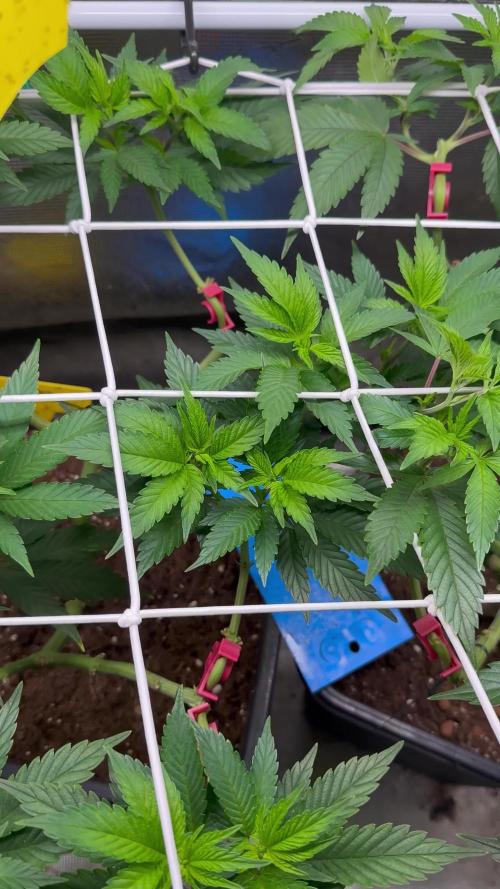
This week I added a scrog net and started guiding some of the branches through it.
A few branches were already long enough to be bent and positioned under the net, while others still need a bit more growth before reaching it.
From now on, the goal is to let the plant grow freely and focus on filling the net evenly before flipping to flower 🌿💪

Likes
8
Share


@XanabaGrows
Follow
This is my First Ever Grow, If you have ANY tips for me, please, don’t hesitate to leave me a comment.

Likes
49
Share


@masterofsmeagol
Follow
6/23 Due To The Two 8 Day weeks this week will only consist of five days to get me back on track. SEE LAST WEEK FOR DETAILS. I DID ANOTHER EIGHT DAY WEEK. I'LL DO THIS WEEK AS SIX DAYS. THAT WAY IM BACK ON SCHEDULE. WATERED 6/22. WENT BACK AT NIGHTCAND WATERED ANOTHER GALLON WITH 1/3 TSP Armor Si. I mixed the solution with kelp you kelp me but I dumped it out. I've mixed silica with other nutes before but I had read something earlier about bioavailability issues and I didn't want to risk it. My plants are the healthiest I've ever grown. I'm considering transplanting the large 10th planet that I'm light depping. I also need to develop my ipm and my nute schedule. Still gonna have to keep an eye onvthe water situation. Luckily I have a buddy in my corner that's co tinualkt Bern a great help.
WENT BACK OVER AROUND NOON. BEAUTIFUL OUTSIDE AND THE PLANTS WERE LOVING THIS SUN. I DEFOLIATED SOME BURNED LEAVES AND MIXED A SOLUTION IF KELP ME KELP YOU THAT I PLAN TO FEED TO THE GARDEN TODAY. IM HAPPY WITH HOW THINGS ARE GOING. WE HAVE SOME RAIN AND THINDERSTORMS COMING. I NEED TO GET MY IPM UP AND RUNNING AND THE NUTES ONLINE. I ALSO NEED TO DECIDE IF IM GOING TO TRANSPLANT THE LIGHT DEP 10th PLANET. Went back over to put the girls to bed at six and if was still 90 degrees. The water from yesterday had dissipated. The tops were dust dry. I mixed two gallons of kelp you kelp me and fed it to the garden. Afterwards I pointed qbd found a couple plants that were more open to the wind were a little lighter. I know tomorrow will be very hot. Maybe quarter inch of rain. However after that it will rain (showers) off and on for days. I wanted to make sure the girls had what the needed to make it through tjis heat wave until they get that rain. I had another gallon mixed up and I'm thinking I should've given it to them. Oh well. I'd rather underwater than overwater any day. I did notice a burnt top on the plant furthest from the tarp that the sun JUST BARELY TOUCHES when the rest are in shade. I'll just raise the tarp a little. These are tiny problems. Can't upload video until tomorrow.
6/24 Good thing u gave the plants that water. I know it wasn't much but we didn't get any rain. Suppised to get a qtr in today and another qtr in tomorrow. Then rain a couple more days. It's working our really good for my watering schedule lol. Yesterday the girls got there first dose of a bottled nute. They got two gallons of kelp me kelp you (1/3 tsp per gallon) and another gallon of just phed water. I was going to do another gallon but held off due to the threat of syring rain. Didn't get it bur it looks like the plants loved the kelp. It had reached 90 yesterday. They look better today. It's 70 at 9 today. I LST the 10th planet in the 3 gallon. It's getting huge. I should start a separate diary for those three light dep plants. Its cool as hell watching this. One of the purple punches is flowering pretty good. I probably should start another diary for them. I'll be starting to feed my plants soon. Wondering if I should pinch plants again. TUCKED THE LITTLE GIRLS IN AT SIX AND SHOT A VIDEO AND TOOK SOME PUCTURES. PLANTS LOOKED PHENOMINAL! GOT HOME AND AROUND SEVEN IT JUST STARTED RORREBTIAL DOWNPOURS! THE TYPE OF RAIN THAT BREAKS STEMS. I SHOULDVE PUT MY OTHET TARP UP BUT I DIDNT. I WISH I HAD. IM A LITTLE NERVOUS. I KNOW THESE GIRLS ARE STRONG THOUGH! TOMORROW. ILL ROLL THE RARP UP AND SECURE THE BOTTOM FOR FAST ACCESS. IM ALSO GOING TO KOOK INTO FINDING A TOP FOR MY CAGE I CAN USE IN INCLIMENT WEATHER.
6/25 That little qtr in of rain we were supposed to get turned into torrential downpours and high winds. Luckily no REAL damage. If you watch the video you'll see what I mean. I'm going to havecto be cognizant moving forward. Noticed a few chunks from leaves butvplants are still healthy. I'm surprised how well these girls withstood this storm. They are certainly resilient. The 2 purple punch 1 10th planet that I'm light depping are flowering nicely now. They missed all the commotion from the storm as they were inside. It's smelling good. I'm happy.
6/26 It's what a friend would say is "maineing") out. That mistcthe plants love. I'm surprised the plants are doing as good as they have been considering the wind. Will be adding nutes soon. Need to add extra supports too. Light dep
6/27 Brief periods or torrential downpours. Light depped 3 gallon 0lants are under an overhanfcwhete the hatsxrain can't hurt them but they still get sun. They are really starting to flower now! I'm going to begin feeding with a base nute and a flower nute I think. I'm thinking about giving the light dep some open sesame or something similar. I need to set up a nute program soon but the plants ALL look so healthy! And it's been raining! I've only watered like once or twice since they've been in the big pots. I've seen zero pests aside from a chunk missing from a grasshopper. Usually by now I'd have battled half a dozen things and be battling another half dozen. However I was posing from clones. These are seeds and boy don't I see the difference!


Likes
7
Share


@Jakobyzone420
Follow
Questa è l’ultima settimana. Faccio fino alla 10 con il flush e dopo taglio
Likes
Comments
Share

@Blast
Follow
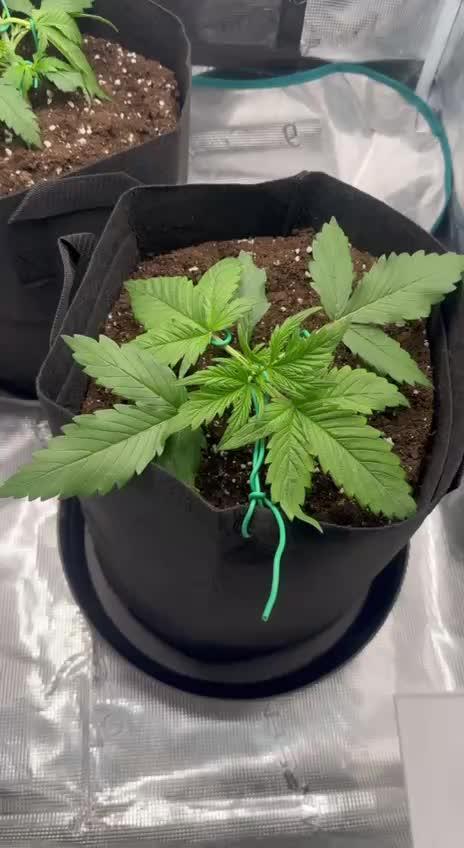
07.02 Попытался делать LST. Главный стебель довольно толстый уже, особо не выгибал. Посмотрю далее на реакцию
12.02 — Проведение LST (с клипсами)

Likes
49
Share

@masterofsmeagol
Follow
7/4 SUN was poking out a little bit. Plants loved that little feeding and seen to he noticeable larger this morning. I'm considering starting the nutes. At least the organic ones as well as upping the water intake I've been scared to water with all this rain and my experience last time. I plan on applying BT this afternoon and doing some work on the bottoms of the plants. I also saw a chipmunk in my cage so I have some spots in my fence that need to be patched. I know I can't compare this year to orher years as these are seeds and all the other years were clones. I CAN say for certain that my plants are healthiest they've been out of any of my journals. Previous plants were much larger but I was fighting numerous fungal, pathogens and pests at the sane time. Ear wigs would've lollipopped most buddies by now but I've seen no sign of them. I'm going to apply more poison where they were and add some rat traps inside the cage for the chipmunks. Once I fix the cage I think I'll be good.
UPDATE: Went back over and fixed the holes on my cage from high winds. I found an old wire trap or cage and just cut sections and ziptied them to the existing wire and to the structure thus covering any open holes. I'll need to put lathes aroubdvtge outside because if a rodent REALLY wanted in they could get in. My belt had been wearing thin but I use shit until it breaks (yesterday the heal came off my shoe lol) so I was working hard sweating my nuts off and my belt gives out totally. At least ive got the major stuff done. I took a few videos too. I'm imagining it was this little bit of sun that gave these plants that boost of growth but I'm wondering if the added nutes had anything to do with it. Bags weren't light and I could feel moisture in the soil so I didn't water. I'll check again tomorrow morning. Since I didn't see many plants or even leaves for that matter with damage I decided to hold off ob the BT and the plant doctor. Only time will tell if that was the right decision.
7/5 Plants look fantastic. I see a few more holes in leaves sporadically amd I'm hoping it's pillars. I've seen lots of lightning bugs on my camera though and grasshoppers are abundant. Not one growth shoot has been chewed (knock on wood) which is what the earwigs had always done. I watched a video from last year and by nowcthey had lollipopped all lower leaves. It may not be the best weather growing season wise but despite the rh consistently in the 90's I still don't have pm or fungal pathogens. Need to get the BT out. Didn't water as we've had all that rain. I'll water either tonight or tomorrow morning. Sunny high in the 90s low is 66. Tomorrow looks good too.
UPDATE WENT BACK OVER AROUND FIVE. IT WAS 88 DEGREES SO I WANTED TO CHECK THE GROW BAGS. THE POTS ARE FINE. IT WAS HUMID AS HELL. ONE PLANT WAS SLIGHTLY DROOPY BUT VERY LIGHT AND DRY. I FOUND TWO OTHERS THAT SEEMED LIGHTER THAN THE REST BUT HADNT DROOPED. I MIXED TWO GALLONS OF WATER WITH 1TSP KANGOROOTS AMD PHED IT CLOSE TO 6. I FED THE 3 PLANTS THAT WERE SUPER DRY LIKE A HALF GALLON AND SPRED THE REST OVER THE OTHER EIGHT PLANTS. THEY WERENT DROOPING BUT THEY WERE VERY DRY. I PLAN ON A FULL WATER TOMORROW. I WOULDVE DONE IT TODAY IF THE TEMPS WERENT SO HIGH. ITS RAINED A MONTH STRAIGHT SO I HAVENT HAD TO WATER. I MADE A COUPLE VIDEOS BUT I'LL HAVE TO UPLOAD TOMORROW.
7/6 Another super hot day. I hefted the pots and they still had some weight but I could tell they were dry. This rain has messed up my watering schedule. Well it made it so I didn't NEED to water. These are big plants now. I need to get a schedule to stick too. They're going to probably need a gallon a piece at least. I'm still nervous watering. Right now I'm just reading the plants. I added .5tsp kelp me/you to 1 gallon of water to help with heat stress. I fed an additional two gallons to the garden this morning including the two container plants in the back. They were dry on top too but I know they have water deeper down. Next watering I'll be more consistent and try to give them there 10%. It's great having the bags elevated. I can finally see when I start getting run off. I could even measure the ph of it instead of relying on that meter. Ill check the ph when I go back over. Still a few 🐛 holes but they are few and far between. I really don't want to spray for such a small problem but if I cant find them at night that's what I'll do.
UPDATE: Another 90 degree day. I went back over and gave the garden a gallon of water as they were dry and it didn't rain. Tried to use a soil ph meter to check ph. First couple were 6.4, 6.5 then I got 7.3 and I accidently dropped it. Then I got somethings that were high eights and even one 9! Obviously the Meter shit the bed. I'll lower the ph of the water slightly when I fully water tomorrow and I'm going to measure the runoff.
7/8 I must've messed up the journal again as the dates are off. GAVE PLANTS A FULL WATERING. Each girl got a gallon. I couldn't upload my videos this morning as I had to break up a fight. 3 on 1. Didn't give me a chance to put the videos up. I'll take some stills then I can upload them. I took stills and they all uploaded but didn't fucking save. I'm nit going to keep trying to upload if it's not going to. Noticed a few more holes in leaves and one skeletinized leaf so I need to either spray the bt or something more versatile. I'm putting more poison around the cage and de between the bags. I'll go check things out tonight. Sick of writing a book and uploading to just hace them disappear
7/9 Did a quick video today. Noticed the bags were fairly light despite the plants being soaked amd the pallets wet. I was pressed for time. I gave two gallons to the entire garden. I hope that will hold them over until tomorrow. I'll need to up how much water I give them. Going with a gallon and a half next time. I see more pillar spots and a moth took off when I shook the plants this morning. So I'm gonna have too apply the BT. I figure if I go over before dark tonight I might be able to see aju nocturnal insects around. Luckily my dad feeds the birds and they are always there. I think they help with pests.
UPDATE IT WAS A LITTLE COOLER TODAY BUT MICH MORE HUMID. I WENT AROUND SIX TO MAKE SURE THE GIRLS WERE OK WITH WATER AND TO GIVE THEM A TREATMENT OF BT. I WENT THROUGH THE GARDEN ANDCGOUND THREE LEQVES TO DEFOLIATE AND LITERALLY A COUPLE LEAVES ON TWO PLANTS WITH PILLAR HILESM WHEN I ARRIVED TWO BIRDS FLEW OUT. A HORNET CAME IN WHILE I WAS THERE. THIS DO LESS APPROACH SEEMS TO BE REALLY WORKING. I DODNT SEE NEARLT ENOUGH DAMAGE TO WARRANT SPRAY8NG MY EXTREMELY HEALTHY GIROS WITH ANYTHING. ILL KEEP AN EYE ON THEM AND CLEAN THEM UP A BIT. I DO NEED TO INSTALL THE VERY8CAL TRELLIS FOR SUPPORT. THEYRE PRETTY HEALTHY THOUGH. ONE PLANT IS ABOUT AS WIDE AS IT IS TALL. STILL......PLANTS ARE EXPLODING AND ITS GETTING TIGHT IN THERE. I NEED TO GET THE TRELLIS UP THOUGH.
7/10 I went over and was planning to water. Plants were wet and it's raining. Top of the medium was moist but the bags were light. ONE bag was super light but seeing that we are having showers all day and an additional half inch of rain coming tonight so I didn't water them. Especially since they looked great. Decided to to spray BT yet as the damage is so small and i think the birds have been taking care of the pillars for me. Now I'm wondering if I should've gave that ONE plant a little bit of water but it will be find. Did a video. I'm being careful not to over water. Last year this is when all my buddies were devoured by earwigs. And no senescence like the years before. I think it was hust those earwigs. I haven't lost shot for leaves. Even the stalks are bright green and look amazing.
Likes
19
Share


@MrJones
Follow
I put 328 grams of wet bud into my dry tent, my target variables are 60F/60RH for 2 week, with the current temps and high out side humidity we are averaging 66F/58%RH so not to far off - these buds will probably be done at 10 days - looking forward to updating this as harvest report when I trim up.
Likes
9
Share


@Soskar69
Follow
The plant is ok, we are near the harvest.
Because she is the smallest , she drinks less than the others plants I have.
Also I've done some research for my problem, and I'm gonna wash the buds. I have read a lot of opinions and all the people that at first were sceptical, say that now they doing it all the time, so I'm gonna try it! If the flavour and the overall experience is good, I'll do it also on my gorilla. And what's your opinion on "bud washing"? Let me know in the comments!
Here the weather is gonna be bad for the next days so I'm a lil worried because I'm so near the harvest and I'don't want to fck up things now. The humidity is gonna reach 90% so for the next 2 days I will take them inside.
Sorry for the bad quality, next time I'll try to use a better camera

Likes
38
Share


@Danger90946
Follow
Here we are in week six of flower and not a lot has happen this week other than the usual watering and letting her do her thing. Only trouble this week was updating GoPro had to try a few times. Other than that we got some rain in my home town and collected about 60 gallons that I'm going to use to finish the rest of the grow. Also, got my new AC Infinity CLOUDLINE T4, Quiet Inline Duct Fan System with Temperature and Humidity Controller, 4-Inch. I was really hoping this two plants would finish before the year ended, however, it looks like they got others plans. See you guys next week.
Likes
14
Share


@Okie4
Follow
Good week so far !! On to my last strength of nutrients !! Then the flush begins. Girls are starting to bulk up. Had to purchase a dehumidifier to keep the humidity down this week. Wish I knew exactly how long this strain went.. any idea ?