


@GreenHouseLab
Follow
Day 10 Of 12-12, defoliated 75% of canopy will leave untouched until day 21 Flower. Running 1250 ppms of cropsalts, light dimmed to 75% @15-18” of canopy


@Zurban_Poison
Follow
Hi all!
now the moment has come when the buds began to grow in width! get fat and become covered with trichomes.
the smell is magnificent, sweet fruity.
the plant eats a lot. 5 liters of fertilizer per day. no wonder she started to get fat!)))


@Comfrey
Follow
Das Substrat ist nach heftigen Regenfällen vollgesaugt aber dennoch gut belüftet. Vitales Pflänzchen. Es stürmt, sie brauchte etwas halt und überstand diese Woche ohne ein nächtliches Glasdach über dem Kopf.
Es sieht vielversprechend aus bis jetzt.


@Headies
Follow
First I soaked the seed for16 hours. Then I put them in a moist paper towel until they sprouted a tail and I placed them in rockwool. Day three I put them in rockwool. I shot for 50 ppm and put a drop of unsulfured molasses in the water for germination.


@Fonzi
Follow
Sehr gute Sorte. Sie Bss#1 hat ein etwas organisches leicht limoniges Aroma und die bss#2 riecht sehr stark nach Eukalyptus. Mir gefallen beide aber ganz gut. Vorallem ist die Wirkung ist sehr gut.


@420keef
Follow
I used a macro lens from a fish eye kit you can buy for any phone to make that macro video, i highly recommend them it’s so easy to see when i can harvest , these are also very cheap but you do need a steady hand haha. I smoked some smaller buds about a week after harvest & it already tastes amazing almost like a reaalllyy sweet banana haha & the burn is good also i was suprised it was smokeable so fast. Fat banana is one of my favourite strains from now on! I also had 1 Sour Diesel in the tent but i’m still curing that one


@Franz1234567
Follow
what is small is beautiful.
The girls look healthy and vital. coconut has an unnecessarily low EC - 0.8 and pH 7.4 - both from leaching measurements from coco samples in distilled water.
The EC of the solution will be set at level 1.5 with the intention of gradually increasing it up to 2.5. pH by the same principle with a start around 6 and an upper limit of 6.5.
looks easy right?
What girls will say. Only time can show.
I almost forgot. the led panel hangs closer to the tops of the plants


@Messypies
Follow
Plants have been germanated in paper towels. Then moved to the final growing container.
Soil used is plant magic soil with no starter nutrients



@Atomik_water
Follow
Week 9 – Late Ripening, Root Zone Reset & Canopy Management
Entering Week 9 puts us squarely on the home stretch.
Transpiration has noticeably tapered off as the plants wrap up floral development, which made the stubborn 6.7–6.8 runoff pH even more critical to resolve before the final flush.
With nutrient demand declining and runoff volumes climbing, I made key structural adjustments to dial in the finish line:
Eliminating the Silicate Buffer:
The root cause behind the elevated runoff pH was Silic Rock (potassium silicate). At this late stage, its strong alkaline buffering was continuously fighting the acidification and blunting the action of Athena Cleanse. I dumped the remaining reservoir and mixed a fresh 35 L batch (EC 1.0 mS/cm, initial pH adjusted to 5.4)—**completely cutting out Silic Rock** while maintaining a 0.2 ml/L dose of Cleanse for root and line hygiene. Dropping the silicate frees the root zone to sit naturally in the optimal coco absorption band.
Metabolic Shifts Under High DLI & CO₂:
The plants have been pushed hard under high light intensity and CO₂ supplementation throughout bulk bloom. Heavy phosphate uptake in prior weeks, coupled with an anion/cation exchange that pushes hydroxyl ions OH into the rhizosphere, left behind concentrated salt pockets in the coco core as transpiration outpaced nutrient consumption.
Canopy Thermal & Radiation Relief:
Looking closely at the main colas directly beneath the fixture's center, several top pistils showed early browning and heat stress. This was photo-oxidation from high PPFD rather than uniform trichome maturity. To relieve canopy stress and protect ripening calyxes, I raised the LED fixture by 10–15 cm, dropped ambient temperature by 2°C, and increased relative humidity by 2% to bring the VPD into a gentle, non-stressful range for the final fade.
Phenotypic Variances (Seed vs. Clone):
Operating four distinct seed-grown phenotypes under an automated dripper setup requires keen observation. Plant #3 developed a noticeably denser root block with slower drainage, requiring targeted manual top-offs to match the wash-through of the other three.
With the fresh, unbuffered reservoir locked in and light stress minimized, the canopy is cruising cleanly through Week 9 to finish cloudy and amber without salt buildup.
Day 58 / Week 9 – Official Start of Nitrogen Cut & Heavy FadeToday marks the official start of the Fade Out / N-Cut phase. This morning was the very last feeding containing any nitrogen; from here on out, it’s 100% zero-N all the way to harvest.These are the final snapshots of the green canopy before the full autumn fade sets in. The goal of this protocol is simple: force the plants to deplete their internal nutrient reserves and break down excess chlorophyll in both leaves and flower calyxes. Excess chlorophyll and lingering nitrates are the primary culprits behind harsh smoke and a grassy taste—cutting nitrogen now guarantees a silky-smooth smoke, clean white ash, and lets the authentic terpene profile shine without interference.Current Reservoir & Regime:Water: 100% pure RO (EC 0.0)Formula: Complete Nitrogen Cut (0 ml N-base). Running a specialized $text{CaCl}_2$ finish for calcium and cell wall rigidity without nitrogen, coupled with light PK and essential micros.Biostimulants: Chitosan oligosaccharide (systemic defense / SAR against botrytis) and Triacontanol + Kinetin for late-stage resin synthesis and terpene density.Parameters: Inflow EC 1.0 mS/cm, pH dialed in at 5.4–5.6 to clear the root zone buffering.Plant 1 is already wrapping up senescence with heavy calyx swelling and rich anthocyanin purples, while Plant 3 is finishing its final push of calyx stacking. The flush/fade clock is officially ticking!


@RussianGrower
Follow
So it's time to harvest Russian machine guns. The plants were high because we pulled them with a lamp and did not use LST. The final product was removed on the shelf of the refrigerator.00


@GreenMunchkin
Follow
Week 7 let's go !
Day 152 - 04/11 : The plant symptoms have seemed to slow down. The soil is also starting to dry out a bit more which might have been a problem.
Day 155 - 07/11 : She was flushed in the morning with about 4L of water and 2L of a 30% strength microbial+trichoderma tea to innocculate the soil in case the microlife took a hit. The run off was 1L.
I also switched the 400W MH for a 400W HPS to finish off with a little extra boost of light + different spectrum and see if it makes any differences.
The light were moved up by approximately 20-30cm. They are now at about 70cm from the plant. I wondered if the light were maybe too close and caused all those strange symptoms. Let's see if there is any change in their behaviour.
Day 156 - 08/11 :
It seems the plant is a lot happier. It has only been a day but I feel like she is fattening up faster suddenly. Or it could be that she has recovered from the slight chock from a few days ago.
Day 158 - 10/11 :
Yep she is definitely happy again. I am convinced it was the light or at least it was part of the problem, I am seeing a lot of growth all of a sudden, on all plants and not just this one. Trichome are up, pistilles are up, calyxes swelling, everything is running smooth again. She is looking ready already, from a bud general appearance I could almost harvest now, but the trichomes are still mostly clear and I have a feeling she has a little more in her. I suspect the reason for such large amount of already brown trichomes might have been the light excess they went through.


@PrairieFrostGrow
Follow
******Week 5 Veg - Jan 6 to 12, 2020
This was a week of growth. She grew up and did very well with a couple of her side branches thickening up. She is a very healthy girl but she is not flipping. I wrestled with this weeks journal because I wanted to get it started to show her great growth but all along I was not sure if I call this week a flower week or not. In the end I waited and I am calling it a Veg week😥😥 She is not flipping......freaking wants to though by all signs.......I got a suspicion but I hope I am wrong......I don’t want to run two flower cycles!
IPM spray with Lost Coast Plant Therapy.......recent thrips experience and staying with a preventative cycle💀👻
Some branches are stiffening since the introduction for silica but others are still very pliable. The main stem is still very “bendy” and perfect for LST right now. Too soft for entering flower given the silica. Why?
She has handled the light intensity fine.....she has not been going to sleep early. She has handled the nutrients well given the amount being put in anticipating her switching and wanting the flower dosages.
She is beautiful little girl at first glance but she has some oddities in her growth......keeping the grow interesting she is young Skywalker😎 👍
More detail:
Jan 6/20 - Day 29
- 2L RO water pH 5.7.
- Run-off: 1150ppm, 6.1pH in try from last. After feed 800ppm, 6.0pH
- Pot light today. Wanted plain water but she is feeding
Jan 7/20 - Day 30
= life was busy........nothing done today for watering.
- Pot was the heaviest of the bunch......enough to wait.
- She was more droopy today.......cold in the tent though....75 degrees?????
Jan 8/20 - Day 31
- Feel she is hungry so fed in AM today.
- AM: full feed except no CalMag
- AM run-off 900ppm, 6.2pH
- PM: full feed with CalMag.
- PM run-off 430ppm, 6.1pH
- No time tomorrow morning and pots were not heavy so decided to feed again in evening.
- She is green and happy.......no bud sites though?
Jan 9/20 - Day 32
- Life busy......noting done......heavy feed yesterday.
Jan 10/20 - Day 33
- Water only. 1L pH to 6.0
= IPM tonight so keeping it light today. Hit her tomorrow with full feed.
= She is looking AWESOME today. Up and happy and still no buds😨😕
- Spray with Plant Therapy from Lost Coast for bug prevention. Fortunately no signs of any issues.......and this will keep it that way😁👊
Jan 11/20 - Day 34
- 2L feed. Upped the base nutrients, Dual Fuel, today to 2ml/L. Wanted to break 1,000ppm and see what happens.
- With Advanced Nutrients I am usually over 1100ppm at a similar stage.
- Played with light intensity in the tent today by giving them all more.
- Pulled 2 fan leaves today.
- Limbs are growing funny. Soft and narrow and not typical symmetrical pattern of growth.
Jan 12/20 - Day 35
- huge growth night....side branches bushed out and got taller!!
- Supplemental focus on this feeding.......help root zone again.
- Voodoo and Piranha for two weeks again at the start of flower and promote growth. Sensyzime to help clean up the roots for better uptake.
- she is 13" tall and 18" wide now.
- 4 large leaves removed and two smaller nodes.
Pictures all added 😀.....fought the website for network connections tonight😡.........update the comments tomorrow now👌........cheers!👏


@Dunk_Junk
Follow
Looking absolutely gorgeous this week.
Incredibly stinky!
Incredibly sticky!
Really fat buds.
And she's done. Will be chopped in 24h.


@Master_weeda
Follow
Bonjour à tous les padawans et maîtres jedis
Jour84 arrosage avec 2 litres d'eau ph6.3
Jour86 arrosage avec 2. 5litres d'eau ph6.3
Jour89 arrosage avec 2 litres d'eau ph6.3
LE MEILLEUR MOMENT POUR RINCER SON CANNABIS
Le rinçage commence en général deux semaines avant la récolte. Si le plant a une période de floraison de huit semaines, le rinçage doit commencer six semaines après le début de la période de floraison. Il est préférable de regarder de près les trichomes sur le plant pour déterminer quand votre cannabis est prêt à être récolter. Si les petits trichomes commencent juste à passer d’une couleur transparente à une teinte laiteuse et blanche, c’est une bonne indication que les plants peuvent commencer à être rincés. Il faut s’arranger pour que la majorité des trichomes aient changé vers la couleur désirée pour la récolte après deux semaines – ça devient plus facile à faire avec l’expérience, alors accrochez-vous !
Le rinçage peut également être un bon moyen de remettre à zéro la terre quand un plant est toujours en phase de croissance végétative. Parfois, un cultivateur suralimente par accident son cannabis, ce qui provoque un changement de couleur et un flétrissement du bout des feuilles. Ceci est appelé une « brûlure par nutriments ». Rincer la terre peut éliminer les nutriments excédentaires, ce qui aide à résoudre le problème. Cependant, c’est une mesure drastique à ce stade de la culture, alors assurez-vous que le problème soit bien une brûlure par nutriments et non quelque chose d’autre.
Le rinçage ne concerne pas que le moment de la récolte. Cette technique peut aussi être mise en place durant la phase de croissance afin de débarrasser le sol des nutriments. Bien évidemment, les nutriments permettent à votre plante de rester en bonne santé et vous assurent des rendements maximaux, mais une trop grande quantité peut causer une accumulation et un état statique durant lequel la plante ne peut plus y accéder.
Le blocage des nutriments peut être causé par une accumulation saline ou des niveaux de pH incorrects. Ces deux causes peuvent être résolues par un rinçage de votre plante à l’eau claire. Les fluides viendront pousser les nutriments en dehors du substrat et le débarrasseront de l’accumulation, permettant ainsi aux racines de pouvoir accéder à nouveau aux nutriments.
EMPÊCHER LE BLOCAGE D'ABSORPTION DES NUTRIMENTS AVANT QU’IL NE POSE PROBLÈME
Au mieux, le blocage des nutriments peut être un problème, au pire, il peut être un vrai désastre. Comme le dit l’adage, il vaut mieux prévenir que guérir. Il vaut mieux prendre de l’avant pour empêcher le blocage des nutriments plutôt que de s’y atteler lorsque c’est trop tard.
Empêcher le blocage des nutriments peut se faire par le biais d’un rinçage de routine. En rinçant vos plantes une fois avant la floraison et une fois au milieu de cette dernière, vous minimiserez l’accumulation de nutriments.
LES ENZYMES À LA RESCOUSSE
Après le rinçage pour contrer l’accumulation ou le blocage des nutriments, vous remarquerez peut-être que vos plantes ont une apparence vert foncé, c’est le signe d’un excès de nutriments. Dans ce cas, certains cultivateurs choisissent d’ajouter une formule riche en enzymes à leur substrat.
Au cas où vous auriez oublié vos cours de biologie, les enzymes sont des protéines qui catalysent les réactions. Elles aident à rincer le substrat en décomposant l’amidon, les glucides et les nutriments. Il existe sur le marché toute une variété de produits qui contiennent des formules d’enzymes très efficaces.
Si l’eau ne suffit pas à vos plantes, ces petites protéines ne feront qu’une bouchée de l’accumulation de nutriments !
COMMENT BIEN RINCER SON CANNABIS
Rincer votre plant de cannabis est un processus simple. À chaque fois que vous apporteriez normalement des nutriments, vous rincez à la place. De l’eau du robinet non traitée est tout ce dont vous avez besoin pour rincer, assurez-vous juste que son pH est sans danger pour le cannabis. La plupart de l’eau de puits a un pH sain et ne nécessite pas de traitement, mais s’il est nécessaire de traiter l’eau de rinçage pour avoir un pH adapté, faites-le. Les ajustements du pH seront donc la seule chose à considérer.
Inonder la terre avec autant d’eau fraîche qu’elle puisse contenir. Laissez l’eau durant quelques minutes pour qu’elle puisse absorber les nutriments, puis inondez la terre encore pour rincer les nutriments loin du plant. Si vous cultivez en intérieur dans des pots, notez la couleur de l’eau qui s’échappe du fond des pots. Elle sera tâchée et aura une couleur sale. C’est à cette étape qu’un appareil de mesure des TDS (Total des Solides Dissous) est utile. Si vous récupérez et mesurez le TDS de l’eau « évacuée », elle devrait avoir un taux de 1300ppm, ce qui est assez élevé. Il est important de rincer le plant jusqu’à ce que total baisse à un niveau de 50ppm, ou du moins qu’il s’approche du TDS de l’eau fraîche que vous utilisez pour rincer le plant. La couleur de l’eau d’évacuation va s’éclaircir et apparaîtra plus propre. Vous devez tirer autant que possible de minéraux dissous du plant.
Comment et Quand Rincer les Plants de Cannabis
Rincer les plants de cannabis avant la récolte peut faire la différence entre les meilleurs têtes ou la plus rude pour la gorge. Cette petite tâche est simple et facile à faire. Ajoutez juste de l’eau ! Attention car le moment du rinçage joue un rôle critique.
Le b.a.-ba du rinçage de ses plants de cannabis.
Sommaire:
1. Qu’est-ce que le rinçage ?
2. Le meilleur moment pour rincer son cannabis
3. Empêcher le blocage d'absorption des nutriments avant qu’il ne pose problème
4. Les enzymes à la rescousse
5. Comment bien rincer son cannabis
6. Comment rincer ses plantes en hydroponie
7. Les résultats du rinçage de son cannabis
8. Quand éviter de rincer son cannabis
Vous avez enfin fini vos cultures et vous vous retrouvez avec un magnifique plant couvert de super têtes, maintenant sèches, vous avez fait le curing et vous êtes prêt à fumer – et pourtant quelque chose ne va pas. La weed semble ne pas vouloir se consumer et quand vous tirez une bouffée, c’est comme si on vous avait donné un coup de poing dans les poumons et vous toussez en craignant pour votre vie ! Le goût est rude et décevant. Si c’est une situation que vous avez vécue, il y a des chances pour que vos plants n’aient pas été rincés correctement avant la récolte.
Cette fumée bien loin d’être agréable est provoquée par la présence dans le plant des nutriments et minéraux utilisés lors de la culture, ce qui altère la façon dont le plant se consume. Rincer le plant élimine ces nutriments restants, ce qui améliore la qualité des sensations. Heureusement, le rinçage des plants de cannabis se fait facilement et sans effort, et cela vous permet de produire des têtes douces et délicieuses en un rien de temps.
ARTICLE LIÉ
Comment Utiliser les Nutriments pour Cannabis
QU’EST-CE QUE LE RINÇAGE ?
L’acte de rincer un plant implique d’utiliser de l’eau pour éliminer tout nutriment présent dans la terre. Une grande quantité d’eau est passée à travers la terre et drainée sur une base régulière. Tous les minéraux et nutriments présents dans la terre sont rincés avec le temps avec l’eau, ce qui laisse une terre propre.
Mais pourquoi vouloir éliminer tous les minéraux de la terre ? N’est-ce pas mauvais pour la récolte ? En fait, cela aide à la récolte de manière significative. Quand les nutriments sont éliminés de la terre, ceci force le plant de cannabis à utiliser tous les nutriments toujours présents dans le plant. C’est comme pour le corps humain. Quand on consomme beaucoup d’aliments, ce que nous n’utilisons pas est transformé en graisses. Dans les situations extrêmes où la nourriture est rare, le corps s’appuie sur cette graisse stockée pour tirer de l’énergie.
Comme rincer force le cannabis à utiliser tous les nutriments restants dans le plant, aucun ne devrait rester et altérer les têtes récoltées. Cependant, si vous le faites trop tôt, cela peut nuire à la santé du plant, le moment est donc clé.
LE MEILLEUR MOMENT POUR RINCER SON CANNABIS
Le rinçage commence en général deux semaines avant la récolte. Si le plant a une période de floraison de huit semaines, le rinçage doit commencer six semaines après le début de la période de floraison. Il est préférable de regarder de près les trichomes sur le plant pour déterminer quand votre cannabis est prêt à être récolter. Si les petits trichomes commencent juste à passer d’une couleur transparente à une teinte laiteuse et blanche, c’est une bonne indication que les plants peuvent commencer à être rincés. Il faut s’arranger pour que la majorité des trichomes aient changé vers la couleur désirée pour la récolte après deux semaines – ça devient plus facile à faire avec l’expérience, alors accrochez-vous !
Le rinçage peut également être un bon moyen de remettre à zéro la terre quand un plant est toujours en phase de croissance végétative. Parfois, un cultivateur suralimente par accident son cannabis, ce qui provoque un changement de couleur et un flétrissement du bout des feuilles. Ceci est appelé une « brûlure par nutriments ». Rincer la terre peut éliminer les nutriments excédentaires, ce qui aide à résoudre le problème. Cependant, c’est une mesure drastique à ce stade de la culture, alors assurez-vous que le problème soit bien une brûlure par nutriments et non quelque chose d’autre.
Flushing
Le rinçage ne concerne pas que le moment de la récolte. Cette technique peut aussi être mise en place durant la phase de croissance afin de débarrasser le sol des nutriments. Bien évidemment, les nutriments permettent à votre plante de rester en bonne santé et vous assurent des rendements maximaux, mais une trop grande quantité peut causer une accumulation et un état statique durant lequel la plante ne peut plus y accéder.
Le blocage des nutriments peut être causé par une accumulation saline ou des niveaux de pH incorrects. Ces deux causes peuvent être résolues par un rinçage de votre plante à l’eau claire. Les fluides viendront pousser les nutriments en dehors du substrat et le débarrasseront de l’accumulation, permettant ainsi aux racines de pouvoir accéder à nouveau aux nutriments.
EMPÊCHER LE BLOCAGE D'ABSORPTION DES NUTRIMENTS AVANT QU’IL NE POSE PROBLÈME
Au mieux, le blocage des nutriments peut être un problème, au pire, il peut être un vrai désastre. Comme le dit l’adage, il vaut mieux prévenir que guérir. Il vaut mieux prendre de l’avant pour empêcher le blocage des nutriments plutôt que de s’y atteler lorsque c’est trop tard.
Empêcher le blocage des nutriments peut se faire par le biais d’un rinçage de routine. En rinçant vos plantes une fois avant la floraison et une fois au milieu de cette dernière, vous minimiserez l’accumulation de nutriments.
LES ENZYMES À LA RESCOUSSE
Après le rinçage pour contrer l’accumulation ou le blocage des nutriments, vous remarquerez peut-être que vos plantes ont une apparence vert foncé, c’est le signe d’un excès de nutriments. Dans ce cas, certains cultivateurs choisissent d’ajouter une formule riche en enzymes à leur substrat.
Au cas où vous auriez oublié vos cours de biologie, les enzymes sont des protéines qui catalysent les réactions. Elles aident à rincer le substrat en décomposant l’amidon, les glucides et les nutriments. Il existe sur le marché toute une variété de produits qui contiennent des formules d’enzymes très efficaces.
Si l’eau ne suffit pas à vos plantes, ces petites protéines ne feront qu’une bouchée de l’accumulation de nutriments !
Comment et Quand Rincer les Plants de Cannabis
COMMENT BIEN RINCER SON CANNABIS
Rincer votre plant de cannabis est un processus simple. À chaque fois que vous apporteriez normalement des nutriments, vous rincez à la place. De l’eau du robinet non traitée est tout ce dont vous avez besoin pour rincer, assurez-vous juste que son pH est sans danger pour le cannabis. La plupart de l’eau de puits a un pH sain et ne nécessite pas de traitement, mais s’il est nécessaire de traiter l’eau de rinçage pour avoir un pH adapté, faites-le. Les ajustements du pH seront donc la seule chose à considérer.
Inonder la terre avec autant d’eau fraîche qu’elle puisse contenir. Laissez l’eau durant quelques minutes pour qu’elle puisse absorber les nutriments, puis inondez la terre encore pour rincer les nutriments loin du plant. Si vous cultivez en intérieur dans des pots, notez la couleur de l’eau qui s’échappe du fond des pots. Elle sera tâchée et aura une couleur sale. C’est à cette étape qu’un appareil de mesure des TDS (Total des Solides Dissous) est utile. Si vous récupérez et mesurez le TDS de l’eau « évacuée », elle devrait avoir un taux de 1300ppm, ce qui est assez élevé. Il est important de rincer le plant jusqu’à ce que total baisse à un niveau de 50ppm, ou du moins qu’il s’approche du TDS de l’eau fraîche que vous utilisez pour rincer le plant. La couleur de l’eau d’évacuation va s’éclaircir et apparaîtra plus propre. Vous devez tirer autant que possible de minéraux dissous du plant.
COMMENT RINCER SES PLANTES EN HYDROPONIE
Le rinçage des plantes en hydroponie est bien plus simple que de se débarrasser des nutriments en terre. Les cultivateurs en hydroponie pourront simplement drainer leur système et le remplacer par une eau au pH neutre.
Le rinçage des plantes en hydroponie est aussi un processus bien plus court. Une fois que la réserve d’eau aura été modifiée, les plantes en hydro n’auront pas accès aux nutriments externes. Pour cette raison, un rinçage de deux jours suffira.
LES RÉSULTATS DU RINÇAGE DE SON CANNABIS
Après la récolte des têtes, prenez du temps pour bien faire le curing pour atteindre le potentiel le plus élevé. Un affinage correct par curing permet de réduire encore plus le côté rude des têtes, en éliminant des choses comme un excès de chlorophylle. Vous serez étonné de voir la différence que ce petite effort peut avoir sur votre produit. Tout votre travail se sentira dans la première bouffée de cette weed douce comme de la soie, qui caresse la gorge comme du miel. Le plus doux de la nature. Vous pouvez donc améliorer la qualité de votre cannabis en ajoutant juste de l’eau !
QUAND ÉVITER DE RINCER SES PLANTES
Le seul moment où nous recommandons d’éviter le rinçage de son cannabis est lorsque l’on travaille avec une terre biologique amendée ou un super soil. Ces substrats ont été développés avec précaution afin d’héberger des micro-organismes bienfaisants tels que des bactéries ou des champignons. Cette délicate biodiversité pourrait être éliminée et endommagée par le rinçage.
Une fois de plus, l’absence de rinçage ne devrait pas poser de soucis, car aucun nutriment externe ou synthétique n’aura été ajouté au substrat. À la place, les plantes comptent sur les micro-organismes pour décomposer la matière organique et la livrer aux racines.
May the force be with you 💪


@DogDoctorOfficial
Follow
🌿 Week 4 – Purple CousKush Auto #12 | Plant B
The Quiet Strategist Begins Her Move | 8×8 Adventure
Every plant has its own story, even when they share the same tent, the same light, the same feeding schedule, and the same care.
That’s one of the reasons I decided to document each phenotype individually throughout this 8×8 Adventure. Every seed carries its own personality, its own pace, and its own way of expressing the genetics hidden inside.
Today the spotlight belongs to Purple CousKush Auto #12 – Plant B.
While a couple of her sisters are already sprinting into flower much earlier than expected, this lady is taking a slightly more measured approach. She’s clearly entering pre-flower, showing her first pistils and announcing that the transition has begun, but she’s doing it on her own schedule. There’s no rush here… just steady, confident progress.
And honestly… I like that.
Sometimes the plants that don’t demand attention early become some of the most rewarding later on.
⸻
🌱 Life inside the 8×8 Adventure
The room continues running under the 12/12 From Seed experiment, a method that constantly surprises me with how differently each cultivar reacts.
Even under identical environmental conditions, every plant interprets that limited photoperiod in its own way. Some immediately focus on reproduction while others continue building structure before committing fully to flowering.
Purple CousKush B seems to belong to the second group.
She continues investing energy into producing new growth while gently stacking pre-flowers across the upper nodes.
Watching these differences unfold is exactly why I enjoy documenting every individual plant instead of only reporting on the room as a whole.
⸻
🌿 Training without forcing nature
This week has mostly been about leaf tucking and a little gentle Low Stress Training.
Rather than removing healthy fan leaves, I’ve simply been moving them out of the way to expose lower growth sites to the LED. It’s amazing how much additional light reaches the interior of the plant with just a few careful adjustments.
LST continues following the same philosophy.
No aggressive bends.
No unnecessary stress.
Just guiding branches into better positions so the canopy can develop naturally while allowing more future flowering sites to receive direct light.
With autoflowers, timing is everything. Every day counts, so I prefer making small corrections instead of major interventions.
Purple CousKush B has responded beautifully, opening her structure while continuing to push healthy new shoots from every direction.
⸻
☀️ Summer is definitely here…
The biggest challenge this week hasn’t been nutrition.
It hasn’t been watering.
It hasn’t been training.
It’s simply been the weather.
Outside temperatures continue climbing, making it surprisingly difficult to keep the grow room perfectly stable—even with the air conditioning working around the clock.
Despite seeing daytime temperatures touching 33°C, humidity has remained reasonably controlled, helping prevent excessive stress while maintaining healthy transpiration.
Considering the conditions, I’m genuinely happy with how all the ladies are responding.
Strong stems.
Healthy green foliage.
Excellent turgor.
No signs of heat damage beyond the normal environmental challenge that summer inevitably brings.
Sometimes growing isn’t about chasing perfect numbers…
It’s about adapting and helping the plants stay comfortable despite Mother Nature trying to make things interesting.
⸻
💧 Week 4 Feeding
The feeding schedule remains simple and consistent:
• Terra Grow — 1.8 ml/L
• Power Roots — 1 ml/L
• Pure Zym — 1 ml/L
• Sugar Royal — 1 ml/L
Solution parameters:
• EC: 1.35 mS/cm
• pH: 6.1
The plants continue responding extremely well, with lush green foliage and vigorous new growth showing that the nutrition remains well balanced.
⸻
🌸 Looking ahead
With pre-flower now clearly underway, I’m expecting Purple CousKush B to begin stretching over the next week.
Unlike some of her faster sisters, she’s building a slightly more open architecture before committing fully to flowering, which could translate into excellent light penetration later in bloom.
Every day brings another surprise inside this tent, and that’s exactly what makes this project so enjoyable.
One room.
One environment.
One feeding program.
Yet every phenotype writes its own story.
I can’t wait to see what chapter Purple CousKush B has planned next.
⸻
As always, a massive thank you to everyone following this adventure, leaving comments, sharing knowledge, and supporting these journals week after week. Your encouragement genuinely makes documenting every phenotype worthwhile.
A huge thank you as well to Plagron for the outstanding nutrition, Zamnesia for the incredible genetics, and everyone helping make this 8×8 Adventure possible.
Growers Love and see you all next week for another chapter. 🌱💚


@Roberts
Follow
Mandarin XL auto is doing some bulking. She had a solution change early week. Been selectively defoliating around her center to open her up to more light. Everything is doing really well and waiting on her to fill in and ripen. Thank you Gen1:11, Medic Grow, and Ganja Farmer. 🤜🏻🤛🏻🌱❄️🌱
Thank you grow diaries community for the 👇likes👇, follows, comments, and subscriptions on my YouTube channel👇. ❄️🌱🍻
Happy Growing 🌱🌱🌱
https://youtube.com/channel/UCAhN7yRzWLpcaRHhMIQ7X4g



@Bones_1986
Follow
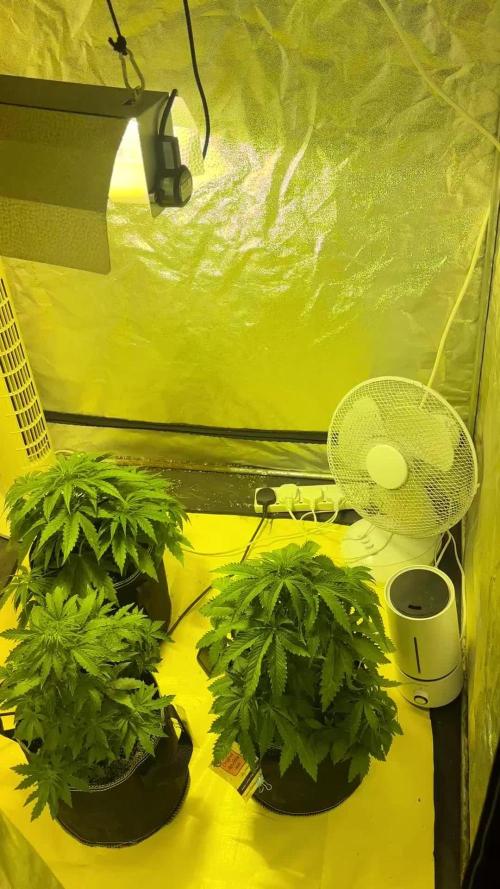
Day 21. Fed just over 1.5L only yesterday and they appear to be really thirsty girls with the pot already feeling light however with the slight curling of Leafs maybe suggests slight overwatering.
Im also thinking a very slight mg deficiency so will add a little cal-mag on the next feed.
Gonna wait at least another 24 hours then Introduce bloom and top max. Would like these to stretch a lot over the next week. Already starting to smell. With this tent being in my garage and the outside temps dropping from 10 degrees now down to 0 the temp inside the tent has gone from 27 to 22. Turned extraction fan down to help hold the heat but with the night 600w HPS on 24-0 as well as plenty of inside airflow, absolute no issues.
Day 23
Just shy of 2L per plant. Responding well. Very early signs of flowering, still stretching about 1” daily really wanna see these shoot up over the next 5 days
Day 25 currently 12-14” height.
Plants are thirsty so another 1.7L fed today.
Day 27.
Cotton berry.
Lacking a little N, so upped the grow. Growing nicely


@420DeepGrow
Follow
Sorprendido por la noticia de mi primera colaboracion con MarsHydro 😊🙏 y muy sorprendido tambien por el envio de las semillas por parte de 420FastBuds. Gracias
a vosotros puedo compartir mis diarios con los usuarios de growdiares
La marca numero uno en focos 💡, carpas de cultivo ⛺️, extractores 🌬️ y demás aparatos que necesitas para tu cultivo.
Para esta aventura arrancaremos con 💡Mars Hydro TS 1000 Full Spectrum LED Grow Light 150W Regulable y 1 semilla autofloreciente a un ciclo de 20/4.
Verdaderos 150w con este TS1000, la mejor luz de cultivo LED para principiantes.
Ofrece una luz adecuada para 2-4 plantas 🌱. Su precio razonable, la marcada mejora del rendimiento y el control variable de la producción la hacen amigable para los nuevos cultivadores. Todo un tesoro para cualquier cultivador que este comenzando.
Usaremos para esta aventura una carpa de 60x60x90, MarsHydro una carpa para los más exigentes.Con una solapa de cremallera mejorada, dobles cremalleras de metal con forro,reflectante diamante tipo Mylar, postes de metal para una estructura mas solida, no se puede pedir nada mas.
Garantizando una respuesta en solo 24 horas tanto si has usado antes la marca como si no.
Que decir de 420FastBuds, uno de los mejores bancos de semillas a nivel mundial. Si quieres una Auto de verdad, esta es tu cepa.
Increíble 28.5 % de THC! 😵😵💫🤯
La autofloreciente más fuerte del mundo hasta el día de hoy, con una producción increíble de tricomas.
Superfiable e increíblemente resistente. Esta variedad heredó las mejores cualidades de sus padres, por lo que es una variedad infalible incluso para cultivadores principiantes.
Productora masiva. Crece alrededor de 150 cm y puede producir hasta 650 g/m² en 10 semanas.
Cogollos gruesos y densos. Produce cogollos del tamaño de pelotas de golf que terminan completamente cubiertos de tricomas y que tienen un aroma excepcional, una excelente opción para cultivadores y extractores comerciales.
Genial para principiantes. Ideal para cultivadores principiantes que buscan una variedad potente, resistente y fácil de cultivar.
💡 MarsHydro TS1000:
https://www.amazon.com/gp/product/B07PLY1WKK
⛺️ 60 x 60 x 90 MarsHydro:
https://www.amazon.com/dp/B081PN2QDN/
🌻 Gorilla Cookies Auto:
https://2fast4buds.com/es/seeds/gorilla-cookies-auto
Doceava semana de floracion, el cogollo principal es inmenso, parece la peluca de un rasta.
Lavado de raíz y corte finalmente esta semana, voy a aguantar una semana más porque se está poniendo duro el cogollo.