


Likes
Comments
Share


@w33dhawk
Follow
Da ich mittlerweile eher der Meinung bin das meine Pflanzen etwas zu viel dünger bekommen haben gebe ich zur Zeit nur noch Wasser werde die auch bis zum Ende jetzt durchziehen (Spülung)........
Ach ja und diese Woche war hart die Temperaturen in der Box unten zu halten habe montag, dienstag und mittwoch in der beleuchtungs Phase das Zelt auf gehabt dadurch hatte ich 28,2 spitzen Temperatur 🌞 ziemlich hoch für die blüte Phase aber bei geschlossenem Zelt hatte ich morgens 32 Grad in der licht Phase da musste ich reagieren das problem an der nummer is das ich in einem Mehrfamilienhaus haus lebe mit 24 Parteien da gab es Dann schon auf meiner Etage komische Blicke Vor allem am Dienstag bin kurz einkaufen gegangen Zelt war offen und habe vergessen das Küchen fenster zu schließen komme wieder und mein Nachbar spricht mich an......... 😂🤣✌️
Das da ja ein sehr schöner Geruch aus meiner Küche kommt und ich sollte doch mal lieber mein Fenster schließen
da er zwar kein Problem mit dem Geruch hat aber es ja noch andere Parteien im Haus gibt..... Puh😰😰😰😰😰😰😰😰😰 mehr Glück als Verstand gehabt. Da ich aber auch den halben Tag dem Geruch von gras ausgesetzt bin nehme ich das auch nicht mehr so stark wahr wie andere.......

Likes
1
Share


@GreenSunrise
Follow
flowers really packing on weight this week. I've had to tie up supports and stripped off quite a few of the older fan leaves. I've started the flush this week to go with the strain timings. any flush advice would be appreciated.

Likes
Comments
Share

@DharmaTheDog
Follow
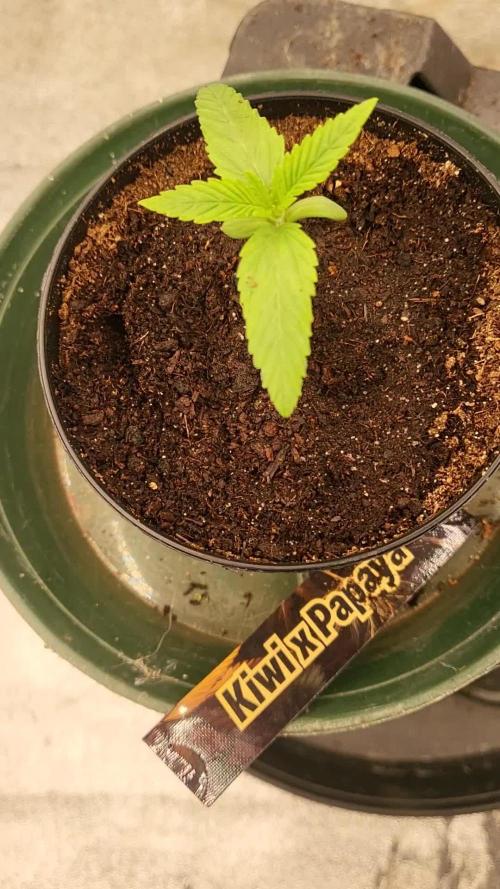
The seeds germinated in two days. I put them in the dark in the cellar where the temperature was stable at 25 degrees. .

Likes
11
Share


@Porroskunk
Follow
14 dias desde el cambio a 12/12, tuve que sacarlas para revisarlas, ya que
se traspaso una plaga de arañitas, y tuve que aplicar insecticida foliar contra la arañita de anasac, antes que entre de lleno a floracion.


Likes
10
Share


Likes
18
Share


@AZMamaBear
Follow
Had to prop up her heavy branches. Should be ready to harvest in a couple of weeks.
Likes
205
Share


@BigDaddyK
Follow
it grew too big, i dont know why, i had all sorts of issues with the height and because of that it had lights on the side,I love the taste, and smell, and Indica hit.0
please note - it was 2050 grams wet, and ive pulled 165 grams dry of superb frosty buds,you have to try the OOZE people.00
I think I've fixed the data , if anyone sees anything change on here of other diaries , to something silly please let me know0

Likes
2
Share


@PalmaGrow
Follow
Se realizó poda apical y de bajos preparándola pra transplante final
14 - 20 julio

Likes
77
Share


@BipolarHellas
Follow
Hello everyone, 🇬🇷
this is my diary for the GHSC Contest...package received on 21st April...I will be growing Banana Crumble in this diary...It's a cross between Banana Punch and OG Kush, from Green House Seeds...
I wish everyone Good Luck!!!!!Let's Do It.
WEEK 1:"COME OUT AND PLAY"
☠️Day 0...seeds are placed in a bowl with wet paper towels,on a heat mat...
...after 48 hours... they need more time...
☠️Day 000..after 56 hours 3 were ready to be planted,the other two seeds need more time...I planted them in coco coir.My earth is called "Coco Humus", it's a Greek product and it consists of coir, perlite and organic matter...I covered them with baggies for extra humidity...They are now under a 50 W Led light...Fingers crossed...
☠️Day 1...24/04/20...the babies have popped their first tiny leaves...their cotyledons are different than usual,they are a bit longer...the are under a 50W Led inside a cupboard..I have removed the baggies...they are still fragile and small
☠️Day 4...the babies are growing very slowly but they are OK
☠️Day 6...so they are growing very slowly...they have just popped their second pair of true leaves but they are still tiny...Our journey has begun...
See u all next week...

Likes
92
Share


@DogDoctorOfficial
Follow
Week 13: Week 5 Flower—A Garden in Full Bloom 🌸✨
Hey, Grow Fam! 💚 We’re deep into Week 13, and this room is nothing short of mesmerizing. Each plant is unique, showcasing its trichome-coated beauty, with white hairs dancing in their distinct patterns. It’s the culmination of patience, hard work, and overcoming challenges. The two-layered canopy—thanks to some ambitious young ones—is a testament to adaptability and dedication. 🌱🌟
Feeding Update: Aptus Holland Breakout Powder
This week, we introduced Aptus Holland Breakout Powder into the feeding mix at 0.5g/L, alongside the nutrients already in use. This powerhouse additive is designed to promote robust flower development, enhancing both density and resin production. Breakout Powder brings that extra “oomph” to the table, helping the girls truly break out into their full flowering potential. 🌺💪
Combined with our existing recipe, the results are already starting to show. Buds are swelling, trichomes are shimmering, and the room smells heavenly. If you’ve ever wondered what a well-rounded feeding schedule can do, this week’s results are the answer!
TrolMaster Magic: Monitoring & Stability
I’ve included a few TrolMaster app prints to share my love for this system. It’s not just about controlling the environment; it’s about mastering it. The app provides real-time data, historical records, and an unmatched level of convenience. Whether I’m sipping coffee or working in the garden, the system keeps me in sync with my grow.
This week, I’m particularly thrilled about how stable the pH levels have become since transitioning to full mineral-based nutrients. Unlike the organic-mineral combo, which required frequent adjustments, the current setup is practically self-sufficient. This stability means happier roots, more consistent nutrient uptake, and ultimately, better plants. The data speaks for itself—check out the comparison print!
Comfort & Style: My Aptus Holland Pants
Oh, and can we talk about how comfortable my Aptus Holland pants are? These have become my go-to garden gear. Stylish, functional, and perfect for spending long hours among the plants. Let’s just say, my plants aren’t the only ones dressed to impress! 😂👖
Shoutouts & Gratitude
As always, a huge thank you to the amazing people and brands that make this journey possible:
• TrolMaster for the tech that keeps me connected to my grow.
• Aptus Holland for the nutrients that take my plants to the next level.
• Pro Mix for the growing medium that supports this foundation.
• Cannakan for ensuring my seeds get the perfect start.
• And of course, the seed banks for these incredible genetics.
A special shoutout to the community—followers, friends, supporters, and even the haters. You all bring energy to this space, and it’s all apprecialoved! Let’s keep growing stronger together. 💚
#TrolMaster #AptusHolland #GrowLife #CannabisCommunity #FlowerWeek4 #NeverGiveUp #GrowWithLove #IndoorHorticulture #Defoliation #PPFD #ControlledEnvironment #SCROGNet #DogDoctorOfficial
Discount Codes so you can save big on your next check out 💚💚💚
Kannabia - DOGDOCTOR 30% off
SeedsmanSeeds - DOGDOCTOR 10% off
CannaKan- DOGDOCTOR 15% off
terpyz.eu - DOCTOR 15% off
The Neutralizer - PORKIT5-DOG 15% off
Fast Buds - DOGDOCT 15% off
As always thank you all for stopping by, for the love and for it all , this journey of mine wold just not be the same without you guys, the love and support is very much appreciated and i fell honored and so joyful with you all in my life 🙏
With true love comes happiness 💚🙏 Always believe in your self and always do things expecting nothing and with an open heart , be a giver and the universe will give back to you in ways you could not even imagine so 💚
Friendly reminder all you see here is pure research and for educational purposes only
Growers Love to you all 💚💚💚


Likes
17
Share


@gottagrowsometime
Follow
Runtz Female 7Lpot & 7 weeks. Ready to clone in the next few days.
Week 7 of the Green Sensation test. Mother plant is growing at an extremely low rate, its focus was on leaf growing so over the week. I starting removing and the plant is starting to take shape. I think I'll be able to grab a nice pair of clones in 5-7 days.
Days 42-46
Slowly over the past few days. I took all of the fan leaves off 1 set a day. Kept the feed low to not stress her. Hopefully I can get 2 good clones. Keeping everything simple as stated in the past few weeks. (If you want more info read back.)
Ppm kept between 3-350 and master root, etc. All detailed in detail.
Day 47-48
Plant has finally started growing its nodes. The two top ones are ready to go. didn't remove any leaves. I'll veg this for 4 more weeks and flip. As I've said before. This one will be kept on Xpert Nutrients.
Day 49
Pheno is doing well. Amazing growth the past 24 hrs. She's coming into a real stride. I'll take 2 clones ready to start the Green Sensation
Day 50 2x clones have been removed.
20% off Zamnesias entire catalogue of seeds:ZAMMIGROW2024
20% off XPERT NUTRIENTS/KANNABIA with code:GGST
20% off Oringal Sensible Seeds with code:

Likes
16
Share


@Mrg7667
Follow
I wanted to try and keep these all in the same "schedule" so i didnt consider day 1 Till the last straggler popped up probably at least 1-2 days later then the rest. So its 1-2 days fluxuation between popping most where opened up by day 2-3 after burying
Also side note currently for the pop i am using 4 1,500 lumen 2,500K CFl and 1 800 lumen 5,000K CFL

Likes
10
Share


@Gruschel_Muschel
Follow
Purple Punch am 26.12.2024
Tag 49 / 14.02.2025
Meine Purple Punch steht schon in der 7 Woche, ein großer Erfolg für mich.
Habe mit Bio Bloom und Bio Grow in der letzte Woche sie gedüngt, das Ergebnis kann sich sehen lassen.
Heute, wird Acti Vera, Alg A Mic und Bio Heaven in das Gießwasser hinzu gegeben.
Feedback:
Ich bin überaus voll zufrieden wie meine Pflanze sich entwickelt hat, ich denke die gute Erde und der Dünger von Biobizz hat ein großen Teil beigetragen. Ich werde mal schauen wie die Pflanze in der 8 Woche aussieht.
Ich nehme gerne Ratschläge von der Community an.
Likes
29
Share


@Spliffing_Around
Follow
Purple lemonade one is going to be harvested. The rest will be pushed two or even more weeks

Likes
16
Share

@Mrg7667
Follow
Lotss of updates! Got a decent commercial LED 600w so just about same wattage as my last three lights but way more coverage and light penetration🙏 I dont have the dimmer so that might be needed as the babies get taller!
Ended up cutting about 6 clones from each plant. Just going to wait for a little recovery then im transplanting into 5 gallon for flower!
Likes
53
Share


@Roberts
Follow
Merlin Mintz Autoflower is doing good. She had got her first lst, and selective defoliation today. Her root tips were pruned. She is looking good, and ready to go. Thank you Aeque Genetics, Athena, and Spider Farmer. 🤜🏻🤛🏻🌱🌱🌱
Thank you grow diaries community for the 👇likes👇, follows, comments, and subscriptions on my YouTube channel👇. ❄️🌱🍻
Happy Growing 🌱🌱🌱
https://youtube.com/channel/UCAhN7yRzWLpcaRHhMIQ7X4g
Likes
13
Share


@Prozak
Follow
the strain is really strong ,
low temperatures resist , 3 weeks around 12/16º graus and steell growing wel
nice new colos between week 4/6 in flowering.
really good strain to manipulate! 5 stars * * * * *
Processing
Likes
10
Share


@CanadianFillmore
Follow
Start of week 4, the blueberries had major bud growth during week 3 and they filled in nicely. There are a few signs of deficiency in the larger fan leaves, but overall I'm very happy with how the blueberries are growing. The Super Lemon Haze is showing signs of deficiencies, she's also hungrier than the blueberries, she got an extra 2 liters of nutes at 1/4 mute strength, the last two weeks. She may require full strength nutes in the extra feeding, to help with the deficiencies. Still, bud site development is coming along nicely on the SLH.

Likes
7
Share


@oTiodoPlantProd
Follow
First week of life watering with pH 6.0 water. waiting for the cotyledons to begin to indicate that they are running out of nutritional reserves to start fertigation . Which will be with the plantProd MJ line. 100% mineral high frequency fertigation.