


Likes
Comments
Share


@Canadian_Growology
Follow
Just starting to flower 😃
This week I foliar sprayed ChitoSal and Rubicon Marinis to help transition to flower.
I also added nets to the rest of the plants since we've had crazy storms lately but they hole their own quite well.
Roughly 30 gallons of soil inside cages wrapped in plastic about a foot and a half high amended with 3 cups Gaia 4-4-4 and 2 cups Gaia 2-8-4 and 2 cups Gaia Feather Meal 13-0-0.
Topped up each month with a cup of each as well as worm casting/soluble kelp/molasses compost tea once a week. Also Fish Shit amendment added at recommended doses.
Orange Kush Cake, Cherry Gar-See-Ya, Mac 'n Jack, Crescendo Rbx1 are all Ethos genetics at 25-35% THC
Blue Afghan is from Jordan Of The Islands.
Recieved clones in the mail in early May.
Happy Growing 😌


Likes
7
Share


@Adam22
Follow
Day 6 in flower the back left one has extremely outgrown the other 3. The front right has shown pistils and the other 2 are short and bushy so hoping I have 3 girls. Going to keep an eye on the tall one till it shows sex. Didn't get a chance to prune at all due to being in tiny pots for veg 6 weeks and causing stress and didn't want to over do it with transplanting them soo late I will wait untill week 3 of flower before I prune and keep bending the fan leaves under the lower canopy untill then. The smell is lovely
Likes
4
Share


@Autower
Follow
Another day another week and coming along nicely only difference this week is I have started pumping some overdrive through them now seems as it’s week 6 flower. 2 weeks on that then hopefully ready for a flush with pure water and a few days dark then harvest time. I’ve got a feeling the papaya is going to be ready before the cookies waiting for.my microscope for my phone to come then will update with some pictures of the trichomes.


Likes
4
Share

@captaincondor
Follow
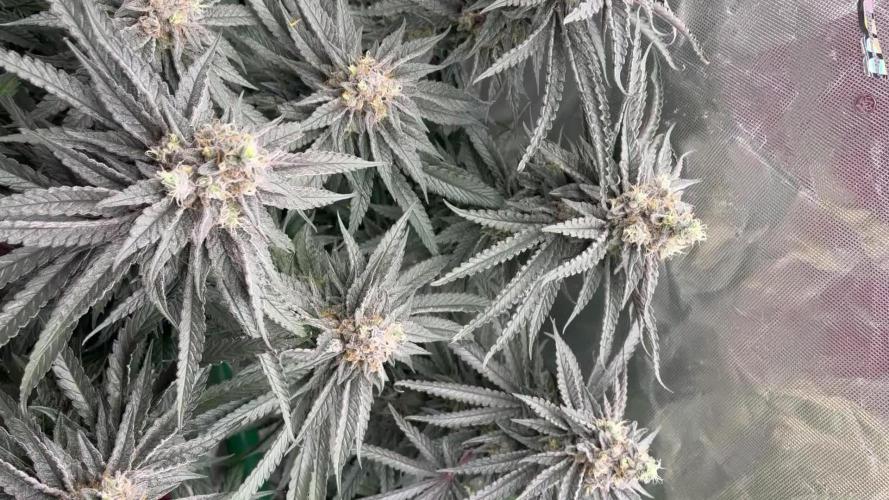
I’ve used dragon force to bring these two plants to the finish line . I’ll be chopping probably in around 8 days

Processing
Likes
15
Share


@GanjaSmoker88
Follow
Settimana 8
Le ragazze stanno bene ed emanano un forte odore di formaggio :)
14/12
1 lt acqua (per pianta) + 3 ml OrganicBloom + 1 ml Allzimes + 1.5 ml Pk Boost + 0.1 ml Silic boost + 1.5 ml Flower Stimulator. Ph 6.48 Ppm 814.
16/12
1 lt acqua (per pianta) + 2.5 ml OrganicBloom + 1 ml Allzimes + 1.5 ml Pk Boost + 2 ml Flower Stimulator. Ph 6.5 Ppm 970.
19/12
1 lt acqua (per pianta) + 2.5 ml OrganicBloom + 1 ml Allzimes + 1.5 ml Pk Boost + 2 ml Flower Stimulator. Ph 6.4 Ppm 930.

Likes
6
Share


@LeRaar
Follow
Semana de mucho calor, se a regado en 2 oportunidades solo con agua ya que se evapora muy rapido!
Video 15 dias luego de pasar a 12/12
Hoy 28-07 ya aplacando el calor
Dias pasados hasta 39 grados soportando las niñas
Likes
19
Share


@Artyparty
Follow
It's been a while since I updated this diary bc work and life has been hella busy for me. But banana hammock has been cruising so far. Going into the end of week 3..I chose not to defoliate this time like I usually do around week 3. Just gone take whatever is blocking a top or at least try to tuck it...shooting for big colas. I'm introducing a few of Humboldt County's Own nutrients...they got good reviews and I just really want to try them lol..just got a few products such as the killer t, snowstorm ultra and the G10
Likes
2
Share


@SolitudeCorners
Follow
We’re deep into Week 8, and Blue Banana Cream is stacking up beautifully. Trichomes are looking frosty, covering the buds in a thick, sticky layer—definitely a strain that’s going to shine post-cure.
The aroma has intensified compared to earlier weeks, now pushing out a stronger creamy, fruity scent with a slight gas undertone. Every time I open the tent, it hits harder. The buds are swelling up nicely, transitioning from airy to more mid-compact density. Pistils are still mostly white, meaning it’s got a bit more time before it fully ripens.
One thing I’ve noticed—the branches are starting to lean from the weight, so some light support might be needed to prevent them from bending too much in the final stretch. I’m keeping temps at 18-20°C and humidity around 55-60% to ensure a proper finish.
With harvest around the corner, it’s just about watching those trichomes shift from clear to cloudy/amber and letting this one reach its peak.
Likes
45
Share


@AsNoriu
Follow
New week, seems ok for first morning, will do heavy feed on day 52.
I already gave away one plant ( strawberry cough photo ) now one of fast diesels still stucked in pre-flower, would love to return to 18/6 regime, just dont want any reveg or hermie. Still lost.
Fingers crossed ;)
Day 53 Morning, leaves a bit down after night, everything looking not bad, thinking to defoliate two midle babies.
Had a big mistake on day 52, they where down, i stayed for one night out and was late with watering for a day, they looked totaly down, like my mobile, thats why no photos, never seen any plant so bad in my hole life... But they are ok now, quess it was on the verge, but damadge was done 100 %
Day 53 evening. I wouldnt be me if i wont be searching ways to screw up the crop ;)))
After many hesitations i decided to do very light defoliation.
And ..... They hated it. Lets give couple days, but 2 huge stresses in 3 days dont give me and girls joy for sure ....
In that rush forgot to make third Fast diesel photo, but i quess she didnt made mind to flower, took like 5 leaves down and left her for a bit,very annoying , she will be a big delay at the end or very early harvest, both ways waste of time....
Plus had to reduce light to 15.5 of day, maybe those 30 min will force her ...
All 3 Fast Diesels are very mag hungry, fed them with epsom salt extra.
Day 54 . Fast Diesel 3 went to 24 hours darkness prison with a heater ;))) hope that will teach her a lesson !
Others got feed with silicic acid, they drink, thats a good sign tho !
Fast Diesel 3 was a day behind from all, even 5 leaves was too much. But its a good time for me to give last trick i can, before downgrading day hours even more.
Day 54 Evening. Girls are praying again, silica always boost them to hapiness ;)
Day 56. Girls are growing, looks like last Fast Diesel starts to make buds from preflower, but a lot of pistils going brown, so either its heat, which i will check today or its hermie ;)))
Could be wind damage, i will check all options today, returned from work, made short shitty video and thats all ;)
End of week.


Likes
Comments
Share

@Germanator
Follow
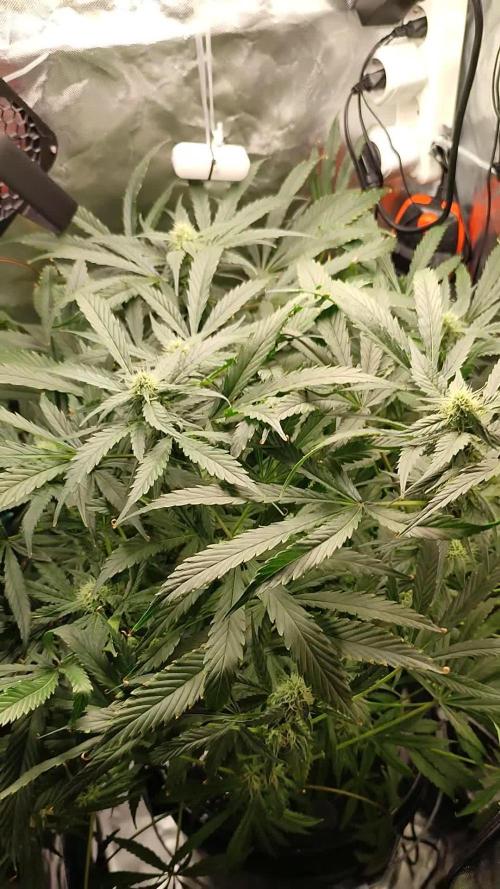
This week was quite unspectacular except that my pH was drifting low and I had to counteract. Removed some lower leaves and branches that were only poorly developed.

Likes
Comments
Share


@absolutgrow
Follow
This is my growdiary for the Royal Gorilla seeds. They are growing together with NL from RQS. I planted 3 of them and all are growing happily. I planted each seed in a different pot so i can look for differences in yield and quality. Im looking forward to share the grow-process with you and i hope you enjoy my diary :).


Likes
17
Share


@420DeepGrow
Follow
Gracias al equipo de Seedsman Marshydro XpertNutrients y Trolmaster sin ellos esto no sería posible.
💐🍁 Tangerine Snow F1 Fast:
Esta gran cepa es un cruce de cuatro vías 75% sativa de (Boost x Tangelo) con (Lavender x Power Plant). Este híbrido Fast F1 proviene de la genética Cali y cuenta con excelentes terpenos cítricos, alta producción de resina para extractos, altos niveles de THC, muy buenos rendimientos y excelente resistencia al moho. Tangerine Snow F1 Fast se puede cultivar tanto en interior como en exterior. Los tiempos de floración en interiores son de entre 8 y 10 semanas, mientras que el tiempo de cosecha en las latitudes del norte es en septiembre, mientras que en el hemisferio sur los productores cosecharán durante marzo. Las regiones climáticas recomendadas son cálidas, secas, húmedas y cálidas. Se trata de plantas altas, semiramificadas, que superan los 200cm y que presentan un alto vigor con muy buena uniformidad. Al igual que muchas otras variedades con fuerte dominancia sativa, Tangerine Snow F1 Fast ofrece una excelente resistencia al moho, así como a las plagas y enfermedades de las plantas. La combinación de terpenos cítricos y mucha resina la convierten en una cepa de muy buen extracto, cuyo método de "lavado" produce muy buenos rendimientos de hachís. El perfil de terpenos cítricos recuerda a las mandarinas y mandarinas y también tiene notas dulces. La producción de THC ha sido verificada en laboratorio en un fuerte 24%, mientras que el CBD es bajo. El efecto es edificante y energizante, perfecto para usar durante el día y las primeras horas de la noche.
🌻🚀 Consigue aqui tus semillas:
💡TS-3000 + TS-1000: se usaran dos de las lámparas de la serie TS de Marshydro, para cubrir todas las necesidades de las plantas durante el ciclo de cultivo, uso las dos lámparas en floracion para llegar a toda la carpa de 1.50 x 1.50 x 1.80.
https://marshydro.eu/products/mars-hydro-ts-3000-led-grow-light/
🏠 : Marshydro 1.50 x 1.50 x 1.80, carpa 100% estanca con ventanas laterales para llegar a todos los lugares durante el grow
https://marshydro.eu/products/diy-150x150x200cm-grow-tent-kit
🌬️💨 Marshydro 6inch + filtro carbon para evitar olores indeseables.
https://marshydro.eu/products/ifresh-smart-6inch-filter-kits/
💻 Trolmaster Tent-X TCS-1 como controlador de luz, optimiza tu cultivo con la última tecnología del mercado, desde donde puedes controlar todos los parametros.
https://www.trolmaster.com/Products/Details/TCS-1
🍣🍦🌴 Xpert Nutrients es una empresa especializada en la producción y comercialización de fertilizantes líquidos y tierras, que garantizan excelentes cosechas y un crecimiento activo para sus plantas durante todas las fases de cultivo.
Consigue aqui tus Nutrientes:
https://xpertnutrients.com/es/shop/
📆 Semana 4:
Continuamos la etapa de vegetación, ella se desarrolla muy bien 😎, comienza el buen tiempo, temperaturas agradables para todos.
Esta semana se aplica una solución de trichodermas para una mejor adaptación aunque realmente va genial.
Se mantiene 1/3 de nutrientes Master Root y Master Grow

Likes
8
Share


@Maggie_de_Block
Follow
Seems like she's taking longer, think this might be because I used my phone flashlight to check on her during dark in the first weeks flower. Not too bothered by this as it means she might get a little fatter :)
Some slight purple discoloration beginning to show from the cold night temps
Processing
Likes
29
Share


@DudeGrowsWeed
Follow
Still unnamed C.A.... Maybe "Callit Anything"? 😜
Anyway, her buds are looking nice and tasty. Who cares what the name is, I'm gonna be smoking this in a few weeks! 👍
Likes
Comments
Share

@fubar_1337
Follow
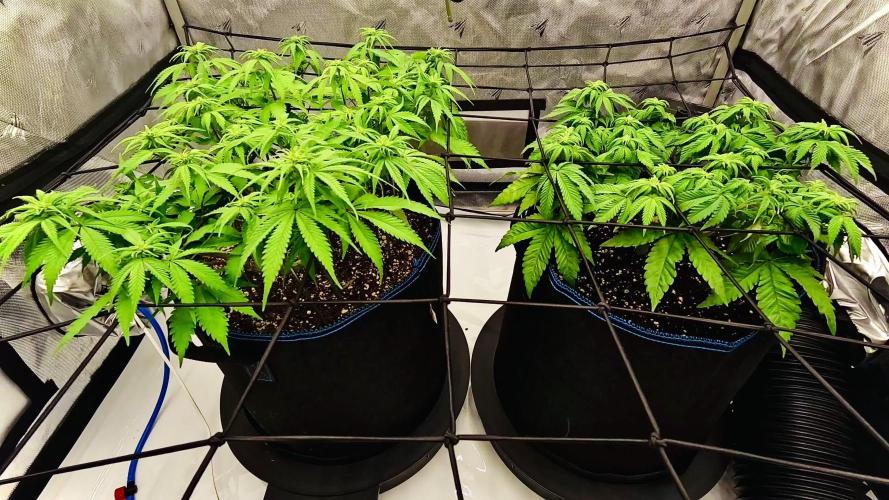
This week was marked by stable climate control and healthy plant response after the recent transplant. The SCROG net was maintained, and light defoliation was performed on the larger plant to open up the canopy. The smaller plant, though bushy, was left mostly intact to avoid over-stressing after transplant. Both plants showed daily leaf movement — reaching for the light during the day and relaxing at night — a sign of good turgor and rhythm. Environmental conditions stayed well within target, with VPD averaging around 1.14 kPa during the day and 0.92 kPa at night. On Sunday, a corrective action was taken to address minor color variations: the feed was adjusted to include the full bloom-phase nutrient mix at 75 % strength. Spoiler: within 24 hours, the color balance already started to improve.
Reason for transplanting the smaller plant:
The smaller Special Queen was transplanted from an 11 L fabric pot into an AutoPot system to ensure more consistent watering and nutrient delivery during the bloom stretch. The original pot was starting to dry out unevenly, which risked fluctuations in moisture and root zone health. By moving it into the AutoPot setup, we aimed to stabilize its environment, promote steady root expansion, and allow it to keep pace with the larger plant under the SCROG. The transplant was carried out carefully to minimize root disturbance, and the plant showed no signs of transplant shock in the following days.


Likes
4
Share


@adam_pawloski87
Follow
@twenty20mendocino Ateam R&D Update! Let’s Go!! What another great week it’s been ! Today is day 39 for all but the 2 Queen of Diamonds an 2 VSOPs got trimmed up a tied down for nice training ! Really opened them up a lot so we get all them heads hit, just wait to see how bushy these girls get, let’s get em big! Your not gonna want to miss next week’s update an see how these girls bounce back! Hope y’all enjoy Peace love and positive vibes to all y’all Cheers 😶🌫️💨💨💨💨🤙🏻


