


Likes
Comments
Share


@Chucky324
Follow
Hello. This is the end of week 8 and the beginning of week 9 of flowering.
Getting near the end and I've started flushing. I like to flush for 2 weeks. I find I get a better end product if I flush.
Things are looking good in here. I had the light up to 80% so the leaves in the main lighting area are turning a little yellow. I'll turn the light down to 70% for a couple of days to slow the yellowing and then back to 80% to finish off this week.
OK, we have finished the Grow Yer Own Stone book printed in 1970 for Canada. My only hope was that you got something out of it that might help your grow or further your knowledge.😊 And it was fun to read too.
OK, Have fun out there. Chuck

Likes
24
Share


@TerpTurtle
Follow
I start with a soak until sink than into BuildASoil 3.0 mix
-Focusing on pictures of Bad Apple this run!
-foliar mix of flower kiss, rhino skin & sensi cal


Likes
2
Share


@EtnoGrow
Follow
we improvised with threads the mesh was badly placed but everything served and fulfilled its function, now the leaves have grown again and the mini jungle is re-formed, we really liked how the previous pruning turned out although aggressive to the plants it did not affect them they recovered almost instantly, and it works in our favor because of the space, so this is already the end of the second or the beginning of the third week, in the next one I will upload the pruning and everything as it is already at the end of almost the 3rd week of flowering, at least of the larger, the others, as you know, are 2 to 3 weeks apart, so for them it is 1 or 2 weeks of flowering, which is noticeable in their development. the risks that are written down in the diary are the fertilizer once a week, and 1 3.5-liter drum or a gallon is used, which is divided into the 2 largest and another equal gallon with a different proportion for the 5 smallest , in the newspaper it is written down of the great ones.
Likes
47
Share

@TrickzCutz
Follow
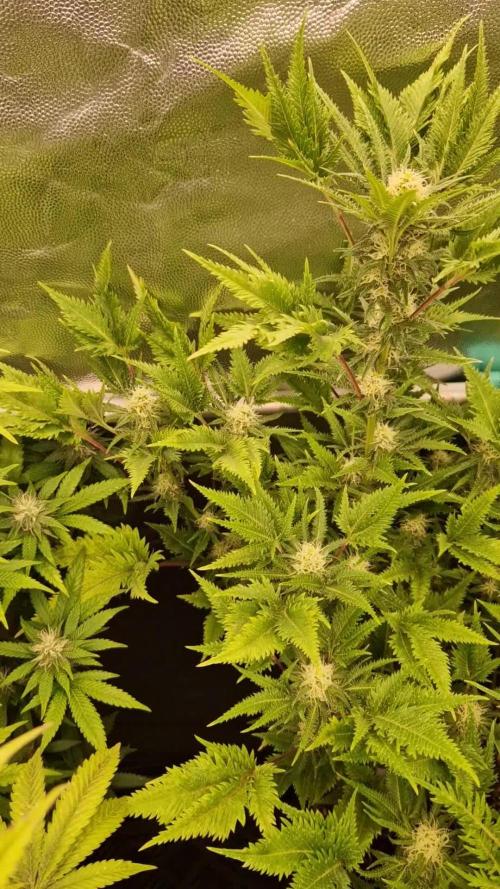
Servus Moin!
Die MDC #1 Raptor hat diese Woche nicht so gut getrunken wie sonst. Es gab einen leicht dunkelbraunen Drain den ich erstmal nicht weiter beachtet hatte... Bei dem 2. mal Gießen diese Woche gab es wieder leichten Drain, diesmal war er aber nicht so braun, trotzdem habe ich diesen dieses mal weggeschüttet, um Salzrückstände zu entfernen, so das sie nicht wieder in den Topf gelangen.


Likes
9
Share


@TiRobotProds
Follow
8e Semaine de floraison impeccable grossi bien chargé en résine irrigation a l'eau uniquement durant les 2 dernières semaines. J'ai vérifié les colas es celle-ci c'est fait polinisé par le male Sour tangie dawg mais rien de grave quelques graines, cela me permettra d'avoir une nouvelle génétique issue de ces deux plantes donc a voir ne pas ce précipiter. Elle dégage une plus douce odeur durant ces derniers jours.

Likes
45
Share


@KrautFabrik
Follow
Day 66: flush 💦
Pictures are taken on day 70📸
--------------------------------------------------
She is getting a nice Purple and the clone is total red/purple now 🍌
Happy growing 🌱✌️

Likes
7
Share

@RelaeX
Follow
## 🌿 Week 19 The jungle is rising:
(Flowering week 2 starts now)
– The Power of the Perfect Root Zone & Controlled Feeding
Welcome to Week 19! This run is proving to be a masterclass in how much difference a proper transplanting schedule and a restrained nutrient approach can make. The setup is thriving, and we have a very surprising plot twist in the tent this time!
Let’s take a virtual step inside the jungle and look at the magic! 🎬👇
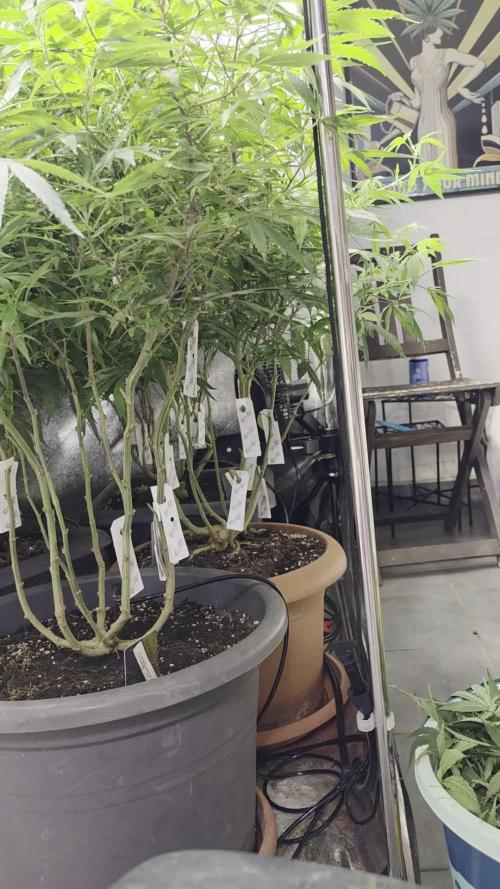
### 🔎 What You See Inside the Jungle (Visual Update)
If you peek into the tent right now, the first thing that hits you is a beautifully structured, deep green sea of leaves with an incredible architectural layout:
* **The Plot Twist: A High Society Takes the Crown! 👑** In a complete reversal from my first run, a **High Society plant sitting right in the center has become the most dominant, aggressive grower in the tent!** To keep the canopy uniform and manage her explosive energy, I spent this week actively tucking and weaving her branches into the Scrog net. By bending her dominant tops horizontally into the grid, I successfully flattened her profile, giving the surrounding plants the crucial time and light they need to catch up and level out the canopy.
* **The Lower Architecture (The "Tree Trunks"):** Looking under the hood, the training this run has been clean and precise. The lower sections look like well-manicured bonsai trunks. The stalks are incredibly thick and woody, providing a massive highway for nutrients. Every single lower fan leaf and weak node has been systematically cleared out (lollipopping), leaving a pristine, well-ventilated under-canopy where the automatic drip irrigation lines are locked into place.
* **The Switch Dimensions & Canopy Balance:** During the switch to flowering, the genetic differences were initially clear—the Zupernova stretched to around **110 cm** and the High Society clones averaged **90 cm**. But with the center High Society pushing the limits and being woven into the net, the white Trellis grid is doing a phenomenal job keeping this jungle perfectly balanced.
* **Pure Health:** The wireless sensor sits right on top of the canopy, bathing in the intense glow of the LEDs. The foliage looks pristine—a vibrant, healthy light-to-mid green sheen with absolutely zero clawing, zero nutrient spots, and zero burnt tips. The first flower clusters are forming beautifully at every single tip.
### 🎛️ The Golden Strategy: What Made the Difference This Run
#### 1. Perfect Root Evolution (No Stagnation)
Looking back at the root photos from transplanting, the root balls were pristine, bright white, and incredibly dense. Moving step-by-step (12 cm $rightarrow$ 11L $rightarrow$ 30L $rightarrow$ Final 35/45L) allowed the root system to thoroughly colonize each container. There are no unestablished "dead zones" or soggy pockets in the soil this time.
#### 2. Natural Deficiencies Solved via Repotting
So, early on, the hungry Zupernova showed a little hint of magnesium deficiency (you know, that classic yellowing between veins on the middle leaves). Instead of freaking out and dumping chemicals or Epsom salts into the soil—which totally messes with the EC—I just let the scheduled transplanting do its thing. The fresh soil immediately fixed the problem naturally, and the color came back in a few days.
#### 3. Super Strict "Less-is-More" Nutrient Control
I've been **super careful with fertilizers** this whole time. Last time, adding too many nutrients too early in pre-amended soil caused a huge EC buildup when the plants started flowering. That led to osmotic blockages where the plants literally dried up from the inside out right after I flushed them in wet pots.
This time, the EC in the soil is perfectly balanced. Since the pots are packed with active, hungry roots, the automatic drip irrigation system works flawlessly, and the soil dries out beautifully and evenly.
### 🌤️ Climate & Parameters
* **Light:** My main LEDs are locked at the perfect height, giving a strong, even light spread across the whole canopy without creating hot spots.
* **Irrigation & Sensors:** The wireless sensors track the climate right at the growth tips. The automatic drip lines ensure a precise dry-back cycle.
The tops are stretching perfectly through the grid, the center dominance is beautifully managed, and the first flower formations are setting up for an epic harvest. Lesson learned: Give the roots space, manage the canopy with the net, and go easy on the nutrients!
Let me know what you think of this center-weaving strategy in the comments! 👇🌲


Likes
52
Share


@Ultraviolet
Follow
The cannabis strain Grape Guava can be a purple strain, depending on its specific phenotype and genetic makeup. While not all phenotypes of Grape Guava are purple, some variations, such as the Zatix Grape Guava, are noted for their striking purple appearance due to the genetic expression of anthocyanin pigments.
https://www.youtube.com/watch?v=cKdVmdoKJ5k
In a garden of green, Grape Guava gleams,
With its fruity aroma, enchanting dreams.
Clusters of grapes, guava's sweetness ignite,
A strain so divine, in purple and white.
Euphoria whispers, a lush fruity haze,
Grape Guava's embrace, a tranquil daze.
Off and away.@1400ppm. The increased CO2 allows plants to thrive at higher temperatures, which in turn necessitates higher humidity to maintain the ideal VPD for healthy growth and transpiration. 80F -5F = 75F LST with 70% RH = 0.72 kPa. Higher temperatures and humidity promote rapid growth, nutrient uptake, and photosynthesis while maintaining a lower stress level. Temperature influences the rate of enzymatic reactions involved in aerobic respiration. Enzymes, such as those involved in glycolysis, the Krebs cycle, and the electron transport chain, work most efficiently at an optimal temperature range. In low temperatures, enzymatic activity will slow down, thus reducing the rate of aerobic respiration. In high temperatures, enzymes can become denatured, thus impairing their function and stopping the process of aerobic respiration. Glucose is the primary fuel for aerobic respiration. The rate of aerobic respiration increases with the availability of glucose, as it is the starting point for glycolysis. If glucose levels are low, cells may rely on alternative energy sources such as fatty acids or amino acids , but these processes may yield less ATP or be less efficient. To determine this effect, carbon dioxide volume was measured (as carbon dioxide is an output of aerobic respiration)
18/6 with the 6 being IR. The near infrared (IR-a) borders around 700nm up to 1400nm @ photon par flux density of 1.8 instead of darkness, keeping temps overnight a neat 77F-80F.
Think of my tent as a lung. What goes in must come out. When the rate of air going out exceeds the amount of air coming in, it creates a negative pressure. Tent concaves (bends in). If set up correctly, your RH will begin to drop slowly to the desired level you set, and the extraction turns off when it reaches desired% RH. The plant, as it performs cellular respiration, will always be releasing more water into the air, so the RH% of the tent overnight will always increase, so long as oxidative phosphorylation is occurring. As soon as the RH% creeps back up to 55%, the extraction turns back on, over and over. This creates a strong pressure differential which will work wonders on your grow. Replicating high and low-pressure fronts in nature. Critical for oxygen diffusion at the critical time of peak cellular respiratory function..
Moisture will not transfer from a saturated atmosphere to another if that air is already at or above its saturation point, meaning the air can't hold any more water vapor. Once I understood that water is produced as a by product during cellular respiration, specifically at the very end of the electron transport chain (ETC) where electrons are finally transferred to molecular oxygen, the higher the RH of the air, the more resistance there is for more moisture to be added to that environment, and effects the ease with which it does so. But none of that water comes from the pot; it's pulled from the air. If you run high daytime RH, your medium/pot is 100% reliant on transpirational root pull to move water. ZERO evaporation happens across the atmosphere if the tent air has high RH%, the medium cannot release its water through evaporation. Once a canopy develops, light no longer slowly wicks and evaporates from the topsoil. The Soil-Plant-Atmosphere Continuum (SPAC) describes the continuous pathway and process of water movement, driven by a gradient in water potential, from the soil, through the plant's roots, stem, and leaves, and finally evaporating into the atmosphere through transpiration. There is evaporation, there is transpiration, and then there is evapotranspiration; Evapotranspiration (ET) is the combined total of two processes: evaporation (water lost directly from soil and surface water into the atmosphere) and transpiration (water released from plants to the atmosphere through their leaves). Evapotranspiration represents the total amount of water that moves from the medium into the air. There is no such thing as a medium with too much water, only a medium that retains too much for too long.
The water must always flow efficiently from one atmosphere(Medium) to another(Air) in a timely manner. Moisture is a critical factor for bacterial growth and decay. Dictating how long it's allowed to sit in any one location for any given period is a key preferred control. To ensure a net reduction in a bacterial population, the rate of removal (ET) must exceed the rate of bacterial growth (decay rate), which is often modeled as a growth rate for the specific bacterium under the given conditions. By optimizing daytime VPD, we also optimize conditions for bacterial growth to explode exponentially above 77°F.. If water is allowed to sit in a medium without an escape within a timeframe, nothing good will happen. IF High RH is maintained overnight as well as during the day, placing 100% of water movement at the behest of daytime transpiration, roots can only pull where they can reach, and if soil is compressed above a certain point, moisture will become trapped in a medium with no way of moving day or night. This will begin the countdown for decay to take hold. When water stagnates in a medium, it loses oxygen, creating anaerobic conditions that foster the growth of harmful microorganisms like bacteria and fungi, which can produce toxins and disease vectors.
Thigmomorphogenesis, the process by which plants respond to mechanical stimuli like touch by altering their growth and development, results in significant morphological changes to improve survival against mechanical perturbations. This complex response involves sensing touch and initiating physiological and genetic responses, leading to changes in form and structure over days or weeks. The process is triggered by physical forces such as wind, rain, or touch. Plants adapt to these stimuli by changing their shape and structure, which may include slower growth, thickened stems, or altered leaf development. Plants possess sophisticated mechanisms to detect even subtle mechanical stimuli and initiate responses. A variety of molecules, including calcium ions, jasmonates, ethylene, and nitric oxide, are involved in signaling these mechanical inputs. Touch can induce the expression of genes that encode proteins for calcium sensing, cell wall modification, and defense mechanisms. A plant exposed to constant wind may become shorter and sturdier. A plant that is touched frequently might grow more slowly to conserve energy and develop thicker cell walls. These changes increase a plant's resilience and ability to survive in harsh environments.
Let's get Thiggy with it.
Likes
8
Share


@Cannabis_Sativa
Follow
Ar first when she sprouted grows slowly and in early veg i made many stress and techniques in little pot before transplanted in big pot she grow really faster and get many inside stems whick i cut them all and stay only big n top ones it was very hard to make lst and somethimes i needed to make hst her stems are wildly hard as steel and not easy to give her nice bodybuilding she had many wound and cuts on stem. Flowering phase was amazing beautiful at first it was full white stretching so long middle stems nonstop growing whole 6week and only at last weeks she get many trichomes flavors and starting yellow pistils visually looked pineapple

Likes
2
Share


@Cannaapeace
Follow
Hey
I topped them for the 2nd time today and tied the main shoots down a bit. 😊
I think she will cope with it. I'll leave her completely alone for a week now to see if she has slowly recovered from the accident 1 week ago.
❌I have a huge problem with humidity. Maybe someone can help me and tell me how to regulate the humidity❌
PPFD- 705
DLI- 46😵💫
Normally I would like to see a 40 DLI but that's not possible without getting below 700 PPFD

Likes
20
Share


@Pulsar00
Follow
Welcome back boys,
A little update with those rock hard colas, the finish line is being seen not far away on the horizon.
I hope they gonna fat a little bit, I think we all wish the big fattening deep down ...
Stay tuned, stay stoned
Likes
9
Share

@TiRobotProds
Follow
Cool sa pousse. Cette semaine j'ai effectué la première coupe de la tête principale. Je vais la laisser vegeter 7jours sans rien lui faire le but étant de pas la stressé d'avantage. Arrosage a l'eau uniquement terreau fertiliser pour 6semaine. A bientôt pour plus d'informations de cet agréable aventure.
Likes
21
Share


@Jays_Not_Here_Man
Follow
A-Day 60, B&C Day 56
A is fattening up! She never did stretch, but then again I had her tied and splayed pretty far out. She has been thirsty, I have been feeding a dose close to 1000 ppm every other feed which has been every other day for her. During the lower feeds, ppm has been around 400. Her tricomes are mostly clear, with some cloudy starting to show. She still has a couple of weeks to go.
B- is going to be a producer! She has so many tips and they are all fattening and developing at about the same rate, she is going to be a beast! Did a defoliation on her, she is appreciating the extra light penetration 😎💨
C- Has stretched up and out! If she stacks as tight as the other two, she will probably be the one with the most weight. Her branches are the tallest and reaching up at least 4-6 inches past both her sisters. I tied her down lightly to allow light to get through, we’ll see how she goes.


Likes
8
Share


@Monkeyboy
Follow
I haven't used anything but water, they are in my green house with at least 8-9 of sun. What do you think?

Likes
25
Share


@Kush_queen
Follow
Well this week I had to give the girls a fairly big trim they were beautifully bushy but they were struggling for space so I cut back the heavy shade leaves that were covering bud sites
I am also adding bloom to there feed from now but they are doing really well and the smell in the tent is devine.
💚🙏🌱🙏💚🙏🌱🙏💚


Likes
3
Share


@Ticfusama
Follow
Just before the start of day 35. Had a small ph issue that needed correction and she didn't like the amount of water she got, so she faded on me a bit. PH issue is corrected though and i shouldn't lose more than a couple of days of development. Buds are right on track and will start to fatten up from here.