The Grow Awards 2026 🏆
Likes
11
Share
@JaysBuds
Follow
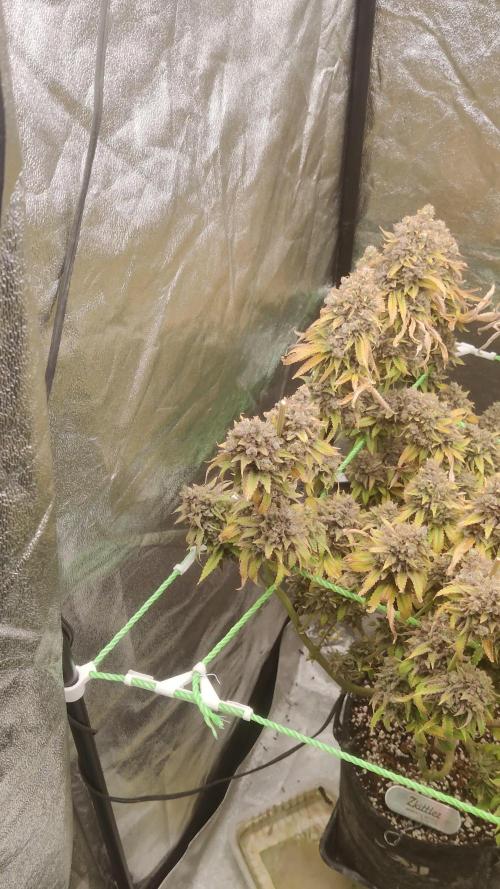
I'm clearly going to have some tucking and training ahead of me again this week...For anyone who wonders if heavy defoliation is detrimental - last week these plants were almost totally stripped and were ALL pulled back under the screen - and I'd said that you'd never know they were bare. Well, here we are a week later and we're pretty much doing the same thing again! I'm blindly hoping to avoid tucking much more. The screen is full and the girls are powerlifting it off the floor - we'll have to get some weights on to keep the canopy level, but what do we really expect from Bruce Banner?? I've also got my fingers crossed that we can manage the rest of the stretch with defoliation, though that's probably unlikely and we'll be working a very full scrog and tent for the next few weeks (based on some diaries it's about 4 weeks of stretch before they settle into a solid budset - I wish I had read that before vegging the screen to 80% capacity!
Likes
64
Share
@yan420
Follow
FERMAKOR BARREL MIX – BASE IN USE (Testing on the Fantasy Feast girl we pulled out of another diary https://growdiaries.com/diaries/274722-grow-journal-by-yan402 ) (FERMAKOR BASE SYSTEM KOH VERSION diary https://growdiaries.com/diaries/278391-grow-journal-by-yan402) (Urea & Micros on the way — first week running without them) 🍶💧🍶💧🍶💧🍶💧🍶 💧 30 L Barrel – Current Working Mix 🍶💧🍶💧🍶💧🍶💧🍶 Step 1 – Calcium Nitrate (Part A) 7 L warm water (~35–40 °C) → added 45 g Calcinit, stirred until fully clear. That’s the calcium + nitrogen backbone for the feed. Step 2 – FERMAKOR PK Base (Part B) 15 L water in the main barrel → added 30 ml FERMAKOR PK Concentrate, mixed well. This forms the main P + K part of the formula. Step 3 – Combine Solutions Slowly poured the Calcinit mix into the barrel while stirring — no reaction, still crystal clear. That confirms the mix is stable and precipitation-free. 🌿 Step 4 – FPJ / FFJ Batch Added 30 ml homemade FPJ (fish + veg batch) ≈ 1 ml/L. Color shifted to a light-amber tone — looks alive and active. 🍋 Step 5 – Citric Acid Balance Added 1 tsp citric acid after everything was blended to fine-tune pH and help chelate micros later on. 📦 Step 6 – Top Up & Check Filled to the 30 L mark with plain water → pH tested with drops, showing yellow-green — roughly 5.8 – 6.0 range. Nice clean look, stable smell, no residue. 💧 Current Base Ingredients (Active Mix) Warm Water ≈ 22 L total Calcinit 45 g → N + Ca foundation FERMAKOR PK Base 30 ml → P + K support Citric Acid 1 tsp → Chelation + pH balance FPJ / Fish Emulsion 30 ml → Organic enzyme booster Result: clean amber mix, mild and balanced. I’ll let this version run for a week before adding anything. 👀👀👀👀👀👀 Observations and changes 👀👀👀👀👀👀 27.10.25 VW27 noticed some min burnt tips so I decreased Calcium Nitrate 45 to → 40g, decided to add two more elements micros and Epsom salts just to make sure they got everything, Fetrilon Combi 1 (Micros): 0.5 g, Epsom salts: 8 g 28.10.25 VW27 she seems devoid of any deficiencies, seems ready for the flip to 12/12 02.11.25 VW27 girl is looking good so I decided to stop making daily videos and do a standard once a week update. 09.11.25 aVW28 7 days since flip,stretch in full swing, first pistils showing, leaf color deep and healthy. Slight tip burn early week → gone after pH stabilized. Feed stayed clear, no residue, roots clean and sweet-smelling, did what I hope is a last cleanup and pruning🎥 10.11.25 VW29 added Phosphoric acid pH down to the schedule for flowering stage. 14.11.25 FW1 FERMAKOR PK Micros 40 → 50 ml 23.11.25 FW2 got some burnt tips, observe and act accordingly in case it worsens, diluted by 25% for this week. 05.12.25 FW3 about 2 weeks ago Calcium Nitrate 35 g → 25 g, FERMAKOR PK Micros 50 ml → 60 ml 12.12.25 FW4 Calcium Nitrate 25 g → 20 g, FERMAKOR PK Micros 60 ml → 80ml 16.12.25 FW4 Calcium Nitrate 20 g → 17 g, FERMAKOR PK Micros 80 ml → 110 ml 🌱💦🌱💦🌱💦🌱💦🌱💦🌱 🌿 Day to day tasks & actions 🌿 🌱💦🌱💦🌱💦🌱💦🌱💦🌱 Fed about 5l a day of #1 and on the weekends I do a pure FERMAKOR PK flush 2l runoff (*RUNOFF reused for tomato plants) 💧💧💧💧💧💧💧💧💧 🌱 Nutrients in 30 L #1 Veg – FERMAKOR 💧💧💧💧💧💧💧💧💧 Calcium Nitrate (Calcinit / Nitcal): 45 → 40 g → 35 g → 25 g → 20 g → 17 g = 1.50 g/L → 1.33 g/L → 1.17 g/L → 0.83 g/L → 0.67 g/L → 0.57 g/L = 207 ppm N / 253 ppm Ca → 184 / 225 → 161 / 197 → 115 / 141 → 92 / 113 → 78 / 96 PK Concentrate (FERMAKOR Base): 30 → 40 ml → 50 ml → 60 ml → 80 ml → 110 ml = 1.00 → 1.33 ml/L → 1.67 ml/L → 2.00 ml/L → 2.67 ml/L → 3.67 ml/L → balanced 1:1 P:K + light micros (from extract) Home-made FFJ/FPJ (Fish + Veg): 30 ml = 1.00 ml/L Epsom Salt (MgSO₄·7H₂O): 8 g = 0.27 g/L → ~26 ppm Mg + ~35 ppm S Fetrilon Combi 1 (Micros): 0.5 g = 0.017 g/L → Fe 0.7 ppm · Mn 0.7 ppm · Zn 0.3 ppm · Cu 0.3 ppm · B 0.1 ppm · Mo 0.02 ppm Phosphoric Acid (pH down) + Citric Acid (chelation): as needed → First set pH with phosphoric acid, then add a little citric only if you want extra chelation Target pH: 5.8 – 6.0 (drop test yellow-green) 📦 TOTAL: Liquids: 60 → 70 → 80 → 90 → 110 → 140 ml per 30 L = 2.00 → 2.33 → 2.67 → 3.00 → 3.67 → 4.67 ml/L Solids (CaNO₃ + Epsom + Fetrilon): 53.5 → 48.5 → 43.5 → 33.5 → 28.5 → 25.5 g per 30 L = 1.78 → 1.62 → 1.45 → 1.12 → 0.95 → 0.85 g/L YouTube Link: https://youtube.com/-m8h?si=A7x4Zlr2kj-_ga31
Likes
4
Share
@Facocero
Follow
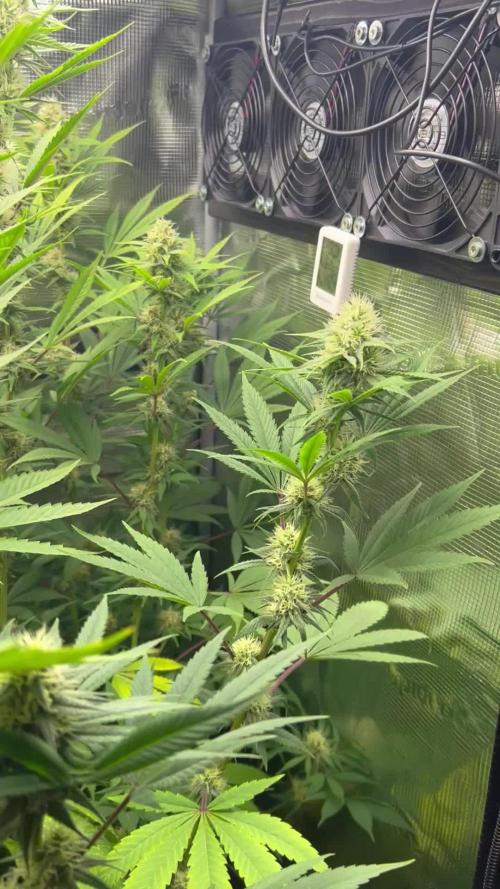
È iniziata da poco la 4°settima, sembra stiano crescendo bene le piccole😍 in questi giorni mi sono dedicato a un po' di defogliazione e di giorno in giorno cerco di migliorare LST per favorire la penetrazione della luce. Alzato il dimmer al 75% e ho allontanato un po' la lampada dalle piante e sembra stia o reagendo bene! Spero tanto di fare un buon lavoro! 💪 Ai prossimi aggiornamenti! AGGIORNAMENTO: Sono passati 2 giorni dalle ultime foto pubblicate, si stanno infoltendo per bene le piccole😍 aspetterò ancora un altro po' per mandarle in fioritura,vorrei riuscire ad occupare più spazio superficiale possibile. Sto alternando con le annaffiature fertilizzando moderatamente una volta si e una no.. per il momento sembra tutto ok!😎
Likes
28
Share
....Understanding Electrical Conductivity Electrical conductivity measures a material’s ability to transmit electric current, which in the context of gardening, relates to the soil or nutrient solution’s ion content. In simpler terms, EC indicates how salty the environment is around the roots of a plant. This “saltiness” is crucial because it affects the plant’s osmotic pressure, which in turn influences nutrient uptake and overall plant health. The Science Behind EC At its core, EC measures the presence of soluble ions like potassium, calcium, magnesium, and nitrates – all vital nutrients for plant growth. These ions carry electrical charges, and their movement creates an electrical current, detectable as conductivity. High EC levels typically mean a high concentration of dissolved ions, whereas low EC levels indicate fewer nutrients are available. The Impact of Electrical Conductivity on Plant Growth The relationship between EC and plant growth is a delicate balance. Just the right EC level can enhance nutrient uptake, bolster plant health, and increase yields. However, when EC levels stray too far from the optimal range, they can lead to nutrient imbalances, osmotic stress, and even plant death. Nutrient Uptake and EC Levels Plants absorb nutrients from the soil or water through their roots, a process influenced by the surrounding EC levels. Ideal EC levels help create an optimal environment for this exchange, ensuring plants receive the nutrients they need without exerting excessive energy. High EC Levels: A Double-Edged Sword While a certain level of dissolved ions is beneficial, excessively high EC levels can harm plants. High salinity can draw water out of plant cells, leading to dehydration and nutrient lockout – a condition where plants cannot absorb essential nutrients despite their presence. Low EC Levels: Undernourished Gardens Conversely, low EC levels can starve plants of necessary nutrients, stunt growth, and lead to underdeveloped or diseased plants. Maintaining an optimal EC range is crucial for healthy plant development. Measuring and Adjusting Electrical Conductivity Understanding the importance of EC is one thing, but applying this knowledge in the garden or greenhouse requires practical steps. Regular monitoring and adjustment can ensure that plants remain in a conducive growth environment. Tools for Measuring EC Gardeners can use various tools to measure EC, from simple handheld meters to more sophisticated systems integrated into hydroponic setups. Regular monitoring allows for timely adjustments to soil or nutrient solutions, ensuring optimal EC levels. Adjusting EC for Optimal Growth Adjusting EC involves changing the concentration of nutrients in the soil or solution. In hydroponics, this might mean diluting or concentrating the nutrient solution. In soil, amendments may be added or flushed with water to correct EC levels. Practical Applications: EC in Various Growing Environments The application of EC knowledge varies across different growing environments, from traditional soil-based gardens to modern hydroponic systems. Soil Gardening In soil, EC measurements can help diagnose nutrient imbalances and guide fertilization practices. Amending soil with organic matter or flushing with water can adjust EC levels to better support plant growth. Hydroponics and Aquaponics In hydroponic and aquaponic systems, where plants are grown in water-based solutions, maintaining optimal EC levels is crucial for nutrient availability. These systems allow for precise control of EC, directly influencing plant health and yield. Greenhouse Cultivation In greenhouses, EC monitoring can help manage the nutritional status of various plants, ensuring that each receives the right nutrient mix for optimal growth. Automated systems can provide real-time EC adjustments based on plant needs. Navigating Challenges: Overcoming EC-Related Issues While maintaining optimal EC levels can significantly enhance plant growth, gardeners may encounter challenges such as fluctuating conditions, equipment malfunctions, or environmental stresses. Regular monitoring, combined with a solid understanding of each plant’s specific needs, can mitigate these issues. Conclusion: The Conductive Path to Lush Gardens Electrical conductivity, though an invisible factor, is a cornerstone of successful gardening and farming. By understanding and managing EC levels, gardeners and farmers can profoundly influence the health and productivity of their plants. As we continue to explore the nuances of plant growth, the role of EC stands out as a testament to the marriage of science and nature in cultivating life. Whether in soil, water, or air, mastering the art of electrical conductivity can unlock the full potential of our green companions, leading to bountiful harvests and vibrant gardens.
Likes
6
Share
smell is strong now. sour 76 has a range of citrus, number 1 is lemon dominated with fuel scent underneath. number 2 has a smell super similar to tangie! seeing sour 76 parent is cali sour d (cali orange x sour d x mexican sativa) cross to 76 afghan it makes sense to me it has reminiscent smell to tangie (cali orange x skunk 1 [mexican sativa x afghan indica x colombian sativa]) very similar parent lineages there! havin smoke test both, sour 76 is much more heavy handed high! plants finish at 66 days this run. at this point I gave last main feeds before tapering nutes back lower for week 8 and then flush week 9
Likes
22
Share
@Siriuz
Follow
18/6 from seed Only water twice a week Only once with nutes When in low pot now in bigger pot we will see how much she needs Very abundant roots you will see the video and notice how well she is growing I really doubt the stress from this fast transplant so we will see it's behavior We already added bloom nutes since she didn't have anything before but whoa so fast did not expected that from red poison but makes me feel great to have you I think you will be my favorite haha Happy growing guys Sweet smokes Thanks for that guys
Likes
5
Share
Definetly an awesome Strain easy to grow with a phenomenal trichome production even the stamps are covered in trichomes 🤷🏻‍♂️💚🤙🏻🤙🏻❄️💯
Likes
139
Share
@JieGrow
Follow
Well we started flushing the day after we updated the last diary, so it is our end week for our first grow and I must say, it's been a roller-coaster but we made it there in the end lmfao! Critical kush has been amazing to grow, she has stood strong throughout all the stress I've put her under with my learning mistakes and she has still turned out superb, I'm looking forward to smoking her if she smokes as good as she smells then ill be amazed! The smell she gives off is a fruity, sweet smell with a strong undertone, hard to explain but it gets my taste buds going! 6 hours later and hella sticky fingers... not my usual type lol... We have the girls down and trimmed, the wet weights are below from each plant and we have separated them in different tiers in the drying net so we can show an accurate wet and dry weight from each plant, intrigued to know how much we will loose once dry as the wet weight is a whopping 1,405g!! Plant one weighing in at 261g Plant 2 is weighing at 242g Plant 3 is weighing at 236g Plant 4 is weighing at 321g Plant 5 is weighing at 345g 51 ounce wet weight with slight stems. Will update harvest section next week once dry :) Happy growing!
Likes
10
Share
@Kali_DC
Follow
calmag deficiency second week of flowering. Foliar sprayed for a couple days, flushed reservoir and add new nutrients with calmag
Likes
11
Share
@hialex62
Follow
26.07. - 01.08. (DD.MM.) 26.07. Watered with 800ml water with flowering fertilizer. 28.07. Watered with 1l water without flowering fertilizer. Because of yellow leaf tips 30.07. Watered with 0,8l water without flowering fertilizer. 01.08. Watered with 0,8l water without flowering fertilizer.
Likes
17
Share
So this is my first diary here and I'm going to start from week 11 so there's should only be another week or two left. My next one I'll do properly from the start. Also this feeding schedule was the last ammendment I did but was in week 10 and not this week. As I only started on week 11 I thought I'd just add it to show what I've given her. This is just 1 Northern Lights Autoflower from Royal Queen Seeds. I've topped her twice and done some LST and lollipopped just as she was going into flower..which was around week 5. I use 100% organic top soil amendments from Living Soils every 2 weeks. I water about 2 days after the top soil goes completely dry only in the mornings. And she's on a 20/4 light cycle. I vegged her in a standard plastic pot then transplanted at the end of week 5 into a 10l pot with the coco loaded with all of the above (minus the guano which I added at the start of week 3 of flower) with the aim of her hitting those amendments at the right time..so I wouldn't have to amend again for another 2 weeks which seemed to work out. I tested the run off shortly after the first feeding for flowering and it was really high - 3000ppm - alongside the pH which which was really low - 4.89 (as expected as its runoff) however I had oyster shell in that first feeding which should help raise the pH and my local tap water is hard so there's extra Calcium and a bit of Megnesium in there too. I also added a couple of drops of biobizz ph+ to the water. And with the mycorrhizae..which should kick in and colonise the root system in about 3 to 4 weeks..should create a mycillium network to help this living soil regulate everything!! Which it did as I tested the runoff again everytime I fed (every 2 to 3 days) and it slowly went down ending up at 1000ppm and a pH of 5.9 which was spot on. I also had a massive scare as I found small white bugs in the medium when I disturbed the top soil. Thinking they were spider mites thankfully they were Symphalans which after researching eats seedling roots or decaying organic matter..so they're essentially cleaning the medium..and they stay under the soil away from the light. She is pretty small and compact. I'm testing autoflowers as I've never tried them before. I'm slightly annoyed as I knocked my dimmer down to 60% without realising..so out it back to 100% and as a result I'm guessing she may have been stunted along with topping her twice or maybe it's just the strain. But I have seen other a lot bigger. But she is looking really healthy and has done from the start. The colour you see has been there from the start and she hasn't had any deficiencies. Tricones are coming along nicely and some of the sugar leaves look like they're starting to deplete in nutritients as they're going slightly yellow on the edges so not long. I'm guessing 2 more weeks from today but I wouldn't be surprised if she hits 13 weeks which is what I'm hoping for as her last feed was last week which would give her an extra week to 'flush'. Also the Bat Boost from Guanokalong has an NPK ratio of 0-10-0 and not 0-0-2 like it states. Next I'll be doing 2 x photoperiod Chocolopes 🍫 Thanks for stopping by - feel free to comment and follow - and I'll have another update next week!! 🤙
Likes
Comments
Share
@Dabking
Follow
I was told to never judge a strain purely off it's THC percentage. To smell a plant, and what your nose picks out is generally the strain that will jive the best with the endocannabinoid system in your body. This strain exemplifies that. It's only around 17% but the high is amazing. An under-rated strain for sure. Very easy strain to grow. Although the same strain, one looked pretty different and was much frostier despite getting the exact same treatment from seed to chop.
Likes
3
Share
using purple cow indicanja soil. 1st time. will add Gaia green 4-4-4 on top later if needed. 1st 6 are starting to sprout. other 8 in 1 gals were planted today. keeping canopy at 12k lux for now whatever that means... but I bought one of the cheap meters to get a rough estimate on light heights in different tents. will raise the lux throughout life cycle. unsure if ill grow them all or just the ones that look best into next transplant.... we will see
Likes
7
Share
to view this lamp or any other marshydro product go to: https://instagram.com/marshydro_aliexpress?igshid=YmMyMTA2M2Y=
Likes
54
Share
@MrJones
Follow
MrJones Cream Mandeiran Auto XL - ViparSpectra XS2000 240W Infrared Full Spectrum LED Grow Light ´🍪⊱╮🍪╰⊰🍪 WEEKLY GOALS 🍪╰⊰´🍪⊱╮🍪 🏡Indoor - 3"x4"x8" Custom Built Grow Closet 🌞Environment - 80F and 60%Humidity - using Humidfyer as needed. 🌾LST and Defoliation - this strain likes to stretch! 🗓️Week 6 Flower ⚱️5-Gallon 📊5.8/6.2 PH 💧 Feeding / Using Dr. Earth Dry Organic Amendments - Home Grown & Bud / Bloom Booster 🌞ViparSpectra XS2000 240W x2 Infrared Full Spectrum LED Grow Light 🕷️ IPM - Will be using Green Cleaner" 1 OZ per Gallon, and CannControl from Mammoth alternating between products each month for Integrated Pest Management. ´🍪⊱╮🍪╰⊰🍪 PLANT UPDATES 🍪╰⊰´🍪⊱╮🍪 📝 Notes - With week 8 underway, Started the week off with an IPM treatment of Green cleaner, the buds are hard and getting very fat, the ViparStrectra XS-2000 lights are just blowing up on these ladies, just amazing! ╰⊰🍪╰⊰´🍪⊱╮🍪╰⊰🍪╰⊰🍪╰⊰´🍪⊱╮🍪╰⊰🍪╰⊰🍪╰⊰🍪⊱╮ 🔶Sunday 08.01.21/ Just watering with H20 PH to 5.8/6.2 🔶Monday 08.02.21/ Watering with 32 ounces daily of H20 PH 5.8 / 6.2 - The plants are starting to show signs of nutrient lockout, adjust the PH to see if I can correct it, just not much time to do anything else. 🔶Tuesday 08.03.21/ Watering with 32 ounces daily of H20 PH 5.8 / 6.2 🔶Wednesday 08.04.21/ Watering with 32 ounces daily of H20 PH 5.8 / 6.2 🔶Thursday 08.05.21/ Watering with 32 ounces daily of H20 PH 5.8 / 6.2 🔶Friday 08.06.21/ Watering with 32 ounces daily of H20 PH 5.8 / 6.2 🔶Saturday 08.07.21/ With the week ending, the ladies ae looking great, just Watering with 32 ounces daily of H20 PH 5.8 / 6.2 ╰⊰🍪╰⊰´🍪⊱╮🍪╰⊰🍪╰⊰🍪╰⊰´🍪⊱╮🍪╰⊰🍪╰⊰🍪╰⊰🍪⊱╮ Cream Mandarine XL Auto®️ Information Tall-stemmed auto-flowering strain. This high-yielding 4th generation auto-flowering strain is the resulting hybrid from the cross between selected specimens of our Cream Mandarine Auto®️ (SWS29)) and a Super Tai’98 elite clone. The genetic coming from the Super Tai’98 elite clone contributes with interesting Sativa characteristics to this hybrid, such as bigger size, but also subtle aromatic and spicy tones with hints of wood and nuts. The so much appreciated Cream Mandarine Auto®️ genetic contributes with traits from the Indica side, such as high flower and resin production, but also sweet and fresh aromas with tones of citric fruits of the mandarin orange type. DATA SHEET Variety SWS55 Indica: 35% / Sativa: 63,4% / Ruderalis: 1,6% THC: 18-23% · CBD: 0,6% Indoor Yield: 450-650 g/m2 Outdoor Yield: 50-300 g/plant Indoor/Outdoor Harvest: 9 weeks from germination Height: 110-150 cm