


Processing
Likes
Comments
Share


Likes
13
Share


@Fatnastyz
Follow
9-3
Yeah yeah yeah, they all got a little light burn. Its fixed. Didn't realize I needed a diffuser. Oops
9-6
Growin great! Little small, but bruh week 2.
500ml with HP Connect.
Added fan, plants need air to breathe.
Likes
1
Share


@FrostyLeafs
Follow
"The 3rd day in flowering. I give 2.2 liters of water every 2 days. I'm still experimenting with how long the timer needs to run to give enough water.
😎✌️
BT6
The stretch is strong and i have no space left 👀
5weeks Vegi was to long

Processing
Likes
15
Share


@CannabisAprendiz
Follow
Plantas de buenas estructuras y fácil de cultivar ,resistente a las plagas y estrés hídricos.
"WAKA" pasará a ser una de mis favoritas ,( guardaremos madres ) . una genéticas maravillosa muy resinosa de cogollos compactos .
Olores muy marcados a cítricos especialmente limón y otras más dulces esto también se refleja al momento de degustar las flores al fumar.
Seguiremos trabajando esta genéticas con las madres que seleccionamos de los fenotipos que más nos gustaron .
Corte : 08.12.2019 (secado)
Curado : 23.12.2019( puestos en frascos )
Likes
10
Share


@GrowLowAuto
Follow
Continuing to water every other day/when dry. Watered with Real Growers Recharge on 5/12/22. New 200w led grow light came in and is looking great!

Likes
7
Share


@GanjaGecko
Follow
Ich musste mich etwas nach dem Wetter richten. Der Sommer hat sich etwas Zeit gelassen. Wir hatten hier noch einige kalte Nächte wo man die Damen dann zu viel hin und her räumen müsste. Dazu auch nicht so viel Sonne wie man sich wünscht. Das soll sich aber in der nächsten Zeit ändern. Um den werdenden Ladys bestmögliche Bedingungen im Outdoor-Bereich zu bieten muss man sich leider etwas nach dem Wetter richten. Daher werden die Seeds kommenden Mittwoch in ein Glas Wasser mit Seedbooster Plus von Plagron für 15/16 Stunden eingelegt bevor es zum keimen in die Anzuchttöpfe geht. Wenn alles nach Plan läuft, erblicken die Ladys spätestens Sonntag das Licht der Welt. Dann werden sie für die erste Woche kontrolliert im kleinen Anzuchtzelt angezogen. Spätestens den Sonntag darauf an Tag 7 kommen die jungen Damen in jeweils 11L Stofftöpfe. Die drei Ladys werden dann bis zu den ersten Blüteanzeichen in einem kleinen Gewächshaus Platz finden.
3 Seeds Auto Candy Bubatz XL von DutchPassion wurden in ein Glas mit Wasser und 2 Tropfen Seedbooster von Plagron für ca 15 Stunden eingelegt. Danach ging es für die Seeds in kleine Anzuchttöpfe. Mit einer kleinen Heizmatte unter den Anzuchttöpfen und den Kuppeln auf den Töpfen wird für das warm/feuchte Klima gesorgt, das die Seeds anfangs benötigen um zu keimen. Am Tag an dem die Ladys das Licht der Welt erblicken, kommen die Kuppeln ab und die Ladys spüren dann auch ihre ersten Luftzüge.
Nach 3 Tagen in den Anzuchttöpfen hat eine Lady und nach 4 Tagen haben auch die beiden anderen Ladys das Licht der Welt erblickt.
Das Substratgemisch besteht aus ca 75% BioBizz Lightmix und ca 25% Cocos mit Perliten. Auf das fertige Substratgemisch kommen dann noch ca 5% Megaworm von Plagron.
Angegossen wurde mit 1g/L BioEnhancer und 1ml/L PowerRoots. Der ph-Wert wurde vor dem gießen auf 6.0 korrigiert. Jede Lady bekam für den Anfang ca 30ml in die Anzuchttöpfe.
Möge der Grow beginnen.


Likes
21
Share


@CanadianFillmore
Follow
Welcome growfessors 👽 to another episode of growfessor theatre, 4x4 edition. Week 5F begins for the ladies and they are looking good! Frosty trichomes are displaying themselves and bud sites are bulking up!! 🌳💚
Thanks for tuning in growfessors 👽🌳💚, tune in again for another episode!


Processing
Likes
23
Share


@Cookie_thefarmer
Follow
Day 122- first signs of the some pistols ambering! Super excited I know to be patient! About 3-4 weeks out I think!
Putting my favorite photos and more on my Instagram! Follow me 📷 @cookie.thefarmer

Likes
24
Share


@Easygrower
Follow
Hello growers day 58 in the garden I gave her a bit of a leaf defo today still not purple some leafs have purple tips but that’s about it she has got some nice looking buds forming so we will see happy growing
Likes
8
Share


@smoking_hills9
Follow
Almost ready, want to give 1 more week for some brown trichomes. Otherwise it's ready. Tones of super nice dence crystal buds. Great genetics. Last few times watering with raw cane molasses or just water. Very good genetics 💯

Likes
2
Share


@Ultraviolet_
Follow
Remember that, however you are played, or by whom, your soul is in your keeping alone. Even though those who presume to play you be kings or men of power, when you stand before God, you cannot say, 'But I was told by others to do thus,' or that virtue was not convenient at the time. This will not suffice. Remember that.
Day:18
84°F and 65% RH (VPD) for the vegetative stage. Approximately 1.15kPa(assuming leaf temperature is about 2°F cooler than the air), which falls right into the ideal vegetative sweet spot (0.8kPa to 1.2kPa). At 1.15kPa, plants can draw water and nutrients efficiently without risking stress or wilting. It keeps the leaf pores (stomata) open, allowing for ideal carbon dioxide intake and maximizing vegetative growth. VPD is determined by the leaf's temperature, not just the ambient air. Because leaves usually run 1° to 3°F cooler than room air under bright grow lights, my actual VPD will be slightly lower, closer to the 1.0kPa mark. As she transitions from vegetative growth to flowering, one can gradually lower the humidity (to around 45–60%) and drop temperatures slightly to prevent disease from settling inside dense buds when they appear.
Night:6
At 70°F and 60% relative humidity, Vapor Pressure Deficit (VPD) is 0.86 kPa. This is right on the cusp of whats optimal for the vegetative stage. During the nighttime, plants generally close their stomata and undergo cellular respiration rather than photosynthesis. Transpiration slows to a near stop, making VPD less critical at night than during the day. However, maintaining a nighttime VPD between 0.8 and 1.0 kPa is highly beneficial in that it ensures the air is dry enough to prevent powdery mildew or bud rot, but moist enough to keep the plant from undergoing unnecessary stress. This range keeps the environment comfortable for cellular processes and prevents large atmospheric swings. Keeping it all flowing.
(Not pushing them yet, these are photoperiods)
The optimal soil (root zone) temperature for cellular root respiration and nutrient uptake in cannabis is between 68F & 72F This narrow range balances biological energy production (cellular respiration) with the dissolved oxygen levels in the soil, maximizing plant growth and health. Warmer soils hold significantly less dissolved oxygen. When soil temperature exceeds 74F oxygen depletion occurs, inhibiting cellular respiration almost entirely, At 68-72F root cells generate optimal adenosine triphosphate (ATP) via respiration to power root-tip elongation and the active transport of water and nutrients.
Too Hot (Above 78F) Root respiration increases, demanding more oxygen, while the water's oxygen-carrying capacity drops. This creates a prime environment for anaerobic pathogens and Pythium (root rot).
Too Cold (Below 60F) Root metabolism and cellular respiration slow to a crawl. This severely impairs nutrient and water absorption, leading to yellowing, wilting, and phosphorus deficiencies.
A lot depends on whether it's automatic or photoperiod; with photoperiod, there is not as much of a need to push "hard" as the real countdown only begins once the flower is initiated. Automatics, on the other hand, the chronological "clock" begins ticking the moment the seed germinates. It is of critical importance that the seedling growth gets off to the races, understanding that early growth is like compound interest, which will pay off come harvest. This reality is why getting autoflowers "off to the races" early on yields such exponential benefits. The "compound interest" is directly related to the surface area of the leaves. Larger, faster-growing seedlings process more light and build bigger root networks early on, which translates into an explosion of vertical and lateral growth during their short vegetative window.
The margins for error are so thin with autoflowers; this early-stage momentum depends on several critical practices. Seedlings exposed to increased atmospheric CO2 levels early in life will develop at an increased rate. To effectively "extend" or optimize the capacity of Photosystem II (PSII) for increased photosynthetic efficiency. In standard oxygenic photosynthesis, Photosystem II (PSII) is naturally limited to the red-light spectrum, peaking at 680nm. Extending its light-harvesting capacity past 700nm into the far-red region requires bypassing the natural limits of standard chlorophyll a. Adding 730 nm (far-red) LEDs alongside standard red/blue lights has been shown to increase canopy photosynthesis by 20–30% in several crops by acting synergistically with shorter wavelengths. However, the limitation is that excessive, pure IR/Far-red light (without accompanying red light) can trigger the "shade avoidance response," causing plants to grow tall, weak, and spindly rather than robust. Utilizing infrared light (specifically the 700-750 nm far-red range) is a viable method to boost photosynthetic efficiency. It acts as a bridge to allow PSII to utilize a broader spectrum of light, breaking the traditional 700 nm barrier. UVR8-mediated signaling (often in conjunction with CRY proteins) triggers protective mechanisms that maintain the stability of the photosynthetic apparatus (including LHCII and reaction center proteins), thus ensuring that the efficiency of Photosystem II remains higher in UV-B-exposed plants compared to plants lacking this receptor. ΦPSII indictates the rate of electron transfer from water to plastoquinone, which drives the production of ATP and NADPH. There is a close link between ΦPSII and the true rate of CO2 fixation (Φ*co2).
ETR stands for Electron Transport Rate. It measures the speed at which electrons are moved through the thylakoid membranes in a plant's chloroplasts during the light-dependent reactions of photosynthesis. Infrared light (particularly Near-Infrared or NIR) improves cellular energy by interacting directly with the electron transport chain (ETC) in mitochondria. This process boosts adenosine triphosphate production, which acts as a metabolic coefficient multiplier by accelerating enzyme activity dramatically.
Extend then multiply.
Far-Red photons interact with plant photoreceptors to accelerate the plant’s biological "clock" or trigger a shade-avoidance response. Autoflowers don't use the plant's biological clock, although the IR will initiate a shade avoidance and make them stretchy. You can just add equal measures of 660nm-680nm to negate the shade avoidance effect. Replacing nights' "darkness" with a combination of IR+ and 660nm. Because autoflowers don't require a dark period to flower, many growers just blast them with light. 18/6 24/0. However, this ignores the plant's metabolic rhythms, where daytime photosynthesis (light reactions) must be perfectly balanced with nighttime carbon fixation and assimilation (Calvin cycle) to avoid bottlenecking plant development. Cellular respiration is a 24/7 process, but it can only function while the plant has the free oxidative capacity to do so. A 100% photosynthetically active leaf cannot perform cellular respiration. The viral trend of defoliation of every leaf that isn't "getting enough light" is of great detriment overall, putting 100% of the cellular respiratory "workload" and responsibility on the 0/4/6 hours of darkness in sub-optimal conditions for enzymatic activity. Photosynthesis captures nearly 100% of the initial energy as carbon, while cellular respiration is the process that unlocks 90% of that captured energy into usable ATP so the plant can use it. Respiration is considered only roughly 30% to 40% efficient. It captures enough of the potential energy in glucose to synthesize around 30 to 38 ATP molecules per glucose molecule. The remaining 60% to 70% of the energy in the sugar is not captured in ATP; instead, it naturally escapes into the environment as heat, which helps regulate plant temperature. In plants, the primary enzymes of the Electron Transport Chain (ETC) and the ATP synthase complexes are typically adapted to function optimally in warmer temperatures (roughly 77°F to 95°F, depending on the specific plant strain). As temperatures rise within this physiological range, molecular collisions increase, speeding up respiration and ATP production. The cannabis plant has a branched respiratory pathway. During heat or cold stress, plants activate Alternative Oxidase (AOX). AOX burns sugars to dissipate energy as heat rather than coupling it to ATP production. This pathway actually functions optimally at elevated temperatures to help protect the cell from the damaging build-up of Reactive Oxygen Species (ROS) during heat stress. Enzyme activity generally scales with heat; there is a strict biological limit. If canopy temperatures in a grow room exceed 104°F, the enzymes and their supporting lipid membranes lose stability. Not saying you need to go crazy, just optimize nights the same as we optimize days.
Phosphorus is the driving force behind early seedling development. It acts as the "energy hub" of the plant, directly driving cell division, robust root growth, and the creation of DNA. Without an adequate, easily accessible supply early on, the plant's overall growth potential and final yield can suffer permanently.
Likes
6
Share


@NLHydroponics
Follow
Wasn't satisfied with the net that came packed with the ACI 4x4 so I modified it with some string and zip ties. I find this works great because I have 2"x2" holes now that are partial elastic making weaving the tops much more forgiving on both me and her. I'm very happy with the direction this grow is heading.
Along with the massive undertaking of redirecting all this growth. Roughly 8 hours off and on to redirect, defoliate and remove branches. She had a nutrient change and I moved on to week 5 of the FF Hydro schedule. I added about 1/2 tsp of Fox Farm Sledgehammer to the nutrients in my reservoir and let it sit for about 30 minutes. Then pumped out the solution and flushed with roughly 20 gallons of fresh cold 6.0 pH tap water. Then added the new solution with Tiger Bloom.
Likes
2
Share


@Liquido
Follow
Nulla di nuovo se non per il fatto che solo una si sta allungando più delle altre
Vorrei defogliare ma non so dove mettere le mani😅
Tutti i rami mi sembrano ben sviluppati anche se sono tutti compatti
Apprezzo consigli in quanto ho paura per la poca ventilazione andando avanti
Grazie❤️

Likes
4
Share


@Oldwied
Follow
The lady is growing slowly. The balcony location is not the best spot. A few more sun hours, would be better.
That's life :D.
The Flower time starts. In the main the first buds are visible.
LST goes on. A big thanks to bud trainers, your clips working well.
Day 27
Photoshooting
Likes
13
Share


@Terp_Djiny
Follow
Today i flip the light. 12/12 for the bloom.
The bright appearance of the leaves and the slightly reddened stems indicate a nutrient deficit. In this case I would say nitrogen. But I have exaggerated a bit with my fertilizer use. Accordingly, I flushed the plants today. The measured pH was 4.8. I think I slightly salted the floor. Let's see if they recover.
Day 73: On the detail photo you can see very well how the stem turns slightly reddish and the stems on the leaves as well.
Day 74: The plants look better than a few days ago. They are now growing visibly from day to day. Timely flushing saved a lot, I hope.
Day 77: Last day of the first week of flower. It was a strange week. But they still grow.

Likes
47
Share


@DankeyeBeaverjuice
Follow
It was a great call to defoliate I'm already seeing the benefits. The only unfortunate parts is the added time, she seems to be progressing at a steady rate none the less and it will be harvest time before I know it. The smells coming off the stem rubs are very enticing and have this seasoned grower super excited for the smoke report!

Likes
35
Share


@SAC87
Follow
Day 63
Well there’s not much going on. Just watering when dry. They seem to be doing better. They are fattening up a bit more and putting on some density. I can tell by the fact that they’re leaning more. This is a 10 wk strain, but I’m gonna push it a bit longer til the trichomes are in a better range.
They have a sweet tropical smell which is quite nice. Not the frostiest buds ever, but we’ll see how it shakes out. The smallest front one is the frostiest of the round.
We’re just on autopilot til the end. Probably a week or 2 more and they’ll be ready to come down.
Happy Growing 🌱
Likes
9
Share

@TeDcz
Follow
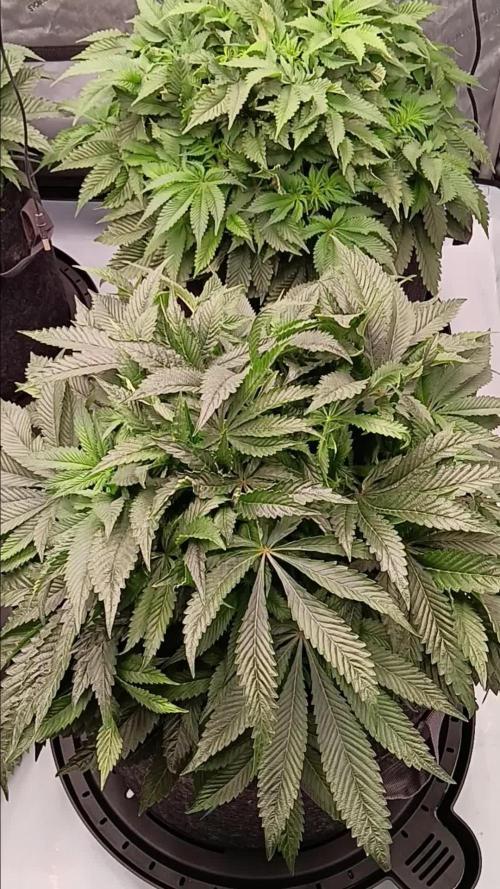
Zdarec, týden v květu za námi a holkám se daří. Dnes výměna aktivního zavlažování za systému vysoce absorpčních knotů od AC Infinity, tak uvidíme jak to bude fungovat.


Likes
26
Share


@MG2009
Follow
03/13/2021
Side branches are developing nice, I may do a little more lst to help lower tops to catch up before flowering starts
Ps.
Couple videos uploaded
Day #6 doing some bending, and broke a branch off so I dipped in rooting powder,threw it in some vermiculite soaked with Bonide Garden Rich Root & Grow 4-10-3 with (IBA) Lets see if she will root! Fingers crossed🙏