


Likes
Comments
Share


@SavTheGrower
Follow
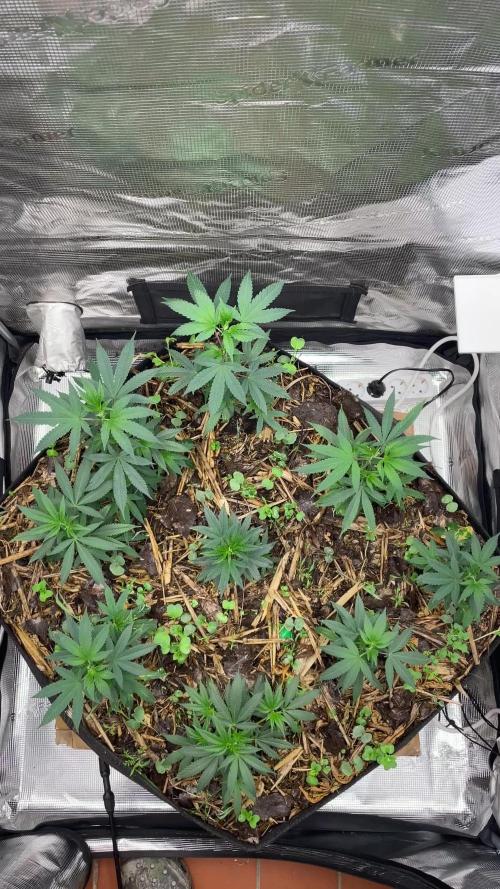
Week 4 is coming along well. Idk if you guys can see in the photos but I’m getting some leaf damage as if some pest is in my garden eating the leaves. Are there any things I can do to eliminate the possible threat?
Transplanted the following plants as well. Deadly Sativa (Unknown gender), Jelly Breath, La Kush Cake, and Platinum Scout V2 into 1 Gal. Pots. Due to the other plants being behind I might just run these 4 thru flower. Also got rid of the mutant Newberry. Stay tuned as these girls will only be in veg for a few more weeks.


Likes
7
Share

@IberianRootcraft
Follow
Another week, a little bit stressed, fixing and growing.
First epsom salt foliar, pretty light (1g/L).





Likes
18
Share


@Green_Blood
Follow
Beautiful fade on all the girls.
Flushing for a few extra days really made a difference, and i did notice a slight final increase in bud size.
Sometimes when you convince yourself it is done cause you are anxious to get it down and dried to smoke a sample
you can miss out on a few extra days of bulking and final development. :)

Likes
63
Share


@AsNoriu
Follow
Day 43.
so main change, i lost my mobile and i had really loads of photos and videos of ex grows. i blacklisted it, but still...
from now i will reduce amount of post and updates, it is stupid, but i cant risk ...
Girls all week on diet, looks like only one Gorilla is starving a bit and would need more, but in my plans last watering with molases this time only.
They already had runs with silica only. cal mag only x2.
Think worm castings was an isue, control garden grows really fine, will be my smallest plants ever, they will have 3 weeks in total for veg.
Happy growing and dont loose your mobiles, huge pain ....
Day 48. Gorillas are really nice and i cant denny it, but ....
Cookies are worst experience ever...
They just dont want to grow and show up new issue the second you fight one....
I even made control garden with more than years old beans of Incredible Bulk and bagseed Strawberry Cough. Both strains grow ok, but not Cookie !!!
Thats honestly wrong genetics, unless someone prove me wrong, open for your advices ...
Hard training again, still on pure water diet with calmag or silica or molases as small bonus while no feed for two weeks + ....
Lights are out because training took longer than i wanted. ...
Next week they go to 24 hours darkness and light is changed to 12/12. That was last week of really hard training, now i will wait for green mass of leaves to cover stems and hope they will make some buds ;))
Choose your beans wisier than me ...
Happy growing !!!


Likes
2
Share


@Unpluggy
Follow
Partially harvested to Test the ripening of the remaining Buds.
Awesome looking and crazy strong smell.
The purple with light Green Looks awesome

Likes
21
Share


@Ultraviolet
Follow
Heyoka.
12x12=144, A dodecahedron is a polyhedron with 12 faces, and in coordination chemistry, it refers to a geometry where ligands surround a central metal atom (in this case, Magnesium) in a specific, 8-coordinate arrangement. Dodecahedrane is a hydrocarbon, meaning it's composed solely of carbon and hydrogen atoms. The carbon atoms are arranged at the corners of a dodecahedron, a 3D shape with 12 pentagonal faces. The water molecules in the dodecahedron form hydrogen bonds that are individually slightly weaker than in either the dimer or the tetramer. However, because three-quarters of the O -H groups in the dodecahedron form hydrogen bonds, it has a more negative energy per molecule than has either the dimer or the tetramer. Magnesium (Mg2+) is the essential, central metal ion in the chlorophyll molecule, crucial for photosynthesis by enabling light absorption and energy transfer. It is chelated by four nitrogen atoms within the porphyrin (or chlorin) ring structure. Chlorophyll appears green because it reflects light in the green region of the visible spectrum, specifically between 490 and 570 nm. The main resonance electronic frequency of a neutral Magnesium (Mg) atom corresponds to the transition from the ground state to the first excited state. Resonance Line Wavelength of Mg2+: 285.1nm (UVB light). The central atom of the chlorophyll molecule is Magnesium (Mg2+), which is coordinated within a porphyrin ring. The electronic "resonance frequency" of this central atom—meaning the frequency at which its electrons absorb energy—is primarily driven by the electronic transitions (ETR) of the surrounding conjugated chlorin ring structure, rather than a discrete atomic transition of the Magnesium atom itself. The resonant electronic frequencies of the chlorophyll porphyrin (technically, a chlorin) ring are determined by the energy required to promote π-electrons within its conjugated system, primarily appearing in the blue and red regions of the visible spectrum.
In standard physics, Chloryphyll b has peak absorption at 460nm (Blue). If we take the peak wavelength 460nm and a UV-B, UVR8 peak absorption wavelength 285nm Tryptophan-285 (W285) Sensing protein. 460/285=1.618 Φ, "natural harmony" and the "structure of light". The cryptochrome photoreceptor (CRY) is a UV-A/blue light receptor that shares this dual sensitivity with several other biological structures and functions, including significant sequence similarity and a common evolutionary ancestor with DNA photolyase enzymes. These are light-activated enzymes that use blue/UV-A light to repair DNA damage caused by UV-B radiation in plants.
Dodecahedrane (C20H20) is a hydrocarbon with a cage-like structure where carbon atoms form 12 pentagonal faces (a regular dodecahedron). It is highly symmetric (icosahedral), contains no delocalized electrons (no aromaticity), and has minimal angle strain, but significant torsional strain. Water Dodecahedron (H2O) forms hydrogen-bonded cages. While individual hydrogen bonds in this structure are weaker than in the linear dimer or tetramer, it has a more negative total energy per molecule. This is because three-quarters (75%) of the groups are involved in hydrogen bonding, creating a very stable, closed-shell configuration. a 3D carbon hydrocarbon (C20H20) to stable water clusters in hydrate, while the Magnesium ion acts as the central activator within a conjugated ring in biological systems, with its electronic absorption dominated by the ring, not the atom itself.
Effective quantum efficiency of photosystem II, often denoted as ΦPSII
In horticultural lighting, adding 730 nm (far-red) LEDs alongside standard red/blue lights has been shown to increase canopy photosynthesis by 20–30% in several crops by acting synergistically with shorter wavelengths. However, the limitation is that excessive, pure IR/Far-red light (without accompanying red light) can trigger the "shade avoidance response," causing plants to grow tall, weak, and spindly rather than robust. Knowing is half the battle however, engineering or utilizing infrared light (specifically the 700-750 nm far-red range) is a viable method to boost photosynthetic efficiency. It acts as a bridge to allow PSII to utilize a broader spectrum of light, breaking the traditional 700 nm barrier.
Extend, then multiply.
UVR8-mediated signaling (often in conjunction with CRY proteins) triggers protective mechanisms that maintain the stability of the photosynthetic apparatus (including LHCII and reaction center proteins), thus ensuring that the efficiency of Photosystem II remains higher in UV-B-exposed plants compared to plants lacking this receptor. ΦPSII indictates the rate of electron transfer from water to plastoquinone, which drives the production of ATP and NADPH. There is a close link between ΦPSII and the true rate of CO2 fixation (Φ*co2), particularly in C4 plants.
Effective quantum efficiency of photosystem II, often denoted as ΦPSII, represents the proportion of light absorbed by Photosystem II (ΦPSII) that is actually used in photosynthetic electron transport. It is a key indicator of how efficiently a plant is using light for photosynthesis, as opposed to losing it as heat or fluorescence. ΦPSII (effective quantum yield of photosystem II) functions primarily as a "multiplier" (a coefficient of efficiency) rather than an additive factor when estimating the overall photosynthetic electron transport rate (ETR). Multipliers are considered far more beneficial than additions because they generate exponential growth, leverage existing resources to their full potential, and create sustainable, self-multiplying capacity, rather than just incremental, linear increases.
Humans, and most other mammals, rely on other mechanisms, such as nucleotide excision repair, to manage and repair UV-induced DNA damage. As such, humans do not have the direct, light-driven repair mechanism that photolyase offers in plants.

Processing
Likes
58
Share


@DailyDabs
Follow
Had some camera issues this week so I didn't have any pictures or videos so heres the time lapse of the whole grow
Likes
6
Share


@RandomStreetMerchant
Follow
Premium cultivars has got a banger here, week 3 started the frost over.
The plant seems to be darkening up in a beautiful way, I love how this plant is looking!!!
She is starting to form nice dense buds these next few weeks will start to be even better.
Till next time growmies ☮️ 08/28/23
Edit: 09/2/23 holy shit guys this girl is putting out some serious frost wish I would have got a clone of her. But at least I got one more seed of this to make into a mother!!! 10/10 so far!!!!




Likes
11
Share


@AUTOBUDDHA
Follow
Smooth sailing on this batch deep into flower! Were sitting at 85 days today and they are looking fantastic! Steady feeding flora bloom and flora micro. Also giving them 5ml/gal of advanced big bud. These ladies are FROSTY! Cannot wait till these ladies wrap it up!
These hubbas are DRIPPING! Literally some of the most sticky bud i have ever seen.
Love them! My first go with mephisto and won't be my last!

Likes
10
Share


@Gatterzzz
Follow
Week 11: So by now the plant has stopped or at least slowed down drastically on the stretching. It’s stacking up on the buds and some of them fattening up amazingly.
Trichomes are generally milky white but still have some clear ones so going to wait a bit more than probably start flushing next week, but obviously depending on the coming days and how it develops.


Likes
Comments
Share


@eldruida_lamota
Follow
Que pasa familia, vamos con la cuarta semana de crecimiento de estas Drizl Pickl feminizadas de Seedstockers.
Vamos al lío ,se trasplantaron en macetas de 7 litros definitivamente.
El ph se controla en 6.0 , la temperatura la tenemos entre 24/20 grados y la humedad ronda el 50%.
El ciclo de crecimiento puse 16h de luz, el foco está al 50% de potencia.
De momento van creciendo a buen ritmo y tienen un buen color, estaban muy bien enraizadas al realizarle el trasplante se notaba la abundancia radicular.
Agradecer Agrobeta por el envío del kit gold series para esta temporada, son unos jefes 🙏
- os dejo por aquí un CÓDIGO: Eldruida
Descuento para la tienda de MARS HYDRO.
https://www.mars-hydro.com
Hasta aquí todo, Buenos humos 💨💨💨
Likes
9
Share


@420DeepGrow
Follow
📆 Semana 9:
La Auto Pablo Escobar mantiene un ritmo estable en floración. Los cogollos siguen engordando y aumentando en densidad, con una producción de resina que no deja de sorprender. Los tricomas son mayoritariamente lechosos, aunque aún se observan muchos pistilos blancos, señal de que la planta todavía tiene margen para seguir desarrollándose. El aroma se vuelve más complejo y envolvente, con notas dulces y cítricas que se intensifican día a día.
¡Seguimos creciendo fuerte! 💪



Likes
2
Share

@Ger-Smurf
Follow
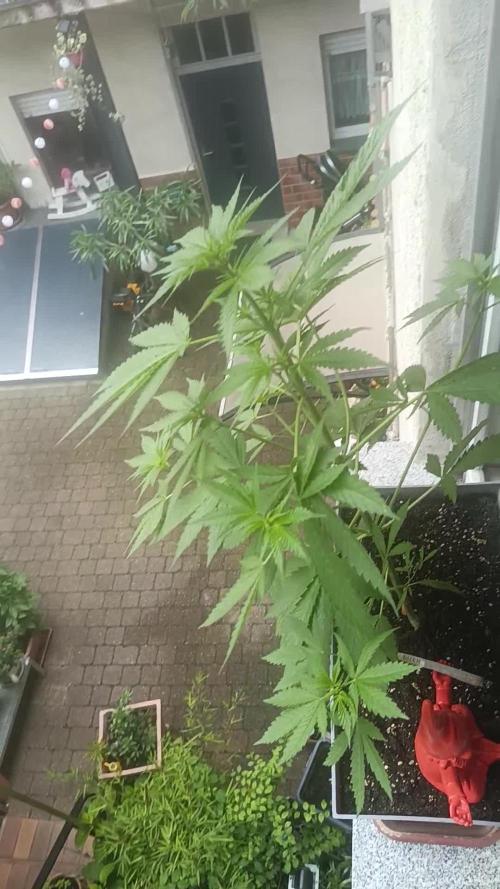
Hallo und Herzlich Willkommen zurück zur Cherry Cola RF3 von Fastbuds 😸
Die letzte Woche war das Wetter sehr wechselhaft, was die Pflanze aber nicht daran gehindert hat ordentlich zu wachsen 👌. Ich habe die ganze Woche über die Seitentriebe unter den großen Blättern hervor geschoben. Dadurch sollen die Seitentriebe mehr Sonnenlicht bekommen.
Während meines Low Stress Training ist mir aufgefallen das sich die ersten Blüten zeigen 😍
Aktuell trinkt die Pflanze alle 2 Tage 1 liter Gießwasser. Den pH-Wert Stelle ich auf 6,2 ein .
Mit 5ml Blüte Dünger auf 1 Liter Gießwasser komme ich auf einen EC-Wert von 1,6 mS.
Ich hoffe euch und euren Pflanzen geht's gut 😁 Bis zur nächsten Woche 👋
Likes
5
Share


@GhostmanGrows
Follow
Because of the hight and cold we have some and very different Pheno's its not gonna be my best run.. but we have still got some time..
Likes
33
Share


@NuggetPawn
Follow
G'day,
Things are going well, she's really growing now, having to adjust LST every couple of days to keep her down to fill the area. Bought all the bits to make a scrog net out of pipes and netting which will be installed in next few days.
I replaced piping from transparent to black, the transparent ones were starting to grow algae, probs wouldn't cause an issue but didn't wanna take any chances.
Changed the reservoir back to black with a spare lid that I had, as the white lid was solar paint I kept being blinded, was getting close to leaving the grow room with a white stick lol
Upped the nutrients up to 797 at TDS 0.5.
P.s I am really surprised the small plant hasn't had nutrient burn, TDS is like triple what it should be for a plant of that size!
Thanks guys...
😊

Likes
7
Share


@JayBane
Follow
FastBuds? More like FatNugz!
What a delight this Strawberry Banana was to grow!
Smelling wonderful, trichome rich and compact buds!
Will update a harvest report once she's dried and trimmed up & ready to bottle.
Likes
15
Share


@Luv2Grow
Follow
This strain was an absolute gem to grow. Had no issues along the way and probably my biggest yield to date.
