


Likes
1
Share


@Skull
Follow
Not to bad a week growth is sure slower in Coco as opposed to Dwc may be not feeding correctly
Likes
2
Share


@Ultraviolet_
Follow
67 days since April 16th, 2026
We become aware at such times of man's wonderful ability to bring seemingly unrelated elements into harmonic balance, and receive a glimpse into a world where everything exists in conscious sympathetic attunement to everything else. When we listen to a piece of music that seems to strike a beautiful chord somewhere inside us, or view a painting that simply glows with harmonic awareness well executed, we probably do not spare much time to contemplate the wonderfully intricate combination of vibrations that our sensors make it possible for us to perceive. We tend to appreciate the relationship between the parts of something by an awareness of the harmony or dissonance of the whole. This ability enables us to say "what a beautiful house!" instead of "analysis has proven that this collection of building materials exhibits certain elements of harmonic proportion." While this ability to instinctively appreciate the beauty of true harmony has an important role to play in evolution, a more analytical understanding of the laws involved can be most useful. This is especially so if we wish to create works of art where each part exists in true harmony, not only with the other part of that particular whole, but with the universe within which the creator and the created exist.
Everything vibrates. From the most dense matter to the most subtle cosmic rays, everything which our senses allow our thoughts to become aware of, can be specified in terms of wavelength or frequency of vibration. These two terms define the same thing, but from different points of view.
The following are the approximate wavelengths of various energy carriers:
Cosmic rays 0.000,000,001 mm
Gamma rays 0.000,000,1 mm
X rays 0.000,500 mm
Ultraviolet rays 0.003 mm
Visible light 0.006 mm
Infrared 0.01 mm
Sound waves 1 meter
Radio waves 300 meters
Violet light 400 nm to 450 nm
Blue light 450 nm to 500 nm
Green light 500 nm to 570 nm
Yellow light 570 nm to 590 nm
Orange light 590 nm to 610 nm
Red light 610 to 700 nm
1 nanometer (nm) = 0.000,000,1 cm = 1/10,000,000 cm
If a guitar string is plucked and we hear a sound, it is not too difficult for the human mind to associate this sound with the vibration of the guitar string. With color it is quite different. It is difficult for us to conceive that the color of a substance is not an inherent property of the substance itself, but an indication picked up by our senses of that substance's ability to absorb or reflect the light which happens to be shining on it at that moment. Neither the matter nor the light is colored. What happens is that the brain learns to differentiate between the frequencies reflected or transmitted by the substance the eyes are focused on. The same thing happens with sound. When we say "Oh! Listen, they're playing my favorite song," what we really mean is: "My brain has stored within it a particular pattern of frequencies. I have compared the new information being received with this stored pattern and have deduced the answer that the two patterns are similar within certain specified tolerances." The 'pleasure' involved could have something to do with our running the pre-recorded pattern at the same time, in 'sympathy' with the new pattern as it is received.
The word sympathy describes very well our ability to appreciate color and sound. It also describes the reason behind certain elements of harmony. For instance, if a substance vibrating at 100 cycles per second (tone 1) is in the proximity of another substance vibrating at 200 cycles per second (tone 2), we could perceive, if we had the right equipment, a certain sympathetic relationship between the two.
We will see from this that there is a uniform doubling of the first tone seen in the second. At various points along the waves, the two are the same in amplitude. At other points, they are at opposite poles to each other. This doubled frequency has more points of similarity to the original than any other frequency except the original itself. If the equipment we had available for measuring these two frequencies was a soundboard amplifier and a pair of ears, then we would hear what would sound to us like one tone. If we had the opportunity to hear one at a time, we would hear that although they sound the same, one is higher in pitch than the other. This characteristic of 'the same but different in pitch', musicians have called the octave. Any two tones produced where one has exactly doubled the frequency of the other is called an octave. Speaking in ratios, an octave would appear then as the ratio 2:1 or 1:2, depending on whether we are talking of an octave up or down.
A single note produced by almost any instrument will contain more than one wavelength or frequency. It will have a dominant frequency, the wavelength of which we would call the note's 'fundamental' or 1st harmonic. It will also have a varying number of upper harmonics, gradually fading in intensity into infinity or silence.
Natural harmonics always have the same pattern of intervals between them. The interval between the 1st and 2nd harmonic is a perfect octave; between the 2nd and 3rd a perfect fifth; between the 3rd and 4th a perfect 4th; and so on, the intervals becoming smaller and smaller until they lose any relationship with the western 12 tone scale as it exists at the moment. Just as an octave has certain elements of sympathy with its fundamental, so some intervals have been noted to be more perfectly in sympathy with the fundamental than others. The ratio of the 'perfect 5th' or interval of 7 semitones, as it occurs in the harmonic series, is 3:2 or 2:3, while that of the 'perfect fourth" is 4:3 or 3:4. All the tones in the western 12 tone scale can be expressed in terms of the ratio between the upper tone and its fundamental. This would seem to be an ideal way of generating a scale from any given fundamental and several attempts have been made to do this, the Pythagorean system being probably the most well known. Although when working with a single tone instrument playing on its own, the Pythagorean formula works wonderfully well, if we had several instruments tuned this way together and asked them to play almost any western music, we would find that at times they sounded quite out of tune to each other.
The lack of flexibility of the various scale systems based on the harmonic series has led to what is known as the 'tempered' scale. This uses as its primary unit of interval the ratio of the octave or 2:1. It then proceeds to divide the interval between any fundamental and its upper octave into 12 smaller intervals by applying the ratio: two to the one-twelfth power, to one (21/12:1). This equals 1.059463094, so by multiplying any frequency by this number, we will obtain the tempered semitone next up from our fundamental. We will also find that any tone twelve semitones up from any other tone, in a scale generated in this way, will have exactly double the frequency.
If we took the note middle C on a piano and halved the wavelength, we would have the note C one octave above. If we halved this, we would have the C above, and so on. However, within about 6 octaves, we would find that although a 'sound' was being produced, no human ear could perceive it. If we kept on going, halving and producing upper octaves of our fundamental C, we would proceed through the infrared band, into the visible light spectrum. If we happened to be outside during the day, we would, for one octave only, see the note C with our eyes. The next octave above would already be in the ultraviolet band, and outside the eye's sensitivity range. If we can think of color as being an indication of a substance's vibratory rate or wavelength, we may begin to see a relationship that could exist between the color and sound spectrums.
The logical extension of what has so far been said is that there exists a scale in the color spectrum that corresponds exactly to the scale in the sound spectrum, each color tone being an octave of the equivalent note in the sound range.
This is not the end of the story but only the beginning. If we can for the moment accept that any wavelength in one band has upper and lower octave stretching out to infinity, then the next question is 'fine, but what shall we use as our fundamental? A particular color? A particular sound frequency?' The musicians among us will probably say 'A 440'. This means that the note A should vibrate at 440 Hertz, or 440 times per second. They would tell us that this is standard pitch has been adopted by most orchestras around the world; pianos are tuned to it, instruments are constructed to formulas based on it, and so to them it would probably seem the most appropriate place to begin. Some of these musicians may know of the battle that is still raging with regards to this being the standard, but few would know why A = 440 Hz was chosen except that it worked when it was set to be a suitable compromise between the many different pitches in use at the time.
432 Hz is said to be mathematically consistent with the patterns of the universe. Studies reveal that 432 Hz tuning vibrates with the universe’s golden mean PHI and unifies the properties of light, time, space, matter, gravity, and magnetism with biology, the DNA code, and consciousness. When our atoms and DNA start to resonate in harmony with the spiraling pattern of nature, our sense of connection to nature is said to be magnified.
Another interesting factor to consider is that the A=432 Hz tuning correlates with the color spectrum, while the A=440 Hz is off. Audiophiles have also stated that A = 432 Hz music seems to be non-local and can fill an entire room, whereas A=440 Hz can be perceived as directional or linear in sound propagation.
Once you adopt the idea that sound (or vibration in general) can have an equalizing and harmonizing effect (as well as a disturbing effect), the science of harmony can be applied to bring greater harmony into one's life or tune to specific energies. There is a form of absolute and relative harmony. Absolute harmony can, for example, be determined by the tuning of an instrument. The ancients tuned their instruments at an A of 432 Hz instead of 440 Hz - and for a good reason. There are plenty of music examples on the internet that you can listen to in order to establish the difference for yourself.
Attuning the instrument to 432 Hz results in a more relaxing sound, while 440 Hz slightly tenses up the body. This is because 440 Hz is out of tune with both macro and micro cosmos. On the contrary, 432 Hz is in tune. To give an example of how this is manifested microcosmically: our breath (0,3 Hz) and our pulse (1,2 Hz) relate to the frequency of the lower octave of an A of 432 Hz (108 Hz) as 1:360 and 1:90.
It is interesting to note that 432 Hz was the standard pitch of many old instruments and that it was only recently (19th and 20th century) the standard pitch was increased. This was done in order to be able to play for bigger audiences. Bigger audiences (more bodies) absorb more of the lower frequencies, so the higher pitch was more likely to “cut through”. One of the oldest instruments of the world is the bell ensemble of Yi Zeng (dated 423 BC), tuned to a standard F4 of 345 Hz, which gives an A= 432 Hz. The frequency of 345 Hz is that of the platonic year! Similarly, many old organs are tuned in A=432 as well; for example, St. Peter’s Capella Gregoriana, St. Peter’s Capella Giulia, S. Maria Maggiore in Rome.
Maria Renold’s book “Intervals Scales Tones and the Concert Pitch C=128 Hz” claims conclusive evidence that 440 Hz and raising concert pitch above scientific “C” Prime=128 Hz (Concert A=432 Hz) disassociates the connection of consciousness to the body and creates anti-social conditions in humanity.
The difference between concert pitch A=440 Hz and Concert A=432 Hz is only 8 cycles per second, but it is a perceptible difference of awareness in the human consciousness experience of the dream we share called existence.
Processing
Likes
5
Share


@Ganjagrandaddy
Follow
Its official , she is a lady !!!. I am relieved to see that she is def female and no signs of Nanners so far !. Her stretch This week has been really helpful in keeping her going lateral with mains. She has approx 15-20 potential good mains around her now so once i can get to the 21 day 12/12 point , i should be able to bring the best of them to the final contenders. She is root building like crazy and the tank she is in is dropping quicker now each day. she is definitely happy and healthy . I am glad I use the quadlining as she would be very tall now. she is 2 weeks younger but the biggest in her group of plants !. The Blue Gelato 41 in her wants to go sativa tall but thankfully the Gorilla zkittelz side is just as happy Thickening out sideways. For such a short veg time she is impressive too. Let's see what buds she can throw up.
Be Well and safe Growmies
Likes
13
Share


@masterofsmeagol
Follow
7/13 It's maine-ing out. Overcast and misting. I guess it rained last night but not much. Today is my watering day although I think they could've made it until tomorrow. These drastic temp changes makes it hard to get a STEADY routine in place. I watered everything in the 20's a gallon the 10's 1/2 gallon. The 10th planet in the front was still heavy so I didn't water it. I'll keep an eye on it. Temps are much milder. I noticed a few more septoria leaves on the 10th planet which I promptly defoliated. This pheno is flowering. I could've put this week as flowering as several plants have started. I also saw ONE leaf on my chem dog that had septoria on it. ONE f-ing leaf! I was planning on treating this early anyway so I mixed one gallon of plant doctor 3 tsp gallon/gallon which was the recommendation. I'll monitor this plant and continue treating it the next two weeks. I may do foliar too but the mixture is different. It's a systemic so I don't think that matters as much. Considering getting mulch to protect from spores on the soil. My plants look GORGEOUS. I Hate to use such a nice plant as a guennie pig but I'm not going to sit here and watch it progress. I'm lucky it's really not that bad and that it's on a reveg. There's so many leaves that I would be forced to prune anyway. I'm seeing two MAYBE three leaves a morning but I want to get this under control. Last year u let a plant with septoria go and it finished but went to extracts. I've got a pretty good feeling about this plant doctor. I've used it before with good results. Only time will tell though.🤞
EDIT: WENT OVER AT ABOUT 1PM. ITS 2 NOW AND BLUE SKIES AND SUNNY. IM SUPER GLAD I WATERED AND EVEN MORE SO THAT I APPLIED THE PLANT DOCTOR HOW I DID. THE GIRLS ALL LOOKED AMAZING. THE TENTH PLANET I TREATED WITH PLANT DOCTOR LOOKS THE BEST IVE EVER SEEN IT. I FOUND ON LEAVE DEEP ON THE INTERIOR WITJ A SMALL SPOT BUT ITS SOMETHING IM SURE I MISSED THIS MORNING. IF THIS WORKS THIS GOOD ILL BE APPLYING IT TO EVERYTHING EVEN IF ITS JUST PREVENTATIVE.
7/14 Rained last night andcwas still sprinkling when I went over. Amazingly the 10th planet that I treated with the plant doctorcmix had ZERO visible signs of septoria. I did find one leaf on Mt chem dog and two on my mk ultra with the big leaves. It could've been calcium deficiency but I really doubt it because I think I saw THAT as well. I'm going to wait a day or two and if there are still no negative results and the plant is still looking good I'm going to treat AT LEAST the two others that MAY be infected. It's a systemic and can be used proactively and supposably breaks down into p and k after stimulating immune response. I'll monitor a little longer but as it stands I think I'm going to treat the other two just in case. I also need to start feeding. I've watered a lot more than I normally do so obviously the soil won't last as long. This has been some tricky weather but I'm happy with how things are progressing. I probably should've changed this to the first week of flower as several plants are popping pistols everywhere.
EDIT: WENT OVER AROUND NOON AND MIXED UP TEO GALLONS OF PLANT DOCTOR PLANNING TO TREAT THE TWO PLANTS BESIDE THE 10TH PLANET. EVERYTHING LOOKED SO PERFECT AND TOMORROW IS MY WATER DAY SO I DECIDED TO HOLD OFF AND APPLY IT WHEN IT NEEDS WATER ANYWAY. I DID NOTICE THAT PLANTS SEEM TO BE FLOWERING MORE AGGREWWIVELY THAN BEFORE. THINGS ARE GETTING INTERESTING.
7/15 It was water day. The girls looked great this morning. I watered everything at least a gallon and 1.5 for the thirstier plants. I treated my big fan leaf mk ultra and my chem dog #4 with the same Plant Doctor mix as i did tge 10th planet beside it. I havent seen ANY septoria on that plant since application and it looks better than ever. I watered them with a half gallon of phed water before doing a soul drench with the gallon of Plant Doctor @ 3tsp/gal. I'm not seeing much septoria but plants are starting flower and I want to nip it in the bud. This product can be used preventatively and I went by the guidelines for medical marijuana. It was 70 earlier this morning. I'll update as I go forward.


Likes
21
Share


@Esmoki_La_Cabrona
Follow
Today is day 22, beginning of week 2 of veg. Looking good after topping yesterday. New growth already. Finding it hard to figure out LST, but making progress as soon as I see a leave that is shading another. Practice is helping toward perfection. I fed her today according to General Hydroponics Flora Series low/weak feed schedule. Did not use calmag because I realized there is already a lot of cal and mag in my tap water. I will be buying a 5 stage water filter reservoir so I will resume using it then. Currently only able to use tap water that is filtered through a Brita pitcher. Turned exhaust fan back on after initial 24 hours of balminess to promote growth and rh is back to normal parameters.
August 18 update - It is summer in the northern hemisphere and guess who just got over covid? This plant mom. Ugh. Updates are dry this week because I was as sick as a dog. A couple of days ago I noticed purple stems on the fan leaves and the fact that the new growth was such a bright contrast compared to the older fan leaves. After a confirmatory TDS reading on the Apera meter regarding my suspicion of nutrient lockout, I flushed Kaboom 4 times to get her readings back to normal parameters. Today, day 28, (happy first month Kaboom) she is looking a lot better, photos and details in the next week :)


Likes
21
Share


@NSABND
Follow
Der Start in Woche 8 ist regnerisch und bewölkt bei kühlen Temperaturen und hoher Luftfeuchtigkeit 😳
The start of week 8 is rainy and cloudy with cool temperatures and high humidity 😳
Day 62 "Haircut" for "Hilde" 😏😉
Likes
10
Share


@sanibelisl
Follow
Can’t find anything negative to report. Summer camp is going well. All girls are in stretch and looking like they’re going to be basketball players. All are on course to be tall for auto’s. The shortest is now the tallest, the Harvey Wallbanger is at 30 inches, the next is the 91 Grapes at 28 inches
and bringing up the rear is the Vanilla Fizz at 26 inches tall. The weather has been a little hotter and drier past few days so the girls will either get a drink tomorrow or the next day.
*** update August 2 Day 44
Girls are about half way through summer camp and have been in stretch for the last week. Big changes have happened with the Harvey W. Now five inches taller than the 91 Grapes and the Vanilla Fizz still being the shortest at 28 inches tall. All three girls have entered flower so additional stretch should be minimal (we will see). Lights have the option of adding different spectrums for specific effects, so added some blue to see if it doesn’t slow down the stretch (I think it will). Should help tighten up the nodes as well. Watered them once on Thursday morning with plain water ph of 6.0. Debating whether or not to top dress with bloom nutrients this next time or wait until stretch has stopped
.
*** video update
***Update/plus video update
Aug. 5. Wow!!! Girls are having so much fun in summer camp this year. They have made themselves right at home in the 10 gallon amended formula 707. Watering requirements have increased but that was to be expected and right on schedule. Yesterday watered again with 2 gallons each with 2 ml calmag/ gallon. Have been defoliating the entire time as needed and still may have gotten behind. They grow so fast. The shortest is now the tallest. Miss Harvey is the tallest autoflower that I have ever grown. She is 42 inches with the Vanilla at 36 And Ms. 91 at 35 inches. Stretch should be winding down (I hope)and bud production will take over. The soil I am positive has plenty of nutrients to go the distance but the plants are super healthy and most likely could handle a more bloom driven menu. So after some thought I will start the ladies on a weeks worth of pk 13/14 beginning with the next watering cycle (day 50 mark). That should get the flowers going good!

Likes
32
Share


@BigDaddyK
Follow
Keep an eye on ph and EC
I change reservoir every Monday
Bucket change - EC 1.9 -2.0 , ph 6
REMEMBER MY EC INCLUDES WATER (0.4).
Likes
120
Share


@Kitties_and_Colas
Follow
~_~_~_~_~_~_~_~_~_~_~_~_~_~_~_~_~_~_~_~_~_~_~_~_~_~_~_~_~_~_~_~_~_~_~_~_~_~_~_~_~_~_~_~_~_~_~_~_~_~_~_~_~_~_~_~_~_~_~_~_~_~_~_~_~_~_~_~_~_~_~_~_~_~_~_~_~_~_~_~_~_~_~_
*Glass of water AND paper towel*
~_~_~_~_~_~_~_~_~_~_~_~_~_~_~_~_~_~_~_~_~_~_~_~_~_~_~_~_~_~_~_~_~_~_~_~_~_~_~_~_~_~_~_~_~_~_~_~_~_~_~_~_~_~_~_~_~_~_~_~_~_~_~_~_~_~_~_~_~_~_~_~_~_~_~_~_~_~_~_~_~_~_~_
10/31/21
😻We're beyond impressed with Seedsman Seeds, this makes our 3rd strains, a total of 15 seeds with a perfect, 100% germination ..Seedsman genetics REALLY want to grow, we couldn't be happier! Thanks for dropping by growmies, we'll update again midweek..happy harvests everyone!!! ❤️💡🌱😽💨
PS: we picked up a 2gallon garden sprayer, best 10$ i've ever spent..i honestly don't know how i lived without one for so long, its been great for seedlings
~_~_~_~_~_~_~_~_~_~_~_~_~_~_~_~_~_~_~_~_~_~_~_~_~_~_~_~_~_~_~_~_~_~_~_~_~_~_~_~_~_~_~_~_~_~_~_~_~_~_~_~_~_~_~_~_~_~_~_~_~_~_~_~_~_~_~_~_~_~_~_~_~_~_~_~_~_~_~_~_~_~_~_

Likes
Comments
Share


@Uneasy
Follow
They got big enough, they covered the entire cabin. After this stage, I will allow vertical growth instead of horizontal. On the 46th day, 12-12 light patterns were started.

Likes
14
Share


@DonPato
Follow
Fin de la semana 5, entrando a la semana 6, fue increíble la forma en que crecieron estas señoritas, sin duda haber renovado la bomba de CO2, por una nueva, completamente hecha a mano y casera (1,5 litros de agua tibia, 500 gr. de azúcar blanca granulada y 15 gr. de levadura fresca, en una botella de refresco, con un hoyo en la tapa), hizo que la fotosíntesis fuese mas apresurada, ideal para las plantas de tipo autoflorecientes, el volumen de crecimiento fue aproximadamente de un 45% y logro que ya empezaran a aparecer los primeros pistilos, estoy muy emocionado como han respondido todos los componentes agregados en este cultivo, desde el sustrato de Canna Terra Proffesional, hasta los nutrientes Top Crop, ademas de mencionar a las semillas Fast Buds y las semillas a granel de Bocanda Growshop en Temuco, Chile.
Una vez dicho eso, las plantas entraron al quirófano para hacerles su única defoliación pesada entrando establemente en floración, para ello, elimine las hojas más grandes y los micro-tallos que no alcanzaron a entrar en flora esta semana, dejando a los más aptos y fuertes, para su engorde con nutrientes orgánicos (Top Bud y Top Candy). Ahora veremos como reaccionan a la defoliacion y al regado con solo agua con PH controlado.
Saludos a todos, buenos humos y gracias por visitar este diario.
Abrazos. Don Pato!
___________________________________________________________________________________________________________________________________________________
(Eng)
End of week 5, entering week 6, it was amazing how these ladies grew up, without a doubt having renewed the CO2 pump, for a new, completely handmade and homemade (1.5 liters of warm water, 500 grams of granulated white sugar and 15 grams of fresh yeast, in a soda bottle, with a hole in the lid), made photosynthesis more rushed, ideal for autoflowering plants, the volume of growth was Approximately 45% and I have already begun to appear the first pistils, I am very excited how all the components added in this crop have responded, from the Canna Terra Proffesional substrate, to the Top Crop nutrients, in addition to mentioning the seeds Fast Buds and bulk seeds from Bocanda Growshop in Temuco, Chile.
Having said that, the plants entered the operating room to make them their only heavy defoliation stably entering flowering, for this, eliminate the largest leaves and the micro-stems that did not reach to enter flora this week, leaving the fittest and strong, for fattening with organic nutrients (Top Bud and Top Candy). Now we will see how they react to defoliation and watering with only water with controlled PH.
Greetings to all, good smokes and thanks for visiting this diaire.
Hugs. Don Pato!

Likes
37
Share


@XperencdGmanXG
Follow
now that the plant has fully recovered it is growing nicely, i will leave it for min. 2 more weeks before I flip to flower. I have decreased light intensity to encourage some stretch.
Likes
9
Share

@benmcintosh
Follow
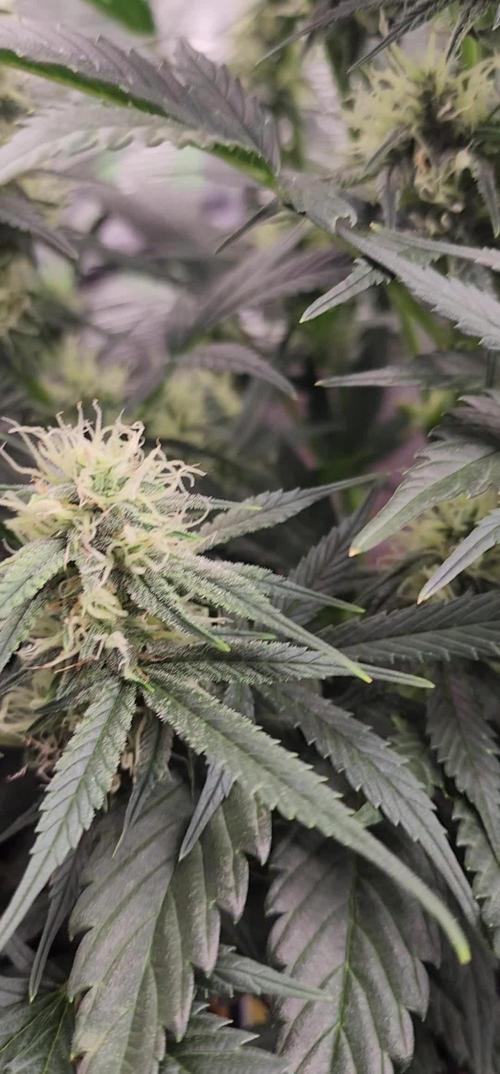
Alls well havent had any hiccups yet. I may of mixed soil a little heavy at start of grow so ran 3 gal of plan ph water to get rid of any build up. The smell in tent is a blueberry/sweet candy smell with a slight citrus lingering in back. Starting giving sticky bandit everyother water. Each girl is drinking about 1 gal 1 1/2 every 3 days or so. CQ is def gonna need some support on side branches soon.
Likes
87
Share


@squalino
Follow
Journal de Culture : Frost 1 -
Babouch (Semaine 10)
Génétique : Frostbanger (F2 Perso) | Système : Autopot 20L (Géré en manuel pour le rinçage)
📣 Remerciements
Un immense merci à toutes les personnes qui suivent ce journal depuis le début ! Un grand merci en particulier à @MIA_BIOTABS et à Mrs_Larimar pour leurs précieux conseils toujours aussi utiles. Merci à tous pour votre soutien !
🛠️ Configuration Technique (Ajustement final)
Éclairage : Lumatek ATS 300W Pro (réduit à 75% pour préserver les fins de fleurs)
Distance lampe/canopée : 50 cm
Climat : Jour : 25°C / Nuit : 21°C
Humidité (HR) : 50% (gérée par le déshumidificateur)
Tente : 1m80 de hauteur
📅 Évolution & Rinçage J+7 :
Des couleurs superbes et fin de floraison en douceur
Hauteur actuelle :
84 cm (parfaitement stabilisée).
Structure des têtes :
Les buds sont vraiment bien gonflés et compacts. On observe de légères "queues de renard" (foxtailing). C'est le résultat d'un petit stress lumineux, la lampe à 100% étant un peu trop près de la canopée la semaine dernière. Rien de bien méchant !
Action éclairage :
Pour calmer ce stress et aborder sereinement la dernière semaine (ou presque), j'ai redescendu le Lumatek à 75%.
Couleurs & Trichomes :
Babouch affiche une couleur superbe qui tire sur le violet / gris sombre, un effet magnifique accentué par la quantité de résine.
Visuellement, les trichomes sont majoritairement laiteux, mais il n'y a pas encore vraiment d'ambrés à l'horizon.
Rinçage & Sénescence (À la diète !) :
Suivi de l'arrosage :
Voilà maintenant 1 semaine complète que la plante est au rinçage à l'eau claire et en mode manuel.
Évolution :
Babouch commence à peine sa sénescence. Les feuilles vont doucement commencer à se décolorer dans les prochains jours au fur et à mesure qu'elle puise dans ses dernières réserves.
Résumé :
Tout va pour le mieux dans la box, la plante est tout simplement superbe. Les têtes sont lourdes, la résine est omniprésente et l'odeur est à son maximum. Le retour à 75% de puissance lumineuse va lui permettre de mûrir tranquillement sans faire de nouvelles excroissances. On surveille les trichomes de près pour le moment fatidique !
Le contraste entre le violet très sombre des calices et le blanc des trichomes sont incroyable à voir. C'est tout à fait normal que la sénescence mette un peu de temps à se lancer : les Biotabs nourrissent tellement bien la terre en profondeur que la plante a beaucoup de réserves à consommer !
À bientôt pour le final ❤️


