


@Frosty_farm
Follow
Week 15....day 106. She's just going to get plain pH 6.0 water for the next few days. I know she wouldn't yield a lot but this plant taught me a lot so I'm satisfied with that. I'm sure from here out you guys will see better yields and quality from me. Day 108.... nothing much has changed but some of her old leaves are getting yellow and brown. Her buds are looking better every day. Day 109... Nothing changed. Day 111.....this plant still looks healthy because my ppm was at 1000. Gave her a couple of flushes and bought it down to about 200. I'll chop her down at the end of this week. Day 112.....last day for this girl, trichomes are looking good, she's not big but I'm loving it. I trimmed most of the big leaves down, I'll chop her down tomorrow and put her in my diy dryer. Very sticky buds, my fingers were sticking together even the clippers were sticking too. See you guys at the harvest


shorts_status_processing


@CBD_Sweden
Follow
2018-03-20 Week 12 Day 1
New week and not much to say. No water or nutes today, just the regular weekly check to see that they look nice and healthy.
Raised the lamp about 10 cm to make sure that the girls don't get burned again.
Power Plant XL nr1 is 55 cm
Power Plant XL nr2 is 49 cm
------------------------------------------------------------------------------------------------------------------------------------
Strain information
Genetics for the famous Power Plant were captured by a group of Dutch growers on a trip to South Africa, back in the 90’s. They managed to breed a strain that was soon a popular choice in coffee shops of the Netherlands, most likely due to the soaring and intense Sativa high. Zambeza Seeds thought that the productiveness of Power Plant should never be forgotten and created an updated version, to bring the legend back to live.
Power Plant XL yields up to 600-750g/m² in a flowering period of approximately 55 days! The efficiency and productiveness of Power Plant XL fears no comparison with many recently bred cannabis strains. Indoor heights of 80-110cm make this sativa-dominant variety relatively easy to grow, but outdoor growers need to be aware of the power that is being released under the sun. Outdoor plants can easily reach heights of 150-200cm, and yields of 500-600g per plant.
The taste of Power Plant XL can be described as a delightful blend of sweet and sour flavours, with subtle hints of pine tree in the background. Smokers who appreciate a very strong and uplifting Sativa high will be more than satisfied with the effects. One will experience feelings of euphoria that are definitely intense and uplifting, typical for a South African Sativa like this. The up-high can also evolve into being more relaxed, especially when larger quantities are being consumed.
Some people suspect Power Plant to be grown in large commercial operations around the world. It doesn’t really matter if these assumptions are the truth or myths, but Zambeza’s breeders are very proud to bring this highly productive legend back to live. The updated version of it, Power Plant XL, is the most efficient Dutch "bud factory" money can buy.
-----------------------------------------------------------------------------------------------


@OoOgAuTo
Follow
Currently on day 97.
3 plants are still flushing and 1 has been given full nutes for 1 more week. I’m not sure if this is good or not but I decided to flush again with flawless finish for 1 more week. I’m still giving the flushed plants terpinator at 10ml per gallon.
Beautiful purplish hues throughout the pheno with some deep purple flowers.





@HideAndFly420
Follow
02/11 strong LST still going on. Today news ferrisilosation, last 2-3 days of veg and the push all into flowering.
Still pushing this plant trying to get all the brush are possibles.
980 ppm
Ph 6.2
Let’s see!!


@eldruidamx
Follow
Day 85. Skipped
Day 86. Fertilizers
Day 87. Skipped
Day 88. Clean water
Day 89. Skipped
Day 90. Fertilizers
Day 91. Skipped


@Brickie74
Follow
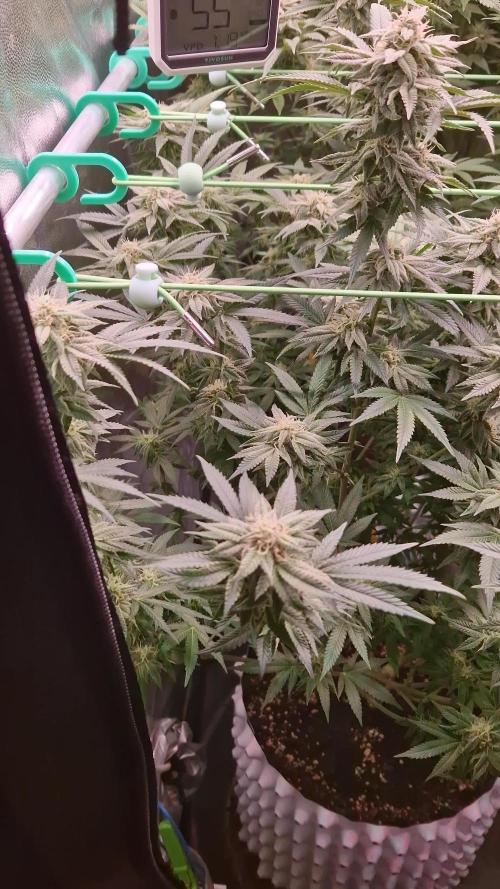
Well week 5....this will be her first week in flower. She has been topped (about a week ago) and I will soon start some LST. I don't get to carried away with training. I know some people do a lot...A lot more than I thought was possible. I just do enough to try and keep all the big colas at about the same height. I started to top my plants about 1 year after I started to grow. I liked it right away. Everything gets a bit more light some parts get a lot more light. If you mix in some light LST you get a much cleaner/organized looking plant....if that makes sense.



@TrickzGrowz
Follow
Viele kleine Popcorn Buds. Das nächste mal bei der Sorte dann doch weniger Triebe vielleicht.


@MadeInGermany
Follow
Hi everyone :-)
This week will be a short update because there is not much to report :-)
It is developing well ;-) and will have some time to grow 👍
Strain
Blue gelato 41 clone from mother (Barney's Farm)
☝️
Genetics: Blueberry x Thin Mint Girl Scout Cookies x Sunset Sherbert
👍
Vega lamp: 2 x Todogrow LED Quantum board 100 W.
💡
Flower lamp: 2 x Todogrow LED Cxb 3590 COB 3500 K 205 W.
💡 ☝️
earth:
Canna Terra Professional +
☝️
Fertilizer:
Canna Terra Vega, Canna Terra Terra Flores, Rizotonic, Cannazym, CANNA Boost, Pk 13/14, Canna Cal / Mag, Canna Ph - Grow, Canna Ph-Flores
☝️🌱
Water:
Osmosis water mixed with normal water (24 hours stale that the chlorine evaporates) to 0.2 EG. Add Cal / Mag to 0.4 Ec Ph with Organic Ph - to 6.0
💦 💧


@GorillaZativus
Follow
Videos:
10 días despertando , transplante 12 días , algunos sistemas radiculares y despertando post transplante .
🌱Solución de riego a micorrizas :
Mycochum y luego riego completo cuando despierten .
Ocupamos granular y great white en polvo para transplante , mitad y mitad.
Ph: 6,0
Ec: 0,7
🌱Solución riego a foleo 1 hora antes que despierten :
1 litro : proactive 5,0 ml y knactive 2 ml.
Ec : 0,5
Ph: 6,0
🌱Sumamos alfalfa alrededor de los tréboles
👑Actualización Jardin 18-19 días .
⌛️Videos :
🎥18 días , con hambre y sueño.
🎥19 días antes de dormir
🎥19 días despertando post foleo y post preventivo de tierra de diatomeas , listas para transplante en 1 semana .
🌱Solución foleo 2 litros :
knactive + proactive (4,0 ml ) y ( 0,8 de proactive ( melazas , quitina , etc ) Y sumamos preventivo después que se secó el foleo.
Ec : 0,4
Ph: 6,1
🌱metimos amarres al central y full lst .




@Ultraviolet_
Follow
18 hours in seconds, 60x60x18 = 64,800 seconds, now multiply by the 833μMol/s reading off the PAR metre. μMol/s (micromol) is the unit in which P.A.R. is expressed.
64,800x833=53,784,000μMol
53,784,000μMol = 54 Mol
54 DLI @ 800ppm, powerful combination. Pushing photosynthesis to peak capacity, accelerated growth and increased biomass. Applied net, stretching her around for a week. Maintaining a minimum air velocity of 0.3m/s within the inner canopy.
E=MC2 looks like a simple multiplication problem; it describes a fundamental physical truth: mass and energy are the same thing. The equation doesn't just calculate a value; it reveals that mass is effectively "congealed" energy. Energy is just numbers. Energy isn't a physical "substance" you can hold or touch. It is essentially an abstract, calculated number that we assign to a system to predict how it will change, interact, or move. A numerical label we attach to matter to track how it behaves. Because the universe runs on laws of symmetry (specifically, that the laws of physics don't change over time), a single global number must be conserved. We call that number "energy".
How well a seedling grows is down to how much knowledge one can acquire to increase the level of conversion to occur. Applying knowledge effectively requires intuition, which comes from hands-on experience. A seasoned stoner learns to read subtle signs—like a slight change in leaf turgor (stiffness), subtle color shifts, or the specific texture of the soil—before a textbook diagnosis can be made. Ultimately, growing is the application of botanical science blended with active observation. Knowledge dictates your potential, but adaptability and attentiveness to the plant's immediate environment determine your results. The human eye is capable of distinguishing more shades of green than any other color in the visible spectrum.
1.618
Nature mathematically optimizes quantum energy transfer and light absorption efficiency within the photosynthetic machinery, as it naturally dictates energy scaling hierarchies and resonance dynamics. External vibration or electromagnetic wave that perfectly matches a plant's natural frequency directly influences plant growth. Low-frequency sound waves and targeted electromagnetic fields stimulate cellular processes and boost photosynthetic efficiency. An angular frequency aligned with the Golden Ratio is often used in wave mechanics and quantum physics to optimize energy transfer.
Alignment with what already exists.
Law of nature, not my opinion: Constructive interference occurs when two or more overlapping waves meet in phase, meaning their crests and troughs perfectly align. Their amplitudes add together, creating a new, amplified wave with greater intensity than the individual components.
Constructive interference is the foundational mechanism that establishes a resonance hierarchy across physical, structural, and acoustic systems.
"Frequencies utilizing this ratio naturally minimize resistance (or impedance) and allow for highly efficient resonance, which can facilitate an increase in Electron Transfer Reactions (ETR) or energy pathways in molecular structures."
Quantum coherence in photosynthesis occurs when a photon of sunlight strikes a leaf; the energy it carries must travel to a reaction center to be converted into chemical energy. This process operates at nearly 100% efficiency. If the energy moved in a traditional "bunching" or random hopping manner, a large portion of it would be lost as heat. Instead, plants utilize quantum superposition. The energy particle (exciton) doesn't just take one path; it exists in a wave state and explores multiple pathways simultaneously. It essentially "chooses" the most efficient route to the reaction center simultaneously.
Research shows that molecular vibrations and the specific network arrangements of chlorophyll molecules (like the naturally evolved Chlorophyll A & B ratios) actively protect against energy overflow, optimizing light capture across different light intensities. Enzymes are the biological catalysts that speed up chemical reactions within a plant's cells, allowing them to grow, metabolize, and repair. Rather than relying solely on the classical kinetic energy of molecules colliding, plants use quantum tunneling. Subatomic particles like electrons and protons (hydrogen ions) can literally "teleport" through energy barriers that they normally wouldn’t have the energy to climb over. This makes vital metabolic reactions happen far faster than classical physics could ever explain!
Effective quantum efficiency of photosystem II, often denoted as ΦPSII, represents the proportion of light absorbed by Photosystem II (ΦPSII) that is actually used in photosynthetic electron transport. It is a key indicator of how efficiently a plant is using light for photosynthesis, as opposed to losing it as heat or fluorescence. ΦPSII (effective quantum yield of photosystem II) functions primarily as a "multiplier" (a coefficient of efficiency) rather than an additive factor when estimating the overall photosynthetic electron transport rate (ETR). Multipliers are considered far more beneficial than additions because they generate exponential growth, leverage existing resources to their full potential, and create sustainable, self-multiplying capacity, rather than just incremental, linear increases. This fascinating observation is rooted in the intersection of subatomic geometry, fractal scaling, and quantum dynamics. In specific molecular arrangements—such as in conjugated polymer networks or biomolecular architectures—the Golden Ratio (PHI) naturally dictates energy scaling hierarchies and resonance dynamics. Mathematically tied to the fine-structure constant, which defines the strength of the electromagnetic interaction. The Golden Ratio can be mapped geometrically as the Golden Angle (137.5 degrees) in atomic structures, linking the charge of the electron to fundamental quantum constants like Planck's constant.
An electromagnetic wave is neither electric nor magnetic, but a combination of both. 137.5
The Golden Angle (137.5) This angle is derived from the Golden Ratio (1.618). It is the smaller of two angles created when a circle is divided such that the ratio of the arcs equals the Golden Ratio.
In quantum physics, Alpha (Α/α) is the approximate denominator of the fine-structure constant (often represented by the Greek letter Alpha (Α/α). It is a fundamental, dimensionless number that dictates how strongly charged particles (like electrons) interact with the electromagnetic field. Its value has puzzled physicists for over a century, as it bridges quantum mechanics, electromagnetism, and relativity.
In quantum mechanics, Omega (Ω/ω) usually represents angular frequency. When applied to "quantum coherence"—the ability of particles to exist in overlapping states without immediately degrading—is key to calculating how long these states last.
The Golden Angle, the value 137.5° is the geometric Golden Angle. It is derived from the Golden Ratio (1.618) and is famously responsible for the beautiful, mathematically optimized spiral patterns found in nature (such as sunflower seeds, pinecones, and leaf arrangements). Because of this, theoretical physicists and mathematicians have long speculated about why nature relies so heavily on the number 137 and the golden angle to govern everything from subatomic light interactions to the macroscopic geometry of the universe.


@Ninjabuds
Follow
Warning beast of a plant lol
My Northern Lights #10 plant is an absolute beast! It's the biggest in the tent, growing incredibly strong. Even the second-deck buds are developing with amazing vigor. This plant is a true powerhouse, and I can't wait to see the massive yield it produces. It's got that classic Northern Lights aroma – earthy and sweet with a hint of pine. This one's gonna be a winner!
This past week has been a whirlwind of work, leaving little time for anything else. My phone's camera roll is sadly neglected, with only a few snapshots to show for it. But finally, I'm finding a moment to catch up on my grow diaries. It's been exciting to see the progress, even if it's just through photos. I'm looking forward to documenting the next stage!


