




Likes
21
Share


@BB_UK
Follow
Was supposed to update my diaries yesterday but literally forgot lol #edibles but they’re flowering nicely and stretching as they go! They’re truly loving life under the ts1000 can’t wait to see what the next week brings!
Likes
13
Share


@goeser
Follow
just a wet papertowel in a plastic bag for one day
then after one day into a germination type of thin from rqs
5x Fat banana Auto Left side
3x Bubble Kush Auto Right Side
Likes
152
Share


@BioBuds
Follow
How is it growing, my fun(k) loving friends?
***INFO*** For more on my setup, why it was monster cropped, and how I made the canopy, see Germination page and subsequent weeks.
They had 48 hrs of darkness, and the time has come to say goodbye to my friends.
I thanked them again, spend some time with them, and under the sound of Amazonian shaman's harvest and healing songs (will post link), asked for their gifts, and apologized for taking their lives.
I do this while in contact with the plants, touching, smelling them, observing every detail, no thoughts, just in the present moment.
I feel emotional as I do this and remember how they were a companion, a source of distraction in a time of worry, sadness, and loss.
How they already comforted me and kept me company in a time of painful insights about honesty, commitment, and staying true to myself.
I thank them again for their wisdom and gifts, viva Santa Maria, viva Planta Maestra, may the mother of all beings give us healing and protection.
And I proceed with the harvest as I visualize my intentions with every cut.
Branch by bud laden branch is tenderly untangled from the scrog net, taken with a clean-cut and immediately hung upside down in the grow tent, which will now double as a curing and drying room.
A couple more weeks and we will have the final cured and dried weight.
More photos and movies will follow, this is where we are so far!!
Thank you for checking in on our journey, all the love, support, and compliments were a true motivation, a very needed distraction, and guidance for me and for Sunshine.
Big hug, lots of love and take care!
***UPDATE***
The final weigh-in is ready. I hadn't seen them in a week, because of my vacation. The humidifier I set up, had failed. So the grow had dried in 7 days, what I wanted to be 14 at least. Thankfully, its Sativa ancestry shines through, the smoke isn't harsh, the buds a sticky and smelly, no hay smell at all.
We ended up at 246 grams, excluding a shitload of larf and popcorn bud, totaling at 310 grams all in, a first at a gram per watt for me, but for the Zambeza seed competition, I stated we would only weigh the quality bud. Overall I'm very happy!!
Guessed weights in the competition:
- @hashy : 0 grams
- @MrHyde : 198 grams
- @JamMAKEcan : 224 grams
- @TrickOrTrip : 260 grams
- @Greeneysgrow: 312.5 grams
- @Ohey_fu_kyu: 350 grams
- @Puffs4Pipes: 385 grams
- @Hempkid : 605 grams
- @DoDrugs420 : 621 grams
TrickorTrip was closest!! Congratulations!!! I will be contacting you to get the seeds with you!! Thanks for playing to all the others and better luck next time, I will give away some seeds again!!
Summary:
Cost of setup: 850 euro
Cost of nutrients and soil: 125 euro
Cost of seeds: None they were cloned
Cost of power: 150 euros in the power bill
Total cost: 1125,-- for setup and this run.
I smoke for medical reasons and it's used for ritual and healing purposes, never to be sold, as it loses its magical properties.
Should I have to buy Gelato of this quality at the dispensary that I frequent, it would cost me at least € 15,-- per gram.
246 x 15 = 3690 euros. also, 49 car rides of 25 miles there and back, 250 euros in gas saved.
Overall conclusion:
I think we can call this a succes. Made back my investment, my cost per grow and we saved the environment.
Thanks for all the love, tips and support! Couldnt have done this on my first indoor LED grow, without you!!
Wish you were here to smoke a fat one, some good conversation about our hobby and now... I'm hungry.... See you on the next one!! Hugs Bud!!!
PS. Should you be interested in Shamanism or Teacherplants by anything I mentioned. Pls watch the following documentaries or read these books:
- The Last Shaman on Netflix
- Fantastic Funghi on Netflix
- Food of the Gods, by Terrence McKenna
- The Herbal Jedi / Yarrow Willard on Youtube
- The Tao of Physics
- DMT: The Spirit Molecule on Youtube
- The Doors of Perception by Aldous Huxley
- Plants of the Gods by Richard Evans Schultes and Albert Hoffman
- What the bleep do we know - Down the rabbithole (although vague and some theories mentioned here, could not be replicated, like the water by Emoto)
- The Secret on Netflix- if you like enlightenment in bitesize, tellsell format
The link to Santo Daime hinarios for the Santa Maria cura, healing ceremony: https://www.youtube.com/watch?v=kSjNgg_-iD0&t=333s
If you want to learn more about permaculture / homesteading, see the following links:
- Pete Kanaris, Green Dreams TV, visits many permaculture farms in tropical area's, he is great!! https://www.youtube.com/user/GreenDreamsFL
- Supersoil recipe by Learn Organic gardening, take your ADD meds first, dont watch if prone to epilepsy... they like to talk... https://www.youtube.com/watch?v=z9_5iIqpTVA&t=1216s
- Mr Canuck, indoor organic cannabis growing master on Youtube: https://www.youtube.com/channel/UCtU2-cpxx18iQ4BvracrxDQ
- People creating food forests all over the world: https://www.youtube.com/user/happenfilms
Happy travels and enjoy!
Final update: Very happy to announce that this dairy had won the sixth place best diary of August 2021. My prize came in yesterday and I'm very happy!! Thank you Growdiaries!! Thank you Fastbuds!!! Thank you all my grow buddies here for the love and support!!
Hope to see you all, maybe at a future Growdiaries Meet and Greet? Wouldn't that be a lovely idea, per country and a yearly one on a different continent every year? The Growdiaries Conference. Would be a great Hemp growers fair... I'll keep dreaming and light another one... Big hug BioBuds

Likes
26
Share


@Nebula420
Follow
Original Sensible Seeds this is the discovery of the year for me, just great genetics, I really liked Auto Destroyer, very tasty plant and easy to grow, suitable for beginners.
Refuse I liked fertilizers from Green Buzz Liquids, just amazing, great result.
Thanks to everyone who follow my grow report, love u all, Peace!

Likes
119
Share


@Natrona
Follow
****DIVINE SEEDS *****
*****OPIUM*****
Sponsored grow
***DIVINE SEEDS *****
Week 11 6/16-23 Opium Loves the outside. She is tall and lanky, towering over the other outside girls: Fractal, Lemon Cake and Drizzle. All are showing yellowing leaves so everyone is now getting nutrients with feedings.
I saw a Japanese beetle on my Lemon Cake and some small holes in the leaves so I added 1/2 tsp neem to the feed solution 6/12. Also started using fish & kelp. I'm still watering 1 gal per plant when I feed 2x/week. With the heat and humidity, I water daily but do not feed daily.
Nutrients:
TPS1 15ml/gal @4 gal =60ml
Signal
1.5 ml
Cal mag 10ml @4 gal
Recharge ½ tsp/gal =10ml
Kelp & fish GS plant foods 1/4c /gal @ 4 gal =1c
Neem ½ tsp (for Japanses beetles)
Ph5.7
PPM 1414
Solution Temp 85
Outside temp 92f
6/19 Opium had a Spa day. Hair cut. All large umbrella fans were removed. Since she is in flower, she didnt need excess vegetation. This defoliation reveals true sativa form. There are 6-8inch stretches between nodes. I added a 6 ft support pole since we've had thunderstorms with high winds. I didn't want her majestic crown to snap off. I water daily and feed 2x per week now.
*****OPIUM*****

Likes
7
Share

@PapaTerps
Follow
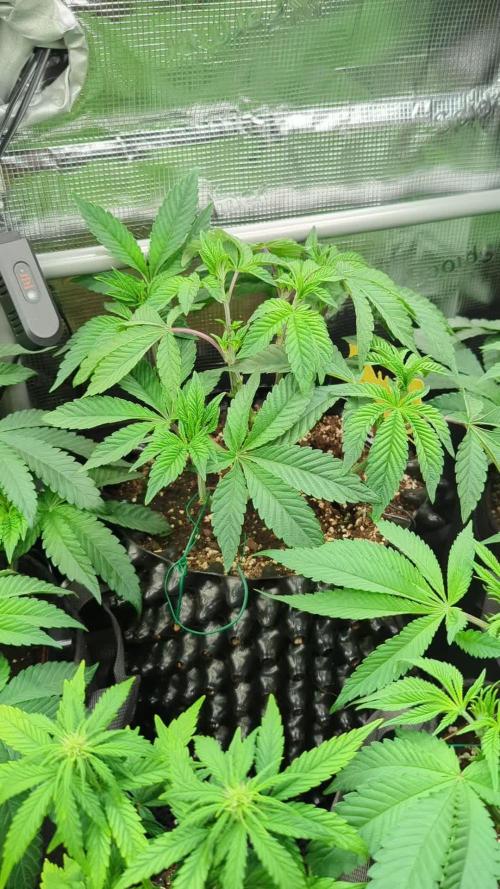
Potion - Wizard Trees
Day 53 -
🚿 she has been watered her with 2L of RO tap water, with defined nutrients, mixed individually in order and then pH'd to 6.3. I've once again upped her bloom nutrients by 0.5ml, as I prepare her to go into flower.
✂️ She had a lot of work performed last week, so this week I've just allowed her to recover and grow more. This will be her last week in veg, so my goal for this week is to ensure she has an even canopy before she starts the switch over to 12-12 👍🏻
☘️ She has recovered well from the topping and defoliation last week and is looking strong and healthy again👌🏻

Likes
26
Share


@Bakeryguy420
Follow
Start of week 6 of flowering for 4
Getting really frosty !!! Coming to and end of week 6 of flowering
Tangie ,gg4,sweet creme and glueberry all.started.to.get flushed!!! Exciting.for.chop . The hazes are all looking amazing .
Forgotten cookies is amazing =).
Just added grapey walter and douple grape. =)

Glueberry Auto · Expert Seeds
Gorrila Glue #4 Auto (Expert Gorilla Auto) · Expert Seeds

Tangie Auto · Fast Buds
Sweet Cream Auto · Expert Seeds

Amnesia Haze Auto · Vision Seeds

Amnesia Gold · Pyramid Seeds
OGesus Auto · Expert Seeds

Royal Haze Automatic · Royal Queen Seeds

Caramella Auto · Custom Breeder & Strain
Rhino Ryder Auto · Fast Buds

Fugue State · Mephisto Genetics
Likes
2
Share
@Smev1337
Follow
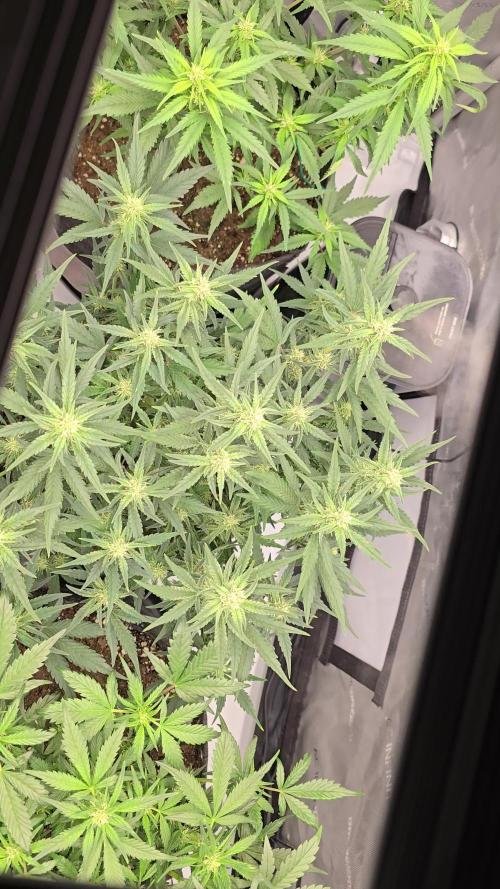
All 3 Plants are going good so far just the left one is giving me a lil bit headache but its fine, lets see how its gonna be next week i hope the left one is out of danger but we will see ✌️💚😎 happy growing all
Likes
3
Share


@Reeferpot420
Follow
For some reason I think there might be something special about this plizzy
Likes
16
Share


@Northern_Ent
Follow
Aug 3: still going strong starting the third week of flowering. I’m putting her in the garage at 9 pm, doing the 730 nm far red light to put plant into dark mode 2 h faster, and then out of garage at 7 am. So 10+ 2 h is 12 h dark and 14 h daylight or a 26 h day. The far red light definitely works as a bloom booster and helps the plants finish faster when the sun is stronger.
Did morning foliar spray of Extreme Blend and potassium silicate.
Aug 4: always some defoliation to be done and I took out all the small stuff that was growing into the centre. If I had a longer season I could have left some of these small branches but I want the energy directed toward the prime bud sites. Also removing leaves makes it more stable in the wind. Yet another growing trade-off.
Aug 5: she looks great coming out of the dark garage this morning. Lots of colas with lots of buds 👍👍
Aug 6: added UV lights from AC Infinity. This far north we run out of strong sunlight before it gets too cold in the fall. By adding UV lights, this will make Edmonton in September seem like California in July.
Along with genetics, UV light is the main factor controlling trichome and THC production. Adding UV light for a couple of hours per day centred at peak sun (currently 1:39 pm) should help a lot this far north.
At the other end of the light spectrum, I use Forever Green Indoor (FGI) 730 nm far red light. This is the third season using the far red light as a bloom booster and it definitely works. A few seconds at dusk is all it takes to put the plant into dark mode two hours faster, and is like getting a 26 h day. Bud ripen earlier and therefore under stronger sun. Both of these lights are low power LED used for a few hours (UV) or just a few seconds (far red). Gotta love science and technology when it allows us to figure this kind of out.
Likes
7
Share

@MistaOC
Follow
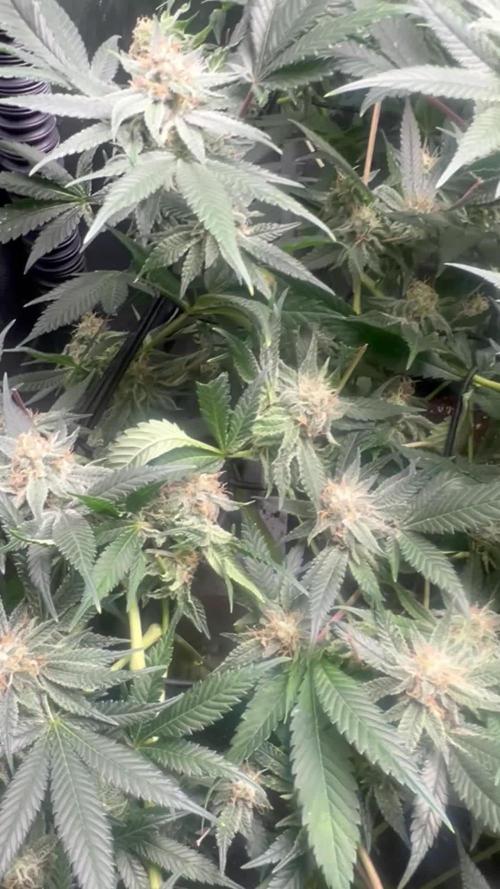
Grow Diary – Day 65 (Flowering Day 45)
Strain: Sour Frootz by Karma Genetics
Plants: 4 clones
Training: HST + SCROG
Nutrients: Green House Feeding – Bio Grow & Bio Bloom
Date: May 16
Status: Maturing beautifully – final phase underway
At Flowering Day 45, the Sour Frootz are deep into the flowering phase and transitioning steadily into the ripening stage. Buds are now dense, resin-coated, and maturing nicely across all tops. Trichome production has intensified significantly—under magnification, the majority are cloudy, with the first few amber heads beginning to show.
The canopy remains uniform thanks to earlier SCROG and HST work. No further stretch has occurred. The branches are supporting impressive bud weight, with some light staking now helping where necessary.
The aroma is rich and layered: strong notes of sweet citrus and sour fruit dominate, backed by a subtle gas-like funk that fills the tent. Terpenes are peaking and beginning to stick to fingers during inspection.
Nutrient Management:
• Bio Grow continues to work in the background as a slow-release base.
• Bio Bloom remains the main driver for flower bulk and resin support.
The organic feeding regimen is holding strong—no signs of lockout, deficiency, or excess. Watering remains consistent, with careful monitoring of humidity to prevent mold as bud density increases.
Current Observations:
• Buds are compact, frosty, and aromatic
• Leaves show natural late-flower fading on older fans (normal)
• No pest pressure or mold present
• Environment stable (moderate RH, good airflow).
Likes
4
Share

@Budhunter
Follow
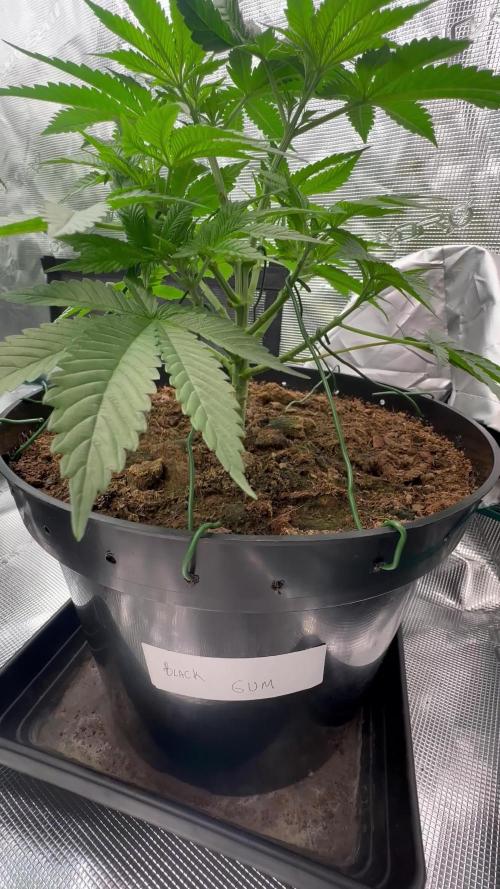
Week 5 Veg - day 41
Black gum seems a bit behind in size in comparison with the other genetics I am running together but overall it’s healthy. I will be vegging it for 1 or 2 weeks more before flipping into flower. Let’s go
Likes
27
Share


@Chubbs
Follow
420 Fastbuds Week 6
Blackberry Auto
What up grow fam. Hope everyone's grow is going as expected. These two Black beauty's are absolutely stunning. The colors they're producing in the flowers are just breath taking. The smell is already very pungent berry so one could only imagine once finished. The bigger of the two seems to be a little further along with its flowers. Decided to add General Hydroponics 3 part flora series to the fed for an added boost if they're needing it. I'll continue the routine I've done up to this point.
Likes
40
Share


@Hempface86
Follow
Another week has stared and thease girls are monsters! The Gummiebears is in a 4 gal pot and is 41 inches tall ( 52 from the floor ) and is outgrowing the tent ( who says you shouldn't too autos? Lmao ) and as you can see the other 3 are in 1.5 gallon pots and are monsters as well .. if I don't pull 20-24 ounces this run I will be surprised honestly..
side note.. I cut the 2 lines branches early on from the Cream auto and put them in a vase for 2 weeks and they rooted so I stuck them both in the same little container and they have settled in nicely as I see new growth daily.. it's gonna yeild me an additional half ounce possibly? Idk 🤷♂️ fun experiment tho .. hope everyone is doing well! Happy growing! Likes and comments are appreciated! ✌️


Likes
27
Share


@adam_pawloski87
Follow
Let’s go day 43!!!! Week went real well , girls started preflower so sometime this week I will be switching up the nutrients for flowering! We are stable and looking super healthy! Can’t wait to see what these ladies do this week! Hope you all enjoy !
Likes
5
Share

@Budhunter
Follow
Unfortunately what we never want to happen has happened with my baby.. bud rot.. on day 98 of cycle I found 1 bud with bud rot, cut it off, checked the plant and could not find more.. flushed the plant and wait next day to see how it goes. After 2 days main bud was identified with bud rot too.. so sad.. probably due high humidity in my environment + colder weather we are starting to have.. so on day 101 harvest it.. could go few more days to get more amber trichomes but decided to harvest it to avoid lose more buds .. I will keep watching it to see if no spread when drying :(


Likes
23
Share


@Buerofrau
Follow
Lemon Cherry Cookies and Purple Lemonade looking not healty at all. But the Buds are quiete impressive
Gorilla Cookies almost reached my light, was thinking about bend her 90° at the top main Bud (HST), but decided against. just let it grow👽👻
Likes
Comments
Share

@The_Doctor_Green
Follow
Hola a todos!!!.
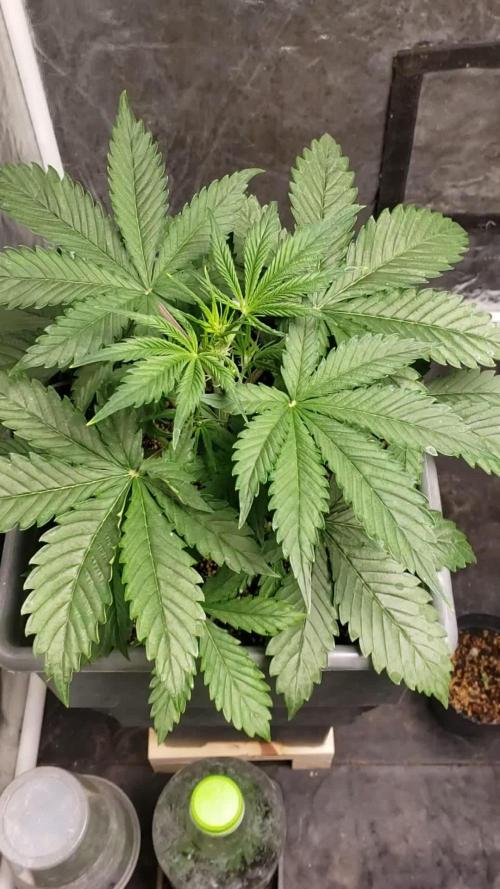
Les comento como le fue esta semana a la auto black opium.
La he regado en 2 ocasiones, en una solo con agua y en la otra regue con top auto 1.5ml x l y la última de top veg 2ml x litro de agua.
En ambas ocasiones regue con 400ml .
Ya comenzó a mostrar los pestillos, asique la próxima semana intuyo que será de floracion.
El ph de dichos riego anduvo en los 6.4 , las ppm no las he medido..creo que no me olvido de anotar nada más.
Hasta la próxima semana, y buenos humos!!!.


