The Grow Awards 2026 🏆 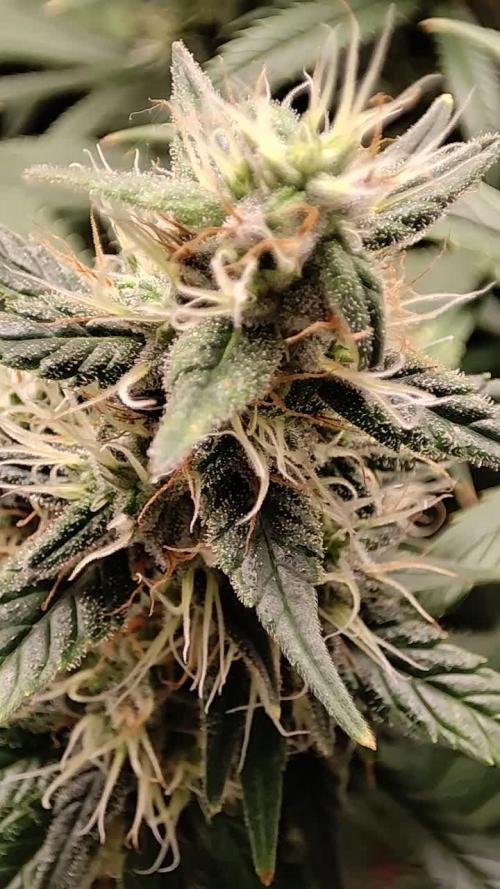







Likes
11
Share
@Bncgrower
Follow
So far so good, this girl is developing really well. She's heading really well into the final weeks ✌️💪🌿

Likes
9
Share
@Black_Venom
Follow
Harvest in week 12. But I screwed up, I didn't have enough room to separate each variety, so I would put an average weight when everything was dry... I had done everything well, I had to mistake on the place of the drying bag
Last pictures, mixed buds

Likes
3
Share
@Organic473
Follow
You can tell she is stacking up. I’m hoping she pulls through the heavy rainfall and high humidity as she nears ripening and harvest stage.

Processing
Likes
40
Share


Likes
61
Share
@MadeInGermany
Follow
Hey friends :-) .
There is not much to tell this week. They smell stronger and stronger, but unfortunately I don't really like the bud production.
It is going very slowly, and she just doesn't want to have many nutrients :-(. Just don't understand why.
I know the genetic, because I have it as a mother, and there are 100% all parameters in the perfect area.
I have prepared a completely new nutrient solution again, and I will watch you closely this week :-). Otherwise everything looks great.
The new update is coming next week. Until then,
I wish everyone a great start to the new week 🍀👍 Let it grow 😎🌱

Processing
Likes
12
Share


Likes
16
Share
@CJgrows
Follow
Starting to ripen up probably another week or two on gorilla glue and strawberry pie the grapefruit is just now packing on bud so I’d say maybe 4-5 weeks left on grapefruit. Little bit of amber showing on the gorilla glue. Mostly clear yet on the strawberry pie. Overall happy with gorilla glue and strawberry pie. Grapefruit not so impressive yet. The smell is quite strong at this point and is getting stronger by the day with the really sweet notes of strawberry and the earthy medicinal smell of the gorilla glue.
Likes
1
Share


Likes
7
Share
@vito_scl
Follow
Se sueltan amarras de LST y se deja de tejer en la malla.
Ramas presentan crecimiento del 100% durante la semana.
Se sube un par de cms la malla.
Defoliación selectiva en día 14.
Riego por medio con fertilizantes.
Riegos abundantes solo con agua.
Pistilos comienzan a ser más notorios.
Leve olor.
Poda de bajos en una semana más.
Ventilador en mínimo durante la noche. Al máximo durante el día.

Likes
10
Share
@StickyFingah420
Follow
Extrema producción de tricomas de esta variedad! Gran parte de los frutos lo usaré para extraer rosin, su resina se ve ideal para este propósito.
Fragancia exquisita a ponche de fruta dulce, con notas ácidas y un fondo de especias.
Como mencioné anteriormente dejaré la parte de la reseña de efectos, sabores y sensaciones para cuando los cogollos estén secos y curados, por ahora solo puedo apreciar lo que mi vista y olfato me permiten captar.
Totalmente conforme por la calidad de estas flores y agradecido de los amigos de Sweet Seeds por la confianza.
Será hasta la cata entonces, buenos humos!

Likes
7
Share
@JayBane
Follow
FastBuds? More like FatNugz!
What a delight this Strawberry Banana was to grow!
Smelling wonderful, trichome rich and compact buds!
Will update a harvest report once she's dried and trimmed up & ready to bottle.
Likes
19
Share
@GrowMo
Follow
As she gets closer to the end these fat dense buds are filling out with a ton of trichomes that are so beautiful some almost look purple when the light hits just right. I can’t wait to try this bud out I’ve been so impatient about this cause it looks so good stay tuned for the chop soon only 2 more weeks!
Fed FloraFlex
B1 B2
3.0ec
6.0ph
No Cal-Mag
Likes
70
Share
@Insaniac_0
Follow
So I have decided to only note when changes are made, observations are warranted, or I feel something of note has happened. I'll still do daily progressions, but the rest has already been documented and no need to create a hundred new pics showing the same. Just understand that if I say "7.1ph," or something with tested amounts that I mean I first calibrated and tested my ph pens and all units are measured for accuracy. I am learning as I go, so it would be of no benefit to report inaccurate details.
112/42
VPD and PPFD are still the same this week. 73-76F in the day and 66-68 overnight with RH set to not exceed 55% but is mostly at 45 to 50% now that winter is here. The fan is set to auto and I have 2 de-humidifiers in the tent. The PH lockout issue is still in progress but I am starting to get the soil up to snuff now. I think using the knitting needles has the most beneficial effect on the soil as it both aerates and allows the nutes to get deeper.
113/43
Defoliated today. I removed the worst of the affected fan leaves and this unfortunately only leaves sugar leaves to run photosynthesis process. Im hoping she still gets enough of everything else to grow the buds, but only time will tell. I will take new control pics for new progression on 3 other sites now.
Watering Days.
All feeds with nutes use either a whole ratio, or combination, of "Veg Mix" and "Bloom Mix"concentrates. These are/will be DILUTED in water until a total ppm of add-in is reached using a (Total Dissolved Solids) TDS Meter measured in PPM (parts per million). The "Veg Mix" concentrate will eventually be added-in larger, then smaller, ratios while the "Bloom Mix" concentrate will eventually replace the "Veg Mix" concentrate entirely. The ppm and ratios will be listed when I feed. Veg mix recipe is on week 3. Bloom Mix recipe is on week 5.
Last feed was day 110/40 (next will be +3)
I expect to continue to use 7.1ph with 650ppm of bloom mix concentrate and feed 2.5 gallons every 3 to 4 days, so I expect about 8 to 11 cups of runoff at that time as well. I have decided that I will try to add 1 ml of CaliMagic (General Hydroponics 1-0-0) per gallon of feed on each feed for a week or two to see if this can help against ph lockout of calcium since it cant be N,P, or K. Cant be N because she uses WAY less N in flower, and it cant be P or K because I am getting nute burn with the feeds I am already using... so my conclusion is that she need more micro nutes from the lockout, and since I was thinking it was Calcium in the start, I am going to try a more detailed treatment to test results against from here.
Day 113/43 (last feed was day 110/40)
Tested and Calibrated my ph pens. Fed 2.5 gallons of purified water (starting with 16ppm) mixed with 658ppm of 100% Bloom Mix Concentrate. Due to this soil showing a possible calcium deficit, I am starting a 1ml per gallon add-in to test on all plants using this soil, so I added 2.5ml of CaliMagic (General Hydroponics 1-0-0) to the feed then I ph balanced before feeding. The ph on this feed was balanced to 7.1. I used knitting needles to help both aerate the soil and create new water pathways for the roots. (a practice I may consider a new feeding standard for all my plants) I got ~7 cups of runoff (~11 cups last feed). Higher runoff volume was expected with the feed volume but glad to see she's taking it better now since I started knitting needles. Runoff was tested at 6.12ph and 2250ppm (5.9ph with 1860ppm last feed). Top soil tested at 6.23,6.31,6.57,6.38 for an avg of 6.372 (6.327 avg after last feed) - next feed will be 7.1ph again as I'm still liking where the ph is finally going, but rather see it closer to 6.3 or 6.4 top and bottom. I dont see any issues with the feed's data other than the possible calcium deficit and I will continue to monitor runoff ppms as I expected this to be lower with less runoff but have to consider they maybe washing out salt with the knitting needles. Next Feed should be 3 gallons of de-chlorinated tap water ph balanced to 7.1 in +4 days (117/47). I will run 650ppm and 3ml of CaliMagic (General Hydroponics 1-0-0) again.
Day 117/47 (last feed was day 113/43)
Tested and Calibrated my ph pens. Fed 3 gallons of de-chlorinated tap water (starting with 299ppm) mixed with 671ppm of 100% Bloom Mix Concentrate. Due to this soil showing a possible calcium deficit, I am starting a 1ml per gallon add-in to test on all plants using this soil, so I added 3.0ml of CaliMagic (General Hydroponics 1-0-0) to the feed then I ph balanced before feeding. The ph on this feed was balanced to 7.4. I used knitting needles to help both aerate the soil and create new water pathways for the roots. (a practice I may consider a new feeding standard for all my plants) I got ~20 cups of runoff (~7 cups last feed). Higher runoff volume was expected with the feed volume increase might let her go to 4 days again and 2.5 next feed. It could be a result of the knitting needle treatment when feeding. Runoff was tested at 6.10ph and 2070ppm - again thinking it could be a result of the knitting needles (6.12ph and 2250ppm last feed). Top soil tested at 6.23,6.31,6.57,6.38 for an avg of 6.372 (6.372 avg after last feed)- next feed will be 7.1ph again as I'm still liking where the ph is finally going, but rather see it closer to 6.3 or 6.4 top and bottom. I dont see any issues with the feed's data other than the possible calcium deficit and I will continue to monitor runoff ppms as I expected this to be lower with less runoff but have to consider they maybe washing out salt with the knitting needles. Next Feed should be 2.5 gallons of de-chlorinated tap water ph balanced to 7.1 in +4 days (121/51). I will run 700ppm and 2.5ml of CaliMagic (General Hydroponics 1-0-0) again.
Likes
4
Share
@alexb420
Follow
been feeding pretty heavily, flipping in a week or 2. hardest plants i’ve grown so far

Likes
200
Share
@Ferenc
Follow
Day 72, 21st of November 2020:
Hi! Wao this is what I can say and luckily stoppe streching....
All LST has been removed as the plants remain the same so no need to keep them in "chains".
Those Original Sensible girls 3 of them (Gelato, Runtz Gum, Do-Si-Dos OG)went crazy, except Black Ghost OG she did not strech much typical little indica lady. And the THC crystals alrady on the leaves on the Runtz Gum and Do-Si-Dos OG just simply beautiful.
Buds are coming getting thick they are gorgeous only I can see some some sort of deficiency on Do-Si-Dos OG a bit on some leaves.
The fertilization schedula isnthe same every 2nd day and happens with the mix and ratio above.
Wedding Gelato is beautiful also I hope the nice purple colour will come out as well in late flowering stage. :)
The lamp is on 11.30 min and off 12.30 min.
Last week was 15 min longer light cycle....
So every week 15 min shorter light cycle until the 5th week. So far -30 min. It switches on at 6 am and off at 17.30 pm.


Likes
97
Share
@Natrona
Follow
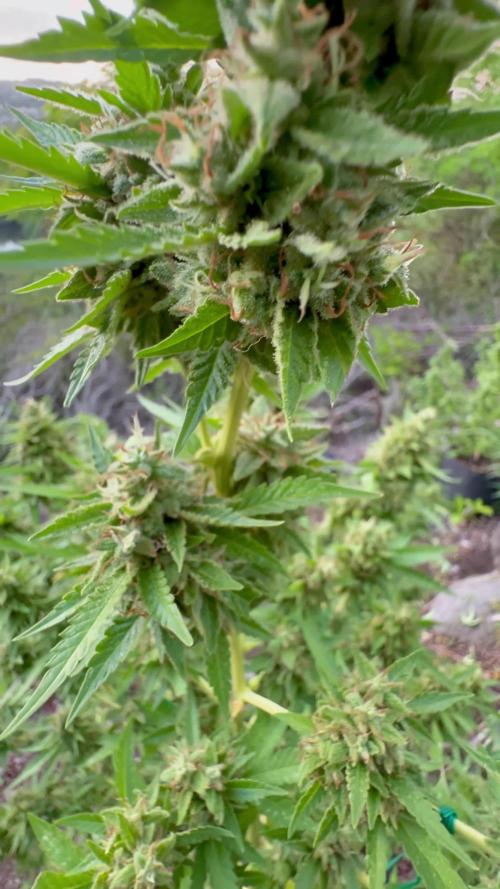
Sour Jealousy Auto FastBuds 2025 Outside Grow
Week 10 June 1-7 FLOWER 4
This week had a couple rainy days but mostly sunny. Temperatures were normal for this time of year – mid 80s in the day and 50s at night.
This next week is calling for rain every day. I may have to move her inside as a cautionary measure to avoid too much moisture in the plant. Our coastal area stays very humid and last year I lost 2 huge plants to bud rot.
Have a great weekend staying high.
Growers love 💚🌿
💫Natrona💫
Likes
23
Share
@HideAndFly420
Follow
Day 78🌱🙂🍊
This lady is doing her great job, Buda are increasing rapidly 🌱 difference between top flower and bottom is evident. For this reason I’m quite sure I’m going to cut in two times, around 85/87 days I’ll cut the high part of biggest bud and around day 95 the rest of the plant.
Day 80🌱🌱🌱🙂🍊
I’m going to go up to 90/95 days, smell now is really strong 👃🌱🤣
I keep giving some water when is really dry because some parts of the plant still needs it.
Day 81 🌱🌱🌱🌱🙂🍊
Hi all fellows, today a big defoliation cleaning to improve light in the bottom
Part of the plant before harvest.
I tought to harvest in like 10 days but as I have some water yesterday I noticed that she’s been quite not drinking anymore.
I’ll give another 2/3 days before harvest.
I will be perfectly in 85 days from seeding.
Smell is crazy now, I can smell cotton, orange, chocolate, pinus..
can’t wait to try it.
Let’s see!
ANY SUGGESTION IS REALLY WELCOME
🌱🌱🌱🌱🌱🌱🌱🏆🏆🏆🏆😊😊😊😊
Likes
11
Share
@molvera
Follow
This might be the last week before chop... Most pistils are already orange. Not a lot of smell in the grow room, the green one smells like green apple candy, and the purple/red one like grape bubble gum. I've had many humidity problems lately, thankfully Dr Zymes has got my back keeping the PM and fungus at bay.
Likes
24
Share
@VAmulasmoke
Follow
Once the drying process is done I'll be coming back to update the smoke report. Her terps are off the charts and she looks very resinous to the naked eye.
UPDATE 02/02/24
The dry and curing process left with some of the most amazing nugs I ever seen and the most is like none other. A pungent smell of lime, diesel, piney and sweet.
Pulled 13G worth of kief which wow I'm impressed by all means.