


Likes
Comments
Share


@SmokingTiki
Follow
Buds keep growing! However, the two Mandarin Punch (Auto) buds grow slower than the two photoperiod plants.
Watering as usual, see report in the pictures for more info. The tips of the leaves continue to slowly getting brown so I increased the dosage of the Biobloom. I'm now adding nutrient as advised by the datasheet compared to past weeks where the dosage was reduced. Let's see if it helps.
I continued to remove some leaves here and there.
Plants heights at the end of the week:
Honey Melon Haze : 120cm (+0)
O.G. Kush : 81cm (+6)
Mandarin Punch #1 : 142cm (+2)
Mandarin Punch #2 : 123cm (+0)
I think the plants have reach their final heights :)


Likes
34
Share


@Damonkey
Follow
So, starting the 6th week of flower with the phantom OG. BIg Bud has been stopped and has passed over the baton to Bloombastic for the last two weeks(ish) before flush. The POG. Are looking nice hopefully the next 3 or 4 weeks will get them looking a bit better than that.😍😍😍
The smell is awesome very fresh and clean, one leaning towards a minty aroma.

Likes
250
Share


@Ju_Bps
Follow
Outdoors 😎🌞 I usually don't do much on the plants, just let them grow, take care of them a bit and admire them.
I am very surprised with the result, especially #3, some nice sticky buds 🌲❄️❄️, #2 is also correct, #1 the smallest, gave little fruit but lots of leaves. If the weather had been better the first 2 growth week the harvest would have been a little better, but compared to my previous outdoor grow I am very happy with the result 🌞🌞😁😁, I expected much less.
👉Thanks community for the support, likes, comments and follows, it's always a pleasure my friends 👩🌾👨🌾💕💕
👉Thanks to @Sweet_Seeds 💕💕 for the seeds gift spend Halloween contest
👇👇👇👇👇👇👇👇👇👇👇👇
https://sweetseeds.es/en/autoflowering-seeds/3188-bruce-banner-auto.html

Likes
19
Share


@GrowAndSmoke
Follow
Ahhhh what a smell Bloom has started 💚 Ladys are stretching day by day. Soil still moist. Today i build some DIY Co2 Generators.(Next time in Veg)
(Day 30)
Today i cleaned the tent, Northern Lights#1 is stretching well. Soil still a little moist. Also prepared 10L ph regulated Water. (Day31)
Budside getting chunky and very hairy 😇Smell is very good. In my timelaps you can see insane grow over one day. You cant tell that i readjusted LST yesterday (Day 32)
Sticky Beast 2 is stretching now, Northern lights 2 still not so much sign's of flower🤨 (Day 33)
Looked at my timelaps and the Nortern Lights almost grew 2 cm 🤩 Today i gave them 1250ml Mineralwater ph 6.3-6.5 . Sticky beast still in preflower (Day 34)
Did some LST and pruning to my sticky beast now she looks even bigger👌(Day35)


Likes
Comments
Share

@TrunkoKush
Follow
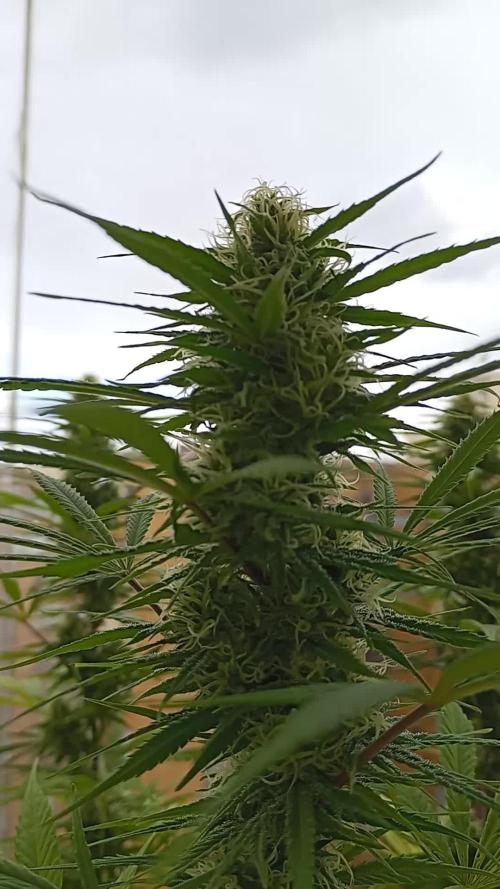
Earthy Wood and Lemons. Purple Trichome Necks. Purple Stems. Senescence. Purpling Leaves


Processing
Likes
1
Share


@CityFarmer
Follow
Hello everyone,
These girls are going good, had to get rid of a couple that ended up male, but they started to flower, they should get bigger, lets see how it goes...
See you guys next week🤘🤘👊👍👊
Likes
7
Share


@Sunstonedgrows
Follow
Going onto week 2 of flower! These were taken dec28, so day 8 of flower. So far looking fine though a bit dehydrated. This one definitely is water hungry now and needs to be watered every other day now. We'll see how she comes along into the next few weeks.
D6 of this week (d13 of flower), and we can start to see flowers coming in a teensy bit. We are still watering every 2 -3 days. On D7 we did a slightly premature feed of the flower girl fertilizer.
Cheers
-Dj Sunstone


Likes
18
Share


@MrDainAndToeniAsiaCrew
Follow
6plants So good & one genetic error or I don’t know how
But I care

Likes
10
Share


@ViTeM
Follow
Mein 1.er grow mit meinem neuen Upgrade 🤩
Kannst kaum erwarten bis alles aufgebaut ist.
Nach monatelanger Recherche habe ich mich nun für eine neue Box mit neuem Licht entschieden und einiges mehr.
Meine "babies" warten auch schon auf ihr neues Zuhause 🌞🌅🌻


Processing
Likes
41
Share


@Gr33nGiant
Follow
My tent is full!....my crude tie back seems to be keeping everything away from the light....not able to get good pics.... we are at day 70 and still drinking a half gallon a day.... seeing nice swelling

Likes
44
Share


@Jays_Not_Here_Man
Follow
The girls have recovered well from my incompetence ( hot solution and too much light) they have took off and are getting some bushiness to them. I will be transplanting to a 2 gallon pot in the very near future.
Temps have been high, but the RH has also been high so the VPD hasn’t suffered too much. Started feeding the girls about 1/3 to 1/2 cup water, and by the end of the week we were at nearly a full cup. They are drying back well, and are needing some water every third day or so…

Likes
2
Share


@HIAZ_urbanbudfarmer
Follow
Back 2 are on week 5 day 34 of flowering & front plant Orange sherbet clone is week 8 day 54 & very close to harvest, changed her over & flushing with water & Rezin only. Awaiting delivery of a new 60x microscope lense to view trichomes but the buds look like their just about done. Calyx closed & swollen, amber pistils curling in, they are nice & dense buds.

Likes
6
Share


@Bwright_315
Follow
The baby of the bunch she huge. I just had to move one of my light down to help my other plants and since I have done that I have started to see some yellowing leave not many but I will keep an eye on it

Likes
5
Share


@JohnnyBarrel
Follow
Week 17
Last week before harvest. Just let the plants ending the maturation process. Good synchronization between the different strains, selected with an approximate identical flowering period. I want harvesting all the plants at the same time.
Flowers are dense, hard and thick, pretty resinous. 4 strains = 4 different smells, 4 different colors….🤩
I flushed consciously and stopped watering 4 days before the harvest day. I turned off the light during 48h, with ventilation on.
All is ready for the cut. Date is programmed to the full moon period….why not…🤔
I will trim a little bit the plants before cutting and hanging them in the tent with the same ventilation cycle, no light of course…


Likes
Comments
Share

@MADMANk
Follow
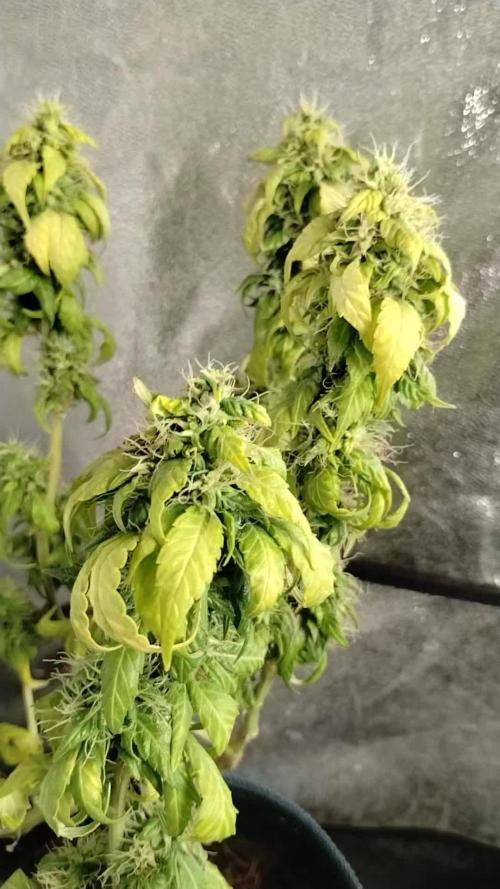
After a rough overwatering, i defoliated a ton of curled leaves, she is currently still recovering (defol and over water 2/3 days ago)
Honestly though... The smell is something else, super pungent gym socks + mangoey ferment + hash
Pistils starting to brown out so im guessing maybe 1/2 weeks from now til finish!
Likes
40
Share


@Bread_n_Buds
Follow
Here we are, ready, after a week of truly fruitful germination we have 20 beautiful plants all marked with the Z of Zamnesia.
We have moved on to autoflowering, unlike many growers I have no prejudice against this type of plant, it is true that they are the easiest to make but it is also true that they have improved a lot in terms of flower quality and if once ease meant lower quality now even the most presumptuous old school flower children growers struggle to understand if a flower is from an autoflowering or a normal photoperiodic plant. There are people who claim to recognize it from the flavor but then never succeed, it's funny. I enjoy making them strip their heads with these magnificent new autoflowering. She is the Blue Cheese, a second generation Dutch strain let's say, traditional but this time in f1 Hybrid version. I loved it so much in the past, let's see.
---- New Home - The ladies have almost all been transplanted into 11-liter pots, which is my favorite size to get the best ratio of plants in the grow box / yield. Especially if you don't have to do excessive topping or you have to grow the plants straight with main cola like I do for catalog needs like I do, 11 liters guarantees you to make excellent plants. Topping with 11-liter pots is recommended up to a maximum of 16 buds (4 main crops) - The pots are square plastic and canvas branded Zamnesia - The soil used is Plagron Promix with peat and worm castings but not fertilized -
--- Start feeding program - A very serious feeding program branded Plagron has begun. We made our own custom table based on the chosen soil (Plagron Promix 100% organic) that you can all do at the link https://plagron.com/en/tools/grow-schedule-calculator and I started giving:
- Power Roots - 1ml/l
- Alga Grow - 2 ml/l
- Pure Zym - 1 ml/l
- Sugar Royal - 1ml/l
- Vita Race - 1 ml/l
- The 100% Organic pack by Plagron can be found on Zamnesia at the link:
https://www.zamnesia.io/it/11457-plagron-easy-pack-natural.html
We are giving a lot of humidity with a humidifier and we oscillate between 65% and 70%.
// Strain Description // If you were looking for a reliable, versatile and accessible strain, here it is. Blue Cheese F1 Automatic by Zamnesia Seeds uses F1 genetics to produce uniform, rewarding and easy-to-grow plants. This strain stays small, so you will have no problem finding a place to grow it. After just 10 weeks from seed, you can enjoy tasty buds with relaxing effects.
- Strain — Get a seed of this fantastic strain - https://www.zamnesia.io/it/10673-zamnesia-seeds-blue-cheese-f1-automatic.html
- Growbox and air sistem --- https://www.secretjardin.com/
- Light — P2000 - https://www.viparspectra.com
- Music and sound --- I made my girls listen to 432hz frequencies and music from www.radionula.com
- Z --- You can find these seeds, much more from the world of cannabis, mushrooms and an incredible series of accessories and gadgets on the reference site not only mine but of many growers ---- https://www.zamnesia.io
Likes
54
Share


@TheCannaProphet
Follow
~ AirCube Active Oxygen Ebb/Flow System sponsored by GrowAce, featuring Strawberry Gorilla Auto by FastBuds ~
Well guy's and gal's here we go again on another exciting Autoflower run together! This time will be different as I will be doing a 'Hydroponic' run utilizing the AirCube Active Oxygen Ebb/Flow System by GrowAce, who were kind enough to sponsor me for this run, so it should be interesting to see what results I get and have some fun along the way!
•Let me first tell you about this 6 Pot Ebb/Flow system from GrowAce:
"The AirCube system is the one and only Ebb & Flow grow system on the market that combines the benefits of air pruning with a fully automated Ebb+Flow system! With the AirCube's proprietary fabric pot in bucket design, this system is guaranteed to outgrow any other Ebb + Flow system on the market. The results speak for themselves- grow MASSIVE roots that result in MASSIVE fruits!
Air Pruning- Air Pruning only happens with fabric pots. As the roots reach the fabric walls of the pot, they penetrate and grow into the breathable fabric. Once penetrated, the roots are exposed to air, which causes the tips of the root to dehydrate and naturally prune themselves. This natural pruning process forces the roots to grow tons of lateral fibrous feeder roots. This results in a plant that utilizes the entire root zone and fills the entire pot with tons of roots. These fibrous feeder roots are incredibly effective in uptaking water and nutrients, resulting in a plant that grows healthier and more vigorously!
Oxygen Benefits- Without oxygen, nutrient absorption cannot occur. On a molecular level, oxygen is needed to transmit nutrients across the cell walls and into the roots of a plant. With the AirCube's proprietary bottom lifted draining design, the system actively draws all of the water out of the bucket pulls vital oxygen into the root zone.
Maximum Versatility with Any Grow Medium: The AirCube System is the only system on the market that allows you to use any growing medium you like. Use coco coir, soil, peat moss, perlite, vermiculite, hydroton, rockwool or any other medium you wish! This system is the most versatile Ebb and Flow bucket system in today's hydroponics industry.
Temperature Control- with the fabric pots constructed with highly porous polypropylene fabric, heat dissipates easily and effectively. Unlike standard plastic pots, heat isn't trapped in the root zone. Heat in standard plastic containers can reach temperatures of up to 125 degrees. When this type of heat is trapped and unable to escape, it can damage your plant's health and limit the potential of your harvest. Growing in the AirCube System, plant roots grow cooler, healthier, and more vigorous.
Largest Pots in its Class- this system features 5 Gallon grow buckets, the largest pot size of any other ebb and flow hydroponic system in the market.
Modular and Expandable- start with 6 grow buckets and expand up to 36 grow buckets with the optional 105 gallons PopTank reservoir!"
For my medium and nutrients I decided to also switch things up from my regular Organic runs, going with Plagron Nutrients and Root Royale 70/30 Coco/Perlite. When filling the fabric pots with medium, I first added just under a gallon of horticulture perlite from Nor-Cal as a base layer to ensure good drainage and then filled the remainder with the Root Royale.
•Now for one of my favorites, and award winning strain from my friends at FastBuds... Strawberry Gorilla Auto:
I'll be running Strawberry Gorilla Autoflower which is a 55/45 Sativa/Indica Hybrid. "ATTENTION ALL! Due to our continuous efforts in evolving our breeding process, we are proud to confirm that our Strawberry Gorilla Auto has now become one of the most potent autoflowers in the world! Paving the way to our recent success where she ranked on top & brought home the gold at the very first American Autoflower Cup in California. Moreover, she proved that not only modern autoflowers can compete with photoperiods, but they can even beat them in their field. At the most recent edition of the Farmer’s Cup and competing against various photoperiodic strains, Strawberry Gorilla Auto took home the title of 'Highest Combined Terpenes' in the highly sought-after 'Home Grow Hash' category, with an impressive 97.163 mg/g total terpene content! Our exceptional genetic selection's crowning Strawberry Gorilla Auto strain is a spectacular hybrid known for producing yields of up to 600 gr/m2 in 70 days. This is a very manageable grow that can reach heights of up to 150 cm - due to its magnitude we recommend it for more experienced growers, as a huge plant may be a little overwhelming for first-timers. This show stopping sativa heavy hybrid is perfect as an all day smoke, producing a taste bud tingling, pungent berry and diesel terpene-rich flavor combo that leaves you with a grin from ear to ear, a perfect choice for those looking for a day-and-night autoflower! "*
*References: GrowAce.com, 2fast4buds.com
________________________________________________________________________________________________________________________________________________________________________________________________________________________________________________________________________________________________________________________
The Setup:
• AC Infinity 4x4 tent
•AC Infinity Cloudline T6 Exhaust Fan w/ Controller 67
•HLG 650R w/UVA Bar *** For some reason GD does NOT have a listing for the USA version of the 650R so I selected the closest match to it.
•AirCube Active Oxygen Ebb/Flow 6 pot System
•TrolMaster Hydro-X Controller for light
•AutoPilot APC8200 co2 controller fed by a 50# tank
•16" Hurricane oscillating fan and 8" floor fan
•Tent cooling via filtered outside air delivered by AC Infinity Cloudline T6 fan
•BlueLab instruments: PH Pen and Truncheon Nutrient Meter
________________________________________________________________________________________________________________________________________________________________________________________________________________________________________________________________________________________________________________________
Weekly Updates:
1/3- Well, here we go into what's looking like the last week for these three beauties from FastBuds!
I'm continuing to flush all three and the #1 and #2 pheno's are really getting some beautiful coloration! The #3 plant that has struggled the entire run is so pale she almost looks white, but she's the terpiest of the three, which I think is due to the stresses that she's been under. All three cultivars are covered in frost, and on the #1 and #2 pheno's the trichomes even cover their shade leaves!
1/5- After checking the trichomes on all three I decided to begin their 72 hours in the dark when today's light cycle is finished. All three plants have 85-90% milky trichomes with 5% amber showing, and will continue to mature during the 72 hour dark period before they are hung to begin the drying process.
1/8- Well, today is the day! All three Strawberry Gorilla's were released from 3 days in 'dark🌑jail' and all three look absolutely gorgeous! 😍
All three Strawberry Gorilla's are loaded with trichomes, and each has its own unique terpene profile with the #3, shockingly the 'loudest' of the trio. The #2 is the best looking of the bunch IMO, with the #1 taking the middle slot.
After taking some pic's of all three, I cut them each off at their base and hung them in my AC Infinity 4x4 to dry for 10-14 days. I have the tent equipped with a de-humidifier, humidifier, and a fan to keep the air gently circulating. It's winter here so I'm pulling in outside air into the tent which is keeping the temp's in the 55-60℉ range, and I'm keeping the RH at 50% for the first 24hrs, then I'll up it to 60% for the remainder of the hang time. I hope to see you at the harvest report, I know I can't wait to see how these beauties finish up! 💚Growers Love!
💚 Thank you for checking out my passion in life! Please visit as often as you wish and I hope you enjoy this journey as much as I know I will! Grow what you love, Love what you grow!💚
Likes
27
Share


@Dunk_Junk
Follow
Last couple of weeks she's been affected by high tent temps, hence all her curled leaves 😓
She is also a big plant in her little 10L fabric pot. I've noticed fabric pots really do dry out faster than airpots. That is a good thing, but you have to watch her drying out too quickly also!
I think she'd make a monster plant in a 20L or 40L airpot.😍
