


Likes
Comments
Share


Likes
81
Share


@NugLife420
Follow
I was finally able to sex them all. 1 Male/Hermie, and the rest have beautiful white pistles forming. They are starting to go through a stretch now as well. I also ordered some more grow lights 3 Mars Hydo TS1000's. I can't wait for those to arrive.)

Likes
27
Share


@Hydronaut
Follow
Big healthy plant for the most part, but the flowering just won’t kick in! This is the week that says she’s running behind or that she’s going to be on a cocaine diet till the end? Need some bulk, it’s week 8 already. I don’t like my girls fast anyways, so I’ll be a patient gent.
Day 51: Early AM: It seems that the flowers are starting to fatten up at a familiar rate now. Stretch is definitely over to boot. Feels like a week or so behind my other Auto grows, but I am gathering from the peeps on GD that grow times can be all over the place with Autos; even with seeds front the same plant. I won't be a Debbie-downer, but I cant help but think what this thing would have done in a bigger space. I left her alone a couple days ago as her stretch slowed noticeably. A pluck here and there moving forward, but that's about it for the sadistic stuff.
Day 51: Late Afternoon: She's about to take off in the flower it feels. 6 hours passed, and I was like "oh, hello there!" If nothing goes too crazy, I'm hoping she'll be a good one regardless of her 3.8 sf living quarters. I never did move the top shelf, so the light is less than 8 inches from the canopy. I'll keep an eye on the "crispy effect" out of complete laziness and fear of dropping the light on the plant! Tallest branches are around the perimeter and still hitting their DLI. The center/down the plant is getting blasted by the light, so I suspect about 6 or so runners to hit the canopy and hang out with the FIM family in the next week or so?
Day 51: Evening: Bigger bucket = bigger plant in hydro? One heck of a root mass going on in her trough. I tried pushing the roots to the back of the bucket so I could ph without getting roots directly. Nope! That bucket is filled with roots, and its an 8 gallon bucket. I would have never thought an auto would have enough time to grow into an 8 gallon bucket. I was banking on some extra nutrient volume, so I could go out of town for 4-5 days. Hard to say on bucket size though, I have grown 10 foot tomato monsters in 3 gallon Ebb/Flow pots so maybe she would have grown the same in a 5 gallon bucket? I don't think that much root volume could grown in an 5 gallon bucket, so bigger bucket = bigger plant here? Things that make you go "hmmm..."
Day 53: A lot of undesirable undergrowth that blew up during stretch. Like a ton of it, but I’m done messing with her.
Took out the top shelf and reconfigured exhaust. What a pain. I didn’t drop the light but the IP cam took a nose dive on a branch. Now the light is about 12-14” from canary instead of 6-8'. She started to get some light burn so I had to do the deed. Wider IP camera view with added distance so that's a plus! Plant is very happy at 550-575ppm. 600ppm seems to be the number without burning plants? Humidity, temp, and ppm AND light distance in check. Raising the light opened the focal point of this light quite a bit; especially in the center where the PPFD was over 2500 at the center and light less than 8 inches from the canopy. Feeling good. All is in check with some room to grow. She will gain another 2" in height I presume through flower.
Day 54: The jury is out of this light. I hits my dli from veg to harvest with it's fixed position design, but wondering if 50watts more would have been the number. I'm going to keep the light in there to keep the data flow congruent to its original design. I hit my DLI right now from the top of the canopy to about 10-12" down the plant. Lighter specs from my last grow, but its hard to tell what is getting what once you leave top of the canopy. Hopefully it will suffice!
I moved the light a few inches closer as my DLI was getting light in some of the corners/perimeter. She right 10-11" and is about as good as she is going to get given150watts. I am realizing that 200 watt is probably the optimized wattage here if some canopy penetration is desired, but light these dimensions are not plentiful[. 250 watt and that would be max with managing heat and exhaust sound levels. 250 watt would accommodate a fix state design no problem. I hate to change the light variable but I only have the luxury of one-at-a-time grows, so everything counts on some levels.
Been using the PAR meter on and off throughout the day. Penetration needs to be about 25% stronger. Its a perfect light for your average auto grow, but if these results repeat themselves a 250 watt is probably in order. I am making the executive decision to install a 250 watt bar light. I found one with a small footprint at 240watts. Hard find, specs are more than adequate for 4 sf.
Will maybe get down a bit deeper but things are looking really crammed with the bottom half. It is PACKED with bud sites and likely not enough light. Questioning the light change, but will definitly thin some lower stuff and "officially" let her be.
Since in bumped up the CalMag to about 1.5 ml/gal the reservoir has been running ph equilibrium for 6 days now at 600ppm. I’m guessing this deficiency was driving down ph instead of the usual up/equilibrium in week 7. My first auto to eat at 600ppm for a week with no tip burn. She looks fit, I’ll keep her diet here as the max.
I have never cut MicroGro out completely in a grow before. I have been faithful to GH 7 part series since for long time. This grow I took the GH feeding chart and worked backwards to a ppm level I found on the web to be an acceptable range for Autos. These ratios have traditionally been acceptable and without issue. Beautiful plants every time. On the last two runs with this concocted feeding schedule Cal/Magic was very light until week 7, and exactly when I started to see rust spots, etc. in this grow. After a 2ml/gal dose of CaliMagic plus addbacks on watering, that issue disappeared overnight. I mean zero issues with any new or progressing growth. Here's the take away with this. Although CalMag issues are easy to spot and resolve, I did learn is that in both runs they HAD A PERSISTANT DROP IN PH IN MY RESERVOIR in late veg/tranistion. Another wards, if you PH is dropping and your ppm are not doing anything, it very well could be a CalMag deficiency. An indication know before the leaves start getting spotted, etc. I guess if one were perceptive enough, you could resolve this issue as it happens, and never see the effect on the leaves?
On this current run, as soon as I dosed the bucket good with Cal/Mag and kept my add/backs a 1.5/ml/gal the PH locked in big. Going on 7 days at 600ppm, 6.0 and the ph is steadily rising. Maybe another bump in ppm. No sign of tip burn yet, why the heck not!:)
Not really the expected progress this week but she may just need time. I don’t think she’ll really bulk up until the end of week 9 / week 10. New light to arrive Tuesday but not sure a stronger light will get much further down. It’s almost a roadblock to get beyond the main tops and they are getting well more than they can handle light wise. Bigger light may only mean more heat.

Likes
22
Share


@GreenHouseLab
Follow
Getting the Veg game on, these are already flipped for about 3 days beautiful structure on all the unicorns.

Likes
11
Share


@ChiefSmitt
Follow
I loved it. Grew some really nice buds, produced an amazing smell that filled the room once I opened my tent. The buds are really sticky, trichomes looked amazing they were about 75% cloudy when I cut her down.

Likes
9
Share

@Fyno_TH
Follow
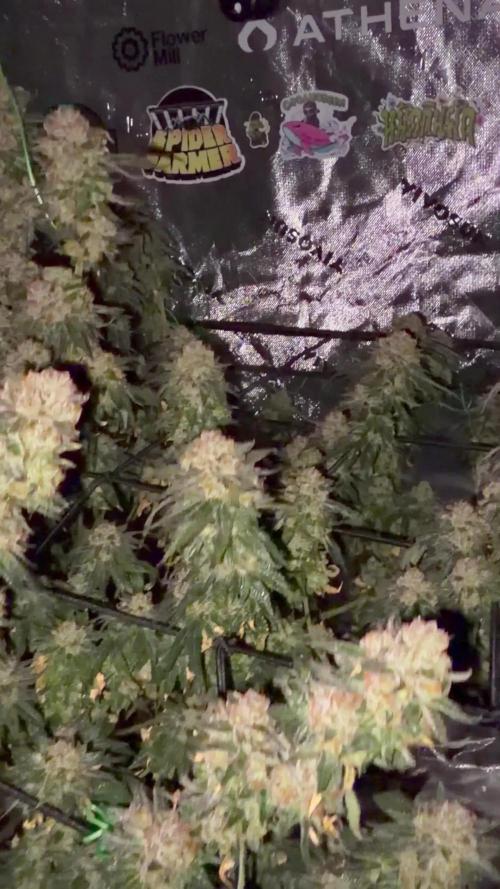
🌸 Week 9 – Late Bloom / Final Swell
This week was all about the final push before flush. Buds stopped stretching and focused on hardening — calyxes swelled, pistils began pulling back, and trichomes turned mostly cloudy with some amber popping in. Frost is heavy and the aroma is loud every time I open the tent ❄️🔥
Plant slowed down drinking a bit, which is usually the sign she’s getting close. Just kept temps steady and RH low to protect the final resin layer.
Excited to wrap up and start the flush next week 🌿✨


Likes
5
Share

@Chucky324
Follow
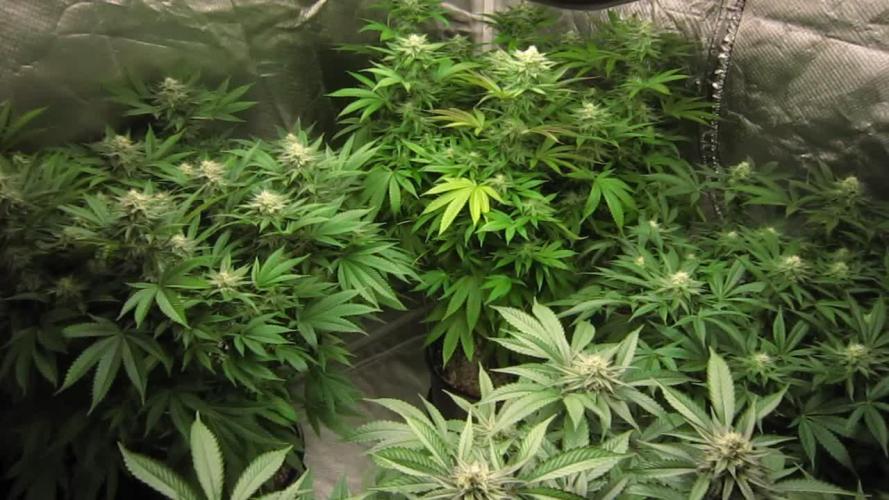
Hello. This is the end of week 5 and the beginning of week 6 of flowering.
It's going good in here. About 5 more weeks to go before harvest. And I flush for the last 2 week.
Starting to get some good resin flow going now, that's slippery to the touch.
Got some nice smells going on now with these girls. Sweet Citrusy Goodness.
They are getting a couple of watering's a week now. They are looking good.
Well we've come to the end of Weirdo #13. Hope it didn't offend anyone... it's only art!!!
I'll find something else to fill that spot for next week.
OK. Have Fun...
Chuck.



Likes
8
Share


@dauntless
Follow
10/15 Same stuff, just keeping it stable is all I'm trying to do.
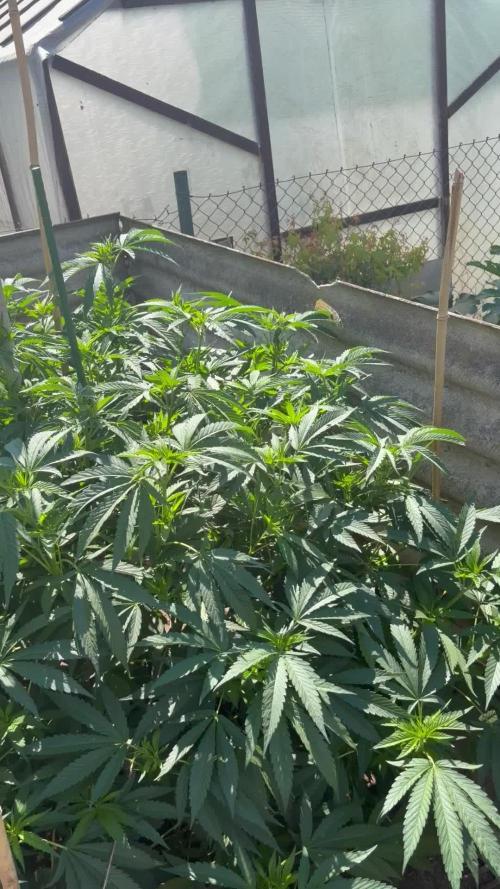
Update 10/18 - Heat was ridiculous this week, had to turn one or more light features off, for example, turned off the HPS -AND- the LED circuit on the Phlizon on the hottest day because inside the tent it was like 91 degrees F. Yeah it may not be the perfect environment, but look at the growth from the 15th til today. Major flowering happening, unless I am tripping. I see a lot more healthy growth now, which in my opinion means the transplant idea was SO WORTH IT. I see a lot of crystals forming now and the tops the leaves are turning more white that I could hav imagined -- with two more weeks at least to go, I think I may have some bomb flowers if I dont fuck anything up.
Northern light to the left in video has more to go and is not as far along as the Vanilla Frosting.
10/20 Added some new nutes for the last two weeks of flower, bubbling like a madman wanting this grow to finish. White Widow (three plants outdoors) will probably finish in the tent, its just really in stasis but it is getting some frosting of its own.
BTW when I smelled the flowers yesterday I was blown away by how awesome they smell, like seriously boutique top shelf aromas going on, this is my first grow indoors and really the first time I have been able to give the attention and care these babies need. I have learned SO much. Especially about stuff I was clueless about before. Like which lights are good. What tent size to get. Ph, nutes, watering, relative humidity, cloning... all new stuff. I have become a better gardener as a result and my 200 sq ft community garden plot is doing way better and I expect next year to be bonkers because I really get the whole ecosystem thing now and how mycorrhizae helps everything. This video helped me a ton: https://www.youtube.com/watch?v=ID9rE5JewVg&ab_channel=ApogeeInstrumentsInc. and this one too: https://www.youtube.com/watch?v=jq_wl8XRUK4&ab_channel=GrowersNetwork Also, really check out Phlizon lights (CREE COB) if your tent can handle the heat. I am already planning my next grow, and I am going high CDB autos... solomatic and fast eddy.
Likes
14
Share


@Smile_gan
Follow
This week
BCN start flowering stage.
Pineapple found little bit white hair on node that sign of female on a little plant size.
I decision to feed Flower Fuel and Myco+ to both BCN plant.
For Pineapple still feed same last week Fish hormone and Myco+
At this point i turn on 2x 100W LM301B again. So, Totally wattage increased to 440W


Likes
24
Share


@SkunkyDog
Follow
Hallo zusammen 🤙.
So das war es für sie.
Wir sehen uns in 3 Wochen mit dem Erntebericht wieder.
Bis dann
Rabattcode für den BIOTABS-Webshop https://biotabs.nl/en/shop/ GDBT420, damit erhalten Sie 15 Prozent

Likes
2
Share


Likes
5
Share


@CanarianGrow92
Follow
Week 3 for our gorilla cookies 🍪 from fastbuds 🍁
We removed the 2 lower branches and leaves. We gave some master root this week.
Some of the plants already showed the first preflowers, flowering is starting soon!
We also placed a net above just in case we need to sustain the buds in later flowering
Likes
26
Share


@Targona
Follow
Technical and general parameters of the breeder:
Auto Bruce Lemon Diesel produces large and powerful flowers and is known to produce a solid yield. The buds have amazing appeal and the frosty seeds can reach up to 20-25% THC under optimal conditions
• This is a strong and easy to grow autoflowering strain. It is a true hybrid that becomes compact to medium sized with relatively short internodes and massive flowers
• Bruce Lemon Diesel car has a strong and pungent fruity, Diesel dominant smell and taste. It has sweet and sour notes of oranges, tangerines and limes, making it a very complex terpene profile
• It is the combination of potency and yield that makes it an interesting strain for commercial growers. The quick seed harvest time of around 11 weeks is also handy. Expect a strong high that can hit pretty hard, its hybrid effect is long lasting and very enjoyable!
Bruce Lemon Diesel car has a strong diesel aroma with hints of jet fuel and oranges, the taste is quite sour and fruity with notes of citrus, tangerine and grapefruit
11 week life cycle
50% Indica 50% Sativa
Internal plant size: 75-100 cm
For cultivation I used:
Cultivation area: 80x80x180cm
1x circulation fan: 15W
LED lighting: Mars Hydro TS 1000 - 150W - vegetation and flowering 💡💡
Exhaust: pipe fan - RAMTT100
Odor filter: PRO-ECO HF carbon filter 160-240m3/h - 100mm - maximum air flow up to 240m3/h
4x textile flower pots 11l
Substrate:
Plagron Lightmix
perlite
coco coir
Thank you to all my friends who support me in growing, who give me advice - @Happy_Rakosnicek, thank you to my friends from Grow Diaries for likes, advice and support 😍❤️❤️
Many thanks to the Super Sativa Seed Club team, especially Johnny, for providing the sponsor seeds 🌱🌱😍
Thanks for the likes and you can follow me on Twitter 🐦: @ Targona666
Many thanks to Mars Hydro, specifically @Coco_Pan2022 for providing the Mars Hydro TS1000 sponsor light💡💡😉
Smoking Review:
I will add the buds after about 10-15 days of drying 💨💨


Likes
5
Share


@HelioCentricGrows
Follow
In flush, 2 smaller ones got cut and just got put into cure bucket. smaller stuff got pressed. 44g in 8.2g out
Likes
34
Share


@PEAKYPLANTERS
Follow
LADIES AND GENTLEMEN,
MASTERS AND BEGINNERS FARMERS!
MY WORK WITH THIS SUMMER LEMON IS FINISHED.
PLANT EASY TO GROW AND ENOUGH RESISTANT
MAINLY IN SATIVA.
HAPPY AND ABUNDANT HARVESTS FOR EVERYONE

Likes
35
Share


@gottagrowsometime
Follow
Welcome to my Alien Moonrocks Diary.
Have to say, out of all 3 plants from original sensible seeds. They have been the biggest, easiest plants I've ever grown. They don't demand much in the way of nutrients are really great growers. The stems that come off from the nodes are huge. And have nice flower points that will no doubt make for some great harvests. (Touch bud).
This lady has been ran off Terra Power and has loved the enzymes. The roots are practically coming out of all drainage holes at the end of the pot. The silca has really taken affect too make for really strong leafs and nodes that responsed really well to late LST. In her 1st week of pre flower she grew 13cm. I've been using my far red IR 730nm to increase the lighting time the plant is under and the change has been so rapid. Usually what takes the other females I grew, takes a week before I'd see pistils. Within 2 days I've seen pistils and well has came together really well.
All her flower sites on top & below they are all showing signs of sex and throwing it pistils.. can't wait to see her in a few weeks to see her true pedigree.
Shout out to my sponsors from mars hydro & Original Sensible Seeds, (reps) Much appreciated for your support and products guys.

Likes
21
Share


@Ultraviolet
Follow
Heyókȟa
I desire naught but the study of nature, to find my way back home.
12x12=144, A dodecahedron is a polyhedron with 12 faces, and in coordination chemistry, it refers to a geometry where ligands surround a central metal atom (in this case, Magnesium) in a specific, 8-coordinate arrangement. Dodecahedrane is a hydrocarbon, meaning it's composed solely of carbon and hydrogen atoms. The carbon atoms are arranged at the corners of a dodecahedron, a 3D shape with 12 pentagonal faces. The water molecules in the dodecahedron form hydrogen bonds that are individually slightly weaker than in either the dimer or the tetramer. However, because three-quarters of the O -H groups in the dodecahedron form hydrogen bonds, it has a more negative energy per molecule than has either the dimer or the tetramer. Magnesium (Mg2+) is the essential, central metal ion in the chlorophyll molecule, crucial for photosynthesis by enabling light absorption and energy transfer. It is chelated by four nitrogen atoms within the porphyrin (or chlorin) ring structure. Chlorophyll appears green because it reflects light in the green region of the visible spectrum, specifically between 490 and 570 nm. The main resonance electronic frequency of a neutral Magnesium (Mg) atom corresponds to the transition from the ground state to the first excited state. Resonance Line Wavelength of Mg2+: 285.1nm (UVB light). The central atom of the chlorophyll molecule is Magnesium (Mg2+), which is coordinated within a porphyrin ring. The electronic "resonance frequency" of this central atom—meaning the frequency at which its electrons absorb energy—is primarily driven by the electronic transitions (ETR) of the surrounding conjugated chlorin ring structure, rather than a discrete atomic transition of the Magnesium atom itself. The resonant electronic frequencies of the chlorophyll porphyrin (technically, a chlorin) ring are determined by the energy required to promote π-electrons within its conjugated system, primarily appearing in the blue and red regions of the visible spectrum.
In standard physics, Chloryphyll b has peak absorption at 460nm (Blue). If we take the peak wavelength 460nm and a UV-B, UVR8 peak absorption wavelength 285nm Tryptophan-285 (W285) Sensing protein. 460/285=1.618 Φ, "natural harmony" and the "structure of light". The cryptochrome photoreceptor (CRY) is a UV-A/blue light receptor that shares this dual sensitivity with several other biological structures and functions, including significant sequence similarity and a common evolutionary ancestor with DNA photolyase enzymes. These are light-activated enzymes that use blue/UV-A light to repair DNA damage caused by UV-B radiation in plants.
Dodecahedrane (C20H20) is a hydrocarbon with a cage-like structure where carbon atoms form 12 pentagonal faces (a regular dodecahedron). It is highly symmetric (icosahedral), contains no delocalized electrons (no aromaticity), and has minimal angle strain, but significant torsional strain. Water Dodecahedron (H2O) forms hydrogen-bonded cages. While individual hydrogen bonds in this structure are weaker than in the linear dimer or tetramer, it has a more negative total energy per molecule. This is because three-quarters (75%) of the groups are involved in hydrogen bonding, creating a very stable, closed-shell configuration. a 3D carbon hydrocarbon (C20H20) to stable water clusters in hydrate, while the Magnesium ion acts as the central activator within a conjugated ring in biological systems, with its electronic absorption dominated by the ring, not the atom itself.
Effective quantum efficiency of photosystem II, often denoted as ΦPSII
In horticultural lighting, adding 730 nm (far-red) LEDs alongside standard red/blue lights has been shown to increase canopy photosynthesis by 20–30% in several crops by acting synergistically with shorter wavelengths. However, the limitation is that excessive, pure IR/Far-red light (without accompanying red light) can trigger the "shade avoidance response," causing plants to grow tall, weak, and spindly rather than robust. Knowing is half the battle however, engineering or utilizing infrared light (specifically the 700-750 nm far-red range) is a viable method to boost photosynthetic efficiency. It acts as a bridge to allow PSII to utilize a broader spectrum of light, breaking the traditional 700 nm barrier.
Extend, then multiply.
UVR8-mediated signaling (often in conjunction with CRY proteins) triggers protective mechanisms that maintain the stability of the photosynthetic apparatus (including LHCII and reaction center proteins), thus ensuring that the efficiency of Photosystem II remains higher in UV-B-exposed plants compared to plants lacking this receptor. ΦPSII indictates the rate of electron transfer from water to plastoquinone, which drives the production of ATP and NADPH. There is a close link between ΦPSII and the true rate of CO2 fixation (Φ*co2), particularly in C4 plants.
Effective quantum efficiency of photosystem II, often denoted as ΦPSII, represents the proportion of light absorbed by Photosystem II (ΦPSII) that is actually used in photosynthetic electron transport. It is a key indicator of how efficiently a plant is using light for photosynthesis, as opposed to losing it as heat or fluorescence. ΦPSII (effective quantum yield of photosystem II) functions primarily as a "multiplier" (a coefficient of efficiency) rather than an additive factor when estimating the overall photosynthetic electron transport rate (ETR). Multipliers are considered far more beneficial than additions because they generate exponential growth, leverage existing resources to their full potential, and create sustainable, self-multiplying capacity, rather than just incremental, linear increases.
Humans, and most other mammals, rely on other mechanisms, such as nucleotide excision repair, to manage and repair UV-induced DNA damage. As such, humans do not have the direct, light-driven repair mechanism that photolyase offers in plants.

Likes
31
Share


@The_Bearded_Grower
Follow
Welcome to 📅 Day 64 5/17/2021. I am very happy with her progress so far and 4 weeks left till harvest and the Mars hydro TS 1000 💡 is doing its job like a champ 🏆.
stay tuned as I will update on thurs, till then happy growing and as always keep your stick in the ice 🏒
update:📅Day 67 5/20/2021 not much change but she is doing great and the TS 1000 is working like a champ
