


Likes
Comments
Share


@DogDoctorOfficial
Follow
she is moving so fast that i think next week will provably b the last one lets see, for now all i do is water and remove dry leafs , observe them trichomes and that's it, nothing else to do but enjoy my self looking at her.
Her color is full on finish and dnt think she will show any new ones, non so ever we can see reds, pinks purples, greens and a bunch more , smell do not at all, cant smell her, mb the rest is absorbing her smell but for now she is the one i grew with lest smell so far ... great for the ones that need discretion
not feeding at all anymore just plain water not even ph no idea should be around 7 .0 or something, its rain water <3 <3 <3
As always thank you all for stopping by, for the love you guys put in the community, in to growing and it all, i am blessed to walk among all of you and am blessed with it all.
Genetics :
AUTO SOMANGO GLUE @ ADVANCED SEEDS
All info and full product details can be find in can find @
https://aptus-holland.com/
https://advancedseeds.com/
https://autopot.co.uk/
https://lumatek-lighting.com/
#aptus #aptusplanttech #aptusgang #aptusfamily #aptustrueplantscience #inbalancewithnature #trueplantscience #growerslove #dogdoctoofficial
With true love comes happiness <3 <3 <3 Always believe in your self and always do things expecting nothing in return and with an open heart , be a giver and the universe will give back to you in ways you could not even imagine so <3 <3 <3
More info and updates @
https://growdiaries.com/grower/dogdoctor
https://instagram.com/dogdoctorofficial
https://youtube.com/channel/UCR7ta4DKLFMg2xxTMr2cpIg
<3 <3 <3 Growers love to you all <3 <3 <3

Likes
8
Share


@Aranseed
Follow
Mejor de lo esperado. No había trabajado nunca con el banco así que no sabía exactamente que esperar pero al momento de ir avanzando en el cultivo, pude apreciar que la planta tomaba una forma hermosa e incluso en las bajas temperaturas se comportaba bastante bien. Cpe bastante recomendable incluso para cultivadores noveles


Likes
14
Share


@Rangi_Kijani
Follow
Day 21 From Sprout - Rez Change
Overall, very happy with the development over this past week. The ones that were already looking good at now looking great!
The couple of “weirdos” (strange development of leaf/node placement) both have decent roots but are growing slowly.
The couple that initially were throwing out more “jagged” leaves seemed to have settled in and are looking good now.
Only 1 (back right corner) is iffy.
Roots are slowwwwly dropping out of the basket but not yet in the water. Going to keep
It around for now and see what happens.
Continuing with Mantis @ the “always” rate of 5 ml/L. They’re loving it!
Several of the “great ones” have 5-6 nodes developed, so I’ll top them back to the 3rd more and start training into a manifold since I’m going to give some of the others time to catch up. I’ll decide on training for them as we go.

Likes
13
Share


@TiiipsyTerpz
Follow
Another easy week. Topped at 4th node. and just continue watering with balanced water. Check out our sponsor at Mars-Hydro.com and use code CGD2021 for a discount.

Likes
3
Share


@Mr_nugs_lover_David
Follow
She looks beautiful, she's a beautiful autoflowering plant, very sweet aroma just like perfume. Love her, she's 100% healthy and producing very tasty flowers. Let's see how she keeps developing

Likes
8
Share


@romeoromeo
Follow
Growing strong and big 💪🏼🌱
Day 15, gave her tap water with bio bizz fertilisers, in the evening did some LST.
Day 16, continuing with the LST, growing strong and healthy 💚
Day 17, gave her only water, 0,5 ml, she is getting bigger 🤭😊

Likes
4
Share


@sjrseid
Follow
Some high-stress training was required. Fartbutt (the plant on the right) outgrew the container again, so I intentionally snapped the top to prevent further upward growth (I left it attached so it could still form a central cola.

Likes
38
Share

@Roberts
Follow
She did get huge, but she has some berry fruity smelly flower on her. Loaded with trichromes and looking like they will be dense and delicious. Thank you Athena, Spider Farmer, and Divine Seeds. 🤜🏻🤛🏻🌱🌱🌱
Thank you grow diaries community for the 👇likes👇, follows, comments, and subscriptions on my YouTube channel👇.
❄️🌱🍻 Happy Growing 🌱🌱🌱
https://youtube.com/channel/UCAhN7yRzWLpcaRHhMIQ7X4g.

Likes
9
Share


@Dthebudguy
Follow
Over all the plants are slowly growing been feeding smal doses of liquid seaweed and foopcanna veg
Likes
32
Share


@Hawkbo
Follow
Ok folks, gunna be one armed for another 6 weeks so I'm just the conductor the true heroes will go unseen. Everything is alive atleast, had a scare yesterday as things got so dried out everything went limp but an hour after feed turned back around. Noticed some yellowing and other coloring coming thru on alot of leaves so I bumped ppm up a little bit this last feed. They dont look like they have a deficiency, it's weird, they look beautiful but with a premature fade almost. I really like Green Buzz' line up/regiment I just have to dial it in which isnt easy since it's a multi strain crop and various size plants. It's very easy to use and makes me feel good knowing it's not poison. Did a minor leaf strip around the tent just to make things fit better. I'll copy and paste this to the diaries for the rest of the crop per usual but go into a little more detail on each plant individually. Pics and vids were taken on day 28 of flower. I'm trying to keep up with these as best I can from start to finish, the flip date was 6.10.19, today is 7.9.19.
Not much to report on these ones, they are growing pretty straight forward and doing very well. They have a great bud structure and #2 looks like it might have some fatties. Cant pick up the scent yet but the frost is comin.
My girl took all the pics, I took the vids and she took pics of me takin the vids and it gives a better indication of the size of the plants/tent. I'm 6'1 165 soakin wet for reference
Likes
4
Share


@DonSchmoekern88
Follow
Mehr Super Cropping
Pflanze für den Umzug in ihr Blüte Zelt vorbereiten 1x1 m


Likes
Comments
Share

@Sakub
Follow
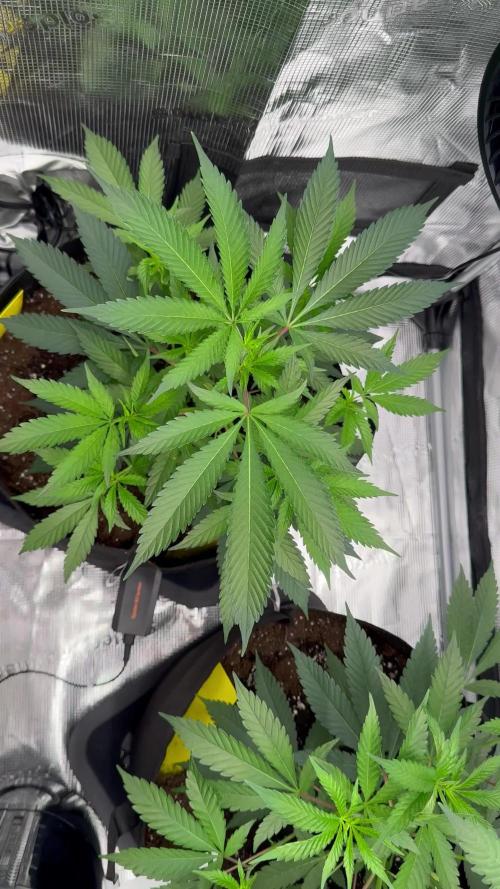
This week, I topped the girls for the first time. They’re still getting just tap water. I went from struggling with low humidity to dealing with high humidity, but the Spider Farmer dehumidifier solved most of the issues. Humidity still spikes for about 20–30 minutes after the lights go off, but after that, it’s all Gucci.

Processing
Likes
15
Share


@FishTankGrow
Follow
Baby Yoda is showing his ears. So cute.
Planted seed with 1/2” tap root on Thursday.
Sprouted on Friday.
Sunday 1” tall already!
Go Yoda.

Likes
18
Share


@bioaccessory
Follow
Hello!
Both plants are growing well, so I'm moving them to flower early next week.
Thank you for stopping by, and be healthy! 🙏
To be continued... 😶

Processing
Likes
8
Share


@Max1973
Follow
Day 35 - few pics and vids..... everything going along nicely 👍
This is a pretty big update, so i'll add to it over the next few days, as i
finish building it all....
i'm building these 2 x SS haze, the full tent, just finishing up the setup.....
trimming them, changing solutions to 12/12 and flower.....
changed the exhaust fan and filter setup to the better outside the tent method....
and installed 12v CPU computer fan, lol ("alta9" fits in 4in ducting perfectly), drops wattage on extractor fan.... 10w tops...
got a few kg of active carbon and making/replacing the carbon filter ....
i'll add afew vids of the new setup in afew days...
Day 36 - few pics/vid of new tent setup...... "alta 9" fan :)
post tomorrow after i finish trimmin and settin up night mode etc......
and into tomorrow we go, lol ... Day 37....
slowly getting there..... little bit more to go...
this should make things abit more interesting..... right tank (short babie) has : 19 lts of tap water @18oC + 150 ml -dutch master one gold FLOWER.... 6.4 PH - 1400 PPM
left tank has : 19 lts of tap water @18oC + 50 ml of elements a and 50ml of b and 10 ml of nitro and 20ml of Crystalic (molasses/pot) .... 6.5 PH - 1200 PPM
more pics / vids of the finished tent setup.... roots, transfer, etc... Day 37 is alot of vids of the clean and change to flower.....
edit - day after build noticed left tank (nutrifield) not enough bubbles..... pulled out the 4 air pump and swapped to the 2 x original oxipumps...
much better, also to fix the problem with ph goin high, and bubbles not stirin the mix, was to add another 10ml of crystallic and another 5ml of nitro...
then pumped both tanks with ph down and set em to 5.8-6.2 - both plants have fully recovered from the big trim, and bounced back within 12-24hrs,
post pics/vid in abit.....
Day 39 - made a freaky video... was curious about what the plants would see looking up at the lights...
the lights and buzzing of air compressors and bubbling tank water, and dazzling lights turned out pretty cool in vid editor,
was in selfie mode....
and final vid of the bounceback from trim :)
👍😎

Likes
Comments
Share


@andzzz
Follow
elongated stems made me worry, but they only needed little support
at day 3 I started spraying them every 2.5h with filtered water
Likes
2
Share


@Budhunter
Follow
Week 11 Flw - Day 77 flw - Day 133 of cycle
Jealousy is asking for harvest 😅 I had a closer look and smell it and I kind liked.. she is smelling a tangie/orange smell, with sweet citrusy.. buds are dense and heavy. It is gonna yield nicely(around 75-100g).. I am harvesting it in 5 days from now, as I will be away for few days and I will let it drying.
Let’s go 🙏🏼💪🏼✨

Likes
24
Share


@Dingle
Follow
Backing off the feeds a little now that they are coming into the final weeks of flower.
Did a good bit of defoliating this week to help get airflow to the lower areas.
Happy with the bud growth they are really starting to fatten up now.
Onto week 8! 😬✌️
Likes
15
Share


@DailyhighclubNLyara
Follow
What a beautiful week this was, jeez. The Daily High Club products really just make the environment so much better. You see that this is a really high quality light and the girls show that too. It’s so fun to see 3 same strain seeds performing soooo different from each other even when all the other factors are the same. We have the small one, which really looks funny and definitely not the way she should look. But hey I don’t want to break up the family. The middle sister is performing right on target, just as the books are saying she is performing like that. And then we have Olga, she doesn’t listen to the books she just has great genes 🍀 She is blessed with a strong stem and strong arms with more than 5 fingers humans has, she has 7! LOL
So anyway learning a lot with what to do and what not to, I’m trying to keep the temperature around 28C when the humidity is around 65-70%. In week 4 im going to decrease the humidity by 5%. I’m also giving 1 half table spoon of kind of molasses solution and they responded immediately after that with big growth.
Enjoy the pictures and see how these Mephisto girls perform in and under Daily High Club products!
