


Likes
Comments
Share


@Colo420
Follow
Todo marcha en orden, la floración interior va 10 puntos. A la de exterior le esta costando la adaptación por los excesivos calores 37°C.
Saludos a todos y gracias por las buenas vibras.


Likes
9
Share

@cangrowz
Follow
Ende Woche 7 / Anfang Woche 8 – Grow Diary Runtz Zamnesia 🍬
Die Buds haben sich in den letzten Tagen nochmal richtig gut entwickelt und legen ordentlich an Masse zu. Durch die sehr niedrige Luftfeuchtigkeit im Zelt musste ich kurzfristig handeln und hab mir einen kleinen Luftbefeuchter von Vivosun geholt – der erfüllt auf jeden Fall seinen Zweck und stabilisiert das Klima deutlich.
Ich werde sie jetzt wahrscheinlich noch ein letztes Mal düngen und danach nur noch etwa eine Woche mit Wasser gießen, bevor es für sie aus dem Zelt geht. Die Zielgerade ist also erreicht.
Nach der Ernte wird auf jeden Fall noch ein finales Ergebnis folgen 👀🔥
Das Rausholen aus dem Scrog wird wahrscheinlich nochmal interessant – denke ich werde sie Stück für Stück, Ast für Ast abschneiden.
Happy Growing Growmies 🌱?💚

Likes
11
Share


@Growing420Dreams
Follow
A principios de semana se aplico poda apical en las 6 plantas y ayer defoliación.
Likes
16
Share


@Esoteric_growing
Follow
Struggling a touch with cold temps at day and night but now swapped the 400mh for a 600hps for the last few days of veg to up temps a touch. Will initiate flower in a couple of days and all looks good.
Limited height room in this chamber so plants are a little smaller than I normally would have liked.


Likes
4
Share


@Gram_Solo
Follow
FastBuds - Gelato Auto x 1
Dry Weight - 2 ounce and 20.73 gram
I can definitely see an increase in weight and yield from doing the mainlining technique I would normally get around 1.7 oz of an auto If I hadn't done any training and not lollypopped and defoilated the plant.
Highly recommend this method to avoid clutter , little popcorn nugs and messy plants.
I thought I lost a plant to herm but I could have been wrong as I seen a diary on here that looked very similar to the one I Isolated and it turned out OK.
Smoked that one already and didn't hear any popping or cracking of seeds so she could have gone longer but I didn't wanna risk other plants turning.
Nugs are rock solid!
Gassy lemony smell!
Tried one last night as a tester and it was niiiiiice! Will try and let the cure begin before I raid the jars lol
Buzzing with results!
This was also a sample from FastBuds so good! 🙌🍦🍦🍦🔥🔥🔥
👊

Likes
25
Share


@Ultraviolet
Follow
Permanent Marker weed strain possesses the genetics for high anthocyanin production, which is responsible for its signature deep purple. While the genes are present, the expression of these colors is often enhanced by "thermal stress" (lower temperatures) during the final three weeks of flowering, which triggers the production of these pigments.
👋 Raising the Carbon-to-Nitrogen (C:N) ratio in the growing medium to avoid over-immobilizing nitrogen, on the flip side, being careful not to trigger early autophagy. Moderate, controlled increases in sugar support the energetic demands of flowering and act as a signal trigger, but excess sugar is more likely to inhibit flowering or damage the plant. Balance, like everything else. Visually, when the chloryphyll green gets darker, it is a subtle indicator that the concentration of nitrogen is increasing / more is being stored than is being used. I noticed when you push very high intensity lighting, it slowly fades the green as the plant degrades chloryphyll faster than it can be replenished. When the green of the leaf continually gets darker, it is an indication that the concentration levels of nitrogen are increasing, and I dont want to increase light intensity.
Turn down the nitrogen faucet. C:N ratio dictates the rate at which nitrification occurs, if at all.
The Carbon-to-Nitrogen (C:N) ratio acts as a critical biological "on/off switch" (or regulator) for nitrogen turnover by determining whether microbes
immobilize (consume/tie up) or mineralize (release) nitrogen during the breakdown of organic matter. This ratio regulates microbial activity by defining the balance between available energy (carbon) and building materials (nitrogen). The C:N ratio in a medium acts as a critical regulator of nitrification, effectively functioning as an "on/off" switch for the dominance of either autotrophic nitrifying bacteria or heterotrophic bacteria.
The shade of green in chlorophyll is subtly linked to the enzyme Rubisco through a co-evolutionary, functional relationship designed to optimize photosynthesis. Chlorophyll absorbs blue and red light for energy, reflecting green light, a process that ensures the "light-dependent" reactions provide the correct, controlled amount of energy (ATP and NADPH) needed by Rubisco to perform its "light-independent" carbon fixation. Because Rubisco is a relatively inefficient and slow enzyme—often considered the bottleneck of photosynthesis—chlorophyll and the overall structure of the leaf have evolved to manage energy distribution to prevent overwhelming the Calvin cycle.
While chlorophyll absorbs mainly red and blue light, it is not perfectly efficient, and leaves appear green because some green light is reflected or transmitted. This reflection allows light to penetrate deeper into the leaf, preventing the surface chloroplasts from becoming overloaded and enabling a more efficient distribution of energy to the high volume of Rubisco located throughout the leaf's mesophyll.
The rate of chlorophyll-driven electron transport (light reactions) is matched to the potential rate of carbon fixation (Rubisco activity). If Rubisco were faster, leaves might be darker; however, the "shade of green" represents a balance that prevents chlorophyll from producing more energy than the inefficient Rubisco can process. The green color itself is a byproduct of a photosynthetic system tailored to feed a slow, yet crucial, enzyme (Rubisco) just enough energy to maximize carbon assimilation without inducing excessive oxidative stress or inefficiency.
The shade of green in leaves is directly linked to the concentration of chlorophyll, which is in turn strongly correlated with the amount of
Rubisco (Ribulose-1,5-bisphosphate carboxylase/oxygenase) and, consequently, the rate of carbon fixation. Darker green leaves generally indicate a higher concentration of both chlorophyll and Rubisco, signifying greater capacity for photosynthesis.
Increase output or reduce input. Subtle tells.
While an excess of nitrogen (specifically ammonium) can cause an imbalance, nitrification—the microbial conversion of ammonia to nitrate—is highly sensitive to a variety of environmental, chemical, and physical factors. Because it depends on specific, slow-growing bacteria (Nitrosomonas and Nitrobacter) and archaea, anything that stresses these organisms can disrupt the process.

Likes
11
Share


@4F1M6
Follow
I started germination of 3 Gorilla Girl beans on 29/12/2020. I pre moistened my rockwool cubes with ph balanced water to 6.4. Made sure the plugs were just damp and not soaked. Using a small wooden dowel I increased the size of the plugs pre made holes. Than I sowed my beans into the holes. Ripped off a small piece of rockwool and mulched it up. Lightly filled the holes in with the mulched rockwool. Than stuck the plugs into a misted humidity dome, to complete germination.
Shouldn't take anymore than 4-5 days to see some sprouts. Once I see some cotlydon leaves bursting to the surface. I will get the plugs planted into some 1 gallon pots. Plus get these ladies situated into their home. Cant wait!
Some background information on my experience with Gorilla Girl. I've only grown this variety out once. Did her in a 1 gallon SOG grow and she was a beast! Fat Chunky main cola just loaded to the tits in trichomes. Amazing bud structre and a definite cut above alot of the genetics flooding the market.
I cant wait to let this variety loose in a larger scale grow. See what these powerhouse genetics really have to offer. Haven't grown out much sweet seeds stuff. But what I did test drive got there genetics into a larger setup. So caps off to them.

Likes
16
Share


@grow_prophet
Follow
6/12/22:
- today makes day 7 of flower/start of week 2
- no other updates besides massive growth the last week
6/13/22:
- tucked branches under net
- did some defoliation for air movement and expose bottom tops
6/14/22:
- refilled reservoir
6/15/22:
- ppfd 710 in center, 500-700 around edges, lights about 18 inches from canopy at 90%
6/18/22:
- refilled reservoir
- growth has been explosive with 1-2 inches a day.


Processing
Likes
7
Share


@MadeInGermany
Follow
Hi everyone 🤗.
The lady developed very well this week 😃.
Only she is a little more hungry than she got 😄 which is why she gets a little more of the Orcanic Grow Liquid from the next watering 👍😃.
Otherwise everything is going great.
I wish you a lot of fun with the update, stay healthy 🙏🏻 and let it grow 🌱
You can buy this Strain at
https://thecaliconnection.com/original-sour-diesel.html
You can buy this Nutrients at
https://greenbuzzliquids.com/
Type:
Original Sour Diesel ( Clone )
☝️🏼
Genetics:
Fem seeds- Original Sour Diesel to Original Sour Diesel BX3 RVSD Male
Reg seeds- Original Sour Diesel x Original Sour Diesel BX3 Male
👍
Vega lamp:
2 x Todogrow Led
Quantum Board 100 W
💡
Bloom Lamp :
2 x Todogrow Led
Cxb 3590 COB 3500 K 205W
💡💡☝️🏼
Soil :
Canna Coco Professional +
☝️🏼
Fertilizer:
Green Buzz Liquids :
Organic Grow Liquid
Organic Bloom Liquid
Organic more PK
More Roots
Fast Buds
Humic Acid Plus
Growzyme Big Fruits
Clean Fruits
Cal / Mag
Organic Ph - Pulver
☝️🏼🌱
Water:
Osmosis water mixed with normal water (24 hours stale that the chlorine evaporates) to 0.2 - 0.4 EC. Add Cal / Mag 2 ml per l water every 2 waterings . Ph with Organic Ph - Pulver to 5.8 .

Likes
11
Share


@Liamp1603
Follow
This grow cycle was one of my best from start to finish I had 5 females 4 of which were brilliant all shown colour all fruity gassy and amazing only the one was bland and green in colour and smelt different really good nug atructure but the smell wasn't there for me ... this is around my fifth grow and I'll be running these strains again to get it down to one pheno of these genetics

Likes
141
Share


@bioaccessory
Follow
Наступил мой самый любимый период цикла - период формирования структуры куста. К этому моменту обычно я уже имею стратегию по дальнейшим действиям: определяюсь с техниками тренировок, примерным сроком перевода светового режима на цветение, и т.д.
На 23-м дне сделал topping на 4-м этаже, и через три дня убрал всё ниже 3-го этажа. Верхние ветки развёл в стороны эластичными проволочками, нижний этаж пока не трогаю - пусть догоняет. 👆😊 И уже по-тихоньку мне нужно прикидывать высоту монтажа сетки.
А на какой высоте вы обычно ставите ScrOG? Буду рад любому мнению в комментариях 👍
Спасибо, что заглянули, и будьте здоровы! 🙏
Продолжение следует ...😶

Likes
8
Share


@CrowMaster
Follow
Gonna start flush this week….everything looking great…no problems this run I love it when they grow themselves practically

Likes
7
Share


@LegalGrowMyOwn
Follow
After 12 weeks of flowering and an incredible fragrance, I cut off the larger top blooms. The smaller ones that were covered will be given another 1-2 weeks to ripen.
Incredibly beautiful colors, pink-purple-green colored flowers
The larger fan leaves were quickly cut off. The scissors were covered in purple resin.
The wet flowers were carefully sorted into the drying net.
Now they can
be dried in the dark at 19°C and a humidity of 50-55%
Likes
8
Share


@Raizativa
Follow
Una fumada con toque cítricos, una volada de otro mundo (con moderación), cogollos densos.
Likes
5
Share


@Kinghaze
Follow
Week 4
They are looking healthy.
But one of the blue zlushi is looking weird, lets see how she develops.
I think next week i will top them and begin training.

Likes
9
Share


@Skinnytalls420
Follow
It’s look beautiful didn’t get very big but the buds are beautiful looks like it’s gonna be some sticky icky lost of crystals can’t wait to smoke it!!!

Likes
17
Share


@BioGrowKing
Follow
Die Woche ist sehr gut verlaufen ich konnte leider nicht so viele Bilder machen dafür mache ich nächste Woche wieder mehrere die Herchen stehen und überall ab und es beginnt auch langsam gut zu riechen Trichome sind auch auf dem Blätter
Ich habe Anfang der Woche noch mal 8 g Bio Blumen hinzugefügt
Und diesen Freitag auch ganz normal wieder enhancer zugefügt

Likes
20
Share


@The_Bearded_Grower
Follow
welcome to 📅 day 86 5/31/2021 harvest went great and now its all drying I will update in 3 days till then Happy Growing and keep your stick on the ice 🏒
Likes
6
Share


@GrapevineGrower2
Follow
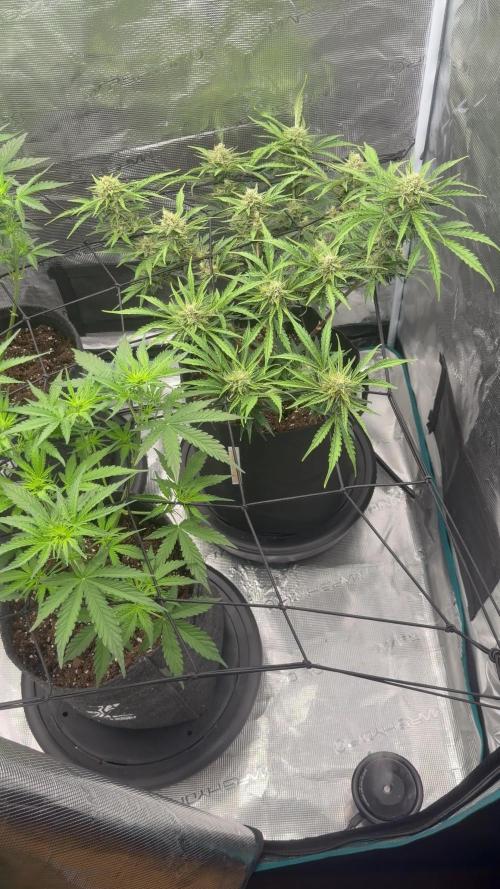
This week all 3 Pheno continue to stretch, which likely will continue through end next week (week 4 flower). Fed girls Recharge prior to defoliation at the end of week. Day and night tent temperatures were constantly between 78F and 65F degrees. Relative humidity a consistent 55%. Using an online calculator found VPD range from day 1.48 (kPa) to 0.95 (kPa) at night. About as closed to optimum as one can get given existing equipment/tools and recent substantial rain in the SoCal region. Due for watering tomorrow, so prior to, I will top dress with worm castings, compost, and Langbeinite 0-0-22. I believe this should carry the 3 through to harvest. Breeder flower time listed is between 56 and 70 days. We are at day 20 flower as of today.

