


Likes
Comments
Share


Likes
8
Share


@GrowingABushWithButch
Follow
NFSOT It's Day 08 For my 02 Kombucha Cream by atlasseed and it's Day 07 For my Snow White and SpliffStrawberry By Spliff Seeds Amsterdam . Last Night when I got Home from work I Blasted (Foliar Spray) all 04 Plants With Some F2 FOLIAR by Quad.Ag. I mix 1L Of Smart Water ph at 6.4 ppm at 146. This Morning was Feeding Day Kombucha Cream 02 and My Snow White received .5ml of Emerald Harvest Nutrients 2-Part Nutrients and 1ml of Quad.AG Products Fulonic Ph at 6.4 and I did a mistake on the video ppm is at 236 not 218. Now Kombucha Cream 01 and My SpliffStrawberry Received .5 of Emerald Harvest Nutrients 3-Part Nutrients and 1ml of Quad Ag Fulonic ph at 6.4 ppm at 346.All 4 Plant received about 100ml . On my next Feeding I will introduce them to the RootWizard and Hygrozym by Hygrozyme 4 Growers .
Happy Growing Growmies 🤘🏻


Likes
6
Share


@Lordviper28
Follow
All the girls looking good all have bud forming on their tops this strain has been really with no problems at all. All except one has staid short and bushy the one topped stretched up and fanned out real nice

Likes
15
Share


@Mazgoth
Follow
I'm only watering with just a ph all those days(writing this at D10) I will update it when I will start using nutrients
D12/14 I start using 0.5ml of nutrients

Likes
8
Share

@GERGrowDesigns
Follow
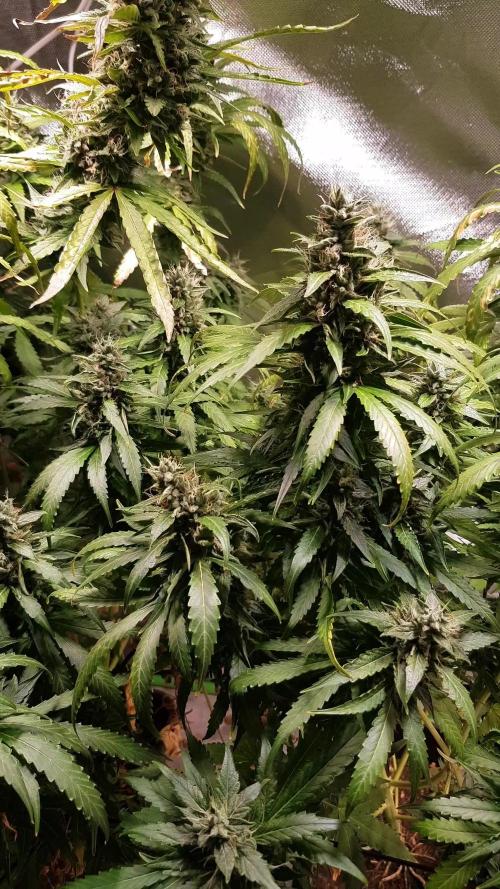
Got Big issues in this Grow Circle because of private Problems and time Problems, and this Strain performed anyway , great work fast buds will try it again ! Its almost died once and still Growed through Flower


Likes
7
Share


@SkunkyDog420
Follow
Hallo zusammen 🤙.
Sie wächst sehr schön und macht keine Probleme.
Rabattcode für den BIOTABS-Webshop https://biotabs.nl/en/shop/ GDBT420, damit erhalten Sie 15 Prozent

Likes
35
Share


@Fatnastyz
Follow
Welcome
First and foremost. Thanks you so much to Zamnesia, plagron and the Eternity Cup. So excited to start this competition everyone!
Gonna be a fun few months!!! 😁
1-18-25
Shook both seeds in some sandpaper. ( Pesky helmet heads). Dropped in some water with a dash of peroxide. Approximately 8am ish.
Every 4 hrs poke the seed down in the water.
( Wanna make sure she takes it.)
1-19
Approximately 24 hrs later. Shells are slightly cracked, just enough to see the white. But not quite a tail yet. This is where I like it.
Grabbed my hand 6 inch pot and filled it with Hp promix. Added 1/8th tsp Mammoth mykos.
Added 1 ounce of water in the center of the pot only. Around 1/4 inch hole, sprinkled with Mammoth ( just a dusting ).
Seeds planted. Dome placed.
See you on day 1
Lets GO!

Likes
19
Share


@Comfrey
Follow
Tropicana had to go back indoor because the temperature outside is the opposite of tropical. I took off two leafs and gave her time to relax after.
Everything is fine and I can already smell something when I‘m near to her. 🤭☺️
Where is the sun? Preparing for sun storm!


Likes
17
Share


@Wild_Satori_Forest
Follow
Well that wraps up the seed preservation run! It was a great learning experience as there were several major hurdles to get over the finish line, but nothing worthwhile comes easy. The seeds are available in my Etsy shop as long as I have stock. Thanks for the support from all of you!
Acapulco Gold Landrace Seeds: https://www.etsy.com/listing/1106636229/acapulco-gold-regular-cannabis-seeds8?ref=shop_home_active_1&pro=1&frs=1

Likes
29
Share


@Prilyfe13
Follow
April 26, 2024 Day 71
This week we focus on watering and nutrients. A secondary focus will be on a changing environment and light intensity changes.
Both ladies had their reservoirs cleaned out and have fresh nutrients. It's also the start of late flower, so things will be changing with the nutrient dosage. I'll most likely keep the nutrients the same for this week, but I may start to drop the dosage a little for each watering until the flush period starts. So depending on how they look, I may change the dosage for this week's last watering. I'll be bringing it down 25%. So 8 ml goes down to 6 ml and 4 ml goes down to 3 ml. I'll change this for the next 2 weeks until it's just plain water for 2 waterings and then Flawless Finish. It should play out quite well.
The lighting will also be changing a bit this week. I'll be dropping the DLI to 43 mol/m²/d mid week and will then lower it to 40 mol/m²/d beginning next week. I'll then drop it to 36 mol/m²/d the week after and finally 32 mol/m²/d for the final week.
The environment will also be dropped from 77° to 75° during the day and from 68° to 65° at night. The humidity is solid at 47% and I think that's the best I can do for the rest of the grow.
Both plants look great. They have tons of orange pistils and tons of trichomes. I'll be taking trichome pics every few days. One for each plant. I feel like it'll be a better comparison than daily pics. For the trichomes anyway. Anyway, they both still have time to swell their buds more. I'm not expecting big buds from these two. Medium sized maybe, but definitely not big. They just don't look like they will get that big.
Grow System Environment:
Temp: 74.2°
RH: 47.7%
VPD: 1.49 kPa
April 27, 2024
Almost all of the pistils are orange now on both plants, but the buds are still swelling. Interesting. I'll be taking trichome pics today at some point. I was going to yesterday, but got distracted with video games. Whoops. There's tons of trichomes. They are definitely frosty and continuing to get frostier.
Nothing much to do today. Each plant got an inspection and passed with flying colors. There were some loose tie downs as well. Mostly from the crowding in the tent. So those got removed.
Tropicana Cookies is looking super good now with her buds being everywhere and them swelling up finally. She could stand to get a few leaves taken off, but I'd rather just leave it alone now. No sense in undue stress.
Tropicana C also looks great. She has to be the biggest of the two. Not the tallest, but definitely the most girthy. Lots of buds and also starting to finally swell up.
I'd also like to mention the colors coming from both plants where the buds are nearly done. Lots of purple hues. You can't really see them from the small sugar leaves and frost covering it. But it's there.
The lighting as I said will stay the same for the first half of this week. Then I'll drop it. However, I may leave it to next week. We shall see.
The environment is looking pretty good. The temp is a bit high currently at 77.8°. the humidity is still at 47%, but I managed to get it down to 44% for most of yesterday afternoon.
The DLI is a bit high today at 1.66 kPa. Nothing a small adjustment won't fix.
Grow System Environment:
Temp: 74.5°
RH: 45.7%
VPD: 1.55 kPa
April 28, 2024
Not a lot going on today. I'll be refilling the reservoirs later this afternoon. That's about it.
I have a bit of a concern. Both ladies have really small buds, and I think they may have stopped swelling. I'm wondering if I have nutrient lockout or something. They are showing signs of stress. So I've already started dropping the nutrients down by cutting Overdrive in half as it seemed to have been the original cause of the nutrient burn. And the next watering will have all nutrients cut in half. Next week I'll drop it to 25% and leave it til flush, which may be next week anyway. We shall see.
Other than that, both plants are covered in trichomes. They smell wonderful as well. Like orange and some other light citrus and gas. Smells super good as well as sweet. There is also a hint of cookies.
The DLI will be dropped to 40 mol/m²/d tomorrow. I'm assuming it will only be a 10% drop on power, so I shouldn't lose much penetration.
The environment is off today. It's warm and super humid with bouts of rain. So naturally, the tent environment is all wonky. The temp is at 75.5° with the humidity way up at 60%. I turned the AC on and now it's just a matter of tweaking and waiting. I may have to crank it and sacrifice some temp for lower humidity. It should be fine that way, but the humidity is definitely too high.
Update: I ended up adding about a half gallon of plain water to both reservoirs. Just Incase I have nutrient lockout or something. They should go through that by tomorrow afternoon. Maybe late evening.
Grow System Environment:
Temp: 75.6°
RH: 52.8%
VPD: 1.39 kPa
April 29, 2024
No watering today. The plants are both still going through the half gallon of plain water from yesterday. Let's hope it clears up the nutrient burn.
They look great with their trichome coverage. The only thing I'm pretty disappointed about is the size of the buds for both plants. I wonder what I did wrong. I'm guessing the introduction to Overdrive was about 2 weeks too early. Removing the Big Bud was also a major mistake I think. It should have stayed in the mix for 2 more weeks. Lesson learned, make adjustments to any feeding schedule to match the plants growth stage. Maybe I'll ask that question.
The lighting was changed today. I dropped the power level down to 70% to get a DLI of 40 mol/m²/d. It's not perfect as the plants do not have level canopies, so some of the spots go all the way up to 45 mol/m²/d still. It's not a bad thing I think. The DLI was a bit high for those tops anyway.
The environment is still wonky. The temp is fine at 76° to 77°. A bit high from what I want, but not out of range. I'd still like it down to 75° or 74°. The humidity is what's out of whack at 60% and it doesn't seem to want to drop. I have a heater on to clear out the room humidity and a dehumidifier in the tent working it's hardest. Which isn't very hard. I believe the fans are going on it. It may be time for another one. Something the same size but more powerful.
Grow System Environment:
Temp: 74.2°
RH: 59.8%
VPD: 1.15 kPa
April 30, 2024
Watering day. Both ladies got their full gallon of nutrients. I'm going to cut it when it drains down some with plain water.
Both plants look good even though they have small buds. They are everywhere and seem pretty dense. So it's just a matter of time. Maybe another 2 weeks. Maybe less. Hopefully less. The nutrient burn was an issue, but now I think it's good. I dropped the Overdrive significantly, but I think I can plainly say, I have ruined my yield for these two plants. Lesson learned. Plain water at the first signs of stress.
The scent is super strong now and smells like oranges and candy. Or something like that. All I know is that it smells great.
The lighting is pretty good. No reaching yet, so it's definitely not too low. I may just leave it here for the rest of the grow. I read that lights don't need to be dimmed for autoflowers. It could be right. I've never dimmed the lights before. We shall see I guess.
The environment is still wonky with the humidity being high still at 57%. I can control the temp pretty easily, but the humidity will not budge. I'll keep trying.
Grow System Environment:
Temp: 75.5°
RH: 57.0%
VPD: 1.26 kPa
May 1, 2024
Nothing to do today with these two. No watering needed, no light changes, nothing.
I pulled them out, tooky pictures and checked them over. No issues pest or fungus or anything.
The only issue I have is the nutrient burn. Some of the leaves are getting yellow spots on them and frankly I have no idea what to do here. Keep the nutrients the same? Cut the nutrients down some over the next week or 2? Go with plain water? Not too sure. I still see many stresses. And I think that is the cause of my tiny buds. It seems that I did take the Big Bud out too early and added the Overdrive way too soon. Oops. Lesson learned with this run. I don't think it's a matter of an over abundance of nutrients, but the wrong ones at the wrong time when the plants weren't ready for it. I'm guessing that's what has happened here.
Both ladies smell fantastic. Super sweet and strong. Crisp, and not pungent. Refreshing even.
Tropicana Cookies has some pretty hard buds and lots of them. Of course, larger buds are preferred, but as long as these come out fire, I'll be happy. Her branches also seem to be holding up nicely.
Tropicana C on the other hand has weaker branches and the tallest top is starting to lean pretty heavily. A great sign for bud density.
Both plants have phenomenal trichome production. It's getting better everyday. Tons of clear with a mix of cloudy and amber, definitely not ready yet, but soon I think. Very soon. Maybe another week and a half? Maybe 2.
As I said before, I didn't change the lighting at all. It's current DLI is 40 mol/m²/d through most of the central canopy. The outside of the canopy is roughly 38 mol/m²/d. So it's all good now.
The environment is still wonky with the humidity being at 59%. It's maddening. The room is 49% and the temp is fine at 75°. I'll sacrifice up to 77° if I can get the humidity around 50%. Not ideal for this stage in life, but it will have to do of I can even get it there. I do have a large dehumidifier, but it doesn't work right. When the compressor shuts off, it blows are that humid air right back into the room. I need a new one.
Grow System Environment:
Temp: 75.2°
RH: 56.1%
VPD: 1.27 kPa
May 2, 2024
Not a lot going on today. No watering, no trimming, nothing.
I did change the light last night to 80% power.
Tropicana Cookies looks great! She has purple coming out all over her buds. No fade yet though. I can assume that will be coming through in the next week or so. Her tops buds are getting slightly fatter and heavier than before. I hope it will continue to do so over the next 2 weeks.
Tropicana C is slightly behind. She doesn't have nearly as many orange pistils and the purple is just starting to come through. However, she has tons of trichomes covering everything top to bottom. Her buds are about the same size as her sister, so they may end up swelling bigger than Tropicana Cookies when all is said and done. We shall see.
As I said earlier in today's post, I changed the light power from 70% back up to 80%. I think I dropped it too early and need to adjust it accordingly. I'll drop it again in a week or so. Maybe less. Now the DLI is at 43 mol/m²/d inside and 40 mol/m²/d on the outside.
The environment is still off, but not as much. The humidity continues to be high, but only at 55% verses the 60% it's been stuck at for the last few days. The temp is fine at 74.5°, but I think I can increase that a bit and hopefully drop the humidity down in turn.
Grow System Environment:
Temp: 73.7°
RH: 55.2%
VPD: 1.24 kPa
Likes
5
Share


@Deltatigrou0169
Follow
Salut salut les Amis
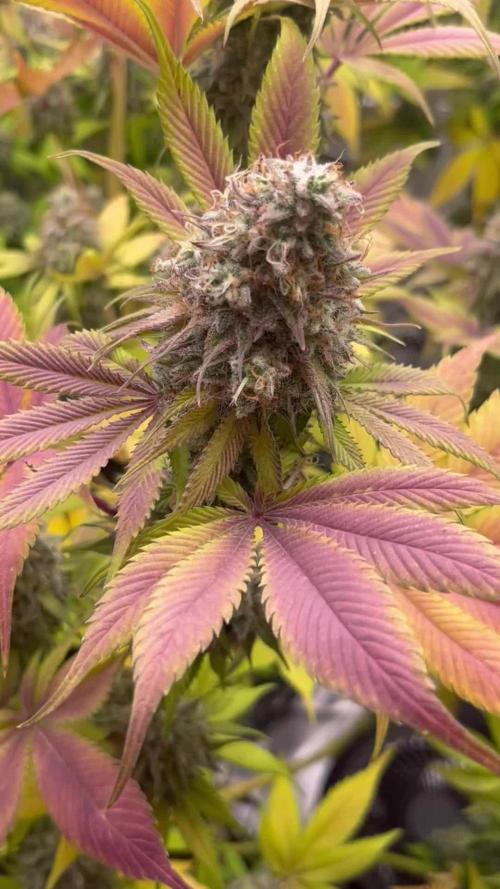
Nous voilà déjà à la fin du mois, mes fifilles viennent de passer en pré-floraison depuis vendredi je suis trop content de mes fifilles.
J'ai commencé à leur mettre de l'engrais (PRO ORGANIC Grow et Bloom) pour la pré-floraison.
Je mettrai le (Bloom Booster) pour la floraison.
Je vous souhaite une bonne soirée à tous et à dans deux jours 😉🙃🙃




Likes
19
Share


@GoldenWeedGrower
Follow
Legend
Timestamp: 📅
Measures: 🛠️
Water: 🌊
Actions: 💼
Thoughts:: 🧠
Events: 🚀
________________________________
📅 D08/V06 - 31/08/23
🛠️
🌊
💼
🧠 She's very fast 🚀
🚀
________________________________
📅 D09/V07 - 01/09/23
🛠️
🌊
💼
🧠 She's growing fast and short and it's just perfect
🚀
________________________________
📅 D10/V08 - 02/09/23
🛠️
🌊
💼
🧠 I'm thinking to change her home
🚀
________________________________
📅 D11/V09 - 03/09/23
🛠️
🌊 RES Changed 💦💦💦
💼 Home changed. Posed another RUNTZ auto
🧠
🚀
________________________________
📅 D12/V10 - 04/09/23
🛠️ EC 0.8 - pH 5.5
🌊
💼
🧠
🚀
________________________________
📅 D13/V11 - 05/09/23
🛠️
🌊 Added pure water
💼
🧠 Now she's growing better
🚀
________________________________
📅 D14/V12 - 06/09/23
🛠️
🌊
💼
🧠 The distance between th two girls is about 2 weeks, I need to keep in mind this difference alongside the grow cycle
🚀 Head of the little one is out, welcome😍

Likes
27
Share


@phobic94
Follow
DAY 33
Vandaag ben ik begonnen met bloei voeding. De plantjes zien er goed uit. Zou het verstandig zijn om wat bladeren te knippen ? graag hoor ik jullie mening alvast bedankt.
Processing
Likes
3
Share


@Reaper
Follow
March 3
Start of week 6
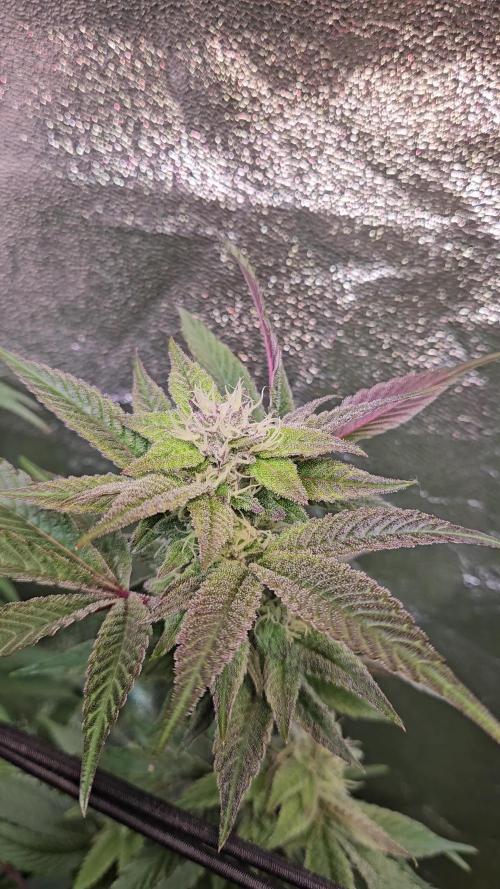
pistils turn brown already buds need to get fat now
march 7
buds start to swell now


Processing
Likes
13
Share


@Rambazamba
Follow
Die Woche ist die gute Weihnachtszucker-Glasur mehr und mehr geworden. Meine Damen fangen an Ihren Zucker mehr und mehr zu zeigen. Die ersten Haare färben sich auch langsam braun.
Ich musste die Woche wenig machen und habe mich beschränkt auf das gießen ohne Hesi um ihnen die Woche so angenehm wie möglich zu machen.
Die Temperatur ist super und ich muss sagen die LED überrascht mich immer noch sehr sehr stark.
Ich werde später noch Tagesaufnahme von den Pflanzen reinsetzen.
Ich kann manchmal gar nicht meine Augen von der natürlichen Schönheit der Pflanzen nehmen.
Ich wünsche alle einen schönen 1.Advent.

Likes
8
Share


@IQuSX
Follow
Hi, topman.
On the week was added red clips for bending, also realise solution of 35% refueling nutrients!
So, looking, please>>
Its has trichomes … I watch in full! They are have in second (AA rasty) too!
And, they are semi full adaptation after transplant from 0,7l in 25l.