The Grow Awards 2026 🏆
Likes
Comments
Share
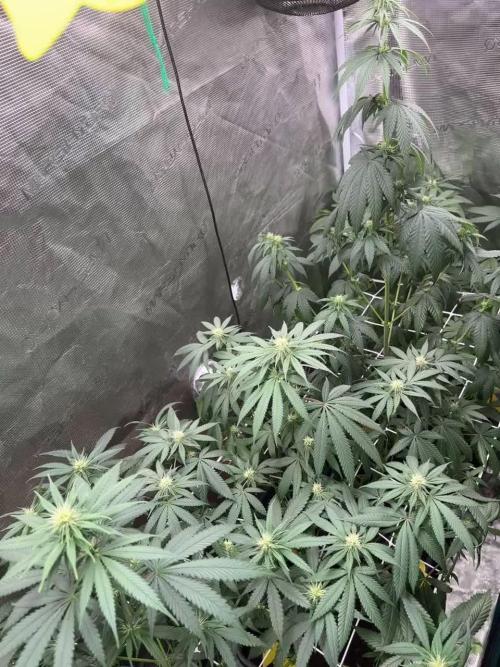
This week I pruned and defoliated heavy. Removed every fan leaf and removed everything before the scrog. I didn't get as horizontal as I would have liked but I'm hopeful I won't burn tops bcuz I'm close, lucky I have the light rail moving the light atotal of 3 feet back and forth allowing me to use more intense like but in spurts. Also the co2 bag and co2 bucket really seem to be helping. Topdressed with endgame and loaded up with basilus, activated em1, orca, great white, king crab, mammoth p, ohn, yucca, alow flakes, count powder, root wise poder and enzymes. Also weekly to every other week I make compost tea from boogie brew. All my water is treated with drops of balance and I also collect and use rainwater. I have an irrometer and run from 10 to 15 kps
Likes
56
Share
Day 63: Hi all , a productive week it has been this week. The #2 has been taken out for her 48hr dark period before trimming and drying. She jas so much frost onher dark purple and red buds now too. she will be trimmed later tonight so will post a few pics later. Gorilla girls #1 is so close to finishing now too. Her colours are starting really come through now she is maturing and her smell is so sweet and clearly pineapples too. Her yield should be ok bit being kept lower may have been a factor in her overall size. perfect for a low , cupboard grow. #3 is very close to #1 in terms of a finish, if only a few days behind . Shebis so much smaller but her finalnpushbjas bought her on par for the amount of decent sized buds that smell so sweet and are starting to brown off on the tops mainly. I won't rush her but she is close. #4 is still my sneaky favourite for appearance without doubt. She is so beautiful as a plant it will be a shame to cut her down. She is so covered in trichs now that she looks silver and red. At least another week I thinks to get the best from this lady. A brilliant example of genetics. Sweet cheese is also very close to her finish but at least a week jumping by the fresh looking pistils poking out all over her thick main. She stinks of fuel now too. I will be interested to see how much she yields compared to trained ladies. Well hopefully the next update will be to say they are all hanging to dry amd maybe 1 actually harvested. Until then . be safe and sane Growmies UPDATE. the #2 is now trimmed and drying....
Likes
Comments
Share
@A-C-H
Follow
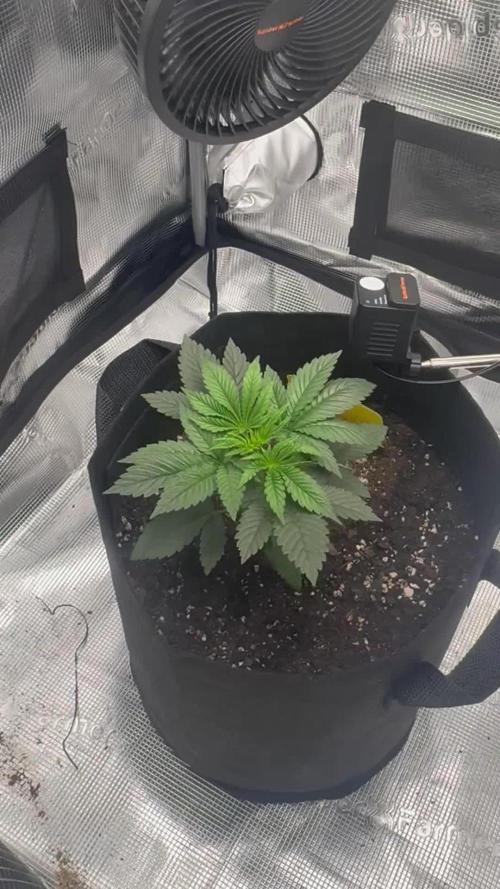
Ich habe sie vor 4 Tagen umgetopft. Sie scheint es zu mögen, die linke hinten ist etwas gelb, weil ich sie gestern umgetopft habe und sie in ihrem alten Topf mehr Platz hatte.
Likes
8
Share
@Kardo
Follow
Amnesia Haze XXL sieht bis jetzt sehr gut aus und hat eine sehr schöne Farbe die buds werden kräftiger
Likes
2
Share
Day 36- 20/6 General: She keeps growing at a very nice pace, flowering stage just started. Today I cut a good amount of foliage, and accidentally broken a nice branch while training her. It broke in a place I couldn't really 'cast it' so I had to let it go. I'm so sad, it was the first time ever. After some very hot days, now came rain, and an exponential increase of RH. Turned off the humidifier for now and still have peaks of 60% with light off and ventilation full on. But RH outside is 95%, so it's hard to do much better for now. Techniques: Training day, moved a little the stems and broke one in the very bottom, so had to discard it. Took some foliage away to get more light in it. Feeding: Fastening day Smell: She's still the queen of the tent when it comes to this topic, no doubts about it. Temps and RH recorded today: 26c - 20c 60% - 39% Pests and plagues: Nothing to record. Day 37- 21/6 General: She's gettin really taller this last days. Up is the way! Need to do a little more training tomorrow or the day after to make sure all the plant gets the same amount of light. Today I didn't touched her, just took some pictures and let her do her thing. The heavy rain brough 96% RH outside, so I had a little peak oh 70% inside the tent for an hour, but it kinda locked on the 62% with the lights off and extractor full on. Techniques: Nothing to record. Feeding: Later today, before lights on, she'll have her first feed with flowering nutes. 1250ml Smell: She's still the queen of the tent when it comes to this topic, no doubts about it. When you trim some foliage, it comes a nice passionfruit punch. So good I can't believe in it. For those who know Rubicon or Brisa passion fruit sodas, it's just like that. 😍 Now my biggest stress is keeping my girlfriend away from the grow and keep it closed, because she loves that smell and is constantly nosing around. Love it. Temps and RH recorded today: 27c - 21c 70% - 42% Pests and plagues: Nothing to record. Day 38 - 22/6 General: It's stretching season for #3. She really needs a bit of training before it starts full on, and some defoliation. After breaking a stem, I'm a bit traumatised and avoiding touching them for some days. I'm giving her water now for a couple days to see if it gets a bit better, looks like I was giving her a bit too many nutes for this stage. So, first let her dry a bit, then start with PH'ed water. Techniques: Nothing to record. Feeding: I'm giving her water now for a couple days to see if it gets abit better, looks like I was giving her a bit too many nutes for this stage. So, first let her dry a bit, then start with PH'ed water. Smell: Same same, nothing new to record. Temps and RH recorded today: 26c - 22c 62% - 41% Pests and plagues: Nothing to record. Day 39 - 23/6 General: This days I really haven't done much. I wanted to give them a week to be themselves, and see after what can I do to improve them, so this weekend I'll use some time to eventually start a Scrog training, If I'm still on time. She's looking good, but I'm afraid the time between them and the advance stage of #1 might not be the perfect condition to do this. Techniques: Nothing to record. Feeding: Only h2o, ph 6.5 Smell: Same same, nothing new to record. Temps and RH recorded today: 27c - 21c 60% - 37% Pests and plagues: Nothing to record. Day 40 - 24/6 General: Another day is gone, nothing new, keep giving her water and thinking about the ScrOG to make this more effective, as they start to fight for space in the middle of the grow. She's outgrowing #1 Techniques: Nothing to record. Feeding: Aqua vulgaris - A.K.A. - Tap water Smell: Same same, nothing new to record. Temps and RH recorded today: 28c - 23c 53% - 37% Pests and plagues: Nothing to record. Day 41/42 - 24-25/6 General: Big big stretch. Techniques: Nothing to record. Feeding: Aqua vulgaris - A.K.A. - Tap water Smell: Same same, nothing new to record. Temps and RH: 30c - 17c (26 average) 62% - 24% (43% average) Pests and plagues: Nothing to record.
Likes
31
Share
Had a lot going on this week so the plants didnt get any care or maintenance at all other than just checking on the water level a couple times. They need some major defoliation which I wanted to do this week but procrastination is the vibes currently. Will probably get some done next week.... the plants are looking good and most of them are bushing out pretty nice. They dont seem to be stretching as much as they normally do by this time, but they are transitioning to flower. Will probably do a flush and water change soon since they haven't had one in over a month. I'm just anxious to see some frosty buds at this point.
Likes
14
Share
July 3: Great week for new growth and plants are starting to send out first flowers. Big stretch on height. About another inch of rain (2.5 cm) this week and soil has plenty of moisture. Today saw some amazing clear sky and strong sun. Expecting the flowers to start stacking. Still need to mulch around the plants. First resin is skunky with a bit of burned rubber (?) - unusual yet appealing. Great structure and impressive vigor.
Likes
17
Share
@Dunk_Junk
Follow
So only 2cm vertical growth this week..... But she got a lot bushier!
Likes
13
Share
Likes
31
Share
Gente! Come abbiamo il miele millefiori, mi sono fatto anch'io un estratto setacciato con 20 varietà di ganja differenti..e direi che HASHISH 1000FLAWER È SPETTACOLARE ,come sapore e, effetto😂🤣😜
Likes
11
Share
Still vegging is a good sign that she can grow some more. Expect her to start Flowering soon. Excited to see what can be achieved by an Autoflower that survived frost and low sunlight hours although not expecting much yield. Will continue with biogrow and fish mix until she start flowering. Added some mulch on day 47. The increasing temperatures and African sun is dehydrating the soil too quickly and forms a hard layer which is a pain in the ass when I water.
Likes
6
Share
Week 12 Correct flowering. The light set-up (TS 1000 x 2) seems working well for this size of tent. The plants weren’t totally healthy when they started the flowering, just recovering from a stress period. Considering that: it’s not so bad for the moment. Some yellow leaves on the base and low branches. I gave more Cal/Mag during watering. The problem of burning leaves is resolved: may be the enriched soil gave enough nutrients and add more nutrients to boost growth was a mistake. Difficult to be certain about the cause of the stress period. Flo since 3 weeks : Sour Diesel and AK47 look more Sativa than the others: vertical stretch + long intermodal distance. Little flowers and pistils for now. Gorilla is not well developed but flowers are growing : producing amazing long pistils. Bubble Gum is a pretty plant, bushy with a regular canopy for a good flowering. Green Punch was the most shocked and hard to save so the flowering is on the way for this surviving plant. CaliFunk is definitely short and solid, with not so much ramifications. Pretty flowers growing.o one of the most advanced plant in the flowering process. Watering each 2 days = CalMag + Master Grower(Flo) = CalMag + PK 13/14 = CalMag + Nettle manure’s Sprayed week 11 a specific insecticide (ok for organic cultivation) against aphids ( Colza oil) and week 12 the nettle manure’s repulse aphids and nitrogen boost.
Likes
101
Share
@Ferenc
Follow
Day 73, 25th of November 2020: Hi! Well they are getting nice maturing buds getting bigger and all good. I love the red colour of the Red Hot Cookies. Unfortunately, Tropicanna Poison and Red Mandarnine does not show any signs of purple or red colour. Kalini Asia neither albeit, the bonsai version gets purple. Gelato is little beauty. So yes, basically not much to say. Fertilization is still the same every second day with the ratio and mixture above stated. The lamp is on 11.15 min and off 12.45 min. Last week was 15 min longer light cycle.... So every week 15 min shorter light cycle until the 5th week. So far -45 min. It switches on at 6 am and off at 17.15 pm.
Likes
56
Share
What's in the soil? What's not in the soil would be an easier question to answer. 16-18 DLI @ the minute. +++ as she grows. Probably not recommended, but to get to where it needs to be, I need to start now. Vegetative @1400ppm 0.8–1.2 kPa 80–86°F (26.7–30°C) 65–75%, LST Day 10, Fim'd Day 11 CEC (Cation Exchange Capacity): This is a measure of a soil's ability to hold and exchange positively charged nutrients, like calcium, magnesium, and potassium. Soils with high CEC (more clay and organic matter) have more negative charges that attract and hold these essential nutrients, preventing them from leaching away. Biochar is highly efficient at increasing cation exchange capacity (CEC) compared to many other amendments. Biochar's high CEC potential stems from its negatively charged functional groups, and studies show it can increase CEC by over 90%. Amendments like compost also increase CEC but are often more prone to rapid biodegradation, which can make biochar's effect more long-lasting. biochar acts as a long-lasting Cation Exchange Capacity (CEC) enhancer because its porous, carbon-rich structure provides sites for nutrients to bind to, effectively improving nutrient retention in soil without relying on the short-term benefits of fresh organic matter like compost or manure. Biochar's stability means these benefits last much longer than those from traditional organic amendments, making it a sustainable way to improve soil fertility, water retention, and structure over time. Needs to be charged first, similar to Coco, or it will immobilize cations, but at a much higher ratio. a high cation exchange capacity (CEC) results in a high buffer protection, meaning the soil can better resist changes in pH and nutrient availability. This is because a high CEC soil has more negatively charged sites to hold onto essential positively charged nutrients, like calcium and magnesium, and to buffer against acid ions, such as hydrogen. EC (Electrical Conductivity): This measures the amount of soluble salts in the soil. High EC levels indicate a high concentration of dissolved salts and can be a sign of potential salinity issues that can harm plants. The stored cations associated with a medium's cation exchange capacity (CEC) do not directly contribute to a real-time electrical conductivity (EC) reading. A real-time EC measurement reflects only the concentration of free, dissolved salt ions in the water solution within the medium. 98% of a plants nutrients comes directly from the water solution. 2% come directly from soil particles. CEC is a mediums storage capacity for cations. These stored cations do not contribute to a mediums EC directly. Electrical Conductivity (EC) does not measure salt ions adsorbed (stored) onto a Cation Exchange Capacity (CEC) site, as EC measures the conductivity of ions in solution within a soil or water sample, not those held on soil particles. A medium releases stored cations to water by ion exchange, where a new, more desirable ion from the water solution temporarily displaces the stored cation from the medium's surface, a process also seen in plants absorbing nutrients via mass flow. For example, in water softeners, sodium ions are released from resin beads to bond with the medium's surface, displacing calcium and magnesium ions which then enter the water. This same principle applies when plants take up nutrients from the soil solution: the cations are released from the soil particles into the water in response to a concentration equilibrium, and then moved to the root surface via mass flow. An example of ion exchange within the context of Cation Exchange Capacity (CEC) is a soil particle with a negative charge attracting and holding positively charged nutrient ions, like potassium (K+) or calcium (Ca2+), and then exchanging them for other positive ions present in the soil solution. For instance, a negatively charged clay particle in soil can hold a K+ ion and later release it to a plant's roots when a different cation, such as calcium (Ca2+), is abundant and replaces the potassium. This process of holding and swapping positively charged ions is fundamental to soil fertility, as it provides plants with essential nutrients. Negative charges on soil particles: Soil particles, particularly clay and organic matter, have negatively charged surfaces due to their chemical structure. Attraction of cations: These negative charges attract and hold positively charged ions, or cations, such as: Potassium (K+) Calcium (Ca2+) Magnesium (Mg2+) Sodium (Na+) Ammonium (NH4+) Plant roots excrete hydrogen ions (H+) through the action of proton pumps embedded in the root cell membranes, which use ATP (energy) to actively transport H+ ions from inside the root cell into the surrounding soil. This process lowers the pH of the soil, which helps to make certain mineral nutrients, such as iron, more available for uptake by the plant. Mechanism of H+ Excretion Proton Pumps: Root cells contain specialized proteins called proton pumps (H+-ATPases) in their cell membranes. Active Transport: These proton pumps use energy from ATP to actively move H+ ions from the cytoplasm of the root cell into the soil, against their concentration gradient. Role in pH Regulation: This active excretion of H+ is a major way plants regulate their internal cytoplasmic pH. Nutrient Availability: The resulting decrease in soil pH makes certain essential mineral nutrients, like iron, more soluble and available for the root cells to absorb. Ion Exchange: The H+ ions also displace positively charged mineral cations from the soil particles, making them available for uptake. Iron Uptake: In response to iron deficiency stress, plants enhance H+ excretion and reductant release to lower the pH and convert Fe3+ to the more available form Fe2+. The altered pH can influence the activity and composition of beneficial microbes in the soil. The H+ gradient created by the proton pumps can also be used for other vital cell functions, such as ATP synthesis and the transport of other solutes. The hydrogen ions (H+) excreted during photosynthesis come from the splitting of water molecules. This splitting, called photolysis, occurs in Photosystem II to replace the electrons used in the light-dependent reactions. The released hydrogen ions are then pumped into the thylakoid lumen, creating a proton gradient that drives ATP synthesis. Plants release hydrogen ions (H+) from their roots into the soil, a process that occurs in conjunction with nutrient uptake and photosynthesis. These H+ ions compete with mineral cations for the negatively charged sites on soil particles, a phenomenon known as cation exchange. By displacing beneficial mineral cations, the excreted H+ ions make these nutrients available for the plant to absorb, which can also lower the soil pH and indirectly affect its Cation Exchange Capacity (CEC) by altering the pool of exchangeable cations in the soil solution. Plants use proton (H+) exudation, driven by the H+-ATPase enzyme, to release H+ ions into the soil, creating a more acidic rhizosphere, which enhances nutrient availability and influences nutrient cycling processes. This acidification mobilizes insoluble nutrients like iron (Fe) by breaking them down, while also facilitating the activity of beneficial microbes involved in the nutrient cycle. Therefore, H+ exudation is a critical plant strategy for nutrient acquisition and management, allowing plants to improve their access to essential elements from the soil. A lack of water splitting during photosynthesis can affect iron uptake because the resulting energy imbalance disrupts the plant's ability to produce ATP and NADPH, which are crucial for overall photosynthetic energy conversion and can trigger a deficiency in iron homeostasis pathways. While photosynthesis uses hydrogen ions produced from water splitting for the Calvin cycle, not to create a hydrogen gas deficiency, the overall process is sensitive to nutrient availability, and iron is essential for chloroplast function. In photosynthesis, water is split to provide electrons to replace those lost in Photosystem II, which is triggered by light absorption. These electrons then travel along a transport chain to generate ATP (energy currency) and NADPH (reducing power). Carbon Fixation: The generated ATP and NADPH are then used to convert carbon dioxide into carbohydrates in the Calvin cycle. Impaired water splitting (via water in or out) breaks the chain reaction of photosynthesis. This leads to an imbalance in ATP and NADPH levels, which disrupts the Calvin cycle and overall energy production in the plant. Plants require a sufficient supply of essential mineral elements like iron for photosynthesis. Iron is vital for chlorophyll formation and plays a crucial role in electron transport within the chloroplasts. The complex relationship between nutrient status and photosynthesis is evident when iron deficiency can be reverted by depleting other micronutrients like manganese. This highlights how nutrient homeostasis influences photosynthetic function. A lack of adequate energy and reducing power from photosynthesis, which is directly linked to water splitting, can trigger complex adaptive responses in the plant's iron uptake and distribution systems. Plants possess receptors called transceptors that can directly detect specific nutrient concentrations in the soil or within the plant's tissues. These receptors trigger signaling pathways, sometimes involving calcium influx or changes in protein complex activity, that then influence nutrient uptake by the roots. Plants use this information to make long-term adjustments, such as Increasing root biomass to explore more soil for nutrients. Modifying metabolic pathways to make better use of available resources. Adjusting the rate of nutrient transport into the roots. That's why I keep a high EC. Abundance resonates Abundance.
Likes
39
Share
a bit of nut burn on tips, nothing to worry about that, healthy as water, trichomes starting to develop stronger day by day, next week i expect to see some litlle leafs covered with thrics. Smell is stronger Regards, AlgarvP.
Likes
34
Share
@Aleks555
Follow
Chimera Cut - Anesia Seeds 124 days of growth and 76 days into flowering, and we’ve finally reached the moment we’ve been waiting for—harvest time! This beauty has exceeded all our expectations with massive buds covered in resin, emitting an intense aroma and showing off an incredible blue hue, exactly like the photo on the seed pack. We couldn’t be happier with the results! We decided not to weigh the wet buds; we’ll wait until they’re dried to get the final dry weight, but we’re confident it’s going to be impressive. A massive thank you to Xpert Nutrients for their outstanding support, top-notch service, and, most importantly, their amazing fertilizers that have allowed us to grow such powerful plants year after year. Without a doubt, your products are the key to our success. An equally huge thanks to Anesia Seeds for providing such incredible genetics. We are beyond satisfied with the results, and we can’t wait to grow more from your amazing seed collection in the near future. Oh, and we’ve already sampled the smoke—this strain is exceptionally strong and flavorful. From the very first hit, it’s clear you’re smoking something premium, top-shelf quality. Truly a connoisseur’s delight! Thank you again to Xpert Nutrients and Anesia Seeds for making this journey so rewarding!🏆
Likes
34
Share
Not much to say at the minute but Candyman is looking happy, I really hope they are female now 🤞🏻 added a small amount of Nutrients and already seems to be loving it and getting bigger daily 😍
Likes
290
Share
@Ferenc
Follow
I decided to place in the tent after 6 weeks. I did LST as well. So it will be half outdoor half indoor. Basically I planted a Auto outside but I can see it ain't gonna be a good yielder. So I should wait till autumn and also that time there is much less sun so I would not have nothing on it. I dont wanna take a risk for nothing so better to boost artificially and have better yield. Day 46: I needed to.cut back she was wilt stressed in the new environment. I removed almost all the fan leaves.
Likes
13
Share
Likes
8
Share
@LoudLemon
Follow
Wish I had left her at least another couple days however all of a sudden their became a sudden need to harvest asap unfortunately, never the less she was well into her finishing stage and and has been an amazing journey with her from start to end!
Likes
53
Share
@buddha61
Follow
6/17 - Watered today. 5 days since last watering. Made sure to add water slowly to the cups, as the medium I'm using is a coco/peat based medium, and I realize that peat becomes hydrophobic when it dries out, and the top was close to that. By watering pretty slow, it allows more of it to be absorbed vs just running through. Both Dreamcatcher plants have 2 nodes developed and are starting on their third nodes (slightly behind the Chinook Haze also being grown in the tent). 6/18 - I watered yesterday, then life hit, and the plants were without lights for just over 24 hours. Looks like the newer area started to yellow a bit, which I assume will green again within a day or two now that the lights are back on. 6/19 - Plants are looking good to me. There seems to be a lot less vein swelling, so it appears the chance of overwatering that looked like it was coming on a week ago is subsiding. Got to let them grow some more before I start to chop them up in an attempt to mainline. 6/21 - Plants will be watered tomorrow. Other than that, it is just slowly moving along, and I am considering going to 1g pots soon. I believe I am going to try to go from solo cup to 1g to 5g this time, and I think that by doing so, I might not need to fertilize at all during veg at least. I figure if I can get 3-4 weeks out of the solo cup, then similar out of a 1g, by the time I get to 5g, I will be close to 8-12 weeks, and close to flipping time. I have dimmed the lights a bit, and raised them close to 35" above the 2 Dreamcatcher plants in hope to induce a little stretch between nodes, but they still seem to be growing fairly compact. 6/22 - Watered the plants today. Could have probably waited another day, but I figure 5 days between watering was enough, and the cups did feel pretty light.