


Likes
Comments
Share


@AsNoriu
Follow
Day 71. Biggest by size, but maybe not by overall weight of harvest ;)))) she is most hungry and lost foliage...
This girl definetly makes me regret, that i didn't use any nutes ...
Smell is weakish, worst from all 3 .
Mars TS1000 did a great job to her during veg, but now she spends time under my quantum board.
Took most damaged leaves away.
3.5 liters of water goes in.
Day 76. 3.5 liters in. Lower part is far from maturity, she needs like 3 weeks still i think. Getting some funky colours ...
Happy Growing !!!

Likes
4
Share


@captaincondor
Follow
I have just been giving her plain water the past few feedings and am planning on harvesting her on tuesday which will be day 67 from seed which is very impressive . I think grown in coco under the spider farmer it would probably be even quicker , also finally a strain that has lived up to its name and actually gone purple whoopee. I am looking forward to trying this when its dried and cured !!! . This seems to be an awesome strain and I am very impressed with the size and density of the buds and the growing time

Likes
9
Share


@Jackweed77
Follow
La zenization della sweetseed è ormai pronta...oggi più tardi farò un controllo con microscopio per vedere lo stato delle cose e decidere de raccogliere o dare lei ancora qualche giorno...

Likes
75
Share


@Dedon
Follow
Happy New Year everyone !
Flo + 58
i'll start flushing this week end and cut them around 12/13 january, there is a strong smell inside the box ^^ it's so pleasant, i'm so impatient to chop them 😁
See you next week !

Processing
Likes
9
Share


@russrahl
Follow
Girls are looking great so far! I added about 2ml/g to the reservoir and the plants responded well. Got a good explosion of growth over the last few days. I was able to start LST training the largest of the 4 today and the other 3 will be a day or 2 until they will be ready to start LST. Had some Ph issues during week 4 because my pen decided to go wonky. I tried to calibrate it again and had a hard time. So I busted out an older one and decided to calibrate it and see if it worked still... calibrated in a few min and sure enough res ph was well bellow 5. So water was changed as it was time anyway and ph’d proper just before lights out so we will see what happens tomorrow.

Likes
25
Share


@Jimmy89
Follow
Nothing much to report this week, I expect there to be more progress next week. All I have done is taken a few leaves off and watered with de chlorinated water at 6.5 ph

Likes
36
Share


@Salokin
Follow
This week Went very uneventful. Reduced the fertilizer down to 600ppm and flushed twice on Wednesday and Thursday, on Wednesday I still had 100ppm in the tank after the second flush it went down to 0. Kept her in darkness until Friday night and then started chopping her down.

Likes
6
Share

@GoodTimesOrganics
Follow
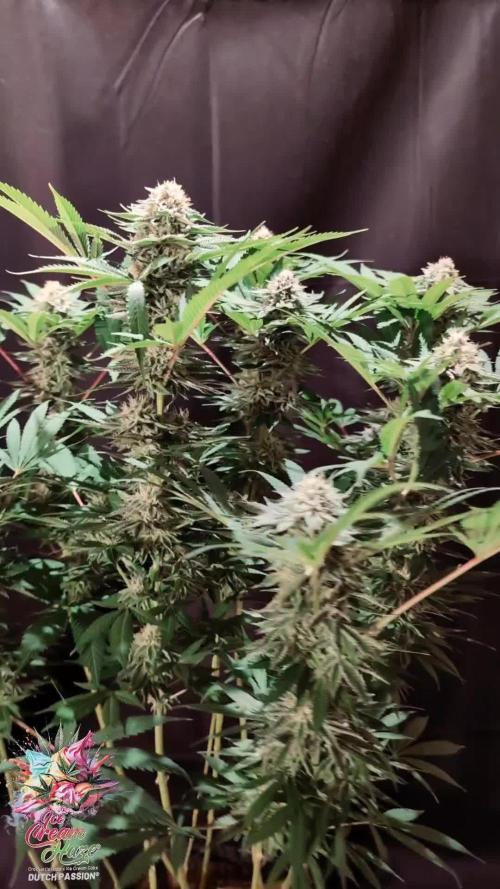
Hi liebe Community! 💚 Nach der fünften Blütewoche schreitet dass Blütenwachstum richtig vorran!
Ein Dichter Tepich aus Stigmen überzieht die Blütenansätze und es bilden sich sehr viele richtig Trichome aus, was der Pflanze einen unfassbar schönes frostiges Aussehen verleiht.
Die Blütenstruktur zieht sich nun den Großteil des Stammes entlang und es entsteht ein dich besiedelter und immer dicker werdender Blütenteppich.
Dies Woche kam zum Boostern der Pflanze noch der Biotabs PK Booster Compost Tee zum Einsatz, welcher sich meiner Meinung nach bei einem soliden Organics Grow nicht mehr weg denken lässt.
Hierzu muss auch gesagt werden dass sich die Blüten sehr rasant entwickeln.
Die Buddichte beträgt bereits 7 cm an der dicksten Stelle.
Insgesamt ist die Pflanze sehr Vital und hat eine sehr schöne und geradlinige Blütenstruktur😉
Sie liefert eine sehr gute Performance ab
Die Wachstumsbedingungen im Growzelt sind weiterhin am Optimum und Stabil:
———————
🌞 Temp: 24,3°C
🌚 Temp: 20 °C
💨 RH: 56%
VPD: 0,97 kPa
😎PPFD: 830 mqm
———————
Stay Tuned! 💚


Likes
379
Share


@yan402
Follow
🌸🍏✨🍭🌸🍏✨🍭🌸🍏✨🍭🌸
Hi and welcome to another Kannabia grow!
This time I’m running their Apple Fritter (feminized photoperiod). She’s going to veg under 24hr light and manifolded.
Still cleaning the rest of my Candy Cream GF (11.04.25) going to sow the seed tomorrow (12.04.25)
*been lazy, sowed on 14.04.25
🌸🍏✨🍭🌸🍏✨🍭🌸🍏✨🍭🌸
💭❗💭❗💭❗💭❗💭❗💭❗💭
❗Events & thoughts worth noting❗
💭❗💭❗💭❗💭❗💭❗💭❗💭
12.04.25 (GW1) Cleaning flushing the old coco coir, might need to add another brick, *no new brick needed✅.
This is how I recycle my coco coir — fast, cheap, no BS.
🌿 Harvest plant
✂️ Chop roots small — they stay in for structure (organic perlite)
💦 Hot water rinse — remove salts & dust
🍶 Pre-soak with light feed:
Micro 10ml Bloom 0ml GreenBuzz 10ml Cal-Mag 60ml FPJ 10ml pH down (citric acid)
♻️ Media stays — Roots stay — Back in service.
14.04.25 (GW1) Plant seed in final pot✅
16.04.25 (GW1) Did last tent clean up and setup✅📸
17.04.25 (GW1) Seed germinated 🎉📸, very good, took roughly 48hrs directly in final pot👌♥️
23.04.25 (VW1) Minimal burnt tips📸 not serious enough to investigate as it's not progressing.
💭❗💭❗💭❗💭❗💭❗💭❗💭
🌱💦🌱💦🌱💦🌱💦🌱💦🌱
🌿 Day to day tasks & actions 🌿
🌱💦🌱💦🌱💦🌱💦🌱💦🌱
20.04.25 (VW1) no water no feed.
21.04.25 (VW1) 1l of #1
22.04.25 (VW1) 1l of #1
23.04.25 (VW1) 1l of #1
25.04.25 (VW1) 5l of #1, 40% runoff used for tomato plants
26.04.25 (VW1) 5l of #1, 40% runoff used for tomato plants
🌱💦🌱💦🌱💦🌱💦🌱💦🌱
🍶💧🍶💧🍶💧🍶💧🍶
💧Nutrients in 30L #1💧
🍶💧🍶💧🍶💧🍶💧🍶
💧 TriPartMicro: 10ml (0.33ml/L)
🍶 TriPartGrow: 0ml
💧 TriPartBloom: 0ml (0.00ml/L)
🍶 GreenBuzzBloom: 10ml (0.33ml/L)
💧 Cal-Mag: 60ml (2.00ml/L)
🍶 Homemade FPJ (veg): 10ml (0.33ml/L)
💧 pH Down: citric acid (buxXtrade)
🍶TOTAL: 100ml (3.32ml/L)
💧🍶💧🍶💧🍶💧🍶💧🍶💧🍶
⚙️✂️⚙️✂️⚙️✂️⚙️✂️⚙️
✂️Tools & equipment✂️
⚙️✂️⚙️✂️⚙️✂️⚙️✂️⚙️
✂️ 2× MarsHydro SP3000
⚙️ MarsHydro 150mm ACF Ventilator
✂️ Trotec dehumidifier (big unit)
⚙️ Mini no-name dehumidifier
✂️ Kebab skewers (LST – stainless)
⚙️ Wire + roast skewers (LST assist)
✂️ Scissors (HST)
⚙️ Vacuum (for spills & cleanup)
⚙️✂️⚙️✂️⚙️✂️⚙️✂️⚙️
🍏🍪🌬️🍬🍏🍪🌬️🍬🍏🍪🌬️🍬
Apple Fritter (Kannabia Seeds)
🍏🍪🌬️🍬🍏🍪🌬️🍬🍏🍪🌬️🍬
Species: 50% Indica / 50% Sativa
Genetics: Sour Apple x Animal Cookies
THC: Up to 25%
Effect: Euphoric, relaxing, creative
Flavor: Sweet, fruity, pastry notes
Flowering: 56–63 days
Resistance: High
Indoor yield: 450–500g/m²
Outdoor yield: 600g/plant
Structure: Strong, bushy, dense buds
🍏🍪🌬️🍬🍏🍪🌬️🍬🍏🍪🌬️🍬


Likes
7
Share


@jackenimbs
Follow
She's starting to get taller and growing each and every day! I'm currently struggling with maintaining humidity during the night, but she seems to be holding up pretty nicely. I'm waiting for her to hit 6 nodes so I can do my first topping (doing a total of 2 toppings for this grow as recommended by the breeder). I have added 3% of silica to every one of my waterings and I have noticed a much heartier and thicker stem as well as big, beautiful leaves. I'll keep y'all updated on the next post, growmies!


Likes
8
Share


@seth
Follow
WEEK 10😎
Even this journey coming to an end. This plant was blocked by Topping technique.
By the way it smells so strong and buds are so dense. Who knows how it would have been if i hadnt blocked it.
PH 6.8
PPM 150-200
Likes
24
Share


@Grnhead
Follow
Went ahead and supercropped as they were getting a little tall. It seemed to have gone mostly well as they have recovered quickly and there are many more bud sites than before. It’s still early in flower but the Pineapple Express 1 is already full of crystals. The rest are behind but looking good.
They all seem to love their nutrients. This week I will try topping off with a nutrient mix just to keep the TDS from dropping like it did last week. The LUX is around 70K on the top of the canopy!
The growth seems to have slowed. There are many bud-sites but I wonder how much this will yield if there isn’t much more vertical growth. Overall feels to be going in the right direction. Learning how to maximize in this space can be challenging!


Likes
11
Share

@Xipsiomega1
Follow
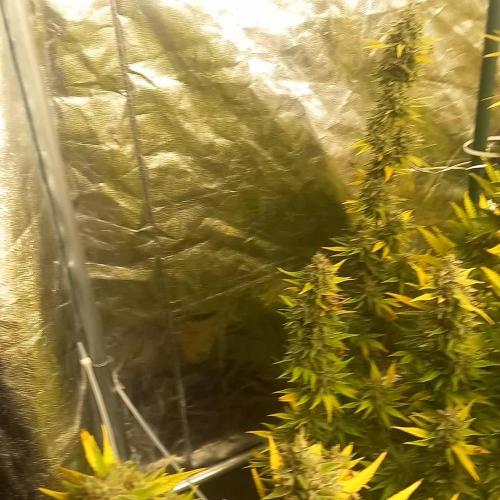
End of week 10 in bloom (day 70) and the time for harvest is approaching. Not all the plants are the same so they will finish gradually and they will be cut gradually. So i will start from Bangi Haze that is almost ready, needs few days more.

Likes
7
Share


@RivenWaters
Follow
Had to trim some because of a tiny bit of powdery mildew. Harvest next week!
I’ve already sampled the Banana Daddy after 6days of drying and it’s awesome already! Forgot what I was doing for a few hours! Can’t wait till it cures!

Likes
18
Share


@DaddyPrime
Follow
4/8 frosting up more and more and buds plumping up but not much. I feel its key to note that ine of the plants is more short stocky and the other has greater internodal spacing
Likes
28
Share


@gottagrowsometime
Follow
Welcome to my Green House Seed cross Diary. This strain is unreleased to public as of yet.
Skipping a few weeks, I was planning to just update. But, I've been hit with hermies on 1/3rd of my plant sadly. I didn't catch a lot of them quick enough and their sacs exploded.. I removed as much growth away from her as I could.
Wk 7. Steady growth. Loving her bigger pot. And she started picking up rapid growth. 40-45cm. (No signs of distress or toxs/def).
Wk 8.. plant has flipped finally and has came into full on pre flower. She looked fine. I checked her, but clearly not Well enough
(No toxs or defs along this week)
Wk9. Found a few male pollen sacs and nanners. Isolated as much as I could and put in corner. Was away for a week or so, And came back to fully open pollen sacs, so, all lower part of plant was riddled with sacs. I really didn't want to lose her all. So, I removed the top 1st 2 nodes. And tried documentated as much as I could. All plants looks fine. Have her confined aa much as I can. I stripped everything around the sacs and everything below them is gone now.
Seemed to be. Coming into wk 10. Will save that weeks update after I get her through this week. And let's see if she's still standing. Hoping I can save her.
Her sister looks fine. But, this plant was so much better. Had lovely big fat colas, or what would have been. I'm gonna do everything I can to try and save as much as possibleGrrrrrrrrr.
I cut everything away with a Stanley blade. (Using gloves) and h202 6% 1-5 ratio mix h202/water. And sprayed and wiped it all down. Just need to watch her now..
Thanks to my sponsors, (reps) from marshydro led lights/tents& Green House Seeds.
COUPON FOR MARSHYDRO
Use code 'ggs', at any official marshydro site for a discount.
Likes
14
Share


@MrHightimes
Follow
Looking really good. great size plants, flowering is starting to look dank!

Likes
1
Share


@Mofumbo273
Follow
She reached the 2nd net 5 days after flipping to 12/12. First signs of flower and female genitals.
Even though she was in veg, she smelled so strong.
