


Likes
Comments
Share


@stonedkoala
Follow
4/17 dropped seeds in distilled water for 12 hours
4/18 transferred to paper towel in plastic container on heat mat in darkness
4/19 tap root sprouts, transfer to rapid rooter in dome on heat mat with light 2 feet away, veg/blue light @ ~40% (~13,700 lux) slowly raising every several days
4/21 seeds sprouts
Temp: ~70-76
Humidity: ~80-90%

Likes
290
Share


@Ferenc
Follow
Hi there. So beautiful. We had really nice week compate to September in the UK sunny and good weather but all has changed this week seems to be crap. Rainy and now it is 11 celsus at 7:00 am in the morning. She would be so thick I can see but because of the weather I ain't gonna have that much buds. Still nice 👌 🤣
OMG the smell is incredibly nice like spicy citrus thing with sweet odour.... amazing! Very strong anyways strong smell LOL

Likes
8
Share


@GogolaGlue
Follow
Flowering stage started 💖 plant looks healthy 💖 ill start Big Bud from second flowering week 💖 im trying LST and i hope everything will be great 💖


Likes
24
Share

@DevelGrow
Follow
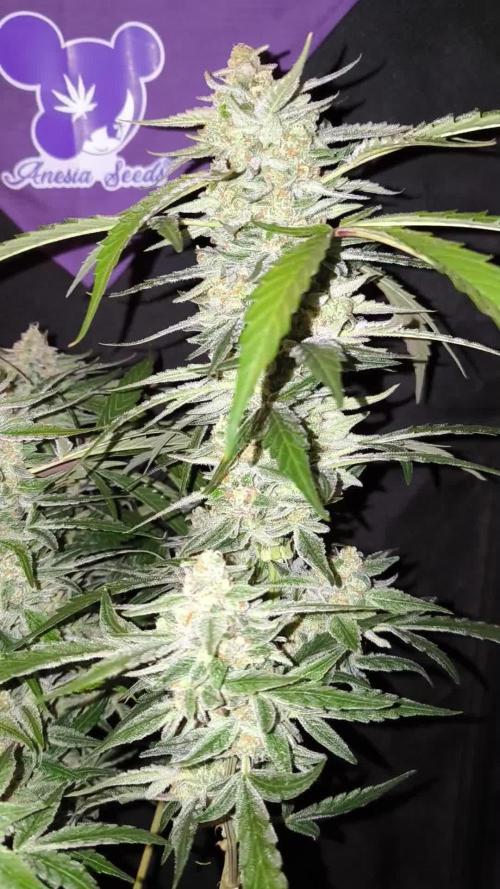
Hallo Freunde 👋 Chaos Cake von Anesia Seeds ist 70 Tage alt! Sie ist eine Augenweide und verströmt einen unglaublichen Geruch! Buds sind Zucker überzogen klebrig Fest und kompakt! ! Bin sehr gespannt wie sie sich trimmen lässt! Ich gebe ihr jetzt noch 4-5 Tage Zeit und dann ist sie fertig! ✌️☺️😋 Keep Green and grow High 🍀💚🍀

Likes
50
Share


@Mr_Motalovah
Follow
Hello growers and tokers! 👋 👩🌾 🧑🌾.🔥💨
There has been much change this week!!
First there was a big defoliation done, I cleaned the bottom of the plants.
All the growth that wouldn't amount to anything because the light doesn't penetrate that low.
Also took off the biggest fan leaves to give more room for light.
Then finally switched to 12/12..
After just 36 hours after the defoliation there was a major change.
New growth everywhere, colas started stretching upwards fast.
By far the tallest girls in the tent. Her colas are stacking up nice and tight if she keeps that up we'll have some nice dense colas. 😁
Great reaction to the defoliation and 12/12 switch.
I'm still watering every other day, After the defoliation I watered with only Enzymes 2ml/L to clean the roots a bit then started with the nutrientes again.
I dropped the amount of grow nutrients from 3ml/L to 1ml/L and started adding bloom nutrientes 2ml/L for now.
I'll slowly be upping the bloom nutrientes and after week 2 I'll no longer add grow nutrients.
That's it for this week. Stay tuned to see how they flower.
Stay safe!

Likes
5
Share


@Burneracct
Follow
Was out of town all week and came back to find the CBD Star in my space bucket not looking good. It looks like a phosphorus deficiency but not entirely sure. Yellow leaves with brown/black spots and dark red/purple stems. I flushed it with 2 gallons 6.5 pH water, re-fertilized, put it out in the sun and defoliated. I defoliated pretty heavily since many of the fan leaves were yellowed and blocking light from the lower bud sites. The center was also getting pretty dense so I carefully removed some of the leaves to help with airflow.
Despite the stress, It seems to have bounced back reasonably well. There’s probably irreparable damage given the level of yellowing but the buds continue to grow and thicken.
Cheese has absolutely exploded and looks great. It probably doubled in height last week with many bud sites on the 5 main stalks. Excited to see how it turns out.

Likes
4
Share

@Bud_vista
Follow
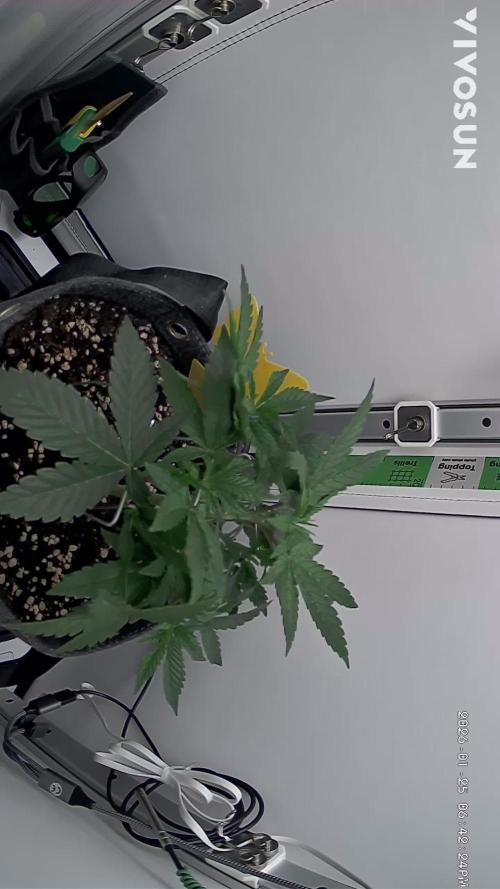
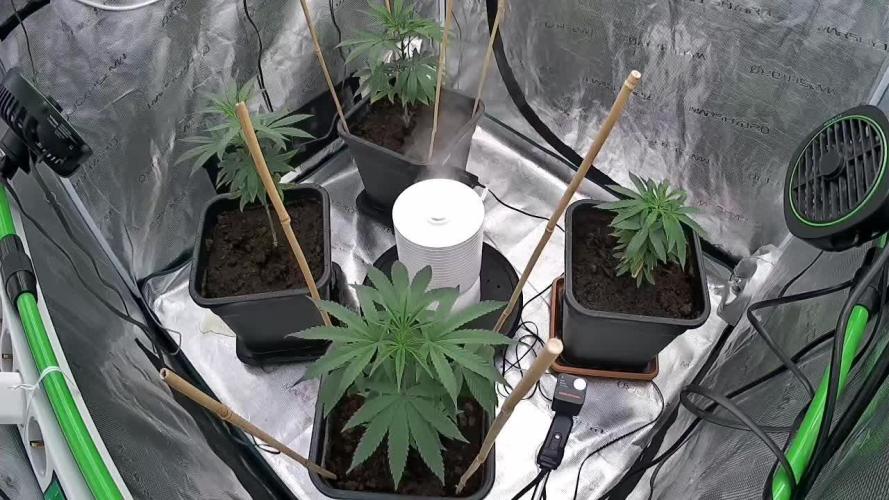
Welcome to week 6 of my White Truffle grow!
First things first: Still no signs of pre flower yet 😄
She’s taken the training and the continuous defoliation like a champ. She got a massive stem and also the 4 main branches are thickening up that I could get some problems later this week of holding the branches under the trellis.
Hopefully some signs of pre flowering will show up this week or I have to move the trellis a little bit upwards.
Update: the lady seems to be a photoperiod and none autoflower, as i asked the breeder recently. So she is going to flower by switching to 12/12 from the mid of week 6. Hopefully she has not a huge stretch, because of the limited space in the Vgrow.
The plant itself looks healthy and vital. Looking forward to this week. ✌️

Likes
Comments
Share

@jeffbudger
Follow
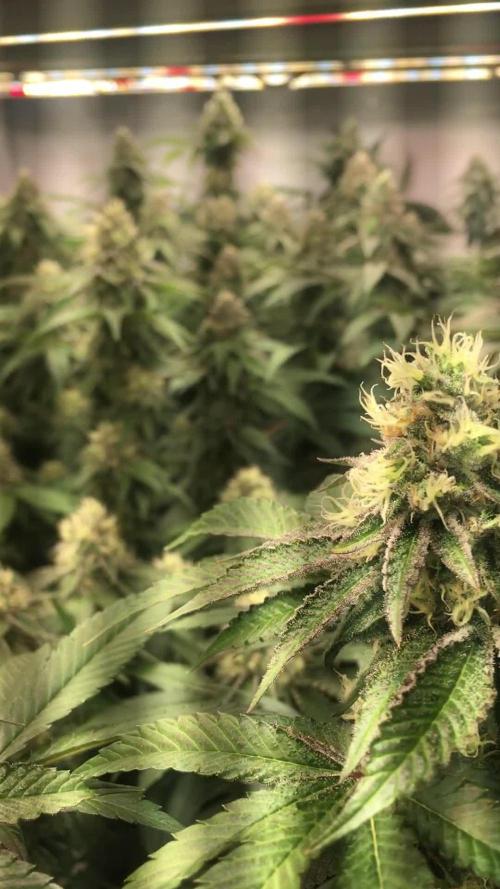
Week 7, the smell is super strong and the nuggs are hard as rocks, they are not too big they needed more P and i failed to supply it at the right time thats totally my fault but they suerly are more beautiful each day that passes, im glad they are good

Likes
19
Share


@GuerillaSweed
Follow
When i arrived i saw that lady twos cage had fell right over her... So some lower branches broke in half.. i tryed to fix it but whatever.. and i took away all the yellow leaves.
Also added some organic biobizz nutrience.
They r looking good flowering!
Weak smell but smells wonderfull.
Any tips or advices feel free to comment!
Cheers homies!!

Likes
3
Share


Likes
38
Share


@Chucky324
Follow
Hello. This is the end of week 8 and the beginning of week 9 of flowering.
Getting near the end and I've started flushing. I like to flush for 2 weeks. I find I get a better end product if I flush.
Things are looking good in here. I had the light up to 80% so the leaves in the main lighting area are turning a little yellow. I'll turn the light down to 70% for a couple of days to slow the yellowing and then back to 80% to finish off this week.
OK, we have finished the Grow Yer Own Stone book printed in 1970 for Canada. My only hope was that you got something out of it that might help your grow or further your knowledge.😊 And it was fun to read too.
OK, Have fun out there. Chuck

Likes
48
Share


@Hashy
Follow
Grow day 84 its end of week 12 and things are still ticking along nicely.
Pineapple express had a big defol during the week and trichomes getting cloudy. She is 78 days old.
Jack herer also had a big defol and is really packing on some weight. She is 78 days.
Gorilla cookies had a tiny defol and her trichomes are starting turning Amber, she isn't going to have much weight but is looking sticky. She is 84 days old.
Lemon pie is about a week behind the others in her production, She is 79days old.
On grow day 83 I switched over to 3ml/L ripen Ec 1.2 Ph 5.6
I will run this for 7 to 10 days before flushing. All 4 will have to be harvested at the same time.
Max 27. deg
Avg 22. deg
Min 17.9 deg
Max 71%
Avg 53%
Min 43.6%

Likes
40
Share


@Totogrowuk
Follow
All popped tails after 48 hours in water and then after approx 24 hours outside in solo cups they all started to break soil.


Likes
8
Share


@Kawannabic
Follow
Esta ha sido una semana de intenso trabajo para las plantas a las que realicé poda apical y lst con un espacio de tiempo corto para la recuperación, pero respondieron genial. Parece que a esta variedad le puedes hacer cualquier cosa. Ni excesos ni carencias de nutrientes

Likes
22
Share


@gottagrowsometime
Follow
Grew well. Got some lovely fade and the buds are rock hard with a low leaf-calyx ratio. Tbh, I'm not a major fan. It's powerful. But, its a very very dank rozay scent. Overpowering so. Like, that's the only smell taste I can get. Again, the rating system isn't great. If it gets better taste wise I'll for sure make a comment.. don't get me wrong. It's nice, very nice. Just when put in comparison to the other 3 Original Sensible Seed grows, she falls short for me.
Again lovely smoke. Just don't the taste I like. The Pink Rozay x Strawberry Banana Auto was lovely combo. But, this is just too much Rozay. It's banging of it. Actually smells like a very strong Rozay wine. More on that later and the high. Which is the reason its getting 9☆ which is still pretty high.
Thanks to Mars-Hydro & Original Sensible Seeds for their products and trust, hopefully will get to test many more of your great products and to you my followers, viewers, ppl who stopped by, or dropped a like/comment much appreciation. Look forward to seen your grows
Good Growing My Friends.
Edit. Upon a 1.5 month cure. The bud is just amazing. Very dank, stands out from all my other grows. Love this lady. Gonna miss opening my bud jars and not getting a bang of Rozay.

Likes
4
Share


@I_Identify_As_A_Dan
Follow
Week 5 for Amnesia Zkittlez by fastbuds,
Has blasted straight into making pre flowers for the last week, shes gotten a little bit extra stretch. Because of her height i will be moving her outdoors with the rest of the flowering autos😎
Shes a little skinny for my liking but lets see how she starts to stack up.
Likes
1
Share


@Billy_Piff
Follow
Fed Gh 3 part with Terpinator in flower and recharge occasionally through a drip feed system.
Likes
44
Share


@MadeInGermany
Follow
Info :
Unfortunately, I had to find out that my account is used for fake pages in social media.
I am only active here on growdiaries.
I am not on facebook instagram twitter etc All accounts except this one are fake.
Flowering day 58
since time change
to 12/12 h.
Hey guys :-) .
We are getting closer and closer to the end :-).
The trichomes are 80% milky, 10% amber and 10% clear.
In the coming days, fresh water will be prepared for the last time with one Pure Ec value of 0.4 so that you can use up the last of the sewing materials for 3-4 days.
I'm very excited about the end result because I have the same phenotype in another diary on Cocos :-).
As always, an update comes during the harvest and the last update comes after drying 👍.
Have fun with the diary and stay healthy 🙏🏻
You can buy this Strain at
www.Zamnesia.com
Type:
Runtz
☝️🏼
Genetics:
Zkittlez
X
Gelato
👍
Vega lamp: 2 x Todogrow LED CXB3590 COB 55 W
1 x Sanlight S2W 62 W
💡
Flower lamp : 2 x Todogrow LED CXB3590 COB 55 W
1 x Sanlight S2W 62 W
💡 ☝️
Grow Aero System : Growtool 0.8
☝️
Fertilizer:
Canna Aqua Vega A + B , Canna Aqua Flores A + B , Rizotonic, Cannazym, CANNA Boost, Pk 13/14, Canna Cal / Mag, Canna Ph - Grow, Canna Ph-Bloom
☝️🌱
Water:
Osmosis water mixed with normal water (24 hours stale that the chlorine evaporates) to 0.2 EG. Add Cal / Mag to 0.4 Ec Ph with ph- to 5.6 - 6.4
💦 💧
